
South Korea Electro-Optical Infrared System Market Size & Forecast:
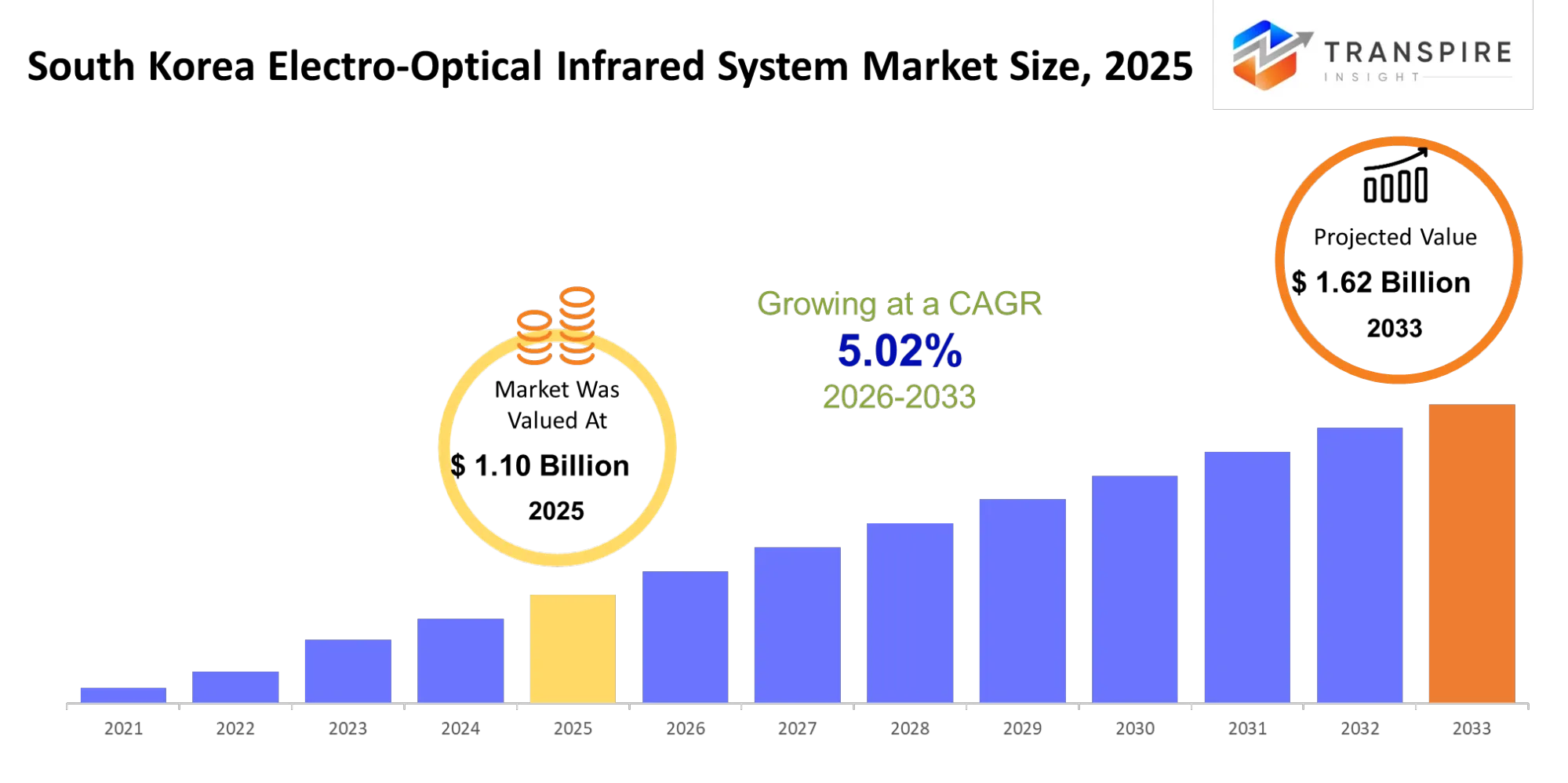
- South Korea Electro-Optical Infrared System Market Size 2025: USD 1.10 Billion
- South Korea Electro-Optical Infrared System Market Size 2033: USD 1.62 Billion
- South Korea Electro-Optical Infrared System Market CAGR: 5.02%
- South Korea Electro-Optical Infrared System Market Segments: By Component (Thermal Cameras, Infrared Sensors, Laser Rangefinders, Targeting Systems, Stabilization Systems, Others); By Platform (Airborne Systems, Naval Systems, Land-based Systems, Space-based Systems, Others); By Application (Surveillance, Target Acquisition, Border Security, Navigation, Others); By End User (Defense Forces, Homeland Security Agencies, Aerospace Companies, Others)
To learn more about this report,  Download Free Sample Report
South Korea Electro-Optical Infrared System Market Summary
The South Korea Electro-Optical Infrared System Market was valued at USD 1.10 billion in 2025. It is forecast to reach USD 1.62 billion by 2033. That is a 5.02% CAGR over the period.
In South Korea, electro-optical infrared systems are used to detect, track, and distinguish objects on land and at sea, supporting naval watchkeeping, coastal safeguarding, border observation, and precise targeting on defense platforms. They take thermal and optical cues and turn them into useful intelligence that operators can act on, so it helps with decision-making in poor visibility and risky situations.
Over the last 3–5 years, the market kind of moved away from “just standalone sensor boxes” toward AI-enabled, connected multi-sensor fusion systems, plugged into drones, naval ships and ground vehicles. One big nudge was the rising security tensions on the Korean Peninsula, plus lessons learned from recent drone fighting, where persistent watching and quick target recognition mattered a lot. Because of that, South Korea has been pushing harder on homegrown defense upgrades and trying to cut back on imported subsystems. So now buying tends to favor interoperable, software-driven EO/IR platforms, which opens more room for domestic builders and systems integrators while also shifting revenue toward upgraded, higher-value solutions.
Key Market Insights
- The South Korea Electro-Optical Infrared System Market seems to be powered by defense digitization, which helps with real time observation, better target accuracy, and stronger maritime awareness in hard situations.
- In the South Korea Electro-Optical Infrared System Market, AI powered sensor fusion combined with network-centric warfare setups is leading, so detection stays efficient even in messy combat scenarios.
- EO/IR payload integration on UAVs and on naval assets is turning into the quickest rising technology path, from 2025 through 2033, no big surprise.
- Gyeonggi and the Seoul Capital Region, together, lead the South Korea Electro-Optical Infrared System Market, holding more than 40% share , mainly because defense R&D is concentrated there, and that matters a lot.
- South Gyeongsang is growing the fastest, helped by shipbuilding strongholds for naval use, plus increasing demand for EO/IR system hookup and integration.
- Thermal imaging systems keep the biggest share in the South Korea Electro-Optical Infrared System Market, because they get adopted heavily for surveillance and for targeting related operations.
- Electro-optical imaging systems are sitting in the second spot, and they’re already used across ground-based and airborne defense platforms, pretty widely.
- Multi sensor fusion EO/IR systems are the fastest growing segment, largely due to AI integration and battlefield-awareness needs , but there’s more too.
What are the Key Drivers, Restraints, and Opportunities in the South Korea Electro-Optical Infrared System Market?
South Korea’s Electro-Optical Infrared System Market is mainly pushed along by the faster defense modernization and, honestly, the bigger move toward AI-equipped intelligence, surveillance, and reconnaissance platforms. The whole momentum behind this push was kicked off by more intense geopolitical pressure on the Korean Peninsula, and also by swift gains in autonomous warfare systems, in particular those drone-based targeting setups. So, because of that , defense agencies are increasingly betting on combined electro-optical infrared payloads that can process thermal and visual streams in real time, which really helps with situational awareness and operational exactness. And sure this transition, kind of directly alters procurement cycles and nudges per-unit system value upward as well. As a result, advanced EO/IR solution providers typically end up with steadier revenue growth.
On the other hand, there’s a structural problem that doesn’t go away easily, the development and integration costs are high, especially for next-generation sensor systems. Advanced EO/IR platforms need complicated calibration, a multi-sensor fusion architecture, and secure software layers. All of this adds up to higher lifecycle spending, which becomes a real obstacle for smaller domestic suppliers. It also tends to slow down the large-scale replacement of older legacy systems in mid-tier defense programs. Plus, defense procurement budgets can be rigid, so adoption cycles don’t speed up as quickly as they could. That means short-term revenue growth can be capped, even when the technology is ready and available.
Still, there’s a noticeable opportunity tied to the expansion of indigenous unmanned platform programs, supported by South Korea’s defense industrial policy. More funding for domestically designed UAVs and autonomous naval systems generates a pretty steady demand stream for compact, AI-integrated EO/IR payloads. For example, adding lightweight infrared targeting modules into next-generation surveillance drones can enable scalable rollout across coastal monitoring and… well, you know, broader operational coverage.
What Has the Impact of Artificial Intelligence Been on the South Korea Electro-Optical Infrared System Market?
Artificial intelligence plus advanced digital technologies are, kind of, reshaping the South Korea Electro-Optical Infrared System Market by turning older imaging systems into “smarter” decision support platforms that get used in naval airborne and ground surveillance operations. Instead of simply capturing video, AI-driven automation is now able to do real-time object recognition, sorting, and even threat ranking right at the sensor edge. That reduces the amount of work for operators, and it helps response speed, especially in maritime and border monitoring spaces where timing matters. Because of this, electro-optical infrared payloads can work more like autonomous observation nodes instead of just being passive imaging devices.
At the same time, machine learning is getting used more and more for preventative upkeep of EO/IR sensors. It can flag thermal drift, lens wear, and calibration irregularities well before anything turns into a failure. In naval use, those capabilities tend to boost mission readiness, and also cut down on unexpected stoppages, meaning better operational availability and steadier surveillance coverage over time. Then there’s AI-assisted image refinement along with sensor blending, which improves outcomes by merging infrared and optical streams. The result is improved detection accuracy in poor visibility, such as foggy conditions or during nighttime maritime operations.
Still, adoption has limits, mostly because there is not enough high-quality labeled data coming from real combat settings and severe marine environments. That shortage can hurt how accurate algorithms remain once they run in edge conditions. Also, the integration effort with older or legacy defense platforms can get messy, and it raises deployment costs while slowing down a full migration toward AI, particularly for mid-tier programs where budgets are tightly controlled, and approval cycles can be slow.
Key Market Trends
- Around 2020, procurement shifted from standalone EO/IR units, toward integrated network-centric battlefield surveillance systems across naval and air defense platforms.
- UAV adoption really sped up between 2022 and 2026, and electro-optical infrared payloads are turning into the default choice for tactical and longer-endurance reconnaissance drones.
- After 2023, AI-enabled edge processing expanded a lot, so real-time target classification can happen directly within the EO/IR sensors, rather than only in centralized command setups, or so it seems.
- Domestic names like Hanwha Systems, and LIG Nex1 gained traction because South Korea is pushing indigenous defense electronics development with more urgency.
- During 2021–2022, semiconductor supply constraints made manufacturers rethink things, they diversified sourcing approaches and that improved resilience across EO/IR imaging component production chains.
- Maritime surveillance demand picked up strongly post 2022 due to increased regional security frictions, leading to more deployments of infrared-based coastal monitoring solutions.
- Export-oriented collaborations grew after 2023, with South Korean EO/IR systems joining joint development programs across Southeast Asia's defense markets.
- The overall industry transition moved from hardware-first imaging systems, into software-defined electro-optical platforms, blending analytics, sensor fusion and even predictive targeting features, altogether.
South Korea Electro-Optical Infrared System Market Segmentation
By Component
In the South Korea Electro-Optical Infrared System Market there is a visible shift toward advanced thermal cameras and bundled infrared sensors for high precision observation across different defense platforms. Component demand moved away from plain imaging units , toward more capable targeting systems which enable real-time tracking and engagement exactness. Laser rangefinders saw more adoption after 2022, mainly because long-distance measurement became more critical in border and coastal monitoring activities. The South Korea Electro-Optical Infrared System Market also shows a growing preference for stabilization systems that help accuracy in vibration-heavy naval , and airborne environments. Manufacturers put more emphasis on compact, high-sensitivity modules, to better serve unmanned systems and mobile surveillance platforms.
Laser rangefinder integration broadened as defense procurement efforts began to favor extended operational reach and precision aiming requirements. Stabilization system upgrades improved overall durability under tough environmental conditions, especially in maritime applications. Component innovation keeps tilting toward miniaturized designs that support multi-sensor fusion and reduce overall system mass across platforms.
By Platform
Airborne systems stay in front in the South Korea Electro-Optical Infrared System Market, driven by more surveillance aircraft deployments and unmanned aerial vehicles. Naval systems also gained quicker traction after2021, since coastal monitoring needs and maritime threat detection kept intensifying. Land-based systems maintain steady deployment across border surveillance infrastructure, and critical facility protection programs. Space based systems got limited but slowly growing attention after 2023 into early-stage reconnaissance and monitoring initiatives. Platform integration strategies also moved toward networked defense architectures, linking airborne, naval , and land based assets into unified surveillance grids.
Naval deployment expansion strengthened after geopolitical tensions increased, and regional maritime monitoring needs started rising more clearly. Airborne system upgrades focused on longer endurance, plus better thermal imaging resolution for extended missions. Platform modernization programs are increasingly emphasizing interoperability across multiple operational environments, not only one.
By Application
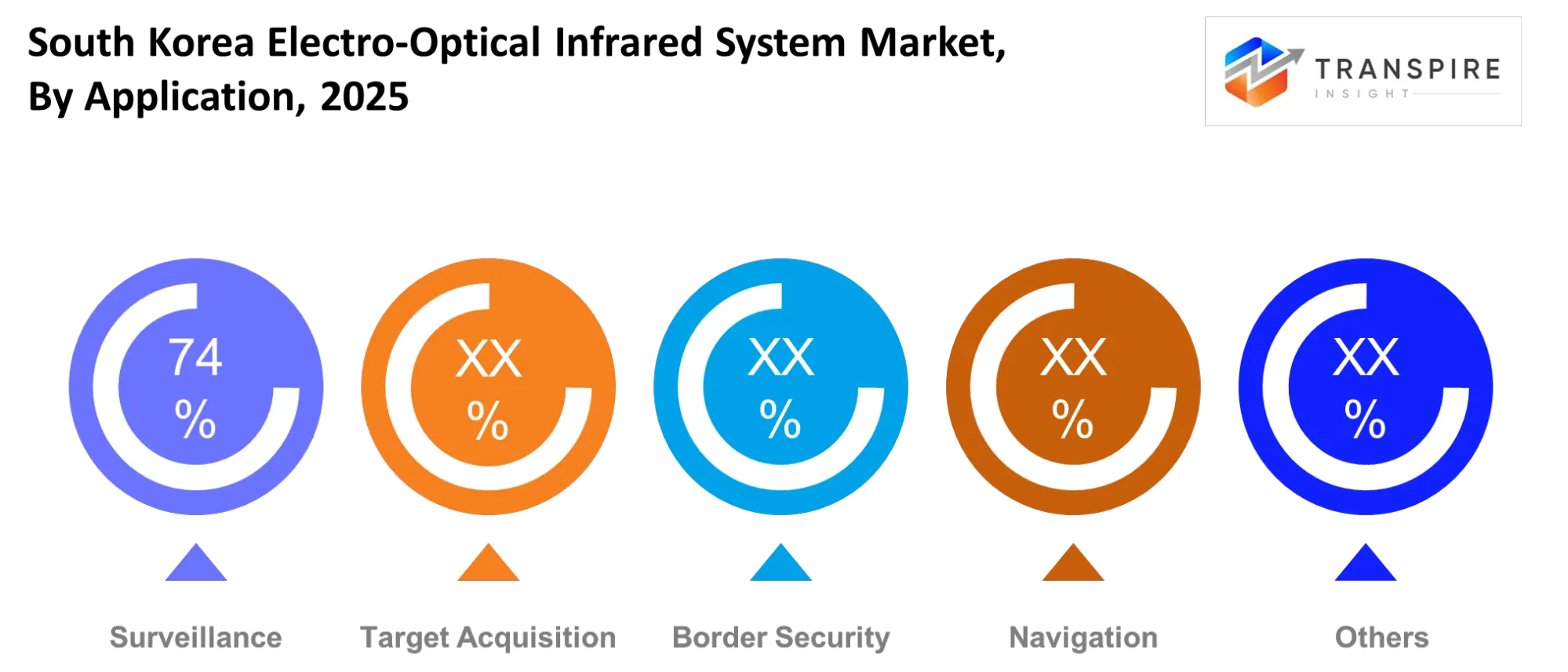
Surveillance still holds the dominant application share in the South Korea Electro-Optical Infrared System Market, because there’s continuous demand for real time situational awareness across defense operations. Target acquisition systems advanced quickly after 2022 with improved AI assisted recognition capabilities, helping shorten engagement cycles. Border security applications widened due to stronger monitoring requirements along sensitive terrestrial zones. Navigation applications improved too, mainly via infrared based visibility enhancement under low light and during adverse weather conditions. Application development is increasingly aligning with automated threat detection, and less reliance on operators during day to day defense operations.
Target acquisition systems saw technology upgrades that help with higher accuracy, even when operations are moving around a lot and the situation is kind of dynamic. Surveillance platforms started using multi sensor data fusion, so detection feels more dependable during long range monitoring missions. Border security deployments also pushed further, mainly because thermal imaging coverage got upgraded, especially in remote, and high risk zones.
To learn more about this report, Download Free Sample Report
By End User
Defense forces are the main end user group in the South Korea Electro-Optical Infrared System Market, basically because modernization programs keep going and surveillance requirements stay advanced. Homeland security agencies ramped up adoption after 2022, driven by more emphasis on coastal monitoring and also urban observation. Aerospace companies got more involved by using electro optical infrared payload integration in next generation aircraft and unmanned systems. Other end users include research institutions and specialist defense contractors who focus on sensor innovation, plus system integration. Procurement trends have shifted toward solutions built domestically, which matches national defense self reliance strategies, and that matters.
Defense procurement now tends to prioritize AI enabled and networked sensor platforms, for better operational efficiency in the field. Homeland security deployments broadened coverage across critical infrastructure, and border regions too. Aerospace integration programs tend to focus on lightweight construction and sharper imaging precision, for advanced mission profiles.
What are the Key Use Cases Driving the South Korea Electro-Optical Infrared System Market?
Surveillance is still the main use case behind adoption in the South Korea Electro-Optical Infrared System Market, even if people sometimes call it something else. Defense forces depend on electro-optical and infrared systems, so they can keep watching coastal zones, military installations and strategic borders. There’s strong demand because they need to detect and then identify targets during night missions, plus in harsh or adverse weather, and that’s why surveillance basically becomes the biggest money maker, revenue-wise.
Target acquisition, as well as border security, is gaining a stronger foothold with homeland security agencies and military operators. With newer infrared imaging along with laser-based tracking, response time is better, and threat assessment feels more precise. On top of that, naval platforms now deploy these systems more and more, to back maritime domain awareness, and to keep an eye on vessel movements in waters that are sensitive.
At the same time, newer openings are showing up in autonomous surveillance platforms, and in next-generation aerospace programs. When EO/IR payloads get integrated into unmanned aerial vehicles, you get long-endurance reconnaissance with less operational risk, sorta like doing it from a distance. Space-based observation systems also look very promising, because defense agencies are exploring persistent monitoring options and wider intelligence-gathering networks throughout the forecast period.
|
Report Metrics |
Details |
|
Market size value in 2025 |
USD 1.10 Billion |
|
Market size value in 2026 |
USD 1.15 Billion |
|
Revenue forecast in 2033 |
USD 1.62Billion |
|
Growth rate |
CAGR of 5.02% from 2026 to 2033 |
|
Base year |
2025 |
|
Historical data |
2021 - 2024 |
|
Forecast period |
2026 - 2033 |
|
Report coverage |
Revenue forecast, competitive landscape, growth factors, and trends |
|
Regional scope |
South Korea |
|
Key company profiled |
Hanwha Systems, LIG Nex1, Thales Group, Lockheed Martin, Raytheon Technologies, Northrop Grumman, Leonardo, Elbit Systems, BAE Systems, Safran, FLIR Systems, Aselsan, Rheinmetall, Hensoldt, Israel Aerospace Industries |
|
Customization scope |
Free report customization (country, regional & segment scope). Avail customized purchase options to meet your exact research needs. |
|
Report Segmentation |
By Component (Thermal Cameras, Infrared Sensors, Laser Rangefinders, Targeting Systems, Stabilization Systems, Others); By Platform (Airborne Systems, Naval Systems, Land-based Systems, Space-based Systems, Others); By Application (Surveillance, Target Acquisition, Border Security, Navigation, Others); By End User (Defense Forces, Homeland Security Agencies, Aerospace Companies, Others) |
Which Regions are Driving the South Korea Electro-Optical Infrared System Market Growth?
The Seoul Capital Region leads the South Korean Electro-Optical Infrared System Market, largely because defense headquarters are concentrated there, along with research institutions and advanced electronics manufacturers. With solid government backing for defense modernization, companies keep putting money into surveillance, targeting, and sensor related technologies. There are also major system integrators and component suppliers operating in the same area, so a fairly mature ecosystem has formed for product development and field deployment. Close cooperation between industry, academia, and defense agencies keeps the region strong and also helps the commercialization of next generation electro-optical infrared solutions, even when projects are delayed here and there.
The Southeastern Region, led by Busan, Ulsan, and South Gyeongsang Province, sits in the second position as the biggest contributor . Its role is shaped less by headquarters density, and more by production muscle, naval programs, and long term industrial investment. Shipbuilding facilities and defense contractors offer a steady base for system assembly and validation work. In other words , consistent procurement cycles and a tough manufacturing network make this region a dependable generator of market revenue.
The Central Region is expected to see the quickest growth during the 2026–2033 period, as defense research keeps expanding and new technology development programs start moving faster. As investment grows in unmanned systems, aerospace technologies, and improved sensor research , electro-optical infrared suppliers get fresh doors to walk through. Research centers, alongside government-backed innovation initiatives , have sped up adoption of AI enabled imaging and sensor fusion features.
Who are the Key Players in the South Korea Electro-Optical Infrared System Market and How Do They Compete?
The competitive landscape stays moderately consolidated, with most of the fight focused on imaging performance, sensor fusion competencies, targeting precision, and platform integration know-how. Established defense technology companies keep strong positions, mostly because military procurement programs tend to value proven reliability, long operational life, and compliance with very strict defense standards. New entrants usually show up in narrower roles—specialized software, artificial intelligence, and sensor-component know-how—rather than in full end-to-end system development. In practice, technological innovation has become the main arena of competition, as defense agencies seek systems that can provide faster detection, higher identification accuracy, and smoother interoperability across different platforms or theaters.
Raytheon Technologies stands out by blending electro-optical, infrared, and networked battlefield capabilities into advanced targeting and surveillance solutions. Lockheed Martin leans heavily on integrating EO/IR technologies into aircraft, missile defense, and intelligence platforms, and that system-level experience gives them a solid edge. Northrop Grumman Corporation emphasizes multi-domain intelligence and reconnaissance options, backed by sustained investment in autonomous systems and next-generation sensing methods. Ongoing collaboration with defense agencies and platform manufacturers also helps these firms widen deployment routes across airborne, naval, and land-based use cases.
Thales Group competes with high performance thermal imaging and sensor fusion technologies meant for complicated operational surroundings. Elbit Systems specializes in compact, lightweight electro-optical payloads that enable unmanned platforms, as well as mobile defense applications—so, their approach is more payload centric than platform-wide.
Company List
- Hanwha Systems
- LIG Nex1
- Thales Group
- Lockheed Martin
- Raytheon Technologies
- Northrop Grumman
- Leonardo
- Elbit Systems
- BAE Systems
- Safran
- FLIR Systems
- Aselsan
- Rheinmetall
- Hensoldt
- Israel Aerospace Industries
Recent Development News
In February 2026, Teledyne FLIR OEM launched the Lepton XDS thermal-visible camera module at Mobile World Congress 2026. The new dual-camera module integrates thermal and visible imaging with patented MSX technology, supporting faster deployment of compact electro-optical sensing solutions across defense and industrial applications.https://oem.flir.com
In February 2026, Teledyne FLIR OEM expanded the Neutrino ISR product family with the launch of the Neutrino SX8 ISR 50-1000 infrared camera module. The long-range, AI-ready surveillance system enhances intelligence, surveillance, reconnaissance, and counter-UAS missions, supporting broader adoption of advanced EO/IR technologies in defense markets.https://www.suasnews.com/
What Strategic Insights Define the Future of the South Korea Electro-Optical Infrared System Market?
The South Korea Electro-Optical Infrared System Market is moving toward, pretty connected, AI enabled sensing networks that will work across air land maritime and space domains. What’s really pushing that change is the rising demand for real-time insight and quicker decisions, in security settings that are getting more complicated every year. In the future, value creation should drift away from standalone imaging hardware and instead toward stitched together platforms that bring advanced sensors, data fusion, autonomous processing, and protected communications into one package.
There’s also a risk that’s a bit less visible but still matters. Supply chain concentration is becoming a headache for critical infrared detector materials, semiconductors, and specialized optical components. If a lot of the sourcing depends on only a few providers, procurement can cost more, and deliveries can stretch, especially during geopolitical tension or when export restrictions show up. Those disruptions can end up shifting system deployment timelines, even if defense budgets are still looking strong.
An opportunity that’s starting to show up is linking electro-optical infrared payloads into autonomous maritime surveillance platforms and the next wave of unmanned systems. This part is still kind of early stage, but it should grow in importance as autonomy keeps expanding. Market participants may want to put money into AI driven sensor fusion, local supply relationships and modular system architectures that can be adapted across multiple defense platforms. That approach should help build firmer long term competitive positioning.
South Korea Electro-Optical Infrared System Market Report Segmentation
By Component
- Thermal Cameras
- Infrared Sensors
- Laser Rangefinders
- Targeting Systems
- Stabilization Systems
- Others
By Platform
- Airborne Systems
- Naval Systems
- Land-based Systems
- Space-based Systems
- Others
By Application
- Surveillance
- Target Acquisition
- Border Security
- Navigation
- Others
By End User
- Defense Forces
- Homeland Security Agencies
- Aerospace Companies
- Others
Frequently Asked Questions
Find quick answers to common questions.
The expected South Korea Electro-Optical Infrared System Market size for the market will be USD 1.62 Billion in 2033.
Key segments for the South Korea Electro-Optical Infrared System Market are Type By Component (Thermal Cameras, Infrared Sensors, Laser Rangefinders, Targeting Systems, Stabilization Systems, Others); By Platform (Airborne Systems, Naval Systems, Land-based Systems, Space-based Systems, Others); By Application (Surveillance, Target Acquisition, Border Security, Navigation, Others); By End User (Defense Forces, Homeland Security Agencies, Aerospace Companies, Others).
Major South Korea Electro-Optical Infrared System Market players are Hanwha Systems, LIG Nex1, Thales Group, Lockheed Martin, Raytheon Technologies, Northrop Grumman, Leonardo, Elbit Systems, BAE Systems, Safran, FLIR Systems, Aselsan, Rheinmetall, Hensoldt, Israel Aerospace Industries.
The South Korea Electro-Optical Infrared System Market size is USD 1.10 Billion in 2025.
The South Korea Electro-Optical Infrared System Market CAGR is 5.02% from 2026 to 2033.
- Hanwha Systems
- LIG Nex1
- Thales Group
- Lockheed Martin
- Raytheon Technologies
- Northrop Grumman
- Leonardo
- Elbit Systems
- BAE Systems
- Safran
- FLIR Systems
- Aselsan
- Rheinmetall
- Hensoldt
- Israel Aerospace Industries
About the Authors

Avinash Kumar
I’m Avinash Kumar, a Senior Research Analyst at Transpire Insight, with expertise in the Electronics and Semiconductor and Energy & Power industry. My work focuses on analyzing emerging technologies, market trends, industry developments, and innovation across these sectors. I specialize in transforming complex technical and market insights into clear, research-backed content that helps professionals, businesses, and decision-makers stay informed. Through continuous industry research and data-driven analysis, I strive to deliver accurate, reliable, and practical perspectives on the latest advancements shaping the semiconductor and energy landscape.

Chakradhar Khansole
Chakradhar serves as the Research Director at Transpire Insight, bringing over 8 years of experience in technology, innovation, and strategic market intelligence. He specializes in transforming complex market data into actionable business insights that enable organizations to make informed, growth-oriented decisions. Recognized for his strategic vision and analytical expertise, Chakradhar leads high-impact research initiatives, delivering comprehensive market assessments, competitive intelligence, and forward-looking industry analysis.
Recently Published Reports
-
Apr 2026
Fiber Optic Faceplates Market
Fiber Optic Faceplates Market Size, Share & Analysis Report By Type (< 300 mm2, 300-350 mm2, and > 350 mm2, By Application (Night Vision, Holographic Imaging, Medical, and Others), and Geography (North America, Europe, Asia-Pacific, Middle East and Africa, South and Central America), 2021 - 2031
-
Apr 2026
High Temperature Superconductors Market
High Temperature Superconductors Market Size, Share & Analysis Report By Type (1G HTS, and 2G HTS), By Application (Power Cable, Fault Current Limiter, and Transformer), and Geography (North America, Europe, Asia-Pacific, Middle East and Africa, South and Central America), 2021 - 2031
-
Apr 2026
Industrial Plugs and Socket Market
Industrial Plugs and Socket Market Size, Share & Analysis Report By Type (Industrial Plugs, Industrial Sockets), By Current (Up to 32 A, 32 to 125 A, Above 125 A), By Protection (Dustproof and Splash Proof, Waterproof, Explosion Proof), By End User (Heavy Industries, Oil and Gas, Chemicals and Pharmaceuticals, Power Generation, Others), and Geography (North America, Europe, Asia-Pacific, Middle East and Africa, South and Central America), 2021 - 2031
-
Apr 2026
InGaAs Avalanche Photodiodes Market
InGaAs Avalanche Photodiodes Market Size, Share & Analysis Report By Type (1100 - 1700 nm, and 1000 - 1600 nm), By Application (Missile Warning System, Muzzle Flash Detection, Wafer Defect Inspection, Laser Rangefinders, and Others), and Geography (North America, Europe, Asia-Pacific, Middle East and Africa, South and Central America), 2021 - 2031