
South Korea Dolomite Mining Market Size & Forecast:
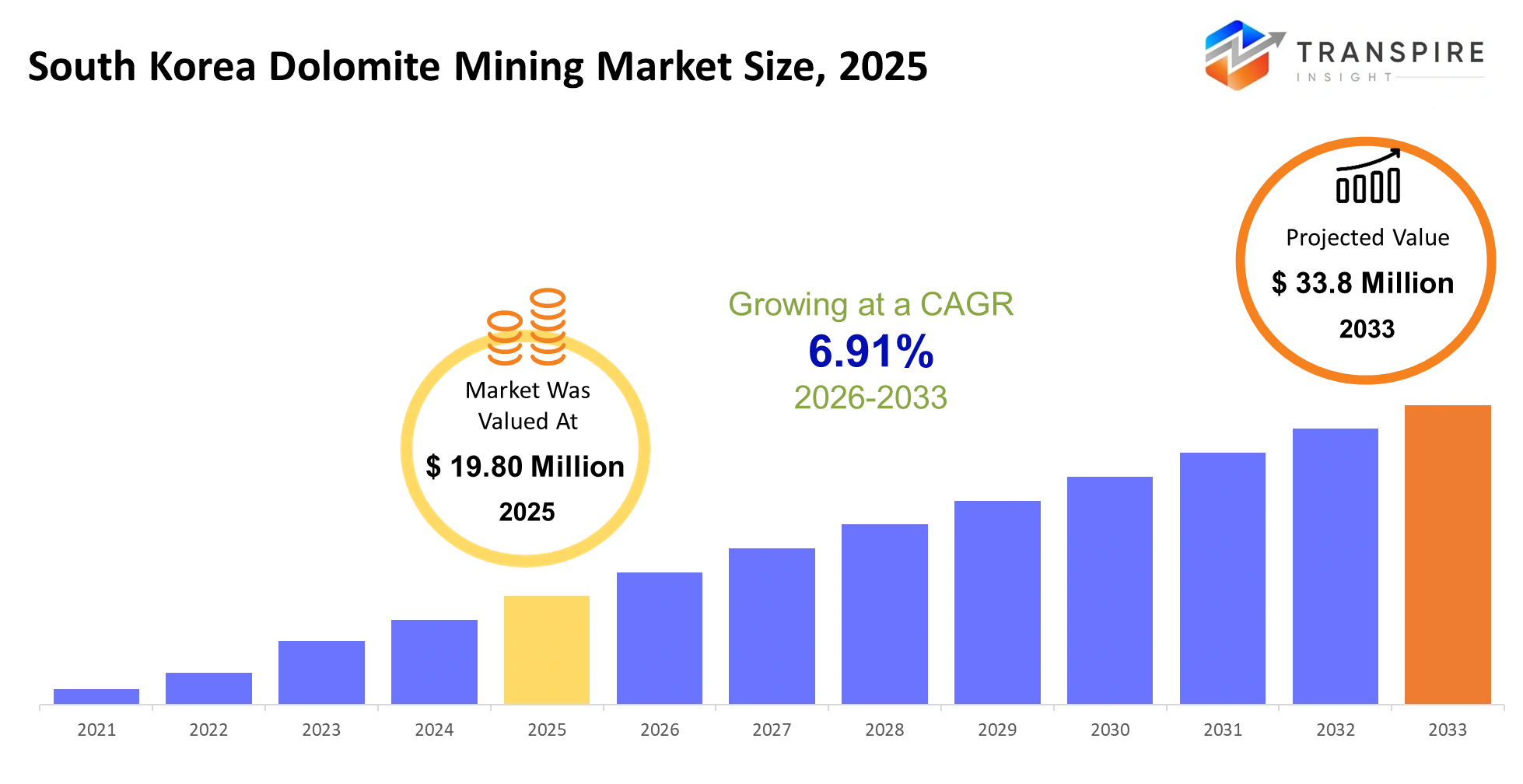
- South Korea Dolomite Mining Market Size 2025: USD 19.80 Million
- South Korea Dolomite Mining Market Size 2033: USD 33.8 Million
- South Korea Dolomite Mining Market CAGR: 6.91%
- South Korea Dolomite Mining Market Segments: By Product Type (Calcined Dolomite, Sintered Dolomite, Agglomerated Dolomite, Dolomite Powder, Others); By Application (Construction Materials, Steel Manufacturing, Glass Production, Agriculture, Ceramics, Others); By Mining Method (Underground Mining, Open-pit Mining, Surface Mining, Others); By End User (Construction Industry, Metallurgy Industry, Agriculture Industry, Chemical Industry, Others); By Form (Lumps, Powder, Granules, Crushed Dolomite, Others).
To learn more about this report,  Download Free Sample Report
South Korea Dolomite Mining Market Summary
The South Korea Dolomite Mining Market was valued at USD 19.80 Million in 2025. It is forecast to reach USD 33.8 Million by 2033. That is a CAGR of 6.91% over the period.
South Korea’s dolomite mining market, in a way, kinda matters a lot for keeping the country’s steel work, building projects, glass processing, and even environmental treatment activities going smoothly, without too many stops or interruptions. Dolomite is usually taken as a flux material for steelmaking, also as a kind of added filler for cement and ceramics, and as a neutralizing agent for wastewater and for emission-control setups, it helps keep things steady. Basically, it helps producers drop impurity levels, get better furnace performance, and meet increasingly strict industrial emission rules.
In recent years, the whole market feel has moved away from simple bulk extraction toward higher-purity processed dolomite that’s tuned for more demanding industrial use, with tighter quality checks. That change really picked up after South Korea tightened carbon reduction measures and upgraded industrial waste management policies , which in turn pushed steelmakers and other heavy manufacturers to improve their raw material inputs.
Also, during the pandemic, those supply chain shakeups made the dependence on imported minerals kinda more glaring. And so, more players went toward domestic sourcing and longer procurement arrangements, rather than the simple short-term buying, you know. Now, since industrial companies are putting money into cleaner production systems and a steady flow of raw materials, dolomite producers are looking for stronger margins through value-added processing not just moving bulk volumes.
Key Market Insights
- The South Korea Dolomite Mining Market kind of benefits from advanced steel manufacturing, which in 2025 made up almost 42% of all dolomite use or consumption in general.
- Gangwon Province pretty much led the South Korea Dolomite Mining Market in 2025, holding around 38% market share mainly because its mineral reserves are more concentrated, like less spread out than other areas.
- North Gyeongsang is expected to be the fastest growing regional market moving toward 2030. That trend is supported by broader industrial processing facilities, plus added investments in infrastructure, and the timing looks strong.
- High-purity calcined dolomite stayed in the spotlight with nearly 46% of the South Korea dolomite industry size in 2025, since steelmakers ask for low-impurity mineral inputs for smoother operations.
- Raw dolomite was still the second-largest product segment, driven by construction material manufacturing and cement blending uses across various industrial projects.
- Steel manufacturing dominated the application demand with almost 48% market share in 2025, because blast furnace operators focused on operational efficiency upgrades, and that’s not surprising at all.
- Environmental treatment uses are showing the fastest expansion within the South Korea Dolomite Mining Market. This happens as industrial emission rules keep tightening , and companies have to comply more strictly now.
- Construction and infrastructure development generated solid revenue especially through cement additives, ceramic production , and industrial filler applications during 2025.
- Meanwhile large integrated steel producers accounted for more than 44% of end-user demand, mainly due to the fact that high-volume furnace operations need dependable dolomite supply contracts, consistently.
- Water treatment and environmental engineering firms are forecasted to post the fastest growth pace during the forecast period up to 2030.
What are the Key Drivers, Restraints, and Opportunities in the South Korea Dolomite Mining Market?
The main force that seems to be shaping the South Korea dolomite mining market is basically the modernization of the local steel sector, but now with tougher carbon limits and efficiency targets. South Korean steelmakers have been tweaking blast furnace operations, plus secondary refining, mainly to push impurity levels down and squeeze out better energy efficiency. In practice, this shift boosted the adoption of higher purity dolomite as a flux, since it can help steady furnace chemistry and also reduce slag -linked operational losses. On top of that, government-supported industrial decarbonization programs sped things up after 2021, so mining and processing firms were pushed to deliver more refined mineral grades. So, in a pretty direct way, producers that can consistently supply processed dolomite with stable chemical makeup are ending up with better contracts and a clearer path for longer term revenue.
Still, the biggest brake on growth is the fact that high-grade dolomite reserves that make economic sense are limited, especially near the industrial hubs. Expanding mining in South Korea is not straightforward, because there are strict land use limits, environmental permits that take real time and effort, and then transport costs that rise a lot when quarries are located far away. These issues feel structural, because opening up new extraction sites requires several years of regulatory checks, and also more infrastructure money. The knock-on effect is that production costs go up and new capacity grows slower, which then makes it harder for the market to respond quickly when industrial buyers suddenly need more material.
Some kind of big opening is showing up, from advanced environmental processing systems in areas like semiconductor, petrochemical and wastewater sites. Basically the plant operators are putting money into mineral, kind of neutralization plus filtration methods, and they need dolomite powder that is milled very finely , with purity targets that are not optional, like strict standards. Places such as North Gyeongsang seem to be pulling in more processing investments too, since industrial clusters are growing and transport links are getting better, so logistics feels easier now.
What Has the Impact of Artificial Intelligence Been on the South Korea Dolomite Mining Market?
Artificial intelligence and advanced digital technologies are slowly nudging operational efficiency across the South Korea dolomite mining sector, especially within mineral processing, heavy machinery oversight, and industrial compliance systems. Mining operators are starting to use AI-enabled monitoring platforms, more or less to automate crusher performance, conveyor load balancing, and even kiln temperature regulation during calcined dolomite production. These setups keep scanning sensor information and then tweak operating settings on the fly, so there is less energy waste and the product stays more consistent for steel use, plus for environmental treatment related applications.
At the same time, machine learning models are being applied to predictive maintenance across excavation fleets, grinding units, and the wider processing plants. When operators examine vibration signatures, fuel use, and component wear signals, they can flag likely equipment faults before a breakdown shows up. A number of processing facilities have described tangible gains like less surprise downtime, better fuel efficiency, and lower maintenance expenditures after they embedded predictive analytics into everyday routines. AI-driven forecasting tools are also being used to help producers set up inventory planning more cleanly, and to line up output with the procurement rhythms in the steel and construction sectors.
Still, uptake isn’t even, because AI rollouts demand a meaningful upfront outlay: industrial sensors, data infrastructure, plus workforce training. Plenty of smaller quarry operators keep depending on patchy operational records, and that can shrink both the accuracy and the scaling potential of predictive solutions in real-world mining settings.
Key Market Trends
- In 2022, a bunch of big steelmakers, like POSCO Holdings, started buying more low-impurity dolomite to boost blast furnace efficiency and also cut down slag waste .
- After 2021, some newer environmental compliance rules came in and they sorta sped up the use of processed dolomite, especially for industrial wastewater neutralization setups and flue gas treatment systems.
- Then around the pandemic era, import disruptions showed how fragile the mineral supply can be so domestic mining operators shifted their money, not just into extraction, but toward calcination and powder-processing facilities, more or less.
- From 2023 into 2025, quarry operators started rolling out AI-enabled conveyor monitoring , which cut down on surprise downtime during processing and made material throughput feel more consistent.
- High transportation costs , particularly from remote quarry areas , pushed manufacturers to set up more localized processing hubs closer to industrial clusters in North Gyeongsang.
- Since 2024, cement and ceramics manufacturers have been signing longer procurement agreements too, to lower their exposure to imported mineral price swings .
- South Korean regulators also tightened land-use and environmental permitting reviews, so new quarry development timelines got longer, and rapid expansion of production capacity got constrained a bit.
- Industrial buyers increasingly picked suppliers that are vertically integrated , meaning they can cover mining, calcination, and logistics under one procurement contract instead of several separate deals.
- Between 2022 and 2026, wastewater treatment facilities expanded how much they use finely processed dolomite powder, mainly to keep up with stricter industrial discharge standards.
South Korea Dolomite Mining Market Segmentation
By Product Type:
Calcined dolomite kinda holds a strong position, because steel and refractory manufacturers need heat-treated material with stable chemical properties, so they keep leaning on it. When it’s processed at really high temperatures, the durability gets a boost and industrial operations can keep furnace efficiency a lot steadier. Because of that, industrial buyers keep moving toward processed mineral grades that back cleaner production systems and reduce operational losses, more or less.
Sintered dolomite tends to fit refractory lining uses, where resistance to extreme temperatures still matters, a lot. Meanwhile agglomerated dolomite is getting more attention in specialized industrial processing since a uniform particle structure makes handling simpler, and performance stays more consistent. Dolomite powder, on the other hand, gets steady use in construction materials, ceramics, and environmental treatment systems due to its fine texture and blending that feels easier, even when mixing at scale. There are also other product groups , like custom mineral blends made for niche industrial and infrastructure needs.
By Application:
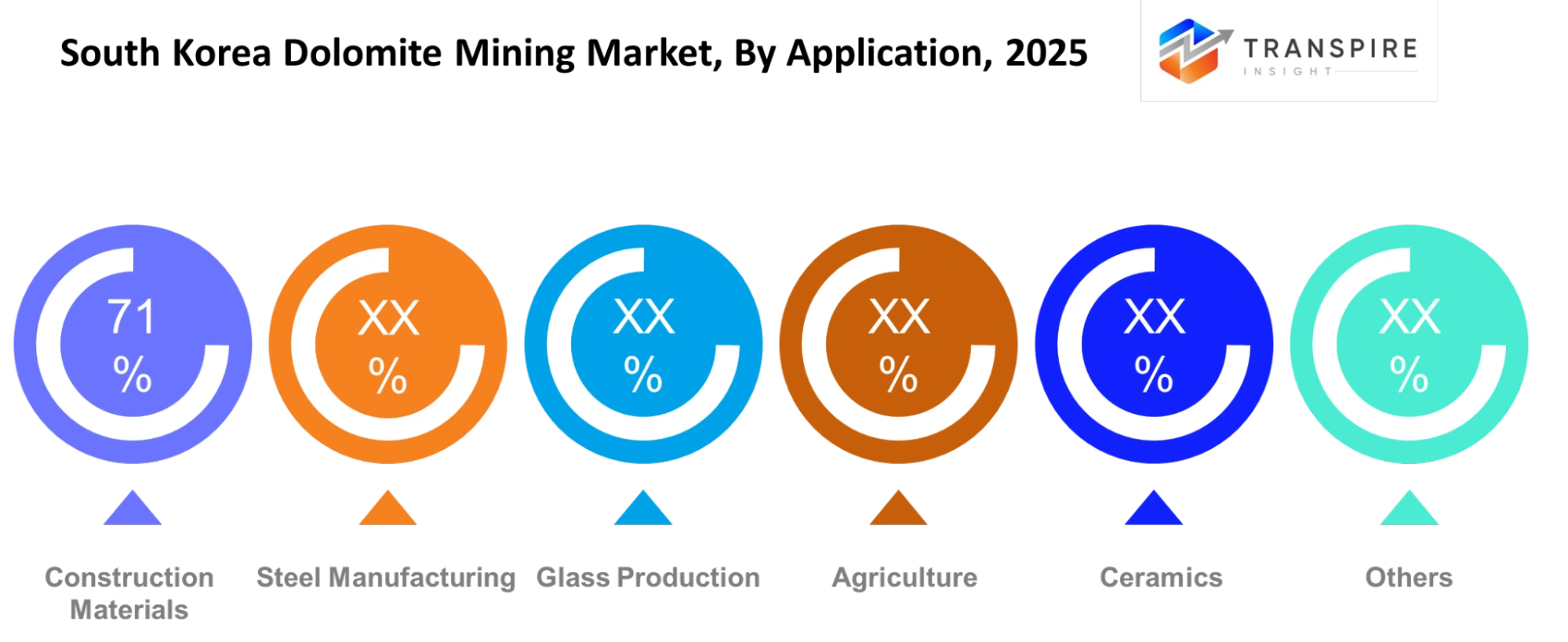
Construction materials show up as this big, major application segment, sort of because dolomite helps cement production, road base setup, and concrete manufacturing work all at once. Even when industrial zones grow, infrastructure development projects keep generating fairly steady mineral demand patterns. Builders tend to favor long-lasting mineral additives, those that help structural strength, and also back cost-effective production methods, in a way.
Steel manufacturing is another big application area. That’s mainly because dolomite works as a flux material during furnace operations. Over in glass production, plus ceramics industries, consumption stays regular too, since mineral purity really matters for product quality , and also for thermal stability. Agricultural uses are still building up slowly, since processed dolomite acts for soil conditioning and supports acidity control across a handful of farming operations.Beyond that, other uses can include chemical processing and industrial environmental treatment activities.
To learn more about this report, Download Free Sample Report
By Mining Method:
Open pit mining still gets picked a lot because getting at the ore from the surface tends to keep things less complicated, and it helps production move faster, in a practical way. Most mining operators will go for it when the mineral reserves are easy to reach, plus when there are workable transport connections nearby. This surface approach stays relevant too, since big scale industrial extraction depends on steady hauling of material , and excavation tends to cost less, compared with more complex options.
Underground mining, on the other hand, plays a role when the deposit sits below the surface depth and the extraction has to be managed very carefully. The need for heavy equipment investment, along with tougher safety obligations, shapes how underground sites plan their daily work. Besides that, you also see other mining tactics , usually smaller and more localized extraction activities meant to cover regional industrial demand, or specialized mineral processing workflows that fit particular materials.
By End User:
The construction field is still taking up a major share, since the expansion of infrastructure and urban growth projects need a stable mineral supply for cement, concrete and road feedstock. Industrial contractors often lean on reliable procurement partnerships that cut down transit slowdowns and help keep continuous manufacturing timetables running across big scale building endeavors, even when timelines shift a bit.
The metallurgy sector also counts as a notable end user, because steel makers need processed dolomite to improve furnace efficiency and manage impurity control. In parallel, agriculture and chemical companies keep using minerals in a fairly steady way, for soil conditioning and for industrial processing tasks, that basically don’t pause much. Other end users include ceramics fabricators and environmental treatment operators who look for mineral ingredients with steady composition , plus dependable performance standards.
By Form:
Lumps are still commonly used in heavy industrial processing because bigger material sizes keep furnace operations steady and they really help with refractory uses, too. Crushed dolomite, by the way, still shows solid demand since construction and infrastructure teams need adaptable aggregate material for roadwork and industrial filling, across several development projects.
Powder and granule formats continue to get more traction because controlled particle size improves blending accuracy in environmental treatment, ceramics, and some chemical processing activities. Also, the processed formats make transportation , storage, and general industrial handling a bit easier . Other variants include customized industrial grades, made for specific application performance and purity expectations, depending on what the site actually needs .
What are the Key Use Cases Driving the South Korea Dolomite Mining Market?
Steel manufacturing is still, kinda the biggest use case for dolomite in South Korea, mostly because the big integrated steel plants need high-purity flux stuff during blast furnace work and refining. Dolomite, it sort of helps clear out impurities , keeps slag chemistry more stable and improves the overall furnace efficiency. So in the end, it becomes kind of a must for major metallurgical output and those long-term industrial procurement agreements.
On the other side, construction materials and ceramics are getting more momentum, especially as infrastructure modernization keeps rolling out in different industrial areas. Cement producers and ceramic manufacturers are using processed dolomite more and more, to boost durability, raise thermal resistance, and keep the material more consistent. Meanwhile agricultural users are also taking up dolomite-based soil conditioners , to balance soil acidity and push better crop productivity in some farming zones.
Then there are emerging uses that are starting to take shape in wastewater treatment and industrial emission control systems. Semiconductor and petrochemical sites are testing finely processed dolomite for neutralization and filtration tasks, since environmental compliance rules are getting tighter. If mineral-based treatment systems keep advancing, they could create new, steady demand channels across the forecast period.
|
Report Metrics |
Details |
|
Market size value in 2025 |
USD 19.80 Million |
|
Market size value in 2026 |
USD 21.17 Million |
|
Revenue forecast in 2033 |
USD 33.8 Million |
|
Growth rate |
CAGR of 6.91% from 2026 to 2033 |
|
Base year |
2025 |
|
Historical data |
2021 - 2024 |
|
Forecast period |
2026 - 2033 |
|
Report coverage |
Revenue forecast, competitive landscape, growth factors, and trends |
|
Country scope |
South Korea |
|
Key company profiled |
Lhoist Group, Sibelco, Omya AG, RHI Magnesita, Carmeuse, Imerys, Nordkalk, Tata Steel Mining, Essel Mining, Arihant MinChem, E. Dillon & Company, JFE Mineral, Beihai Group, Mineral Technologies, Dongyang Steel. |
|
Customization scope |
Free report customization (country, regional & segment scope). Avail customized purchase options to meet your exact research needs. |
|
Report Segmentation |
By Product Type (Calcined Dolomite, Sintered Dolomite, Agglomerated Dolomite, Dolomite Powder, Others); By Application (Construction Materials, Steel Manufacturing, Glass Production, Agriculture, Ceramics, Others); By Mining Method (Underground Mining, Open-pit Mining, Surface Mining, Others); By End User (Construction Industry, Metallurgy Industry, Agriculture Industry, Chemical Industry, Others); By Form (Lumps, Powder, Granules, Crushed Dolomite, Others). |
Which Regions are Driving the South Korea Dolomite Mining Market Growth?
Gangwon Province stays at the top in South Korea’s dolomite mining market , mostly because the area holds some of the country’s oldest and most proven dolomite reserves plus the extraction setup that already works. The mines have been operating for a long time, they have pretty direct access to industrial transport routes, and they are close to steel and cement makers, so mineral supply can keep moving at a large scale. Local officials have also kept permitting processes pretty stable , so companies can modernize their processing facilities , without too many big stops in output. There’s also a kind of practical network around it , quarry operators, logistics providers, mineral processors and industrial customers , and that whole group keeps Gangwon as the country’s main production hub.
North Chungcheong looks a bit different, because the region’s momentum depends less on how concentrated the raw reserves are, and more on whether industrial processing stays steady. It benefits from fairly even manufacturing across chemicals, ceramics, and building materials , which means dolomite and related inputs keep finding demand even when steel production has its ups and downs. Operators here keep building long-running procurement relationships and local supply routes, aiming to lower transportation uncertainty. In the end, this steadiness makes North Chungcheong more like a dependable long-term revenue contributor, not just a place for high-volume extraction, full stop.
North Gyeongsang looks like it’s turning into the fastest-growing area, partly because industrial infrastructure is stretching out and investment has been getting more serious toward advanced manufacturing operations since after 2022 . It seems like growth really kicked up when stricter environmental compliance requirements came in, so semiconductor , petrochemical, and wastewater treatment facilities had to lock in larger volumes of processed mineral materials. With logistics connectivity getting better too, and industrial clusters expanding in the same breath, mining and processing companies started forming new regional supply agreements. During 2026–2033, this kind of momentum should deliver more attractive opportunities for investors who care about value-added processing, industrial mineral refining, plus environmental treatment applications.
Who are the Key Players in the South Korea Dolomite Mining Market and How Do They Compete?
The competitive landscape in South Korea’s dolomite mining market still feels moderately consolidated , mostly because only a handful of industrial mineral suppliers really manage the gate to large processing capacity, plus the long term industrial contracts. In other words, competition doesn’t revolve just around extraction volume or price anymore. Industrial buyers are more into chemical uniformity, dependable logistics , and that practical capability to deliver processed dolomite grades that are engineered for steelmaking, environmental treatment, and also ceramics production. The big operators keep trying to hold their ground , often by using vertically integrated processing networks. Meanwhile smaller regional firms seem to chase a different angle more niche mineral applications and tighter, localized supply arrangements
POSCO Holdings , for example , builds its edge by linking directly with steel manufacturing operations. It leans into high purity dolomite sourcing and refining systems that boost furnace performance and cut down impurity driven production losses. Because of this setup , POSCO has stronger leverage over raw material quality and procurement steadiness than buyers who are not vertically connected. Hyundai Steel looks similar in concept, but it tends to emphasize long term domestic supply agreements to limit the impact of imported mineral price swings , and to avoid transportation disruptions that can pop up unexpectedly.
SsangYong C&E sort of stands apart because it ties its regional processing setup in a close way with cement and construction material networks, like really close. By doing that the company tends to get quicker delivery cycles and keeps more solid relationships with infrastructure contractors across industrial zones. Hanil Cement keeps on expanding its processed mineral capabilities, in support of specialty cement needs where you want a stable material composition. Meanwhile KCC Corporation leans toward ceramics and industrial materials, where mineral purity that stays consistent and processing specifications that are customized, help margins feel stronger than just going with plain bulk commodity supply alone.
Company List
- Lhoist Group
- Sibelco
- Omya AG
- RHI Magnesita
- Carmeuse
- Imerys
- Nordkalk
- Tata Steel Mining
- Essel Mining
- Arihant MinChem
- E. Dillon & Company
- JFE Mineral
- Beihai Group
- Mineral Technologies
- Dongyang Steel
Recent Development News
In December 2025, POSCO Future M secured a KRW469.1 billion supply contract with POSCO for quicklime, limestone, and dolomite products. The agreement strengthened domestic demand visibility for South Korea’s industrial mineral and dolomite supply chain through 2026.
Source: https://www.itiger.com/
In February 2026, the Ministry of Trade, Industry and Energy announced the resumption of overseas mineral development investments by state-owned enterprises. The policy shift is expected to support South Korea’s long-term supply security for critical industrial minerals, including dolomite-related raw materials used in steel and manufacturing sectors.
Source: https://en.sedaily.com/
What Strategic Insights Define the Future of the South Korea Dolomite Mining Market?
In South Korea, the dolomite mining market is moving (kind of) toward a more specialized, processing-focused setup over the next five to seven years, since industrial buyers are pushing for stricter mineral purity thresholds and a steadier domestic supply chain. So, instead of just chasing extraction volume, growth will lean more heavily on value-added refinement, automated quality checks, plus linkage with steel decarbonization programs and industrial emission management systems. This kind of change should, in practice, reward the firms that can blend mining, refining, and logistics almost like one continuous operational web rather than running each step separately, in different places.
There’s also a less obvious risk, not everyone notices it, and it’s tied to reliance on a smaller group of big industrial buyers, especially in steel manufacturing. If steel production slows down due to export pressure, or if alternative production technologies gain traction, then mineral procurement volumes can get squeezed fast across the whole chain. At the same time, some newer environmental treatment uses, like for semiconductor and petrochemical installations are starting to look like a solid long term opportunity, especially around industrial zones such as North Gyeongsang. Companies should probably put money into high-purity processing technologies, and build long-term industrial relationships, rather than only expanding raw extraction output, like that alone will solve everything.
South Korea Dolomite Mining Market Report Segmentation
By Product Type
- Calcined Dolomite
- Sintered Dolomite
- Agglomerated Dolomite
- Dolomite Powder
By Application
- Construction Materials
- Steel Manufacturing
- Glass Production
- Agriculture
- Ceramics
By Mining Method
- Underground Mining
- Open-pit Mining
- Surface Mining
By End User
- Construction Industry
- Metallurgy Industry
- Agriculture Industry
- Chemical Industry
By Form
- Lumps
- Powder
- Granules
- Crushed Dolomite
Frequently Asked Questions
Find quick answers to common questions.
The South Korea Dolomite Mining Market size is USD 33.8 Million in 2033.
Key segments for the South Korea Dolomite Mining Market are By Product Type (Calcined Dolomite, Sintered Dolomite, Agglomerated Dolomite, Dolomite Powder, Others); By Application (Construction Materials, Steel Manufacturing, Glass Production, Agriculture, Ceramics, Others); By Mining Method (Underground Mining, Open-pit Mining, Surface Mining, Others); By End User (Construction Industry, Metallurgy Industry, Agriculture Industry, Chemical Industry, Others); By Form (Lumps, Powder, Granules, Crushed Dolomite, Others).
Major South Korea Dolomite Mining Market players are Lhoist Group, Sibelco, Omya AG, RHI Magnesita, Carmeuse, Imerys, Nordkalk, Tata Steel Mining, Essel Mining, Arihant MinChem, E. Dillon & Company, JFE Mineral, Beihai Group, Mineral Technologies, Dongyang Steel.
The South Korea Dolomite Mining Market size is USD 19.80 Million in 2025.
The South Korea Dolomite Mining Market CAGR is 6.91% from 2026 to 2033.
- Lhoist Group
- Sibelco
- Omya AG
- RHI Magnesita
- Carmeuse
- Imerys
- Nordkalk
- Tata Steel Mining
- Essel Mining
- Arihant MinChem
- E. Dillon & Company
- JFE Mineral
- Beihai Group
- Mineral Technologies
- Dongyang Steel
Recently Published Reports
-
May 2026
Healthcare Polymer Packaging Market
Healthcare Polymer Packaging Market Size, Share & Analysis Report By Packaging Type (Syringes, IV Bottles and Pouches, Clamshells, Blisters, Bottles & Jars, Containers, Tubes, IV Parental Packaging, Others), By Type (Regulated, Non-regulated), By Polymer Type (LDPE (Low-Density Polyethylene), HDPE (High-Density Polyethylene), Homo-polymer (Homo), Random Copolymer (Random), Block Copolymer (Block), PET, Polystyrene, Polyvinyl Chloride, Polyamide/EVOH, Others), and Geography (North America, Europe, Asia-Pacific, Middle East and Africa, South and Central America), 2021 - 2031
-
Apr 2026
Hydrophilic Tape (Waterstop) Market
Hydrophilic Tape (Waterstop) Market Size, Share & Analysis Report By Type (Bentonite-Based Hydrophilic Tape, Rubber-Based Hydrophilic Tape), By Application (Residential Buildings, Commercial Buildings, Infrastructure Projects), and Geography (North America, Europe, Asia-Pacific, Middle East and Africa, South and Central America), 2021 - 2031
-
Apr 2026
Metalens Market
Metalens Market Size, Share & Analysis Report By Type (Visible Light Metalens, and Infrared Metalens), By Application (Consumer Electronics, Automotive Electronics, Industrial, Medical, and Others), and Geography (North America, Europe, Asia-Pacific, Middle East and Africa, South and Central America), 2021 - 2031
-
Apr 2026
PBT Resin Market
PBT Resin Market Size, Share & Analysis Report By Type (Reinforced PBT Resin, Unreinforced PBT Resin), By Processing Method (Injection Molding, Extrusion, Blow Molding, Others), By End-User (Automotive, Electrical & Electronics, Consumer Appliances, Industrial Machinery, Medical Devices, Packaging, Others), and Geography (North America, Europe, Asia-Pacific, Middle East and Africa, South and Central America), 2021 - 2031