
South Korea Contract Research Organization Services Market Size & Forecast:
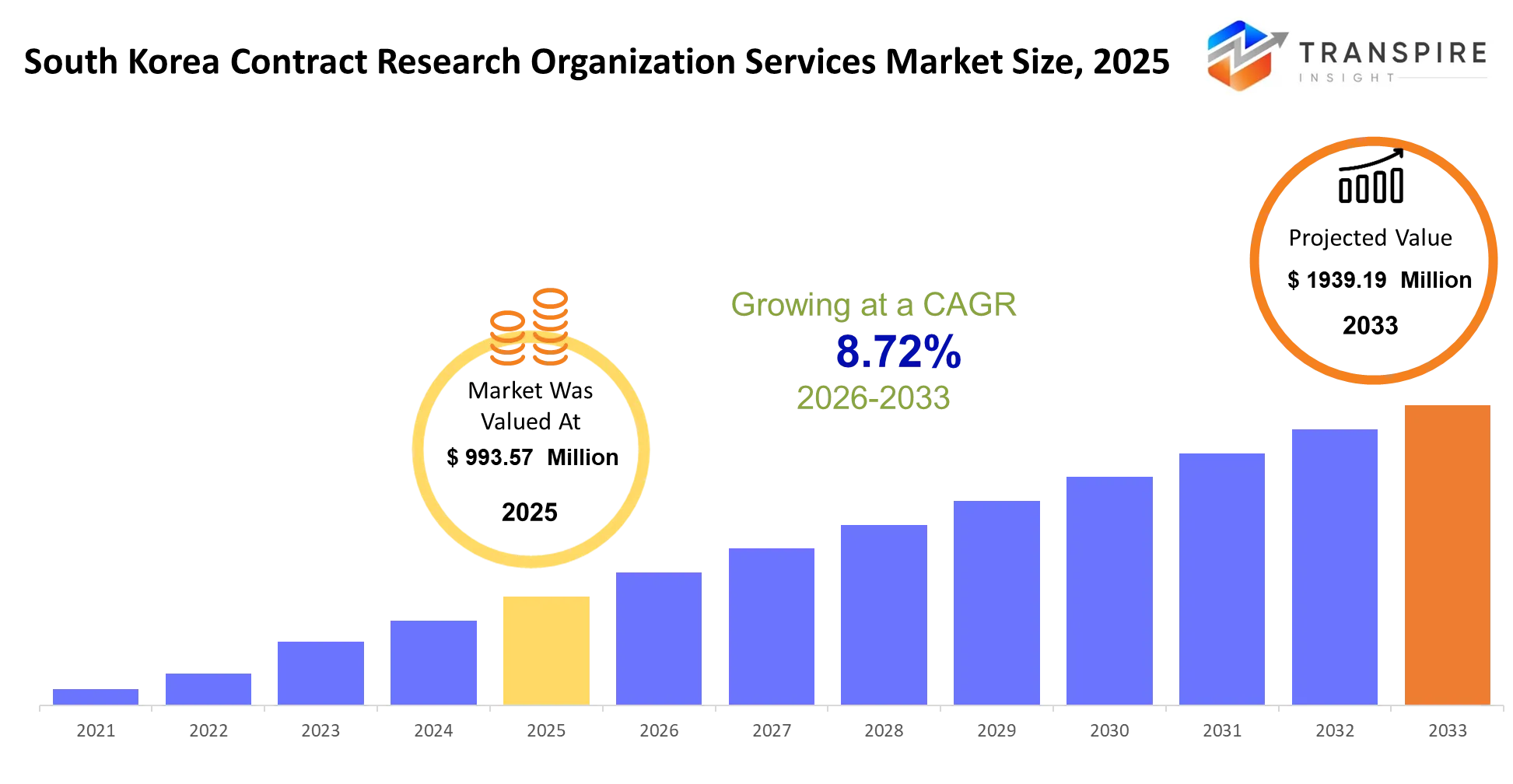
- South Korea Contract Research Organization Services Market Size 2025: USD 993.57 Million
- South Korea Contract Research Organization Services Market Size 2033: USD 1939.19 Million
- South Korea Contract Research Organization Services Market CAGR: 8.72%
- South Korea Contract Research Organization Services Market Segments: By Service Type (Clinical Trial Services, Preclinical Services, Laboratory Services, Pharmacovigilance Services, Regulatory Services, Data Management Services, Biostatistics Services, Medical Writing Services, Others); By Phase (Phase I, Phase II, Phase III, Phase IV, Discovery Research, Others); By Therapeutic Area (Oncology, Cardiology, Neurology, Infectious Diseases, Rare Diseases, Others); By End User (Pharmaceutical Companies, Biotechnology Companies, Medical Device Companies, Academic Institutes, Others); By Deployment (On-site Services, Decentralized Clinical Trials, Virtual Clinical Trials, Others)
To learn more about this report,  Download Free Sample Report
South Korea Contract Research Organization Services Market Summary
The South Korea Contract Research Organization Services Market was valued at USD 993.57 Million in 2025. It is forecast to reach USD 1939.19 Million by 2033. That is a CAGR of 8.72% over the period.
In South Korea, the Contract Research Organization Services Market kind of sits at the center of it all for pharmaceutical, biotechnology, and medical device firms. It helps them move through drug development faster, without having to carry the whole in house clinical cost structure. Typically these CRO providers handle the clinical trial set up, patient sourcing, the regulatory submissions, lab testing, and day to day data management, so sponsors can compress development timelines while also dealing with compliance rules that keep getting more complicated. Over the last five years, things have shifted in a noticeable way, from trial management that was mostly labor heavy toward more digitally stitched, and sometimes decentralized clinical research models. These are increasingly powered by AI driven analytics and remote patient monitoring, even when the study footprint is complicated.
The COVID-19 pandemic was a big trigger, because it showed weaknesses in how trials ran globally and kept running, and it pushed sponsors to rethink where and how they run studies. In that context, South Korea became a more attractive option, as technically advanced markets in Asia started showing real momentum. On top of that, government backed biotechnology investments and faster regulatory coordination have made the country stronger as a regional clinical research hub. And as biologics, cell therapies, and precision medicine programs keep expanding, CROs that focus deeply on specific therapeutic areas are getting more contract volume. They are also earning higher value service revenues, which makes the whole market feel more mature, even if it’s still moving quickly.
Key Market Insights
- South Korea Contract Research Organization Services Market keeps growing and it now kinda leads across Asia-Pacific for biologics outsourcing, mainly because of more advanced hospital infrastructure and quicker regulatory coordination, which really kicked in after 2021.
- Europe still showed up with nearly 38% of international contract inflow in 2025, as pharmaceutical sponsors went further into oncology and biosimilar trials in South Korea.
- Between 2026 and 2033, Asia-Pacific turned into the fastest-growing contributor, partly due to cross-border precision medicine collaborations and extra investments into biotechnology infrastructure.
- Clinical Trial Services held more than 40% market share in 2025 because sponsors basically leaned on outsourced patient recruitment, ongoing monitoring, and even late-stage regulatory support, rather than managing everything in-house.
- After 2022, Data Management Services became one of the fastest-growing parts of the market, as CROs started using AI-driven analytics and cloud-based compliance tracking platforms, for better reporting discipline.
- In 2025, Oncology accounted for about 35% of therapeutic research demand, supported by wider immunotherapy pipelines and biomarker-driven treatment development.
- Decentralized clinical trials grabbed more share after 2021 too, where wearable monitoring systems and virtual patient engagement helped reduce recruitment delays and lowered participant dropout rates, a pretty practical shift.
- Pharmaceutical companies remained the leading end-user segment, contributing over 45% of revenue, due to aggressive biologics and rare disease drug development programs that stayed on momentum.
- Since 2023, biotechnology companies recorded the quickest growth path, because smaller innovators increasingly outsourced clinical operations instead of trying to build internal infrastructure from scratch.
- Samsung Biologics pushed its strategic expansion in 2025 by launching organoid-based drug screening services, aimed at oncology-focused contract research partnerships.
What are the Key Drivers, Restraints, and Opportunities in the South Korea Contract Research Organization Services Market?
One of the major things driving the South Korea CRO services market is the fast growth of domestic biobased technology and precision medicine programs, which are supported by government funding and cross-border pharmaceutical collaborations . South Korea has also been pushing clinical trial infrastructure forward, mainly through regulatory modernization plus quicker approval routes, so sponsors can move compounds into evaluation more efficiently. As a result, outsourcing is getting more momentum, because pharmaceutical companies are sort of forced to lower development expenses while still speeding up time-to-market for biologics and focused therapies. CRO providers that are skilled in oncology, immunotherapy, and biosimilar assays are ending up landing bigger multi-phase agreements, and they get better revenue predictability.
The biggest “but” or restraint here is the structural shortfall of highly specialized clinical research personnel who can handle advanced biologics studies and the messy multinational regulatory paperwork. Getting truly seasoned clinical investigators, biostatisticians, and regulatory specialists up to speed takes years of technical development, so the talent gap is hard to close, at least not quickly. This bottleneck can slow down trial execution capacity and it tends to raise operating costs, especially for smaller local CRO providers that are competing against global firms with deeper resource pools .
A strong opportunity is showing up via decentralized clinical trial platforms that mix telemedicine , wearable monitoring devices , and AI-based patient engagement tooling. With South Korea having solid digital healthcare infrastructure, the conditions are pretty good for hybrid trial setups, which can reduce participant dropouts and help data capture run in a more efficient way.
What Has the Impact of Artificial Intelligence Been on the South Korea Contract Research Organization Services Market?
Artificial intelligence plus more advanced digital platforms are really reshaping clinical research operations throughout South Korea , in a way that makes trials run faster, keeps the admin load lower, and supports stronger predictive choices. CRO providers these days increasingly rely on AI- based systems that can do things like patient screening, protocol matching, validating electronic data capture, and even watching adverse events in near real time. As a result, teams spend less hours on manual processing and they can handle bigger multi- site studies with a steadier approach. On top of that, machine learning models are getting used to estimate patient enrollment timelines, refine site selection, and spot possible protocol deviations before they turn into problems that mess with trial outcomes.
Then there are advanced analytics platforms that keep operations smoother by speeding up data review cycles, and cutting trial slowdowns that come from incomplete paperwork or participant noncompliance. In oncology as well as rare disease work, predictive algorithms help sponsors locate the high- response patient groups, so recruitment improves and trials don’t waste money on lower yield cohorts. AI-supported monitoring systems have also helped lower operational costs, partly by trimming repetitive manual audits and by making regulatory reporting more accurate.
Still, the adoption story isn’t completely clean. Bringing AI platforms into legacy hospital systems, plus connecting them with fragmented clinical databases, stays expensive and technically demanding, with a lot of moving parts. Also, a lot of clinical datasets don’t have enough volume or consistency for building predictive models that are consistently accurate, especially in rare disease trials where information is naturally limited. Because of these limits, full- scale deployment keeps getting delayed, even with all the investment momentum happening across South Korea’s digital healthcare ecosystem.
Key Market Trends
- Starting in 2021, oncology trials have somehow become more than 35% of outsourced clinical research activity, while biologics and immunotherapy pipelines expanded in a pretty aggressive way.
- It is like, IQVIA, Parexel, ICON also began integrating AI driven patient recruitment platforms more and more between 2023 and 2025, which helped cut down enrollment delays and protocol deviations by a lot.
- After COVID-19, decentralized clinical trial adoption took off, with remote patient monitoring usage going up across Phase II and Phase III studies, pretty much since 2022.
- Then in 2025, Samsung Biologics didn’t just stay at manufacturing , they expanded by launching organoid based CRO services aimed at oncology drug screening and translational medicine programs, so yeah broader than before.
- Also, South Korean biotech funding kept rising steadily after 2021 which drove higher outsourcing demand from smaller therapy developers, who often lack internal regulatory capabilities plus trial infrastructure.
- Regulatory approval timelines meanwhile improved by close to 20% since 2020, aided by digital submission systems ,and faster coordination between Korean and international authorities.
- Pharmaceutical companies have increasingly been moving multi-country Asia-Pacific studies into South Korea too, largely because hospitals there are more digitized and patient retention rates are high.
- At the same time demand for pharmacovigilance and real-world evidence services grew rapidly after stricter post market safety monitoring requirements started showing up across biologics and rare disease therapies.
- Clinical data management platforms also shifted from manual reporting systems toward cloud based analytics environments ,which support AI assisted compliance monitoring and adaptive trial designs.
- Finally, cross-border partnerships between Korean CROs and U.S. biotechnology firms increased noticeably after 2023, as precision medicine and cell therapy pipelines expanded across regions, globally.
South Korea Contract Research Organization Services Market Segmentation
By Service Type
Clinical Trial Services kind of hold the top spot , because pharmaceutical and biotechnology companies keep outsourcing patient recruitment, site monitoring, protocol stewardship, and the actual trial run to specialist providers that have global compliance know-how. Big oncology and biologics programs have also pushed up reliance on multi-site coordination features , especially for late-stage studies where enrollment has to happen quickly and where data oversight is pretty intricate. Preclinical Services still sit in a strong secondary lane , driven by the uptick in early-stage drug discovery work that’s backed by biotechnology funding, plus translational research programs. Laboratory Services stay essential for biomarker testing, pharmacokinetics work, and genomic profiling, while Pharmacovigilance Services keep broadening as regulators ask for more robust post-approval safety surveillance setups.
Regulatory Services together with Data Management Services are getting more traction, mostly from the fact that documentation keeps getting more complicated and multinational studies lean harder on digital trial infrastructure. Biostatistics Services help meet higher-end analytics needs for adaptive trial frameworks and precision medicine efforts, mainly in oncology and rare disease areas. Medical Writing Services benefit from more frequent submission activity tied to biologics and biosimilars, while the other service lines stay narrow, and they tend to be very project dependent. In the forecast window, Data Management Services and Pharmacovigilance Services are likely to grow the quickest, largely because AI-enabled compliance tracking and real-world evidence monitoring are becoming a central part of how global drug development is planned .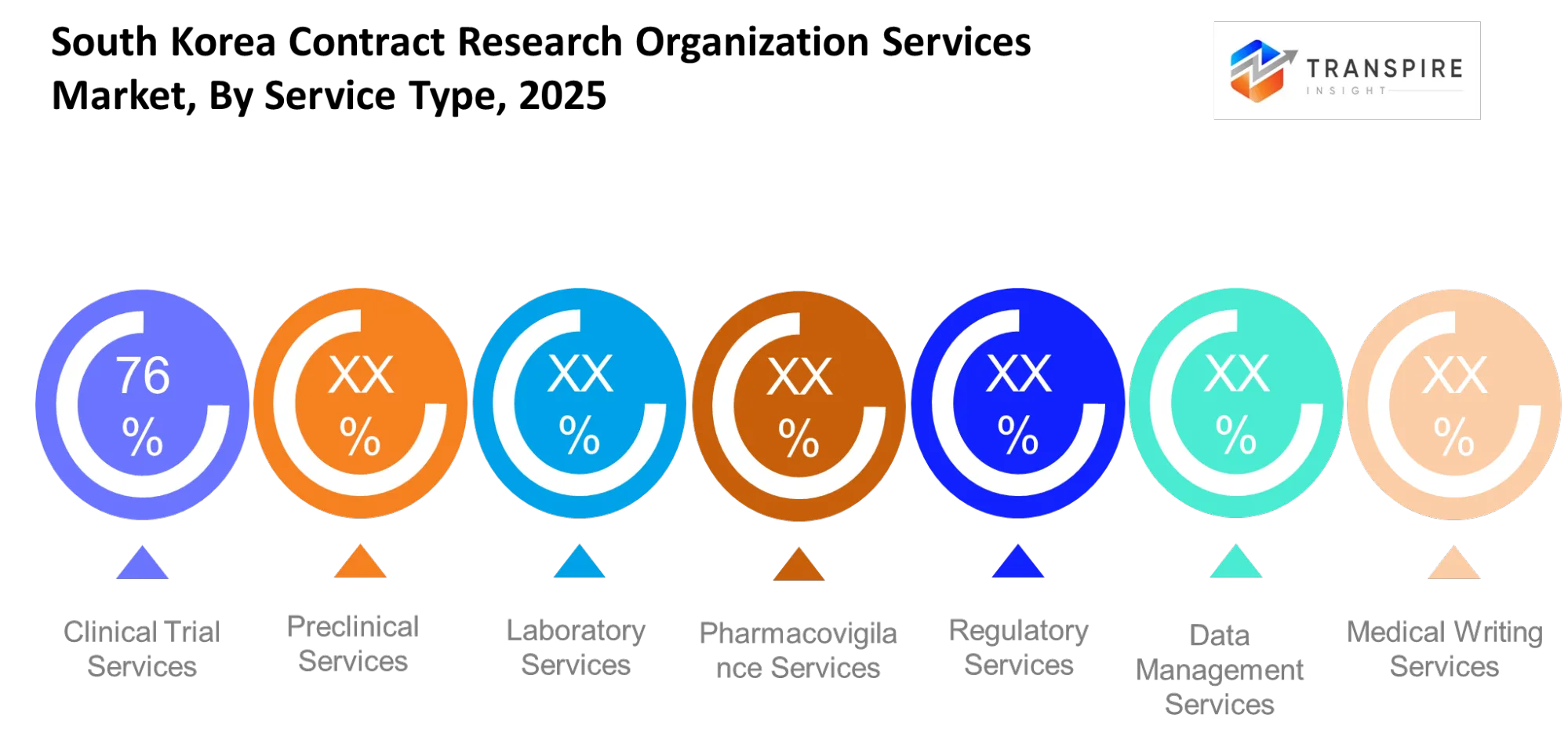
To learn more about this report, Download Free Sample Report
By Phase
Phase III studies kinda take the lead because the late-stage clinical trials need the most patients, longest watching periods and the most extensive regulatory paperwork. Pharmaceutical sponsors typically swing big budgets into Phase III programs since a clean, successful run basically decides the commercialization schedule and also market approval results. Phase II sits in the second slot, mostly because there is more and more focus on proving efficacy, plus tuning the dose, for biologics, immune therapies ,and targeted treatments. Phase I stays fairly steady in demand through the expansion of early-stage oncology pipeline work and the first-in-human trials that are often backed by specialized research hospitals.
Phase IV activity keeps climbing too since regulators keep asking for long-term safety monitoring and real-world effectiveness checks after the product gets approved. Discovery Research still matters a lot for biotechnology startups and academic spinoffs building new therapeutic candidates, even if funding volatility can mess with continuity of the project, a bit. The other development phases carry on supporting more niche research work that links to medical devices and combo therapies. Over the forecast period, Phase I services and Phase IV services are expected to grow quickly as personalized medicine development increases, along with post-market surveillance requirements, driving additional investment into specialized clinical infrastructure and long term patient outcome tracking.
By Therapeutic Area
Oncology still has the leading spot because there’s been a lot of money put into immunotherapy, targeted biologics, and that wider precision medicine research stuff across global pharma pipelines. Cancer programs need complicated biomarker checks , flexible or adaptive study structures , and lots of patient observation, so there’s a real opportunity for outsourcing to specialized CRO providers. Cardiology stays steady too, mainly since chronic cardiovascular disease prevalence keeps pushing long-running outcomes studies , plus medical device evaluations that take time. Neurology keeps growing at a consistent pace, helped by the rising interest in therapies for neurodegenerative disorders and the continued rollout of more advanced central nervous system drug development programs.
Infectious Diseases got a renewed push after the pandemic, because vaccine work moved faster and antiviral treatment development programs expanded across Asia-Pacific markets. Rare Diseases are smaller, but they’re climbing quickly, often driven by orphan drug incentives and improvements in genetic testing, which makes sponsors look for highly specialized therapeutic research. The other therapeutic buckets are pretty varied, mostly tied to project-by-project sponsor pipeline priorities and whatever funding conditions are happening at the time. Over the forecast window, Oncology and Rare Diseases are expected to pull in the most investment, since precision diagnostics , cell based therapies, and related approaches depend on sophisticated clinical know-how and advanced patient stratification abilities.
By End User
Pharmaceutical Companies are still in the lead, mainly because big multinational drug manufacturers keep outsourcing clinical operations, kind of to shrink their own internal infrastructure costs and, well, speed up development timelines. Between high volume biologics pipelines and the way regulatory complexity keeps rising, long-term tie ups are getting stronger between pharmaceutical sponsors and full service CRO providers. Next, Biotechnology Companies sit as the second largest segment, driven by fast paced innovation in gene therapy, cell therapy, and precision medicine platforms, supported through venture capital along with government backed research funding. Medical Device Companies also add meaningful demand, especially for safety testing, performance validation, and those post market compliance programs that never really go away.
Academic Institutes, meanwhile, are a smaller but still vital slice, they support investigator led studies, translational medicine efforts, and shared research activities with biotechnology firms, sometimes in a very “ask first then expand” kind of way. Other end users include public health organizations and emerging digital health companies, both looking for specialized trial management know-how for niche therapeutic programs. Biotechnology Companies are anticipated to grow the fastest through the forecast window. Smaller innovators are increasingly choosing outsourced development partnerships rather than building internal clinical infrastructure from scratch. This overall change should nudge strong demand for flexible service models, decentralized trial support, and more integrated regulatory consulting capabilities.
By Deployment
On-site Services kinda keep that top spot still, because complex clinical trials rely a lot on hospital based patient monitoring, lab work, and actual direct investigator oversight. Big oncology, cardiology, and neurology studies really need a physical setup, plus specialized medical devices, and decentralized models just can’t fully swap that out. Decentralized Clinical Trials show up as the second-largest slice, mainly when pharmaceutical sponsors start using remote monitoring tools, and digital patient engagement systems , to cut down recruitment delays and deal with the geographic hurdles. Virtual Clinical Trials are smaller overall, but they’re getting more attention for low-risk observational work and for longer-term patient follow up programs.
Decentralized Clinical Trials also ride on broader smartphone penetration, wearable health devices, and growing regulatory comfort with remote data capture across Asia-Pacific healthcare systems. Virtual Clinical Trials tend to help with retention, since participants don’t need to travel as much, and data can be collected continuously outside the usual hospital settings. The other deployment styles stay more niche, mostly hybrid approaches or one-off project uses, depending on therapeutic complexity and the exact regulatory context. Over the forecast period, Decentralized Clinical Trials are expected to grow the quickest, because sponsors increasingly want operational flexibility, faster enrollment, and more cost-efficient patient management—often enabled by AI backed digital health infrastructure.
What are the Key Use Cases Driving the South Korea Contract Research Organization Services Market?
Clinical trial management still comes out on top, i mean, pharmaceutical and biotechnology companies lean on outsourced know how to run oncology, immunology, and biosimilar programs that are getting more and more complex. CRO providers help with patient sourcing, regulatory coordination, site supervision, and statistical interpretation, so sponsors can push drug commercialization ahead of schedule while keeping day to day operational costs in check.
Right next door, adjacent uses are starting to gather momentum in medical device evaluation and post market vigilance. Local medical technology manufacturers are increasingly giving safety validation and compliance documentation to specialized research partners, rather than handling everything internally, which makes the workflows kind of smoother. Bioanalytical laboratory services are also growing, because biologics and cell therapy developers now need stronger pharmacokinetic assessments and biomarker analysis capabilities.
On the emerging side, decentralized clinical trials are becoming more common, supported by wearable devices and remote patient monitoring setups. AI helped trial blueprinting and virtual recruiting marketplaces are getting attention too, particularly from precision medicine teams that want quicker enrollment and better participant sticking power in rare disease trials and individualized treatment studies.
|
Report Metrics |
Details |
|
Market size value in 2025 |
USD 993.57 Million |
|
Market size value in 2026 |
USD 1080.17 Million |
|
Revenue forecast in 2033 |
USD 1939.19 Million |
|
Growth rate |
CAGR of 8.72% from 2026 to 2033 |
|
Base year |
2025 |
|
Historical data |
2021 - 2024 |
|
Forecast period |
2026 - 2033 |
|
Report coverage |
Revenue forecast, competitive landscape, growth factors, and trends |
|
Regional scope |
South Korea |
|
Key company profiled |
IQVIA, Labcorp Drug Development, Syneos Health, Parexel, ICON plc, Charles River Laboratories, Medpace, WuXi AppTec, PRA Health Sciences, Samsung Biologics, Novotech, PPD, CMIC Group, ClinChoice, TFS HealthScience |
|
Customization scope |
Free report customization (country, regional & segment scope). Avail customized purchase options to meet your exact research needs. |
|
Report Segmentation |
By Service Type (Clinical Trial Services, Preclinical Services, Laboratory Services, Pharmacovigilance Services, Regulatory Services, Data Management Services, Biostatistics Services, Medical Writing Services, Others); By Phase (Phase I, Phase II, Phase III, Phase IV, Discovery Research, Others); By Therapeutic Area (Oncology, Cardiology, Neurology, Infectious Diseases, Rare Diseases, Others); By End User (Pharmaceutical Companies, Biotechnology Companies, Medical Device Companies, Academic Institutes, Others); By Deployment (On-site Services, Decentralized Clinical Trials, Virtual Clinical Trials, Others) |
Which Regions are Driving the South Korea Contract Research Organization Services Market Growth?
Europe is currently, kind of the main regional driver behind South Korea’s Contract Research Organization services revenue. This happens because multinational pharmaceutical companies keep moving complicated biologics and oncology trials toward seasoned Asian research hubs that have solid regulatory credibility . South Korean CRO firms get a boost from how well they match global clinical standards, plus they have advanced hospital networks and a pretty dense cluster of biotechnology capability around Seoul and Incheon. Lately European drug developers have been outsourcing both early-stage and late-phase studies to South Korean partners, partly to shave down enrollment timelines and also to tap digitally integrated healthcare systems.
North America stays in the second spot, still influential but in a different way. Its impact is less about simple trial diversification, and more about outsourcing efficiency as a strategy. Big U.S. pharmaceutical companies are under pressure to rein in rising R&D spending, while also keeping biologics pipelines moving aggressively, so they depend more on specialized CRO partnerships in South Korea. U.S. sponsors also tend to like South Korea for precision medicine work, where advanced diagnostics integration matters , and where patient recruitment can be relatively quick, especially for oncology and immunotherapy programs.
Asia-Pacific is coming up as the fastest-growing regional opportunity. That’s tied to the rapid spread of biotechnology across China, Japan, Singapore, and Southeast Asia. New money is going into trial infrastructure across the region, and since the post-pandemic period, healthcare modernization policies have been pushing demand for cross-border study coordination , plus decentralized trial models that do not rely on a single location.
Who are the Key Players in the South Korea Contract Research Organization Services Market and How Do They Compete?
Competition in South Korea’s CRO services market is moderately consolidated, with global clinical research firms pitted against specialized regional providers that lean into biotechnology, and precision medicine programs. What matters most, has shifted a bit beyond mere cost efficiency, toward therapeutic specialization, digital trial handling capabilities , regulatory know-how, and better access to top tier patient recruitment networks. The bigger multinational CROs keep trying to defend their market share using integrated end-to-end service models, and meanwhile newer Asian firms try to win deals by moving operations faster and by pushing stronger localization for regional biotech clients, kind of like quicker turnaround with local context.
IQVIA stands out mainly because of its healthcare data infrastructure, plus AI enabled analytics tools that can support protocol optimization, patient matching, and even decentralized trial management. It has been extending its technology ecosystem via long-term partnerships with Veeva and with academic research organizations, which helps it tackle tougher clinical trial execution tasks more efficiently. Parexel, on the other hand, leans hard into regulatory consulting and advanced therapeutics development, especially across oncology and regenerative medicine. Its work with S.Biomedics on Parkinson’s disease clinical development in the United States and Japan shows a clear intent, securing specialized cell therapy programs where regulatory complexity tends to be high.
Samsung Biologics is also moving outward from just manufacturing, into contract research through organoid-based drug screening services aimed at oncology discovery. The company blends its large scale biologics manufacturing capacity with early stage research support. That combination gives it a vertically integrated service position, which only a small number of competitors can mirror, at least not without major gaps in either infrastructure or know-how.
Company List
- IQVIA
- Labcorp Drug Development
- Syneos Health
- Parexel
- ICON plc
- Charles River Laboratories
- Medpace
- WuXi AppTec
- PRA Health Sciences
- Samsung Biologics
- Novotech
- PPD
- CMIC Group
- ClinChoice
- TFS HealthScience
Recent Development News
In June 2025, Samsung Biologics launched its “Samsung Organoid” CRO service. The company expanded into organoid-based drug screening and early-stage oncology research services, strengthening South Korea’s position in biologics-focused contract research and integrated drug development.https://koreajoongangdaily.joins.com
In December 2025, Samsung Biologics announced acquisition of Human Genome Sciences from GSK for approximately USD 280 million. The acquisition secured Samsung Biologics’ first U.S.-based manufacturing and research facility, expanding its end-to-end biopharmaceutical development and contract research capabilities for global clients.https://www.reuters.com
What Strategic Insights Define the Future of the South Korea Contract Research Organization Services Market?
South Korea CRO services market seems to be shifting, kinda structurally, toward very specialized, tech driven clinical development setups with focus on biologics, cell therapy, and also precision medicine research. The main push behind this is basically the coming together of digital healthcare infrastructure plus strong advanced manufacturing, and then a lot of government backed biotech investment. Still there’s a less obvious danger showing up, because the market is concentrating around just a handful of big multinational sponsors and their biologics pipelines. So if the global pharma funding rhythm slows down, or if those sponsors start pulling more work in house for clinical development, smaller CRO providers could run into real contract instability and pricing squeeze.
At the same time there’s an opening that looks more and more promising in decentralization along with hybrid trials for rare diseases and regenerative medicine efforts across Asia-Pacific. South Korea’s advantage with digital health integration lets local CROs step into a role like regional coordinators, helping run cross-border virtual trial networks. Any company trying to move into this area should put effort into AI enabled patient recruitment systems, solid regulatory consulting know-how, and careful hospital partnership building instead of trying to win mostly on price.
South Korea Contract Research Organization Services Market Report Segmentation
By Service Type
- Clinical Trial Services
- Preclinical Services
- Laboratory Services
- Pharmacovigilance Services
- Regulatory Services
- Data Management Services
- Biostatistics Services
- Medical Writing Services
- Others
By Phase
- Phase I
- Phase II
- Phase III
- Phase IV
- Discovery Research
- Others
By Therapeutic Area
- Oncology
- Cardiology
- Neurology
- Infectious Diseases
- Rare Diseases
- Others
By End User
- Pharmaceutical Companies
- Biotechnology Companies
- Medical Device Companies
- Academic Institutes
- Others
By Deployment
- On-site Services
- Decentralized Clinical Trials
- Virtual Clinical Trials
- Others
Frequently Asked Questions
Find quick answers to common questions.
The Expected South Korea Contract Research Organization Services Market size for the Market will be USD 66.8 Billion in 2033.
Key Segments for the South Korea Contract Research Organization Services Market are By Service Type (Clinical Trial Services, Preclinical Services, Laboratory Services, Pharmacovigilance Services, Regulatory Services, Data Management Services, Biostatistics Services, Medical Writing Services, Others); By Phase (Phase I, Phase II, Phase III, Phase IV, Discovery Research, Others); By Therapeutic Area (Oncology, Cardiology, Neurology, Infectious Diseases, Rare Diseases, Others); By End User (Pharmaceutical Companies, Biotechnology Companies, Medical Device Companies, Academic Institutes, Others); By Deployment (On-site Services, Decentralized Clinical Trials, Virtual Clinical Trials, Others)
Major South Korea Contract Research Organization Services Market Players are IQVIA, Labcorp Drug Development, Syneos Health, Parexel, ICON plc, Charles River Laboratories, Medpace, WuXi AppTec, PRA Health Sciences, Samsung Biologics, Novotech, PPD, CMIC Group, ClinChoice, TFS HealthScience.
The Current South Korea Contract Research Organization Services Market size is USD 1939.19 Million in 2025.
The South Korea Contract Research Organization Services Market CAGR is 8.72% from 2026 to 2033.
- IQVIA
- Labcorp Drug Development
- Syneos Health
- Parexel
- ICON plc
- Charles River Laboratories
- Medpace
- WuXi AppTec
- PRA Health Sciences
- Samsung Biologics
- Novotech
- PPD
- CMIC Group
- ClinChoice
- TFS HealthScience
Recently Published Reports
-
Apr 2026
Cord Blood Banking Services Market
Cord Blood Banking Services Market Size, Share & Analysis Report By Type of Service (Collection, Processing, Storage), By Bank Type (Private Banks, Public Banks, and Hybrid Banks), By Component (Cord Blood, and Cord Tissue), By End User (Hospitals, Research Institutions, Biotechnology Companies, and Others) and Geography (North America, Europe, Asia-Pacific, Middle East and Africa, South and Central America), 2021 - 2031
-
Apr 2026
ELISA Processors Market
ELISA Processors Market Size, Share & Analysis Report By Type (Optical Filter ELISA Analyzer, and Optical Grating ELISA Analyzers), By Mode (Automated ELISA Analyzers, and Semi-Automated ELISA Analyzers), By Applications (Immunology, Vaccine development, Drug Monitoring, and Others), By End Users (Biotechnology Companies, Pharmaceutical Companies, Contract Research Organization, and Diagnostic Laboratories) and Geography (North America, Europe, Asia-Pacific, Middle East and Africa, South and Central America), 2021 - 2031
-
May 2026
Microscope Slide Scanner Market
Microscope Slide Scanner Market Size, Share & Analysis Report By Type (Portable Microscope Slide Scanner, and Desktop Microscope Slide Scanner), By Application (Biological Research, Medicine, Veterinary, and Other) and Geography (North America, Europe, Asia-Pacific, Middle East and Africa, South and Central America), 2021 - 2031
-
Apr 2026
Microwave Cookware Market
Microwave Cookware Market Size, Share & Analysis Report By Material Type (Plastic, Glass, Ceramic, Silicone, and Metal), By Application (Cooking, Reheating, and Defrosting), By End User (Household, Commercial (Restaurants, Hotels, and Cafes), and Food Service Industry), By Sales Channel (Online Retail, Offline Retail (Supermarkets, Hypermarkets, Specialty Stores), and Direct Sales (Company Outlets)) and Geography (North America, Europe, Asia-Pacific, Middle East and Africa, South and Central America), 2021 - 2031