
South Korea CO2 Laser Market Summary:
According to Transpire Insights, a detailed research report on the market reflects that the industrial manufacturing application segment dominates the South Korea CO2 Laser Market, accounting for approximately 58% of the total share worldwide. TRUMPF Group leads the market with approximately (around USD 5.0 billion) in annual revenue and an estimated 14–18% South Korea market share, making it the leading contributor to South Korea market development, innovation, advanced CO2 laser technology production, expanding manufacturing capabilities, and growth dynamics.
Market Snapshot
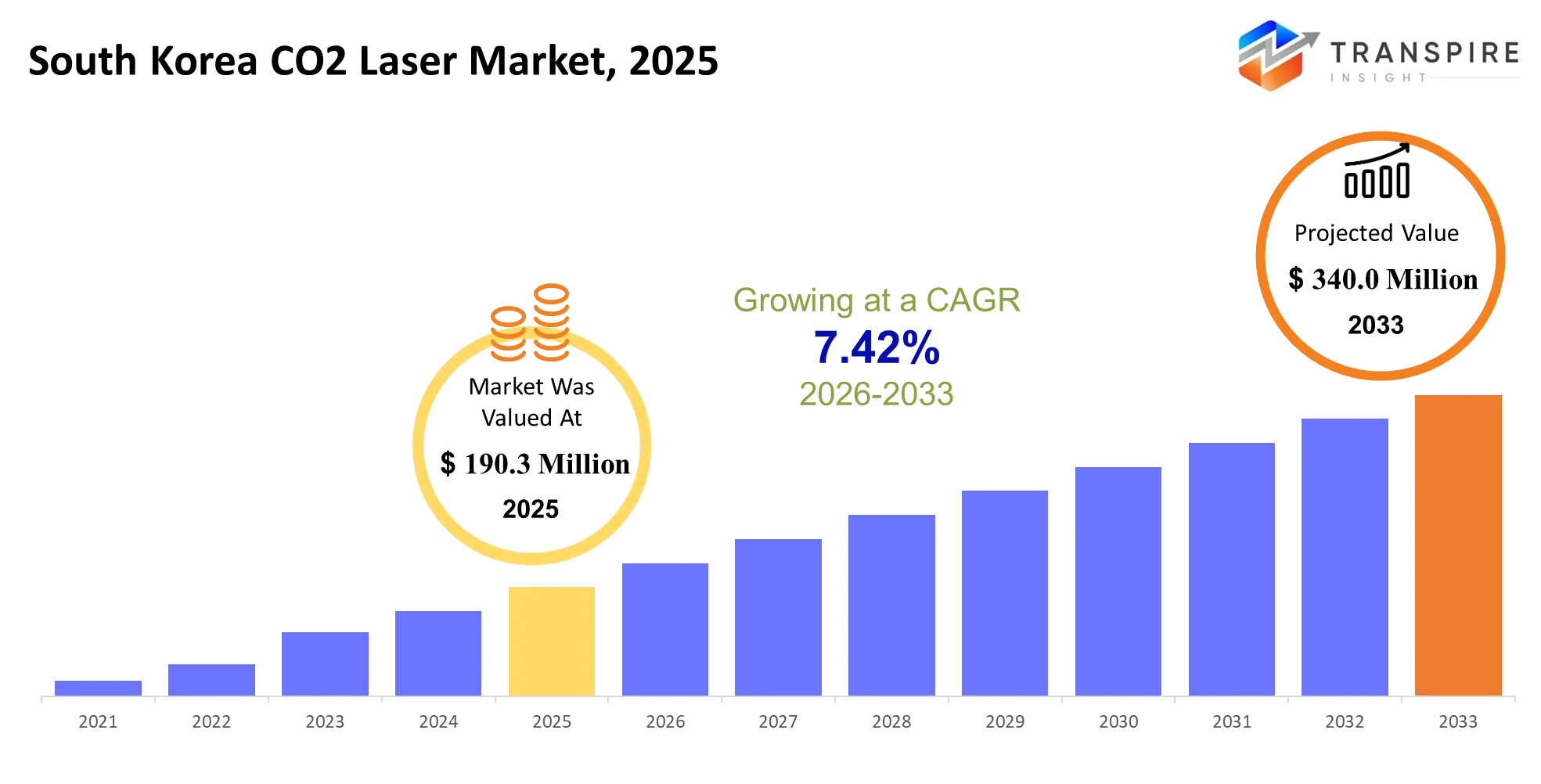
- Market Value (2025): USD 190.3 Million.
- Expected Market Value (2026): USD 206.0 Million.
- Estimated Market Value (2033): USD 340.0 Million.
- Forecast CAGR (2026–2033): 7.42%
Introduction
The CO2 laser sector refers to the commercial manufacturing, sales, and application of gas laser systems, with a carbon dioxide (CO2) gas mixture as the medium for infrared laser beams production. It comprises CO2 lasers, cutters and engravers, medical instruments, and surgical instruments such as scalpels. These lasers find extensive applications in industrial fabrication, electronics, semiconductors, and plastic surgery. A CO2 laser is a type of gas laser that utilizes a gas mixture consisting primarily of carbon dioxide, nitrogen, and helium as a gain medium. It is part of the infrared spectrum, having a wavelength of around 10600 nanometers, making it adept at cutting materials and in medical procedures. The CO2 Laser Market in South Korea is advantageous because of its precision, performance, and versatility due to its common 10,600 nm wavelength. The CO2 laser is best for applications where energy absorption must be controlled such as in the medical or industrial sector. Moreover, CO2 lasers are simple to operate, can reduce consumable materials, improve maintenance, and minimize operation costs. CO2 lasers are characterized by their versatility in processing procedures. In fact, CO2 lasers can be used for working on non-metallic materials like wood, acrylic, paper, as well as performing dermatological treatments (e.g. skin resurfacing and scar treatment).
Key Market Highlights: -
- By power, the Medium Power segment dominated the market and holds nearly 43% share in 2025 and is projected to grow at a substantial CAGR during the forecast period.
- By application, the Cutting segment dominated the market and holds nearly 30% share in 2025 and is projected to grow at a substantial CAGR during the forecast period.
- By product, the Laser Systems segment dominated the market and holds nearly 75% share in 2025 and is projected to grow at a substantial CAGR during the forecast period.
- Assistance for Eco-friendly Production Technologies: The policies adopted by South Korea aimed at energy efficiency and green and smart-factory manufacturing are helping encourage manufacturers to use advanced production technologies. These policies will indirectly help the CO2 Laser Market because of increased automation, efficient resource utilization, digitalization, and sustainable manufacturing practices.
How is Technology Driving Growth in the South Korea CO2 Laser Market?
The CO2 Laser Market of South Korea is being influenced significantly by the developments taking place in Industry 4.0 and Smart Manufacturing. Automation and Robotics help automate the operations involved in loading and unloading, calibrating, and processing through laser cutting while also ensuring greater efficiency in the operations. The use of AI and IoT helps in real-time monitoring, predictive maintenance, digital control, and minimizes the downtime of the machines. Smart Manufacturing programs initiated by the government and investments in technology by the major electronics and semiconductor firms are contributing towards increased uptake. At the same time, various industries such as Automotive, Electronics, Semiconductor Packaging, and Precision Manufacturing are driving the need for advanced micro machining.
Market Drivers
The CO2 laser market in South Korea is largely determined by the advanced manufacturing ecosystem of semiconductors and electronics, where laser processing enables wafer processing, micromachining, and component production. The country’s automotive and electric vehicle industries are also expanding laser applications in manufacturing processes such as cutting and welding. The medical and aesthetic fields additionally contribute to the demand for CO2 fractional laser systems. Further, adoption of Industry 4.0 and investments in smart factory initiatives are stimulating the incorporation of automated and interconnected laser equipment. The increasing need for high precision, quality and consistency of processes serves as a motivation for manufacturers to switch from traditional methods to laser technologies. Overall, the laser processing market in South Korea is anticipated to register 10.0% CAGR in 2025-2030. The CO2 Laser Market in South Korea is strongly influenced by sophisticated semiconductor and electronic systems, with key firms including Samsung and LG contributing to the development of precision laser processing, laser cutting, drilling, and micromachining technologies. Demand from consumers for cosmetic-related procedures such as skin surfacing and other non-invasive treatments is boosting the use of CO2 fractional lasers in the medical industry. At the same time, government measures focused on industrial research and development, smart factories, advanced manufacturing, and the creation of medical devices stimulate further growth of this market. Also, the increased automation speeds up the application of CO2 lasers in combination with robotics, CNC machines, and digitized production lines, allowing for better accuracy, output, productivity, and operations efficiency.
Restrain
High capital and maintenance expenditures hamper the use of CO2 laser devices in South Korea. The intense competition and pricing pressure may also lead to lower margins for manufacturers. Precision optical components suppliers might have to face the problems due to supply-chain disruptions that will delay delivery. The fast pace of technology development combined with the fact that fiber laser technology can produce obsolescence also need to be taken into consideration. In addition, it should be noted that different regulations, long procurement processes, and hiring issues should be considered too.
|
Driver |
Relative Impact on Market Growth (%) |
Geographic Relevance |
Impact Timeline |
Demand Strength |
Growth Mechanism |
Key Beneficiaries |
Major Constraint |
|
Expansion of semiconductor and electronics manufacturing |
28% |
Gyeonggi, Seoul Metropolitan Area, Chungcheong |
Long-term |
High |
Enables precision cutting, drilling, marking, and material processing |
Laser manufacturers, semiconductor equipment suppliers, fabs |
High capital costs and process-specific equipment requirements |
|
Rising automotive, EV, and battery production |
23% |
Ulsan, Gyeonggi, Chungcheong, Gwangju |
Long-term |
High |
Supports high-speed cutting, welding, marking, and component fabrication |
Laser OEMs, automotive suppliers, EV manufacturers |
Competition from fiber and ultrafast laser technologies |
|
Industrial automation, robotics, and smart-factory adoption |
20% |
Gyeonggi, Seoul, Busan, Gyeongsang |
Medium-term |
High |
Integrates CO₂ lasers into automated precision manufacturing lines |
Automation vendors, laser integrators, manufacturers |
Integration complexity and skilled-labor shortages |
|
Demand for high-precision and flexible material processing |
16% |
Nationwide; manufacturing clusters |
Medium-term |
High |
Improves processing accuracy across plastics, glass, textiles, and nonmetals |
Laser OEMs, machine builders, contract manufacturers |
Material limitations and application-specific optimization |
|
Sustainability, energy efficiency, and advanced manufacturing investment |
13% |
Nationwide; major industrial clusters |
Long-term |
Medium |
Encourages efficient processing and modernization of production assets |
Equipment suppliers, industrial users, technology vendors |
Upfront modernization costs and uncertain investment cycles |
Analysis of Prices and Consumer Behaviour
The industrial processing applications segment accounts for a major share in the CO2 laser market (USD 1.6 billion globally in 2025), driven by the need for cutting, welding, engraving, marking, and other similar applications. A CO2 laser system requires investments of a higher degree as compared to conventional systems due to the use of advanced laser source technology, optical components, automation technology, and precision control technologies. The market for CO2 lasers in South Korea is expected to reach USD 190.3 million by 2025. The strong demand for these lasers across industries such as automobile production, electronic, aerospace, medical, manufacturing, etc. is expected to drive above-average sales volume. The industrial manufacturing segment of end users is expected to generate USD 1.3 billion worldwide by 2025, owing to the implementation of CO2 laser systems in CNC and robotics. In today’s world, the basis of major purchasing decisions is reliability of the product, processing speed, energy consistency, and availability of the equipment.
Who are the Key Players in the South Korea CO2 Laser Market and how do they compete?
In the South Korea market of CO2 lasers, firms whose business lies in the technologies used in laser systems, finding ways of utilizing laser systems in different applications and methods of precise processing, and even establishing communication channels, create competition in this market. The competition in this industry is not only price-based; in fact, it is primarily based on the effectiveness of replacing heating methods with high power laser technologies.
The technology competition for growing laser technologies is also accompanied by intensive product development flow. Thanks to advancements in the area of laser sources, precise processing technologies, and CNC laser systems, TRUMPF Group is enhancing its role in the market. Its ability to provide high-performance laser systems designed for semiconductors, automotive, electronics, and related industries creates differentiation from competitors and promotes the technological development of the company in the market.
Top Companies in the South Korea CO2 Laser Market
- Coherent
- TRUMPF
- IPG Photonics
- Lumentum
- Han's Laser
- FANUC
- Mitsubishi Electric
- Panasonic Industry
- Bystronic
- Mazak
- Prima Power
- AMADA
- Hypertherm
- Synrad
- EO Technics
|
Company |
Est. Revenue Share Range |
Key Offerings |
Strategic Positioning |
Geographic Strength |
Technology Focus |
|
TRUMPF |
12–16% |
TruFlow CO₂ lasers; cutting systems; welding solutions; laser processing software |
Premium industrial laser technology and integrated manufacturing solutions |
Europe, Asia Pacific, North America |
High-power CO₂; energy management; process integration |
|
Coherent |
10–14% |
DIAMOND C/Cx; DIAMOND J; J-1000; DC Series CO₂ lasers |
Broad CO₂ source portfolio serving diverse industrial applications |
North America, Europe, Asia Pacific |
RF/slab CO₂; multiple wavelengths; modular integration |
|
Bystronic |
9–13% |
PowerLine C; CO₂ processing systems; laser cutting platforms; service solutions |
Integrated sheet-metal processing and application specialization |
Europe, Asia Pacific, North America |
CO₂ processing; scanner systems; automation; software |
|
AMADA |
8–12% |
CO₂ laser machines; LCG series; legacy CO₂ platforms; laser automation |
Established machine-tool ecosystem with broad manufacturing customer base |
Asia Pacific, Europe, North America |
CO₂ cutting; beam delivery; automation; process optimization |
|
Mitsubishi Electric |
7–10% |
CO₂ laser oscillators; laser processing systems; CNC platforms |
Precision manufacturing solutions supported by automation expertise |
Asia Pacific, North America, Europe |
CO₂ oscillators; CNC integration; precision processing |
|
Yamazaki Mazak |
6–9% |
Laser processing machines; CNC laser systems; automated processing solutions |
Integrated machine-tool and laser-processing platform |
Asia Pacific, Europe, North America |
CNC laser processing; automation; production integration |
|
Han's Laser |
5–8% |
CO₂ laser systems; cutting/engraving equipment; industrial laser solutions |
Value-oriented Asian expansion with broad laser portfolio |
Asia Pacific, Europe, North America |
CO₂ cutting; engraving; automation; integrated systems |
|
Yongli Laser |
4–7% |
CO₂ laser tubes; RF lasers; power supplies; laser accessories |
Component-focused specialization and OEM/integrator supply |
Asia Pacific, Europe, Middle East & Africa |
CO₂ tubes; RF excitation; laser components |
|
Novanta / Synrad |
3–5% |
Sealed CO₂ lasers; industrial laser sources; OEM laser solutions |
Specialized CO₂ source supplier emphasizing OEM integration |
North America, Europe, Asia Pacific |
RF-excited CO₂; sealed architecture; OEM integration |
|
Trotec Laser |
2–4% |
CO₂ laser engravers; cutting systems; laser software; automation |
Application-focused solutions for engraving and nonmetal processing |
Europe, North America, Asia Pacific |
CO₂ engraving; cutting; software; automation |
South Korea CO2 Laser Market Segmentation
The South Korea CO2 Laser Market share is divided into five categories: By power, type, application, industry and product.
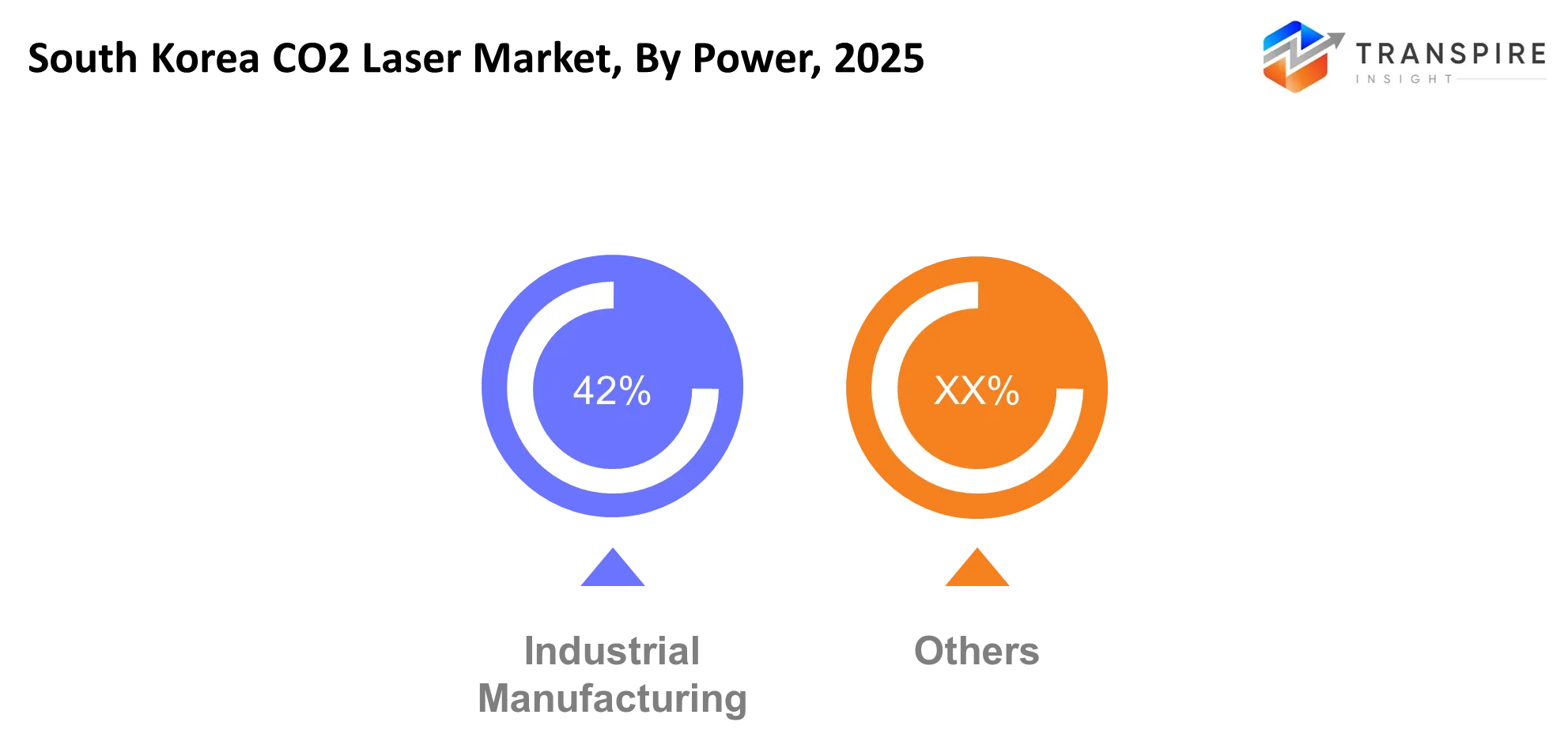
The Medium Power dominated the market, accounting for nearly 43% in 2025 and is expected to rise at a significant CAGR during the forecast period.
The South Korea CO2 Laser Market is segmented by power into Low Power, Medium Power, High Power, Ultra-High Power, Continuous-Wave, Pulsed, Sealed-Tube. Among these, the Medium Power segment dominated the market, accounting for nearly 43% in 2025 and expected to increase at a significant CAGR during the forecast period. The Medium Power category was the leading category and held a share of nearly 43% in 2025 owing to the balanced nature of its operations and efficient performance. Growing demand for efficient power solutions and energy-efficient equipment is aiding the growth of the category. This trend is expected to aid in maintaining a substantial CAGR during the forecast period.
The Cutting dominated the market, accounting for nearly 30% in 2025, and is expected to rise at a significant CAGR during the forecast period.
The South Korea CO2 Laser Market is segmented by application into Cutting, Welding, Drilling, Engraving & Marking, Heat Treatment, Cladding, Medical Procedures. Among these, the Cutting segment dominated the market, accounting for nearly 30% in 2025 and expected to increase at a significant CAGR during the forecast period. The Cutting section held a major share of nearly 30% in 2025 owing to its wide-ranging applications in various sectors including manufacturing, construction, automotive, and metalwork industries. Increasing demands for accurate cutting processes, rapid production, efficient use of materials, and cutting technology innovations are propelling its adoption. Industrial automation and infrastructural developments are anticipated to propel CAGR growth in the coming years.
The Laser Systems dominated the market, accounting for nearly 75% in 2025 and is expected to rise at a significant CAGR during the forecast period.
The South Korea CO2 Laser Market is segmented by product into Laser Systems, Laser Sources, Processing Heads, Controllers, Optics, Accessories, Services. Among these, the Laser Systems segment dominated the market, accounting for nearly 75% in 2025 and expected to increase at a significant CAGR during the forecast period. The Laser Systems accounted for more than 75% of the overall revenue and led the market owing to their greater accuracy, faster processing, automation, and reliable cutting and welding. The increasing usage in various industries such as automobiles, electronics, aerospace, and manufacturing due to growing demand for new technologies in manufacturing is expected to drive the market at a healthy CAGR rate.
Future Market Trends for the South Korea CO2 Laser Market: -
- Integration of Smart Factories: Manufacturers are integrating CO2 laser systems with artificial intelligence and Internet of Things technology to achieve predictive maintenance, minimize waste and enhance production line efficiency.
- Growth in Aesthetic & Medical Markets: Strong growth in consumer interest in minimally invasive cosmetic procedures and presence of world-class medical infrastructure boost demand for the CO2 laser and surgical lasers.
- Advent of Industry 4.0 and Small Batch Customization: Encouraged by government-led smart manufacturing initiatives, manufacturers are switching to advanced laser devices that can be used for small customized production runs.
- Cutting Edge R&D and Cooling Capabilities: Constant investments in sophisticated cooling properties of the CO2 laser allow boosting the power while preventing overheating.
Recent Development
- In July 2026: LASER KOREA 2026 was held in South Korea at KINTEX, featuring the latest in laser sources, laser processing, laser devices, optical systems, and medical lasers. This conference helped promote technological advancements as well as development within the industry and emphasized new opportunities available within the South Korean CO₂ Laser Market.
- In August 2026: Market analysis showed an increase in the use of CO2 laser technology in South Korea, driven by digital transformation, automation, smart manufacturing, and growing need for precise processing in electronics, automobiles, and manufacturing.
Market Segment
This study forecasts revenue at South Korea, regional and country levels from 2020 to 2033. Transpire Insights has segmented the South Korea CO2 Laser Market based on the below-mentioned segments:
South Korea CO2 Laser Market, By Power
- Low Power
- Medium Power
- High Power
- Ultra-High Power
- Continuous-Wave
- Pulsed
- Sealed-Tube
South Korea CO2 Laser Market, By Type
- Sealed CO2 Laser
- Flowing Gas CO2 Laser
- Slab CO2 Laser
- Waveguide CO2 Laser
- TEA CO2 Laser
- Transverse Flow
- RF-Excited
South Korea CO2 Laser Market, By Application
- Cutting
- Welding
- Drilling
- Engraving & Marking
- Heat Treatment
- Cladding
- Medical Procedures
South Korea CO2 Laser Market, By Industry
- Automotive
- Electronics & Semiconductors
- Industrial Manufacturing
- Aerospace & Defense
- Healthcare
- Packaging
- Textiles
South Korea CO2 Laser Market, By Product
- Laser Systems
- Laser Sources
- Processing Heads
- Controllers
- Optics
- Accessories
- Services
Frequently Asked Questions
Find quick answers to common questions.
The market is projected to reach USD 340.0 million by 2033, growing at a 7.42% CAGR from 2026 to 2033.
The Medium Power segment dominated with nearly 43% share in 2025, supported by balanced performance, efficiency, and broad industrial applications.
Cutting dominated with nearly 30% share in 2025, driven by precision processing, faster production, material efficiency, and industrial applications
Laser Systems dominated with nearly 75% share in 2025, driven by accuracy, automation, faster processing, and reliable manufacturing performance.
Smart manufacturing, Industry 4.0, automation, semiconductor production, automotive applications, and increasing demand for high-precision processing are driving market growth
- Coherent
- TRUMPF
- IPG Photonics
- Lumentum
- Han's Laser
- FANUC
- Mitsubishi Electric
- Panasonic Industry
- Bystronic
- Mazak
- Prima Power
- AMADA
- Hypertherm
- Synrad
- EO Technics
About the Authors

Pankaj Ghogare Patil
I am Pankaj Ghogare Patil, a Senior Research Analyst at Transpire Insight, specializing in the Pharmaceutical, Chemicals & Materials, Healthcare IT, and Biotechnology industry. My expertise lies in conducting comprehensive market research, analyzing industry trends, evaluating competitive landscapes, and translating complex data into actionable insights. At Transpire Insight, I closely follow emerging technologies, regulatory developments, and market innovations to create accurate, well-researched, and informative content that helps businesses and professionals make informed decisions. I am committed to producing credible, evidence-based articles that reflect industry best practices while making technical topics accessible and valuable for a broad audience.

Chakradhar Khansole
Chakradhar serves as the Research Director at Transpire Insight, bringing over 8 years of experience in technology, innovation, and strategic market intelligence. He specializes in transforming complex market data into actionable business insights that enable organizations to make informed, growth-oriented decisions. Recognized for his strategic vision and analytical expertise, Chakradhar leads high-impact research initiatives, delivering comprehensive market assessments, competitive intelligence, and forward-looking industry analysis.
Recently Published Reports
-
May 2026
Healthcare Polymer Packaging Market
Healthcare Polymer Packaging Market Size, Share & Analysis Report By Packaging Type (Syringes, IV Bottles and Pouches, Clamshells, Blisters, Bottles & Jars, Containers, Tubes, IV Parental Packaging, Others), By Type (Regulated, Non-regulated), By Polymer Type (LDPE (Low-Density Polyethylene), HDPE (High-Density Polyethylene), Homo-polymer (Homo), Random Copolymer (Random), Block Copolymer (Block), PET, Polystyrene, Polyvinyl Chloride, Polyamide/EVOH, Others), and Geography (North America, Europe, Asia-Pacific, Middle East and Africa, South and Central America), 2021 - 2031
-
Apr 2026
Hydrophilic Tape (Waterstop) Market
Hydrophilic Tape (Waterstop) Market Size, Share & Analysis Report By Type (Bentonite-Based Hydrophilic Tape, Rubber-Based Hydrophilic Tape), By Application (Residential Buildings, Commercial Buildings, Infrastructure Projects), and Geography (North America, Europe, Asia-Pacific, Middle East and Africa, South and Central America), 2021 - 2031
-
Apr 2026
Metalens Market
Metalens Market Size, Share & Analysis Report By Type (Visible Light Metalens, and Infrared Metalens), By Application (Consumer Electronics, Automotive Electronics, Industrial, Medical, and Others), and Geography (North America, Europe, Asia-Pacific, Middle East and Africa, South and Central America), 2021 - 2031
-
Apr 2026
PBT Resin Market
PBT Resin Market Size, Share & Analysis Report By Type (Reinforced PBT Resin, Unreinforced PBT Resin), By Processing Method (Injection Molding, Extrusion, Blow Molding, Others), By End-User (Automotive, Electrical & Electronics, Consumer Appliances, Industrial Machinery, Medical Devices, Packaging, Others), and Geography (North America, Europe, Asia-Pacific, Middle East and Africa, South and Central America), 2021 - 2031