

Laser Marking Market Summary:
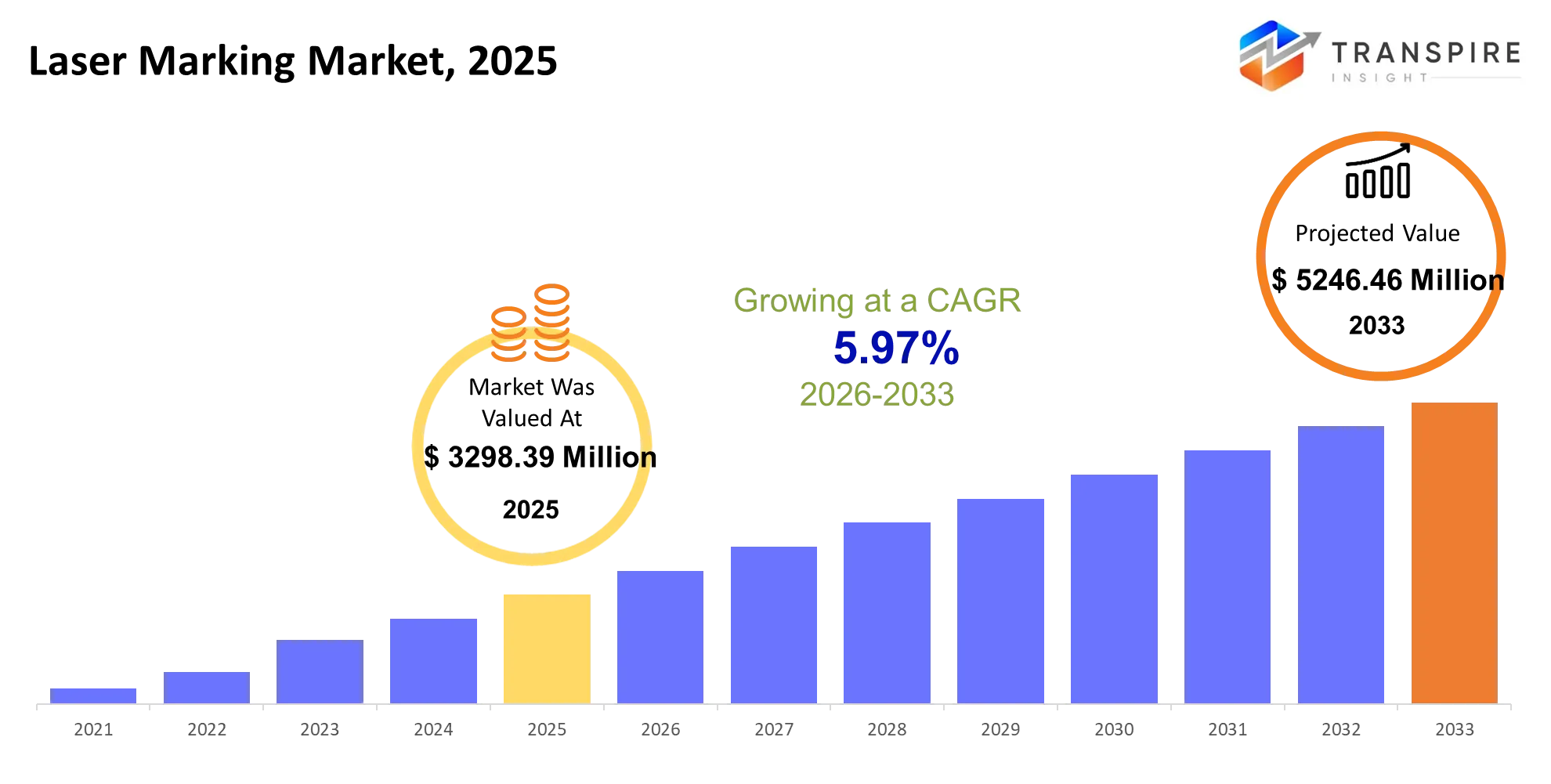
As per the Transpire Insight, The Laser Marking Market size is estimated at USD 3298.39 million in 2025 and is anticipated to reach USD 5246.46 million by 2033, growing at a CAGR of 5.97% from 2026 to 2033.
The laser marking space has shifted from standalone traceability solutions to configuration- and production-agnostic infrastructure. For the past three to five years, these systems have evolved from fixed-focus, manual operation to fibre, UV and ultrafast systems equipped with robotics, vision and factory software. The most fundamental change is the shift from code and mark installations to permanent, durable, machine-readable markings. This change has been driven by the DPP framework of the European Union (Digital Product Passport) and the EU Commission's 2026 solution of unique product identifiers and data carriers. The DPP Registry was established by the EU Commission in July 2026, driving even more momentum for this space. This is now expanding, moving beyond logo and SN marking to lifecycle marking. Automated focus, inline inspection, and software-controlled job changes at the equipment level reduce setup loss and scrap. This is why adoption is growing where manufacturers need rapid changeover and auditable product history, but not manual marks.
Laser Marking Market Size & Forecast:
- Market Size 2025: USD 3298.39 Million
- Expected Market Value (2033): USD 5246.46 Million
- Forecast CAGR (2026–2033): 5.97%
- Leading Region in 2025: Asia Pacific
- Fastest Growing Region: North America
- Key Company Profiles: KEYENCE, TRUMPF, Coherent, IPG Photonics, Han's Laser, Trotec Laser, Gravotech, Videojet Technologies, FOBA, Rofin-Sinar, Panasonic, 3D-Micromac, Epilogue Laser, LaserStar Technologies, MECCO
Key Laser Marking Market Insights:
Laser marking is no longer just a coding station but is becoming a node with AI technology to support traceability in smart and regulation-based manufacturing lines. Asia Pacific's 43.20% CAGR and North America's 7.40% CAGR indicate the electronics and automotive scale and high-value adoption of battery passports and medical and aerospace applications, respectively.
- Asia Pacific leads with 43.20%, with electronics (46%) being driven by the economies of China, Japan and India, while compact fibre modules are being pushed for high-mix lines, with KEYENCE and Panasonic present.
- As a result of EU-MDR and Digital Product Passport rules, Europe accounts for 27.00% of the market.TRUMPF and Trotec combine laser cells and MES to support UDI-compliant medical and pharma serialization.
- Products for heat-sensitive substrates increase the 23.00% market share for North America with ultrafast and green-laser products, with Coherent and IPG Photonics advancing their product ranges.
- The dominance of 48.30% is attributed to the cost efficiency and power scalability of fibre lasers, while Han's Laser and Rofin-Sinar aim at mid-tier manufacturers by offering turnkey fiber cells which replace CO2 in metal marking.
- The 8.80% and 10.00% shares for flexible packaging and micro-electronics, respectively, are being tracked by UV lasers, while high-speed UV coding on thin films and flexible circuits is being tracked by Videojet and FOBA.
- Real-time quality verification and automatic parameter tuning to reduce scrap and downtime are now standard, as are AI-driven vision and adaptive control, as found by Gravotech and MECCO.
- Labels on reusable surgical instruments and battery cells are currently being replaced by direct-part marking, under the UDI and battery-passport requirements, while 3D-Micromac and LaserStar target micro-features on implants and power devices.
- Pressure and sustainability considerations support processes that do not use ink or solvents, such as the laser processes offered by Epilog Laser and LaserStar that can help reduce VOCs in pharma and food packaging lines.
- Meanwhile, both Latin America (4.00%) and Middle East & Africa (2.80%) are emerging markets with potential as domestic automotive and medical manufacturing expands to meet export-compliant demand.
What are the Key Drivers, Restraints, and Opportunities in the Laser Marking Market?
Driver:
Traceability requirements are moving from optional quality practice toward embedded, auditable identification. The trigger is the European Union’s 2026 implementation of Digital Product Passport standards and registry infrastructure, which formalises unique identifiers, data carriers, and machine-readable product information. This strengthens adoption because permanent laser marks can carry serial numbers, 2D codes and identifiers directly on components, reducing label loss and supporting automated verification and recall control across production and distribution.
Restraint:
High initial system cost remains a barrier, particularly for small manufacturers replacing established inkjet, dot-peen, or labeling equipment. The structural issue is not only laser source pricing; installations can require safety enclosures, extraction, optical tooling, software integration, vision inspection, and operator training and maintenance planning. Where production volumes or product changeovers are limited, payback periods can therefore remain difficult to justify.
Opportunity:
The expansion opportunity is integrated, adaptive marking that combines laser sources with vision, robotics and software. Datalogic’s 2026 AREX400 AF illustrates this shift by using software-controlled adjustable focus to mark multi-level parts without manual refocusing or positioning axes. These architectures can reduce changeover time, accommodate mixed production, and improve traceability economics, opening opportunities in electronics, automotive components, medical devices, and contract manufacturing across Asia and Europe.
What Has the Impact of Artificial Intelligence Been on the Laser Marking Market?
Artificial intelligence is increasingly enabling laser marking to evolve from simple programming execution to intelligent inspection. AI-enabled vision systems can inspect whether a code is readable, in focus, properly positioned, and complete in a networked manufacturing environment. This enables automated rejection instead of downstream manual inspection. Datalogic's 2026 demos demonstrate AI-enhanced decoding and link it to direct-part-marked codes on reflective, damaged, and low-contrast surfaces, in pursuit of line downtime and reject reduction.
Within the production environment, artificial intelligence can optimise marking parameters by correlating material, geometry, speed, pulse settings, and quality output; help operators choose stable recipes for a new batch; predict focus drift, irregular cycle behaviour, or faulty operation before defects occur system-wide; and enable planned maintenance to increase line availability. AI-linked traceability ties each mark to production records for faster root-cause analysis. Its main drawback is the cost of integrating AI: it requires cameras, computer processing, proper markings for inspection, and a link to PLC, MES, or quality systems. Also, accuracy could degrade on novel materials and surface finishes, requiring validation and recalibration of the AI model.
In June 2026, Datalogic officially launched the AREX400 AF fibre laser marking system alongside its latest AI-powered sensing, tracking, and machine vision solutions. This system breaks free from the constraints of traditional fixed-focus laser marking by embedding software-controlled Adjustable Focus technology directly into the scanhead.
Key Laser Marking Market Trends:
Laser marking is becoming more than just a finishing process, and with the advent of adaptive optics, machine vision, and software, it is playing an increasingly important role in production and verification. As factories transition to connected production architectures, the strategic focus is on data-connected, flexible systems which enable shorter production runs, permanent identification and compliance-driven histories.
- In automotive and electronics marking cells, fibre lasers are replacing CO2 for a growing number of metal and many plastics workhorse applications.
- For heat-sensitive polymers, thin films, and micro-electronics, fibre lasers are competing with UV and green sources for market share, as they are more likely to melt or discolour the materials.
- Ultrafast (picosecond/femtosecond) lasers are now starting to reach volume manufacturing of medical devices and semiconductors with sub-micron features without heat-affected zones.
- New systems are now increasingly incorporating AI-based vision and adaptive control, which allow immediate quality checking and intelligent parameter optimisation of the system for material batches.
- Reusable surgical instruments, implants and battery cells are getting direct-part marking to comply with UDI and battery-passport requirements.
- Mark data is being integrated with MES/ERP and IIoT platforms, and is now becoming real-time traceability feeds for recall management and anti-counterfeit authentication.
- Portable, robotic marking of large or awkward parts in aerospace and heavy equipment applications is being made possible by the development of compact, low-power diode and fibre modules.
- Buyers are under pressure to adopt ink-free, solvent-free laser processes that minimise waste, VOCs and consumables in packaging and pharma lines.
Laser Marking Market Segmentation
Laser Type:
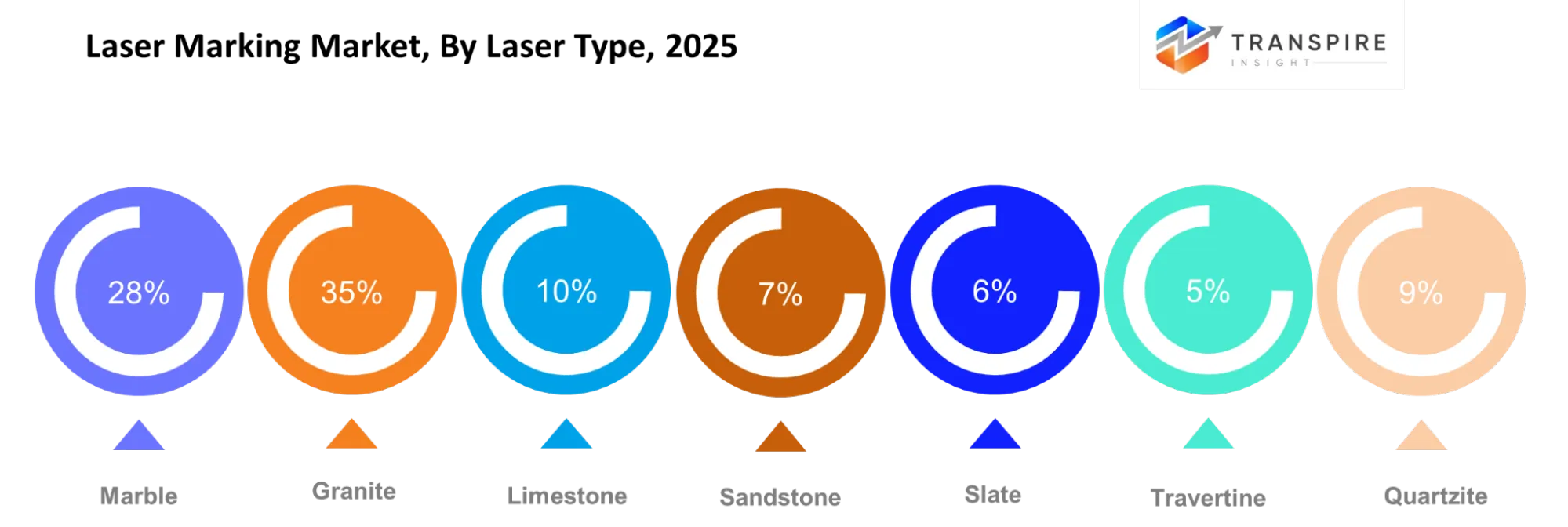
Fiber laser holds 48.30% of the laser-type segment, supported by high throughput, low maintenance, and strong compatibility with metals used across automotive and industrial production. CO2 lasers account for 20.00%, retaining relevance in nonmetallic applications, while UV lasers are the fastest-growing category at 8.80% CAGR, as shorter wavelengths reduce thermal damage on plastics, electronics and medical components. Green lasers represent 6.00%, Nd: YAG 7.00%, and diode lasers 4.00%, serving specialised materials and geometries. Excimer and other lasers contribute 2.00% and 2.70%, respectively, supporting niche precision and application-specific requirements.
Marking Type:
Engraving and etching remain core processes because they create durable depth and contrast for serial numbers, logos and identification codes. Annealing is increasingly preferred for corrosion-sensitive metal components because it changes the surface colour without removing material, preserving structural integrity. Ablation is gaining relevance for removing coatings with controlled precision, while foaming and carbonisation support high-contrast identification on polymers. Colour-change marking is also expanding where manufacturers require readable codes without compromising thin or delicate substrates. These methods allow manufacturers to select marking intensity according to material, durability and traceability requirements.
Material:
Metal represents the strongest material opportunity because laser marking produces permanent identification without inks, solvents or labels. Fiber lasers particularly support marking on steel, aluminium, copper and engineered alloys used in automotive, aerospace and industrial components. Plastic applications are expanding as UV and wavelength-optimised fiber systems improve contrast while limiting thermal deformation. Glass and ceramic remain specialised because their brittle surfaces require controlled energy delivery and pulse parameters. Wood and rubber support niche decorative and identification applications, while semiconductor marking increasingly benefits from precise, low-damage processing required for miniaturised components and sensitive electronic substrates.
Application:
Automotive, electronics, aerospace and defense, medical devices, packaging, industrial equipment and jewelry constitute key application areas, with electronics and medical devices increasingly adopting precise, low-thermal-impact marking for miniaturized components. Continuous-wave and pulsed systems support high-throughput production, while Q-switched and nanosecond lasers provide controlled precision for industrial identification. Ultrafast technologies, particularly picosecond and femtosecond lasers, are gaining importance in high-value microprocessing where minimal heat-affected zones, fine resolution, and surface integrity are critical for advanced components.
Technology:
Continuous-wave technology remains suitable for selected high-throughput applications where consistent energy delivery is more important than extremely fine detail. Pulsed and Q-switched lasers dominate precision marking because controlled energy bursts improve contrast and reduce unwanted thermal effects. Nanosecond lasers provide a practical balance between processing speed, precision, and equipment economics, supporting broad industrial deployment. Picosecond and femtosecond technologies are moving toward premium applications requiring minimal heat-affected zones. Their shorter pulses enable finer processing of electronics, glass and sensitive components, creating opportunities where conventional nanosecond systems cannot consistently achieve required surface quality.
End User:
Manufacturing remains the primary end-user environment because permanent identification is increasingly integrated into automated production and quality workflows. Automotive OEMs use marking for component traceability, serialisation and inspection, while electronics manufacturers require compact, high-contrast codes on increasingly smaller components. Packaging companies emphasise variable identification, batch information and regulatory compliance, creating demand for flexible marking systems. Healthcare manufacturers prioritise permanent device identification and verification, whereas aerospace companies require durable marks capable of surviving demanding operating conditions. Research institutions also support adoption by developing specialised ultrafast processing techniques and application-specific marking parameters.
What are the Key Use Cases Driving the Laser Marking Market?
The core use case is permanent direct-part identification aligned with the fibre laser position. Automotive producers use it for serial numbers, Data Matrix codes, logos, and component IDs because marks withstand handling and process exposure better than labels.
Applications are expanding across electronics, medical devices, aerospace and packaging. Electronics manufacturers use fine marks for miniature components, while medical-device producers use UDI identifiers. Packaging lines apply variable codes without plates or inks.
Emerging use cases connect marks to digital identities and inspection. The EU’s 2026 Digital Product Passport infrastructure strengthens the case for machine-readable codes, while AI-enabled vision can verify codes in-line. This shifts marking toward lifecycle traceability and quality control.
|
Report Metrics |
Details |
|
Market size value in 2025 |
USD 3298.39 Million |
|
Market size value in 2026 |
USD 3495.23 Million |
|
Revenue forecast in 2033 |
USD 5246.46 Million |
|
Growth rate |
CAGR of 5.97% from 2026 to 2033 |
|
Base year |
2025 |
|
Historical data |
2021 - 2024 |
|
Forecast period |
2026 - 2033 |
|
Report coverage |
Revenue forecast, competitive landscape, growth factors, and trends |
|
Regional scope |
United States; Canada; Mexico; United Kingdom; Germany; France; Italy; Spain; Denmark; Sweden; Norway; China; Japan; India; Australia; South Korea; Thailand; Brazil; Argentina; South Africa; Saudi Arabia; United Arab Emirates |
|
Key companies profiled |
KEYENCE, TRUMPF, Coherent, IPG Photonics, Han's Laser, Trotec Laser, Gravotech, Videojet Technologies, FOBA, Rofin-Sinar, Panasonic, 3D-Micromac, Epilogue Laser, LaserStar Technologies, MECCO. |
|
Customization scope |
Free report customization (country, regional & segment scope). Available customised purchase options to meet your exact research needs. |
|
Report Segmentation |
Laser Type (Fiber Laser, CO2 Laser, UV Laser, Green Laser, Nd: YAG Laser, Diode Laser, Excimer Laser); Marking Type (Annealing, Engraving, Etching, Ablation, Foaming, Carbonization, Color Change); Material (Metal, Plastic, Glass, Ceramic, Wood, Rubber, Semiconductor); Application (Automotive, Electronics, Aerospace & Defense, Medical Devices, Packaging, Industrial, Jewelry); Technology (Continuous Wave, Pulsed Laser, Q-Switched, Ultrafast Laser, Nanosecond, Picosecond, Femtosecond); End User (Manufacturing, Automotive OEMs, Electronics Manufacturers, Packaging Companies, Healthcare, Aerospace Companies, Research Institutions) |
Which Regions are Driving the Laser Marking Market Growth?
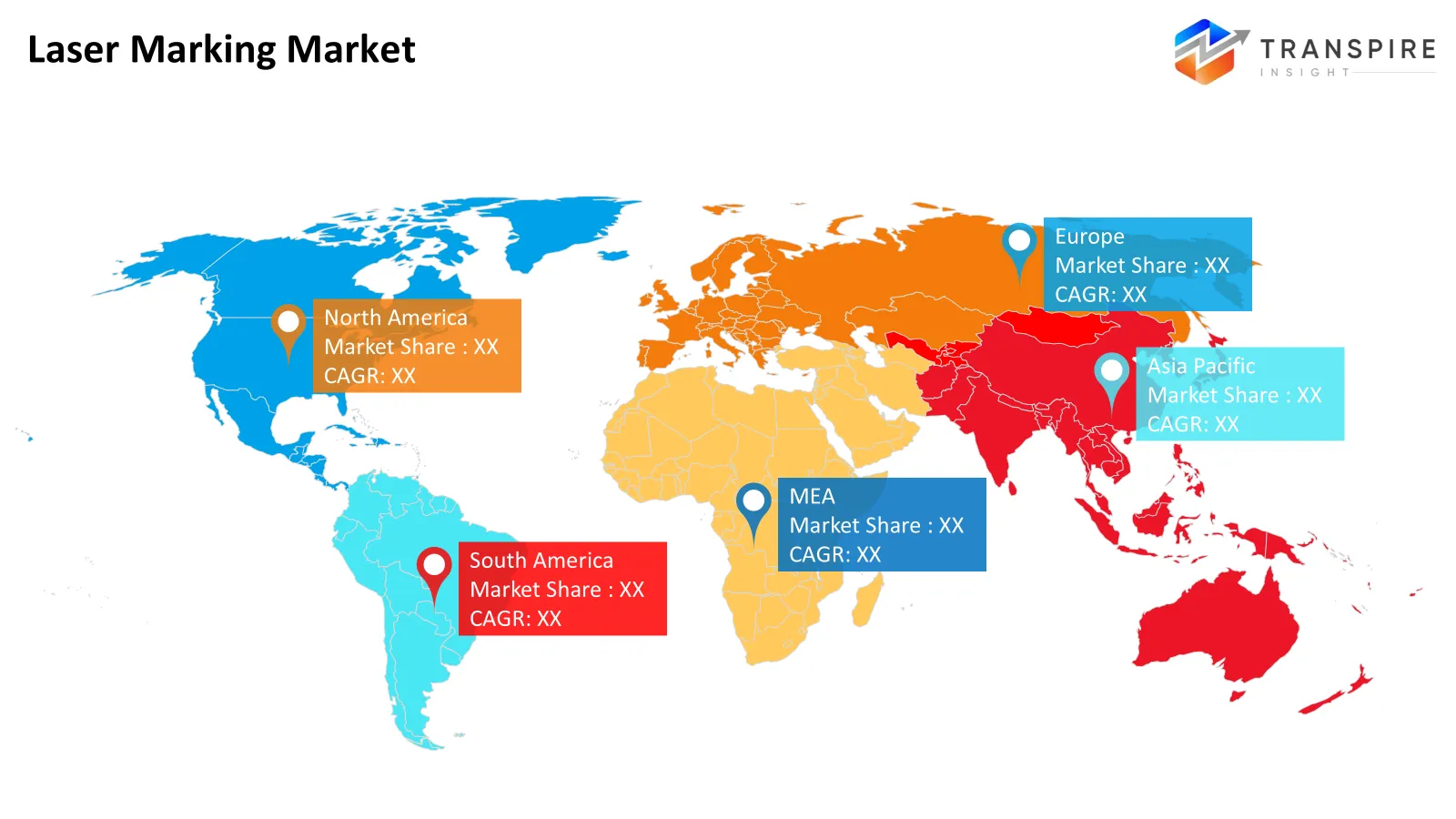
The Asia Pacific region maintains a strong market share of 43.20%, as China produces the largest amount of electronics and automobiles in terms of volume and contributes significantly to the overall market share of production for lithium-ion batteries. The region also benefits from the presence of a strong network of suppliers, government initiatives supporting smart manufacturing, and compliance with export/import regulations mandating permanent and machine-readable marks from OEMs. The region's 46% revenue comes from the electronics vertical, followed by the automotive and machinery verticals. Companies like KEYENCE and Panasonic hold a significant presence, helping to provide inexpensive yet effective small fibre modules for large and mixed-volume factories across the region.
In September 2026, KEYENCE India launched the SJ-Q Series High-Accuracy High-Speed Sensing Ioniser and the VS-G Series AI-Powered High-Performance Vision System.
https://www.keyence.co.in/news-events/
Europe accounts for 27.00% and is the largest regulator by value. Where Asia's demand growth is scale-driven, Europe's demand is driven by regulations – EU-MDR, UDI and the Digital Product Passport (which mandates embedded traceability data for all medical, pharmaceutical, and industrial products, in transit and at rest, by 2027). Germany, France, the UK and Italy underpin the region's demand and are durable demand anchors, with automotive and medical-device manufacturing, respectively. TRUMPF and Trotec benefit from these demand anchors and develop integrated laser cells that automatically feed marking data to quality and regulatory systems.
In February 2026, Bystronic completed its acquisition of Coherent’s Tools for Materials Processing business unit, including the Rofin brand and laser marking technologies.
North America, at 23.00% market share and 7.40% CAGR, remains the fastest-growing region with high-value growth. Recently upgraded drivers include higher enforcement of the FDA Unique Device Identification regulations, aerospace traceability solutions, and emerging passport regulations for batteries used in electric vehicle supply chains. These drivers further establish North America's journey away from Asia's volume-driven play and Europe's broad-based industrial compliance drive, toward high-margin implants, aerospace parts, and enabling next-generation battery cells. Opportunities ahead will be ultrafast and green lasers for burn-sensitive electronics and advanced package support, where Coherent and IPG Photonics continue to ramp applications and capacity.
In June 2026, Coherent Corp. signed a letter of intent to receive up to $50 million in direct funding under the CHIPS and Science Act from the U.S. Department of Commerce. This funding is dedicated to expanding its 6-inch Indium Phosphide (InP) semiconductor manufacturing facility in Sherman, Texas.
Who are the Key Players in the Laser Marking Market, and how do they compete?
The worldwide laser marking market is conceptually reasonably concentrated, with the presence of international competition leaders in laser sources, system integrators, and specialists within niche functions. Competition is on the basis of engineering depth, regulatory compliance, and total value of ownership. Competition is centred on bundling dependable laser sources with software programs that comply with regulations, and a service community that reduces line downtime for regulated producers.
KEYENCE and Panasonic aim for low cost and small footprint, differentiating with small-footprint fibre and UV modules that can be readily integrated into Asian electronics and automotive production lines. TRUMPF and Coherent are pushing innovation with ultrafast, green and high-power fibre platforms targeting medical, aerospace, and micro-electronics markets where fine detail with low heat input supports high prices. IPG Photonics and Han's Laser are competing on scale and vertical integration, presenting broad product ranges with various power levels and "turnkey" solutions to large OEMs and mid-tier manufacturers. Different players differentiate themselves by offering application-specific systems for medical applications, jewellery and packaging, such as Trotec, Gravotech, FOBA or MECCO. Many of them also embed vision, robotics, or compliance software. Some laser manufacturers like Videojet Technologies, Rofin-Sinar, 3D-Micromac, Epilogue Laser and Laser Star Technologies target specific verticals – pharma coding, micro features on implants, low consumption systems – riding the regulatory tailwinds rather than competing on price.
Key Players are:
- KEYENCE
- TRUMPF
- Coherent
- IPG Photonics
- Han's Laser
- Trotec Laser
- Gravotech
- Videojet Technologies
- FOBA
- Rofin-Sinar
- Panasonic
- 3D-Micromac
- Epilogue Laser
- LaserStar Technologies
- MECCO
Recent Development News
- In September 2026, World Star Tech launched the NEXGEN MOPA Laser Marker. The 30 W fibre laser system combines adjustable MOPA pulse control, autofocus, integrated vision, and AI-powered multi-object detection, improving precision, automation, and throughput for industrial marking and traceability applications. https://www.laserfocusworld.com/newsletters
- In March 2026, Datalogic launched the AREX400 AF fibre laser marking system. Its software-controlled Adjustable Focus technology enables automatic focus changes across varying part heights, reducing manual intervention and supporting faster, more flexible marking in automated production lines. https://www.datalogic.com/eng/company/media-center/press-releases-nw-7.html
- In June 2026, Americhem launched its Laser Marking Solutions platform. This newly introduced portfolio of masterbatches and engineered compounds enables durable, machine-readable markings across diverse polymer systems, driving enhanced component traceability and colour capabilities on dark substrates within medical and industrial production. https://www.americhem.com/news/americhem-launches-laser-marking-solutions/
What Strategic Insights Define the Future of the Laser Marking Market?
The industry is moving towards adaptive marking cells with lasers, machine vision, robotics, and production software that shares process data. The hidden danger is in the fragmentation of integration of incompatible controllers, inspection systems, and factory platforms that will potentially reduce the level of automation improvements and increase lifecycle support costs. There is a risk that regulatory traceability will make marking unnecessarily complex, and that faster-than-today smaller factories will afford the equipment and validation costs.
Yet the opportunity is emerging of turning permanent marks into a digital gateway for the product, correlating component identity with manufacturing, regulatory, aftersales, and recycling records. The Digital Product Passport concept from the EU is pushing in this direction, with persistent identification and machine-readable data carriers. Strategically, suppliers should focus on open interfaces, flexible optics, AI-enabled verification, and modular architectures rather than competing on laser power. Vendors offering integrated marking, inspection, and traceability within interoperable workflows will capture more value per deployment across complex factories.
Key Segmentations are:
Laser Type
- Fibre Laser
- CO2 Laser
- UV Laser
- Green Laser
- Nd: YAG Laser
- Diode Laser
- Excimer Laser
Marking Type
- Annealing
- Engraving
- Etching
- Ablation
- Foaming
- Carbonization
- Colour Change
Material
- Metal
- Plastic
- Glass
- Ceramic
- Wood
- Rubber
- Semiconductor
Application
- Automotive
- Electronics
- Aerospace & Defense
- Medical Devices
- Packaging
- Industrial
- Jewelry
Technology
- Continuous Wave
- Pulsed Laser
- Q-Switched
- Ultrafast Laser
- Nanosecond
- Picosecond
- Femtosecond
End User
- Manufacturing
- Automotive OEMs
- Electronics Manufacturers
- Packaging Companies
- Healthcare
- Aerospace Companies
- Research Institutions
By Regional Analysis
North America
- US
- Canada
- Mexico
Europe
- Germany
- UK
- France
- Italy
- Spain
- Russia
- Rest of Europe
Asia Pacific
- China
- Japan
- India
- South Korea
- Australia
- Rest of Asia Pacific
South America
- Brazil
- Argentina
- Rest of South America
Middle East & Africa
- UAE
- Saudi Arabia
- Qatar
- South Africa
- Rest of the Middle East & Africa
Frequently Asked Questions
Find quick answers to common questions.
The laser marking market size was valued at USD 3298.39 million in 2025 and is poised to reach USD 5246.46 million by 2033, expanding at a 5.97% CAGR.
Key segments for the laser marking market are Laser Type (Fiber Laser, CO2 Laser, UV Laser, Green Laser, Nd: YAG Laser, Diode Laser, Excimer Laser); Marking Type (Annealing, Engraving, Etching, Ablation, Foaming, Carbonization, Color Change); Material (Metal, Plastic, Glass, Ceramic, Wood, Rubber, Semiconductor); Application (Automotive, Electronics, Aerospace & Defense, Medical Devices, Packaging, Industrial, Jewelry); Technology (Continuous Wave, Pulsed Laser, Q-Switched, Ultrafast Laser, Nanosecond, Picosecond, Femtosecond); End User (Manufacturing, Automotive OEMs, Electronics Manufacturers, Packaging Companies, Healthcare, Aerospace Companies, Research Institutions).
Growth is primarily driven by automation and traceability requirements, adoption of direct-part marking, demand for high-precision marking in electronics and medical devices, integration of machine vision and AI, and regulatory requirements for permanent machine-readable identification.
The laser marking market is led by major manufacturers, including KEYENCE, TRUMPF, Coherent, IPG Photonics, Han's Laser, Trotec Laser, Gravotech, Videojet Technologies, FOBA, Rofin-Sinar, Panasonic, 3D-Micromac, Epilogue Laser, LaserStar Technologies, MECCO.
Asia Pacific holds 43.20% of the laser marking market, supported by large-scale electronics, automotive, and semiconductor manufacturing, dense supplier networks, rapid factory automation, and expanding adoption of integrated laser marking and inspection systems.
Commercial opportunities include AI-enabled inspection, adaptive laser systems, Digital Product Passport traceability, UV and ultrafast marking for sensitive components, and integrated marking-vision-robotics solutions.
- KEYENCE
- TRUMPF
- Coherent
- IPG Photonics
- Han's Laser
- Trotec Laser
- Gravotech
- Videojet Technologies
- FOBA
- Rofin-Sinar
- Panasonic
- 3D-Micromac
- Epilogue Laser
- LaserStar Technologies
- MECCO
About the Authors

Avinash Kumar
I’m Avinash Kumar, a Senior Research Analyst at Transpire Insight, with expertise in the Electronics and Semiconductor and Energy & Power industry. My work focuses on analyzing emerging technologies, market trends, industry developments, and innovation across these sectors. I specialize in transforming complex technical and market insights into clear, research-backed content that helps professionals, businesses, and decision-makers stay informed. Through continuous industry research and data-driven analysis, I strive to deliver accurate, reliable, and practical perspectives on the latest advancements shaping the semiconductor and energy landscape.

Chakradhar Khansole
Chakradhar serves as the Research Director at Transpire Insight, bringing over 8 years of experience in technology, innovation, and strategic market intelligence. He specializes in transforming complex market data into actionable business insights that enable organizations to make informed, growth-oriented decisions. Recognized for his strategic vision and analytical expertise, Chakradhar leads high-impact research initiatives, delivering comprehensive market assessments, competitive intelligence, and forward-looking industry analysis.
Recently Published Reports
-
Apr 2026
Fiber Optic Faceplates Market
Fiber Optic Faceplates Market Size, Share & Analysis Report By Type (< 300 mm2, 300-350 mm2, and > 350 mm2, By Application (Night Vision, Holographic Imaging, Medical, and Others), and Geography (North America, Europe, Asia-Pacific, Middle East and Africa, South and Central America), 2021 - 2031
-
Apr 2026
High Temperature Superconductors Market
High Temperature Superconductors Market Size, Share & Analysis Report By Type (1G HTS, and 2G HTS), By Application (Power Cable, Fault Current Limiter, and Transformer), and Geography (North America, Europe, Asia-Pacific, Middle East and Africa, South and Central America), 2021 - 2031
-
Apr 2026
Industrial Plugs and Socket Market
Industrial Plugs and Socket Market Size, Share & Analysis Report By Type (Industrial Plugs, Industrial Sockets), By Current (Up to 32 A, 32 to 125 A, Above 125 A), By Protection (Dustproof and Splash Proof, Waterproof, Explosion Proof), By End User (Heavy Industries, Oil and Gas, Chemicals and Pharmaceuticals, Power Generation, Others), and Geography (North America, Europe, Asia-Pacific, Middle East and Africa, South and Central America), 2021 - 2031
-
Apr 2026
InGaAs Avalanche Photodiodes Market
InGaAs Avalanche Photodiodes Market Size, Share & Analysis Report By Type (1100 - 1700 nm, and 1000 - 1600 nm), By Application (Missile Warning System, Muzzle Flash Detection, Wafer Defect Inspection, Laser Rangefinders, and Others), and Geography (North America, Europe, Asia-Pacific, Middle East and Africa, South and Central America), 2021 - 2031