

South Korea Ceramic Filters Market Summary:
According to Transpire Insight, a detailed research report on the market reflects that the water treatment application segment dominates the South Korea Ceramic Filters Market, accounting for approximately 55% of the total share. A leading ceramic filtration manufacturer contributes significantly to the market through advanced ceramic filter production, technological innovation, expanding manufacturing capabilities, water treatment applications, and overall market development and growth dynamics.
Market Snapshot
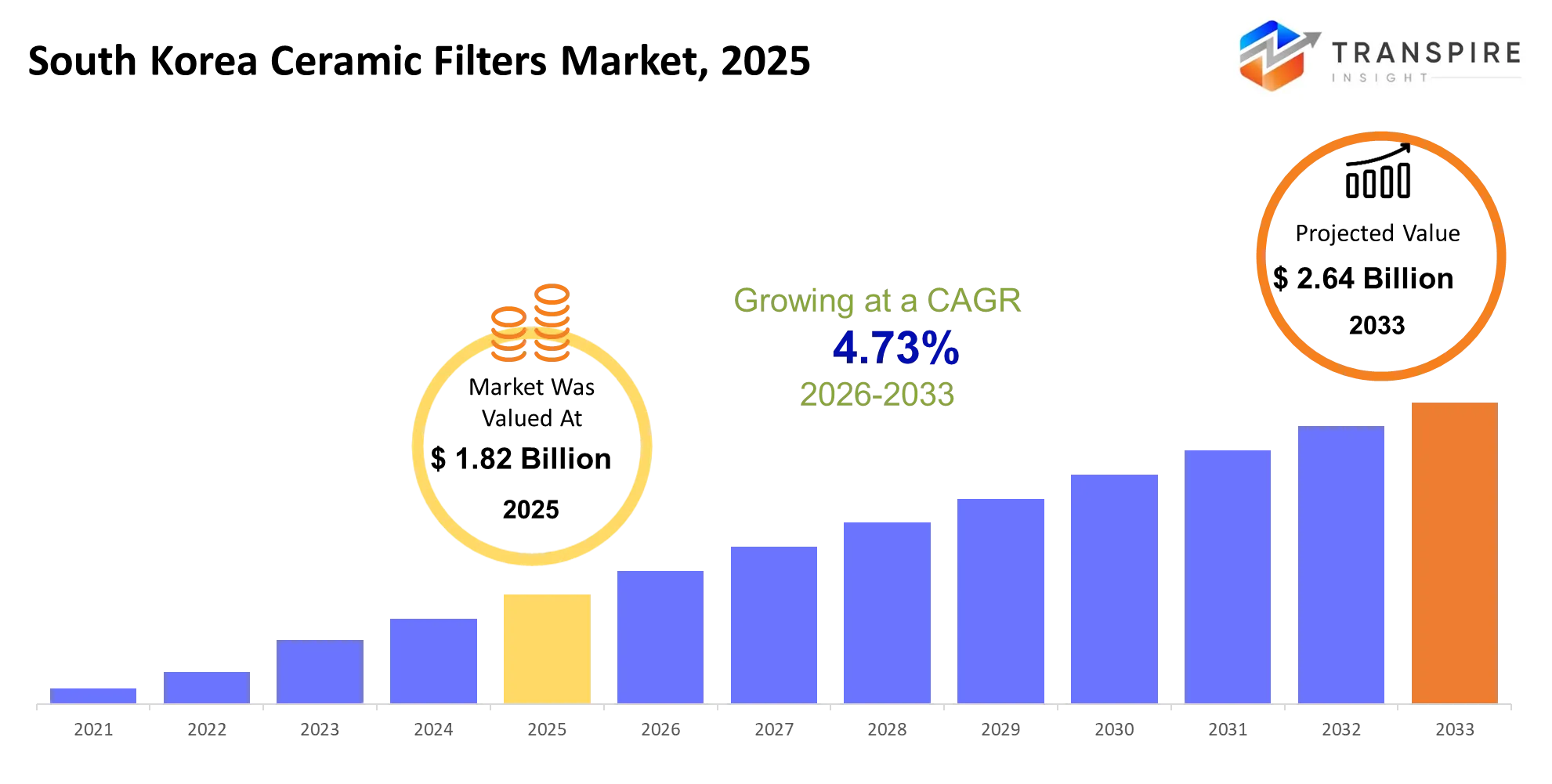
- Market Value (2025): USD 1.82 Billion.
- Expected Market Value (2026): USD 1.91 Billion.
- Estimated Market Value (2033): USD 2.64 Billion.
- Forecast CAGR (2026–2033): 4.73%.
Introduction
The ceramic filters market consists of ceramic materials made from aluminum oxide, zirconium oxide, and silicon dioxide, with microscopic pores that can be used to filter solids, pollutants, microorganisms, and slag from liquids and gases. In South Korea, the ceramic filters market includes segmented markets such as ceramic foam filters for the foundry segment and components for the clean utility filtration for semiconductor and advanced manufacturing sectors. The ceramic filter denotes a multi-purpose and versatile filtration medium made of porous ceramic materials (e.g. kaoline, terracotta, or fine silicon powder) and consists of several parts such as housing unit, filtering pad or element, and sealing ring; it works through a pore system of smaller spaces. Ceramic filters have numerous advantages in industrial filtration applications due to their durability, high filtration accuracy, and reliability. Unlike polymer filters that are subject to degradation from chemicals, temperature, and stress, ceramic filters tend to last longer. The use of ceramic filtration technologies that allow for the removal of smallest impurities, microorganisms, viruses, colloidal issues, and other particles makes it possible to acquire pure fluids. Ceramic filters are resistant to both temperature and corrosion, and they can be used in harsh chemical industries, water treatment and even in difficult conditions in the industry. Additionally, ceramic filters are washable, reusable, and have a high durability level, which in turn minimizes pollution.
Key Market Highlights: -
- By filter type, the Ceramic Water Filters segment dominated the market and holds nearly 53% share in 2025 and is projected to grow at a substantial CAGR during the forecast period.
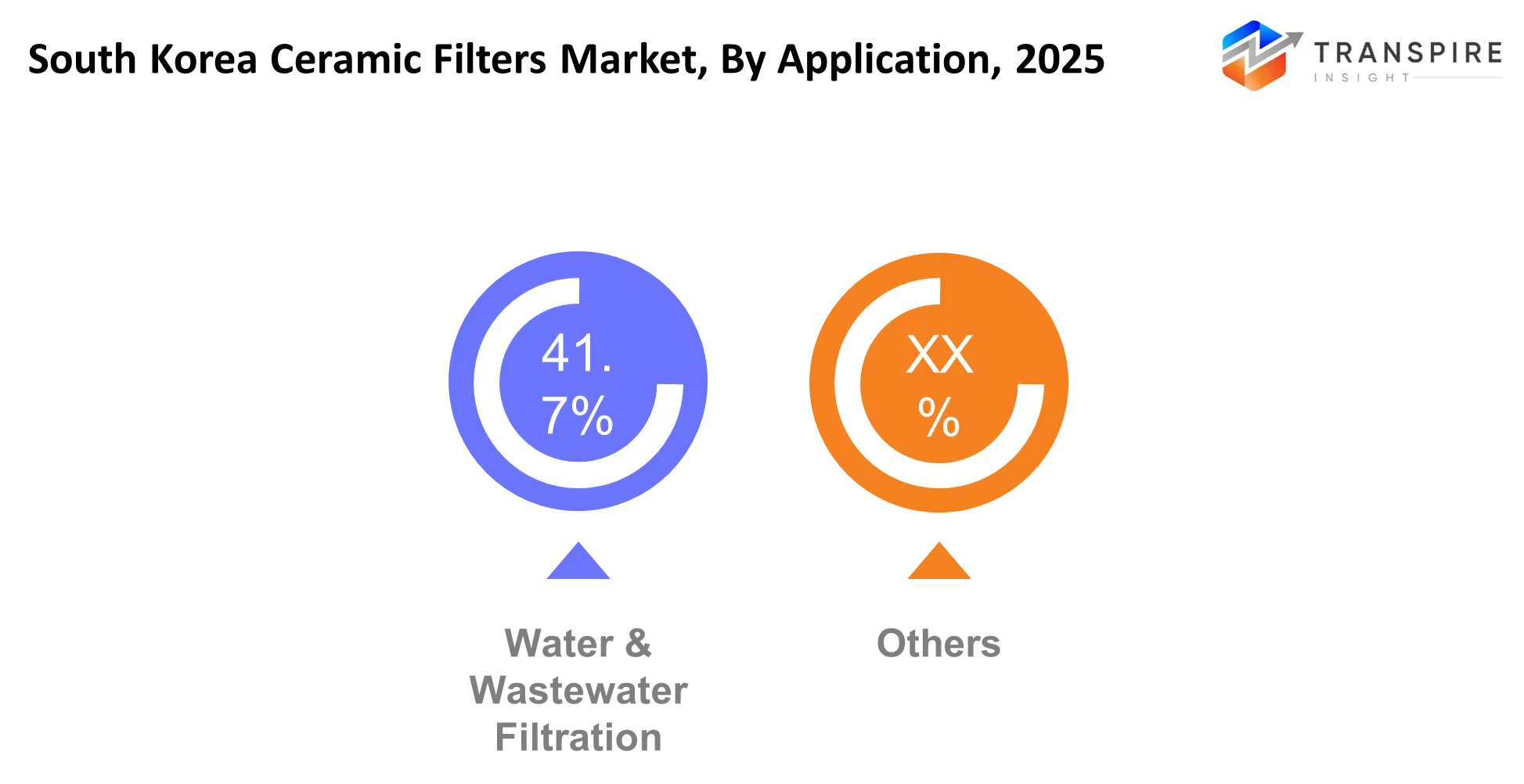
- By application, the Water Treatment segment dominated the market and holds nearly 55% share in 2025 and is projected to grow at a substantial CAGR during the forecast period.
- By end user, the Municipal Water Treatment segment dominated the market and holds approximately 33% share in 2025 and is projected to grow at a substantial CAGR during the forecast period.
- Research and Development Roadmap for Advanced Ceramics: The Korean government is committing funds of about KRW 100 billion through 2030 as part of its implementation of the Ceramic R&D Roadmap for the advancement in ceramic materials, durability, reliability, and processes. The project promotes innovations readyatable to above-mentioned advanced industrial applications thus giving rise to a number of favorable opportunities in the area of ceramic filters, high-temperature filtration, and industrial filtration systems.
How is Technology Driving Growth in the South Korea Ceramic Filters Market?
The ceramic filter market is evolving due to advancements in materials science, digital integration, and precision engineering. Advanced alumina, zirconia and ceramic fiber composites provide better thermal stability, chemical resistance, filtration efficiency and service life. Modern pore structure technologies make it possible to achieve the required level of contamination under onerous conditions, miniature designs allow for compact applications. IV technologies, related to the Internet of Things and including embedded sensors, real-time monitoring, predictive maintenance, and automated process control systems, help improve operational efficiency and minimize downtime. On the other hand, additive technologies used for manufacturing of complex geometries of filters and automated production processes improve efficiency, consistency and quality of production and assemblage..
Market Drivers
The growth of ceramic filters market in South Korea can be attributed to strict environmental regulations that mandate the need for advanced filtration and treatment equipment. Efforts towards industrial modernization and embracing Industry 4.0 are further driving demand for high quality ceramic filtering solutions. The boom in electronics manufacturing and the introduction of 5G networks in the region have opened up more opportunities for specialized ceramic filter applications. Efforts towards localizing the supply chain in South Korea are also helping to develop domestic capacities for filtering equipment manufacturing, thereby reducing dependence on imported components. Sustainability initiatives are yet another driver behind the growth of the market, as companies are keen on using durable and chemically resistant ceramic materials that are able to improve resource efficiency and extend the lifespan of the equipment. There are multiple benefits that ceramic filters bring with them leading to their increased usage not just in South Korea but also in the field of industrial filtration and water treatment. Durability: The high mechanical durability of the filters ensures efficient functioning when used in tough operating conditions. Heat & Chemical Resistance: The filters ensure high stability in terms of temperature resistance and in corrosive environments as well leading to their usage in many industries. Precise Filtration: The filters have structures designed in a way to permit effective removal of all kinds of small particles, bacteria, and other uses. Sustainability and Profitability: The use of the filters reduces the number of times they need replacing along with the amount of materials used for repair.
Restrain
When it comes to the ceramic filters market, certain hindrances exist. One such problem includes the considerable costs of manufacturing and implementing ceramic filters. On top of that, their raw materials, alumina and zirconia, have fluctuating pricing. The ceramic filters are inherently brittle, and can be subject to thermal shock, mechanical stresses, and other similar issues. Furthermore, the traditional industries are reluctant to adopt modern filtration technologies, leading to increased supply chain risks, procurement expenses, and challenges in usage.
|
Driver |
Relative Impact on Growth (%) |
Geographic Relevance |
Impact Timeline |
Demand Strength |
Growth Mechanism |
Key Beneficiaries |
Major Constraint |
|
1. Expansion of Advanced Water & Wastewater Treatment |
28% |
Nationwide; major industrial and municipal clusters |
Medium-term (2–4 years) |
High |
Expands ceramic membrane deployment across treatment infrastructure |
Ceramic membrane manufacturers; water utilities; EPC providers |
High upfront system and installation costs |
|
2. Semiconductor Industry Water Demand & Reuse |
24% |
Gyeonggi, Chungcheong, Gwangju and southwest regions |
Long-term (≥4 years) |
High |
Increases demand for ultrapure-water and wastewater filtration |
Filter manufacturers; semiconductor fabs; water-treatment technology vendors |
Extremely stringent purity and qualification requirements |
|
3. Government Ceramic R&D and Supply-Chain Localization |
18% |
Nationwide; R&D and manufacturing centers |
Medium-term (2–4 years) |
High |
Accelerates domestic ceramic technology development and commercialization |
Ceramic producers; research institutes; technology developers |
Funding spans multiple ceramic applications |
|
4. Advanced Low-Pressure Ceramic Membrane Innovation |
16% |
Nationwide; technology-development clusters |
Medium-term (2–4 years) |
High |
Reduces energy requirements while improving filtration performance |
Membrane developers; system integrators; industrial users |
Commercial scale-up and manufacturing complexity |
|
5. Sustainability, Water Reuse & Resource Efficiency |
14% |
Nationwide; industrial and municipal facilities |
Long-term (≥4 years) |
Medium–High |
Encourages durable membranes and wastewater-reuse systems |
Municipalities; industrial plants; sustainability technology providers |
High retrofit costs and operational complexity |
Analysis of Prices and Consumer Behaviour
In South Korea, microfiltration accounts for the largest portion of the ceramic filters market (in 2024), owing to the high demand for water treatment and industrial filtration purposes. South Korea’s ceramic membranes market is estimated to be worth USD 209.6 million in 2024 and is projected to reach USD 454.1 million by 2030, at a CAGR of around 13.8% for the period between 2025 and 2030. In 2024, South Korea accounted for around 2.0% of total ceramic membranes consumption globally. The sales volume will be supported by ceramic membranes being durable, resistant to chemicals, efficient, and long-lasting. Water treatment will be one of the main application areas, while ultrafiltration will register the fastest growth during the forecast period.
Who are the Key Players in the South Korea Ceramic Filters Market and how do they compete?
Success in the Ceramic Filters market is determined by companies that employ latest technologies in filtration and provide specialized solutions, as well as use developed distribution networks. The essence of competition is based on pricing and effectiveness, which offers a vital advantage for constant innovation in product development and ability to improve water quality and production efficiency.
Toray Advanced Materials Korea is establishing its presence in the market thanks to innovative technologies and advanced solutions in ceramics and water purification. LG Chem distinguishes itself from competitors due to the use of unique materials in the production of filtration systems and membranes. Kolon Industries grows its market reach through the implementation of sophisticated materials and technologies in the field of ceramics. CeraMem implements advanced ceramic membrane solutions in the industrial and waste treatment sectors.
Top Companies in the South Korea Ceramic Filters Market
- Pall Corporation
- CeramTec
- CoorsTek
- NGK Insulators
- Kyocera
- Saint-Gobain
- TAMI Industries
- LiqTech
- Atech Innovations
- METAWATER
- Toto
- Noritake
- Murata Manufacturing
- Ibiden
- SKC
|
Company |
Est. Revenue Share Range |
Key Offerings |
Strategic Positioning |
Geographic Strength |
Technology Focus |
|
Toray Industries, Inc. |
7–10% |
Ceramic membranes; water-treatment membranes; filtration systems |
Technology-led membrane and water-treatment diversification |
Asia Pacific; North America; Europe |
Advanced membrane separation; water purification; process filtration |
|
NGK Insulators, Ltd. |
6–9% |
Ceramic separation membranes; water-purification membranes; precision filtration membranes |
Advanced ceramics and precision filtration specialization |
Asia Pacific; Europe; North America |
Nano-ceramic membranes; ultrafiltration; molecular separation |
|
METAWATER Co., Ltd. |
5–8% |
Ceramic membrane filtration systems; mobile ceramic filtration; water-reuse systems |
Integrated water-treatment engineering and services |
Asia Pacific; Middle East; Europe |
Ceramic membranes; water reuse; ICT monitoring |
|
CoorsTek, Inc. |
4–7% |
Ceramic membrane filters; multi-tube systems; hollow-fiber ceramic systems |
High-performance technical ceramic filtration |
North America; Asia Pacific; Europe |
Alumina membranes; tubular modules; high-temperature filtration |
|
Cerafiltec GmbH |
3–6% |
Ceramic flat-sheet membranes; ultrafiltration modules; water-treatment systems |
Innovation-led ceramic membrane water-treatment expansion |
Europe; Asia Pacific; South Korea |
Flat-sheet ceramic UF; low-energy filtration; scalable modules |
|
LiqTech International, Inc. |
3–5% |
SiC ceramic membranes; liquid-filtration systems; wastewater solutions |
Silicon-carbide technology differentiation |
Europe; North America; Asia Pacific |
SiC membranes; crossflow filtration; high-flux separation |
|
TAMI Industries |
2–4% |
Tubular ceramic membranes; tangential filtration systems; process filtration |
Specialized industrial ceramic membrane expertise |
Europe; Asia Pacific; North America |
Ceramic crossflow filtration; multichannel membranes; process separation |
|
Saint-Gobain |
2–4% |
Advanced ceramic filtration components; porous ceramics; industrial filtration materials |
Advanced-materials scale and application diversification |
Europe; North America; Asia Pacific |
Porous ceramics; refractory materials; high-temperature filtration |
|
CeramTec GmbH |
1–3% |
Porous ceramic components; technical ceramics; filtration-related ceramic structures |
Premium technical ceramics and engineered components |
Europe; Asia Pacific; North America |
Advanced ceramics; porous structures; engineered filtration components |
|
SI Membranes, Inc. |
1–3% |
Ceramic membrane solutions; localized testing; pilot filtration systems |
Korea-focused commercialization and technical support |
South Korea; Asia Pacific |
Ceramic membrane testing; pilot systems; application engineering |
South Korea Ceramic Filters Market Segmentation
The South Korea Ceramic Filters Market share is divided into six categories: By filter type, material, application, pore size, configuration and end user.
The Ceramic Water Filters dominated the market, accounting for nearly 53% in 2025 and is expected to rise at a significant CAGR during the forecast period.
The South Korea Ceramic Filters Market is segmented by filter type into Ceramic Membrane Filters, Ceramic Water Filters, Ceramic Air Filters, Ceramic Gas Filters, Porous Ceramic Filters, Honeycomb Ceramic Filters, Ceramic Candle Filters, Ceramic Disc Filters. Among these, the Ceramic Water Filters segment dominated the market, accounting for nearly 53% in 2025 and expected to increase at a significant CAGR during the forecast period. In 2025, ceramic water filters accounted for almost 53% of share in the overall regulation for a wide spectrum of reasons such as lower operating expenses, high accuracy in contaminant removal, and high durability in the use of ceramic filter systems. Due to rising popularity of safe drinking water, particularly in households and undeveloped regions, utilization of ceramic filtration technology is witnessing a surge across all applications, both in residential and community sectors.
The Water Treatment dominated the market, accounting for nearly 55% in 2025, and is expected to rise at a significant CAGR during the forecast period.
The South Korea Ceramic Filters Market is segmented by application into Water Treatment, Wastewater Treatment, Air Filtration, Gas Filtration, Chemical Processing, Food & Beverage, Pharmaceuticals, Automotive. Among these, the Water Treatment segment dominated the market, accounting for nearly 55% in 2025 and expected to increase at a significant CAGR during the forecast period. In 2025, the Water Treatment segment led the market, capturing almost 55% of the market due to rising requirements for safe drinking water, tough water standards, rapid urbanization, and industrial water usage. The increase in spending in local infrastructure, wastewater treatment plants, and innovative filtration technologies also contributes to the growth of the market.
The Municipal Water Treatment dominated the market, accounting for nearly 33% in 2025 and is expected to rise at a significant CAGR during the forecast period.
The South Korea Ceramic Filters Market is segmented by end user into Municipal Water Treatment, Industrial Water Treatment, Chemical Companies, Pharmaceutical Companies, Food Producers, Automotive Manufacturers, Electronics Companies, Power Plants. Among these, the Municipal Water Treatment segment dominated the market, accounting for nearly 33% in 2025 and expected to increase at a significant CAGR during the forecast period. The Municipal Water Treatment sector led the market, being responsible for almost 33% share by 2025. This has been attributed to the increase in population in cities and the demand for municipal water. Moreover, several government regulations have increased the demand. The continuous growth in the market is supported by the investments in advanced technologies, the modernization of water infrastructure, and the various sanitation projects.
Future Market Trends for the South Korea Ceramic Filters Market: -
- Water Reuse Technology & Municipal Treatment Strategy: Quick acceptance of ceramic membranes for industrial wastewater treatment in compliance with 2050 carbon-neutral regulations.
- 5G Technology and Electronic Component Integration: Transition to miniaturized 5G ceramic filters, completely replacing metal cases and providing low signal latency, high thermal stability, and low power consumption.
- Smart Equipment Monitoring Technology: Integration of IoT sensors into filtration systems for real-time predictive maintenance and operational control.
- Eco-Friendly Production Advancements: Regulatory drive to promote sustainable production practices through recyclable ceramic composites with a minimized carbon footprint.
Recent Development
- In March 2026: KIMS has made the advancement in producing the zirconia based ceramic Nanofiltration membrane that can work at about 2 bar and reduce the filter pressue around 80% compared to conventional devices. The new membrane has shown above 99.8% efficiency in absorbing dye out of fluid and has a selective permeability for salt ions too, thus fostering innovations in the filtration industry in South Korea.
- In May 2026: By cooperating with South Korea's SI Membranes, Inc., Cerafiltec has enhanced its strategic partnership with the company. The partnership allows both companies to conduct localized testing and pilot-scale development of ceramic membrane technology. This partnership has a positive impact on the ceramics filters market of South Korea by fostering innovations in ultrafiltration technologies applicable to industries and municipalities.
Market Segment
This study forecasts revenue at South Korea, regional and country levels from 2020 to 2033. Transpire Insight has segmented the South Korea Ceramic Filters Market based on the below-mentioned segments:
South Korea Ceramic Filters Market, By Filter Type
- Ceramic Membrane Filters
- Ceramic Water Filters
- Ceramic Air Filters
- Ceramic Gas Filters
- Porous Ceramic Filters
- Honeycomb Ceramic Filters
- Ceramic Candle Filters
- Ceramic Disc Filters
South Korea Ceramic Filters Market, By Material
- Alumina
- Silicon Carbide
- Zirconia
- Cordierite
- Mullite
- Titania
- Porous Glass-Ceramic
- Other Ceramics
South Korea Ceramic Filters Market, By Application
- Water Treatment
- Wastewater Treatment
- Air Filtration
- Gas Filtration
- Chemical Processing
- Food & Beverage
- Pharmaceuticals
- Automotive
South Korea Ceramic Filters Market, By Pore Size
- Microfiltration
- Ultrafiltration
- Nanofiltration
- Sub-Micron
- 0.1–1 µm
- 1–10 µm
- 10–50 µm
- Above 50 µm
South Korea Ceramic Filters Market, By Configuration
- Tubular
- Monolithic
- Multichannel
- Flat Sheet
- Disc
- Hollow Fiber
- Candle
- Cartridge
South Korea Ceramic Filters Market, By End User
- Municipal Water Treatment
- Industrial Water Treatment
- Chemical Companies
- Pharmaceutical Companies
- Food Producers
- Automotive Manufacturers
- Electronics Companies
- Power Plants
Frequently Asked Questions
Find quick answers to common questions.
Water treatment demand, environmental regulations, industrial modernization, semiconductor manufacturing, sustainability initiatives, and advanced ceramic filtration technologies drive market growth.
Ceramic Water Filters dominate, accounting for nearly 53% in 2025, supported by durability, filtration accuracy, and water-treatment demand.
Water Treatment leads with nearly 55% share, driven by stringent standards, industrial usage, infrastructure investment, and wastewater-treatment requirements.
Advanced materials, optimized pores, IoT monitoring, predictive maintenance, automation, additive manufacturing, and low-pressure ceramic membranes are transforming filtration performance.
Water reuse, wastewater treatment, smart filtration, semiconductor applications, sustainable manufacturing, and advanced ceramic membranes present significant future market opportunities.
- Pall Corporation
- CeramTec
- CoorsTek
- NGK Insulators
- Kyocera
- Saint-Gobain
- TAMI Industries
- LiqTech
- Atech Innovations
- METAWATER
- Toto
- Noritake
- Murata Manufacturing
- Ibiden
- SKC
About the Authors

Pankaj Ghogare Patil
I am Pankaj Ghogare Patil, a Senior Research Analyst at Transpire Insight, specializing in the Pharmaceutical, Chemicals & Materials, Healthcare IT, and Biotechnology industry. My expertise lies in conducting comprehensive market research, analyzing industry trends, evaluating competitive landscapes, and translating complex data into actionable insights. At Transpire Insight, I closely follow emerging technologies, regulatory developments, and market innovations to create accurate, well-researched, and informative content that helps businesses and professionals make informed decisions. I am committed to producing credible, evidence-based articles that reflect industry best practices while making technical topics accessible and valuable for a broad audience.

Chakradhar Khansole
Chakradhar serves as the Research Director at Transpire Insight, bringing over 8 years of experience in technology, innovation, and strategic market intelligence. He specializes in transforming complex market data into actionable business insights that enable organizations to make informed, growth-oriented decisions. Recognized for his strategic vision and analytical expertise, Chakradhar leads high-impact research initiatives, delivering comprehensive market assessments, competitive intelligence, and forward-looking industry analysis.
Recently Published Reports
-
May 2026
Healthcare Polymer Packaging Market
Healthcare Polymer Packaging Market Size, Share & Analysis Report By Packaging Type (Syringes, IV Bottles and Pouches, Clamshells, Blisters, Bottles & Jars, Containers, Tubes, IV Parental Packaging, Others), By Type (Regulated, Non-regulated), By Polymer Type (LDPE (Low-Density Polyethylene), HDPE (High-Density Polyethylene), Homo-polymer (Homo), Random Copolymer (Random), Block Copolymer (Block), PET, Polystyrene, Polyvinyl Chloride, Polyamide/EVOH, Others), and Geography (North America, Europe, Asia-Pacific, Middle East and Africa, South and Central America), 2021 - 2031
-
Apr 2026
Hydrophilic Tape (Waterstop) Market
Hydrophilic Tape (Waterstop) Market Size, Share & Analysis Report By Type (Bentonite-Based Hydrophilic Tape, Rubber-Based Hydrophilic Tape), By Application (Residential Buildings, Commercial Buildings, Infrastructure Projects), and Geography (North America, Europe, Asia-Pacific, Middle East and Africa, South and Central America), 2021 - 2031
-
Apr 2026
Metalens Market
Metalens Market Size, Share & Analysis Report By Type (Visible Light Metalens, and Infrared Metalens), By Application (Consumer Electronics, Automotive Electronics, Industrial, Medical, and Others), and Geography (North America, Europe, Asia-Pacific, Middle East and Africa, South and Central America), 2021 - 2031
-
Apr 2026
PBT Resin Market
PBT Resin Market Size, Share & Analysis Report By Type (Reinforced PBT Resin, Unreinforced PBT Resin), By Processing Method (Injection Molding, Extrusion, Blow Molding, Others), By End-User (Automotive, Electrical & Electronics, Consumer Appliances, Industrial Machinery, Medical Devices, Packaging, Others), and Geography (North America, Europe, Asia-Pacific, Middle East and Africa, South and Central America), 2021 - 2031