

South Korea Cashew Nuts Market Size & Forecast:
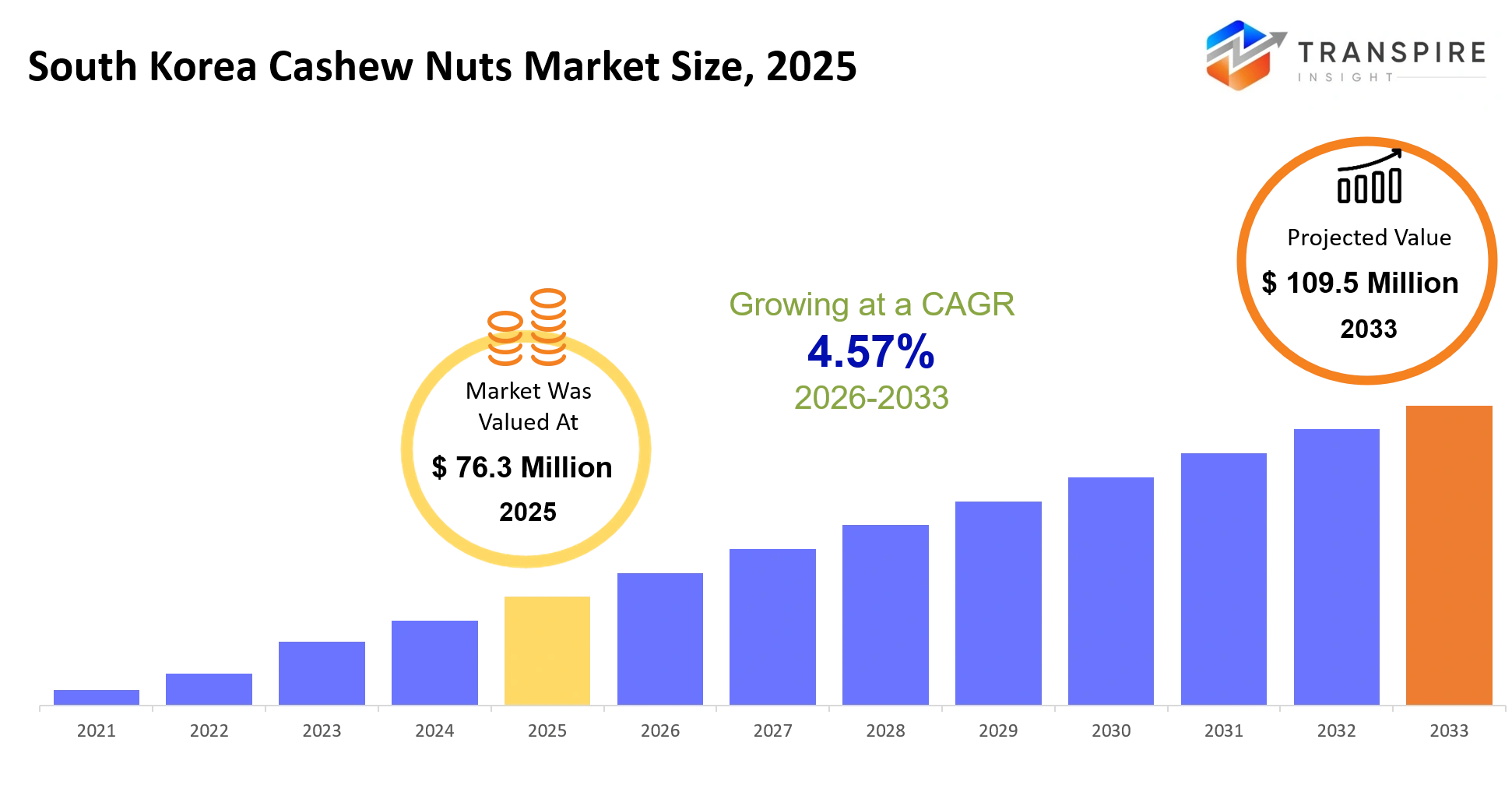
- South Korea Cashew Nuts Market Size 2025: USD 76.3 Million
- South Korea Cashew Nuts Market Size 2033: USD 109.5 Million
- South Korea Cashew Nuts Market CAGR: 4.57%
- South Korea Cashew Nuts Market Segments: By Product Type (Raw Cashew Nuts, Roasted Cashew Nuts, Flavored Cashew Nuts, Organic Cashew Nuts, Cashew Kernels, Cashew Powder, Others) | By Form (Whole, Splits, Pieces, Granules, Paste, Butter, Others) | By Application (Snacks, Bakery & Confectionery, Dairy Alternatives, Nutraceuticals, Food Processing, Others) | By Distribution Channel (Supermarkets, Convenience Stores, Online Retail, Specialty Stores, Wholesale, Others).
South Korea Cashew Nuts Market Summary
The South Korea Cashew Nuts Market was valued at USD 76.3 Million in 2025. It is forecast to reach USD 109.5 Million by 2033. That is a CAGR of 4.57% over the period.
In South Korea, the cashew nuts market kind of acts like an import-driven food ingredient and also a premium snack supply chain, connecting global growers in Vietnam, India, and Africa to local food manufacturers , retailers, and convenience channels. It does not only behave like raw commodity trade. Instead it supports bakery, confectionery, dairy alternatives, and ready-to-eat snack segments. In the past 3 to 5 years, the whole market has moved away from bulk commodity imports, and more toward premiumize, packaged, and health-positioned snack styles. This change has been helped a lot by fast growth in e-commerce grocery platforms and convenience-store private labels. There is also this structural tilt toward functional snacking , where cashews are promoted for protein density and clean label positioning. That angle has effectively strengthened value-added processing inside Korea. This evolution was also pushed along by COVID 19 related supply chain disruptions and sudden freight rate volatility , which showed how dependent some players were on a narrow set of origin sources. So importers started to diversify suppliers and secure longer term contracts. As a consequence, pricing pressure and sourcing tactics are now getting managed more tightly across the whole import-to-retail chain.
Key Market Insights
- Seoul and Gyeonggi, sort of dominate the South Korea Cashew Nuts Market , with about 48% share in 2025. This is mostly pushed by urban retail density, and yeah it feels very concentrated.
- Busan and Incheon are also standing out with the fastest growth, mainly from logistics expansion plus import-re-export activity that’s expected to keep rising, forecast 2024–2028.
- In the southern provinces regional penetration is increasing too, because of convenience-store network expansion , and the online grocery reach that’s getting wider.
- Whole cashews end up taking the lead in the South Korea Cashew Nuts Market, roughly 55% share, and it’s really tied to retail snack dominance.
- Roasted and flavored cashews end up as the second-largest segment, driven by a more premium snacking culture among urban consumers.
- Cashew-based spreads and dairy substitutes are currently the fastest-growing segment over the 2025–2030 forecast period. On applications, snacks are still the main demand driver, reaching nearly 62% share in 2025.
- Bakery and confectionery applications are emerging fastest as well, mostly due to premium ingredient reformulation trends across 2024–2029.
- For end users, retail consumers stay on top, contributing about 58% share in 2025 consumption. And then foodservice plus HoReCa is expanding quickly, thanks to menu diversification and health-oriented ingredient substitution.
What are the Key Drivers, Restraints, and Opportunities in the South Korea Cashew Nuts Market?
In the South Korea Cashew Nuts Market, the primary driver is kinda the structural move toward premium, health minded snacking, strengthened by the post pandemic eating habits that people kind of kept, plus the rising appetite for plant based protein sources. Retailers and food manufacturers, you know, have been redoing their product lines with nutrient dense ingredients, and that directly lifts import volumes while also improving the value realization per unit. Overall it has made the revenue situation better for importers and processing players, especially in the packaged and flavored cashew space, where consumers pay a bit more.
The main restraint, though, is the high dependency on imported raw cashews, mostly coming from Vietnam and India. This leaves the market exposed to freight swings and currency fluctuations. And honestly this structural reliance cannot be fixed fast, since domestic cultivation is limited in feasibility and also heavily influenced by climate constraints. So procurement costs stay a little unstable, then margins for mid tier distributors get squeezed, and price sensitive adoption slows down in the mass market segments.
A big opportunity sits in broadening plant based and functional food uses, especially cashew derived dairy alternatives as South Korea’s vegan and flexitarian population keeps expanding. Investments in local food tech startups and co manufacturing partnerships with well known nut processors are speeding up product innovation. In turn, this could open up higher margin categories and gradually lessen reliance on the usual traditional snack formats during the next growth phase.
What Has the Impact of Artificial Intelligence Been on the South Korea Cashew Nuts Market?
Artificial intelligence is slowly, like step by step, reshaping day to day operational efficiency across the South Korea cashew nuts market. The biggest shifts seem to show up in import forecasting, inventory optimization and also retail demand prediction. Importers and distributors are increasingly relying on machine learning models, they look at consumer habits across various retail channels, and this helps them plan shipments more accurately while lowering the chances of having too much stock sitting around. As a result inventory turnover can feel more stable, and working capital efficiency improves, especially for the mid to large distributors.
In logistics and supply chain monitoring, AI systems are being used for route planning of imported consignments that come in via Busan and Incheon ports. Predictive analytics then try to anticipate freight delays as well as price swings, so procurement teams can time contracts better and make faster purchasing choices. Some bigger distributors mention roughly 5–10% gains in inventory efficiency and fewer spoilage losses, mainly because their planning is being supported by AI based tools and smarter schedules.
Still, adoption is not fully smooth because data is fragmented across importers, retailers and distributors. There is often weak real time connection between suppliers in origin countries and the demand records in Korea, so the models lose accuracy when sudden global price shocks happen, or when shipping gets disrupted. On top of that, the costs to implement AI enabled ERP and supply chain platforms can be heavy, which holds back many smaller and mid sized importers. So the market hasn't reached full scale digital transformation yet, not in a consistent way.
Key Market Trends
- Import sourcing got more diversified after 2021, Vietnam and India kind of lost share, dropping from 78% to 65% by 2025.
- In the meantime, premium flavored cashew products started getting more shelf placement in convenience stores, and that shelf space grew around 22% from 2022 to 2025, kinda steady.
- Online grocery platforms also nudged cashew sales penetration up by 18% in 2024, mostly because subscription style snack demand kept rising.
- Food manufacturers began reformulating bakery lines with cashew flour substitutes starting in 2023, so they could lean into clean-label positioning, which is a term people use a lot.
- Retail pricing became more wobbly after 2022 freight disruptions, and that pushed importers into long term supply contracts—though not overnight, it’s more like a gradual shift.
- Plant based dairy startups increased their use of cashew milk by about 30% between 2023 and 2025 in urban areas, where adoption seems faster.
- Convenience store chains like CU and GS25 broadened their private label nut snack options from 2024 onward, and it shows in the aisles.
- Functional snacking kept moving too, with more cashew based protein snack launches from global brands during the 2024–2026 cycles.
- Finally, HoReCa adoption rose in a steady way, as restaurants swapped almond based ingredients for cashew based alternatives, mainly for cost control.
South Korea Cashew Nuts Market Segmentation
By Product Type :
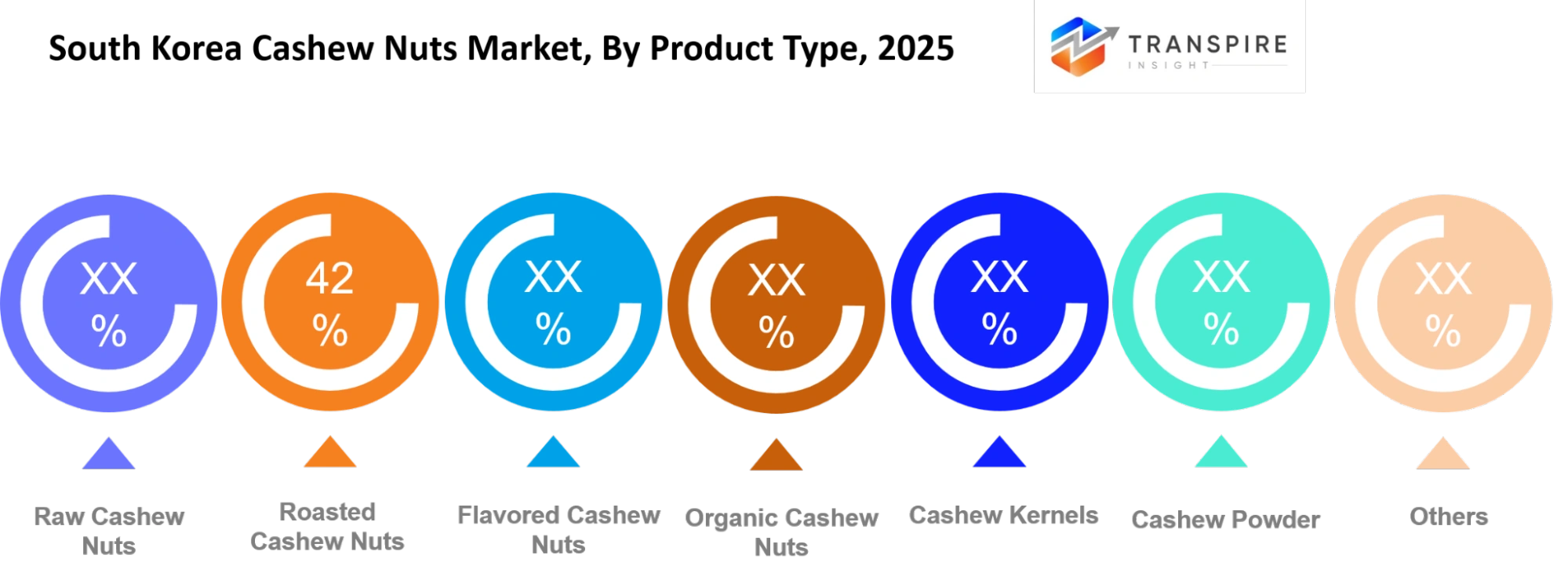
Raw cashew nuts basically mean unprocessed imported kernels that are used as a base material , for more roasting seasoning and then packaging here in South Korea. Roasted cashew nuts are heat treated products, with a richer taste and a longer shelf life, and they show up a lot in the retail snack packs you grab on the way. Flavored cashew nuts cover salted, spicy, and coated variants, made for everyday city snack eating, while organic cashew nuts are for buyers who are more health-minded and want chemical free sourcing.
Cashew kernels are the shelled edible part that shows up across food manufacturing. Cashew powder is used in bakery work and in dairy related applications, and then you also see other forms like blended or processed derivatives, which end up being used in industrial food production. Overall this kind of product mix helps companies stay flexible across retail channels and food processing channels, and it helps improve how well imports get used, plus how quickly the market can adapt.
By Form :
Whole cashews are the most preferred form in the South Korea Cashew Nuts Market, since they’re common for direct snacking and they fit premium retail packaging nicely. Splits and pieces are smaller broken pieces , and they get used in bakery and confectionery production where looks matter less , but cost efficiency really does. Granules are finely broken cashews that are used for toppings and in processed foods.
Cashew paste and butter are being used more and more in dairy alternative products, spreads , and dessert recipes. Other forms can include blended textures that go into industrial food output. This segmentation in form also supports demand from both the consumer side and the ingredient side, so it’s easier to match different price tiers and different use cases.
By Application :
Snacks still kind of stay as the biggest use within the South Korea Cashew Nuts Market , mostly because more people in city households want ready to eat healthy options that are easy and fast. In bakery and confectionery stuff, cashews show up in cakes , cookies and chocolates too , they’re used to give a better feel in the bite and also improve taste. Dairy alternatives are another thing , like cashew milk and cashew cream , which fit into plant based eating plans.
Nutraceuticals also rely on cashews for protein and mineral levels, so they end up in health supplements as a sort of supporting ingredient. In food processing, cashews are used for sauces, spreads, and packaged meals where they act like a base component. There are also more specialty food preparations that use cashews in smaller or more specific formats. Overall this mix helps cashews plug in strongly across both retail shelves and industrial food systems, which is kind of the whole point.
By Distribution Channel :
On distribution, supermarkets pretty much dominate the South Korea Cashew Nuts Market because products get lots of visibility and families buy in bulk for everyday use. Convenience stores matter a lot too , since they drive impulse purchases and single serve packaged snack items especially in urban zones. Online retail channels are also growing quickly, pushed by grocery delivery platforms and subscription based snack services that just keep showing up.
Specialty stores focus on premium and organic cashew products, aimed at consumers who are more health focused and willing to pay extra. Wholesale channels supply food manufacturers , bakeries , and restaurants with larger quantities of cashew inputs. Other routes include institutional sales and direct import distribution. So, the channel structure basically balances mass market access with premium niche positioning, even if it feels a bit split sometimes.
What are the Key Use Cases Driving the South Korea Cashew Nuts Market?
Snack consumption still feels like the main driver of the South Korea Cashew Nuts Market, and cashews are pretty much everywhere in packaged, ready-to-eat items you can grab through retail or convenience channels. The biggest pull is coming from city shoppers, because they want protein-rich snacks, often in portion-controlled formats, that match those fast-paced routines and the more health-oriented eating habits. This specific use case tends to bring the most volume too, mainly because purchases happen often, and the products are easy to find in supermarkets and corner stores.
At the same time, bakery and confectionery manufacturing is widening, as food processors fold cashews into chocolates, biscuits, and more premium desserts. Dairy alternative production is rising as well, in particular among plant-based beverage producers that use cashew foundations for milk and cream substitutes. Those directions are mostly pushed by food manufacturers and HoReCa players who are looking for ingredient upgrades, plus “cleaner label” style formulations.
Meanwhile, some newer applications are showing up in nutraceutical recipes and functional meal concepts. Here cashews get used for protein enrichment in health bars and dietary blends. Cashew-based mix-ins in ready meal kits are also starting to gain noticeable attention, especially from e-commerce food brands that are aiming at fitness-minded consumers.
|
Report Metrics |
Details |
|
Market size value in 2025 |
USD 76.3 Million |
|
Market size value in 2026 |
USD 80.1 Million |
|
Revenue forecast in 2033 |
USD 109.5 Million |
|
Growth rate |
CAGR of 4.57% from 2026 to 2033 |
|
Base year |
2025 |
|
Historical data |
2021 - 2024 |
|
Forecast period |
2026 - 2033 |
|
Report coverage |
Revenue forecast, competitive landscape, growth factors, and trends |
|
Country scope |
South Korea |
|
Key company profiled |
Olam Group, Vietnam Cashew Corporation, Cargill, ADM, Royal Nuts, Happilo, Nutraj, KingNuts, Bismi Cashew, NutWalker, Mariani, Blue Diamond, Wonderful Pistachios, HBAF, Lotte Foods. |
|
Customization scope |
Free report customization (country, regional & segment scope). Avail customized purchase options to meet your exact research needs. |
|
Report Segmentation |
By Product Type (Raw Cashew Nuts, Roasted Cashew Nuts, Flavored Cashew Nuts, Organic Cashew Nuts, Cashew Kernels, Cashew Powder, Others) | By Form (Whole, Splits, Pieces, Granules, Paste, Butter, Others) | By Application (Snacks, Bakery & Confectionery, Dairy Alternatives, Nutraceuticals, Food Processing, Others) | By Distribution Channel (Supermarkets, Convenience Stores, Online Retail, Specialty Stores, Wholesale, Others). |
Which Regions are Driving the South Korea Cashew Nuts Market Growth?
Seoul Capital Area is kinda leading the South Korea Cashew Nuts Market, mainly because there’s this dense retail web, plus a solid import distribution system that just keeps moving. A lot of the cashew imports come in close by, through Incheon port and then they get rushed into processing and packaging places. You see high supermarket penetration , and the density of convenience stores, which helps keep customer demand fairly steady. Also, the e-commerce fulfillment centers here make the product turnover faster, so premium snack adoption goes up more easily too.
Meanwhile Busan and the broader southeastern industrial strip stays a dependable part of the South Korea Cashew Nuts Market. The big reason is strong port operations, plus a steady arrival of imported nuts that feed the food manufacturing clusters. Local processors then supply bakery and confectionery makers, so ingredient demand stays consistent. It’s not as fast as Seoul, but it feels more stable, because there are long-standing industrial agreements, and HoReCa consumption patterns that don’t really wobble much.
The quicker growth seems to be showing up in Chungcheong and some specific southern provinces, where logistics parks, along with new distribution centers, are growing pretty fast. Fresh warehouse capacity has improved cold storage, and it also smooths inventory flow for packaged snack items. With online grocery going up, semi-urban customers are getting easier access to cashew-based products, and that change hints at stronger distributor openings for retail expansion, somewhere between 2026 and 2033.
Who are the Key Players in the South Korea Cashew Nuts Market and How Do They Compete?
Competition in the South Korea Cashew Nuts Market still feels pretty moderately fragmented, with global importers, ingredient suppliers, and packaged snack brands all jumping in at once, competing on price plus product differentiation in a way that looks a little familiar but not fully. Most of the time firms don’t rely on domestic production strength, instead they lean on sourcing efficiency, supply chain stability and, yes, product novelty. Because the country imports so much, companies end up paying extra attention to contract terms with origin suppliers, plus they push hard on fast-moving retail partnerships, so margins don’t slip and shelf presence stays intact.
Olam Group tends to play a cost-focused game with big sourcing reach across Vietnam and West Africa. What really sets them apart is integrated supply chain control, which basically helps them keep pricing steadier and quality more consistent for Korean importers. Their expansion strategy leans on longer procurement agreements with food manufacturers and also bulk ingredient distributors, like they lock in the flow before demand shifts.
Intersnack Group competes by leaning into branded snack innovation and flavored cashew ranges, built for those more premium retail sections. Their differentiation is tied to strong packaging design, plus flavor diversification strategies that specifically chase convenience store shoppers. Growth is supported by retail relationships, and by widening distribution across Asian markets, not only chasing one channel.
John B. Sanfilippo & Son leans toward value-added processing and private label supply, especially for supermarkets and foodservice buyers. Their edge is flexibility in product customization such as roasted, chopped and blended cashew formats. For market expansion, they depend heavily on private label agreements with retailers that want dependable nut supplies at optimized cost levels, without drama.
Borges Agricultural & Industrial Nuts positions itself in the premium and organic cashew space, using certified sourcing standards as a core message. Differentiation comes from quality certifications and traceable supply chains, which appeals to health-leaning consumers who care about more than just taste. The whole approach feels like a quiet emphasis on verification and origin, rather than only volume.
Company List
- Olam Group
- Vietnam Cashew Corporation
- Cargill
- ADM
- Royal Nuts
- Happilo
- Nutraj
- KingNuts
- Bismi Cashew
- NutWalker
- Mariani
- Blue Diamond
- Wonderful Pistachios
- HBAF
- Lotte Foods
Recent Development News
In May 2026, South Korean investor consortium led by Daejoo and KC Group announced interest in cashew production investments in Cambodia. The delegation discussed agricultural expansion projects focused on cashew cultivation and processing to capture more value beyond raw exports. The move signals a strategy to secure upstream supply integration for South Korea’s cashew import and processing ecosystem.
Source: https://cac-camcashew.org/
In February 2026, PSL Group participated in Gulfood 2026 in Dubai to expand its distribution partnerships across Asian and Middle Eastern nut import markets. The participation focused on securing new long-term contracts for roasted and processed cashew products, which directly supports supply stability for Korean importers. This move strengthened cross-border sourcing resilience at a time when freight volatility remains high.
Source: https://www.gulfood.com/exhibitors-2026
What Strategic Insights Define the Future of the South Korea Cashew Nuts Market?
The South Korea Cashew Nuts Market is kind of structurally moving into a more value-added, health-minded ingredient ecosystem where cashews stop being only snack kind of imports and start acting like multifunctional food inputs across both packaged foods and plant based formulations. This is mostly pushed by ongoing urban diet changes, stronger pull for clean label proteins, and a deeper kind of integration of imported nuts into processed food manufacturing. Over the next 5 to 7 years, growth will rely less on plain volume expansion, and more on premiumization of products plus tighter supply chain control across import and retail networks, sort of all in one.
There is also this hidden risk in having concentrated dependency on a relatively narrow group of origin countries. That situation makes the market more exposed to synchronized climate shocks, and also to export policy tightening happening in West Africa and Southeast Asia. So pricing stability could wobble even if domestic demand stays relatively steady.
On the opportunity side, cashew based dairy alternatives are rising quickly in Korea’s flexitarian segment, and that’s supported by food-tech investments plus retail private label experimentation. Companies in the space should push for long term origin diversification contracts and also put money into local processing or co manufacturing relationships. The goal would be to capture margin expansion while reducing the overall exposure to supply volatility.
South Korea Cashew Nuts Market Report Segmentation
By Product Type
- Raw Cashew Nuts
- Roasted Cashew Nuts
- Flavored Cashew Nuts
- Organic Cashew Nuts
- Cashew Kernels
- Cashew Powder
By Form
- Whole
- Splits
- Pieces
- Granules
- Paste
- Butter
By Application
- Snacks
- Bakery & Confectionery
- Dairy Alternatives
- Nutraceuticals
- Food Processing
By Distribution Channel
- Supermarkets
- Convenience Stores
- Online Retail
- Specialty Stores
- Wholesale
Frequently Asked Questions
Find quick answers to common questions.
The South Korea Cashew Nuts Market size is USD 109.5 Million in 2033.
Key segments for the South Korea Cashew Nuts Market are By Product Type (Raw Cashew Nuts, Roasted Cashew Nuts, Flavored Cashew Nuts, Organic Cashew Nuts, Cashew Kernels, Cashew Powder, Others) | By Form (Whole, Splits, Pieces, Granules, Paste, Butter, Others) | By Application (Snacks, Bakery & Confectionery, Dairy Alternatives, Nutraceuticals, Food Processing, Others) | By Distribution Channel (Supermarkets, Convenience Stores, Online Retail, Specialty Stores, Wholesale, Others).
Major South Korea Cashew Nuts Market players are Olam Group, Vietnam Cashew Corporation, Cargill, ADM, Royal Nuts, Happilo, Nutraj, KingNuts, Bismi Cashew, NutWalker, Mariani, Blue Diamond, Wonderful Pistachios, HBAF, Lotte Foods.
The South Korea Cashew Nuts Market size is USD 76.3 Million in 2025.
The South Korea Cashew Nuts Market CAGR is 4.57% from 2026 to 2033.
- Olam Group
- Vietnam Cashew Corporation
- Cargill
- ADM
- Royal Nuts
- Happilo
- Nutraj
- KingNuts
- Bismi Cashew
- NutWalker
- Mariani
- Blue Diamond
- Wonderful Pistachios
- HBAF
- Lotte Foods
About the Authors

Chetan Dhatrak
I’m Chetan Dhatrak, a Senior Research Analyst at Transpire Insight, specializing in the Consumer Goods, Foods and Beverages industry. I focus on analyzing market trends, consumer behavior, competitive landscapes, and industry developments to deliver accurate, data-driven insights. My research at Transpire Insight is built on credible sources and in-depth analysis, helping businesses and readers better understand market dynamics, emerging opportunities, and evolving consumer preferences. I’m committed to creating reliable, well-researched content that supports informed decision-making and reflects the latest developments in the consumer goods and food & beverage sectors.

Chakradhar Khansole
Chakradhar serves as the Research Director at Transpire Insight, bringing over 8 years of experience in technology, innovation, and strategic market intelligence. He specializes in transforming complex market data into actionable business insights that enable organizations to make informed, growth-oriented decisions. Recognized for his strategic vision and analytical expertise, Chakradhar leads high-impact research initiatives, delivering comprehensive market assessments, competitive intelligence, and forward-looking industry analysis.
Recently Published Reports
-
Apr 2026
Baby Infant Formula Market
Baby Infant Formula Market Size, Share & Analysis Report By ype (Infant Milk, Follow On Milk, Specialty Baby Milk, Growing-Up Milk), By Ingredient (Carbohydrate, Fat, Protein, Minerals, Vitamins, and Others), By Product Form (Powder, Liquid, and Ready-to-feed), By Distribution Channels (Supermarket/Hypermarket, Specialty Store, Pharmacies, Online Retail, and Others), and Geography (North America, Europe, Asia-Pacific, Middle East and Africa, South and Central America), 2021 - 2031
-
Apr 2026
Edible Insects for Animal Feed Market
Edible Insects for Animal Feed Market Size, Share & Analysis Report By Type (Insect Powder, Insect Meal, Insect Bar, Insect Paste, Insect Oil, and Others), By Insect Type (Beetles, Cricket, Caterpillar, Hymenoptera, Orthoptera, Tree Bugs, and Others), By Application (Livestock, Pet Food, and Aquaculture), By Livestock Type (Poultry, Swine, and Others), and Geography (North America, Europe, Asia-Pacific, Middle East and Africa, South and Central America), 2021 - 2031
-
Apr 2026
Food Industry Disinfection and Bacterial Control Market
Food Industry Disinfection and Bacterial Control Market Size, Share & Analysis Report By Type (Chemical Disinfectants, Physical Disinfectants, and Biocides and Antimicrobials), By Application (Food Processing Equipment Surface Disinfection, Food Preparation Areas Surface Disinfection, Storage Areas Surface Disinfection, Anti-microbial Coatings Food Preservation, and Preservative Solutions Food Preservation), By End User (Meat and Poultry Processing, Dairy Processing, Seafood Processing, Bakery and Confectionery, Restaurants and Commercial Kitchens, and Food Service Providers), By Sales Channel (Online, Offline), and Geography (North America, Europe, Asia-Pacific, Middle East and Africa, South and Central America), 2021 - 2031
-
May 2026
Freeze Dried Food Market
Freeze Dried Food Market Size, Share & Analysis Report By Product Type (Fruits, Vegetables, Freeze-Dried Dairy Products, Freeze-Dried Meat and Seafood, Freeze-Dried Pet Food, and Prepared Meal), By Nature (Organic, and Conventional), By Form (Powdered, Granules, and Diced), By End Use (Breakfast Cereals, Dairy Products, Bakery & Confectionery, Nutritional Bars & Supplements, Powdered Beverages, Snacks, and Retail (Household)), and Geography (North America, Europe, Asia-Pacific, Middle East and Africa, South and Central America), 2021 - 2031