

South Korea Carboxymethyl Cellulose Market Size & Forecast:
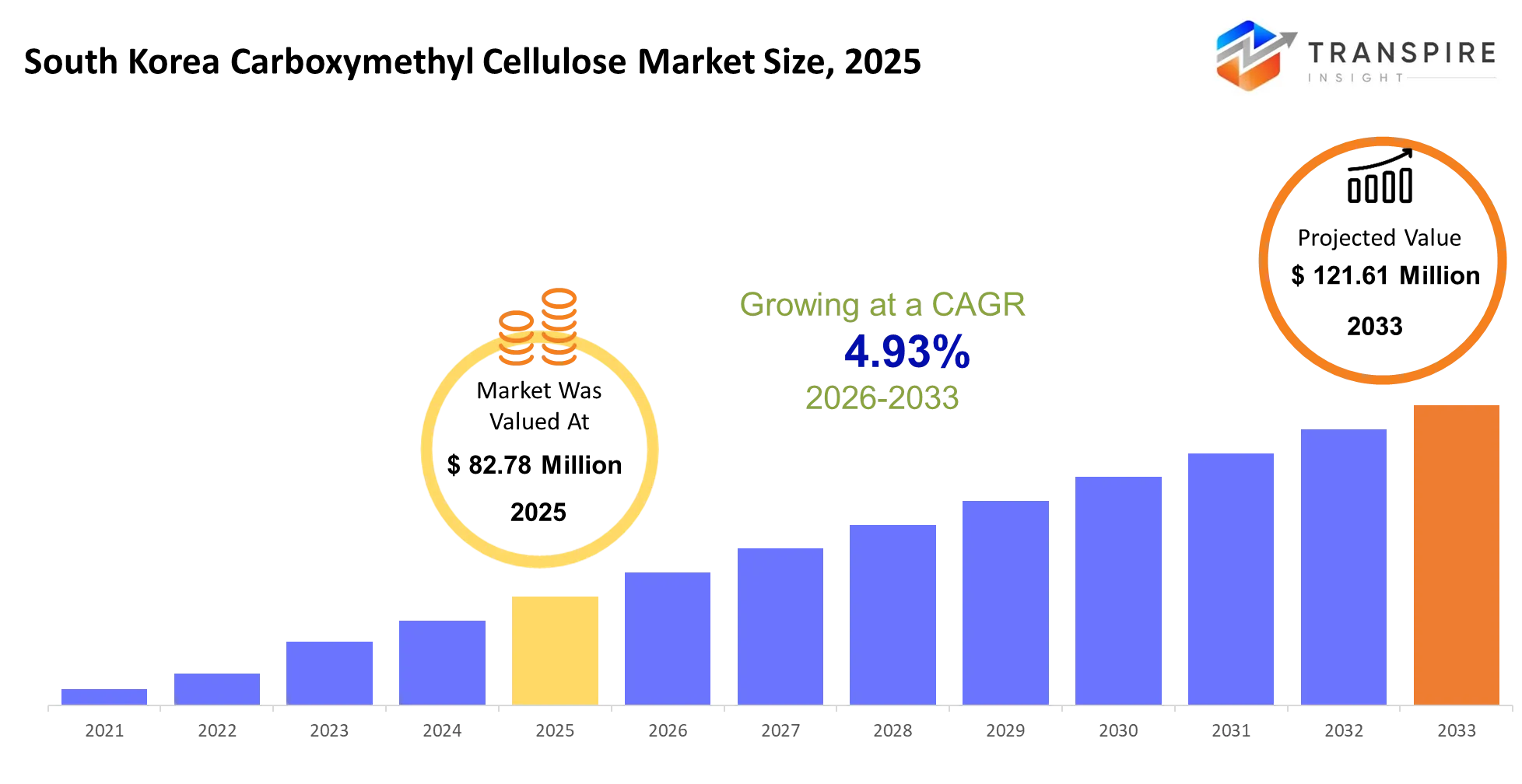
- South Korea Carboxymethyl Cellulose Market Size 2025: USD 82.78 Million
- South Korea Carboxymethyl Cellulose Market Size 2033: USD 121.61 Million
- South Korea Carboxymethyl Cellulose Market CAGR: 4.93%
- South Korea Carboxymethyl Cellulose Market Segments: By Grade (Food Grade CMC, Pharmaceutical Grade CMC, Industrial Grade CMC, Cosmetic Grade CMC, Others); By Application (Food & Beverage, Pharmaceuticals, Oil & Gas Drilling, Personal Care, Detergents, Others); By Form (Powder CMC, Granular CMC, Liquid CMC, Others); By End User (Food Industry, Pharmaceutical Industry, Oil & Gas Industry, Cosmetics Industry, Others); By Function (Thickening Agent, Stabilizer, Binder, Emulsifier, Others)
To learn more about this report,  Download Free Sample Report
South Korea Carboxymethyl Cellulose Market Summary
The South Korea Carboxymethyl Cellulose Market was valued at USD 82.78 Million in 2025. It is forecast to reach USD 121.61 Million by 2033. That is a CAGR of 4.93% over the period.
The South Korea Carboxymethyl Cellulose Market kind of plays a big role in keeping things steady in formulations, it helps with viscosity and generally pushing product outcomes across pharmaceuticals, food processing, personal care, detergents, and even battery making. In real practice, manufacturers often lean on carboxymethyl cellulose so the texture stays consistent in processed foods, also it assists with tablet binding in pharma, plus it makes slurry behavior stronger for lithium-ion battery electrodes. Over the last five years, the whole market seems to have moved away from basic commodity-grade cellulose derivatives toward higher-purity options and more tailored, application-focused formulations, especially for electric vehicle battery materials and newer healthcare use cases.
This change actually sped up after those global supply chain interruptions in 2021–2023, because they basically showed South Korean producers how exposed they were to raw material swing and import dependency, not just cost but reliability too. And when battery producers started expanding domestic capacity under Korea’s EV industrial strategy, the specialty CMC suppliers got more leverage on pricing and they secured longer term contracts. Now that shift is driving more use of premium cellulose grades, improving operating margins, and it’s reshaping how competitors fight, like they compete more on technical performance, rather than just bulk pricing alone.
Key Market Insights
- South Korea carboxymethyl cellulose market demand, from lithium-ion battery manufacturers went up by more than 18% between 2022 and 2025 because EV supply chain localization sorta kicked in.
- In 2025, Gyeonggi Province represented almost 38% of industry consumption, largely driven by grouped pharmaceutical and advanced materials manufacturing clusters, you know the kind.
- Battery-grade CMC showed up as the quickest growing product segment after Korean EV cell producers expanded anode material output throughout 2023–2025.
- Meanwhile, food-grade carboxymethyl cellulose stayed with the biggest market share in 2025, backed by processed food exports and texture stabilization needs, more or less.
- For 2025, pharmaceutical uses grabbed above 22% market share as Korean drug makers stepped up tablet coating and controlled-release production.
- Personal care applications also picked up steam after 2023, since cosmetic manufacturers started using premium viscosity-control ingredients, especially for export-oriented skincare blends.
- Ashland, in 2025, expanded specialty additives optimization programs to boost profitability and to stay focused on high-value cellulose technologies.
- CP Kelco and Nouryon increased their attention on high-performance industrial formulations for coatings and battery uses across Asia-Pacific markets, at a fairly consistent pace.
- South Korean producers increasingly moved away from imported commodity cellulose derivatives toward localized specialty production after logistics disruptions raised procurement risks during 2021–2023.
- Then after 2024, strategic partnerships between chemical suppliers and battery makers intensified, because manufacturers were chasing longer-term raw material security, and also formulation customization options.
What are the Key Drivers, Restraints, and Opportunities in the South Korea Carboxymethyl Cellulose Market?
The strongest growth driver in the South Korea Carboxymethyl Cellulose Market comes from this rapid, messy kind of expansion in domestic lithium-ion battery manufacturing. South Korea battery producers have put more money into electric vehicle supply chain setups after the United States Inflation Reduction Act, and then the regional localization policies… basically encouraging non-Chinese sourcing. That change has boosted demand for battery-grade CMC , because it is used as a binder and also a rheology modifier in anode slurries. Right now manufacturers seem to favor higher-purity cellulose formulations that can improve electrode stability, increase cycle life and keep slurry uniformity more consistent. As those battery factories keep scaling output, suppliers with technical-grade formulations are moving toward longer-term supply agreements, and in turn they get better revenue visibility, too
The biggest restraint is still raw material volatility tied to purified cellulose feedstock and energy-demanding processing costs. This is sort of structural , since South Korea still leans on imported cellulose pulp and specialty intermediates. Currency swings , freight disruptions and uneven global pulp availability keep squeezing operating margins. Smaller producers tend to absorb less of these cost swings, so capacity expansion gets delayed and they lose ground on competitiveness against larger multinational suppliers
A major opportunity is also showing up in pharmaceutical excipients, plus controlled drug release systems . South Korea contract drug manufacturing is growing quickly, supported by export-oriented biologics and generic medicine work. High-purity CMC grades used for tablet binding and suspension stabilization are starting to get real traction with domestic pharmaceutical firms. Suppliers who invest in pharmaceutical-grade certification, low-contaminant processing, and customized formulation.
What Has the Impact of Artificial Intelligence Been on the South Korea Carboxymethyl Cellulose Market?
Artificial intelligence is kind of remaking operational efficiency across the South Korea Carboxymethyl Cellulose Market, especially in chemical processing , quality control, and also battery material manufacturing. A lot of producers are rolling out AI based monitoring systems, to squeeze better viscosity consistency, moisture levels, and reaction stability during cellulose ether production. For lithium ion battery uses, machine learning models are getting used so manufacturers can anticipate slurry behavior, and then improve electrode coating uniformity before they even start full scale production. The overall effect is fewer rejected batches, and faster formulation development, more or less.
At the same time, advanced analytics platforms are pushing predictive maintenance across chemical plants. AI systems keep an eye on temperature swings, equipment vibration, and energy consumption patterns, so operational anomalies get flagged before production downtime actually shows up. A few South Korean specialty chemical manufacturers mentioned a directional uptick in production uptime, along with lower energy losses after integrating automated process control, during 2023-2025.
Digital twin technologies are also becoming more relevant for pharmaceutical grade CMC manufacturing. They essentially simulate formulation performance under different humidity, and processing conditions, which feels pretty important when requirements get tighter. With that, producers can better satisfy stricter quality specifications tied to export markets, overall.
Still, there’s a clear limitation with AI adoption. A bunch of mid sized manufacturers are stuck with legacy processing infrastructure that does not have integrated sensor networks, and standardized production data. The high integration costs and the messy, fragmented operational datasets keep slowing down wider deployment of advanced AI systems across the broader specialty cellulose ecosystem.
Key Market Trends
- South Korean battery manufacturers started pulling in more battery-grade CMC, roughly 18% higher over 2023–2025, after their home EV supply chain investments somehow kicked into a faster gear.
- Processed food companies then moved toward premium stabilizer blends as export-driven producers tightened their texture consistency, and also pushed longer shelf-life targets for overseas customers.
- Pharmaceutical producers leaned into higher-purity cellulose derivatives too, after Korean drug exports to North America and Europe rose, by more than 12% from 2022 through 2025.
- Local manufacturers also loosened their reliance on imported industrial additives following logistics disruptions plus raw material shortages that were felt during the 2021–2023 global supply chain crisis.
- Digital quality-control systems became a lot more common, especially once manufacturers aimed for nearly 15% lower batch rejection rates and stricter viscosity tolerances, in 2024.
- Ashland ran manufacturing optimization programs in 2025 to boost cost competitiveness in specialty additives production, and that mattered.
- Competition got sharper between multinational suppliers and regional producers, because Korean buyers started preferring customized formulations rather than standardized bulk products for industrial use.
- Cosmetic ingredient suppliers increasingly used specialty cellulose mixes after South Korean skincare exports went beyond USD 10 billion across Asia-Pacific markets in 2024.
- Sustainability audits became more persuasive in purchasing decisions, once major industrial buyers rolled out tighter supplier traceability and emissions reporting requirements during 2024.
- Long-term supply agreements expanded, across both battery and pharmaceutical sectors, as manufacturers tried to guard themselves from raw material price swings and procurement yeah, more “planning” than just buying.
South Korea Carboxymethyl Cellulose Market Segmentation
By Grade
Food Grade CMC keeps that top market spot pretty much because it gets used a lot across processed foods , bakery setups , dairy stabilisation , and also for thickening beverages. There’s high consumption from food producers so demand stays pretty steady, since product consistency and texture handling are still kinda non negotiable for large scale manufacturing. The Pharmaceutical Grade CMC is not far behind, it gets picked for tablet binding , suspension setups , and controlled release drug formulas where performance needs to stay predictable. Industrial Grade CMC holds steady as well, mainly for detergents, drilling fluids, and coatings , where cost effectiveness usually matters more than very high purity.
Food Grade CMC is still moving up because export focused Korean food manufacturers keep pushing for dependable shelf-life behavior and uniform texture. Pharmaceutical Grade CMC gets a boost from growing drug exports and tougher formulation requirements in regulated regions like North America and Europe. Industrial Grade CMC is seeing moderate headwinds from replacement by higher performance additives in a few specific use cases. Cosmetic Grade CMC is also expanding as personal care brands adopt viscosity control materials for more premium skincare mixes. Other types stay more niche but they do well when specialty research shows up, plus the whole customized formulation demand keeps things alive.
By Application
Food & Beverage comes out as the biggest application part, mainly because it is used pretty widely to help stabilize sauces, dairy products, baked goods, and processed meals, in a sense it does the job of texture keeping while also helping shelf life. In Korea specifically, the export-led food business runs at high production levels so demand stays pretty steady for additives that improve mouthfeel and keep products lasting longer. Pharmaceuticals are the next major piece, and that one is backed by tablet manufacturing, plus the ongoing expansion of drug formulation across both domestic use and export markets. Detergents then keep a stable role too, mostly driven by the need for viscosity management in liquid cleaning items, so the product flows right.
Oil & Gas Drilling is smaller but still works as a segment, where CMC is applied for fluid loss control and drilling stability—nothing huge, but it keeps showing up. Personal Care is moving ahead at a steady pace, since cosmetic manufacturers are increasingly blending cellulose-based rheology modifiers into skincare and haircare compositions. This growth also lines up with the premium turn in Korean beauty exports, plus more demand for safer formulation supports. Others cover more niche industrial uses, like paper processing and ceramics, which deliver dependable but low-volume pull across various industrial supply chains.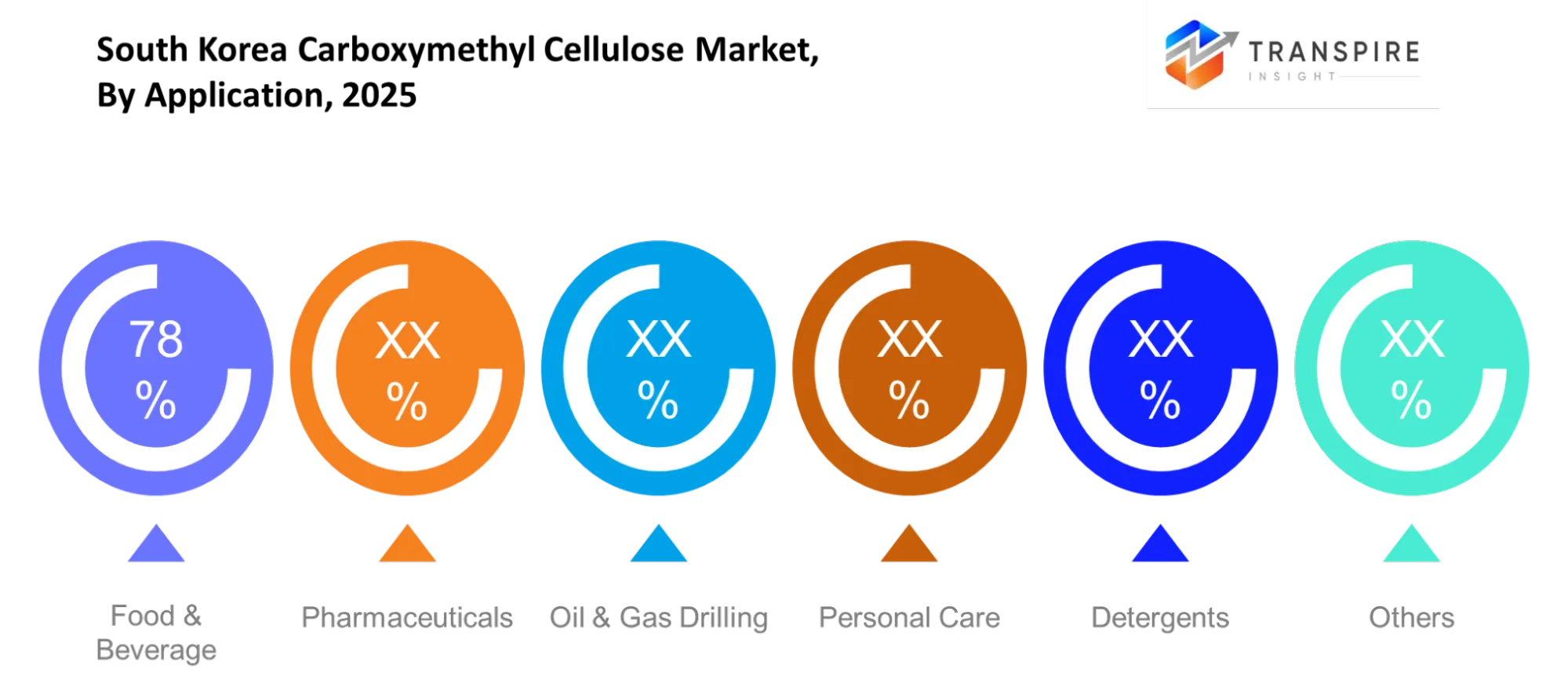
To learn more about this report, Download Free Sample Report
By Form
Powder CMC kinda dominates the market, mostly because it’s easier to store and move around, and it also fits well with those big industrial mixing systems. Its high solubility plus cost efficiency is why it ends up being the go to form across food, pharmaceutical, and detergent production. Granular CMC sits in a secondary spot, especially where people want controlled dissolution, and also less dust during processing, though it’s not the main choice. Liquid CMC still stays a smaller slice of the pie, largely from higher transport costs and, well, limited shelf stability.
The powder form keeps expanding too, because major manufacturers really prioritize bulk handling practicality and standardized manufacturing routines. Granular CMC is getting some moderate momentum in pharma and specialty food use cases, where precision dosing is kind of the priority. Liquid CMC gets used in certain niche industrial setups, but it’s held back by logistics complexity and a shorter storage life. Then there are the “others” category too, meaning custom blends made for specialized manufacturing environments, where tailored viscosity performance matters, and where faster integration into the production flow is needed.
By End User
The Food Industry shows up as the leading end-user slice, basically because stabilizers binders, and emulsifiers are used on a big scale in processed food output. With high-volume production, plus export led supply chains, the demand stays steady for additives that have consistent quality, most days. The Pharmaceutical Industry is close behind, driven by more drug formulation work and a rising need for high-purity excipients, especially for regulated export markets. Meanwhile the Cosmetics Industry keeps moving forward at a fairly stable pace, fueled by skincare innovation and the push toward premium product design.
For Oil & Gas, it is more of a smaller end-user group, but still it is kind of important in practice, CMC helps with drilling fluid stability and supports operational efficiency at the site. And the growth trend for the Pharmaceutical Industry looks even stronger, mostly because stricter compliance rules keep tightening up and contract manufacturing keeps expanding in Korea. In Cosmetics, the expansion continues too, since Korean beauty exports keep growing across different global markets. Then there are the Others category, like industrial manufacturing fields such as paper, textiles, and ceramics, where the demand is more diversified but not quite the same volume, so stability tends to be lower but still present.
By Function
Thickening Agent kind of holds the dominant position, because it’s used everywhere in food formulations, personal care products, and those industrial fluids that need viscosity control, in a pretty direct way. Stabilizer function comes right after it, pushed by the need for texture consistency and also better shelf-life for products in food and beverage use. Binder applications are also kind of critical in pharmaceutical tablet production, where structural integrity matters, and controlled release is the main performance requirement. Emulsifier applications keep steady usage too in food and cosmetic formulations.
Demand for Thickening Agent keeps growing, mainly since manufacturers are focused on better texture and a nicer sensory feel in processed foods and cosmetics. The Stabilizer function gets a boost as export standards rise, and those standards ask for consistent product quality even across long distance supply chains. Binder applications are moving upward too, because pharmaceutical production is increasing and global compliance requirements are getting stricter. Emulsifier use is gaining attention in hybrid cosmetic and food applications, while Others covers specialized roles in coatings, paper processing, and industrial chemical formulations
What are the Key Use Cases Driving the South Korea Carboxymethyl Cellulose Market?
The largest slice of market demand kind of comes from food and beverage processing, where manufacturers use carboxymethyl cellulose to help stabilize the texture, boost viscosity , and stretch shelf consistency in things like dairy products, sauces bakery fillings, and instant foods. In South Korea the export facing processed food segment depends a lot on formulation steadiness, so CMC becomes this basically non optional production material.
Then there’s battery making and pharmaceutical production which are turning into big secondary uses. For lithium ion batteries, battery grade CMC is used as a binder inside anode slurry setups, improving coating steadiness and electrochemical outcomes. On the pharma side, manufacturers also lean on refined cellulose derivatives for tablet binding, suspension stabilization, and controlled-release style drug formulations
More newer directions are also showing up, including biodegradable industrial coatings, better cosmetic mixes, and specialty ceramic processing. Korean personal care brands are, over time, starting to test cellulose based rheology modifiers in premium skincare lines, and meanwhile electronics firms are assessing specialty CMC mixes for high performance conductive material processing through the forecast period.
|
Report Metrics |
Details |
|
Market size value in 2025 |
USD 82.78 Million |
|
Market size value in 2026 |
USD 86.85 Million |
|
Revenue forecast in 2033 |
USD 121.61 Million |
|
Growth rate |
CAGR of4.93% from 2026 to 2033 |
|
Base year |
2025 |
|
Historical data |
2021 - 2024 |
|
Forecast period |
2026 - 2033 |
|
Report coverage |
Revenue forecast, competitive landscape, growth factors, and trends |
|
Regional scope |
South Korea |
|
Key company profiled |
Ashland Global, CP Kelco, Nouryon, Daicel Corporation, Lamberti, DKS Co. Ltd., Akzo Nobel, Shandong Head Group, Nippon Paper Industries, Ugur Seluloz Kimya, Química Amtex, Sinocmc, Wealthy Chemical Industry, Fushixin Polymer Fiber, Amtex |
|
Customization scope |
Free report customization (country, regional & segment scope). Avail customized purchase options to meet your exact research needs. |
|
Report Segmentation |
By Grade (Food Grade CMC, Pharmaceutical Grade CMC, Industrial Grade CMC, Cosmetic Grade CMC, Others); By Application (Food & Beverage, Pharmaceuticals, Oil & Gas Drilling, Personal Care, Detergents, Others); By Form (Powder CMC, Granular CMC, Liquid CMC, Others); By End User (Food Industry, Pharmaceutical Industry, Oil & Gas Industry, Cosmetics Industry, Others); By Function (Thickening Agent, Stabilizer, Binder, Emulsifier, Others) |
Which Regions are Driving the South Korea Carboxymethyl Cellulose Market Growth?
Asia-Pacific still feels like the big dominant regional force within the South Korea Carboxymethyl Cellulose Market , mainly because the area basically stacks several drivers at once. Large scale battery manufacturing, advanced food processing capability, and solid pharmaceutical production networks all show up together. China, South Korea, and Japan in particular, jointly host the highest clustering of lithium-ion battery manufacturing facilities in the world. South Korea gets an extra advantage from integrated chemical processing infrastructure, and from policy support that clearly backs EV supply chain localization. Also, the region’s rather mature industrial ecosystem helps speed up the commercialization of specialty cellulose formulations—especially for electronics and healthcare uses, even when adoption cycles are not always smooth.
North America comes in as the second-largest contributor though, but the way it moves is kind of different compared to Asia-Pacific. In that region, growth is driven less by pure manufacturing scale and more by regulatory compliance, pharmaceutical innovation , and domestic battery reshoring investment. The United States expanded incentives for localized EV battery supply chains after 2022, this has created a steady procurement pull for high-performance cellulose binders. On top of that, long-term agreements between specialty chemical suppliers and battery producers keep revenue generation more stable across the region, because volumes tend to be prearranged.
Europe is currently showing the fastest growth. That happens due to strict sustainability mandates, plus accelerated investment in battery infrastructure. Since 2023, new EV battery plants announced across Germany, Hungary , and France have increased demand for high purity binder materials and specialty additives. European regulators also tightened quality checks and traceability requirements for industrial chemical inputs. So suppliers with stronger processing capabilities are more likely to get preferred status. Overall, this regional change should open attractive opportunities for exporters and technology.
Who are the Key Players in the South Korea Carboxymethyl Cellulose Market and How Do They Compete?
Competition in the South Korea Carboxymethyl Cellulose Market stays kind of moderately consolidated, with multinational specialty chemical producers holding most of the premium application space ,while regional manufacturers push back pretty hard on cost and that supply flexibility angle. Lately the whole market seems to lean toward technical formulation know-how more than big volume commodity output. Buyers in battery materials, pharmaceuticals, and food processing now tend to look first for purity consistency, regulatory certifications , and also application-specific tinkering when they pick vendors.
Ashland Global leans into high-value specialty additives and pharmaceutical-grade cellulose technologies rather than chasing low-margin commodity volumes. They also talked about manufacturing optimization efforts announced in 2025, which helped shore up margin resilience even when raw materials get volatile . CP Kelco keeps separating itself via hydrocolloid know-how and long standing relationships with major food manufacturers, where customized viscosity and stabilization solutions matter. Nouryon competes using specialty industrial formulations plus an R&D approach that’s tuned to coatings, detergents , and advanced materials.
Daicel Corporation leans on its strong Japanese materials science ecosystem to move further into electronics and healthcare uses that demand precision-grade cellulose derivatives. Nippon Paper Industries benefits from upstream pulp integration , giving it steadier feedstock control and better cost management than smaller specialty producers. Chinese suppliers such as Shandong Head Group are also showing up more often , typically via scale economics and export-focused manufacturing, especially across industrial-grade cellulose segments across
Company List
- Ashland Global
- CP Kelco
- Nouryon
- Daicel Corporation
- Lamberti
- DKS Co. Ltd.
- Akzo Nobel
- Shandong Head Group
- Nippon Paper Industries
- Ugur Seluloz Kimya
- Química Amtex
- Sinocmc
- Wealthy Chemical Industry
- Fushixin Polymer Fiber
- Amtex
Recent Development News
In July 2025, Ashland announced progress on its USD 60 million manufacturing network optimization initiative. The restructuring strengthened operational efficiency and improved the company’s cost competitiveness in specialty cellulose and additives production.https://www.technologytimesnewjersey.com
In June 2025, Ashland showcased its Bondwell carboxymethylcellulose binders for lithium-ion batteries at The Battery Show Europe 2025. The launch reinforced the company’s strategy to expand into EV battery materials and high-performance energy storage applications.https://solving.ashland.com
What Strategic Insights Define the Future of the South Korea Carboxymethyl Cellulose Market?
The South Korea Carboxymethyl Cellulose Market is kinda drifting toward high purity, application specific mixtures that hook up with EV batteries, pharmaceuticals and more advanced industrial products. The real move underneath this shift is the increasing need for reliable performance consistency, plus localized supply channels inside industries that are kinda strategically sensitive. In the next five to seven years, providers who can ship customized formulations, with tighter quality tolerances will likely end up taking more than their fair share of market value.
One smaller noticed risk is feedstock concentration exposure. A lot of producers still rely on imported purified cellulose pulp. So their margins get squeezed by freight volatility, energy price swings, and geopolitical trade disruptions, sometimes all at once. This problem could get worse if battery grade CMC demand ramps up faster than the upstream raw material capacity expansion pace.
A big emerging chance is tied to the next generation sodium ion batteries, where specialized cellulose binders are starting to see early commercial attention. The pitch here is cost and thermal stability advantages, which sounds good to buyers early on. Firms that invest early in battery material partnerships, and also offer localized technical support, may be able to lock in strong competitive positioning before broad adoption really kicks off.
Market actors should focus on vertical integration, diversify regional sourcing, and run application focused R&D, rather than trying to win purely by competing on commodity pricing alone.
South Korea Carboxymethyl Cellulose Market Report Segmentation
By Grade
- Food Grade CMC
- Pharmaceutical Grade CMC
- Industrial Grade CMC
- Cosmetic Grade CMC
- Others
By Application
- Food & Beverage
- Pharmaceuticals
- Oil & Gas Drilling
- Personal Care
- Detergents
- Others
By Form
- Powder CMC
- Granular CMC
- Liquid CMC
- Others
By End User
- Food Industry
- Pharmaceutical Industry
- Oil & Gas Industry
- Cosmetics Industry
- Others
By Function
- Thickening Agent
- Stabilizer
- Binder
- Emulsifier
- Others
Frequently Asked Questions
Find quick answers to common questions.
The Estimated South Korea Carboxymethyl Cellulose Market size for the Market will be USD 121.61 Million in 2033.
Key Segments for the South Korea Carboxymethyl Cellulose Market are By Grade (Food Grade CMC, Pharmaceutical Grade CMC, Industrial Grade CMC, Cosmetic Grade CMC, Others); By Application (Food & Beverage, Pharmaceuticals, Oil & Gas Drilling, Personal Care, Detergents, Others); By Form (Powder CMC, Granular CMC, Liquid CMC, Others); By End User (Food Industry, Pharmaceutical Industry, Oil & Gas Industry, Cosmetics Industry, Others); By Function (Thickening Agent, Stabilizer, Binder, Emulsifier, Others)
Major South Korea Carboxymethyl Cellulose Market Players are Ashland Global, CP Kelco, Nouryon, Daicel Corporation, Lamberti, DKS Co. Ltd., Akzo Nobel, Shandong Head Group, Nippon Paper Industries, Ugur Seluloz Kimya, Química Amtex, Sinocmc, Wealthy Chemical Industry, Fushixin Polymer Fiber, Amtex
The Current South Korea Carboxymethyl Cellulose Market size is USD 82.78 Million in 2025.
The South Korea Carboxymethyl Cellulose Market CAGR is 4.93% from 2026 to 2033.
- Ashland Global
- CP Kelco
- Nouryon
- Daicel Corporation
- Lamberti
- DKS Co. Ltd.
- Akzo Nobel
- Shandong Head Group
- Nippon Paper Industries
- Ugur Seluloz Kimya
- Química Amtex
- Sinocmc
- Wealthy Chemical Industry
- Fushixin Polymer Fiber
- Amtex
Recently Published Reports
-
May 2026
Healthcare Polymer Packaging Market
Healthcare Polymer Packaging Market Size, Share & Analysis Report By Packaging Type (Syringes, IV Bottles and Pouches, Clamshells, Blisters, Bottles & Jars, Containers, Tubes, IV Parental Packaging, Others), By Type (Regulated, Non-regulated), By Polymer Type (LDPE (Low-Density Polyethylene), HDPE (High-Density Polyethylene), Homo-polymer (Homo), Random Copolymer (Random), Block Copolymer (Block), PET, Polystyrene, Polyvinyl Chloride, Polyamide/EVOH, Others), and Geography (North America, Europe, Asia-Pacific, Middle East and Africa, South and Central America), 2021 - 2031
-
Apr 2026
Hydrophilic Tape (Waterstop) Market
Hydrophilic Tape (Waterstop) Market Size, Share & Analysis Report By Type (Bentonite-Based Hydrophilic Tape, Rubber-Based Hydrophilic Tape), By Application (Residential Buildings, Commercial Buildings, Infrastructure Projects), and Geography (North America, Europe, Asia-Pacific, Middle East and Africa, South and Central America), 2021 - 2031
-
Apr 2026
Metalens Market
Metalens Market Size, Share & Analysis Report By Type (Visible Light Metalens, and Infrared Metalens), By Application (Consumer Electronics, Automotive Electronics, Industrial, Medical, and Others), and Geography (North America, Europe, Asia-Pacific, Middle East and Africa, South and Central America), 2021 - 2031
-
Apr 2026
PBT Resin Market
PBT Resin Market Size, Share & Analysis Report By Type (Reinforced PBT Resin, Unreinforced PBT Resin), By Processing Method (Injection Molding, Extrusion, Blow Molding, Others), By End-User (Automotive, Electrical & Electronics, Consumer Appliances, Industrial Machinery, Medical Devices, Packaging, Others), and Geography (North America, Europe, Asia-Pacific, Middle East and Africa, South and Central America), 2021 - 2031