
South Korea Calcium Sulfate Market Size & Forecast:
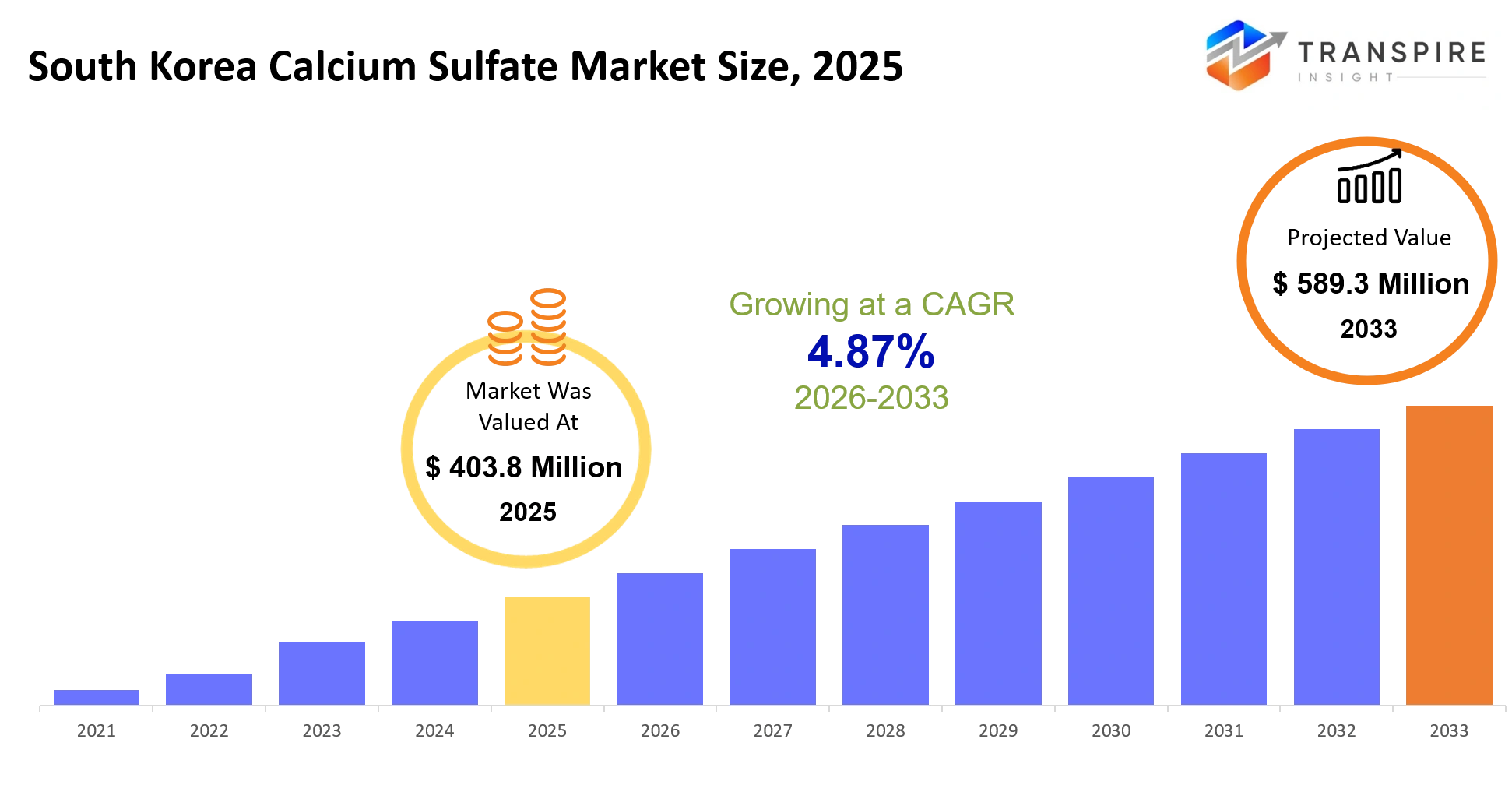
- South Korea Calcium Sulfate Market Size 2025: USD 403.8 Million
- South Korea Calcium Sulfate Market Size 2033: USD 589.3 Million
- South Korea Calcium Sulfate Market CAGR: 4.87%
- South Korea Calcium Sulfate Market Segments: By Type (Gypsum, Anhydrite, Hemihydrate, Others); By Application (Construction, Agriculture, Food Additives, Pharmaceuticals, Others); By End User (Construction, Agriculture, Industrial, Others).
South Korea Calcium Sulfate Market Summary
The South Korea Calcium Sulfate Market was valued at USD 403.8 Million in 2025. It is forecast to reach USD 589.3 Million by 2033. That is a CAGR of 4.87% over the period.
From a practical standpoint, the South Korean market for calcium sulfate produces base material that can form dry walls, cement boards, industrial molds, used as stabilizers in the construction industry, and specific grades for food & drugs. Within 5-year period, there is a shift in structural supply of the market towards synthetic gypsum (originated from Flue-Gas Desulfurization processes) due to the South Korea's environmental regulations imposed on coal-fired power generation industry, which drove up imported natural gypsum prices due to international shipping restrictions in the past global logistics crunch.
As a result, cement manufacturers as well as board producers changed procurement tactics towards domestic recycled supply, decoupling calcium sulfate demand from imported material. Therefore, its market is stabilized by guaranteed supply of industrial byproducts and the construction sector has found a new stabilization factor, which can help it to be rebuilt. Local supply of construction & high purity industrial grades is thus consolidated in certain positions.
Key Market Insights
- The synthetic gypsum market shares the biggest share and will take more than 55% of the South Korea Calcium Sulfate Market as a byproduct of flue-gas desulfurization in 2025.
- Rapidly implemented regulatory decarbonization policies (2021-2025) promote the substitution of imported natural gypsum in cement and drywall supply chain.
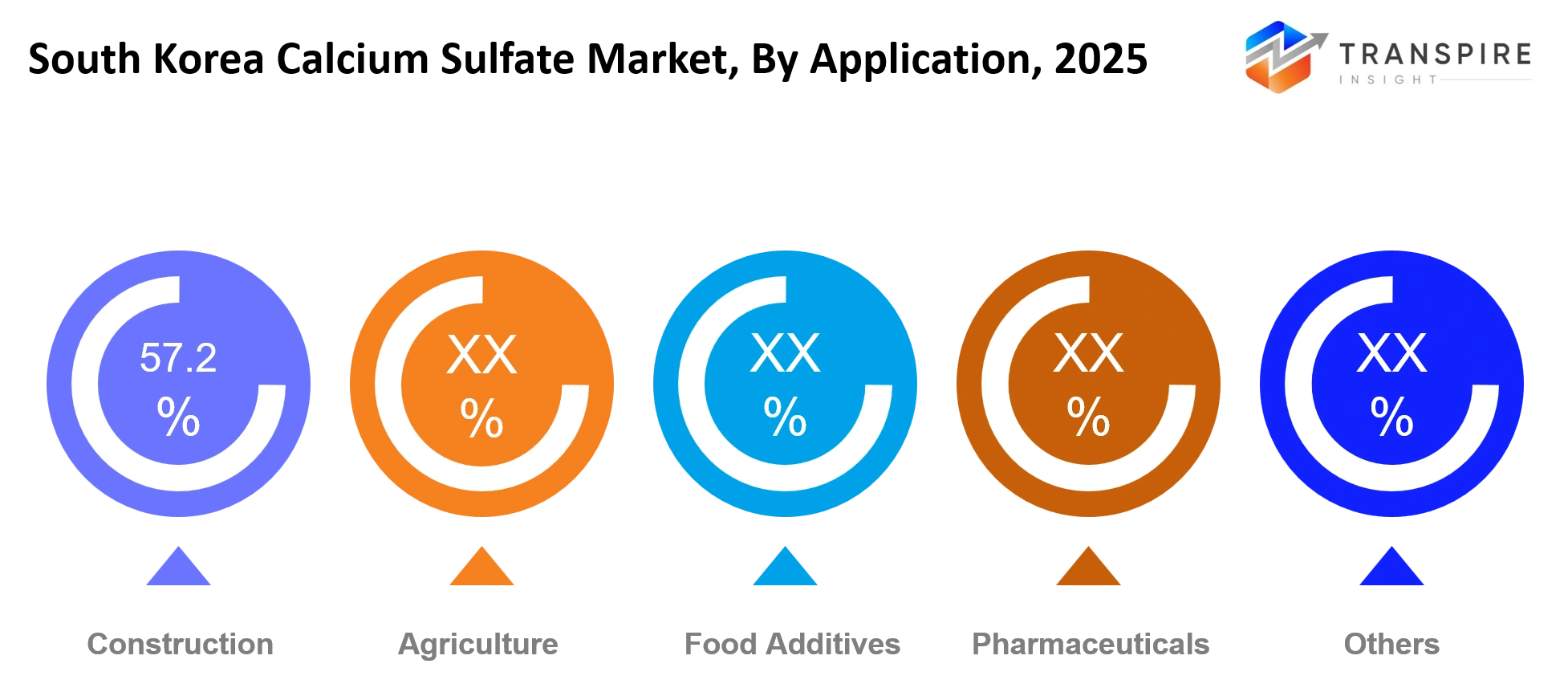
- Construction-grade calcium sulfate captured a share of nearly 48%, due to renovation in residence and retrofit in commercial building industries.
- Industrial-grade calcium sulfate, as the fastest growing segment, witnessed remarkable growth in 2024-2030 in pharmaceutical and specialty chemical applications.
- Seoul-Gyeonggi region has about 42% share and accounts for the most share of the South Korea Calcium Sulfate Market because of the high density of construction and manufacturing industries.
- Southern coastal provinces achieve a fast growth due to the expansion of port-connected industrial activities and new eco-industrial parks developing projects.
- The highest share product is construction-grade calcium sulfate for wall systems, drywall, and cement boards in the South Korea Calcium Sulfate Market.
- Synthetic gypsum-based products show the fastest growing trend due to improvements in waste utilization technology.
- The building material industry, with approximately 60% of the South Korea Calcium Sulfate Market share, will remain the dominant application industry.
- Pharmaceutical and food additives are expected to grow the fastest in demand due to improved purity standards and regulated excipients supply needs.
What are the Key Drivers, Restraints, and Opportunities in the South Korea Calcium Sulfate Market?
Sulfur emission controls in the power and industrial segments, which generate flue-gas desulfurization gypsum, are the main driving force in the South Korea Calcium Sulfate Market. The structural transformation has facilitated a consistent domestic source of raw material, decreasing reliance on imports and production instabilities for cement board and construction material makers, and consequently the use of calcium sulfate has become coupled to regulated industrial systems rather than the mining industry.
Quality inconsistencies within recycled gypsum streams remains a major constraint, thereby restricting the use in high purity pharmaceutical and specialty applications. This issue results from the inconsistency of industrial desulfurization feeds, hence, extra refining process adds production costs, and delays expansion in South Korea Calcium Sulfate Market's premium sectors.
Advanced purification and material upgradability solutions to produce high-grade gypsum for regulated sectors represent the greatest opportunity. Increasing investment in AI sorting and refinement plants in industrial regions such as Ulsan and Incheon, are likely to facilitate more profitable applications and develop export capacity in the coming years of growth.
What Has the Impact of Artificial Intelligence Been on the South Korea Calcium Sulfate Market?
AI is now an integral part of the calcium sulfate ecosystem through an integrated automatic control system and the digitization of flue-gas desulfurization plants. Today's cement and gypsum factories rely on the input of AI sensors which enable them to optimize and stabilize sulfur absorption and the quality of the calcium sulfate produced (while controlling temperature, moisture, proportions of chemical inputs in the stream).
Consequently, the quality of production and waste of exhaust-gas treatment technology chains has greatly enhanced. Machine learning models are also implemented to conduct predictive maintenance operations on the scrubber plants and the industrial ovens, enabling producers to foresee future wear and breakdown on machines prior to failure. This predictive model has enhanced the machinery uptime and also the energy efficiency thanks to a better cycle management during combustion on industrial ovens in power-integrated gypsum plants.
On operational sides producers declare better monitoring over environmental regulation fulfillment and lower energy costs due to predictive AI driven forecast tools allowing better control of emission standards; however these are still subject to the price of the implementation and the lack of real time data transmission from widespread production site especially from small regional units where network access remains irregular.
Key Market Trends
- Shifted from imported natural gypsum to synthesized calcium sulfate since 2020, ranging from less than 40% to more than 55%.
- Expanded flue-gas desulfurization output from coal power plants due to rigorous sulfur emission regulations for 2021-2025 and reoriented material supplying flow.
- Reduced importing volume since 2022 due to severe impact on the maritime transport and secured domestic calcium sulfate sources among Korean manufacturers after the global shipment turmoil.
- The trend of Korean construction shifted from newly built constructions to building retrofits in 2023 and it expedited the cycles of gypsum board replacement.
- Increase the adoption of pharmaceutical grade calcium sulfate following the tightened excipient purity regulations from Korean authorities in the amendment of 2022-2024 compliance.
- Implemented AI technology in the process supervision after 2023 and gained enhanced kiln operation efficiency as well as reduced energy loss in the processing plant of gypsum.
- Augmented production capacity of calcium sulfate at the south coastal industrial zone after the expansion of the port linked eco industrial parks from 2024.
- Global corporations including Saint-Gobain and Knauf increased localizations of their operations in Korea thereby reduced the volume of importing and strengthened the controls in the local sourcing.
- Enhanced recycling rates in industrial byproducts from 2023 onwards under the circular economy policies in Korea which consequently increased the use of synthesized calcium sulfate in various industries.
South Korea Calcium Sulfate Market Segmentation
By Type :
Gypsum usage continues to be the dominant form in both construction materials and board manufacturing, with a continuing steady supply from industrial wastes. The limited demand for anhydrite continues growing in cement addition products where simple use of direct heating proved to be stable. Hemihydrate continues to find a stable use in plaster where quick set time allows for accelerated building at higher speeds.
The gypsum based production has been rising as more efficient power plant flue-gas desulphurization installation. The domestic market is benefiting from this improvement as availability level is increasing. Hemihydrate usage is taking a trend on the interior finishing due to renovation works prevalent in several urban centres. Anhydrite market takes a steady shape and is used for dedicated industrial blending applications which need improved durability and heat resistance.
By Application :
Construction is the main application still as due to the wide usage of wallboards, plaster, and cement products in infrastructure and housing repair. Agriculture use of calcium sulfate is less extensive than in construction as it is used for soil conditioning. Food additivities and pharmaceuticals are growing consistently using the calcium sulfate's highest purity manufacturing.
Construction-Demand is rising as remodeling replaces new housing growth patterns with gypsum board replacement cycles. Pharmaceutical-Applications are expected to grow as new tighter regulation of ingredient compliance rules-effective from 2022-are being implemented. Agricultural-Demand for applications is improving slowly with soil improvement programs; food grade calcium sulfate is experiencing controlled growth in processed food manufacturing requirements.
By End User :
End-use applications within the construction industry account for most consumption levels given the constant need for construction materials as the residential and commercial industries continue repair work. Users in the agricultural sector utilize calcium sulfate for their soil condition. In industrial use, calcium sulfate is used within chemical processes and manufacturing as an input source where constant mineral input is required.
The construction application market grows with the increasing trend of remodeling and energy efficient buildings in metropolitan areas. In the industrial use market, recycling of gypsum materials will rise due to increasing supply stability brought about by the enhancement of the production systems in China. The consumption in agricultural use is steady, due to the incremental improvements in farming techniques and land management projects.
What are the Key Use Cases Driving the South Korea Calcium Sulfate Market?
The primary driver of South Korea's use of calcium sulfate is construction, particularly in gypsum boards, plasters, and cement panels for home renovations and commercial interior fitting. The high demand reflects the builders' continued adoption of calcium sulfate due to rapid installation times, fire safety characteristics and the benefits of controlling construction costs within cycles of tight urban construction.
Secondary uses include agricultural soil conditioning and pharmaceutical grade use where a stringent level of purity is required. Use in food processing includes applications as a food stabilizer, whilst industrial applications involve uses such as molding and chemical processes.
New applications in recent times involve high-purity recycled gypsum recovered from flue gas and the increase in the advanced materials recovery promoted by the growing trend towards circular economy principles. This also includes increased use in AI-aided quality control processes, as well as the adoption of low carbon construction materials due to tightening emissions control regulations.
|
Report Metrics |
Details |
|
Market size value in 2025 |
USD 403.8 Million |
|
Market size value in 2026 |
USD 422.5 Million |
|
Revenue forecast in 2033 |
USD 589.3 Million |
|
Growth rate |
CAGR of 4.87% from 2026 to 2033 |
|
Base year |
2025 |
|
Historical data |
2021 - 2024 |
|
Forecast period |
2026 - 2033 |
|
Report coverage |
Revenue forecast, competitive landscape, growth factors, and trends |
|
Country scope |
South Korea |
|
Key company profiled |
USG, Saint-Gobain, Knauf, Yoshino Gypsum, National Gypsum, Etex, Georgia-Pacific, Boral, Lafarge, Holcim, Siniat, Gypsemna, American Gypsum, CertainTeed, Gyproc. |
|
Customization scope |
Free report customization (country, regional & segment scope). Avail customized purchase options to meet your exact research needs. |
|
Report Segmentation |
By Type (Gypsum, Anhydrite, Hemihydrate, Others); By Application (Construction, Agriculture, Food Additives, Pharmaceuticals, Others); By End User (Construction, Agriculture, Industrial, Others). |
Which Regions are Driving the South Korea Calcium Sulfate Market Growth?
Seoul-Gyeonggi province will dominate the South Korean Calcium Sulfate Market because of concentrated building industry and Strict building materials standard control. Continuous demand from major residential redevelopment projects and reconstruction of commercial infrastructure boost the construction sector. A concentration of large producers in the cement industry and gypsum wallboard manufacturing facilities ensures domestic consumption is still large. Moreover, Incheon port logistics are good in both imports, substitution, and export of goods.
Busan-Ulsan-Gyeongnam province is a mature second cluster, its demand from heavy industries is less dependent on the building cycle. Industries including shipbuilding, petrochemicals, and general manufacturing maintain stable usage demand for calcium sulfate in processing and industrial consumption application. In contrast with the capital province, demand is based on long-term industrial contract and export oriented production structure. This enables a relatively stable consumption level throughout the housing market recession.
Southern coastal provinces will grow quickly because eco-industrial parks and recycled gypsum industrial complexes expanded rapidly. New investments in port-oriented manufacturing area following 2024 significantly boost the production capacity on synthetic gypsum recovery. Local governments have introduced circular economy policies to increase consumption of industrial by-products. With this potential over 2026-2033, more new suppliers will flock to Southern coastal provinces seeking for a cost effective production base and export supply chain.
Who are the Key Players in the South Korea Calcium Sulfate Market and How Do They Compete?
The South Korea Calcium Sulfate Market is moderately consolidated with the global material manufacturers facing each other along with local gypsum manufacturers. Competition is seen between firms in synthetic gypsum procurement efficiency, environmental regulations adherence and reliable delivery of material to construction and industrial sector users. In addition, businesses having an integrated recycling system in place coupled with the consistent source of raw materials enjoys the privilege of higher price-control and stable margins.
Saint-Gobain's dominance further strengthened through their high-performance gypsum boards for energy-efficient constructions which are facilitated through certification-based sales in high-end construction ventures. Knauf's investment into cost-effective drywall systems coupled with local manufacturing partnerships aids them to overcome the imports dependencies and provides superior supply chain responsiveness. USG Corporation is focused on technologically advanced formulation of fire resistant boards and serves niches with a rigorous emphasis on safety compliance in construction of commercial infrastructure. Etex Group expands through their lighter construction materials with the cooperation of regional distributors aiding market penetrability in the retrofit segment. Yoshino Gypsum's strong position in Asia stems from their precision-controlled gypsum products and a gradual integration of recycled gypsum into their production.
Company List
- USG
- Saint-Gobain
- Knauf
- Yoshino Gypsum
- National Gypsum
- Etex
- Georgia-Pacific
- Boral
- Lafarge
- Holcim
- Siniat
- Gypsemna
- American Gypsum
- CertainTeed
- Gyproc
Recent Development News
In February 2026, Knauf entered a strategic partnership with regional recycling operators in Asia to increase flue-gas desulfurization gypsum utilization, improving synthetic calcium sulfate recovery rates for construction-grade applications.
Source: https://www.knauf.com
In January 2026, USG Corporation upgraded its automated gypsum board manufacturing lines with digital quality control systems, enhancing calcium sulfate processing consistency and reducing production waste across high-volume drywall facilities.
Source: https://www.usg.com
What Strategic Insights Define the Future of the South Korea Calcium Sulfate Market?
South Korea Calcium Sulfate Market is structurally changing to a circular, on-shore supply chain relying primarily on synthesized gypsum from industrial waste, to dominate the feedstock mix within the next 5-7 years, driven by a gradual enforcement of the decarbonization measures and stable increases in FGDS capacities which reduces demand for imported gypsum for construction and industrial sectors.
An obscure threat is increasing concentration in the supply for synthesized gypsum as reliance on coal-linked industrial production would decrease sooner than expected due to hastened energy transition policies and supply could become tight.
An opportunity, for example, is the emergence of a high-purity recycled calcium sulfate market due to advancements in purification technologies at industrial complexes in coastal regions, targeted at pharmaceutical and fine chemical sectors. Players should invest in production systems capable of switching between construction and high-purity demands in anticipation of regulatory and energy transition related fluctuations.
South Korea Calcium Sulfate Market Report Segmentation
By Type
- Gypsum
- Anhydrite
- Hemihydrate
By Application
- Construction
- Agriculture
- Food Additives
- Pharmaceuticals
By End User
- Construction
- Agriculture
- Industrial
Frequently Asked Questions
Find quick answers to common questions.
The South Korea Calcium Sulfate Market size is USD 589.3 Million in 2033.
Key segments for the South Korea Calcium Sulfate Market are By Type (Gypsum, Anhydrite, Hemihydrate, Others); By Application (Construction, Agriculture, Food Additives, Pharmaceuticals, Others); By End User (Construction, Agriculture, Industrial, Others).
Major South Korea Calcium Sulfate Market players are USG, Saint-Gobain, Knauf, Yoshino Gypsum, National Gypsum, Etex, Georgia-Pacific, Boral, Lafarge, Holcim, Siniat, Gypsemna, American Gypsum, CertainTeed, Gyproc.
The South Korea Calcium Sulfate Market size is USD 403.8 Million in 2025.
The South Korea Calcium Sulfate Market CAGR is 4.87% from 2026 to 2033.
- USG
- Saint-Gobain
- Knauf
- Yoshino Gypsum
- National Gypsum
- Etex
- Georgia-Pacific
- Boral
- Lafarge
- Holcim
- Siniat
- Gypsemna
- American Gypsum
- CertainTeed
- Gyproc
About the Authors

Pankaj Ghogare Patil
I am Pankaj Ghogare Patil, a Senior Research Analyst at Transpire Insight, specializing in the Pharmaceutical, Chemicals & Materials, Healthcare IT, and Biotechnology industry. My expertise lies in conducting comprehensive market research, analyzing industry trends, evaluating competitive landscapes, and translating complex data into actionable insights. At Transpire Insight, I closely follow emerging technologies, regulatory developments, and market innovations to create accurate, well-researched, and informative content that helps businesses and professionals make informed decisions. I am committed to producing credible, evidence-based articles that reflect industry best practices while making technical topics accessible and valuable for a broad audience.

Chakradhar Khansole
Chakradhar serves as the Research Director at Transpire Insight, bringing over 8 years of experience in technology, innovation, and strategic market intelligence. He specializes in transforming complex market data into actionable business insights that enable organizations to make informed, growth-oriented decisions. Recognized for his strategic vision and analytical expertise, Chakradhar leads high-impact research initiatives, delivering comprehensive market assessments, competitive intelligence, and forward-looking industry analysis.
Recently Published Reports
-
May 2026
Healthcare Polymer Packaging Market
Healthcare Polymer Packaging Market Size, Share & Analysis Report By Packaging Type (Syringes, IV Bottles and Pouches, Clamshells, Blisters, Bottles & Jars, Containers, Tubes, IV Parental Packaging, Others), By Type (Regulated, Non-regulated), By Polymer Type (LDPE (Low-Density Polyethylene), HDPE (High-Density Polyethylene), Homo-polymer (Homo), Random Copolymer (Random), Block Copolymer (Block), PET, Polystyrene, Polyvinyl Chloride, Polyamide/EVOH, Others), and Geography (North America, Europe, Asia-Pacific, Middle East and Africa, South and Central America), 2021 - 2031
-
Apr 2026
Hydrophilic Tape (Waterstop) Market
Hydrophilic Tape (Waterstop) Market Size, Share & Analysis Report By Type (Bentonite-Based Hydrophilic Tape, Rubber-Based Hydrophilic Tape), By Application (Residential Buildings, Commercial Buildings, Infrastructure Projects), and Geography (North America, Europe, Asia-Pacific, Middle East and Africa, South and Central America), 2021 - 2031
-
Apr 2026
Metalens Market
Metalens Market Size, Share & Analysis Report By Type (Visible Light Metalens, and Infrared Metalens), By Application (Consumer Electronics, Automotive Electronics, Industrial, Medical, and Others), and Geography (North America, Europe, Asia-Pacific, Middle East and Africa, South and Central America), 2021 - 2031
-
Apr 2026
PBT Resin Market
PBT Resin Market Size, Share & Analysis Report By Type (Reinforced PBT Resin, Unreinforced PBT Resin), By Processing Method (Injection Molding, Extrusion, Blow Molding, Others), By End-User (Automotive, Electrical & Electronics, Consumer Appliances, Industrial Machinery, Medical Devices, Packaging, Others), and Geography (North America, Europe, Asia-Pacific, Middle East and Africa, South and Central America), 2021 - 2031