
South Korea Barium Chloride Market Size & Forecast:
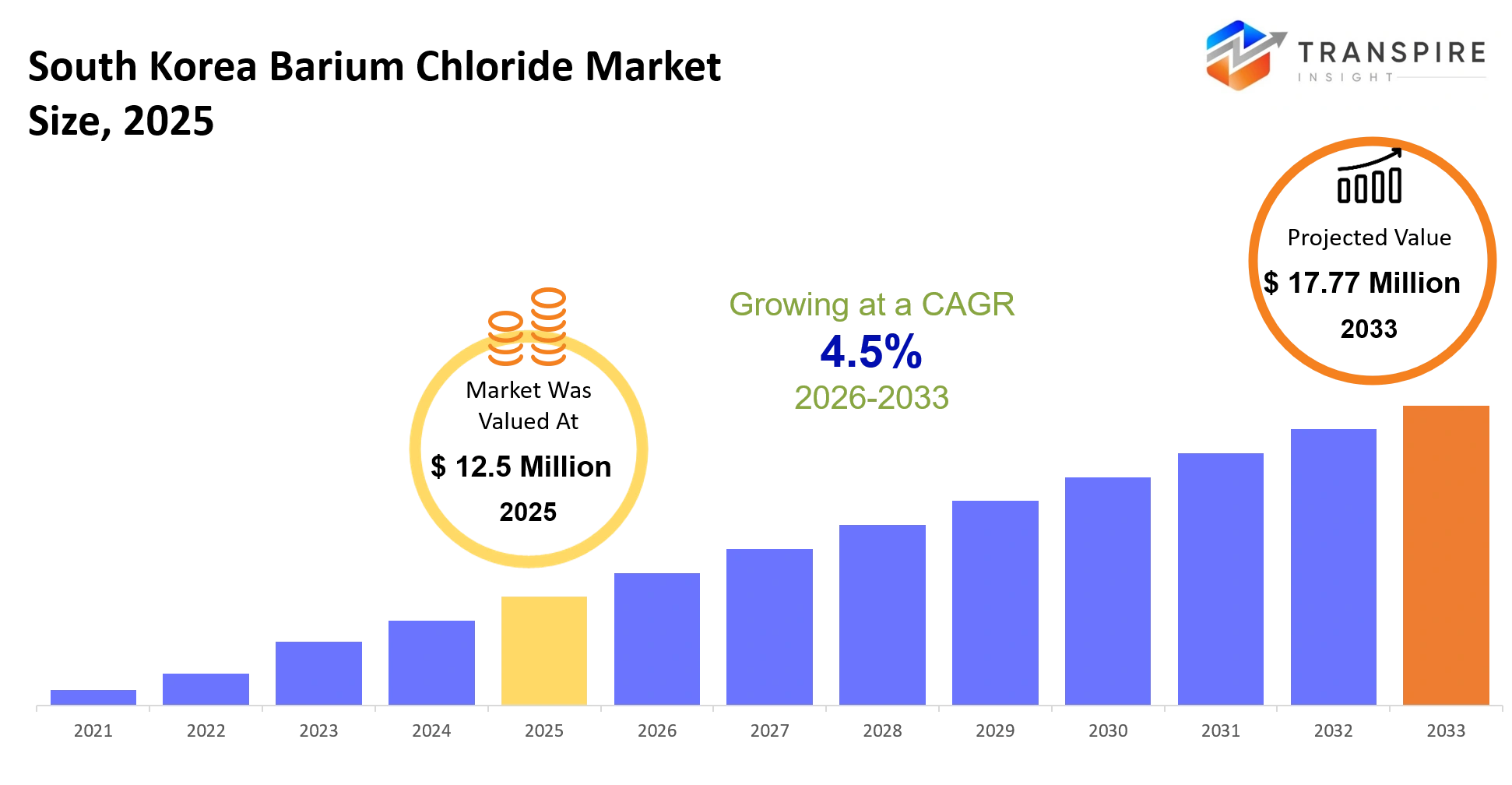
- South Korea Barium Chloride Market Size 2025: USD 12.5 Million
- South Korea Barium Chloride Market Size 2033: USD 17.77 Million
- South Korea Barium Chloride Market CAGR: 4.5%
- South Korea Barium Chloride Market Segments:By Grade (Industrial Grade, Reagent Grade, Others); By Application (Water Treatment, Chemicals Manufacturing, Pigments, Heat Treatment, Others)
To learn more about this report,  Download Free Sample Report
South Korea Barium Chloride Market Summary
The South Korea Barium Chloride Market was valued at USD 12.5 million in 2025. It is forecast to reach USD 17.77 million by 2033. That is a CAGR of 4.5% over the period.
South Korea Barium Chloride Market kinda plays a practical role in industrial processing, where manufacturers use it to pull out sulfate impurities from water and various chemical streams, so the whole process runs smoother and the end product quality feels more steady. On top of that, it shows up in pigment production, a couple heat treatment operations, and specialty chemical manufacturing, in those cases consistent material behavior is basically what keeps industrial output on track.
Over the last five years, there has been a noticeable structural shift toward higher purity chemical inputs in South Korea. This happened as local manufacturers tightened up production expectations, and also leaned more into advanced materials and precision manufacturing. Because of that change, reagent-grade barium chloride, plus more specialized forms, has been used more frequently across industrial sites. One big trigger was global supply chain disruptions, along with raw material price swings, after geopolitical tensions kept surfacing and logistics got slowed down. That pushed firms to rethink how they source materials and to lock in more dependable chemical inventories. Now, as operators keep investing in process refinement, better water treatment efficiency, and higher value chemical output, barium chloride usage is getting more tied to day to day operational performance, which in turn supports stronger market revenues, and wider adoption across industrial sectors.
Key Market Insights
- The South Korea Barium Chloride Market is doing well. It is getting bigger because it is very important for treating water making special chemicals, pigments and doing industrial work.
- The South Korea Barium Chloride Market will keep growing because people need pure chemicals, industries are getting modernized and there is a lot of demand from places that make advanced things.
- Gyeonggi Province is the part of the South Korea Barium Chloride Market and it will have around thirty to thirty five percent of the market in twenty twenty five because it has a lot of industries and factories.
- The Chungcheong region is growing fast and it will keep growing until twenty thirty because people are investing in special chemicals and making new industries.
- There are a lot of industries, around Seoul and Incheon. They need the South Korea Barium Chloride Market for treating water and doing chemical work.
- Industrial Grade is the part of the South Korea Barium Chloride Market and it will have around sixty five to seventy percent of the market in twenty twenty five because it is used a lot for treating water and doing manufacturing work.
- Reagent Grade is the biggest part of the South Korea Barium Chloride Market because it is used in laboratories, research and industries that need very pure things.
- Reagent Grade will grow fast until twenty thirty because people want better quality things.
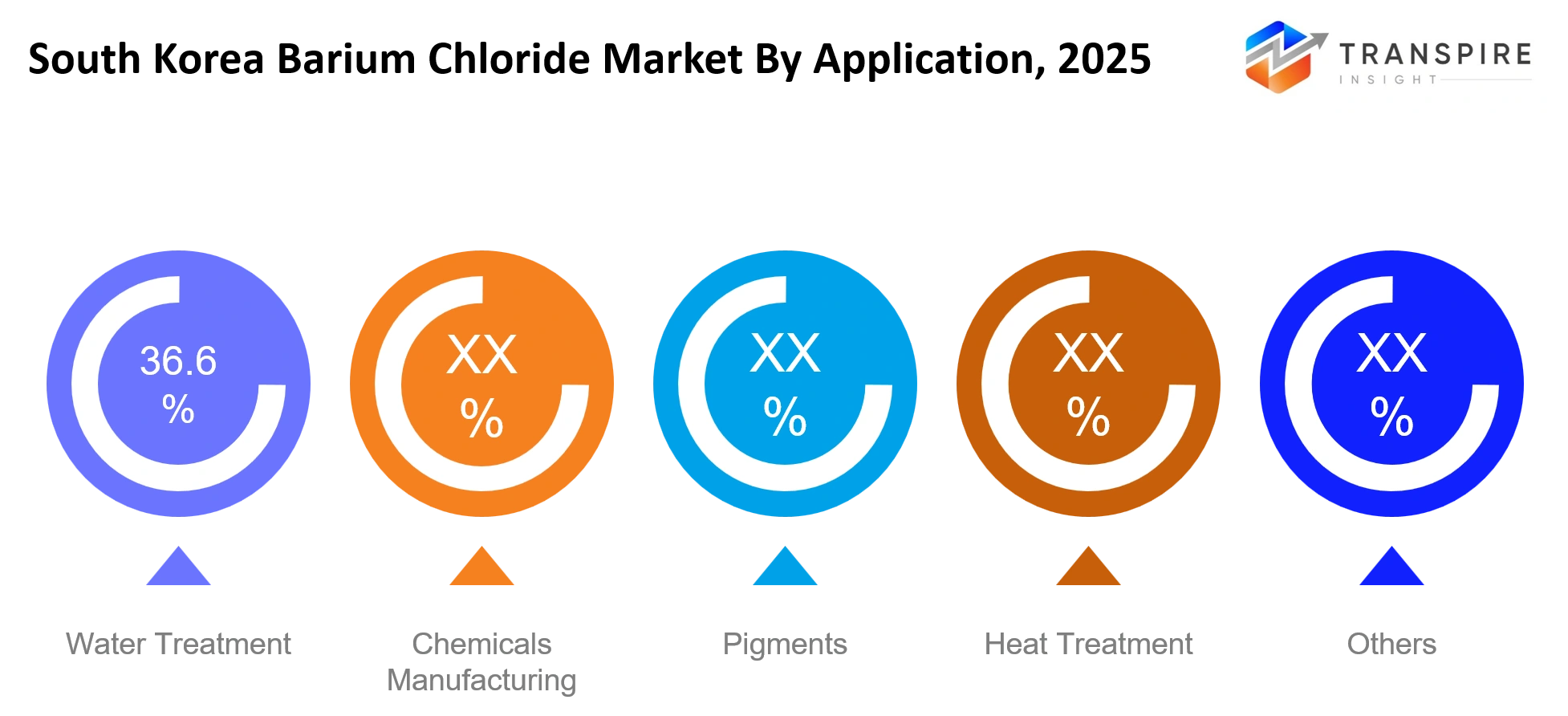
- Water Treatment is the use of the South Korea Barium Chloride Market and it will have around thirty five to forty percent of the market in twenty twenty five because industries need to remove sulfate from water.
- Chemicals Manufacturing is also an use of the South Korea Barium Chloride Market because it helps make special chemicals.
What are the Key Drivers, Restraints, and Opportunities in the South Korea Barium Chloride Market?
The main force pushing the South Korea Barium Chloride Market forward is basically the modernization of industrial processing and, um, water treatment systems. Companies feel pressure to boost production efficiency, trim out impurities , and also satisfy tighter quality expectations in chemical and materials manufacturing. Because of this change, barium chloride is used more often for sulfate removal and for process stabilization. Once plants start upgrading their treatment infrastructure and then switch to higher-performance chemical inputs, consumption tends to rise. At the same time, there is also a stronger pull for premium-grade products. So overall, revenue goes up too, since higher-purity formulations usually get stronger pricing, and they’re also used in more value-added industrial applications.
The biggest obstacle is South Korea’s reliance on imported raw materials and specialty chemical supply chains. That issue is structural, because domestic production capacity for a number of upstream inputs is still limited. And trying to build substitute supply networks takes serious capital spending, plus development timelines that can be kind of long. On top of that, global logistics disruptions and trade uncertainties, along with raw material price swings, can hit procurement costs and overall supply dependability. In many cases, these conditions slow down buying decisions and shrink margin flexibility for manufacturers. In the end, that tends to hold back wider market expansion.
There is a big opportunity sort of hidden inside the expansion of advanced materials and specialty chemical production. South Korea keeps putting money into higher value manufacturing lines, the ones that really need precise chemical processing, plus more strict quality control, like that, every step. So for instance, when specialty pigments start growing, and electronic materials along with advanced industrial chemicals also push forward , that’s when the need for higher-purity, reagent-grade barium chloride increases. As those industries scale up their output and spend time on process optimization, the suppliers that can consistently deliver quality and offer real technical backing will end up with fresh revenue channels .
What Has the Impact of Artificial Intelligence Been on the South Korea Barium Chloride Market?
Artificial intelligence and advanced digital technologies are starting to nudge industrial operations that lean on barium chloride across South Korea’s chemical manufacturing, and also in water treatment. You can see producers using AI enabled process control systems to automate impurity removal, chemical dosing, and reaction monitoring, which kind of helps plants keep product quality steady while also cutting back on manual involvement. In water treatment, smart sensors are running continuously—tracking sulfate concentrations, then they automatically tune barium chloride input levels, so the whole treatment tends to run more efficiently while at the same time reducing chemical waste.
Meanwhile machine learning models are showing up for predictive maintenance on pumps reactors filtration units and storage systems that are tied to chemical processing. By looking at equipment vibration, temperature, and day to day operational data these tools can spot likely failures before anything really goes wrong. So manufacturers often get less unplanned downtime, better asset utilization, and smaller maintenance costs overall. A few sites are even using predictive analytics to anticipate raw material consumption and to fine tune inventory management, which ends up helping stabilize procurement spending during stretches of supply volatility, and in general makes scheduling feel less chaotic.
The operational impact shows up as higher plant uptime, improved process consistency, better compliance with regulations, and more efficient chemical utilization . Still, when it comes to AI adoption there is a significant limitation. A lot of legacy industrial facilities run on fragmented data infrastructure so the whole system integration becomes costly, and that in turn reduces the availability of high quality historical data sets needed to train reliable predictive models. This challenge keeps dragging down larger scale deployment across the wider industry, sort of.
Key Market Trends
- Since 2021 chemical manufacturers have been using more of a kind of barium chloride to make sure the materials they produce are very pure.
- They had to change the way they buy things after there were problems with getting things from countries in 2022.
- Now companies try to get things from different places and keep more extra supplies just in case.
- The people who take care of the water in factories are using machines to add the amount of chemicals, which helps them not waste chemicals and makes the process the same everywhere.
- From 2020 to 2025 manufacturers spent money on digital tools to help them use chemicals in a better way and save money on operating costs.
- Because the cost of energy and raw materials is higher producers are trying to make their processes more efficient so they are updating their systems.
- In South Korea the companies that make special chemicals like to make long-term agreements with suppliers so they are not affected by changes in prices.
- Companies like Merck and Thermo Fisher Scientific are focusing more on making very pure chemicals because the standards for making things are getting stronger.
- The rules about taking care of the environment are making industrial operators try to remove sulfate from the water so they are using special chemical processes.
- Since 2023 the technology that helps predict when machines will break down is being used more in plants, which helps reduce the time the machines are not working and makes them more reliable.
- What makes one company better than another is not about selling a lot of things but, about the quality of the products the help they give to customers and how reliable their supply chain is.
South Korea Barium Chloride Market Segmentation
By Grade:
The market is kind of split into Industrial Grade, Reagent Grade, and Other(s) based on purity levels and what they’re meant for. Industrial Grade takes up a major portion, mostly because it is used a lot in water treatment, chemical manufacturing, pigment production, and heat treatment processes , where cost efficiency and day to day operational performance really matter. Reagent Grade is more about labs, research facilities, and high-precision industrial work , where they want higher purity standards and also tighter quality control. As for the Other(s) bucket , it covers specialized grades made for niche industrial needs, plus customized processing setups that don’t fit the usual profiles.
The gap between these grades comes mainly from purity specifications , how consistent the quality is , and what the end user actually needs. Industrial Grade tends to support big scale industrial operations, while Reagent Grade fits the sectors where accuracy is non negotiable and product quality can’t really slip. And with industrial modernization moving forward, plus more specialty manufacturing activities popping up , grade selection keeps getting shaped across a range of industries.
By Application:
On the basis of application, the market gets split into Water Treatment, Chemicals Manufacturing, Pigments, Heat Treatment, and Others, kindof. Water Treatment is still the key part, because barium chloride is broadly used to get rid of sulfate impurities, and it helps improve process efficiency in industrial water systems. In Chemicals Manufacturing the compound shows up for the creation of multiple chemical intermediates and specialty products, while Pigments applications can benefit from its work in a handful of manufacturing workflows. For Heat Treatment, barium chloride is used in metal processing tasks where a controlled chemical performance is needed, and thats it.
Demand is shaped by industrial output levels, quality expectations, and also process optimization pushes. As manufacturers lean more toward operational efficiency and stronger product standards, the use of barium chloride keeps growing across several industrial procedures. The Others segment covers niche and emerging uses, these support specific technical needs, or industrial constraints , depending on the case.
To learn more about this report, Download Free Sample Report
What are the Key Use Cases Driving the South Korea Barium Chloride Market?
Industrial water treatment still seems like the main reason people consume barium chloride in South Korea, even if the story is a bit more nuanced than that. In most cases manufacturing facilities use it to pull out sulfate impurities from the process water , which in turn helps keep equipment running smoothly and supports stable product quality. That said heavy industries and chemical plants, plus various industrial processing sites create a lot of the pull, because dependable water treatment really does influence production continuity , and it also touches operating costs pretty directly.
More uptake is also showing up in chemical manufacturing and pigment production, kind of as an additional path. Specialty chemical producers often rely on barium chloride during processing and purification steps, to improve product consistency. Meanwhile pigment manufacturers fold it into certain production workflows , usually only where it fits the formulation needs. These uses are slowly getting heavier relevance as South Korea pushes further into high value manufacturing and advanced materials production, at least according to the usual market signals.
Then there are emerging opportunities in advanced materials processing and specialty industrial formulations, which is where things get interesting. Producers tied to electronic materials and performance chemicals keep asking for higher purity inputs so they can meet strict quality requirements. Even though this area is a smaller slice today , the ongoing investment in precision manufacturing and specialty chemical production should open new growth avenues across the forecast period.
|
Report Metrics |
Details |
|
Market size value in 2025 |
USD 12.5 million |
|
Market size value in 2026 |
USD 13.06 million |
|
Revenue forecast in 2033 |
USD 17.77 million |
|
Growth rate |
CAGR of 4.5% from 2026 to 2033 |
|
Base year |
2025 |
|
Historical data |
2021 - 2024 |
|
Forecast period |
2026 - 2033 |
|
Report coverage |
Revenue forecast, competitive landscape, growth factors, and trends |
|
Regional scope |
South Korea |
|
Key company profiled |
Solvay, Sakai Chemical, Nippon Chemical, Yingfengyuan, Vishnu Chemicals, Noah Chemicals, GFS Chemicals, Merck, Alfa Aesar, Thermo Fisher, Loba Chemie, Sigma-Aldrich, CDH Fine Chemical, Santa Cruz Biotechnology, Shenzhou Jiaxin |
|
Customization scope |
Free report customization (country, regional & segment scope). Avail customized purchase options to meet your exact research needs. |
|
Report Segmentation |
By Grade (Industrial Grade, Reagent Grade, Others); By Application (Water Treatment, Chemicals Manufacturing, Pigments, Heat Treatment, Others) |
Which Regions are Driving the South Korea Barium Chloride Market Growth?
Gyeonggi Province is still the main regional market, mostly because there are a lot of chemical manufacturing facilities grouped together there, plus industrial parks , and pretty concentrated advanced production clusters. Being close to Seoul also really matters , since companies can tap into research institutions, a pool of skilled labor, and the big industrial customers that end up using specialty chemicals. On top of that there’s strong infrastructure and logistics networks that are already well built, so distribution can move smoothly between domestic manufacturing areas. All together this mix of industrial capacity, technical know-how, and supply chain connectivity basically keeps the region on top.
The southeastern industrial belt—like Busan, Ulsan, and South Gyeongsang Province—acts as the second-biggest contributor. Compared with Gyeonggi, momentum here is more tied to heavy industry, petrochemicals, refining activities, and export-driven manufacturing. The industrial footprint in this area is not new, so demand tends to be steady, and chemical suppliers can count on a dependable customer base. And with ongoing industrial investment, along with export activity that stays resilient, the market revenues can remain fairly stable even when the economy feels shaky.
Chungcheong region is kinda emerging as the fastest-growing area lately, mainly because investments are expanding in specialty chemicals, advanced materials and, high-value manufacturing too. In the last few years new industrial projects, and also production facility expansions have pushed up demand for higher-purity chemical inputs, more than before. At the same time local governments are backing industrial development via infrastructure improvements and business-friendly investment policies, so things move a bit faster. For market participants and investors this kind of momentum basically means attractive opportunities from 2026 to 2033, especially where advanced manufacturing and specialty chemical production are the core focus.
Who are the Key Players in the South Korea Barium Chloride Market and How Do They Compete?
Competition in the South Korea Barium Chloride Market is kinda moderately consolidated , it’s not like totally one giant player but more of a blend—global chemical suppliers plus a few specialized manufacturers chasing industrial contracts. Most companies mostly go after customers using product purity and then supply dependability, plus technical support and the ability to hit those pretty strict industrial requirements. Instead of only going after price, suppliers seem to lean more into quality steadiness and building long-run customer ties. Switching suppliers is not easy, since the entry hurdles stay fairly high, industrial buyers want to see proven product behavior, regulatory compliance , and supply chains that they can trust before they even think about changing sources.
Merck stands out with high-purity chemical grades aimed at research, lab use , and advanced industrial jobs where quality control is basically non negotiable. They also push their advantage by ongoing investment in specialty chemical lineups and in technical assistance services, so customers can keep their production standards nice and tight. Sigma-Aldrich, which is within Merck’s life science group, tends to concentrate on specialized products and reagent grades for users that need very tight purity requirements. That focus on quality sensitive use cases helps it compete without just leaning on commodity -style pricing , you know, like pure cost pressure.
Solvay kind of competes by leaning hard on broad chemical manufacturing knowledge, plus those solid industrial customer ties across different sectors , even when the market gets messy. Thermo Fisher Scientific expands its role not just with more production but also with extensive distribution strengths and a mixed catalog of products that basically serves both lab users and industrial end users, you know. Vishnu Chemicals, on the other hand stands out through cost-efficient production , and a solid grasp of chemical manufacturing capabilities, so they can offer competitive supply for industrial uses. Overall these firms keep pushing their positions forward via capacity improvements, regional distribution growth, and more frequent engagement with specialty chemical clients as well as advanced manufacturing customers.
Company List
- Solvay
- Sakai Chemical
- Nippon Chemical
- Yingfengyuan
- Vishnu Chemicals
- Noah Chemicals
- GFS Chemicals
- Merck
- Alfa Aesar
- Thermo Fisher Scientific
- Loba Chemie
- Sigma-Aldrich
- CDH Fine Chemical
- Santa Cruz Biotechnology
- Shenzhou Jiaxin
Recent Development News
In May 2025, Vishnu Chemicals announced continued investment in its barium chemicals business, including upgrades to the Ramadas Minerals plant and commissioning of a precipitated barium sulphate (PBS) facility. The investment strengthened production capabilities and supported expansion in value-added barium compound applications relevant to industrial and specialty chemical markets. [https://www.congruenceadvisers.com
In February 2025, Merck KGaA entered a strategic partnership with a regional chemical producer in Southeast Asia to establish localized production facilities. The initiative was designed to reduce supply chain risks, improve regional supply security, and enhance access to high-purity barium-based chemical products across Asian markets. [https://www.linkedin.com
In March 2025, Sigma-Aldrich launched a new ultra-high-purity barium chloride product line targeting advanced semiconductor etching applications. The product introduction expanded the availability of 99.999% purity materials and supported growing demand from high-precision electronics and semiconductor manufacturing sectors. [https://www.linkedin.com
What Strategic Insights Define the Future of the South Korea Barium Chloride Market?
Over the next five to seven years, the South Korea Barium Chloride Market is expected to drift toward something more specialized and quality centered, not just a purely volume driven kind of setup. The main push behind this shift is basically the growth of advanced manufacturing sectors that need tighter process control , higher purity chemical feedstocks, and more dependable supply chains. When industrial buyers put more weight on production efficiency, and material uniformity , suppliers that can provide those specialized grades are likely to grab a bigger chunk of the value creation.
There is also a quieter risk, more in the background, because alternative treatment approaches and substitute chemical formulations can slowly grow, and in turn lessen reliance on barium chloride used in certain industrial routines. Adoption is still limited at the moment, but if innovation keeps moving, it could reshape consumption patterns over the long run.
At the same time, an opportunity is starting to form in the Chungcheong region, where investments in specialty chemicals, plus advanced materials manufacturing, are ramping up. Market players should probably focus on collaborations with high value industrial customers, and then build or expand their higher purity product capabilities. Differentiation via quality, and technical support , will likely act more as the edge than sheer production scale alone, so yeah it matters.
South Korea Barium Chloride Market Report Segmentation
By Grade
- Industrial Grade
- Reagent Grade
- Others
By Application
- Water Treatment
- Chemicals Manufacturing
- Pigments
- Heat Treatment
- Others
Frequently Asked Questions
Find quick answers to common questions.
The expected South Korea Barium Chloride Market size for the market will be USD 17.77 million in 2033.
Key segments for the South Korea Barium Chloride Market are By Grade (Industrial Grade, Reagent Grade, Others); By Application (Water Treatment, Chemicals Manufacturing, Pigments, Heat Treatment, Others).
Major South Korea Barium Chloride Market players are Solvay, Sakai Chemical, Nippon Chemical, Yingfengyuan, Vishnu Chemicals, Noah Chemicals, GFS Chemicals, Merck, Alfa Aesar, Thermo Fisher, Loba Chemie, Sigma-Aldrich, CDH Fine Chemical, Santa Cruz Biotechnology, Shenzhou Jiaxin.
The South Korea Barium Chloride Market size is USD 12.5 Million in 2025.
The South Korea Barium Chloride Market CAGR is 4.5% from 2026 to 2033.
- Solvay
- Sakai Chemical
- Nippon Chemical
- Yingfengyuan
- Vishnu Chemicals
- Noah Chemicals
- GFS Chemicals
- Merck
- Alfa Aesar
- Thermo Fisher Scientific
- Loba Chemie
- Sigma-Aldrich
- CDH Fine Chemical
- Santa Cruz Biotechnology
- Shenzhou Jiaxin
About the Authors

Pankaj Ghogare Patil
I am Pankaj Ghogare Patil, a Senior Research Analyst at Transpire Insight, specializing in the Pharmaceutical, Chemicals & Materials, Healthcare IT, and Biotechnology industry. My expertise lies in conducting comprehensive market research, analyzing industry trends, evaluating competitive landscapes, and translating complex data into actionable insights. At Transpire Insight, I closely follow emerging technologies, regulatory developments, and market innovations to create accurate, well-researched, and informative content that helps businesses and professionals make informed decisions. I am committed to producing credible, evidence-based articles that reflect industry best practices while making technical topics accessible and valuable for a broad audience.

Chakradhar Khansole
Chakradhar serves as the Research Director at Transpire Insight, bringing over 8 years of experience in technology, innovation, and strategic market intelligence. He specializes in transforming complex market data into actionable business insights that enable organizations to make informed, growth-oriented decisions. Recognized for his strategic vision and analytical expertise, Chakradhar leads high-impact research initiatives, delivering comprehensive market assessments, competitive intelligence, and forward-looking industry analysis.
Recently Published Reports
-
May 2026
Healthcare Polymer Packaging Market
Healthcare Polymer Packaging Market Size, Share & Analysis Report By Packaging Type (Syringes, IV Bottles and Pouches, Clamshells, Blisters, Bottles & Jars, Containers, Tubes, IV Parental Packaging, Others), By Type (Regulated, Non-regulated), By Polymer Type (LDPE (Low-Density Polyethylene), HDPE (High-Density Polyethylene), Homo-polymer (Homo), Random Copolymer (Random), Block Copolymer (Block), PET, Polystyrene, Polyvinyl Chloride, Polyamide/EVOH, Others), and Geography (North America, Europe, Asia-Pacific, Middle East and Africa, South and Central America), 2021 - 2031
-
Apr 2026
Hydrophilic Tape (Waterstop) Market
Hydrophilic Tape (Waterstop) Market Size, Share & Analysis Report By Type (Bentonite-Based Hydrophilic Tape, Rubber-Based Hydrophilic Tape), By Application (Residential Buildings, Commercial Buildings, Infrastructure Projects), and Geography (North America, Europe, Asia-Pacific, Middle East and Africa, South and Central America), 2021 - 2031
-
Apr 2026
Metalens Market
Metalens Market Size, Share & Analysis Report By Type (Visible Light Metalens, and Infrared Metalens), By Application (Consumer Electronics, Automotive Electronics, Industrial, Medical, and Others), and Geography (North America, Europe, Asia-Pacific, Middle East and Africa, South and Central America), 2021 - 2031
-
Apr 2026
PBT Resin Market
PBT Resin Market Size, Share & Analysis Report By Type (Reinforced PBT Resin, Unreinforced PBT Resin), By Processing Method (Injection Molding, Extrusion, Blow Molding, Others), By End-User (Automotive, Electrical & Electronics, Consumer Appliances, Industrial Machinery, Medical Devices, Packaging, Others), and Geography (North America, Europe, Asia-Pacific, Middle East and Africa, South and Central America), 2021 - 2031