
South Korea Ballast Water Treatment Market Size & Forecast:
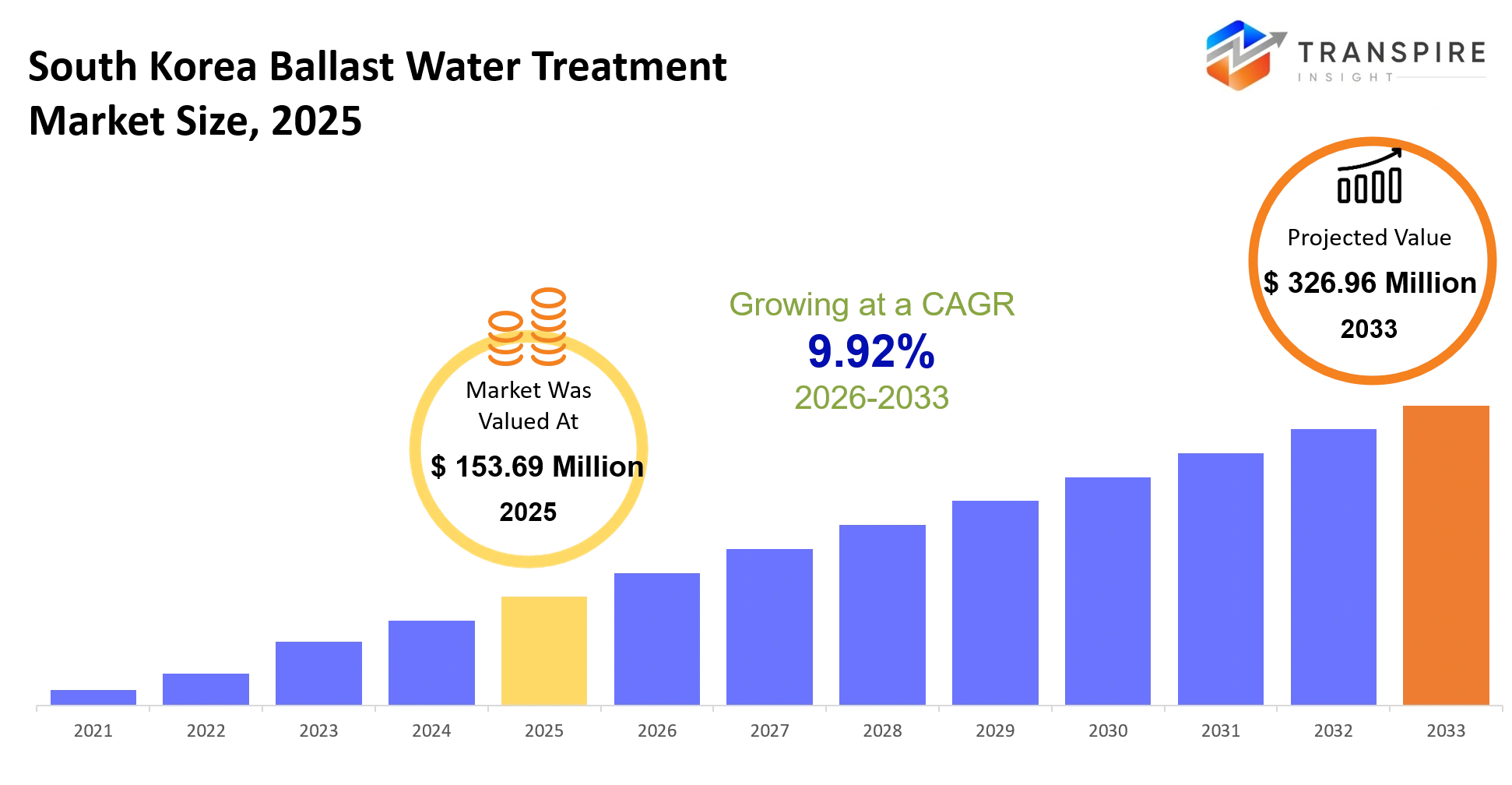
- South Korea Ballast Water Treatment Market Size 2025: USD 153.69 Million
- South Korea Ballast Water Treatment Market Size 2033: USD 326.96 Million
- South Korea Ballast Water Treatment Market CAGR: 9.92%
- South Korea Ballast Water Treatment Market Segments: By Technology (UV Treatment, Electrochlorination, Chemical Treatment, Deoxygenation, Others); By Ship Type (Cargo Ships, Tankers, Container Ships, Others)
To learn more about this report,  Download Free Sample Report
South Korea Ballast Water Treatment Market Summary
The South Korea Ballast Water Treatment Market was valued at USD 153.69 million in 2025. It is forecast to reach USD 326.96 million by 2033. That is a CAGR of 9.92% over the period.
The South Korea Ballast Water Treatment Market kinda has a critical role in helping shipping operators stop the transfer of invasive aquatic organisms from one port to another. Basically, ballast water treatment systems let vessels meet international environmental standards while still keeping vessel stability safe during cargo work. They’re now a key piece of fleet modernization, and also it supports broader maritime compliance plans.
In the last five years, the whole market structure moved away from typical chemical-based approaches toward more advanced UV and electrochlorination solutions. These newer methods tend to be more efficient operationally, and they are often viewed as having a lower environmental footprint. One big push for this change has been the International Maritime Organization’s Ballast Water Management Convention. That enforcement sped up retrofit programs across existing fleets, and it also started shaping equipment requirements for new builds. As compliance deadlines kept getting closer shipowners leaned toward certified treatment systems, so they could avoid operational limitations and those annoying port access issues. That shift in turn opened more installation opportunities for technology providers, boosted aftermarket service income, and encouraged ongoing upgrades in things like system dependability, automation controls and energy efficiency across South Korea’s maritime space.
Key Market Insights
- South Korea had a share of the market in 2025, more than 85% of it. This was because Ulsan, Busan and Geoje have shipbuilding areas.
- The coastal areas in the southeast have a lot of the market share. This is because they have a lot of ports and shipyards.
- Busan and Ulsan are going to grow. They will be the growing areas till 2030. This is because people want to fix and build ships.
- In 2025 systems that use electrochlorination were the popular. They had 45% of the market. This is because they work well on ships.
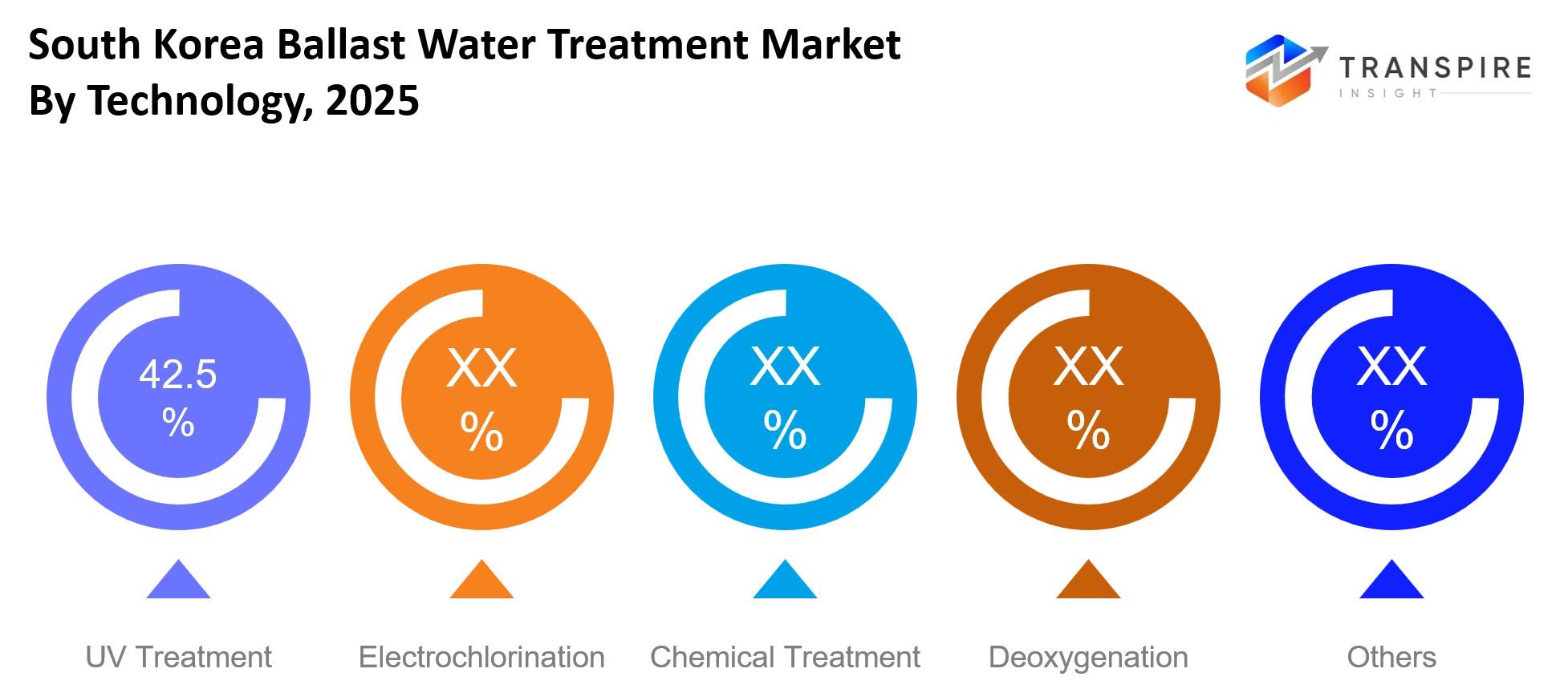
- The biggest segment was UV treatment systems. They are good because they do not use chemicals. They also make it easy to follow rules.
- Hybrid treatment technologies will grow the most from 2025 to 2030. This is because people want to have options when they operate ships.
- In 2025 cargo ships had 40% of the market. They were the type of ship.
- Tankers also had a share. This is because they have to follow rules about the environment.
- Container ships will grow the most till 2030. This is because more and more goods are being traded.
- The people who own ships had the most money in 2025. They had, than 60% of the market. They were the group of customers.
What are the Key Drivers, Restraints, and Opportunities in the South Korea Ballast Water Treatment Market?
What really drives the South Korea Ballast Water Treatment Market, you could say, is the strict push from international rules for managing ballast water especially the International Maritime Organization’s Ballast Water Management Convention. Once the compliance dates started to matter, shipowners were basically forced to retrofit older ships with already approved treatment units, and also to fold compliant technology into new ship builds. It’s like that regulatory nudge turned ballast water treatment, from this kinda “nice to have” green expense into a must-do operational thing. Then naturally, equipment sellers, installation teams, and ongoing service providers saw a more constant stream of retrofit work, plus certification support, and longer maintenance agreements , all of which keeps market revenues moving.
At the same time, the biggest roadblock stays the large upfront spending and the total lifecycle costs tied to ballast water treatment systems. Putting these systems in place can mean the vessel has to be out of service , plus engineering changes, and careful integration with whatever is already onboard. And this is kinda structural, because a lot of older ships were not built with advanced treatment hardware in mind in the first place. For smaller operators, the financial load can easily tip the balance, so the “payback” argument feels weaker than the actual cash needed for retrofits. Because of that, some companies delay improvements until the mandatory inspection window shows up, which slows adoption, and it also squeezes suppliers’ near term income potential.
A big growth opening is really in tying together digital monitoring and “foresee and repair” maintenance features into ballast water treatment systems. Shipowners are starting to ask for approaches that lower repair expenses and boost day to day dependability, which is kind of the point. For instance smart setups with remote diagnostics and performance analytics can flag a failing part before it actually fails. Meanwhile , as South Korea keeps pushing investments into smart shipping ideas and upgraded shipbuilding skills, suppliers that bring digitally enabled treatment platforms are sitting in a good spot to win more valuable contracts and also grow aftermarket service income..
What Has the Impact of Artificial Intelligence Been on the South Korea Ballast Water Treatment Market?
Artificial intelligence and advanced digital tech are starting to shape ballast water treatment work across South Korea’s maritime sector , especially when shipowners push for stronger dependability and regulatory alignment. In recent years, the newer treatment setups tend to use automated control platforms , they watch water quality factors, flow speed, disinfection output, and the overall system health in real time. Because of this, there’s usually less hands on work, and vessel operators can keep up with international ballast water rules, without so much operational turbulence or timing headaches.
Also, machine learning is being rolled into marine equipment management platforms for predictive maintenance help. These models sift through past sensor records, equipment vibration signatures, power draw, and day to day operating conditions, and then flag possible component faults before they fully surface. That way, maintenance teams can arrange service and fixes during pre planned windows, which boosts readiness and cuts down on surprise stoppages. Some operators even mention lower maintenance spend and better system uptime after switching toward condition based maintenance approaches , though results can vary by ship class and duty cycle.
Advanced analytics further helps with performance optimization , by picking out operating patterns that make treatment run more efficiently and lower energy use. On top of that, fleet-wide compliance tracking platforms do assist shipping companies in streamlining reporting and managing certification across many vessels, sort of end to end.
That said, AI adoption still hits limitations. Reliable predictive models need big volumes of good quality operational data, gathered while conditions vary at sea. Also, inconsistent onboard connectivity , and the expense of integrating digital systems into older vessels can delay deployment and may reduce how effective the real time analytics are when you actually need them.
Key Market Trends
- Since 2020 shipowners have changed the way they think about ballast water treatment systems. They used to want to comply with the rules but now they want systems that use less energy can be controlled automatically and need less maintenance.
- Electrochlorination technology became more popular between 2021 and 2025 because ship operators wanted systems that could handle cargo vessels and tankers.
- UV-based treatment systems got better and used power so they became a more popular choice.
- In South Korea shipyards started to install ballast water treatment systems when they built the vessels of adding them later.
- Big companies like Alfa Laval, Wärtsilä and Optimarin started to offer services to help with maintenance because they wanted to make money from it.
- After the International Maritime Organization set deadlines fleet operators started to replace systems with new ones that meet the rules.
- Around 2022 digital monitoring platforms became important because they allowed operators to check on their systems from away and make sure they are compliant.
- Now people who buy equipment think about how much it will cost in the run not just how much it costs to install.
- Between 2023 and 2025 companies that make treatment systems started to work with shipbuilders, which made it faster to install the systems.
- Shipping companies started to use data to predict when equipment might fail so they can fix it before it breaks. The vessel has to stop.
- Shipowners are still looking for ballast water treatment systems that use energy and need less maintenance because this is what they want now.
- Electrochlorination technology and UV-based treatment systems are still choices, for ballast water treatment systems because they are good options.
South Korea Ballast Water Treatment Market Segmentation
By Technology:
UV treatment systems have started to get a lot more acceptance across commercial fleets, mostly because the treatment happens without adding any chemicals to the ballast water. Over time, improvements in lamp efficiency, system design, and day to day operational reliability have helped push down energy use compared with earlier set ups. On top of that, compliance requirements basically nudge vessel operators toward technologies that make checking and inspection less of a headache , while also keeping environmental concerns during operations lower. And honestly the continuous product development side keeps making the performance more steady even when water quality shifts.
Electrochlorination technology still keeps a strong place, especially on bigger vessels that move huge ballast water volumes. Being able to treat large quantities of water in a cost effective way helps it spread across cargo , tanker, and similar fleets. Manufacturers have rolled out more efficient control systems along with monitoring functions, so operations stay more consistent instead of swinging around. At the same time , hybrid and more advanced treatment solutions are also showing up in the market, because operators want extra flexibility, stronger treatment effectiveness, and lower long term operating expenses.
To learn more about this report, Download Free Sample Report
By Ship Type:
Cargo ships make up a big chunk of ballast water treatment installations, mostly because there’s a lot of international trade happening, plus ships keep doing port calls, all the time. Because regulations are getting more strict, fleet operators have been pushed to upgrade their treatment systems on both older ships and brand new builds. Retrofit work is still going strong too, operators keep updating equipment so they can pass inspections, and still run their trading schedules without getting paused. Basically, the need for dependable treatment results steers the buying choices across the cargo shipping segment.
Tankers keep being a key part of the market, since ballast water management is still critical for operational safety and also for environmental compliance. Those large ballast water volumes mean the treatment setup has to be sturdy, able to deal with tough operating conditions. Container vessels are adopting these systems more and more as modernization efforts move forward, and as global trade routes keep changing and expanding. For new builds, more shipyards now install treatment systems during the construction stage , so shipowners can cut down on later alterations and manage compliance more neatly, with less hassle overall.
What are the Key Use Cases Driving the South Korea Ballast Water Treatment Market?
Ballast water treatment systems in South Korea are mostly used for regulatory compliance on commercial ships that run international routes, you know, that kind of thing. Cargo carriers end up driving the most demand because ships are moving between ports a lot, so ballast water has to be handled almost nonstop, just to stay aligned with international discharge rules. In practice, the compliance requirements turn these treatment systems into a must-have operational investment, not something you can really treat as an optional upgrade.
Growth is not stopping there either, adoption is spreading across tanker fleets and container shipping too. Tanker operators lean on these systems to cope with very large ballast water volumes while still meeting environmental obligations across global trade corridors. Meanwhile container vessel operators are increasingly adding more advanced treatment technologies as part of wider fleet modernization efforts, aiming for both operational efficiency and compliance readiness, at least that is what many operators say.
There are also emerging angles in smart vessel management and digitally connected marine operations. More advanced treatment platforms with remote monitoring and predictive maintenance features are getting attention because operators expect lower lifecycle costs. And then there is the new-build side, where vessels are being designed with automated compliance reporting functions baked in, which feels like a promising pathway as shipbuilders integrate extra digital capabilities into vessel design.
|
Report Metrics |
Details |
|
Market size value in 2025 |
USD 153.69 million |
|
Market size value in 2026 |
USD 168.60 million |
|
Revenue forecast in 2033 |
USD 326.96 million |
|
Growth rate |
CAGR of 9.92% from 2026 to 2033 |
|
Base year |
2025 |
|
Historical data |
2021 - 2024 |
|
Forecast period |
2026 - 2033 |
|
Report coverage |
Revenue forecast, competitive landscape, growth factors, and trends |
|
Regional scope |
South Korea |
|
Key company profiled |
Alfa Laval, Wartsila, Veolia, Ecochlor, Optimarin, BIO-UV Group, Panasia, Hyundai Heavy Industries, NK Co., Desmi, Mitsubishi Heavy Industries, Erma First, Sunrui, Evoqua, Trojan Technologies |
|
Customization scope |
Free report customization (country, regional & segment scope). Avail customized purchase options to meet your exact research needs. |
|
Report Segmentation |
By Technology (UV Treatment, Electrochlorination, Chemical Treatment, Deoxygenation, Others); By Ship Type (Cargo Ships, Tankers, Container Ships, Others) |
Which Regions are Driving the South Korea Ballast Water Treatment Market Growth?
The south-eastern coastal region is still basically the front-runner when it comes to ballast water treatment activity in South Korea. Bigger shipbuilding towns, like Ulsan, Busan, and Geoje, end up making a tight customer circle for system manufacturers, service providers, and engineering firms. Strong regulatory watch at the major global ports has also pushed compliance-related spending across commercial fleets, sooner than expected. And because there’s a mature maritime setup, with shipyards, classification societies , and repair facilities backing it, the region keeps holding its position.
Meanwhile, the western coastal region sits as the second-largest contributor, yet it moves forward in a different rhythm compared with the south-east. Here, the work is powered by a mix of industrial ports, fairly steady cargo flow, and the usual ongoing need for vessel upkeep, more than by huge shipbuilding output. In this area shipowners usually lean toward long-term operational reliability, and then they do gradual fleet improvements instead of fast overhauls. Local economic steadiness and port routines that you can count on have helped keep demand steady for ballast treatment systems and the associated services too.
The eastern coastal region is showing the most noticeable growth momentum, as port development projects and fleet modernization initiatives are picking up speed. More spending in maritime infrastructure has made regional ports more appealing for domestic shipping and international activity . New vessel deployments plus technology upgrades have opened up fresh chances for advanced treatment system installation work. Growth in this area should also pull in equipment suppliers, technology providers, and service investors who are looking for expansion opportunities sometime between 2026 and 2033 .
Who are the Key Players in the South Korea Ballast Water Treatment Market and How Do They Compete?
Competition in the South Korea Ballast Water Treatment Market is kinda moderately concentrated, with a handful of global marine technology suppliers pushing head-to-head alongside more specialized treatment system providers. In practice , the technology performance, regulatory certification status, lifecycle operating costs, and even aftermarket service strength matter more than basic equipment pricing. A bunch of long-time suppliers keep defending their market share through product upgrades and service network expansion, rather than only leaning on installed base “history” or advantages. The market also feels more competitive lately because vessel operators are trying to assess long-term reliability, energy efficiency , and those digital monitoring functions before they commit to any single system.
Alfa Laval stands out with a pretty wide marine equipment portfolio, which makes it easier to integrate ballast water treatment solutions with other onboard systems, more or less in a smooth way. The focus has been on improving energy efficiency and operational flexibility, while also growing service support close to major shipbuilding and shipping hubs. Wärtsilä, on the other hand , pushes its competitive edge through advanced automation features and digital service packages that let operators keep an eye on system performance and, in turn, cut back maintenance needs. They also build on strong relationships with shipyards and vessel owners, so project work can keep flowing across both retrofit programs and new-build work, even when schedules shift a bit.
Optimarin has built up a fairly strong, competitive position via UV-based treatment technology and this idea of operational simplicity that just keeps showing up everywhere. Through ongoing tuning of UV system performance, they’ve managed to handle worries tied to power usage ,and also how the water conditions can vary. On the other hand BIO-UV Group really stresses compact treatment designs and environmentally oriented technologies, which tends to speak to operators who want solutions that are chemical-free rather than just “reduced chemical” or similar. Ecochlor differentiates in a different way: their treatment approach is made for harsh, demanding operating environments, and they keep pushing their market reach forward by working with shipowners, engineering companies and maritime service providers, in sort of strategic partnerships over time.
Company List
- Alfa Laval
- Wartsila
- Veolia
- Ecochlor
- Optimarin
- BIO-UV Group
- Panasia
- Hyundai Heavy Industries
- NK Co.
- Desmi
- Mitsubishi Heavy Industries
- Erma First
- Sunrui
- Evoqua
- Trojan Technologies
Recent Development News
In June 2025, Optimarin launched the Optimarin Guardian ballast water treatment system. The new system was designed to deliver high treatment efficiency, lower power consumption, and reduced lifecycle costs, strengthening competitive differentiation in ballast water management solutions and supporting fleet modernization efforts. [https://www.marinelink.com
In June 2025, Optimarin showcased expanded ballast water treatment capabilities and technology investments ahead of Nor-Shipping 2025. The initiative emphasized adaptable system designs, long-term serviceability, and operational resilience, reinforcing the company's position in a market facing tighter regulations and rising operating costs. [https://optimarin.com
In 2025, Alfa Laval continued expanding deployment and support for its PureBallast 3 ballast water management platform through collaboration with shipbuilders and compliance support services. The strategy strengthened system adoption among vessel operators seeking certified ballast water treatment solutions with established global service coverage. [https://www.alfalaval.in
What Strategic Insights Define the Future of the South Korea Ballast Water Treatment Market?
Over the next five to seven years, the South Korea Ballast Water Treatment Market is expected to move past that compliance focused stage and go into something more performance driven, like a service model thats centered on digital monitoring, predictive upkeep, and lifecycle optimization. The reason for this turn is pretty clear, more vessel operators are looking for approaches that can lower operating costs while still keeping regulatory compliance steady, no interruptions. And as retrofit demand slowly turns into a steadier pattern, the real value tends to come from software enabled services, system upgrades, and longer term maintenance agreements… not only from selling the equipment itself.
There’s also a risk that s a bit quieter, market concentration around a smaller set of certified technology providers and some critical system parts. If supply gets disrupted, if certifications change, or if there’s too much dependence on one narrow supplier base, shipowners could see installation delays and higher overall costs. Still, an opportunity is also showing up, especially around smart ballast water treatment platforms that bring remote diagnostics together with fleet wide compliance management tools. Market players should lean into investments for digital capabilities and service infrastructure, because differentiation may rely more on operational insight and recurring support revenue than on the treatment hardware alone.
South Korea Ballast Water Treatment Market Report Segmentation
By Technology
- UV Treatment
- Electrochlorination
- Chemical Treatment
- Deoxygenation
- Others
By Ship Type
- Cargo Ships
- Tankers
- Container Ships
- Others
Frequently Asked Questions
Find quick answers to common questions.
The expected South Korea Ballast Water Treatment Market size for the market will be USD 326.96 million in 2033.
Key segments for the South Korea Ballast Water Treatment Market are By Technology (UV Treatment, Electrochlorination, Chemical Treatment, Deoxygenation, Others); By Ship Type (Cargo Ships, Tankers, Container Ships, Others).
Major South Korea Ballast Water Treatment Market players are Alfa Laval, Wartsila, Veolia, Ecochlor, Optimarin, BIO-UV Group, Panasia, Hyundai Heavy Industries, NK Co., Desmi, Mitsubishi Heavy Industries, Erma First, Sunrui, Evoqua, Trojan Technologies.
The South Korea Ballast Water Treatment Market size is USD 153.69 Million in 2025.
The South Korea Ballast Water Treatment Market CAGR is 9.92% from 2026 to 2033.
- Alfa Laval
- Wartsila
- Veolia
- Ecochlor
- Optimarin
- BIO-UV Group
- Panasia
- Hyundai Heavy Industries
- NK Co.
- Desmi
- Mitsubishi Heavy Industries
- Erma First
- Sunrui
- Evoqua
- Trojan Technologies
About the Authors

Pankaj Ghogare Patil
I am Pankaj Ghogare Patil, a Senior Research Analyst at Transpire Insight, specializing in the Pharmaceutical, Chemicals & Materials, Healthcare IT, and Biotechnology industry. My expertise lies in conducting comprehensive market research, analyzing industry trends, evaluating competitive landscapes, and translating complex data into actionable insights. At Transpire Insight, I closely follow emerging technologies, regulatory developments, and market innovations to create accurate, well-researched, and informative content that helps businesses and professionals make informed decisions. I am committed to producing credible, evidence-based articles that reflect industry best practices while making technical topics accessible and valuable for a broad audience.

Chakradhar Khansole
Chakradhar serves as the Research Director at Transpire Insight, bringing over 8 years of experience in technology, innovation, and strategic market intelligence. He specializes in transforming complex market data into actionable business insights that enable organizations to make informed, growth-oriented decisions. Recognized for his strategic vision and analytical expertise, Chakradhar leads high-impact research initiatives, delivering comprehensive market assessments, competitive intelligence, and forward-looking industry analysis.
Recently Published Reports
-
May 2026
Healthcare Polymer Packaging Market
Healthcare Polymer Packaging Market Size, Share & Analysis Report By Packaging Type (Syringes, IV Bottles and Pouches, Clamshells, Blisters, Bottles & Jars, Containers, Tubes, IV Parental Packaging, Others), By Type (Regulated, Non-regulated), By Polymer Type (LDPE (Low-Density Polyethylene), HDPE (High-Density Polyethylene), Homo-polymer (Homo), Random Copolymer (Random), Block Copolymer (Block), PET, Polystyrene, Polyvinyl Chloride, Polyamide/EVOH, Others), and Geography (North America, Europe, Asia-Pacific, Middle East and Africa, South and Central America), 2021 - 2031
-
Apr 2026
Hydrophilic Tape (Waterstop) Market
Hydrophilic Tape (Waterstop) Market Size, Share & Analysis Report By Type (Bentonite-Based Hydrophilic Tape, Rubber-Based Hydrophilic Tape), By Application (Residential Buildings, Commercial Buildings, Infrastructure Projects), and Geography (North America, Europe, Asia-Pacific, Middle East and Africa, South and Central America), 2021 - 2031
-
Apr 2026
Metalens Market
Metalens Market Size, Share & Analysis Report By Type (Visible Light Metalens, and Infrared Metalens), By Application (Consumer Electronics, Automotive Electronics, Industrial, Medical, and Others), and Geography (North America, Europe, Asia-Pacific, Middle East and Africa, South and Central America), 2021 - 2031
-
Apr 2026
PBT Resin Market
PBT Resin Market Size, Share & Analysis Report By Type (Reinforced PBT Resin, Unreinforced PBT Resin), By Processing Method (Injection Molding, Extrusion, Blow Molding, Others), By End-User (Automotive, Electrical & Electronics, Consumer Appliances, Industrial Machinery, Medical Devices, Packaging, Others), and Geography (North America, Europe, Asia-Pacific, Middle East and Africa, South and Central America), 2021 - 2031