
Japan Shipbuilding Market Size & Forecast:
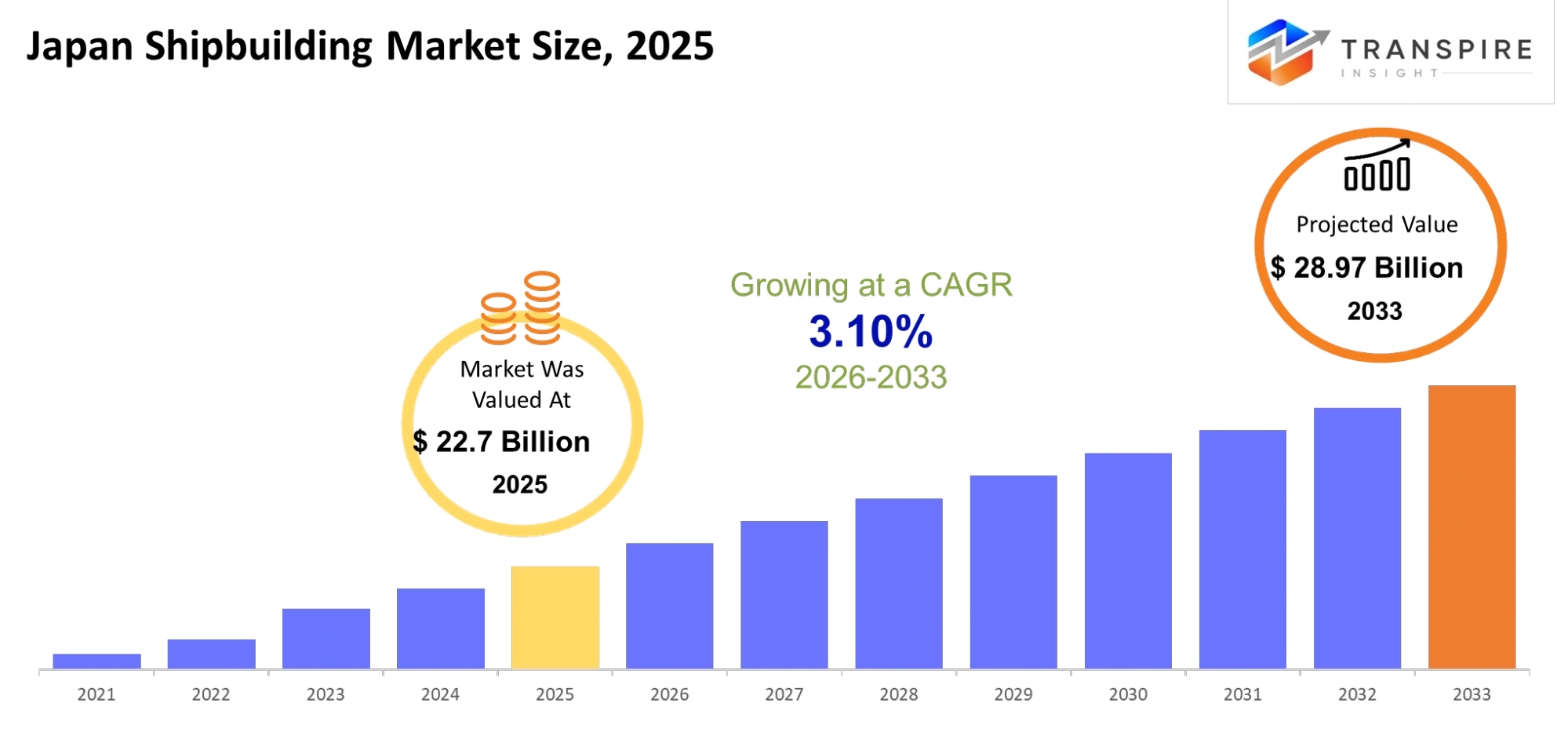
- Japan Shipbuilding Market Size 2025: USD 22.7 Billion
- Japan Shipbuilding Market Size 2033: USD 28.97 Billion
- Japan Shipbuilding Market CAGR: 3.10%
- Japan Shipbuilding Market Segments: By Type (Commercial Ships, Naval Ships, Offshore Vessels, LNG Carriers, Bulk Carriers, Others); By Application (Cargo Transport, Defense, Offshore Exploration, Passenger Transport, Logistics, Others); By End-User (Shipping Companies, Defense Organizations, Government, Oil & Gas Companies, Logistics Providers, Others); By Vessel Size (Small, Medium, Large, Ultra Large, Others)
To learn more about this report,  Download Free Sample Report
Japan Shipbuilding Market Summary
The Japan Shipbuilding Market was valued at USD 22.7 Billion in 2025. It is forecast to reach USD 28.97 Billion by 2033. That is a CAGR of 3.10% over the period.
The Japanese shipbuilding industry supports maritime transportation and commercial shipping operations through its ship design and construction services which enable the movement of raw materials and finished products and energy resources through international and domestic shipping routes. The organization maintains efficiency in export-based supply chains through its work with offshore energy operations and defense activities and its development of specialized marine transportation systems. The market has undergone a fundamental transformation during the last five years because shipping companies now focus on developing next-generation vessels which include liquefied natural gas carriers and ammonia-ready ships and smart vessels with digital systems.
Fleet modernization processes received an acceleration because the International Maritime Organization established emissions regulations and the Russia-Ukraine conflict caused global energy supply disruptions which resulted in unpredictable fuel costs. Japanese shipbuilders increased their funding for advanced propulsion systems and strategic partnerships through their research and development efforts. The order books for specialized high-value vessels have increased because shipping companies now concentrate on regulatory compliance and operational efficiency which has resulted in better profit margins while shifting revenue generation from traditional volume-based construction methods to advanced shipbuilding technologies.
Key Market Insights
- The Japan Shipbuilding Market which has 58% of its market share in 2025 will be led by Western Japan because the region contains all main shipbuilding facilities located in Hiroshima and Ehime.
- The Kyushu region will become the most rapidly expanding area until 2030 because of its planned port improvements and its investments in high-level maritime engineering facilities.
- The export-driven manufacturing sector enables coastal industrial areas to expand their market presence while increasing regional ship manufacturing capacity and speeding up ship delivery times.
- The Japan Shipbuilding Market will be dominated by bulk carriers which will hold approximately 31% of the market in 2025 because of their strong demand for transporting goods through Asia-Pacific shipping routes.
- Japan maintains its position as a leading producer of high-value gas transportation vessels which enables LNG carriers to secure their second-largest market position with approximately 24% of the total market.
- The most rapidly expanding segment of the market includes ammonia-ready and hydrogen-compatible vessels which experts predict will experience substantial growth between 2026 and 2030.
- Commercial shipping dominates with nearly 62% market share, driven by replacement demand for aging fleets and international freight efficiency requirements.
- Offshore renewable support vessels are emerging rapidly as offshore wind development expands across East Asian maritime corridors.
- International shipping operators account for over 54% of market demand due to long-haul fleet replacement programs.
- Energy logistics companies are the fastest-growing end-user category as LNG and clean fuel transportation infrastructure expands.
What are the Key Drivers, Restraints, and Opportunities in the Japan Shipbuilding Market?
The shipping market in Japan experiences its most powerful growth acceleration because worldwide regulations require reduced maritime emissions according to International Maritime Organization carbon intensity and fuel efficiency standards. The regulations have forced shipping companies worldwide to advance their fleet replacement schedules by which they intended to retire their outdated ships. Japanese shipbuilders have achieved success because they possess advanced technical skills which enable them to construct LNG-powered carriers and dual-fuel propulsion systems and advanced hull optimization technologies. The industry transition to ammonia-ready and methanol-compatible ships has generated additional income from design and engineering services.
The primary obstacle the market faces emerges from Japan's high shipbuilding expenses which result from worker shortages and an aging technical workforce and the elevated costs of domestic production when compared to South Korean and Chinese shipbuilding operations. The situation requires extended resolution time because it takes multiple years to develop specialized maritime engineering skills and essential automated systems need substantial financial backing to implement. Japanese shipyards struggle to compete for price-sensitive bulk vessel contracts which leads to reduced production capacity and limited chances to gain additional market share.
The best chance for growth exists through development of next-generation alternative fuel ships. Japanese investments in ammonia fuel supply infrastructure and green shipping corridors create optimal conditions for domestic shipbuilders to prosper. Japanese shipyards can become first movers in the premium global market through their ammonia-powered bulk carrier and hydrogen transport vessel projects.
What Has the Impact of Artificial Intelligence Been on the Japan Shipbuilding Market?
Artificial intelligence together with advanced digital systems enables better ship emission monitoring and onboard equipment management and maritime regulation compliance for Japan's shipbuilding industry. Japanese shipyards use AI-powered scrubber systems which automatically control exhaust gas cleaning processes based on current sulfur oxide levels and fuel usage and engine power output. The system operates through automatic data transmission which enables ongoing system tracking without needing human operators to monitor operations. Machine learning models use equipment monitoring data to identify maintenance needs by detecting early signs of equipment faults through vibration and temperature and pressure analysis of propulsion systems.
The predictive capabilities have enabled organizations to achieve operational improvements which they can measure. Smart hull monitoring and AI-assisted voyage optimization systems have helped reduce fuel consumption by 5 to 8 percent on selected commercial vessels, while predictive maintenance platforms have lowered unplanned downtime by improving maintenance scheduling accuracy. Digital twins enable operators to create more accurate emissions predictions which help them choose engine settings and route plans for carbon intensity compliance.
The current integration process has reached a level of complexity which prevents organizations from fully adopting new technologies. The process of retrofitting existing ships with advanced sensor systems requires companies to invest significant funds because AI systems face difficulties when they encounter unstable offshore connections and incomplete operational data. The system limitations cause two problems because they decrease precise decision-making abilities and they hinder the expansion of older ship fleets.
Key Market Trends
- The Japanese shipbuilding industry has redirected almost 30 percent of its new design activities since 2022 toward creating vessels that meet ammonia and methanol standards because upcoming compliance deadlines approached.
- Operators began retiring their outdated vessels earlier because 2023 introduced global carbon intensity regulations which led to increased demand for fuel-efficient ships manufactured by Japanese shipbuilders.
- Mitsubishi Heavy Industries and Imabari Shipbuilding extended their digital twin technology usage from 2023 through 2025 to enhance design precision while reducing their manufacturing time.
- Asian importers began acquiring additional specialized shipping capacity after 2021 because energy supply interruptions created a greater demand for LNG carrier orders.
- Shipbuilders have responded to increasing labor shortages since 2020 by implementing robotic welding systems and automated panel assembly systems in their major domestic shipbuilding facilities.
- The Japanese shipping industry has stopped using low-profit standard bulk carrier contracts to focus on operating specialized vessels which generate higher profits and engineering service contracts.
- The marine engine developers established more partnerships with builders after 2024 to expedite the development of dual-fuel ammonia propulsion systems which they planned to use for export markets.
- Between 2022 and 2025 the manufacturers increased their supply chain localization efforts by cutting down their use of imported marine components which had been disrupted during the pandemic.
- Shipowners are moving toward digitally integrated vessels which contain built-in compliance monitoring systems because classification societies and regulators now mandate real-time emissions tracking.
Japan Shipbuilding Market Segmentation
By Type :
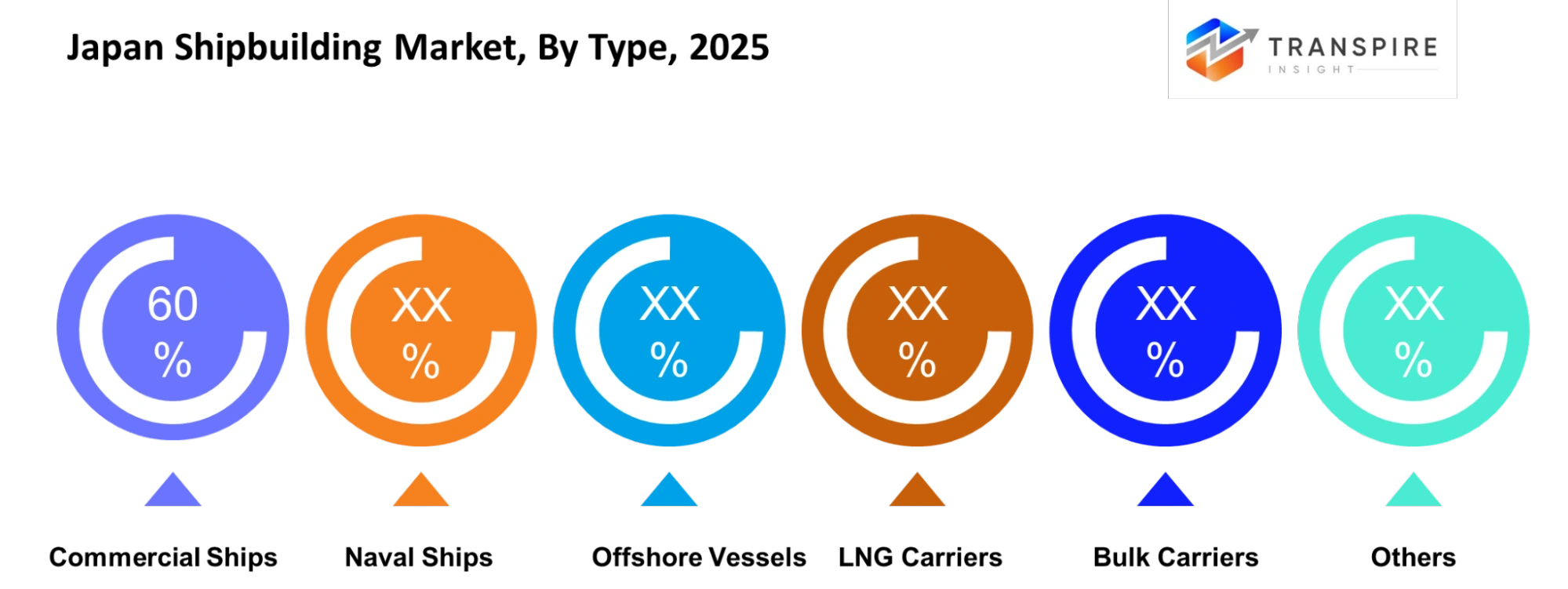
The Japan Shipbuilding Market uses type-based classification for its primary ship classification which includes commercial ships and naval ships and offshore vessels and LNG carriers and bulk carriers and other ship types. Each type serves a specific role linked to trade movement through domestic and international waters and energy transport and defense needs and industrial support.
Commercial ships handle general cargo transportation and trade operations while naval ships provide support for national defense missions. Offshore vessels enable marine resource activities while LNG carriers transport gas. Bulk carriers handle large-scale raw material movement while other vessel types provide specialized support for different marine operations.
To learn more about this report, Download Free Sample Report
By Application :
The Japan Shipbuilding Market uses application-based segmentation to show how various vessels operate according to their specific operational requirements which include cargo transport and defense activities and offshore exploration and passenger transport and logistics assistance and various other marine operations that enable economic and industrial movement. The cargo transport and logistics applications create systems which enable the movement of goods throughout supply chains. Security operations use defense applications to support their activities. Offshore exploration activities involve searching for energy resources and other valuable resources. The passenger transport system provides mobility services to users while other specialized operations exist to meet maritime infrastructure requirements.
By End-User :
The Japan Shipbuilding Market divides its end-user market through demand from shipping companies and defense organizations and government organizations and oil companies and logistics companies and all other institutional users who need vessels for their commercial operations and strategic functions and operational activities.
Shipping companies drive trade-related demand, while defense organizations focus on security needs. Government use supports national maritime infrastructure. Oil and gas companies depend on marine transport for energy operations. The logistics providers handle supply movement, while other users meet their specific maritime needs which different industries require.
By Vessel Size :
The Japan Shipbuilding Market divides vessel size into four categories which include small, medium, large, and ultra-large based on their capacity and operational range and their usage requirements. Different maritime operations require different size categories which handle specific cargo amounts and travel distances and meet industry needs through their various functionality options.
Small vessels operate between two points while medium vessels operate between two points. Large vessels operate between two points to transport big cargo. Ultra-large vessels operate between two points to transport high volumes of cargo across international waters which enables efficient maritime logistics and energy transport operations.
What are the Key Use Cases Driving the Japan Shipbuilding Market?
International cargo transportation represents its most effective application because commercial fleet operators now replace old ships with new vessels that use less fuel and meet advanced emission standards. The application creates maximum demand because export-driven trade routes require vessels that operate at high capacity and provide low-cost operations while achieving international maritime efficiency standards.
The military sector and offshore industrial support are both starting to adopt secondary applications. Naval procurement programs create consistent requirements for surveillance and multi-role operational vessels, while offshore service operators are commissioning specialized support ships for renewable energy installation and subsea infrastructure maintenance.
The development of alternative fuel transportation and autonomous vessel operations has resulted in the creation of new use cases. Strategic interest in ammonia and hydrogen carrier development has increased as energy infrastructure development processes continue to advance. The remotely controlled smart vessels are currently receiving funding because they operate in coastal logistics and short-sea transport areas where digital navigation systems improve route accuracy and reduce operational expenses linked to crew members.
|
Report Metrics |
Details |
|
Market size value in 2025 |
USD 22.7 Billion |
|
Market size value in 2026 |
USD 23.4 Billion |
|
Revenue forecast in 2033 |
USD 28.97 Billion |
|
Growth rate |
CAGR of 3.10% from 2026 to 2033 |
|
Base year |
2025 |
|
Historical data |
2021 - 2024 |
|
Forecast period |
2026 - 2033 |
|
Report coverage |
Revenue forecast, competitive landscape, growth factors, and trends |
|
Country scope |
Japan |
|
Key company profiled |
Mitsubishi Heavy Industries, Kawasaki Heavy Industries, Japan Marine United, Imabari Shipbuilding, Oshima Shipbuilding, Sumitomo Heavy Industries, Hyundai Heavy Industries, Samsung Heavy Industries, Daewoo Shipbuilding, CSSC, Fincantieri, Damen, STX Offshore, Tsuneishi, Namura Shipbuilding |
|
Customization scope |
Free report customization (country, regional & segment scope). Avail customized purchase options to meet your exact research needs. |
|
Report Segmentation |
By Type (Commercial Ships, Naval Ships, Offshore Vessels, LNG Carriers, Bulk Carriers, Others); By Application (Cargo Transport, Defense, Offshore Exploration, Passenger Transport, Logistics, Others); By End-User (Shipping Companies, Defense Organizations, Government, Oil & Gas Companies, Logistics Providers, Others); By Vessel Size (Small, Medium, Large, Ultra Large, Others) |
Which Regions are Driving the Japan Shipbuilding Market Growth?
The western part of Japan serves as the primary shipbuilding center because its various existing shipyards operate throughout the Hiroshima and Ehime regions together with their nearby industrial areas. The region maintains its ability to construct complicated vessels because of its strong port connections and deep-water docking facilities and its built environment which has developed through numerous years of engineering expertise. The national industrial policies which back maritime decarbonization research have created additional funding for the development of advanced propulsion systems and digital ship design capabilities.
The mature supplier ecosystem which includes steel processors and marine equipment manufacturers and testing facilities has helped the region maintain its position as a leader in the industry. Central Japan holds the second strongest position but growth dynamics differ from the western shipbuilding hubs. The region achieves economic strength through its stable economy and diverse industrial production and ongoing financial support from its established shipping companies.
The shipyards in this area concentrate their efforts on developing specialized vessel retrofitting projects and component engineering and precision manufacturing work which supports their extended domestic business agreements. The region maintains reliable revenue generation capabilities because its stable operating environment allows revenue generation through regular business operations without needing aggressive growth initiatives which other regions require.
Kyushu has become the fastest expanding area because of new port development projects and growing investments in advanced marine fuel systems. The increased development of ammonia and LNG bunkering since 2024 has established optimal conditions for building and testing ships that use alternative fuels. The regional authorities have fast-tracked their maritime innovation projects which aim to boost local shipbuilding industry competitiveness against foreign shipyards. The current market situation provides excellent investment prospects for both established companies and new businesses that want to invest in modern ship technologies and environmentally friendly shipping methods until 2033.
Who are the Key Players in the Japan Shipbuilding Market and How Do They Compete?
The shipbuilding industry in Japan exhibits a moderate level of competition because a small number of large domestic shipbuilders maintain control over premium ship contracts while smaller shipyards focus on their specific retrofitting services and local construction projects. The competitive focus has shifted away from price-based rivalry because South Korean and Chinese shipbuilders often hold cost advantages in standard vessel production. Japanese companies operate their market defense through engineering precision and advanced propulsion systems and their specialized knowledge of complex ships which includes LNG carriers and alternative fuel vessels.
The combination of technology capabilities and regulatory compliance expertise and lifecycle service offerings has become the primary factor that determines competitive positioning for businesses and not their production capacity. Imabari Shipbuilding has strengthened its position through scale efficiency and rapid digital production upgrades that shorten construction timelines. The company benefits from its strong relationships with global commercial fleet operators because these connections enable it to win repeat cargo vessel contracts while its investments in ammonia-ready ship designs will help meet future export needs.
Japan Marine United distinguishes itself through its technical expertise in large bulk carriers and energy transport vessels. The company establishes strategic partnerships with engine manufacturers to enable rapid dual-fuel propulsion system integration which enhances their product value for operators who need to meet emissions standards.
Mitsubishi Heavy Industries competes through its advanced engineering capabilities and its research-heavy vessel programs which focus on LNG and next-generation hydrogen transport technologies. The company dedicated its resources to digital twin simulation which enhances its ability to optimize vessel performance before the construction phase starts. Kawasaki Heavy Industries developed its business through its liquefied hydrogen carrier projects and its strategic alliances for developing clean energy shipping corridors which enabled access to high-value markets that require advanced technical skills.
Company List
- Mitsubishi Heavy Industries
- Kawasaki Heavy Industries
- Japan Marine United
- Imabari Shipbuilding
- Oshima Shipbuilding
- Sumitomo Heavy Industries
- Hyundai Heavy Industries
- Samsung Heavy Industries
- Daewoo Shipbuilding
- CSSC
- Fincantieri
- Damen
- STX Offshore
- Tsuneishi
- Namura Shipbuilding
Recent Development News
In January 2026, Imabari Shipbuilding completed its acquisition of a 60% controlling stake in Japan Marine United (JMU). The transaction consolidated JMU into Imabari’s subsidiary structure, creating one of the world’s largest shipbuilding groups and strengthening Japan’s global competitiveness against South Korean and Chinese yards.
Source https://www.maritimenews.com/
In January 2026, Imabari Shipbuilding finalized the equity transfer of Japan Marine United following regulatory approvals. The deal shifted ownership to Imabari (60%), JFE Holdings (20%), and IHI Corporation (20%), marking a major consolidation move aimed at improving efficiency and accelerating next-generation ship design, including alternative-fuel vessels. Source https://www.imarinenews.com/
What Strategic Insights Define the Future of the Japan Shipbuilding Market?
Over the next five to seven years, Japan's shipbuilding sector will begin working on a new production system which will build alternative-fuel ships and digital navigation systems and special energy transport vehicles. The current path of development exists because international emission standards have become more stringent while shipping companies now focus on better operational performance instead of their outdated fleet replacement programs. The company needs to achieve revenue growth through its technological innovations because it cannot expand through building more production facilities.
The supply chain risks which exist for advanced marine components distribution systems because they rely on specific parts like cryogenic containment systems and dual-fuel engines and high-grade specialty steel components. If global demand increases faster than component manufacturing capacity, companies will experience production delays because they have limited options for sourcing components. Autonomous coastal cargo vessels present new business opportunities because they enable automated transportation operations between regional logistics corridors which face labor shortages and have standardized shipping routes.
Market participants should establish more joint development partnerships with engine developers and digital navigation companies and regional port organizations to create successful strategic initiatives. The early ecosystem alignment process will develop fast certification procedures and minimize risks of system integration while helping companies secure premium contracts for the upcoming demand of next-generation vessels.
Japan Shipbuilding Market Report Segmentation
By Type
- Commercial Ships
- Naval Ships
- Offshore Vessels
- LNG Carriers
- Bulk Carriers
By Application
- Cargo Transport
- Defense
- Offshore Exploration
- Passenger Transport
- Logistics
By End-User
- Shipping Companies
- Defense Organizations
- Government
- Oil & Gas Companies
- Logistics Providers
By Vessel Size
- Small
- Medium
- Large
- Ultra Large
Frequently Asked Questions
Find quick answers to common questions.
The Japan Shipbuilding Market size is USD 28.97 Billion in 2033.
Key segments for the Japan Shipbuilding Market are By Type (Commercial Ships, Naval Ships, Offshore Vessels, LNG Carriers, Bulk Carriers, Others); By Application (Cargo Transport, Defense, Offshore Exploration, Passenger Transport, Logistics, Others); By End-User (Shipping Companies, Defense Organizations, Government, Oil & Gas Companies, Logistics Providers, Others); By Vessel Size (Small, Medium, Large, Ultra Large, Others).
Major Japan Shipbuilding Market players are Mitsubishi Heavy Industries, Kawasaki Heavy Industries, Japan Marine United, Imabari Shipbuilding, Oshima Shipbuilding, Sumitomo Heavy Industries, Hyundai Heavy Industries, Samsung Heavy Industries, Daewoo Shipbuilding, CSSC, Fincantieri, Damen, STX Offshore, Tsuneishi, Namura Shipbuilding.
The Japan Shipbuilding Market size is USD 22.7 Billion in 2025.
The Japan Shipbuilding Market CAGR is 3.10% from 2026 to 2033.
- Mitsubishi Heavy Industries
- Kawasaki Heavy Industries
- Japan Marine United
- Imabari Shipbuilding
- Oshima Shipbuilding
- Sumitomo Heavy Industries
- Hyundai Heavy Industries
- Samsung Heavy Industries
- Daewoo Shipbuilding
- CSSC
- Fincantieri
- Damen
- STX Offshore
- Tsuneishi
- Namura Shipbuilding
Recently Published Reports
-
Apr 2026
ATV & UTV Market
ATV & UTV Market Size, Share & Analysis Report By Type (ATV, and UTV), By Variants (Less Than 400 CC, 400 CC To 800 CC, and More Than 800 CC), and Geography (North America, Europe, Asia-Pacific, Middle East and Africa, South and Central America), 2021 - 2031
-
Apr 2026
Automotive Central Gateway Module Market
Automotive Central Gateway Module Market Size, Share & Analysis Report By Type (Ethernet Central Gateway Module, CAN Central Gateway Module, LIN Central Gateway Module, and FlexRay), By Application (Powertrain Control, Body Control, Infotainment System, Advanced Driver Assistance Systems (ADAS), and Others), By End User (Passenger Vehicles, and Commercial Vehicles), and Geography (North America, Europe, Asia-Pacific, Middle East and Africa, South and Central America), 2021 - 2031
-
Apr 2026
Automotive Engine Oil Filter Market
Automotive Engine Oil Filter Market Size, Share & Analysis Report By Filter Type (Fuel Filter, Engine Oil Filter, Hydraulic Oil Filter, and Others), By Filter Media (Cellulose, Synthetic, and Micro), By Sales Channel (OEMs, and Aftermarket), By Vehicle Type (Passenger Cars, Light Commercial Vehicles, Heavy Duty Trucks, Buses and Coaches, and Off-road Vehicles), and Geography (North America, Europe, Asia-Pacific, Middle East and Africa, South and Central America), 2021 - 2031
-
Apr 2026
Automotive Parts Aluminium Die Casting Market
Automotive Parts Aluminium Die Casting Market Size, Share & Analysis Report By Production Process (Pressure Die Casting, Vacuum Die Casting, Squeeze Die Casting, Gravity Die Casting), By Application (Body Parts, Engine Parts, Transmission Parts, Battery And Related Components, Other Application Types), and Geography (North America, Europe, Asia-Pacific, Middle East and Africa, South and Central America), 2021 - 2031
Our Clients