

South Korea Autonomous Mobile Manipulator Robots Market Summary:
According to Transpire Insights, a detailed research report on the market reflects that the manufacturing application segment dominates the South Korea Autonomous Mobile Manipulator Robots Market, accounting for a significant share of the total market. Doosan Robotics leads the market with approximately KRW 32.98 billion (about USD 23–24 million) in annual revenue in 2025, making it an important contributor to South Korea market development, innovation, advanced autonomous mobile manipulator robot production, expanding manufacturing capabilities, and growth dynamics.
Market Snapshot
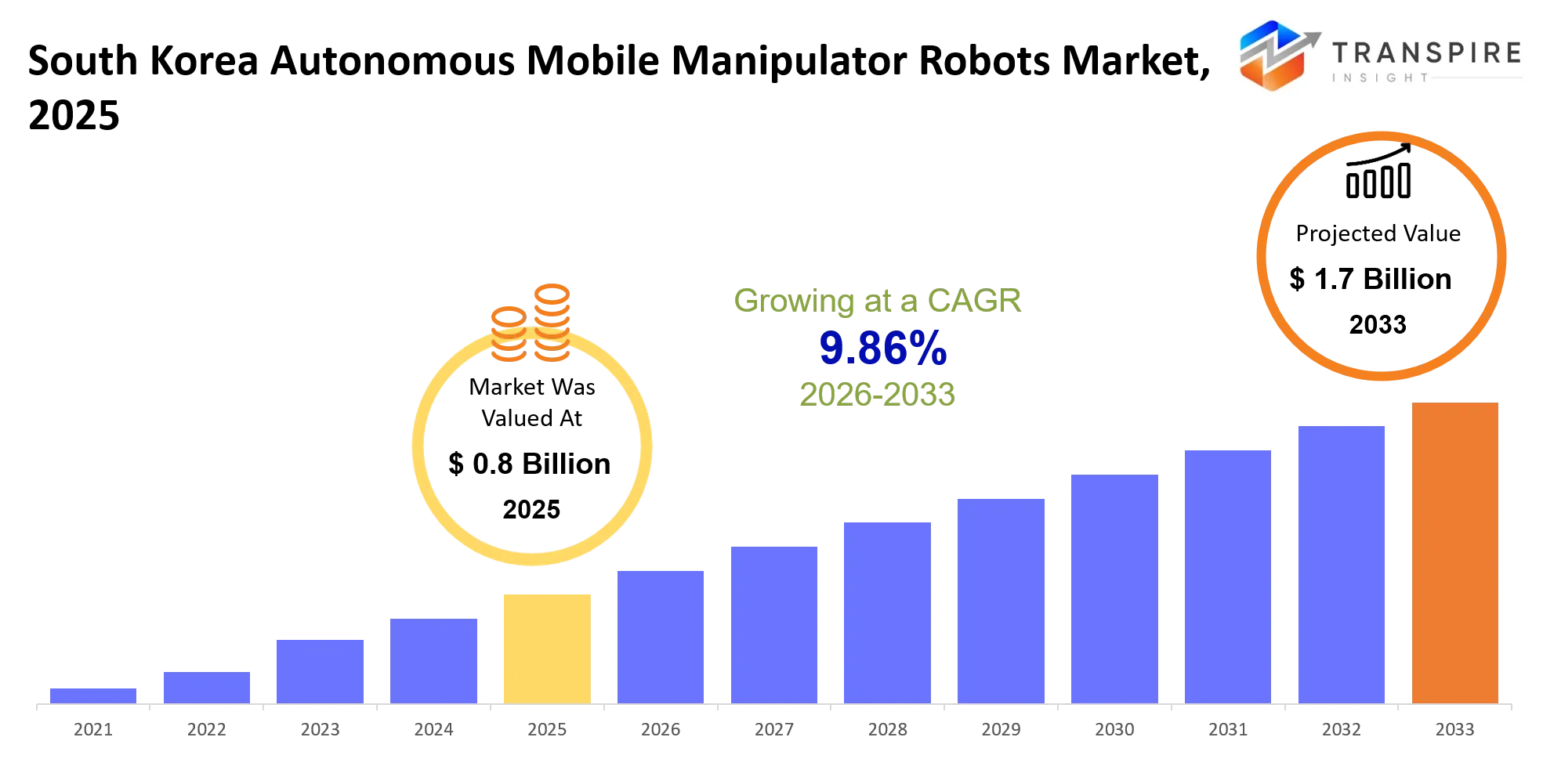
- Market Value (2025): USD 0.8 Billion.
- Expected Market Value (2026): USD 0.88 Billion.
- Estimated Market Value (2033): USD 1.7 Billion.
- Forecast CAGR (2026–2033): 9.86 %
Introduction
Autonomous Mobile Manipulator Robot (AMMR) is a sophisticated automated system consisting of an autonomous mobile robot (AMR) platform (an automated system used for independent movement within a dynamic environment in absence of any external guiding tracks) along with a robotic arm/manipulator (used for manipulation purposes such as grasping and assembling). The robots navigate through dynamic environments such as warehouses and manufacturing plants to complete tasks including sorting, packaging and machine tending on their own without any human interference. The South Korea Autonomous Mobile Manipulator Robots Market is taking shape through the combination of autonomous mobility and robotic dexterity that enables robots to move, pick, place, sort and assemble the parts without human assistance. As opposed to fixed automation, mobile manipulators offer increased flexibility through the ability to adapt to changes in SKUs, processes, and manufacturing through software modifications. Mobile manipulators can also resolve the issue of lack of skilled labor and increasing costs of human capital in semiconductor manufacturing, electronics, logistics, and advanced assembly applications. In addition, technologies like LiDAR, computer vision, and SLAM make it possible for robots to navigate effectively, safely, and accurately.
Key Market Highlights: -
- By robot type, the Autonomous Mobile Robots segment dominated the market and holds nearly 35 % share in 2025 and is projected to grow at a substantial CAGR during the forecast period.
- By application, the Material Handling segment dominated the market and holds nearly 31% share in 2025 and is projected to grow at a substantial CAGR during the forecast period.
- By end user, the Logistics segment dominated the market and holds nearly 42 % share in 2025 and is projected to grow at a substantial CAGR during the forecast period.
- The government-sponsored robotics programs in South Korea help with research and development, commercialization, demonstration, and implementation of advanced robotics technology. Such programs that are dedicated to physical AI, autonomous robotics, intelligent manipulation, and automation in industry play an important role in building the ecosystem for autonomous mobile manipulator robots.
How is Technology Driving Growth in the South Korea Autonomous Mobile Manipulator Robots Market?
The market for autonomous mobile manipulator robots in South Korea will see growth due to AI-based perception capabilities, autonomy, 5G technologies, and Industry 4.0 implementations. Advanced machine vision, LiDAR sensors, and sensor fusion help machines recognize parts, autonomously navigate, avoid obstacles, and perform manipulation. 5G technologies improve communication and coordination within a fleet of robots as well as optimize traffic flow and multi-robot interactions within smart factories and warehouses. The implementation of Industry 4.0 programs, massive investments in research & development, and the lack of personnel and increased wages are other factors that drive automation. Moreover, the use of new robotic hardware and advanced end-effectors increases applications in the production of semiconductors, electronics, logistics, handling, assembly, and industrial processes.
Market Drivers
The market for Autonomous Mobile Manipulator Robots in South Korea is influenced by factors like shortage of labor, rising cost of labor, and industrial automation. The age of the workforce is motivating manufacturers to use robots in order to carry out continuous material handling and manufacturing assistance. The presence of the semiconductor and electronics industry in South Korea is creating a need for precise material handling and transport. The technological convergence of mobile robots and dexterous robot manipulators facilitates movement in dynamic environments while carrying out material handling and other activities. An ecosystem with strong prospects for the growth of the Autonomous Mobile Manipulator Robots market is created in South Korea through extensive use of industrial robots, well-developed manufacturing industry, government initiatives, and advanced research capacity. Highly developed automation in manufacturing creates a good basis for implementation of mobile manipulation technology. The competitive semiconductor and electronics manufacturing industry creates demand for advanced flexible robots. Government programs focused on intelligent manufacturing and robotics help to promote and implement new technologies into the manufacturing industry. At the same time, advanced R&D capacities and investments of leading technology companies help to develop artificial intelligence, autonomous navigation, machine vision, and robotic manipulation technologies.
Restrain
These issues can retard the growth of the market by adding to the overall cost and complexity involved in deploying Autonomous Mobile Manipulator Robots. The high level of initial investment will make these robots inaccessible for small manufacturers, whereas the difficulties involved in integrating the system will need some technical know-how. Technical constraints might pose some challenges for these robots in complex settings.
|
Driver |
Relative Impact on Growth (%) |
Geographic Relevance |
Impact Timeline |
Demand Strength |
Growth Mechanism |
Key Beneficiaries |
Major Constraint |
|
Driver 1: Semiconductor & Electronics Automation |
27% |
Seoul, Gyeonggi, Chungcheong |
Medium-term |
High |
Enables precision handling across advanced production workflows. |
Robot OEMs, semiconductor fabs, electronics manufacturers |
High integration requirements increase deployment costs. |
|
Driver 2: Labor Shortages & Workforce Aging |
23% |
Nationwide; major manufacturing clusters |
Short-term |
High |
Replaces repetitive manual tasks with autonomous robotic labor. |
Manufacturers, logistics operators, robotics integrators |
High upfront investment limits SME adoption. |
|
Driver 3: Industry 4.0 & Smart Factory Investment |
20% |
Nationwide; Seoul metropolitan industrial ecosystem |
Medium-term |
High |
Accelerates connected automation and intelligent factory deployment. |
Automation vendors, manufacturers, software providers |
Legacy systems complicate technology integration. |
|
Driver 4: AI, Vision & Physical-AI Advances |
17% |
Seoul, Daejeon, Pangyo, major R&D hubs |
Long-term |
High |
Improves perception, navigation, manipulation, and task autonomy. |
AI firms, robot manufacturers, component suppliers |
Complex environments challenge reliable manipulation. |
|
Driver 5: Government Robotics Support & Demonstration |
13% |
Nationwide; Seoul and designated robotics clusters |
Medium-term |
Medium |
Reduces commercialization barriers through R&D and demonstrations. |
Robotics startups, OEMs, research institutions, end users |
Funding cycles and commercialization uncertainty constrain scaling. |
Analysis of Prices and Consumer Behaviour
The market for South Korea autonomous mobile manipulator robots will be determined by the demand in manufacturing, semiconductor, electronics, and logistics industry sectors. The South Korea autonomous mobile robot market is worth USD 177.6 million in 2025 and USD 216.5 million in 2026 and will expand with 15.17 % CAGR between 2026 to 2035. The market is expected to grow up to USD 771.8 million by 2035. Autonomous mobile manipulators belong to the fastest growing product segment in the overall AMR market. The number of sales will be affected by the flexibility in the use of such devices both in the manufacturing and logistics and the flexibility of implementation of mobile robotic technology. The semiconductor and electronics industry is a major buyer of this technology. Purchasing decisions will be based on autonomous navigation, payload, safety, system integration, scalability, and efficiency.
Who are the Key Players in the South Korea Autonomous Mobile Manipulator Robots Market and how do they compete?
Competitiveness in the South Korea Autonomous Mobile Manipulator Robots Market relies on companies that specialize in innovations in the field of robotics, autonomous navigation, collaborative robotics, artificial intelligence, and integrated automation systems. Competing both on price and on payload, mobility, precision, safety, machine vision, AI-perception, and integration into manufacturing and warehouse processes, such a competitive strategy implies continuous product innovation and contributes to automation, flexibility, and productivity.
With the development of collaborative robots, AI-powered robotic solutions and advanced automation solutions, Doosan Robotics improves its market position. The development of autonomous mobile robots and intelligent logistics systems, intended for the use in manufacturing, warehousing, and industrial settings, allows companies to distinguish themselves from their competitors. Samsung Electronics strengthens its market position through artificial intelligence, robotics, and advanced automation technologies.
Top Companies in the South Korea Autonomous Mobile Manipulator Robots Market
- Samsung Electronics
- LG Electronics
- Hyundai Motor Group
- Doosan Robotics
- Rainbow Robotics
- Neuromeka
- Hyundai Robotics
- Hanwha Robotics
- ROBOTIS
- Yujin Robot
- Rainbow Robotics
- KT
- Samsung SDS
- LG CNS
- Hyundai WIA
|
Company |
Est. Revenue Share Range |
Key Offerings |
Strategic Positioning |
Geographic Strength |
Technology Focus |
|
Rainbow Robotics |
8–12% (Estimated) |
RBY Dual-Arm Mobile Manipulator; RBM Series AMRs; collaborative robots; mobile platforms |
Integrated Korean mobile-manipulation technology leadership |
South Korea, Asia-Pacific, North America |
AMR, dual-arm manipulation, LiDAR, perception |
|
Hyundai Motor Group |
7–11% (Estimated) |
MobED; MobED Alliance; AI robotics platforms; mobile robotic systems |
Ecosystem-led commercialization and industrial integration |
South Korea, North America, Asia-Pacific |
AI robotics, mobility, autonomous navigation, manipulation |
|
OMRON |
5–9% (Estimated) |
Mobile Manipulator (MoMa); LD/MD AMRs; TM collaborative robots; MobilePlanner |
Integrated automation platform and flexible deployment |
Asia-Pacific, North America, Europe |
Vision, AMR, cobots, fleet management, automation |
|
Yujin Robot |
4–7% (Estimated) |
GoCart AMR; autonomous logistics robots; factory automation; AMR solutions |
Specialized Korean AMR and logistics automation |
South Korea, Asia-Pacific, Europe |
AMR, LiDAR, SLAM, logistics automation |
|
Neuromeka |
3–6% (Estimated) |
Moby AMR; Indy collaborative robot; mobile-manipulation configurations; Indy software |
Collaborative robotics with mobile flexibility |
South Korea, Asia-Pacific, North America |
Cobots, AMR, force control, autonomous mobility |
|
Doosan Robotics |
3–6% (Estimated) |
Collaborative robots; mobile cobot solutions; AI-enabled robotics; automation systems |
Cobot-led industrial automation diversification |
South Korea, North America, Europe, Asia |
Cobots, AI, machine vision, force control |
|
Hanwha Robotics |
2–5% (Estimated) |
Collaborative robots; mobile robot solutions; intelligent automation; robotic systems |
Industrial automation and smart-factory integration |
South Korea, Asia-Pacific, Europe |
Cobots, AI, vision, smart-factory automation |
|
LG Electronics |
2–5% (Estimated) |
CLOi robots; logistics/service robots; autonomous mobile solutions; smart-factory robotics |
Enterprise ecosystem and service-robot diversification |
South Korea, North America, Asia-Pacific |
AI, autonomous mobility, vision, cloud connectivity |
|
Samsung Electronics |
1–4% (Estimated) |
Rainbow Robotics integration; AI robotics; intelligent automation; humanoid/mobile robotics |
AI-driven ecosystem and strategic robotics expansion |
South Korea, Asia-Pacific, North America |
AI, robotics software, perception, autonomous systems |
|
ABB |
1–3% (Estimated) |
AMRs; mobile robotics; robotic arms; integrated automation solutions |
Global industrial automation and technology integration |
Europe, Asia-Pacific, North America |
Industrial robotics, AMR, vision, AI, automation |
South Korea Autonomous Mobile Manipulator Robots Market Segmentation
The South Korea Autonomous Mobile Manipulator Robots Market share is divided into six categories: By robot type, payload, application, component, technology and end user.
The Autonomous Mobile Robots dominated the market, accounting for nearly 35% in 2025 and is expected to rise at a significant CAGR during the forecast period.
The South Korea Autonomous Mobile Manipulator Robots Market is segmented by robot type into Mobile Manipulators, Autonomous Mobile Robots, Collaborative Mobile Robots, Autonomous Manipulators, Wheeled Robots, Humanoid Mobile Robots, Articulated Mobile Robots, Hybrid Robots. Among these, the Autonomous Mobile Robots segment dominated the market, accounting for nearly 35% in 2025 and expected to increase at a significant CAGR during the forecast period. The Autonomous Mobile Robots category was the leading one in 2025 owing to increasing requirements for warehouse flexibility, intelligent material handling, navigation in real time, and efficient logistics operation. The integration with Artificial Intelligence, sensors, machine vision, and fleet management systems enhances efficiency and cuts down manual labor and increases smart manufacturing and e-commerce fulfillment.
The Material Handling dominated the market, accounting for nearly 31% in 2025, and is expected to rise at a significant CAGR during the forecast period.
The South Korea Autonomous Mobile Manipulator Robots Market is segmented by application into Material Handling, Assembly, Picking & Placing, Machine Tending, Inspection, Warehousing, Logistics, Healthcare. Among these, the Material Handling segment dominated the market, accounting for nearly 31% in 2025 and expected to increase at a significant CAGR during the forecast period. In 2025, the Market Handling segment accounted for a leading share in the market because of the growing automation of warehouses, the need for efficient material handling, and the implementation of autonomous mobile manipulators. The use of technologies such as AI, machine vision, navigatiohttps://www.agile-robots.com/en/news/detail/mobile-manipulators-dynamic-flexibility-in-action/n, and robotic arms allows performing tasks of picking up, transporting, sorting, and loading materials.
The Logistics dominated the market, accounting for nearly 42% in 2025 and is expected to rise at a significant CAGR during the forecast period.
The South Korea Autonomous Mobile Manipulator Robots Market is segmented by end user into Automotive, Electronics, Manufacturing, Logistics, Warehousing, Healthcare, Food & Beverage, Research Institutions. Among these, the Logistics segment dominated the market, accounting for nearly 42% in 2025 and expected to increase at a significant CAGR during the forecast period. The Logistics segment was the dominant one in 2025 because of the growth of automation within warehouses, the need for quicker movement of materials, and the shortage of labor force. The autonomous mobile manipulator robots are used to improve picking, sorting, transporting, and fulfilling orders by using artificial intelligence, machine vision, and manipulation.
Future Market Trends for the South Korea Autonomous Mobile Manipulator Robots Market: -
- Emergence of Dual Arm and Humanoid Manipulators: Companies are shifting from basic transporting AMRs to sophisticated manipulator capable AMRs that are capable of not only delivering goods but also assembling or picking the objects.
- Several Conglomerates' Led Ecosystems: Companies such as Samsung (with a rise in its ownership of Rainbow Robotics by 35% through its subsidiary), Hyundai, and LG are spearheading commercial pilot projects and automation integration.
- ADVANCED AI AND VISION NAVIGATION: Transitioning from using conventional LiDAR SLAM to advanced 3D Vision and AI driven navigation systems, and natural language interface for better human-robot collaboration.
- Overcoming Labor Shortage Problem: Increased investment in smart factories to compensate for falling domestic labor pool in manufacturing lines with short life cycles of products.
Recent Development
- In September 2026: Collaboration of HL Robotics with the Construction Group at Samsung C&T involved the design of smart homes with the help of PARKIE, which is an indoor autonomous mobile robot for automatic parking. This is evidence that the utilization of AMR, IM, and robotic automation has been increasing in South Korea.
- In June 2026: OMRON Robotics has launched its latest LD-150 and LD-300 AMRs with increased load-bearing capacity, greater safety features, better navigation capability, and integration of FLOW Core fleet management software. This development will help facilitate material handling flexibility and industrial automation scalability, and is significant in relation to the South Korea Autonomous Mobile Manipulator Robots Market and Industry 4.0 environment.
Market Segment
This study forecasts revenue at South Korea, regional and country levels from 2020 to 2033. Transpire Insights has segmented the South Korea Autonomous Mobile Manipulator Robots Market based on the below-mentioned segments:
South Korea Autonomous Mobile Manipulator Robots Market, By Robot Type
- Mobile Manipulators
- Autonomous Mobile Robots
- Collaborative Mobile Robots
- Autonomous Manipulators
- Wheeled Robots
- Humanoid Mobile Robots
- Articulated Mobile Robots
- Hybrid Robots
South Korea Autonomous Mobile Manipulator Robots Market, By Payload
- Below 5 kg
- 5–10 kg
- 10–20 kg
- 20–50 kg
- 50–100 kg
- 100–200 kg
- Above 200 kg
- Custom Payload
South Korea Autonomous Mobile Manipulator Robots Market, By Application
- Material Handling
- Assembly
- Picking & Placing
- Machine Tending
- Inspection
- Warehousing
- Logistics
- Healthcare
South Korea Autonomous Mobile Manipulator Robots Market, By Component
- Robotic Arm
- Mobile Base
- Sensors
- Cameras
- Controllers
- Actuators
- Batteries
- Software
South Korea Autonomous Mobile Manipulator Robots Market, By Technology
- AI
- Computer Vision
- SLAM
- Machine Learning
- Autonomous Navigation
- Object Recognition
- Path Planning
- Sensor Fusion
South Korea Autonomous Mobile Manipulator Robots Market, By End User
- Automotive
- Electronics
- Manufacturing
- Logistics
- Warehousing
- Healthcare
- Food & Beverage
- Research Institutions
Frequently Asked Questions
Find quick answers to common questions.
The market is projected to grow from USD 0.8 billion in 2025 to USD 1.7 billion by 2033, expanding significantly.
A. Autonomous Mobile Robots dominate, accounting for nearly 35% share in 2025, driven by warehouse automation, material handling, navigation, and logistics.
Material Handling dominates, accounting for nearly 31% share in 2025, supported by warehouse automation, transportation, sorting, picking, and loading.
Key players include Samsung Electronics, LG Electronics, Hyundai Motor Group, Doosan Robotics, Rainbow Robotics, Neuromeka, Hanwha Robotics, and Yujin Robot.
Labor shortages, rising costs, Industry 4.0, semiconductor manufacturing, robotics investments, government programs, AI, SLAM, and machine vision drive market growth.
- Samsung Electronics
- LG Electronics
- Hyundai Motor Group
- Doosan Robotics
- Rainbow Robotics
- Neuromeka
- Hyundai Robotics
- Hanwha Robotics
- ROBOTIS
- Yujin Robot
- Rainbow Robotics
- KT
- Samsung SDS
- LG CNS
- Hyundai WIA
About the Authors

Avinash Kumar
I’m Avinash Kumar, a Senior Research Analyst at Transpire Insight, with expertise in the Electronics and Semiconductor and Energy & Power industry. My work focuses on analyzing emerging technologies, market trends, industry developments, and innovation across these sectors. I specialize in transforming complex technical and market insights into clear, research-backed content that helps professionals, businesses, and decision-makers stay informed. Through continuous industry research and data-driven analysis, I strive to deliver accurate, reliable, and practical perspectives on the latest advancements shaping the semiconductor and energy landscape.

Chakradhar Khansole
Chakradhar serves as the Research Director at Transpire Insight, bringing over 8 years of experience in technology, innovation, and strategic market intelligence. He specializes in transforming complex market data into actionable business insights that enable organizations to make informed, growth-oriented decisions. Recognized for his strategic vision and analytical expertise, Chakradhar leads high-impact research initiatives, delivering comprehensive market assessments, competitive intelligence, and forward-looking industry analysis.
Recently Published Reports
-
Apr 2026
Fiber Optic Faceplates Market
Fiber Optic Faceplates Market Size, Share & Analysis Report By Type (< 300 mm2, 300-350 mm2, and > 350 mm2, By Application (Night Vision, Holographic Imaging, Medical, and Others), and Geography (North America, Europe, Asia-Pacific, Middle East and Africa, South and Central America), 2021 - 2031
-
Apr 2026
High Temperature Superconductors Market
High Temperature Superconductors Market Size, Share & Analysis Report By Type (1G HTS, and 2G HTS), By Application (Power Cable, Fault Current Limiter, and Transformer), and Geography (North America, Europe, Asia-Pacific, Middle East and Africa, South and Central America), 2021 - 2031
-
Apr 2026
Industrial Plugs and Socket Market
Industrial Plugs and Socket Market Size, Share & Analysis Report By Type (Industrial Plugs, Industrial Sockets), By Current (Up to 32 A, 32 to 125 A, Above 125 A), By Protection (Dustproof and Splash Proof, Waterproof, Explosion Proof), By End User (Heavy Industries, Oil and Gas, Chemicals and Pharmaceuticals, Power Generation, Others), and Geography (North America, Europe, Asia-Pacific, Middle East and Africa, South and Central America), 2021 - 2031
-
Apr 2026
InGaAs Avalanche Photodiodes Market
InGaAs Avalanche Photodiodes Market Size, Share & Analysis Report By Type (1100 - 1700 nm, and 1000 - 1600 nm), By Application (Missile Warning System, Muzzle Flash Detection, Wafer Defect Inspection, Laser Rangefinders, and Others), and Geography (North America, Europe, Asia-Pacific, Middle East and Africa, South and Central America), 2021 - 2031