
Hybrid Silane-Terminated Polymer Adhesives for EV Battery Pack Assembly Market Summary:
As per Transpire Insight Analysis, the Hybrid Silane-Terminated Polymer Adhesives for EV Battery Pack Assembly Market size is estimated at USD 286.4 Million in 2025 and is anticipated to reach USD 840.1 Million by 2033, growing at a CAGR of 11.82% from 2026 to 2033. Growth is mainly attributed to growth in EV production, tougher battery safety requirements, and rising need for superior quality adhesives.
The Hybrid Silane-Terminated Polymer Adhesives for EV Battery Pack Assembly Market is changing because electric vehicle manufacturers want to make their batteries safer and last longer. They also want to make their vehicles lighter. So they are using adhesives instead of the usual ways of putting things together. These adhesives make the batteries stronger and better able to withstand vibrations. They also seal things better.
Over the past few years, the Hybrid Silane-Terminated Polymer Adhesives for EV Battery Pack Assembly Market has started to use better adhesives because the batteries in electric vehicles are getting more complicated. More electric vehicles are being made now. The rules for keeping vehicles safe are getting stricter, and new battery technologies are being developed quickly. This is making companies come up with better products.
The Hybrid Silane-Terminated Polymer Adhesives for EV Battery Pack Assembly Market is also growing because more money is being invested in making vehicles and batteries. This means that companies that make adhesives can create products that are just for certain jobs. These products help make the manufacturing process more efficient and the batteries reliable in the long term. They also make it easier to put the batteries in.
Hybrid Silane-Terminated Polymer Adhesives for EV Battery Pack Assembly Market Size & Forecast:
- Global Market Size 2025: USD 286.4 Million
- Expected Market Value (2033): USD 840.1 Million
- Forecast CAGR (2026–2033): 7.27%
- Leading Region in 2025: Asia Pacific
- Fastest Growing Region: Europe
- Key Company Profiles: Henkel, Sika, Arkema, H.B. Fuller, Dow, 3M, Wacker Chemie, Bostik, Momentive, Evonik Industries, Huntsman, BASF, Permabond, Panacol, Dymax

Key Market Insights:
There is an increased emphasis on adhesive technologies, which offer not only strength but also elasticity, sealing, and efficient manufacturing processes. In addition, the electric vehicle industry relies more and more on adhesive selection based on battery design, heat considerations, and automation.
- The Structural STP Adhesives form 39% and are considered the largest product segment due to their high strength and durability for assembling battery packs.
- The One-Component STP Adhesives segment forms 22% and is driven by easy handling and applicability as well as an automated assembly process.
- The Flexible STP Adhesives occupy 15% and are used because of the necessity for vibration resistance and moving parts in EV batteries.
- The Two-Component STP Adhesives have 10% and are popular where controlled curing and good bonding properties are needed.
- The Thermal Conductive STP Adhesives take 10% and, according to the provided data, are considered the fastest-growing segment with a CAGR of 19.4% due to increased focus on battery thermal management.
- The Hybrid STP Adhesives have 2% and cover special requirements for specific applications.
- Others have 2% and cover niche battery assembly needs.
- Manufacturers produce more and more formulations for special applications that allow automation, lightweight assembly, thermal control and structural bonding in the modern production of EV batteries.
What are the Key Drivers, Restraints, and Opportunities in the Hybrid Silane-Terminated Polymer Adhesives for EV Battery Pack Assembly Market?
Drivers,
Market growth is mainly fueled by the increasing demand for batteries due to the rapid increase in the production of electric vehicles. With the advancement of technology, batteries are getting bigger, and thus there is a need for an adhesive that will offer good structural strength, sealing and durability without adding extra weight. Due to the opening up of new plants for producing electric vehicles and battery gigafactories, there has been increased demand for hybrid silane-terminated polymer adhesives.
Restraints
limitation is the rigorous qualification and certification procedure that needs to be fulfilled before incorporating the novel adhesive formulations in battery construction. The automobile industry undertakes detailed testing procedures to conform to stringent safety standards. This long process of validation adds to the cost of development and time-to-market.
Opportunities
opportunity for the suppliers would be the creation of the next generation of batteries and thermal management systems. With the launch of high-energy-density batteries and lightweight vehicle platforms by the automakers, there would be a growing need for multi-functional adhesives with better thermal and structural performance. Additionally, the growing investment in battery production in Europe and the Asia Pacific region would open new opportunities for the suppliers.
What Has the Impact of Artificial Intelligence Been on the Hybrid Silane-Terminated Polymer Adhesives for EV Battery Pack Assembly Market?
Artificial intelligence technology plays an increasing role in enhancing processes related to development, production, and use of hybrid silane-terminated polymer adhesives in the assembly of electric vehicle batteries. Manufacturers utilize artificial intelligence-powered simulations to test the material composition and find an optimal balance between bonding ability, flexibility, curing time, and thermal properties. This allows for a more efficient development process and helps suppliers to provide custom-tailored solutions that fit the current battery design.
During production, AI technologies are used in automated dispensing systems for optimisation of adhesive flow rate and application patterns as well as curing conditions. Predictive analytics allows for monitoring of the manufacturing equipment condition, identifying potential faults, and scheduling equipment maintenance before any breakdowns occur, thus providing higher production efficiency. The implementation of AI can be rather difficult for many manufacturers. Integration of artificial intelligence into production facilities requires considerable investments, technical knowledge, and availability of relevant data. Small adhesive producers can struggle with the creation of predictive models due to a lack of digitalisation. Thus, the process becomes less efficient. In May 2025, at The Battery Show Europe 2025, BASF unveiled the latest in digital and sustainable battery assembly solutions, including “Debonding on Demand” polyurethane adhesives technology for EV battery packs. The company focused on digital engineering and AI-based material development techniques to enable rapid development of adhesives, making batteries more easily repairable and recyclable.
Key Market Trends:
The market is currently experiencing a change since manufacturers of EV batteries are now opting for adhesives that will ensure battery safety, ease of manufacturing, and better performance of the vehicles. Innovations are being made in order to provide solutions for lightweight batteries, automation, and thermal management instead of conventional bonding techniques.
- Innovations in EV battery manufacturing are moving away from the use of mechanical fastening and towards the use of advanced adhesives that provide structural integrity and reduction of the total vehicle weight.
- Innovations in adhesive chemistry are aimed at providing enhanced bonding capability and flexibility to satisfy the demands of current battery pack architecture.
- Automation is one of the major trends in the industry, where manufacturers start to use precision dispensing technology.
- Innovations in thermal management are emerging in connection with the increase in battery capacities of batteries and the need for better heat dissipation.
- Product development of sustainable products becomes an important driver for innovations as manufacturers start to offer low-emission products.
- Partnerships among adhesives manufacturers, battery producers, and automotive OEMs become popular.
Hybrid Silane-Terminated Polymer Adhesives for EV Battery Pack Assembly Market Segmentation
By Product Type
The Structural STP Adhesives lead the By Product Type segment, comprising 39% share of the market owing to the requirement of higher bond strength and durability for assembly of the EV batteries. One Component STP Adhesives constitute 22% share of the market, supported by the benefits of ease of use and processability in automated production lines, whereas Flexible STP Adhesives comprise 15% share owing to their vibration and thermal expansion properties. Two Component STP Adhesives and Thermal Conductive STP Adhesives form 10% each in the By Product Type Segment. Among them, Thermal Conductive STP Adhesives have been recognised as the fastest growing segment, growing at a CAGR of 19.4%. The Hybrid STP Adhesives and Others make up 2% each of the market.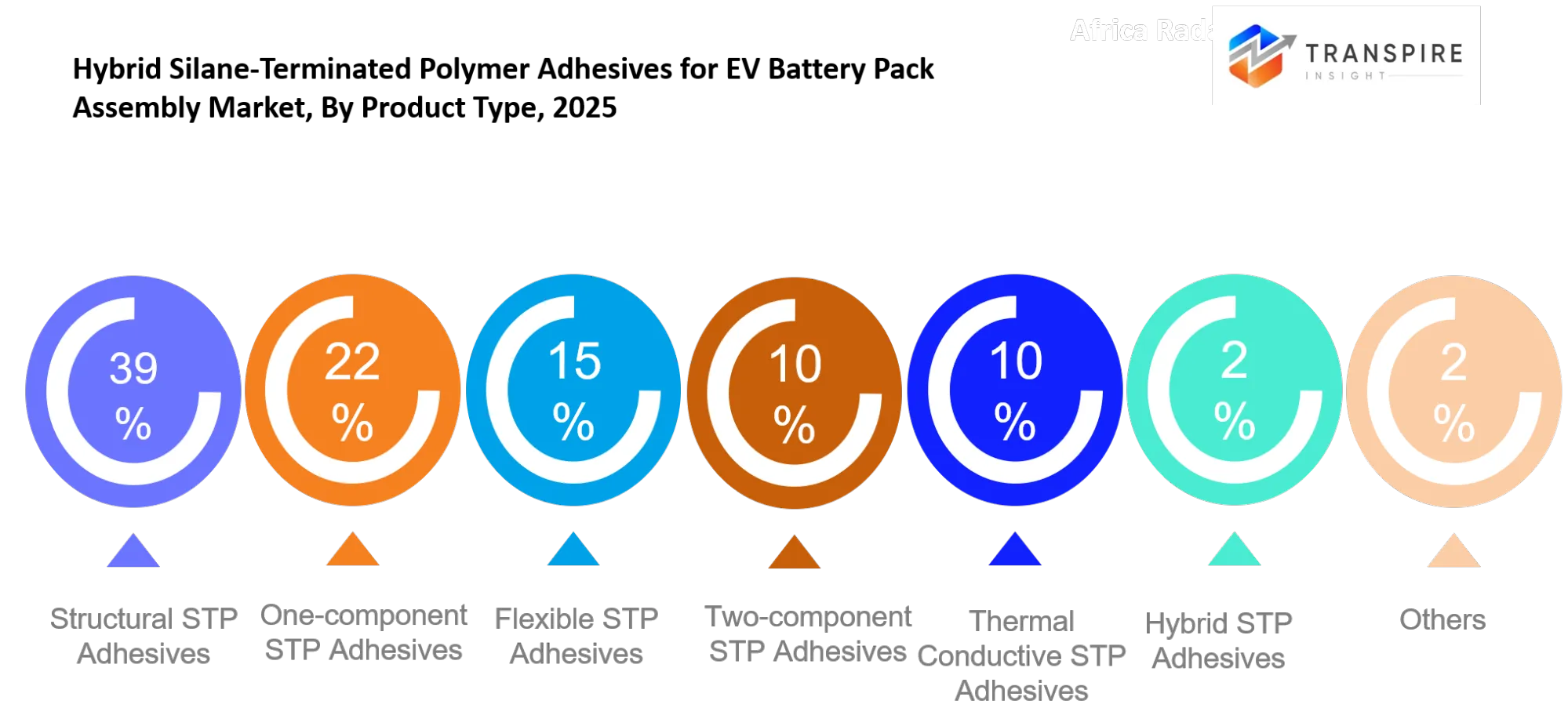
By Application
The By Application area is largely driven by Battery Pack Assembly and Structural Bonding as the high-performance adhesives provide increased mechanical strength, sealing ability, and durability. The application areas of Battery Module Bonding and Thermal Management continue growing as the companies strive for better thermal management and assembly process performance. Cell Encapsulation is becoming increasingly popular as a means of protecting battery cells from humidity and contamination, while EV Chassis Assembly and Electronic Components are generating new applications due to the lightweight nature of the vehicle platforms.
By Curing Technology
In the Curing Technology category are Moisture Cure, Dual Cure, UV-cured, Heat-cured, Hybrid Cure System, and Others. Moisture Cure is popular due to its reliable curing ability at regular manufacturing conditions. Dual Cure and Hybrid Cure systems have gained increasing importance for applications that require increased processability and improved adhesion characteristics. UV-cured and Heat-cured systems offer quick production cycles along with increased manufacturing efficiency.
By Distribution Channels
In the Distribution Channels section, the major players include Direct Sales and OEM suppliers, owing to the technical aspect of selecting adhesives and the importance of cooperation during the development of the batteries. Automotive Adhesive Distributors assist in increasing the geographical presence and providing technical assistance to the manufacturers, while Online B2B Platforms are becoming increasingly important by streamlining the product procurement process. With the increase in global production of EVs, the distribution channels are expected to become more specialised, allowing for quicker deliveries and increased market access.
What are the Key Use Cases Driving the Hybrid Silane-Terminated Polymer Adhesives for EV Battery Pack Assembly Market?
The use case for Structural STP Adhesives is battery pack assembly, in which they are extensively used to form robust bonds between battery housing, modules, and supporting parts. By enhancing structural strength, reducing vibrations, and ensuring reliable sealing, these adhesives allow for the improvement of battery safety and reduction of car weight.
In addition to the traditional uses, these adhesives find more applications such as thermal management, battery module bonding, cell encapsulation, and structural bonding. By providing reliable adhesion in severe conditions of operation, these adhesives allow for the production of superior electric vehicles and increase manufacturing efficiency. The new applications are chassis assembly of electric vehicles, electronics integration, and battery systems of the next generation. As battery technologies develop, manufacturers turn to the use of new adhesive solutions that possess structural, flexible, and thermal performance properties.
|
Report Metrics |
Details |
|
Market size value in 2025 |
USD 286.4 Million |
|
Market size value in 2026 |
USD 327.7 Million |
|
Revenue forecast in 2033 |
USD 840.1 Million |
|
Growth rate |
CAGR of 14.4% from 2026 to 2033 |
|
Base year |
2025 |
|
Historical data |
2021 - 2024 |
|
Forecast period |
2026 - 2033 |
|
Report coverage |
Revenue forecast, competitive landscape, growth factors, and trends |
|
Regional scope |
United States; Canada; Mexico; United Kingdom; Germany; France; Italy; Spain; Denmark; Sweden; Norway; China; Japan; India; Australia; South Korea; Thailand; Brazil; Argentina; South Africa; Saudi Arabia; United Arab Emirates |
|
Key company profiled |
Henkel, Sika, Arkema, H.B. Fuller, Dow, 3M, Wacker Chemie, Bostik, Momentive, Evonik Industries, Huntsman, BASF, Permabond, Panacol, Dymax |
|
Customization scope |
Free report customization (country, regional & segment scope). Avail customized purchase options to meet your exact research needs. |
|
Report Segmentation |
By Product Type (One-component STP Adhesives, Two-component STP Adhesives, Structural STP Adhesives, Flexible STP Adhesives, High-strength STP Adhesives, Thermal Conductive STP Adhesives, Hybrid STP Adhesives, Others); By Application (Battery Module Bonding, Battery Pack Assembly, Thermal Management, Structural Bonding, Cell Encapsulation, EV Chassis Assembly, Electronic Components, Others); By End User (Electric Vehicle OEMs, Battery Manufacturers, Tier-1 Automotive Suppliers, Electronics Manufacturers, Industrial Adhesive Companies, Others); By Curing Technology (Moisture Cure, Dual Cure, UV-assisted Cure, Heat-assisted Cure, Hybrid Cure Systems, Others); By Distribution Channel (Direct Sales, Automotive Adhesive Distributors, OEM Suppliers, Online B2B Platforms, Others) |
Which Regions are Driving the Hybrid Silane-Terminated Polymer Adhesives for EV Battery Pack Assembly Market Growth?
North America
North America accounts for 22% of the worldwide market and sustains its steady growth by implementing innovations in technology and manufacturing. In contrast to Asia Pacific, North America has more focus on developing advanced batteries, conducting research, and manufacturing quality electric vehicles. Growing investments in battery manufacturing, government initiatives for green transportation, and cooperation between car manufacturers and suppliers of adhesives help increase the level of market stability. In turn, it stimulates the need for adhesive solutions that will improve battery safety and longevity. In September 2025, Henkel inaugurated its North America Battery Application Centre located in Madison Heights, Michigan, to enable the development and validation of advanced adhesive, sealing, and thermal management products used in EV battery pack assembly for automotive OEMs and battery suppliers. This centre enables rapid development and deployment of battery assembly adhesives for next-generation EV batteries.
Europe
Europe is the leading market with a share of 28%, and at the same time it is the fastest-growing one with a CAGR of 18.8%. The growth of the region is connected to new emission requirements for vehicles, increasing investments in sustainable transport, and a growing number of battery factories. As there is increasing demand for batteries for electric vehicles manufactured locally, the producers of adhesives try to offer innovative products according to strict environmental and performance requirements. With the ongoing expansion of battery manufacturing capacity, Europe will become a significant source of opportunities for hybrid silane-terminated polymer adhesives.In April 2025, Henkel launched battery assembly technologies at The Battery Show Europe 2025, which include AI-enabled virtual development of adhesives, debonding technology, thermal management products, and advanced adhesive systems that can be used in EV battery packs. Such innovations provide safety, light weight, and sustainability in the battery assembly.
Asia Pacific
Asia Pacific is the dominant region, holding a 45% share in the global market. The region gains an advantage from the established manufacturing base for electric vehicles, large-capacity battery production, and an established supply chain of automotive parts. The government initiatives to support EV usage, investment in battery gigafactories, and production expansion capacities are driving the regional demand for adhesives technologies. The involvement of major automotive OEMs and battery producers in the region also plays an important role in its dominance in the use of adhesives technologies for battery pack assembly.In July 2025, Panasonic Energy launched large-scale manufacturing of its new EV lithium-ion battery plant located in Kansas, in addition to the expansion of its global manufacturing network of batteries under its leadership in the Asia-Pacific region in terms of engineering skills in the manufacturing of batteries.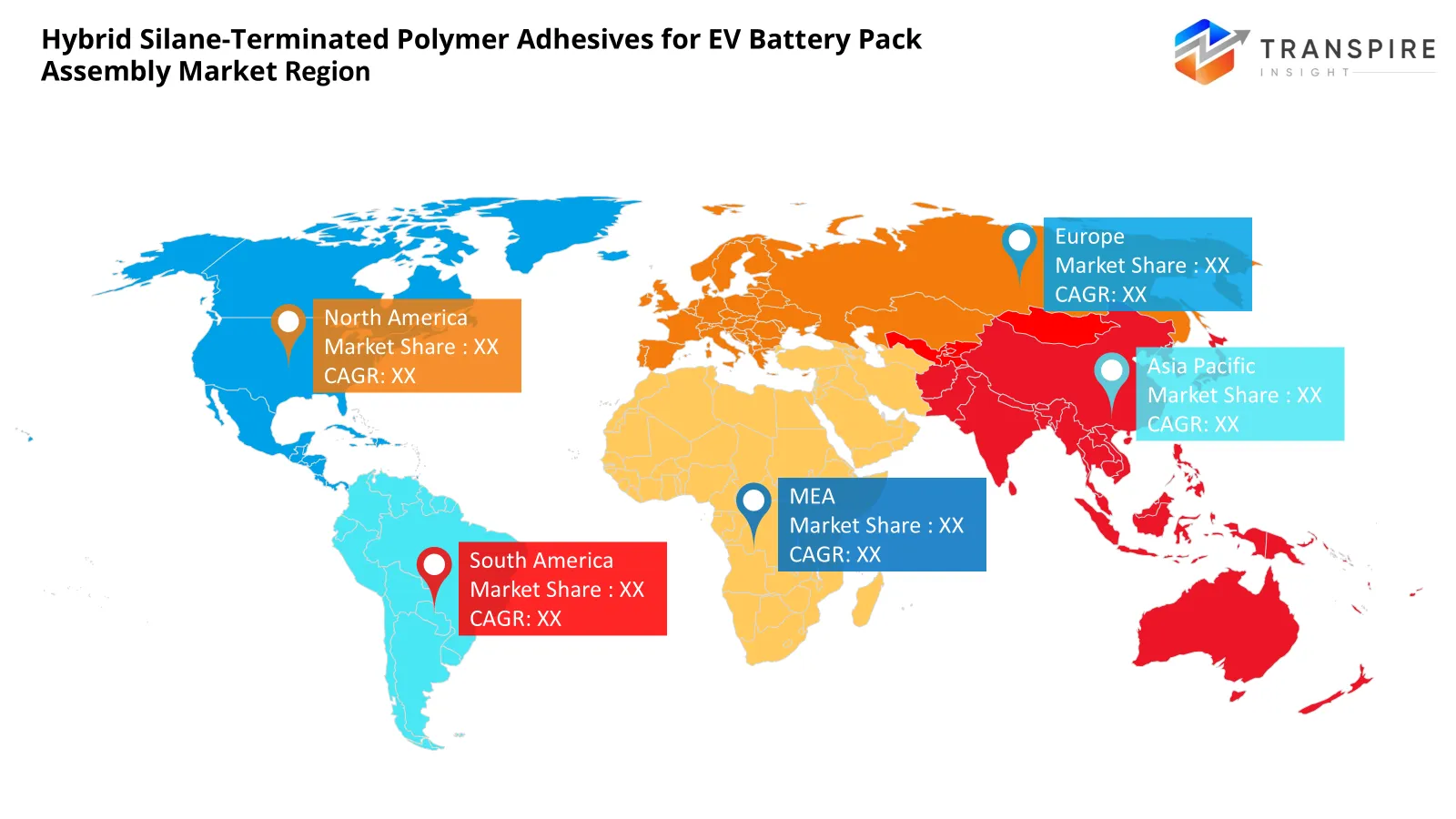
Who are the Key Players in the Hybrid Silane-Terminated Polymer Adhesives for EV Battery Pack Assembly Marketand how do they Compete?
The competition in the international hybrid silane-terminated polymer adhesives for EV battery pack assembly market is influenced by ongoing innovation in the products, cooperation with EV producers, and developments of advanced adhesives.
Emphasis is placed on the enhancement of structural and thermal characteristics, curing process and production compatibility in order to satisfy the needs of battery producers. The enlargement of manufacturing capacity and development of technical support have also become significant factors of competition. The leading players, including Henkel AG & Co. KGaA, Sika AG, Arkema S.A., and H.B. Fuller Company, are characterised by efforts to innovate their high-performing adhesive solutions for the latest EV batteries. The strategies involve the development of lightweight bonding agents, expansion of product lines, and cooperation with automakers to develop specific solutions. The differentiation is achieved via material science knowledge, a global distribution network, and customisation services.
Hybrid Silane-Terminated Polymer Adhesives for EV Battery Pack Assembly Market companies
- Henkel
- Sika
- Arkema
- H.B. Fuller
- Dow
- 3M
- Wacker Chemie
- Bostik
- Momentive
- Evonik Industries
- Huntsman
- BASF
- Permabond
- Panacol
- Dymax
Recent Development News
February 2026, Arkema signed a Memorandum of Understanding (MoU) with Senior for enhancing cooperation on advanced battery materials. Collaboration between these firms is centred around advanced adhesion technologies, coating of electrodes, and battery production processes for enhancing battery performance, safety, and industrial scalability.
April 2025, Henkel showcased its new innovations, such as AI-generated virtual adhesives, structural adhesive debonding technology, and advanced battery coating at The Battery Show Europe 2025. All of these technologies allow EV manufacturers to accelerate their product development cycles, increase the safety of batteries, and recycle them.
What Strategic Insights Define the Future of the Hybrid Silane-Terminated Polymer Adhesives for EV Battery Pack Assembly Market?
The future of the international market for the hybrid silane-terminated polymer adhesives used in assembling EV battery packs will depend on innovations in the battery industry, higher volume of EV production, and an increased focus on lightweight high-performance materials. The adhesive suppliers will likely pay attention to developing multifunctional adhesive products that are going to ensure structural integrity, heat dissipation, and durability of the products while providing for accelerated assembly procedures. Another hidden risk that can emerge in the industry is associated with the increasing complexity of the automotive qualification process. As battery technologies advance, it is becoming necessary for the adhesive companies to comply with new stringent requirements and undergo a prolonged approval process.
There is an opportunity for the adhesive companies to develop custom-made application-specific adhesive products and to build up partnerships with the EV manufacturers, battery companies, and material technology providers. This will allow them to achieve better results in the research process, regional manufacturing, and engineering services.
By Product Type
- One-component STP Adhesives,
- Two-component STP Adhesives
- Structural STP Adhesives
- Flexible STP Adhesives
- High-strength STP Adhesives
- Thermal Conductive STP Adhesives
- Hybrid STP Adhesives
By Application
- Battery Module Bonding
- Battery Pack Assembly
- Thermal Management
- Structural Bonding
- Cell Encapsulation
- EV Chassis Assembly
- Electronic Components
By End User
- Electric Vehicle OEM
- Battery Manufacturers
- Tier-1 Automotive Suppliers
- Electronics Manufacturers
- Industrial Adhesive Companies
By Curing Technology
- Moisture Cure
- Dual Cure
- UV-assisted Cure
- Heat-assisted Cure
- Hybrid Cure Systems
By Distribution Channel
- Direct Sales
- Automotive Adhesive Distributors
- OEM Suppliers
- Online B2B Platforms
Regional Outlook
North America
- US
- Canada
- Mexico
Europe
- Germany
- UK
- France
- Italy
- Spain
- Russia
- Rest of Europe
Asia Pacific
- China
- Japan
- India
- South Korea
- Australia
- Rest of Asia Pacific
South America
- Brazil
- Argentina
- Rest of South America
Middle East & Africa
- UAE
- Saudi Arabia
- Qatar
- South Africa
- Rest of the Middle East & Africa
Frequently Asked Questions
Find quick answers to common questions.
The Hybrid Silane-Terminated Polymer Adhesives for EV Battery Pack Assembly Market size was valued at USD 286.4 Million in 2025 and is poised to reach USD 840.1 Million by 2033, expanding at a 14.4% CAGR.
Key segments for the Hybrid Silane-Terminated Polymer Adhesives for EV Battery Pack Assembly Market are By Product Type (One-component STP Adhesives, Two-component STP Adhesives, Structural STP Adhesives, Flexible STP Adhesives, High-strength STP Adhesives, Thermal Conductive STP Adhesives, Hybrid STP Adhesives, Others); By Application (Battery Module Bonding, Battery Pack Assembly, Thermal Management, Structural Bonding, Cell Encapsulation, EV Chassis Assembly, Electronic Components, Others); By End User (Electric Vehicle OEMs, Battery Manufacturers, Tier-1 Automotive Suppliers, Electronics Manufacturers, Industrial Adhesive Companies, Others); By Curing Technology (Moisture Cure, Dual Cure, UV-assisted Cure, Heat-assisted Cure, Hybrid Cure Systems, Others); By Distribution Channel (Direct Sales, Automotive Adhesive Distributors, OEM Suppliers, Online B2B Platforms, Others).
Growth is primarily driven by an increase in the manufacture of electric vehicles, a rise in the need for lighter and stronger adhesives, an increase in the production of batteries for EVs, tougher safety and emissions standards, and innovations in adhesives technology.
The global market is led by major manufacturers including Henkel, Sika, Arkema, H.B. Fuller, Dow, 3M, Wacker Chemie, Bostik, Momentive, Evonik Industries, Huntsman, BASF, Permabond, Panacol, Dymax.
Asia-Pacific accounts for 45% of the total market because of the presence of robust manufacturing capabilities of EVs, growing production of batteries, an efficient automotive value chain, governmental initiatives towards e-mobility, and increased expenditure on innovative adhesives in China, Japan, and South Korea.
Opportunities in the commercial sector include the increased production of batteries for electric vehicles, increasing need for light and tough bonding agents, growing use of battery gigafactories, increased use of sustainable low-VOC adhesives, and developments in fast-curing adhesives.
- Henkel
- Sika
- Arkema
- H.B. Fuller
- Dow
- 3M
- Wacker Chemie
- Bostik
- Momentive
- Evonik Industries
- Huntsman
- BASF
- Permabond
- Panacol
- Dymax
About the Authors

Pankaj Ghogare Patil
I am Pankaj Ghogare Patil, a Senior Research Analyst at Transpire Insight, specializing in the Pharmaceutical, Chemicals & Materials, Healthcare IT, and Biotechnology industry. My expertise lies in conducting comprehensive market research, analyzing industry trends, evaluating competitive landscapes, and translating complex data into actionable insights. At Transpire Insight, I closely follow emerging technologies, regulatory developments, and market innovations to create accurate, well-researched, and informative content that helps businesses and professionals make informed decisions. I am committed to producing credible, evidence-based articles that reflect industry best practices while making technical topics accessible and valuable for a broad audience.

Chakradhar Khansole
Chakradhar serves as the Research Director at Transpire Insight, bringing over 8 years of experience in technology, innovation, and strategic market intelligence. He specializes in transforming complex market data into actionable business insights that enable organizations to make informed, growth-oriented decisions. Recognized for his strategic vision and analytical expertise, Chakradhar leads high-impact research initiatives, delivering comprehensive market assessments, competitive intelligence, and forward-looking industry analysis.
Recently Published Reports
-
May 2026
Healthcare Polymer Packaging Market
Healthcare Polymer Packaging Market Size, Share & Analysis Report By Packaging Type (Syringes, IV Bottles and Pouches, Clamshells, Blisters, Bottles & Jars, Containers, Tubes, IV Parental Packaging, Others), By Type (Regulated, Non-regulated), By Polymer Type (LDPE (Low-Density Polyethylene), HDPE (High-Density Polyethylene), Homo-polymer (Homo), Random Copolymer (Random), Block Copolymer (Block), PET, Polystyrene, Polyvinyl Chloride, Polyamide/EVOH, Others), and Geography (North America, Europe, Asia-Pacific, Middle East and Africa, South and Central America), 2021 - 2031
-
Apr 2026
Hydrophilic Tape (Waterstop) Market
Hydrophilic Tape (Waterstop) Market Size, Share & Analysis Report By Type (Bentonite-Based Hydrophilic Tape, Rubber-Based Hydrophilic Tape), By Application (Residential Buildings, Commercial Buildings, Infrastructure Projects), and Geography (North America, Europe, Asia-Pacific, Middle East and Africa, South and Central America), 2021 - 2031
-
Apr 2026
Metalens Market
Metalens Market Size, Share & Analysis Report By Type (Visible Light Metalens, and Infrared Metalens), By Application (Consumer Electronics, Automotive Electronics, Industrial, Medical, and Others), and Geography (North America, Europe, Asia-Pacific, Middle East and Africa, South and Central America), 2021 - 2031
-
Apr 2026
PBT Resin Market
PBT Resin Market Size, Share & Analysis Report By Type (Reinforced PBT Resin, Unreinforced PBT Resin), By Processing Method (Injection Molding, Extrusion, Blow Molding, Others), By End-User (Automotive, Electrical & Electronics, Consumer Appliances, Industrial Machinery, Medical Devices, Packaging, Others), and Geography (North America, Europe, Asia-Pacific, Middle East and Africa, South and Central America), 2021 - 2031