
South Korea Automotive Zonal Architecture & Domain Controller Market Summary:
According to Transpire Insights, a detailed research report on the South Korea Automotive Zonal Architecture & Domain Controller Market reflects that the ADAS/Autonomous Driving application segment dominates the South Korea Automotive Zonal Architecture & Domain Controller Market, accounting for approximately 67% of the total share worldwide. Leading automotive technology and electronics companies contribute significantly to the market, with approximately USD 7.8 billion in annual revenue and an estimated 17–21% South Korea market share, making them leading contributors to South Korea market development, innovation, advanced automotive zonal architecture and domain controller production, expanding manufacturing capabilities, and growth dynamics.
Market Snapshot
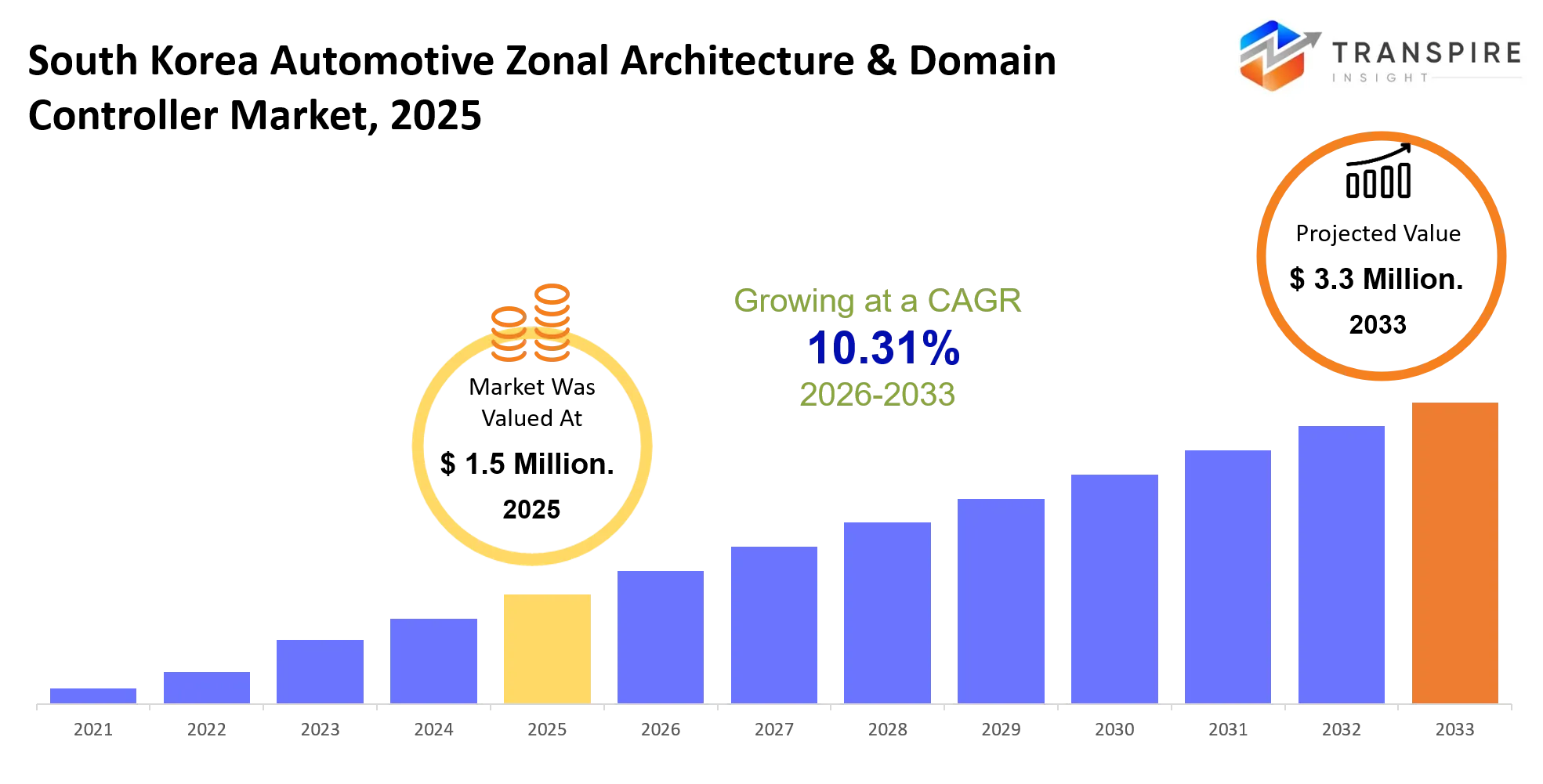
- Market Value (2025): USD 1.5 Billion.
- Expected Market Value (2026): USD 1.66 Billion.
- Estimated Market Value (2033): USD 3.3 Billion.
- Forecast CAGR (2026–2033): 10.31%.
Introduction
South Korea Automotive Zonal Architecture & Domain Controller Market comprises sophisticated automotive architectures which combine zonal controllers, domain control units, high-performance vehicle computing systems, automotive network, power distribution, and embedded software. The market is shifting from traditional distributed electronic control units to more simplified architectures which include centralized and zonal systems that help in software-defined development of vehicles. The zonal architecture helps in local control of the sensors, actuators, and power systems whereas domain controller helps in consolidating the computation of requirements for systems like ADAS, cockpit/infotainment, body control and vehicle connectivity. The adoption of such systems by South Korea’s automotive industry has been increasing in order to develop features such as intelligent mobility, electrification, autonomous driving, high-speed vehicle networks and software-based functionalities.
Key Market Highlights: -
- By Architecture, the Domain architecture dominated the market and holds approximately 49 % share in 2025 and is projected to grow at a substantial CAGR during the forecast period.
- By Domain, the ADAS & Autonomous Driving dominated the market and holds approximately 51% share in 2025 and is projected to grow at a substantial CAGR during the forecast period.
- By Controller Type, the Enamel Regeneration Manufacturers segment dominated the market and holds approximately 38.2 % share in 2025 and is projected to grow at a substantial CAGR during the forecast period.
- The SDV-oriented policies, semiconductor investments for the automobiles, artificial intelligence for the vehicles, and connectivity infrastructure in South Korea are driving zonal architecture, domain controller, centralized computing, and software-defined vehicle adoption.
How is Technology Driving Growth in the South Korea Automotive Zonal Architecture & Domain Controller Market?
Technology is fueling the South Korea Automotive Zonal Architecture & Domain Controller Market due to the transition from the hardware-oriented design towards software-defined vehicles, centralized computing, and intelligent electronic architectures. The high-performance vehicle computers and zone controllers are consolidating the vehicle functionality while reducing the wiring complexity as well as providing software scalability. Advanced ADAS systems, artificial intelligence systems for the vehicles, advanced automotive networking technology, and automotive connectivity are raising the need for high-performance domain controllers as well as zonal control. The hardware-software separation also allows for regular OTA software updates, feature deployment, diagnosis, and optimization of the system.
Market Drivers
Market of South Korea Automotive Zonal Architecture & Domain Controller is developing due to the change in approach of car manufacturers to vehicle control systems where software-defined architecture is gaining traction instead of distributed electronic control units. The combination of centralized high-performance computing along with zonal controllers and domain controllers helps to manage vehicle functions effectively, making electronic/electrical architectures simpler. With rising popularity of electric vehicles, there is an increasing need for lightweight wiring, intelligent power distribution, and vehicle computing scalability. Moreover, the rising integration of ADAS, sensor fusion, connected services, and high-speed automotive Ethernet is supporting advanced domain-control features. Also, software-hardware decoupling and over-the-air updates help to implement new features constantly, thus becoming key components for South Korea’s future connected, electrified, and software-defined cars.
Restrain
Implementation costs, architectural shift from E/E to centralized computing, and software hybrid vehicles compatibility may become limitations for the market of South Korea Automotive Zonal Architecture & Domain Controller. A move to centralized computing involves significant changes in the car’s network, electrical system, and software. The growing demands on cybersecurity and functional safety add another challenge to testing and certification. Furthermore, the adoption of centralized architectures is changing the existing roles of automotive suppliers, forcing tier 1 and tier 2 suppliers to gain new competencies.
|
Driver |
Relative Impact on Growth (%) |
Geographic Relevance |
Impact Timeline |
Demand Strength |
Growth Mechanism |
Key Beneficiaries |
Major Constraint |
|
Driver 1: Rapid Software-Defined Vehicle (SDV) Adoption |
28% |
South Korea; Seoul, Gyeonggi, Ulsan |
Long-term (≥4 years) |
High |
Accelerates centralized computing and hardware-software decoupling |
OEMs, domain-controller suppliers, software developers, semiconductor vendors |
High development costs and complex software integration requirements |
|
Driver 2: Expansion of ADAS and Autonomous Driving |
24% |
South Korea; Seoul, Gyeonggi, autonomous-driving clusters |
Medium-term (2–4 years) |
High |
Increases demand for high-performance real-time vehicle computing |
ADAS suppliers, DCU manufacturers, sensor vendors, OEMs |
Functional-safety validation and autonomous-system complexity |
|
Driver 3: Transition Toward Zonal E/E Architecture |
20% |
South Korea; major automotive manufacturing regions |
Medium-term (2–4 years) |
High |
Consolidates ECUs through zone controllers and high-speed networking |
ZCU manufacturers, Ethernet vendors, wiring suppliers, OEMs |
Architecture redesign requires significant engineering investment |
|
Driver 4: Automotive Semiconductor and High-Performance Computing Integration |
16% |
South Korea; semiconductor and automotive technology hubs |
Long-term (≥4 years) |
High |
Enables powerful domain controllers through advanced automotive processors |
Semiconductor firms, SoC vendors, DCU manufacturers, OEMs |
Semiconductor complexity and automotive-grade qualification requirements |
|
Driver 5: Electrification and Connected Vehicle Expansion |
12% |
South Korea; nationwide EV and connected-mobility ecosystem |
Medium-term (2–4 years) |
Medium |
Drives intelligent power control, connectivity, and centralized vehicle electronics |
EV manufacturers, connectivity providers, controller suppliers, consumers |
High system costs and evolving vehicle technology standards |
Analysis of Prices and Consumer Behaviour
The South Korean automotive zonal architecture and domain controllers market is dominated by centralized computing solutions that offer high performance (68% of total market; majorly because of the requirements of electric vehicles, ADAS, software-defined vehicles and connected automotive systems). The cost of a high-performance, state-of-the-art domain controller that will have high performance processors as well as networking technology will be 35% higher compared to others in the market. This is due to the fact that the product will be designed using state-of-the-art automotive computing technology, quality parts as well as performance. About 45% of all units sold for automotive zonal architecture and domain controllers belong to centralized computing and zonal control systems. The sales volumes are due to the flexibility of these products in the vehicle electronics, ADAS, cockpit, body control and power management applications. The demand of the applications come from ADAS and software-defined vehicles industry that constitutes around 70%. The purchase behavior of the automotive manufacturers shows that 55% of the buyers consider computing performance, reliability and automotive networking capability as the most important factor. A further 33% of consumers would rather buy their systems using bulk purchase or contract arrangements because they seek to lower their costs of purchasing sophisticated automotive electronic systems while ensuring a consistent flow of supply to their customers worldwide.
|
Company |
Est. Revenue Share Range |
Key Offerings |
Strategic Positioning |
Geographic Strength |
Technology Focus |
|
Hyundai Mobis |
Estimated 12–16% |
Body Domain Controller (BDC); Central Communication Unit (CCU); Body & Connectivity Unit (BCU); SDV control units |
Korean OEM-aligned platform and vertical integration strategy |
Asia Pacific; North America; Europe |
SDV controllers, vehicle networking, centralized E/E architecture |
|
LG Electronics |
Estimated 10–14% |
Cockpit Domain Controller; High-Performance Computing; zonal aggregator architecture; SDV-ready vehicle computing |
Integrated cockpit and centralized computing ecosystem strategy |
Asia Pacific; North America; Europe |
HPC, Ethernet/TSN, domain consolidation, software-defined vehicles |
|
Continental |
Estimated 9–13% |
Zone Control Units; Vehicle Control HPC; Cross-Domain HPC; server-zone architecture |
Full-stack server-zone architecture and modular platform strategy |
Europe; Asia Pacific; North America |
ZCU, HPC, smart power distribution, automotive Ethernet |
|
HARMAN International |
Estimated 8–12% |
Ready Upgrade Cockpit Domain Controller; Central/Zonal Compute; Ready CQuence Run; connected vehicle platforms |
Software-led cockpit and centralized compute differentiation strategy |
North America; Asia Pacific; Europe |
Virtualization, cockpit computing, OTA, centralized E/E architectures |
|
Robert Bosch |
Estimated 8–11% |
Zone Control Unit; Body Control Module; vehicle computer; E/E architecture integration |
Broad Tier-1 integration and scalable architecture strategy |
Europe; Asia Pacific; North America |
Zonal control, Ethernet, cybersecurity, vehicle integration platforms |
|
Aptiv |
Estimated 7–10% |
Zone Controllers; Power Data Centers; Central Vehicle Controllers; Open Server Platforms |
Architecture-led integration with intelligent power-data distribution |
North America; Europe; Asia Pacific |
Zonal networking, smart fusing, Ethernet, predictive diagnostics |
|
ZF Friedrichshafen |
Estimated 6–9% |
Vehicle motion domain controllers; central vehicle computing; connectivity/control electronics; SDV solutions |
Motion-domain expertise combined with centralized vehicle computing |
Europe; North America; Asia Pacific |
Vehicle control, centralized computing, networking, functional safety |
|
Valeo |
Estimated 5–8% |
Zone Controllers; ADAS Domain Control Units; centralized computing; E/E architecture solutions |
ADAS-centric architecture innovation and scalable controller platforms |
Europe; Asia Pacific; North America |
ADAS compute, zonal control, Ethernet, smart power management |
|
NXP Semiconductors |
Estimated 4–7% |
S32G vehicle networking processors; S32K5 MCUs; CoreRide Z248; zone-controller reference designs |
Semiconductor ecosystem strategy enabling OEM architecture adoption |
Asia Pacific; North America; Europe |
Automotive Ethernet, ASIL-D processing, zonal compute, edge AI |
|
HL Klemove |
Estimated 3–6% |
Integrated autonomous-driving domain controller; ADAS controllers; LiDAR/radar/camera integration; autonomous-driving platforms |
Korean ADAS specialization with integrated controller development |
Asia Pacific; North America; Europe |
ADAS domain computing, sensor fusion, autonomous-driving electronics |
Who are the Key Players in the South Korea Automotive Zonal Architecture & Domain Controller Market and how do they compete?
Competitive advantage in international South Korea Automotive Zonal Architecture & Domain Controller Market will be achieved through companies focusing on innovations in technology, specialized solutions in automobiles, and creating distribution networks around the globe. Through competing not with pricing but using automotive electronics, high-performance computing, connected and smart vehicles, and integration with vehicle software platforms, this type of competitive advantage will lead to continuous product innovation as well as help organizations to become more productive, efficient, resource-optimized, and operationally visible.
Through innovations in intelligent automotive electronics, zonal architecture, domain controller, autonomous driving, and connected vehicle, Hyundai Mobis achieves a competitive advantage in the market. Samsung Electronics gains competitive advantage through innovations in high-performance automotive electronics used in vehicle computing, ADAS, cockpit, and other applications in the automotive industry. LG Electronics creates a competitive advantage through innovations in automotive electronics, connected vehicles, software-defined vehicles, automation, and smart mobility helping auto manufacturers to enhance their vehicle performance and efficiency.
Top Companies in the South Korea Automotive Zonal Architecture & Domain Controller Market
- Hyundai Mobis
- Samsung Electronics
- LG Electronics
- Hyundai Motor Group
- Bosch
- Continental
- Aptiv
- ZF
- Valeo
- Denso
- Harman
- NXP Semiconductors
- Renesas Electronics
- Infineon Technologies
- Qualcomm
South Korea Automotive Zonal Architecture & Domain Controller Market Segmentation
The South Korea Automotive Zonal Architecture & Domain Controller Market share is divided into six categories: By Architecture, By Domain, By Controller Type, By Vehicle Type, By Technology, By End User.
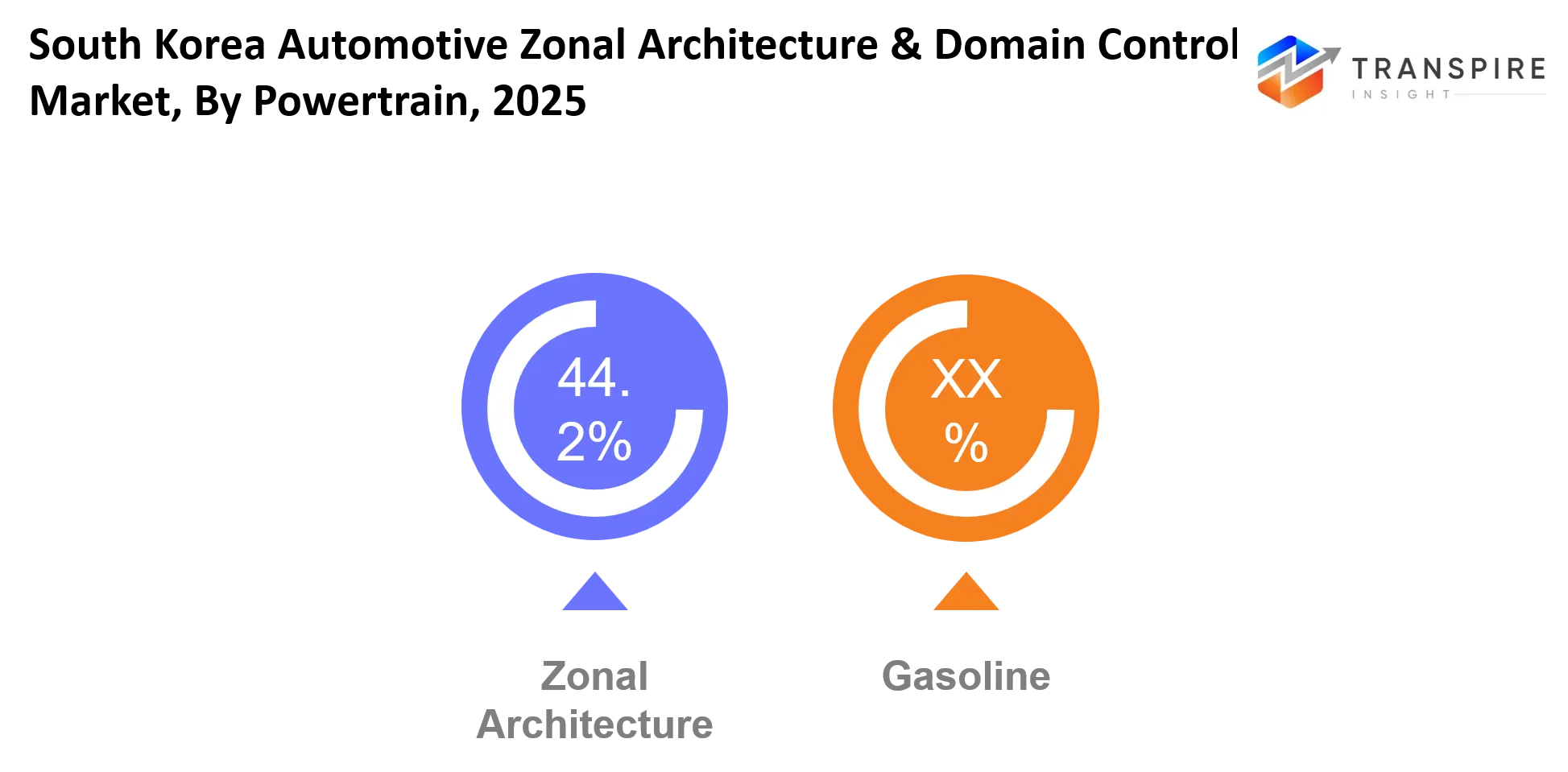
The Domain architecture dominated the market, accounting for nearly 49% in 2025 and is expected to rise at a significant CAGR during the forecast period.
The South Korea Automotive Zonal Architecture & Domain Controller Market is segmented by architecture into zonal architecture, domain architecture, centralized architecture, distributed architecture, hybrid architecture, vehicle computer architecture, software-defined vehicle architecture, ethernet-based architecture. Among these, the Domain architecture segment dominated the market, accounting for nearly 49% in 2025 and expected to increase at a significant CAGR during the forecast period. The Domain architecture segment held the highest share of the market, recording around 49% in 2025 and is predicted to grow at an impressive CAGR during the forecast period on account of centralized computing, ADAS incorporation, software-defined vehicles, and electronic system consolidation.
The ADAS & Autonomous Driving dominated the market, accounting for nearly 51% in 2025, and is expected to rise at a significant CAGR during the forecast period.
The South Korea Automotive Zonal Architecture & Domain Controller Market is segmented by domain into adas, infotainment, body control, powertrain, chassis, connectivity, vehicle motion, cockpit. Among these, the ADAS & Autonomous Driving dominated the market, accounting for nearly 51% in 2025 and expected to increase at a significant CAGR during the forecast period. The ADAS & Autonomous Driving segment accounted for the largest share of the market, recording around 51% in 2025, due to growing sensor incorporation, centralized computing, real-time processing, and development of autonomous vehicles.
The Enamel Regeneration dominated the market, accounting for nearly 38.2% in 2025 and is expected to rise at a significant CAGR during the forecast period.
The South Korea Automotive Zonal Architecture & Domain Controller Market is segmentedby controller type into zonal controllers, domain controllers, central vehicle computer, gateway controllers, body controllers, adas controllers, cockpit controllers, powertrain controllers. Among these, the Enamel Regeneration dominated the market, accounting for nearly 38.2% in 2025 and expected to increase at a significant CAGR during the forecast period. The Enamel Regeneration segment accounted for the leading market share of almost 38.2% in 2025, owing to the growing demand for advanced dental biomaterials, minimally invasive procedures, and restorative techniques.
Future Market Trends for the South Korea Automotive Zonal Architecture & Domain Controller Market:-
Zonal E/E Architectures Development in Korea: Korean automakers are increasingly using zone controllers, automotive Ethernet at high speed, and central processing to make the electronics of their vehicles simpler.
AI-enabled Domain Computing: Highly advanced domain controllers are being developed for AI acceleration, fusion of sensors, and intelligent diagnostic features for the enhancement of ADAS, digital cockpit, connected mobility, and autonomous driving.
Semiconductor Technology Advancements for Advanced Automotive: The integration of automotive semiconductor SoCs, ASICs, high-performance processors, and networking in the automotive industry is making advanced domain controllers possible.
Recent Development
In July 2026 – Adoption Launch: South Korea increased its efforts on adopting ADAS and vehicle body domain controllers, aided by the development of automotive electronics supply chain capabilities by Hyundai-Kia.
In July 11, 2026 – Technology Launch: South Korea made progress in its automotive domain controller market through AI-based cockpit and safety technology.
In June 2026 – Zonal Architecture Launch: South Korea’s automotive suppliers enhanced their networking and automotive Ethernet solutions that complied with AUTOSAR standards, thereby providing efficient integration of ZCU into vehicles.
Market Segmentation
This study forecasts revenue at Japan, regional and country levels from 2020 to 2033. Transpire Insights has segmented the South Korea Automotive Zonal Architecture & Domain Controller Market based on the below-mentioned segments:
South Korea Automotive Zonal Architecture & Domain Controller Market, By Architecture
- Zonal Architecture
- Domain Architecture
- Centralized Architecture
- Distributed Architecture
- Hybrid Architecture
- Vehicle Computer Architecture
- Software-Defined Vehicle Architecture
- Ethernet-Based Architecture
South Korea Automotive Zonal Architecture & Domain Controller Market, By Domain
- ADAS
- Infotainment
- Body Control
- Powertrain
- Chassis
- Connectivity
- Vehicle Motion
- Cockpit
South Korea Automotive Zonal Architecture & Domain Controller Market, By Controller Type
- Zonal Controllers
- Domain Controllers
- Central Vehicle Computer
- Gateway Controllers
- Body Controllers
- ADAS Controllers
- Cockpit Controllers
- Powertrain Controllers
South Korea Automotive Zonal Architecture & Domain Controller Market, By Vehicle Type
- Passenger Cars
- SUVs
- Electric Vehicles
- Hybrid Vehicles
- Luxury Vehicles
- Commercial Vehicles
- Autonomous Vehicles
- Connected Vehicles
Frequently Asked Questions
Find quick answers to common questions.
Software-defined vehicles, ADAS expansion, electrification, centralized computing, automotive Ethernet adoption, and increasing demand for intelligent connected vehicle architectures.
Domain architecture dominates, supported by centralized computing, ADAS integration, software-defined vehicles, and increasing consolidation of electronic vehicle functions.
ADAS and autonomous driving lead demand because vehicles increasingly require real-time processing, sensor fusion, advanced computing, and intelligent safety.
AI enables faster sensor fusion, intelligent diagnostics, predictive functions, autonomous driving capabilities, and advanced decision-making within centralized vehicle computing platforms.
Automotive Ethernet, AI processors, high-performance computing, centralized architectures, advanced semiconductors, OTA software, and software-defined vehicle platforms will dominate.
- Hyundai Mobis
- Samsung Electronics
- LG Electronics
- Hyundai Motor Group
- Bosch
- Continental
- Aptiv
- ZF
- Valeo
- Denso
- Harman
- NXP Semiconductors
- Renesas Electronics
- Infineon Technologies
- Qualcomm
About the Authors

Avinash Kumar
I’m Avinash Kumar, a Senior Research Analyst at Transpire Insight, with expertise in the Electronics and Semiconductor and Energy & Power industry. My work focuses on analyzing emerging technologies, market trends, industry developments, and innovation across these sectors. I specialize in transforming complex technical and market insights into clear, research-backed content that helps professionals, businesses, and decision-makers stay informed. Through continuous industry research and data-driven analysis, I strive to deliver accurate, reliable, and practical perspectives on the latest advancements shaping the semiconductor and energy landscape.

Chakradhar Khansole
Chakradhar serves as the Research Director at Transpire Insight, bringing over 8 years of experience in technology, innovation, and strategic market intelligence. He specializes in transforming complex market data into actionable business insights that enable organizations to make informed, growth-oriented decisions. Recognized for his strategic vision and analytical expertise, Chakradhar leads high-impact research initiatives, delivering comprehensive market assessments, competitive intelligence, and forward-looking industry analysis.
Recently Published Reports
-
Apr 2026
Fiber Optic Faceplates Market
Fiber Optic Faceplates Market Size, Share & Analysis Report By Type (< 300 mm2, 300-350 mm2, and > 350 mm2, By Application (Night Vision, Holographic Imaging, Medical, and Others), and Geography (North America, Europe, Asia-Pacific, Middle East and Africa, South and Central America), 2021 - 2031
-
Apr 2026
High Temperature Superconductors Market
High Temperature Superconductors Market Size, Share & Analysis Report By Type (1G HTS, and 2G HTS), By Application (Power Cable, Fault Current Limiter, and Transformer), and Geography (North America, Europe, Asia-Pacific, Middle East and Africa, South and Central America), 2021 - 2031
-
Apr 2026
Industrial Plugs and Socket Market
Industrial Plugs and Socket Market Size, Share & Analysis Report By Type (Industrial Plugs, Industrial Sockets), By Current (Up to 32 A, 32 to 125 A, Above 125 A), By Protection (Dustproof and Splash Proof, Waterproof, Explosion Proof), By End User (Heavy Industries, Oil and Gas, Chemicals and Pharmaceuticals, Power Generation, Others), and Geography (North America, Europe, Asia-Pacific, Middle East and Africa, South and Central America), 2021 - 2031
-
Apr 2026
InGaAs Avalanche Photodiodes Market
InGaAs Avalanche Photodiodes Market Size, Share & Analysis Report By Type (1100 - 1700 nm, and 1000 - 1600 nm), By Application (Missile Warning System, Muzzle Flash Detection, Wafer Defect Inspection, Laser Rangefinders, and Others), and Geography (North America, Europe, Asia-Pacific, Middle East and Africa, South and Central America), 2021 - 2031