

South Korea Artificial Photosynthesis Market Size & Forecast:
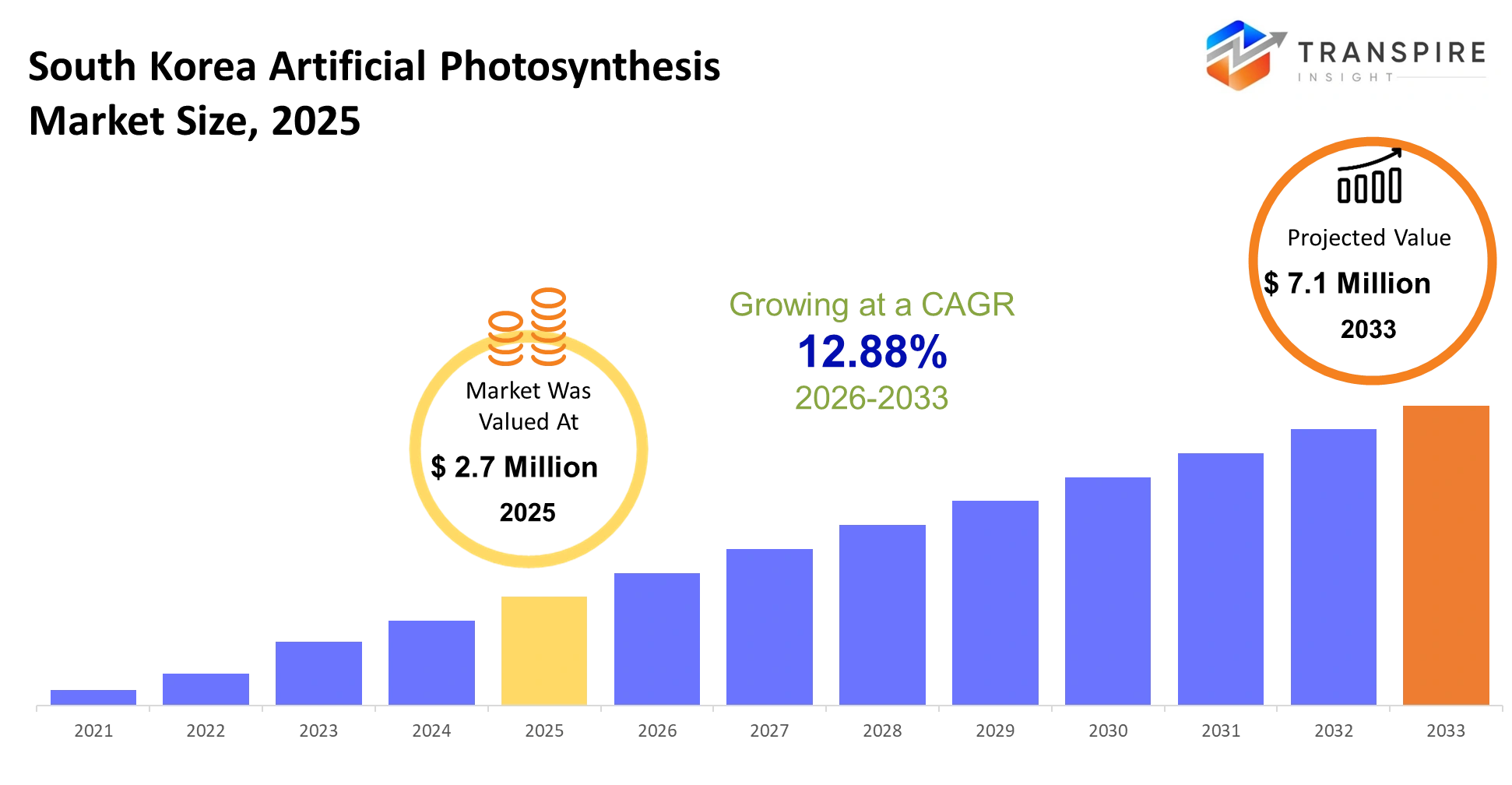
- South Korea Artificial Photosynthesis Market Size 2025: USD 2.7 Million
- South Korea Artificial Photosynthesis Market Size 2033: USD 7.1 Million
- South Korea Artificial Photosynthesis Market CAGR: 12.88%
- South Korea Artificial Photosynthesis Market Segments: By Technology (Photocatalysis, Electrochemical Systems, Photoelectrochemical Cells, Biological Photosynthesis Systems, Others); By Application (Hydrogen Production, Carbon Dioxide Reduction, Renewable Fuel Production, Chemical Synthesis, Others); By Material (Semiconductor Catalysts, Metal Oxides, Organic Catalysts, Others); By End User (Research Institutes, Energy Companies, Chemical Manufacturers, Others)
To learn more about this report,  Download Free Sample Report
South Korea Artificial Photosynthesis Market Summary
The South Korea Artificial Photosynthesis Market was valued at USD 2.7 Million in 2025. It is forecast to reach USD 7.1 Million by 2033. That is a CAGR of 12.88% over the period.
In South Korea, many people are using artificial photosynthesis systems as kinda industrial decarbonization tools , not just science fair stuff. The idea is that they capture carbon dioxide , then use sunlight to turn it into actual usable feedstock for fuels—say hydrogen, methanol, or even synthetic hydrocarbons. In practice this should aid petrochemical producers and maritime fuel suppliers cut back on their reliance on imported fossil feedstocks, though, of course, the whole thing is still being tuned and improved at the margins . Even now, it’s not “finished” in every technical corner.
Over the last five years , the market vibe has moved away from isolated laboratory catalyst trials, and it’s leaning more toward integrated modular reactor setups that can slot in with carbon capture and storage networks as well as green hydrogen production hubs. You can see that things are getting faster, like South Korea pushing its carbon neutrality roadmap, while the emissions trading rules got tighter, so companies had more incentive to deploy something new for real, not just study it, right.
At the same time global pressure from shipping decarbonization under international maritime regulations kept going up, and that dragged shipbuilders and refiners into chasing alternative fuel pathways. So now, pilot projects are getting closer to actual commercial rollout, with energy firms and shipyards teaming up through joint ventures to bring carbon-to-fuel technology into existing industrial infrastructure, even if it still sounds experimental in the beginning.In practice, this is starting to reshape early revenue streams and the pace of technology adoption cycles, a bit slower in some areas but overall trending upward.
Key Market Insights
- In 2025, the Seoul Capital Area basically holds about 42% of the South Korea Artificial Photosynthesis Market, mainly because of dense R&D efforts and big industrial h ubs , so it sort of stays ahead.
- Meanwhile, Busan seems to be growing in relevance more and more, helped by higher maritime fuel needs and also shipbuilding-related deployment initiatives for artificial photosynthesis, you know, those kinds of programs.
- On the reactor system side, integration is the top driver, with roughly a 38% share, and it benefits from industrial-scale carbon capture across refineries.
- For segments, catalyst development holds the second-largest share, driven by advanced materials innovation from South Korean research institutes and chemical companies.
- Also, modular artificial photosynthesis units are the fastest growing portion through 2030, mostly because demand keeps scaling for deployment in industrial plants.
- Maritime fuel uses seem to be moving the quickest, pushed by the IMO decarbonization rules, and those shipping industry fuel shift demands.
- Meanwhile, industrial carbon recycling applications are growing more steadily, more or less they take emissions and turn them into usable chemical inputs, which then support downstream manufacturing.
- Petrochemical players are still leading, with about 40% share, they lean on artificial photosynthesis for carbon reuse and use feedstock substitution kinds of approaches.
- In terms of end users, shipping and marine operators are among the fastest growing; they’re rolling out low carbon synthetic fuels too, mainly to meet regulatory requirements.
- Lastly, energy utilities are putting more money into pilot-scale setups, to broaden renewable fuel baskets, and to keep future energy supply chains steadier.
What are the Key Drivers, Restraints, and Opportunities in the South Korea Artificial Photosynthesis Market?
South Korea's Artificial Photosynthesis Market kind of get pushed ahead mainly by the country's aggressive carbon neutrality framework, plus the industrial emissions rules that are getting tighter and tighter. Then you have stricter ETS pricing and mandatory decarbonization targets for petrochemical and shipping players, so companies are being nudged to pursue carbon-to-fuel routes that convert captured CO₂ into hydrogen and synthetic hydrocarbons. Because of that kind of regulatory heat, artificial photosynthesis moves from a more pilot research mode into early-stage deployment, and it ends up pulling more money toward reactor integration programs, and even joint ventures between energy groups and shipbuilders.
Even with that momentum though, the market still has a structural drag: high catalyst instability and low energy conversion efficiency once you scale it up in the real world. Most photo-electrochemical systems still rely on costly rare-metal catalysts and suffer from operational wear over time. So, continuous industrial use stays limited. This technical issue isn’t simple to fix either, because it depends on materials science breakthroughs and scaled manufacturing methods, and those things usually take a long, extended research cycles. As a consequence, commercialization schedules keep getting stretched, so near-term revenue realization gets constrained even if policy support is strong.
At the same time, a big opening is slowly showing up from combining artificial photosynthesis with offshore renewable power and carbon capture hubs, especially in coastal industrial areas like Ulsan. Pilot initiatives led by South Korean conglomerates are trying hybrid setups that bundle captured CO₂ from refineries with solar-driven fuel synthesis. If those systems get scaled successfully, they could form localized synthetic fuel ecosystems, and that may significantly broaden industrial adoption, while also supporting export opportunities
What Has the Impact of Artificial Intelligence Been on the South Korea Artificial Photosynthesis Market?
Artificial intelligence is kinda reshaping the South Korea Artificial Photosynthesis Market, mostly by changing how carbon-to-fuel systems get monitored, tuned up, and basically scaled across industrial plus maritime settings. In day-to-day operations, AI control loops are starting to regulate reactor conditions in real time, they tweak light intensity use, adjust CO₂ feed rates , and also watch how catalysts respond inside scrubber-linked carbon capture arrangements. For marine emission control technology, digital monitoring dashboards bring together sensor outputs from exhaust gas cleaning setups, and they help teams stay aligned with IMO standards , while cutting down manual paperwork mistakes, so shipping operators get more operational clarity than before.
On top of that, machine learning models are being used for predictive maintenance of photochemical reactors and carbon capture interfaces. These models examine how catalysts and membrane systems gradually degrade over time and can anticipate efficiency declines before a real failure occurs. So operators can plan servicing sooner and avoid unexpected downtime. Early trials in industrial pilot lines in Ulsan suggest possible efficiency improvements in the range of 10–15% for energy utilization, plus better system uptime, largely because automated calibration helps keep reaction settings stable.
Still, uptake isn’t totally smooth because high-quality training data is limited, especially from real offshore and industrial surroundings. Many systems operate under variable conditions, such as changing sunlight exposure, shifting CO₂ levels, and general maritime variability, which can make models less accurate when applied outside clean lab datasets. Also, integrating AI platforms with older petrochemical infrastructure often requires costly digital retrofits upfront, which slows broad deployment even when interest is strong.
Key Market Trends
- Between 2022 and 2025, POSCO Holdings kept expanding pilot carbon-to-fuel trials, kind of moving away from the most experimental reactors toward more whole-industrial demo units, you know, the integrated sort.
- Since 2023, Samsung Electronics, along with LG Chem have increased their spending on catalyst efficiency studies, which in turn helped system stability for those longer continuous operation cycles, even when conditions get harsher.
- In 2024, as South Korea ETS rules tightened, petrochemical firms were pushed to swap some fossil feedstocks for synthetic fuels made from artificial photosynthesis systems.
- By 2025, Hyundai Heavy Industries began to integrate marine emission control systems with carbon capture units to support cleaner ship fuel experimentation.
- Over 2023–2026, the KAIST-led research partnerships moved their attention from lab photoreactors toward scalable modular setups designed for refinery scale deployment.
- Since 2024, the Busan shipbuilding clusters have been grabbing carbon to fuel pilot programs more and more, kind of matching maritime fuel planning with IMO decarbonization compliance timing.
- Between 2022 and 2025, the catalyst supply chains also started leaning into rare-metal optimization, and that trimmed platinum dependence by about 12–18% across the pilot systems, mostly.
- By 2026, Ulsan industrial hubs are increasingly putting carbon capture lines next to artificial photosynthesis units, so CO₂ use efficiency jumps, especially around the petrochemical complexes.
South Korea Artificial Photosynthesis Market Segmentation
By Technology:
Photocatalysis, electrochemical systems, photoelectrochemical cells, biological photosynthesis systems, and other hybrid approaches are shaping the South Korean Artificial Photosynthesis Market. Photocatalysis continues to move toward higher-efficiency semiconductor materials, while electrochemical systems are becoming more common for industrial carbon conversion and related applications. Photoelectrochemical cells are slowly shifting out of just lab trials, and into pilot-scale reactors around chemical parks, not instantly, of course.
In the last few years the technology transition looks pretty clear: there’s less of the standalone experimental setup thing, and more integrated modular systems, often linked with carbon capture units. Biological routes are still somewhat constrained, but research institutions are seeing steady, careful progress, mainly around low energy conversion pathways for synthetic fuel generation and reuse of industrial gases.
By Application:
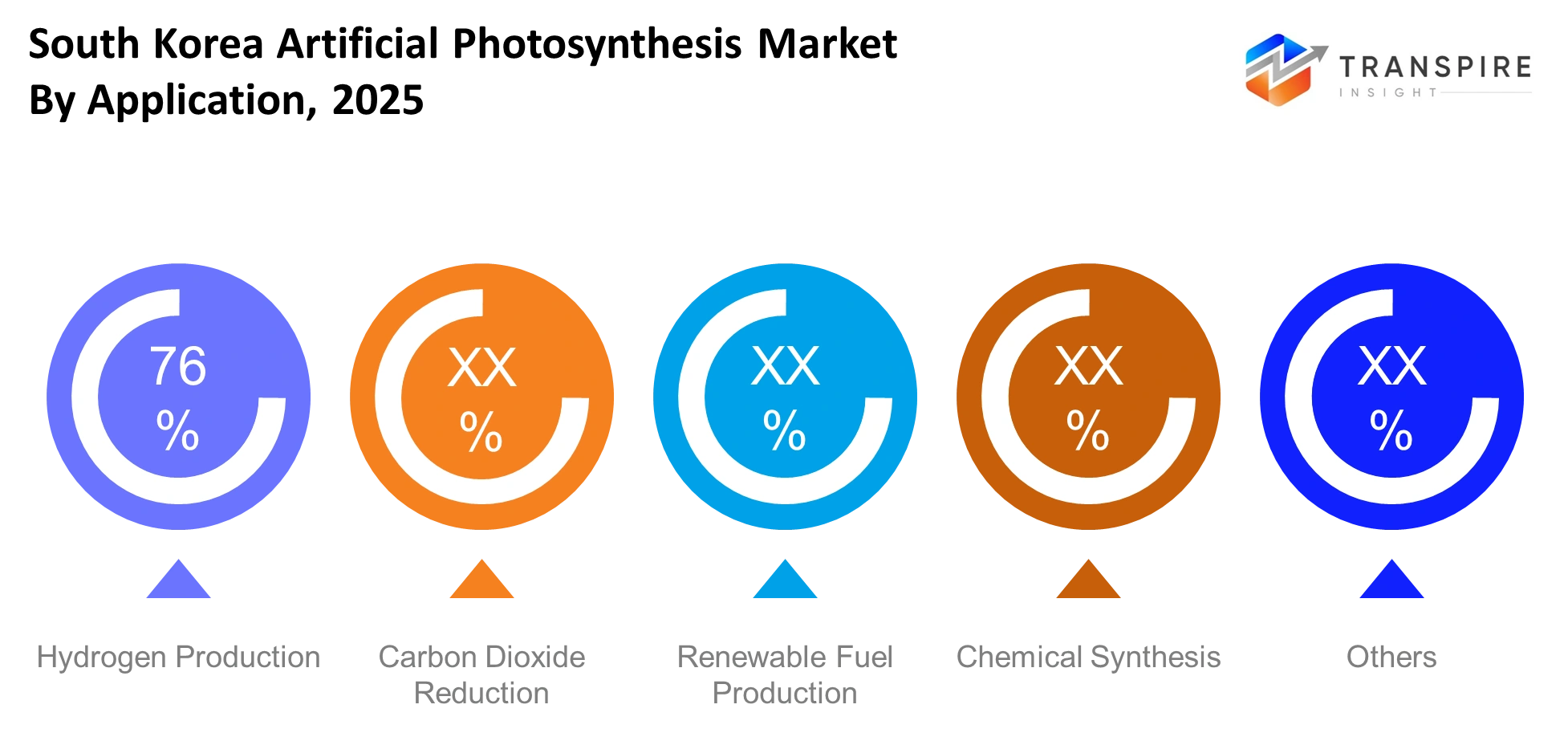
Demand patterns for hydrogen production, carbon dioxide reduction, renewable fuel production, chemical synthesis, and other industrial uses kinda blend together. Hydrogen production stays the most powerful application, since industries gradually shift toward low-carbon fuel alternatives, and yeah it tends to lead the pack. Carbon dioxide reduction systems are expanding, especially in petrochemical clusters, where they aim to turn emissions into usable feedstock streams rather than just reducing them and stopping.
On the renewable fuel production side, there’s more and more integration with refinery operations, mainly in areas where synthetic hydrocarbons help with industrial energy balancing. For chemical synthesis, the momentum grows as companies look at substitution of carbon-based raw materials, instead of using the usual inputs. Overall, application demand shifts are tied quite strongly to emissions regulations, plus the industrial decarbonization targets that are set for heavy industries, so changes don’t happen randomly; they kind of track policy.
To learn more about this report, Download Free Sample Report
By Material:
Semiconductor catalysts, metal oxides, organic catalysts, and advanced composite materials kinda make up the main material base. Semiconductor catalysts seem to win most of the time because light-absorption efficiency increases significantly, and charge-separation performance also improves under controlled conditions. Metal oxides are still widely used in pilot installations across chemical and energy facilities.
Material development is slowly drifting toward durability-centered formulations, those that can stretch operational life when industrial stress conditions hit. Organic catalysts stay mostly in early-stage research, but they also get more attention lately for their low-cost manufacturing potential. And yeah, material innovation really affects conversion efficiency plus how scalable artificial photosynthesis systems can become later on.
By End User:
Research institutes, energy companies, chemical manufacturers, and other industrial users shape the pace of adoption. Research institutes often move first, doing early-stage work, and they focus on catalyst refinement plus system stability testing in controlled conditions, not just in theory. Energy companies then ramp up investment in pilot deployments that align with national decarbonization goals.
Chemical manufacturers are also expanding adoption, mainly to support carbon recycling and alternative feedstock production within their existing production lines. Industrial teamwork between research groups and big conglomerates helps commercialization happen step by step. Meanwhile, end-user demand keeps shifting from experimental validation toward operational integration in energy and chemical production infrastructure, so it’s no longer just “proof of concept,” if that makes sense.
What are the Key Use Cases Driving the South Korea Artificial Photosynthesis Market?
Hydrogen production still feels like the main use case in the South Korean Artificial Photosynthesis Market, driven by demand from refineries and petrochemical players seeking low-carbon fuel alternatives, not just theory. In practice industrial operators lean on carbon-to-hydrogen conversion systems to lower emissions intensity while still keeping a constant feedstock flow for downstream chemical work, which is kind of crucial for uptime.
Carbon dioxide reduction and renewable fuel synthesis are also getting more traction though, especially with chemical manufacturers and energy companies that are folding artificial photosynthesis units into their current production setup. These things help swap fossil based inputs with synthetic hydrocarbons and even methanol, for industrial energy balancing, and to keep compliance smoother.
More “new” or emerging applications show up as decentralized chemical synthesis inside industrial clusters, plus on-site carbon recycling for manufacturing plants, particularly where emissions trading rules are getting tighter. At the same time research institutes and pilot-scale energy developers are testing integrated arrangements, aiming at localized fuel generation. That effort is building early pathways toward distributed low-carbon production models, slowly.
|
Report Metrics |
Details |
|
Market size value in 2025 |
USD 2.7 Million |
|
Market size value in 2026 |
USD 3.04 Million |
|
Revenue forecast in 2033 |
USD 7.1 Million |
|
Growth rate |
CAGR of 12.88% from 2026 to 2033 |
|
Base year |
2025 |
|
Historical data |
2021 - 2024 |
|
Forecast period |
2026 - 2033 |
|
Report coverage |
Revenue forecast, competitive landscape, growth factors, and trends |
|
Country scope |
South Korea |
|
Key company profiled |
Panasonic, Toshiba, Fujitsu, Mitsubishi Chemical, Toyota Central R&D Labs, Samsung Electronics, LG Chem, Siemens Energy, Hitachi, Honda R&D, BASF, JGC Holdings, Sumitomo Chemical, Sharp Corporation, ENGIE |
|
Customization scope |
Free report customization (country, regional & segment scope). Avail customized purchase options to meet your exact research needs. |
|
Report Segmentation |
By Technology (Photocatalysis, Electrochemical Systems, Photoelectrochemical Cells, Biological Photosynthesis Systems, Others); By Application (Hydrogen Production, Carbon Dioxide Reduction, Renewable Fuel Production, Chemical Synthesis, Others); By Material (Semiconductor Catalysts, Metal Oxides, Organic Catalysts, Others); By End User (Research Institutes, Energy Companies, Chemical Manufacturers, Others) |
Which Regions are Driving the South Korea Artificial Photosynthesis Market Growth?
Seoul Capital Area sort of leads the South Korean Artificial Photosynthesis Market, mainly because it has a high concentration of national R&D institutes, chemical headquarters, and government-backed decarbonization schemes. With policy alignment sitting tightly against the national carbon neutrality roadmap, it basically nudged earlier rollout of carbon-to-fuel pilot systems in industrial parks. Plus, the region gets an advantage from a pretty dense web of connectivity between research universities and big conglomerates, so technology can move quicker from lab-to-field. Also, there is regulatory oversight in place and funding support , which makes the whole environment feel stable for long-run pilot checking and scale-up activities.
Ulsan is more like a steady contributor to the market. It leans on its huge petrochemical foundation and an integrated energy setup. Compared with the Seoul Capital Area, Ulsan growth seems to depend less on research leadership and more on industrial continuity and those longer capital investment cycles from refiners and chemical producers. Firms there tend to concentrate on operational integration of artificial photosynthesis into existing production lines, in order to keep meeting emissions requirements. That stability-first method helps preserve steady demand, even if experimental adoption cools down in other regions.
Busan has been turning into the fastest-growing region, largely because of ramped up maritime decarbonization efforts along with port modernization investments that tie back to international shipping rules. In the last stretch, recent upgrades to the port infrastructure and more shipyard commitments toward low-carbon fuel trials, sort of opened up fresh deployment chances. The change is also backed by shipping operators who are testing synthetic fuels, so they can satisfy the stricter IMO compliance requirements. Then through 2026–2033, this kind of momentum puts Busan in a strong position as an important entry point for technology providers aiming at maritime-related carbon utilization markets.
Who are the Key Players in the South Korea Artificial Photosynthesis Market and How Do They Compete?
In South Korea, the Artificial Photosynthesis Market seems to sit in a fairly moderately consolidated setup where a few big industrial conglomerates and energy groups end up leading the early commercialization push, sort of. What really drives competition is less about price, and more about how efficient the tech is, how long the catalyst stays reliable, and how well the system can be folded into carbon capture and refinery infrastructure, plus all that integration stuff. Older incumbents keep their edge with long-term pilot programs and R&D alliances that are often tied to government initiatives, while newer arrivals, meaning some materials science startups or university spin-offs, try to shake things up using more advanced photocatalyst configurations. Competitive pressure is gradually rising too, because the work is moving from lab proof , towards actual industrial deployment, which is when the gaps really show.
POSCO Holdings kinda stays on large-scale carbon utilization systems, and they plug them directly into the steel plus chemical processes. By leaning on their own industrial infrastructure , they manage to cut the rollout costs, and also to get early proof it works in real operations. SK Innovation, meanwhile, is more focused on synthetic fuel pathways , like they connect carbon capture units with hydrogen production setups. That approach, backed by partnerships with domestic energy research institutes, really helps them lock in momentum. LG Chem differentiates itself through advanced catalyst development programs, targeting improved conversion efficiency while also extending reactor lifespan.
They do that and keep widening collaboration with university-driven research clusters. Samsung Electronics adds value in a more practical way through precision sensor and control system integration, which supports greater stability in photoelectrochemical reactor performance. Hyundai Heavy Industries also stays true to its niche, especially maritime-linked use cases, by aligning artificial photosynthesis systems with shipbuilding and offshore energy projects. Overall, these firms grow mostly through joint ventures, step-by-step pilot-to-commercial transitions, and by embedding into national decarbonization demonstration initiatives.
Company List
- Panasonic
- Toshiba
- Fujitsu
- Mitsubishi Chemical
- Toyota Central R&D Labs
- Samsung Electronics
- LG Chem
- Siemens Energy
- Hitachi
- Honda R&D
- BASF
- JGC Holdings
- Sumitomo Chemical
- Sharp Corporation
- ENGIE
Recent Development News
In April 2026, the German Aerospace Center and Korea Institute of Machinery and Materials entered a research cooperation agreement. The €9 million partnership will jointly develop and test cost-effective CO2-neutral hydrogen technologies over the next five years, strengthening South Korea’s clean energy and artificial photosynthesis-related innovation ecosystem.
Source https://www.dlr.de/en/
In March 2026, Reliance Industries entered a long-term green ammonia supply partnership with Samsung C&T. The agreement, valued at more than $3 billion over 15 years, is expected to accelerate South Korea’s adoption of low-carbon hydrogen and ammonia technologies that complement artificial photosynthesis and clean fuel development efforts.
Source https://www.reuters.com/
What Strategic Insights Define the Future of the South Korea Artificial Photosynthesis Market?
The South Korea Artificial Photosynthesis Market is kind of structurally heading toward integrated carbon to fuel ecosystems, where artificial photosynthesis sort of get stitched into refinery, petrochemical and even maritime energy networks. And this movement is pushed by tighter carbon pricing mechanisms, plus industrial decarbonization mandates that increasingly punish direct fossil fuel reliance, while at the same time rewarding closed-loop carbon utilization systems. Over the next 5 to 7 years, I’d expect the momentum to gather around modular, scalable deployments rather than isolated pilot reactors, because industrial buyers want setups that can plug straight into the existing carbon capture and hydrogen infrastructure without too much fuss.
There’s also a risk that’s less noticeable at first. For example, technology substitution could occur because green hydrogen electrolysis is progressing quickly. It may end up feeling more attractive in cost efficiency and commercialization speed, compared with artificial photosynthesis. If electrolyzer scaling improves faster than people currently assume, then funding could rotate away from photoelectrochemical pathways, which might squeeze long term capital availability. On top of that, the whole thing leans on high cost catalyst materials, and that dependency can bring supply chain volatility into the picture, even when demand stays steady.
One emerging opportunity, meanwhile, centres on port-integrated synthetic fuel hubs in Busan. Their carbon capture , renewable energy input , and fuel synthesis systems could run inside a single industrial loop, kinda like an integrated circuit. This concept aligns well with maritime decarbonization timelines and could accelerate early commercial uptake. Market players should focus on partnerships with port authorities and energy conglomerates, so they can secure infrastructure-linked pilot projects before large scale standardization starts.
South Korea Artificial Photosynthesis Market Report Segmentation
By Technology
- Photocatalysis
- Electrochemical Systems
- Photoelectrochemical Cells
- Biological Photosynthesis Systems
By Application
- Hydrogen Production
- Carbon Dioxide Reduction
- Renewable Fuel Production
- Chemical Synthesis
By Material
- Semiconductor Catalysts
- Metal Oxides
- Organic Catalysts
By End User
- Research Institutes
- Energy Companies
- Chemical Manufacturers
Frequently Asked Questions
Find quick answers to common questions.
The expected South Korea Artificial Photosynthesis Market size is USD 7.1 Million in 2033.
Key segments for the South Korea Artificial Photosynthesis Market are By Technology (Photocatalysis, Electrochemical Systems, Photoelectrochemical Cells, Biological Photosynthesis Systems, Others); By Application (Hydrogen Production, Carbon Dioxide Reduction, Renewable Fuel Production, Chemical Synthesis, Others); By Material (Semiconductor Catalysts, Metal Oxides, Organic Catalysts, Others); By End User (Research Institutes, Energy Companies, Chemical Manufacturers, Others).
Major South Korea Artificial Photosynthesis Market players are Panasonic, Toshiba, Fujitsu, Mitsubishi Chemical, Toyota Central R&D Labs, Samsung Electronics, LG Chem, Siemens Energy, Hitachi, Honda R&D, BASF, JGC Holdings, Sumitomo Chemical, Sharp Corporation, ENGIE.
The South Korea Artificial Photosynthesis Market size is USD 2.7 Million in 2025.
The South Korea Artificial Photosynthesis Market CAGR is 12.88% from 2026 to 2033.
- Panasonic
- Toshiba
- Fujitsu
- Mitsubishi Chemical
- Toyota Central R&D Labs
- Samsung Electronics
- LG Chem
- Siemens Energy
- Hitachi
- Honda R&D
- BASF
- JGC Holdings
- Sumitomo Chemical
- Sharp Corporation
- ENGIE
Recently Published Reports
-
Apr 2026
Active Power Filter Market
Active Power Filter Market Size, Share & Analysis Report By Type (Shunt Active Power Filters, Series Active Power Filter, Hybrid Active Power Filter), By Application (Harmonics Mitigation, Reactive Power Compensation, Voltage Regulation, Power Factor Correction), By Phase (Single Phase, Three Phase), By End-User Industry (Manufacturing, Healthcare, Commercial, Automotive, Oil and Gas, Others), and Geography (North America, Europe, Asia-Pacific, Middle East and Africa, South and Central America), 2021 - 2031
-
Apr 2026
Electrical Transformer Market
Electrical Transformer Market Size, Share & Analysis Report By Core (Closed, Shell, and Berry), By Insulation (Gas, Oil, Solid, Air, and Other), By Phase (Single, and Three), By Rating (100 MVA to 500 MVA, 501 MVA to 800 MVA, and 801 MVA to 1200 MVA), and Geography (North America, Europe, Asia-Pacific, Middle East and Africa, South and Central America), 2021 – 2031
-
Apr 2026
Hydraulic Piston Pumps Market
Hydraulic Piston Pumps Market Size, Share & Analysis Report By Type (Axial Piston Pumps, Radial Piston Pumps), By Operating Pressure (Low Pressure, Medium Pressure, High Pressure), By Application (Construction, Mining, Agriculture, Automotive, Oil & Gas, Industrial Machinery, Others), By End-User (OEMs, Aftermarket), and Geography (North America, Europe, Asia-Pacific, Middle East and Africa, South and Central America), 2021 – 2031
-
Apr 2026
Laboratory Gas Generators Market
Laboratory Gas Generators Market Size, Share & Analysis Report By Product (Nitrogen Gas Generator, Hydrogen Gas Generator, Zero Air Gas Generator, Purge Gas Generator, TOC Gas Generators, Others), By Application (Gas Chromatography, Liquid Chromatography-mass Spectrometry (LC-MS), Gas Analyzers, Others), By End-user (Life Science, Chemical & Petrochemical, Food & Beverage, Others), and Geography (North America, Europe, Asia-Pacific, Middle East and Africa, South and Central America), 2021 – 2031