
South Korea Ammonium Carbonate Market Size & Forecast:
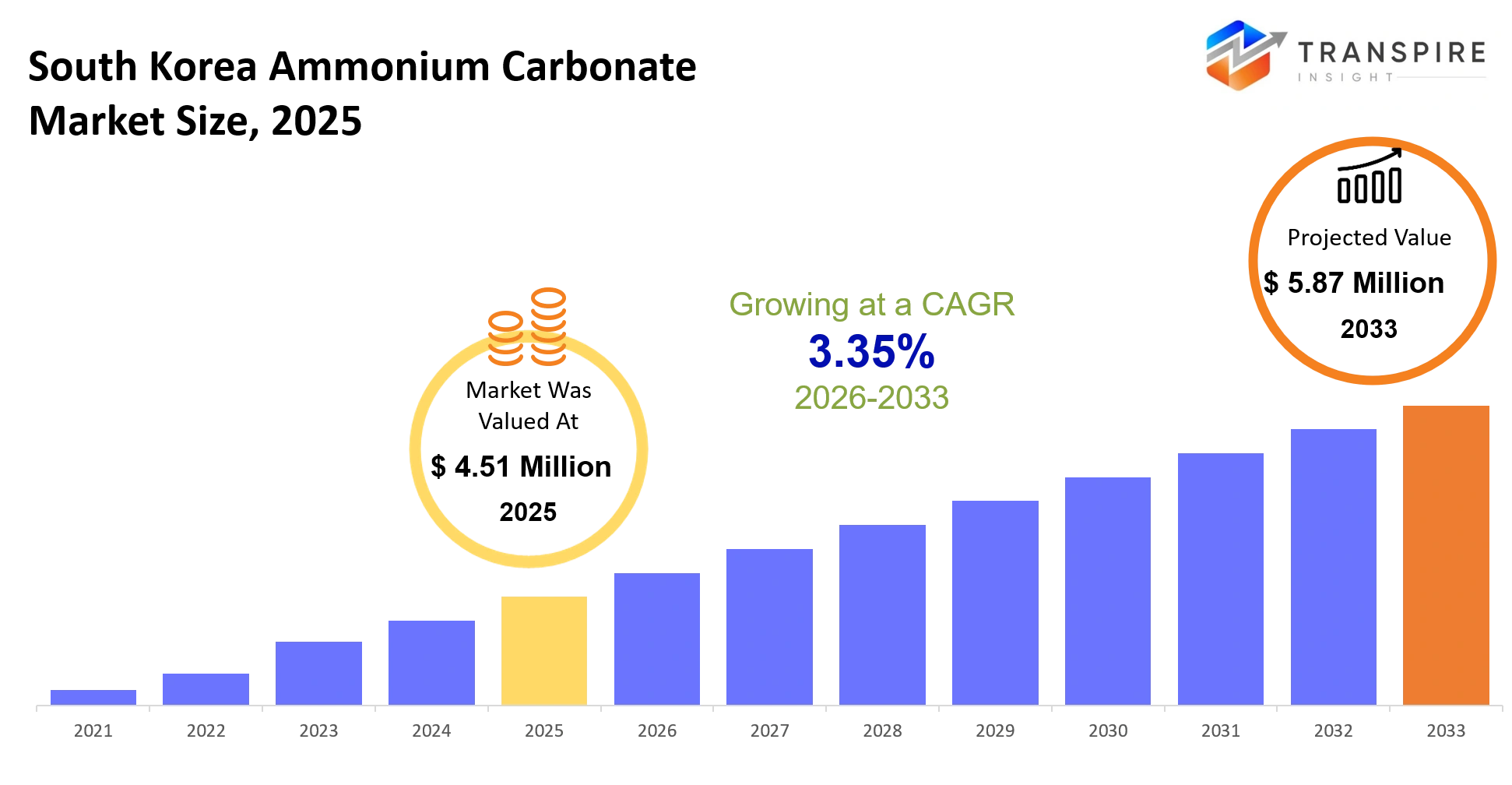
- South Korea Ammonium Carbonate Market Size 2025: USD 4.51 Million
- South Korea Ammonium Carbonate Market Size 2033: USD 5.87 Million
- South Korea Ammonium Carbonate Market CAGR: 3.35%
- South Korea Ammonium Carbonate Market Segments: By Grade (Food Grade, Industrial Grade, Pharma Grade, Others); By Application (Food Processing, Chemicals, Pharmaceuticals, Agriculture, Others); By End User (Food Industry, Chemical Industry, Healthcare, Others)
To learn more about this report,  Download Free Sample Report
South Korea Ammonium Carbonate Market Summary
The South Korea Ammonium Carbonate Market was valued at USD 4.51 Million in 2025. It is forecast to reach USD 5.87 Million by 2033. That is a CAGR of 3.35% over the period.
South Korea's ammonium carbonate market runs mostly as a niche but kinda essential input for bakery manufacturers and specialty chemical processors. It works like a fast-acting leavening agent that releases ammonia and carbon dioxide while baking, which helps form crisp textures in biscuits, and crackers, you know. It also gets used in smaller amounts for pharmaceuticals and laboratory-grade applications, but that’s more limited. Over the last 3–5 years, the overall market structure sort of moved sideways a bit: food makers tightened their formulation control and pushed for clearer ingredient labeling, so they pretty much stopped using it in an indiscriminate, scattered way and instead concentrated demand among industrial-scale bakers.
At the same time, the 2021–2023 global ammonia supply shocks, plus the energy price oscillations, jumbled upstream feedstock stability. That in turn led to higher procurement costs. Because of that, Korean buyers started diversifying suppliers, and also building buffer inventories, just to stay safer. All these pressures together changed how they buy—so instead of chasing pure volume growth, they care more about supply assurance, consistency, and reliability, which in turn supports steady revenue expansion for the qualified domestic distributors.
Key Market Insights
- Gyeonggi-do and Incheon kinda dominate the South Korea Ammonium Carbonate Market, holding more than 40% share, mainly because the chemical and food processing industries are really concentrated there.
- You see, the Southeast industrial zones are also showing the fastest growth through 2026, it looks like decentralized food manufacturing and logistics expansion are pushing that demand, pretty strongly.
- In terms of type, Food-grade ammonium carbonate leads the South Korea Ammonium Carbonate Market, with almost 55% share, and it’s backed by bakery plus confectionery uses.
- Then there’s the Technical-grade segment, which takes the second-largest portion, mostly due to pharmaceutical and laboratory chemical requirements across industrial research facilities and related labs.
- Meanwhile, purity-optimized variants are growing the quickest from 2024–2030, as the quality bar keeps getting tighter in processed food production, and producers have to comply.
- Finally, bakery and biscuit manufacturing is basically the biggest application category, with over 60% share, keeping its traditional role for leavening, texture control and consistent rise.
- Pharmaceutical formulation use is going pretty strong, honestly one of the fastest-growing applications, pushed by the ongoing demand for controlled decomposition reagents and regulated production standards , so it just keeps climbing.
- For industrial bakery manufacturers, they tend to lead end-user demand, with almost a 58% share in the South Korea Ammonium Carbonate Market, it’s a dominant angle there.
- Meanwhile specialty chemical laboratories and pharma firms are expanding rapidly too, driven by a need for precise reagent requirements and the broader move toward quality compliance, which keeps shaping how things are done.
What are the Key Drivers, Restraints, and Opportunities in the South Korea Ammonium Carbonate Market?
The main growth driver is really the steady widening of industrial bakery output, especially for biscuit and snack production, where ammonium carbonate is still kind of indispensable for that crisp, snappy texture. Demand did get a stronger push after 2022, not just because people wanted more, but because food processors adjusted their formulations so the final products stayed pretty consistent even while energy and raw material costs kept climbing. Also, once the big bakeries across South Korea started consolidating production, procurement kind of shifted toward standardized, high purity inputs. That then helps repeat ordering cycles turn more regular, and it supports suppliers in the South Korea Ammonium Carbonate Market with better revenue predictability.
The biggest constraint is that it has an inherent hazardous decomposition behavior, meaning it releases ammonia during processing, so handling controls have to be strict. This limitation in structure prevents wider substitution into newer food formulations, and it also keeps usage from expanding much beyond controlled industrial settings. Plus, compliance requirements lift storage and transport costs, which slows adoption among smaller manufacturers. So even if the core demand is stable, incremental market expansion gets suppressed, a bit like it cannot fully catch up.
A key forward-looking opportunity is localized specialty chemical production around the Gyeonggi and Incheon industrial clusters, where food-grade chemical blending units are being upgraded with more precise dosing technologies. If mid-sized bakery suppliers invest in automated ingredient handling systems by mid timeline, they could reduce dependence on imports, and also support customized formulation development. That could open up extra growth potential for the South Korea Ammonium Carbonate Market, in a more practical and controlled way.
What Has the Impact of Artificial Intelligence Been on the South Korea Ammonium Carbonate Market?
Artificial intelligence is slowly reshaping operational decision making, connected to scrubber performance system controls and more wide marine emission management tech ecosystems. These changes end up influencing how much demand shows up for industrial chemicals like ammonium carbonate, which is often used in controlled processing settings. In South Korea’s industrial and maritime chemical supply chain, AI enabled automation is being rolled out more and more inside monitoring systems that watch emissions compliance in real time. This is especially visible in exhaust gas cleaning technology used by shipping operators and coastal industrial facilities. The whole point is that these systems cut down manual inspection loops by continuously tweaking scrubber parameters, which helps operational steadiness too, and it also tends to reduce compliance related downtime.
Machine learning models are also finding their way into predictive maintenance, where sensor streams from pressure, temperature, and chemical dosing units are examined. The goal is to anticipate equipment wear and avoid those sudden, unplanned stoppages. As a result, maintenance scheduling efficiency can climb an estimated 10–15% across integrated industrial chemical handling arrangements. At the same time, reagent utilization becomes more steady, and operational waste decreases within processing spaces tied to the South Korea Ammonium Carbonate Market ecosystem.
Still, adoption is not fully smooth, mainly because getting high quality training data is hard in rough maritime conditions. Even with a well designed approach, sensor drift plus those little connectivity gaps can lower model accuracy in practice. Still, AI driven optimization keeps getting better, boosting fuel efficiency, shoring up regulatory compliance trust, and supporting tighter cost management , across the chemical and emissions control value chains , modernization keeps moving forward.
Key Market Trends
- Around 2023 , industrial bakeries in South Korea started moving away from spot buying toward long-term agreements, so procurement became less jumpy, especially for chemical inputs.
- In 2022, food-grade compliance rules got tighter, which basically pushed manufacturers to upgrade their purification steps so ammonium carbonate use stayed consistent, like always in specs.
- Meanwhile domestic distributors added warehousing capacity by roughly 18% since 2021, kind of to cushion import interruptions and keep supply continuity from stalling.
- Between 2022 and 2025, bakery manufacturers also consolidated some production lines , and that helped improve bulk chemical procurement efficiency across the South Korea Ammonium Carbonate Market.
- After 2023 import dependency on China eased over time, as firms diversified sourcing toward nearby Southeast Asian suppliers for risk reduction.
- In 2024, OCI Company Ltd kinda expanded its specialty chemical handling infrastructure, so it could support higher-purity food grade distribution networks a bit better.
- After 2022, digital inventory tracking systems were adopted, and they improved stock rotation efficiency by about 12–15% across a lot of major chemical distributors and processors.
- Meanwhile, pharmaceutical grade usage kept climbing steadily starting in 2023, mostly because stricter formulation controls showed up in laboratory reagent applications, across regulated industries.
- Also, energy price volatility during 2022–2024 made manufacturers rethink their batch production cycles, and that reduced waste in ammonium carbonate handling processes.
- Then in 2025, sustainability driven procurement audits were introduced, which raised supplier qualification requirements across the South Korea Ammonium Carbonate Market ecosystem.
South Korea Ammonium Carbonate Market Segmentation
By Grade :
Food grade takes the biggest chunk, basically because its steady use shows up in bakery production, where reliable rising behavior is needed for biscuits and crackers. After 2022, the demand started to move toward higher purity levels, since food safety checks got tighter, and suppliers had to adjust. Industrial grade is mainly placed in chemical processing , since a controlled breakdown is required for particular steps in manufacturing.
Pharma grade is smaller, but it does look like it is inching up as laboratory use and controlled formulation needs grow, especially in regulated settings. Many makers are also leaning into more cleaner manufacturing processes to pass stricter quality checks that were introduced after 2023. Other grades stay limited for niche work, most often research and testing tasks, where the requirement is small yet steady, especially among industrial labs.
By Application :
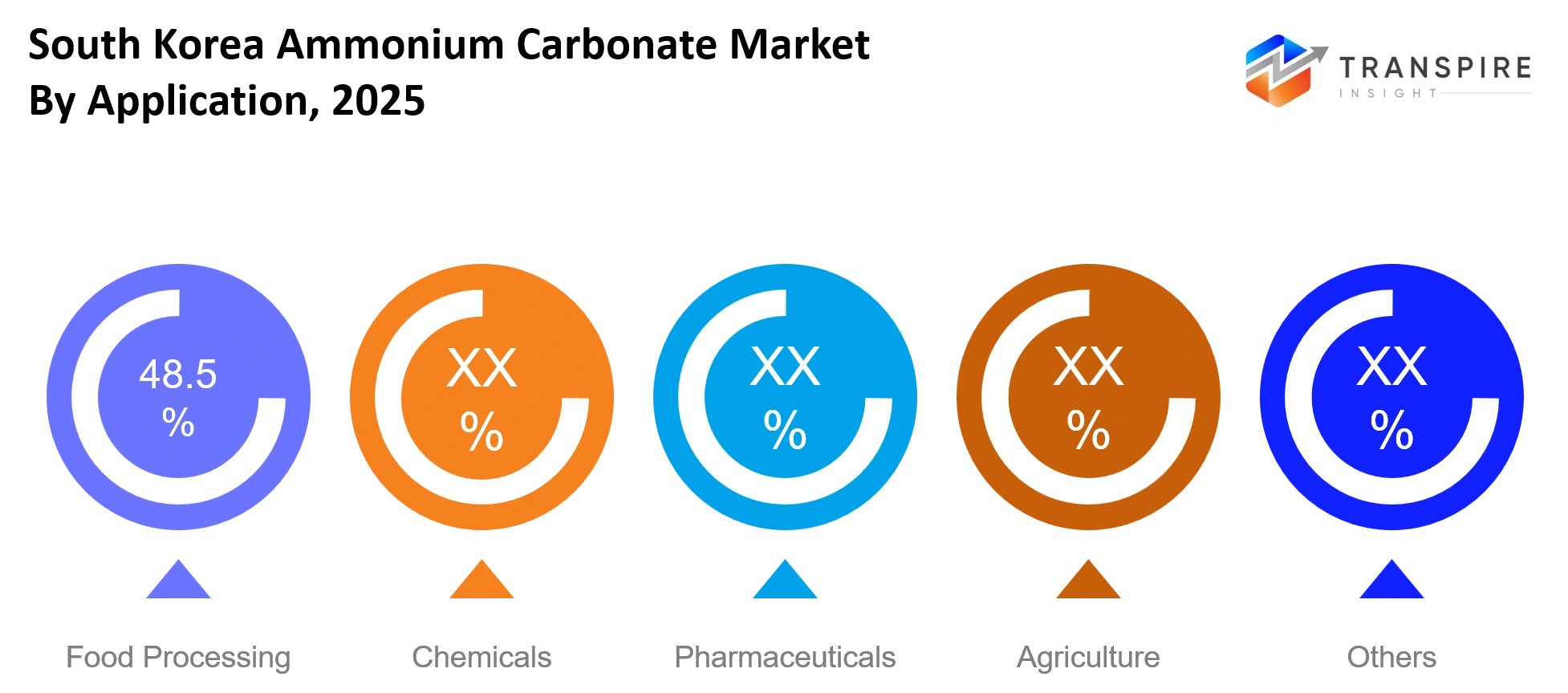
Food processing basically grabs most of the application demand, mostly because bakery and snack production needs fast-acting leavening properties, or at least that’s what the market story says. After 2021 the usage patterns shifted, industrial bakeries pushed for better batch consistency and they also dialed down ingredient variation, which made things more steady. Chemical applications also play along, helping with controlled reactions in manufacturing processes, where stability plus a predictable output still matters a lot for day to day operational efficiency, even if people don’t always call it that.
On the pharma side, growth is kinda slow, mainly because testing and formulation standards have gotten higher in the last few years. For agriculture it stays limited, more in controlled soil setups and trial projects rather than big scale farming. Other uses show up too, like lab research, plus specialty industrial needs, those keep demand fairly steady but at low volume, especially in regulated environments where everyone watches the numbers closely.
To learn more about this report, Download Free Sample Report
By End User :
In the food industry, the leading end user is kind of industrial bakeries and processed food manufacturers really rely on consistent availability, for production continuity. Procurement started to change after 2022 toward longer term contracts, so it improved stability in input sourcing, in general. The chemical industry, too, plays a role since its use supports manufacturing operations that need controlled decomposition agents for particular stages of output, not just random ones.
For healthcare, the end users make up a smaller share but it stays steady, mostly via laboratory testing, and pharmaceutical formulation requirements that keep coming back. Demand also looked better after stricter compliance checks, which pushed quality control measures higher. Other end users include research institutions and specialty labs, where consumption is small scale but still continuous, and it helps testing, along with development work, across regulated environments where you cannot really cut corners.
What are the Key Use Cases Driving the South Korea Ammonium Carbonate Market?
Industrial bakery production is kinda the real driver behind the South Korea Ammonium Carbonate Market demand, because the compound helps as a fast-acting leavening agent in biscuits and crackers. Big food processors lean on it heavily, not only because it gives a steady texture but also because the expansion stays controlled while baking, and that supports stable output on those continuous production lines, even when temperatures run high.
Then there is secondary uptake that seems to be growing, especially in specialty chemical manufacturing and in pharmaceutical laboratory environments. Chemical processors apply it inside controlled reaction setups where the gas release is more predictable, and that predictable release adds to overall process steadiness. On top of that , food industry suppliers and regulated healthcare labs depend on it too, for formulation trials and quality validation under tighter safety and compliance rules that were introduced in recent years.
New use cases are now showing up in precision food formulation and in automated ingredient dosing systems within smart food factories. These setups use finer process control to cut down on waste, and to push for better batch uniformity. Research institutions are also looking into how it may fit into experimental low-emission processing approaches, which is something that matches stricter industrial safety expectations lately.
|
Report Metrics |
Details |
|
Market size value in 2025 |
USD 4.51 Million |
|
Market size value in 2026 |
USD 4.66 Million |
|
Revenue forecast in 2033 |
USD 5.87 Million |
|
Growth rate |
CAGR of 3.35% from 2026 to 2033 |
|
Base year |
2025 |
|
Historical data |
2021 - 2024 |
|
Forecast period |
2026 - 2033 |
|
Report coverage |
Revenue forecast, competitive landscape, growth factors, and trends |
|
Country scope |
South Korea |
|
Key company profiled |
BASF, Merck, Thermo Fisher, Avantor, Loba Chemie, CDH Fine Chemical, Alfa Aesar, Sigma-Aldrich, Shandong Haihua, TCI Chemicals, Noah Chemicals, Vizag Chemical, Otto Chemie, Sisco Research, Spectrum Chemical |
|
Customization scope |
Free report customization (country, regional & segment scope). Avail customized purchase options to meet your exact research needs. |
|
Report Segmentation |
By Grade (Food Grade, Industrial Grade, Pharma Grade, Others); By Application (Food Processing, Chemicals, Pharmaceuticals, Agriculture, Others); By End User (Food Industry, Chemical Industry, Healthcare, Others) |
Which Regions are Driving the South Korea Ammonium Carbonate Market Growth?
Gyeonggi plus Incheon sort of make up the lead region in the South Korea Ammonium Carbonate Market because there is a really dense industrial clustering and a sturdy food processing backbone. You can see this in how large scale bakery manufacturers and chemical distributors keep feeding the same demand streams, not really letting things go quiet. Around Incheon port the logistics web is well built, so importing , then redistribution of chemical inputs stays efficient. On top of that, food safety rules are enforced in a strict way which kind of pushes suppliers to keep high grade, compliant product flows moving through this corridor.
Then there’s the Busan–Ulsan industrial belt which acts as the steady second region, mainly due to its export minded manufacturing base. It feels a bit different from the capital area, because here demand links more to long term industrial contracts, rather than huge, high volume food processing clusters. The shipbuilding related chemical supply chains and the ongoing chemical plant routines help produce a consistent baseline consumption. Regulatory adoption has been gradual, sure but also predictable, so companies can plan procurement without too much surprise disruption across the cycles.
Finally the fastest growing part seems to be the southern coastal corridor past Busan, where industrial park expansion and logistics modernization programs have pushed chemical handling capacity forward. Since 2023, investments in cold chain and food processing facilities have broadened downstream usage opportunities. So this is starting to open new procurement channels for specialty inputs among mid sized manufacturers. If you are a investor or a new entrant, this corridor reads like diversified demand growth, with less dependence on traditional metropolitan supply hubs across 2026–2033.
Who are the Key Players in the South Korea Ammonium Carbonate Market and How Do They Compete?
The South Korea Ammonium Carbonate Market still feels moderately consolidated, not totally, but kinda. A small cluster of domestic chemical producers along with a few global specialty players runs most of the high purity supply chain, more or less. What drives competition seems less about price only, and more about product steadiness, food grade certification, and delivery dependability. Incumbents tend to keep their grip via long term agreements with bakery manufacturers, while smaller distributors try to sneak ahead using more adaptable sourcing, and shorter replenishment rhythms across industrial pockets.
OCI Company Ltd leans into cost efficient bulk chemical handling and locks in secured distribution contracts with food processors, so the scale helps it push standardized grades. LG Chem differentiates itself with high purity chemical processing know-how and integrated supply systems, which keeps industrial grade output consistent. Hanwha Solutions expands by juggling diversified chemical portfolios and building partnerships with downstream manufacturers, to smooth out those demand cycles.
BASF leans toward niche specialty chemical supply, using higher purity benchmarks and regulatory compliance systems to support high spec uses in food and lab segments. Merck KGaA improves its position through laboratory grade materials plus certification led supply chains for precise use cases. Both firms also grow through regional ties with Korean distributors and by landing targeted contracts with regulated end users.
Company List
- BASF
- Merck
- Thermo Fisher
- Avantor
- Loba Chemie
- CDH Fine Chemical
- Alfa Aesar
- Sigma-Aldrich
- Shandong Haihua
- TCI Chemicals
- Noah Chemicals
- Vizag Chemical
- Otto Chemie
- Sisco Research
- Spectrum Chemical
Recent Development News
In March 2026, Reliance Industries Limited and Samsung C&T Corporation entered into a long-term supply and purchase agreement for the supply of green ammonia.” The USD 3+ billion 15-year agreement aims to supply green ammonia from India to South Korea, strengthening Korea’s future feedstock availability for downstream nitrogen-based chemicals and potentially stabilizing input costs for ammonium compound production.
Source https://csdronline.com/
In May 2026, South Korea’s Ministry of Climate, Energy and Environment launched a public-private task force to promote the use of New Approach Methodologies (NAMs) in chemical safety assessments.” The initiative is expected to streamline approval pathways for industrial chemicals, indirectly improving regulatory efficiency for inorganic salts and specialty chemicals including ammonium carbonate derivatives. Source https://gpcgateway.com/
What Strategic Insights Define the Future of the South Korea Ammonium Carbonate Market?
The South Korea Ammonium Carbonate Market is kinda moving toward tighter consolidation, around high purity contract based supply systems over the next 5–7 years, anyway. Demand stability will increasingly hinge on industrial bakery scale up efficiency and stronger food safety enforcement, which really favors suppliers who can manage consistent grade control and also get logistics integration right, every time. It also signals a gradual drift away from fragmented spot trading, toward more structured long term procurement ecosystems across the big industrial zones.
There’s another risk that’s a bit less obvious too. You can feel a slow substitution pressure from other leavening agents used in reformulated bakery products especially when manufacturers experiment with ammonia free or enzyme based options to boost labeling clarity. That change might quietly put a lid on long term volume growth even if overall food production keeps climbing. Meanwhile concentration risk may rise, because only a few distributors might end up controlling the certified food grade supply chains.
On the opportunity side, something is starting to emerge in automated food manufacturing clusters in southern coastal industrial parks, where smart dosing systems need highly stable chemical inputs for precision baking lines. Market players should lean into certification led differentiation, and lock in multi year agreements with large bakery manufacturers, because procurement certainty will likely become the main competitive edge in this reshaped setup.
South Korea Ammonium Carbonate Market Report Segmentation
By Grade
- Food Grade
- Industrial Grade
- Pharma Grade
By Application
- Food Processing
- Chemicals
- Pharmaceuticals
- Agriculture
By End User
- Food Industry
- Chemical Industry
- Healthcare
Frequently Asked Questions
Find quick answers to common questions.
The expected South Korea Ammonium Carbonate Market size is USD 5.87 Million in 2033.
Key segments for the South Korea Ammonium Carbonate Market are By Grade (Food Grade, Industrial Grade, Pharma Grade, Others); By Application (Food Processing, Chemicals, Pharmaceuticals, Agriculture, Others); By End User (Food Industry, Chemical Industry, Healthcare, Others).
Major South Korea Ammonium Carbonate Market players are BASF, Merck, Thermo Fisher, Avantor, Loba Chemie, CDH Fine Chemical, Alfa Aesar, Sigma-Aldrich, Shandong Haihua, TCI Chemicals, Noah Chemicals, Vizag Chemical, Otto Chemie, Sisco Research, Spectrum Chemical.
The South Korea Ammonium Carbonate Market size is USD 4.51 Million in 2025.
The South Korea Ammonium Carbonate Market CAGR is 3.35% from 2026 to 2033.
- BASF
- Merck
- Thermo Fisher
- Avantor
- Loba Chemie
- CDH Fine Chemical
- Alfa Aesar
- Sigma-Aldrich
- Shandong Haihua
- TCI Chemicals
- Noah Chemicals
- Vizag Chemical
- Otto Chemie
- Sisco Research
- Spectrum Chemical
About the Authors

Pankaj Ghogare Patil
I am Pankaj Ghogare Patil, a Senior Research Analyst at Transpire Insight, specializing in the Pharmaceutical, Chemicals & Materials, Healthcare IT, and Biotechnology industry. My expertise lies in conducting comprehensive market research, analyzing industry trends, evaluating competitive landscapes, and translating complex data into actionable insights. At Transpire Insight, I closely follow emerging technologies, regulatory developments, and market innovations to create accurate, well-researched, and informative content that helps businesses and professionals make informed decisions. I am committed to producing credible, evidence-based articles that reflect industry best practices while making technical topics accessible and valuable for a broad audience.

Chakradhar Khansole
Chakradhar serves as the Research Director at Transpire Insight, bringing over 8 years of experience in technology, innovation, and strategic market intelligence. He specializes in transforming complex market data into actionable business insights that enable organizations to make informed, growth-oriented decisions. Recognized for his strategic vision and analytical expertise, Chakradhar leads high-impact research initiatives, delivering comprehensive market assessments, competitive intelligence, and forward-looking industry analysis.
Recently Published Reports
-
May 2026
Healthcare Polymer Packaging Market
Healthcare Polymer Packaging Market Size, Share & Analysis Report By Packaging Type (Syringes, IV Bottles and Pouches, Clamshells, Blisters, Bottles & Jars, Containers, Tubes, IV Parental Packaging, Others), By Type (Regulated, Non-regulated), By Polymer Type (LDPE (Low-Density Polyethylene), HDPE (High-Density Polyethylene), Homo-polymer (Homo), Random Copolymer (Random), Block Copolymer (Block), PET, Polystyrene, Polyvinyl Chloride, Polyamide/EVOH, Others), and Geography (North America, Europe, Asia-Pacific, Middle East and Africa, South and Central America), 2021 - 2031
-
Apr 2026
Hydrophilic Tape (Waterstop) Market
Hydrophilic Tape (Waterstop) Market Size, Share & Analysis Report By Type (Bentonite-Based Hydrophilic Tape, Rubber-Based Hydrophilic Tape), By Application (Residential Buildings, Commercial Buildings, Infrastructure Projects), and Geography (North America, Europe, Asia-Pacific, Middle East and Africa, South and Central America), 2021 - 2031
-
Apr 2026
Metalens Market
Metalens Market Size, Share & Analysis Report By Type (Visible Light Metalens, and Infrared Metalens), By Application (Consumer Electronics, Automotive Electronics, Industrial, Medical, and Others), and Geography (North America, Europe, Asia-Pacific, Middle East and Africa, South and Central America), 2021 - 2031
-
Apr 2026
PBT Resin Market
PBT Resin Market Size, Share & Analysis Report By Type (Reinforced PBT Resin, Unreinforced PBT Resin), By Processing Method (Injection Molding, Extrusion, Blow Molding, Others), By End-User (Automotive, Electrical & Electronics, Consumer Appliances, Industrial Machinery, Medical Devices, Packaging, Others), and Geography (North America, Europe, Asia-Pacific, Middle East and Africa, South and Central America), 2021 - 2031