

United Kingdom Precipitated Calcium Carbonate Market Size & Forecast:
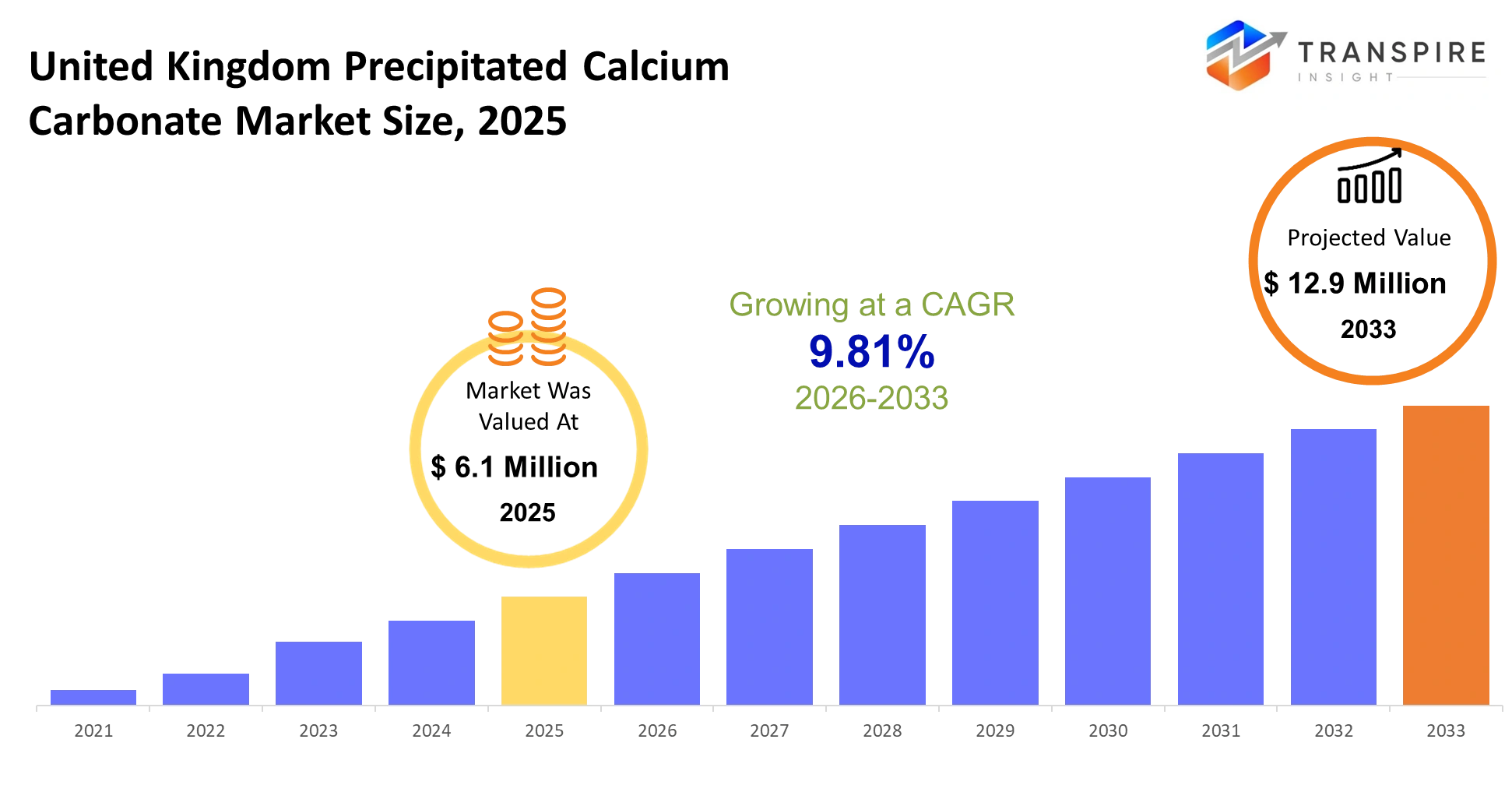
- United Kingdom Precipitated Calcium Carbonate Market Size 2025: USD 6.1 Million
- United Kingdom Precipitated Calcium Carbonate Market Size 2033: USD 12.9 Million
- United Kingdom Precipitated Calcium Carbonate Market CAGR: 9.81%
- United Kingdom Precipitated Calcium Carbonate Market Segments: By Product Type (Ground Calcium Carbonate, Nano Precipitated Calcium Carbonate, Coated PCC, Uncoated PCC, Others); By Application (Paper Manufacturing, Plastics, Paints & Coatings, Adhesives & Sealants, Pharmaceuticals, Rubber Industry, Others); By End User (Paper Industry, Plastics Industry, Construction Industry, Healthcare Industry, Packaging Industry, Others); By Form (Powder PCC, Slurry PCC, Granular PCC, Others); By Grade (Industrial Grade, Pharmaceutical Grade, Food Grade, Others)
To learn more about this report,  Download Free Sample Report
United Kingdom Precipitated Calcium Carbonate Market Summary
The United Kingdom Precipitated Calcium Carbonate Market was valued at USD 6.1 Millionin 2025. It is forecast to reach USD 12.9 Million by 2033. That is a CAGR of 9.81%over the period.
The United Kingdom, which kind of quietly plays a key role in boosting product performance across paper plastics, paints pharmaceuticals and even construction materials, you know. Manufacturers use precipitated calcium carbonate in order to improve brightness, opacity, durability and surface smoothness, but also to cut formulation costs and lessen dependence on heavier mineral fillers. In the UK industrial ecosystem, it shows up in high-value manufacturing processes where precision of particle size and purity, really sway product quality and overall production efficiency.
Over the last five years, the market has kind of moved away from simpler commodity-grade fillers, toward more finely engineered calcium carbonate formulations, you know, basically dialed in for specialty coatings, recyclable packaging, and lighter-weight polymer uses. This shift sped up after supply chain disruptions during the COVID 19 period, and the increasing European energy costs also pushed manufacturers to localize sourcing, and tighten material efficiency, kind of across the board. UK packaging producers and paper converters have been adopting higher performance PCC grades more and more, mostly to meet recyclability targets and also lower raw material waste. As a result, long term contracts between chemical suppliers and end use manufacturers have become more steady , which then supports stronger pricing power and higher value revenue streams across the domestic market.
Key Market Insights
- England basically led regional consumption with close to 68% market share during 2025, largely because paper, plastics, and construction manufacturing clusters were running strong.
- Scotland came up as the quickest-growing regional market , with specialty chemical production and sustainable packaging investments picking up after 2022.
- Fine particle PCC grades held around 44% share in 2025, mainly because paper makers need stronger brightness and steady print quality performance.
- Nano-precipitated calcium carbonate was the swifter moving segment, driven by advanced polymer reinforcement, and also by pharmaceutical formulation use cases through 2033.
- Paper and pulp applications kept a stake above 38% market share as UK converters moved toward recyclable plus lighter packaging materials, slowly but surely.
- Plastics and polymer use expanded pretty fast after 2021, as automotive and consumer goods manufacturers aimed for lightweight material substitution, with less fuss.
- The pharmaceutical end-user group gathered more momentum because PCC is used more often in tablet coatings, calcium supplements and controlled-release drug formulations.
- Key players like Omya, Minerals Technologies Inc., Imerys, Huber Engineered Materials, and Sibelco expanded their specialty PCC offerings across 2022 to 2025, in multiple waves.
- Manufacturers increasingly leaned into carbon capture integration, and low-emission mineral processing methods too, to improve their competitive posture and meet regulatory compliance demands.
What are the Key Drivers, Restraints, and Opportunities in the United Kingdom Precipitated Calcium Carbonate Market?
The main driver in the United Kingdom, that is really accelerating the precipitated calcium carbonate market, is the ongoing restructuring of the packaging and paper sector, towards lightweight recyclable and higher performance materials. In the UK, producers are running into tighter rules on packaging waste, plus elevated raw material expenses, so converters end up replacing older fillers with engineered PCC grades. These engineered grades typically deliver better opacity, improved printability and extra strength, while also cutting back on the overall amount of material used. In turn, this kind of shift boosts the revenue chances for specialty PCC suppliers. Premium formulations tend to pull higher margins, and they also support longer industrial supply commitments . Meanwhile, the rise of water based coatings and the movement to more sustainable packaging formats has added extra momentum across domestic manufacturing lines .
The main restraint however stays the same , the market’s exposure to swinging energy prices and the continued pressure of expensive production. PCC manufacturing relies on carefully managed chemical processing plus steady kiln operations, which means producers are exposed to electricity and natural gas price shifts. Unfortunately, this isn’t something that can be fixed overnight because modernizing facilities and bringing in alternative energy options takes substantial capex , even for companies with decent cash flow . Smaller manufacturers often can’t absorb these new costs, so growth in output gets constrained, and adoption tends to slow down among end users that are especially price sensitive.
A noticeable opportunity is also starting to show up via low carbon industrial materials and carbon utilization technologies. A number of UK and broader European mineral processing firms are testing PCC production routes that connect to captured carbon dioxide streams coming from cement plants and other industrial operations .
What Has the Impact of Artificial Intelligence Been on the United Kingdom Precipitated Calcium Carbonate Market?
Artificial intelligence and advanced digital tech are, honestly, reshaping precipitated calcium carbonate manufacturing, by making process control a bit more deterministic and smoothing energy management, then also improving production consistency at UK industrial facilities. PCC production really needs careful regulation because the particle size distribution, carbonation rates, temperature stability, and chemical purity all have to stay inside pretty tight tolerances. Manufacturers are increasingly leaning on AI-enabled monitoring systems to automate reactor control, adjust slurry concentration more precisely and also reduce those annoying process deviations during continuous operations. With that kind of setup, plants can keep product quality fairly steady while cutting material losses and lowering energy consumption overall.
On top of that, machine learning models are also assisting with predictive maintenance across grinding, filtration, and kiln operations. When they analyze vibration patterns, heat swings, and equipment performance traces, operators can pick up mechanical failures ahead of time, so shutdowns are less often. Some mineral processing facilities have reported step-like gains in operational uptime, plus fewer maintenance interruptions once predictive analytics got folded into plant management systems. AI-assisted production scheduling also supports inventory efficiency, and it shortens delivery timelines for specialty PCC grades used in pharmaceuticals, and engineered plastics as well.
Meanwhile, digital twin technology is getting more traction for simulating carbonation processes and testing formulation adjustments before anything goes full scale. This can reduce expensive trial-and-error cycles and speed up specialty product development. Still, AI adoption isn’t everywhere yet, mainly because the integration costs are high, and the industrial data environments are fragmented, kind of split across systems and teams.
Key Market Trends
- UK paper manufacturers did this kinda thing, they increased specialty PCC use by almost 22% from 2021 up to 2025, mostly to bump print quality and also make packaging more recyclable.
- After 2022, plastics processors started leaning more toward nano grade calcium carbonate additives. they said it helps polymer rigidity, without piling on extra product weight, or so the story goes.
- Domestic producers put money into energy efficient carbonation systems, once UK industrial electricity prices started jumping hard during the 2022 energy crisis. kinda ugly spike timing really.
- Pharmaceutical grade PCC adoption grew across tablet coatings and nutraceutical production, specially with precision healthcare manufacturers who operate in England.
- Omya and Minerals Technologies also tightened localized supply relationships with UK paper converters , aiming to cut back on import dependency after the pandemic disruptions.
- From 2023 onward, carbon capture linked PCC production projects got more attention across the industry, because manufacturers were looking at carbon utilization as a real commercial opportunity.
- Recycled paper packaging demand kept rising and that drove more ultra fine PCC formulations, the kind that can hold brightness even when fiber content is lower in the packaging material.
- In construction too, suppliers began integrating PCC into adhesives, sealants, and architectural coatings to support durability, and keep surface consistency more steady.
- At the same time automated mineral processing systems spread through large scale facilities, which reduced quality drift and improved batch consistency for specialty uses.
- Finally, export focused manufacturers prioritized high purity PCC grades for advanced polymers and medical applications, where performance specs got stricter and stricter over time.
United Kingdom Precipitated Calcium Carbonate Market Segmentation
By Product Type
Ground Calcium Carbonate keeps the dominant market position, because producers of paper, plastics, and construction materials still lean on cost efficient mineral fillers for large scale manufacturing uses. There is also a steady backing from the strong availability of limestone reserves and these lower processing costs that make the industrial adoption feel pretty straightforward across packaging, coatings, and infrastructure. Uncoated PCC stays in a notable secondary spot, mostly because manufacturers prefer simpler formulations, for standard industrial processing and for bulk filler use cases. Meanwhile Coated PCC keeps expanding, somehow more consistently, since it matches polymers better, disperses more easily, and it’s seeing stronger pull from engineered plastics plus automotive component makers. Nano Precipitated Calcium Carbonate is still smaller, but it’s clearly pushing forward, and it connects to specialty polymers, healthcare items, and high performance industrial mixes.
Ground Calcium Carbonate is expected to hold leadership, since major volume industries continue choosing economical mineral reinforcement solutions. Nano Precipitated Calcium Carbonate is set up for the quickest growth too, because advanced material producers look for lightweight yet high strength additives aimed at premium manufacturing. Coated PCC suppliers are likely to gain from increasing use in electric vehicle plastics, flexible packaging films, and specialty coatings where enhanced surface properties matter. Product developers, and even investors, are placing more attention on particle engineering technologies and sustainable production approaches, these improve functionality while also reducing energy consumption and raw material waste.
By Application
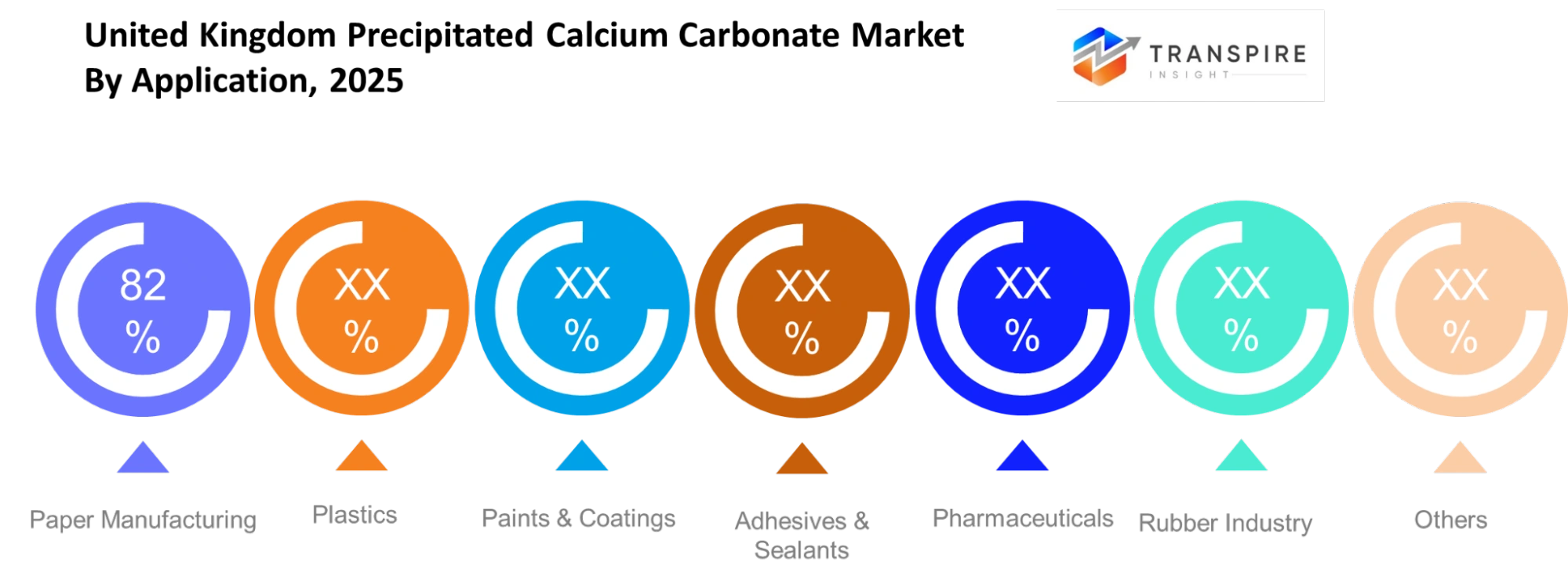
Paper Manufacturing keeps the leading spot, more or less, because paper mills and packaging converters need calcium carbonate to boost brightness, printability, opacity, and overall production efficiency. Even so, it seems the real driver is still recyclable packaging materials and lightweight paper solutions, and this keeps pushing mineral filler usage steady across many local production facilities. Plastics stay in the second-largest position, mainly from the rising use of mineral additives in automotive parts, flexible packaging, and consumer goods manufacturing. Paints & Coatings hold a pretty stable demand curve too, since producers rely on calcium carbonate to improve texture, durability, and coverage efficiency. Pharmaceuticals , and also Adhesives & Sealants, keep picking up momentum through the demand for controlled particle size formulations, plus high-purity specialty mineral compounds.
In terms of what happens next, Paper Manufacturing should keep its structure-like dominance, because sustainability goals for packaging are still reworking how paper is produced across the United Kingdom. Plastics are likely to grow faster as lightweight material substitution and polymer reinforcement technologies become more commercial. Pharmaceutical applications are set up for solid long-term expansion, because healthcare manufacturers increasingly want precision-grade mineral ingredients for tablets, coatings, and nutraceutical formulations. Investors and manufacturers are expected to focus on special-purpose application development too, where higher purity requirements and advanced particle control can support better profit margins and longer industrial contracts.
To learn more about this report, Download Free Sample Report
By End User
The Paper Industry keeps the strongest end-user position because big scale paper converters, and packaging producers rely on calcium carbonate quite a lot, for print quality enhancement and raw material optimization. Solid growth in recyclable packaging demand is still showing up, and it keeps supporting long-term consumption across commercial paper production sites. The Plastics Industry keeps a notable secondary share thanks to rising need for lighter compound blends and reinforced polymer materials, used in automotive, consumer items, and industrial uses too. The Construction Industry shows steady demand because mineral fillers help cement goods, adhesives, architectural coatings, and sealants perform better.
Healthcare Industry adoption is climbing too, since pharmaceutical manufacturing and nutraceutical product development they really need high-purity mineral grades. In the outlook, the Paper Industry should still hold strong market influence, as sustainable packaging rules keep pushing fiber-efficient production methods, and that’s pretty consistent. The Healthcare Industry is likely to show the quickest expansion, largely because there’s more pharmaceutical manufacturing activity, and also demand for specialized excipient materials. Packaging Industry players are expected to step up investment in improved coating systems and lightweight material technologies, so recyclability and transportation efficiency can improve. Over the forecast period, end user competition should be turning more around formulation performance, regulatory compliance, and supply chain reliability, not mineral cost on its own.
By Form
Powder PCC keeps the dominant market spot, a lot of manufacturers in paper, plastics, and coatings just go with it since dry mineral formulations feel easier for storage, transport, and blending flexibility. Its broad fit with automated industrial mixing setups still keeps adoption humming across bigger manufacturing sites. Slurry PCC sits in a fairly strong secondary place, mainly because it is widely used inside integrated paper production lines where direct liquid dispersion helps operational efficiency, and keeps processing steadier. Granular PCC stays more focused on niche industrial uses, where less dust generation matters, and handling during bulk transfer should be calmer. Other specialized forms keep showing up for limited technical needs in healthcare and in more advanced industrial processing spaces.
Powder PCC should keep that long term edge, since industrial buyers keep leaning toward versatile, and generally cost effective material handling approaches. Slurry PCC seems set up for faster momentum within paper production facilities that want better process automation and fewer downtime surprises. Granular options may draw selective traction in industries that care about workplace safety upgrades, and more controlled material dosing systems. Suppliers, and investors too, are more and more pointing at packaging optimization, logistics efficiency, and delivery formats tailored to automated industrial production needs.
By Grade
Industrial Grade keeps the upper hand in the market, sort of the main share spot, because paper manufacture, plastics conversion, paints, binders, and building activities soak up huge amounts of minerals for normal industrial output. Lower refinement needs and wide commercial fit help it keep that revenue concentrated in this segment , even when things shift. Pharmaceutical Grade sits a bit smaller, but it matters strategically, since strict purity targets and regulated particle limits are needed for film coatings, calcium supplements, and other healthcare formulations , basically where quality control is not optional. Food Grade keeps growing step by step too, driven by fortified foods, drinks, and wellness additions that depend on mineral ingredients cleared by regulation. The other specialized grades stay mostly locked into limited industrial roles and lab uses.
Industrial Grade is likely to stay on top because materials for infrastructure, packaging production, and polymer fabrication are still producing big, steady demand at scale. Pharmaceutical Grade should post the quickest long term growth as health production capacity and nutraceutical output ramp up around the United Kingdom. Food Grade vendors may gain more from rising investment in fortified nutrition products and functional food manufacturing through the forecast. Players who emphasize regulatory certification, ultra-fine particle management, and systems that stay contamination-free are placed well to win a stronger edge in premium-grade applications.
What are the Key Use Cases Driving the United Kingdom Precipitated Calcium Carbonate Market?
In the United Kingdom paper and packaging production is still like the biggest, most obvious use case for precipitated calcium carbonate , or PCC as people shorten it. Manufacturers use it so the paper comes out with better brightness, clearer printing, higher opacity, and a smoother feel. At the same time they cut back on fiber consumption, and production costs, which is kind of the point. Also the movement toward recyclable packaging materials really bumped up demand from paper converters and the packaging producers too, mostly.
Then there is plastics and polymer manufacturing, which keeps growing fast. Automotive suppliers , consumer goods manufacturers, and makers of flexible packaging increasingly lean on PCC to reinforce lightweight plastic compounds, and they help improve dimensional stability as well. Paints, coatings, and adhesives producers also depend on engineered PCC grades, for a finer surface finish and better long term durability.
There are also emerging uses that feel more niche but expanding. Think pharmaceutical formulations, nutraceutical supplements, and newer construction materials. Higher purity PCC grades are starting to gain momentum in controlled release tablets, medical coatings, and low-carbon cement alternatives. UK industrial producers seem to be pushing harder into higher-value specialty mineral applications, so PCC fits that direction.
|
Report Metrics |
Details |
|
Market size value in 2025 |
USD 6.1 Million |
|
Market size value in 2026 |
USD 6.7 Million |
|
Revenue forecast in 2033 |
USD 12.9 Million |
|
Growth rate |
CAGR of9.81%from 2026 to 2033 |
|
Base year |
2025 |
|
Historical data |
2021 - 2024 |
|
Forecast period |
2026 - 2033 |
|
Report coverage |
Revenue forecast, competitive landscape, growth factors, and trends |
|
Regional scope |
United Kingdom |
|
Key company profiled |
Omya AG, Minerals Technologies, Imerys, Huber Engineered Materials, Mississippi Lime Company, Fujian Sanmu Nano Calcium Carbonate, Maruo Calcium, Schaefer Kalk, Nordkalk, Shiraishi Kogyo, Calchem Industries, Gulshan Polyols, Solvay, Okutama Kogyo, NanoMaterials Technology . |
|
Customization scope |
Free report customization (country, regional & segment scope). Avail customized purchase options to meet your exact research needs. |
|
Report Segmentation |
By Product Type (Ground Calcium Carbonate, Nano Precipitated Calcium Carbonate, Coated PCC, Uncoated PCC, Others); By Application (Paper Manufacturing, Plastics, Paints & Coatings, Adhesives & Sealants, Pharmaceuticals, Rubber Industry, Others); By End User (Paper Industry, Plastics Industry, Construction Industry, Healthcare Industry, Packaging Industry, Others); By Form (Powder PCC, Slurry PCC, Granular PCC, Others); By Grade (Industrial Grade, Pharmaceutical Grade, Food Grade, Others) |
Which Regions are Driving the United Kingdom Precipitated Calcium Carbonate Market Growth?
England is still kind of the leading region in the United Kingdom precipitated calcium carbonate market , mainly because it pulls together the country’s biggest paper manufacturing base with more advanced plastics, coatings, and also pharmaceutical production clusters. Industrial areas in the North West, Yorkshire and the Midlands give pretty direct access to chemical processing infrastructure, skilled workforce, and already-established logistics networks. Those things help back large-scale PCC distribution. On top of that, stricter environmental compliance rules have pushed manufacturers to move toward higher-purity calcium carbonate formulations, this is said to improve recyclability and also production efficiency. The region’s connected mix of converters, specialty chemical suppliers, packaging companies , and research organizations keeps reinforcing its top spot in domestic market revenue, even when conditions shift.
Scotland, meanwhile , has a smaller but very steady market share, mostly driven by specialty chemicals and advanced materials industries. And unlike England where the bulk volume manufacturing tends to drive demand, Scotland’s PCC usage is more tied to higher-value applications, like engineered polymers, healthcare products, and industrial coatings. Investment in sustainable manufacturing, plus industrial decarbonization, has helped specialty mineral additives keep being adopted across industrial production facilities. Also, long-range infrastructure planning and steady policy encouragement for low-carbon manufacturing make Scotland a reliable contributor to market growth , though its industrial base is comparatively smaller.
Wales is starting to grow faster than the other regions, driven by renewed investment in sustainable construction materials and industrial modernization projects.
Who are the Key Players in the United Kingdom Precipitated Calcium Carbonate Market and How Do They Compete?
In the United Kingdom, competition across the calcium carbonate market looks moderately consolidated, not too fragmented, with this small bunch of multinational mineral tech firms holding a notable portion of the higher value industrial uses. What really moves the rivalry isn’t so much raw production volume, but sort of the know-how behind formulations, particle engineering, dependability of supply, and also the long, patient industrial relationships. Long standing producers keep their foothold by pushing specialty-grade innovation and offering local technical support, rather than leaning on price competition only. For new entrants, the hurdles show up as energy-heavy production needs, regulatory compliance expenses, and the slow customer qualification cycles, especially in pharmaceuticals and in engineered plastics.
[Omya AG] sets itself apart with customized calcium carbonate setups that fit packaging, polymers , and paper manufacture. They bolster customer stickiness by running on-site production solutions, which cut transport expenses and improve supply steadiness for paper mills. [Minerals Technologies] plays the game with a satellite PCC plant model plus proprietary process capabilities, so customers can fine tune brightness, opacity, and fiber replacement in paper output. Their growth plan tends to lean on long term industrial agreements and regional diversification across manufacturing areas that are growing faster. [Imerys] leans into specialty mineral formulations for coatings, life sciences, and performance polymers, and in practice that tends to place them stronger in premium industrial applications, where purity and particle precision really matter.
Company List
- Omya AG
- Minerals Technologies
- Imerys
- Huber Engineered Materials
- Mississippi Lime Company
- Fujian Sanmu Nano Calcium Carbonate
- Maruo Calcium
- Schaefer Kalk
- Nordkalk
- Shiraishi Kogyo
- Calchem Industries
- Gulshan Polyols
- Solvay
- Okutama Kogyo
- NanoMaterials Technology
Recent Development News
In February 2026, Minerals Technologies announced continued investment in strategic growth initiatives and advanced specialty mineral product development. The expansion supports geographic penetration and specialty precipitated calcium carbonate applications across packaging and industrial markets.https://investors.mineralstech.com
In March 2026, Omya expanded collaboration activities around calcium carbonate applications for advanced fiber and polymer materials. The initiative strengthened specialty PCC adoption in recyclable packaging and nonwoven industrial applications.https://www.omya.com
In January 2026, Shiraishi-Omya continued scaling ultrafine precipitated calcium carbonate production capabilities for adhesives, sealants, and specialty plastics markets in Europe. The development improved regional supply responsiveness and strengthened access to high-performance PCC applications.https://www.omya.com/
What Strategic Insights Define the Future of the United Kingdom Precipitated Calcium Carbonate Market?
The United Kingdom precipitated calcium carbonate market is kind of structurally shifting toward specialty, low-carbon, and application-tailored mineral technologies rather than doing the big high-volume commodity production thing. The strongest pull behind this change is the growing integration of PCC into recyclable packaging, lightweight polymer matrices, pharmaceutical compositions, and lower-emission construction materials where the performance requirements are getting a lot more exact. Still, there is a hidden catch, because the whole market remains dependent on energy-intensive production infrastructure, and at the same time industrial electricity plus natural gas price volatility stays structurally elevated across Europe. That situation may squeeze margins for smaller producers, and it can also speed up consolidation toward multinational suppliers.
At the same time, there’s a real emerging opening in carbon capture-linked PCC manufacturing, where captured industrial carbon dioxide gets turned into higher-value mineral products. Firms that plug in carbon utilization technologies early might collect both regulatory benefit and commercial upside, sort of in parallel. So market players should lean into investments for specialty-grade formulations, localized supply arrangements, and energy-efficient processing methods, instead of trying to outcompete everyone purely on sheer production scale or pricing.
United Kingdom Precipitated Calcium Carbonate Market Report Segmentation
By Product Type
- Ground Calcium Carbonate
- Nano Precipitated Calcium Carbonate
- Coated PCC
- Uncoated PCC
- Others
By Application
- Paper Manufacturing
- Plastics
- Paints & Coatings
- Adhesives & Sealants
- Pharmaceuticals
- Rubber Industry
- Others
By End User
- Paper Industry
- Plastics Industry
- Construction Industry
- Healthcare Industry
- Packaging Industry
- Others
By Form
- Powder PCC
- Slurry PCC
- Granular PCC
- Others
By Grade
- Industrial Grade
- Pharmaceutical Grade
- Food Grade
- Others
Frequently Asked Questions
Find quick answers to common questions.
The expected United Kingdom Precipitated Calcium Carbonate Market size for the market will be USD 12.9 Million in 2033.
Key segments for the United Kingdom Precipitated Calcium Carbonate Market are By Product Type (Ground Calcium Carbonate, Nano Precipitated Calcium Carbonate, Coated PCC, Uncoated PCC, Others); By Application (Paper Manufacturing, Plastics, Paints & Coatings, Adhesives & Sealants, Pharmaceuticals, Rubber Industry, Others); By End User (Paper Industry, Plastics Industry, Construction Industry, Healthcare Industry, Packaging Industry, Others); By Form (Powder PCC, Slurry PCC, Granular PCC, Others); By Grade (Industrial Grade, Pharmaceutical Grade, Food Grade, Others).
Major United Kingdom Precipitated Calcium Carbonate Market players are Omya AG, Minerals Technologies, Imerys, Huber Engineered Materials, Mississippi Lime Company, Fujian Sanmu Nano Calcium Carbonate, Maruo Calcium, Schaefer Kalk, Nordkalk, Shiraishi Kogyo, Calchem Industries, Gulshan Polyols, Solvay, Okutama Kogyo, NanoMaterials Technology.
The United Kingdom Precipitated Calcium Carbonate Market size is USD 6.1 Million in 2025.
The United Kingdom Precipitated Calcium Carbonate Market CAGR is 9.81% from 2026 to 2033.
- Omya AG
- Minerals Technologies
- Imerys
- Huber Engineered Materials
- Mississippi Lime Company
- Fujian Sanmu Nano Calcium Carbonate
- Maruo Calcium
- Schaefer Kalk
- Nordkalk
- Shiraishi Kogyo
- Calchem Industries
- Gulshan Polyols
- Solvay
- Okutama Kogyo
- NanoMaterials Technology
About the Authors

Pankaj Ghogare Patil
I am Pankaj Ghogare Patil, a Senior Research Analyst at Transpire Insight, specializing in the Pharmaceutical, Chemicals & Materials, Healthcare IT, and Biotechnology industry. My expertise lies in conducting comprehensive market research, analyzing industry trends, evaluating competitive landscapes, and translating complex data into actionable insights. At Transpire Insight, I closely follow emerging technologies, regulatory developments, and market innovations to create accurate, well-researched, and informative content that helps businesses and professionals make informed decisions. I am committed to producing credible, evidence-based articles that reflect industry best practices while making technical topics accessible and valuable for a broad audience.

Chakradhar Khansole
Chakradhar serves as the Research Director at Transpire Insight, bringing over 8 years of experience in technology, innovation, and strategic market intelligence. He specializes in transforming complex market data into actionable business insights that enable organizations to make informed, growth-oriented decisions. Recognized for his strategic vision and analytical expertise, Chakradhar leads high-impact research initiatives, delivering comprehensive market assessments, competitive intelligence, and forward-looking industry analysis.
Recently Published Reports
-
May 2026
Healthcare Polymer Packaging Market
Healthcare Polymer Packaging Market Size, Share & Analysis Report By Packaging Type (Syringes, IV Bottles and Pouches, Clamshells, Blisters, Bottles & Jars, Containers, Tubes, IV Parental Packaging, Others), By Type (Regulated, Non-regulated), By Polymer Type (LDPE (Low-Density Polyethylene), HDPE (High-Density Polyethylene), Homo-polymer (Homo), Random Copolymer (Random), Block Copolymer (Block), PET, Polystyrene, Polyvinyl Chloride, Polyamide/EVOH, Others), and Geography (North America, Europe, Asia-Pacific, Middle East and Africa, South and Central America), 2021 - 2031
-
Apr 2026
Hydrophilic Tape (Waterstop) Market
Hydrophilic Tape (Waterstop) Market Size, Share & Analysis Report By Type (Bentonite-Based Hydrophilic Tape, Rubber-Based Hydrophilic Tape), By Application (Residential Buildings, Commercial Buildings, Infrastructure Projects), and Geography (North America, Europe, Asia-Pacific, Middle East and Africa, South and Central America), 2021 - 2031
-
Apr 2026
Metalens Market
Metalens Market Size, Share & Analysis Report By Type (Visible Light Metalens, and Infrared Metalens), By Application (Consumer Electronics, Automotive Electronics, Industrial, Medical, and Others), and Geography (North America, Europe, Asia-Pacific, Middle East and Africa, South and Central America), 2021 - 2031
-
Apr 2026
PBT Resin Market
PBT Resin Market Size, Share & Analysis Report By Type (Reinforced PBT Resin, Unreinforced PBT Resin), By Processing Method (Injection Molding, Extrusion, Blow Molding, Others), By End-User (Automotive, Electrical & Electronics, Consumer Appliances, Industrial Machinery, Medical Devices, Packaging, Others), and Geography (North America, Europe, Asia-Pacific, Middle East and Africa, South and Central America), 2021 - 2031