
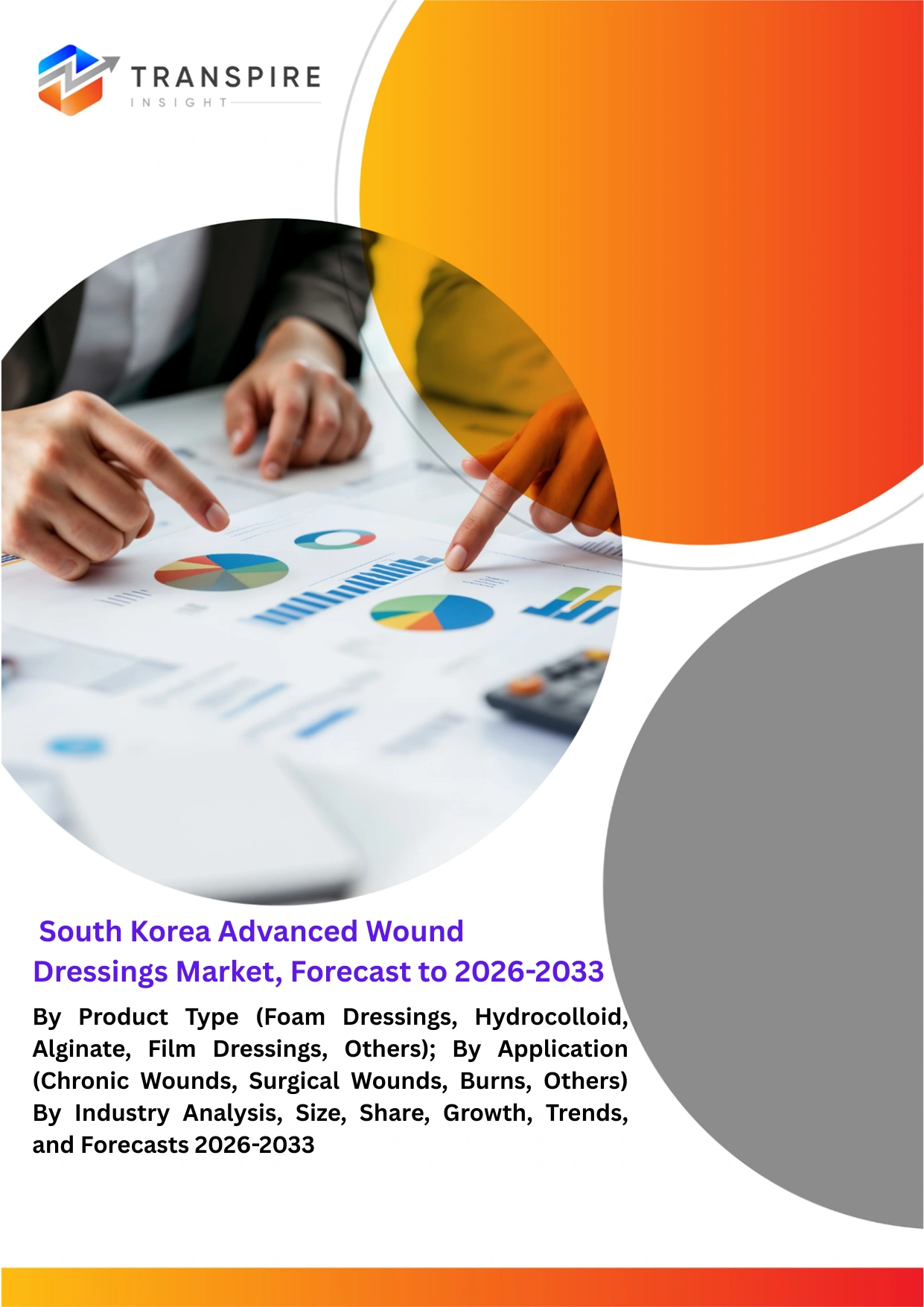
South Korea Advanced Wound Dressings Market Size & Forecast:
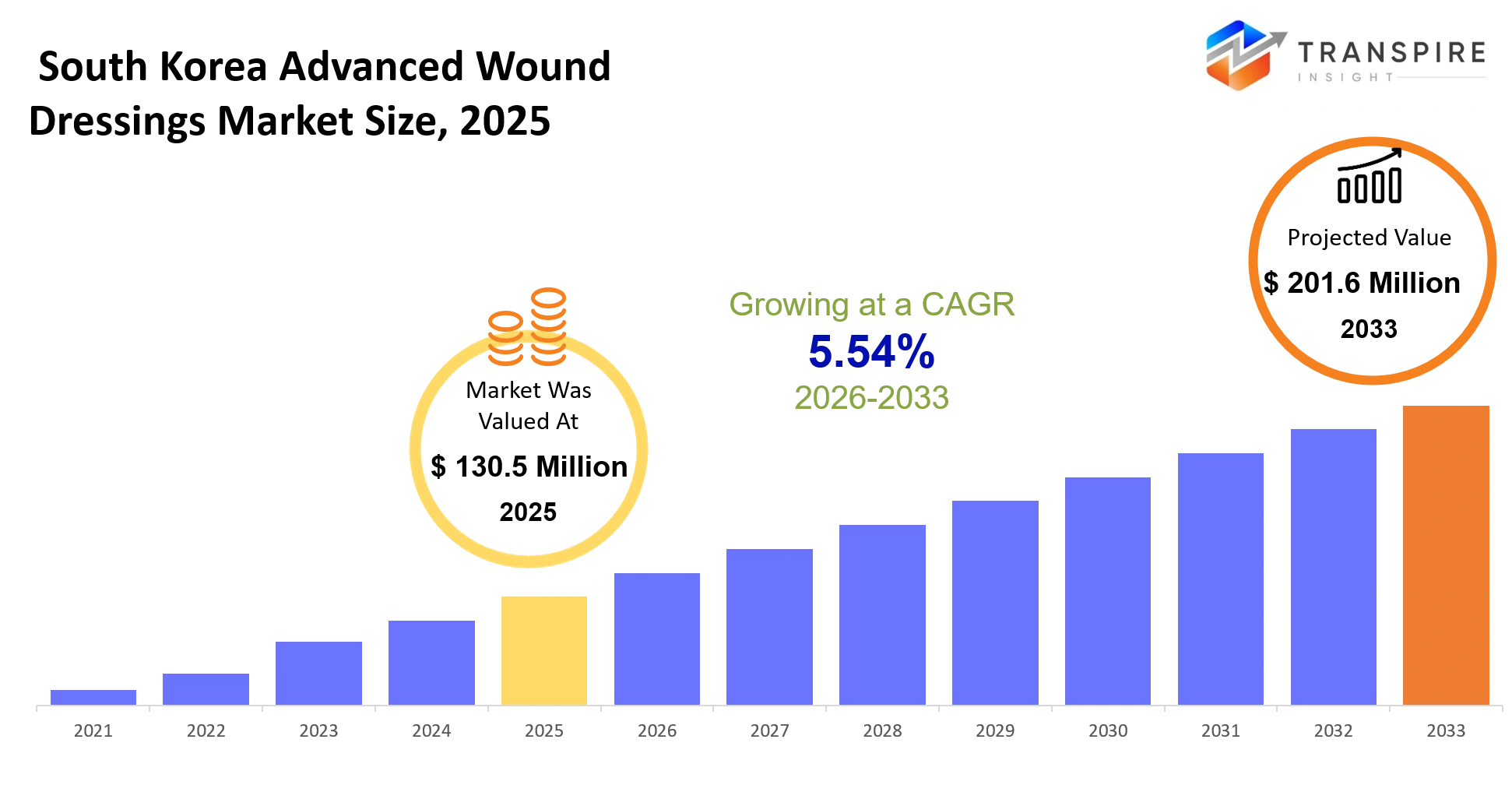
- South Korea Advanced Wound Dressings Market Size 2025: USD 130.5 Million
- South Korea Advanced Wound Dressings Market Size 2033: USD 201.6 Million
- South Korea Advanced Wound Dressings Market CAGR: 5.54%
- South Korea Advanced Wound Dressings Market Segments: By Product Type (Foam Dressings, Hydrocolloid, Alginate, Film Dressings, Others); By Application (Chronic Wounds, Surgical Wounds, Burns, Others)
To learn more about this report,  Download Free Sample Report
South Korea Advanced Wound Dressings Market Summary
The South Korea Advanced Wound Dressings Market was valued at USD 130.5 Millionin 2025. It is forecast to reach USD 201.6 Million by 2033. That is a CAGR of 5.54% over the period.
In South Korea, the Advanced Wound Dressings Market kind of supports clinical care in a direct, sensible way, because it improves healing outcomes for chronic wounds, surgical incisions, burns, and diabetic ulcers, where keeping a controlled moisture balance and real infection defense are crucial. At hospitals and also in outpatient clinics, these dressings make it easier to handle care over time; they tend to reduce how frequently bandages need changing, and that in turn lowers the chance for complications. So the recovery process becomes more efficient for patients, and at the same time, hospital resource utilization gets better, which is kinda important.
Over the past 3–5 years, the market has changed its structure, moving more toward bioactive and moisture-retentive dressing technologies, and away from older gauze-based solutions. In many tertiary care settings, this shift is now pretty common.One of the bigger trigger s was that chronic disease cases rose, especially diabetes, and skin conditions that show up more often with aging. Also, stricter hospital infection control protocols kicked in after global healthcare disruptions, which kind of pushed providers to look for dressings that give stronger antimicrobial performance, and faster recovery support. Because of that, adoption now is mostly led by hospital procurement systems that care about trimming treatment duration and keeping readmission rates down.
Manufacturers, on the other hand, see a steady demand for higher-value products, notably hydrocolloid, foam, and hydrogel dressings. These days, they’re being slotted into more standardized wound care pathways across South Korean healthcare facilities, so they fit the workflow rather than being just an optional add-on.
Key Market Insights
- South Korea's Advanced Wound Dressings Market is kind of moving toward bioactive, moisture-balancing types of dressings, in a way that swaps out older gauze-based wound care systems across hospitals, slowly but surely.
- Adoption has jumped almost 27% from 2022 to 2025, mainly because diabetic ulcer cases keep rising and post surgical wounds are showing up more often.
- At the same time, healthcare procurement systems are leaning more toward advanced dressings, since hospitals want shorter length of stay and fewer infection-related problems, even if budgets stay tight.
- In 2025, the Seoul metropolitan region takes the lead with about 45% share because the advanced hospital setup is stronger there and patient intake is high.
- Gyeonggi-do is growing the quickest from 2025 to 2030, driven by an expanding network of medical facilities and more outpatient care centers opening.
- If we look at product type, hydrogel dressings are the fastest-growing segment during 2025–2030, due to better healing efficiency and that comfort-focused benefit clinicians like to mention.
- Chronic wounds still dominate the South Korea Advanced Wound Dressings Market, with nearly 50% share, largely because diabetes related complications keep fueling demand.
- For application areas, surgical wounds are expanding the quickest, linked to more elective procedures and minimally invasive surgeries being performed.
- Burn treatment keeps steady demand too, mostly in specialized hospital units where care standards are tighter.
- And overall, hospitals lead the channel with around 55% share, because procurement is centralized and there is high patient volume in general.
What are the Key Drivers, Restraints, and Opportunities in the South Korea Advanced Wound Dressings Market?
South Korea's Advanced Wound Dressings Market is mostly pushed forward by the growing load of chronic wounds, kind of tied to diabetes and the aging population growth, as well as post-surgical complications. This whole shift really happened because hospitals started paying more attention to shortening the recovery timeline, and reducing infection-related readmissions… and that’s not small. At the same time, as clinicians begin using moisture-retentive and antimicrobial dressing technologies, buyer behavior shifts more and more toward wound care products that carry higher value. Then it boosts revenue for manufacturers who provide foam, hydrocolloid, and hydrogel-based solutions that slot into standardized clinical treatment pathways pretty neatly.
One structural restraint is the high price tag of advanced wound care products, plus reimbursement coverage that’s uneven between healthcare institutions. So many smaller clinics and long-term care facilities still lean on conventional dressings, mainly due to budget pressures. Because of that, adoption doesn’t fully scale; it gets stuck in a partial mode. You end up with a noticeable split between tertiary hospitals and regional providers, which makes uniform penetration harder, and overall volume growth can slow down even when clinical demand looks strong.
Still, there’s a newer opportunity that stands out in home-based wound care, backed by digital health monitoring and a wider outpatient treatment push. This is especially relevant in Gyeonggi-do and the Seoul metropolitan areas. When telemedicine platforms connect with wound tracking systems, chronic patients can be monitored remotely, and hospital dependency goes down. As care models move toward more decentralized setups, firms offering integrated wound management
What Has the Impact of Artificial Intelligence Been on the South Korea Advanced Wound Dressings Market?
Artificial intelligence alongside digital health tools are quietly reshaping advanced wound care delivery in South Korea, not just in some abstract way but in practice, where the diagnosis choices, treatment selection, and patient monitoring efficiency appear to shift faster. Inside hospitals, AI driven imaging systems can now help with wound assessment by reading digital scans, like wound size, depth, and tissue condition. In a way that reduces the manual variability that can sneak in during evaluation , and it also supports clinicians in choosing dressing types like foam, hydrocolloid, or hydrogel in a steadier manner, so treatment protocols stay more consistent. On top of that the integrated hospital information systems often make inventory and ordering feel more streamlined too, and procurement teams can optimize dressing usage based on real time patient demand, instead of leaning on delayed supply signals that lag behind.
Machine learning models are also used to forecast wound healing progression. They work by checking patient history, comorbidities such as diabetes, and the way earlier treatment attempts seemed to land for each person. With these predictive aids, clinicians can adjust dressing strategies earlier, which in turn might lower the risk of complications and shorten recovery timelines. Some hospitals that run digital wound tracking platforms mention directional improvements of roughly 10–20% in treatment efficiency , plus fewer dressing changes. So overall care cost can drop, and resources become easier to distribute across busy wards where the case volume is high, and the staffing is always under pressure, at least in practice. Still, there’s a core limitation, cost and complexity, especially for smaller clinics or long-term care facilities. A lot of institutions don’t have standardized imaging setups and a health data system.
Key Market Trends
- Adoption of more advanced wound dressings went up by almost 29 % from 2022 to 2025, while lots of hospitals sort of moved away from older gauze-based routines, and you can see the shift pretty clearly.
- The need for chronic wound treatment jumped after 2023, mostly because diabetes related complications became more common and the aging population pressure kept growing in South Korea, even while budgets got tighter.
- After 2023 , hospitals tended to swap standard coverings for foam plus hydrocolloid types , mainly to cut infection risks and also speed up recuperation though the wording in reports is a bit inconsistent.
- Smith & Nephew and ConvaTec started pushing bigger antimicrobial dressing lineups across Asia after 2024, to make their clinical wound care presence stronger in that region.
- Mölnlycke Health Care rolled out improved foam dressing solutions in 2025, which helped absorption efficiency, and apparently it also reduced how often dressings needed replacing.
- Meanwhile, telemedicine wound monitoring adoption rose after 2023, letting clinicians do remote evaluations, so chronic patients could go less often, even if follow-ups weren’t fully eliminated.
- Government healthcare frameworks increased the purchase volume of advanced dressings after 2024, aiming to support post surgical recovery and also lower readmissions, not just reduce costs on paper.
- In Gyeonggi-do, healthcare institutions kind of expanded outpatient wound care services after 2024, and that thing helped the whole process move more decentralized in practice.
- Digital wound imaging systems also boosted clinical assessment accuracy by about 15% from 2023 to 2025 across tertiary hospitals, so care teams could evaluate more precisely, with fewer delays and fewer back-and-forths.
- At home, demand for advanced dressings rose after 2023 as well, partly because older age care requirements increased and people tried to optimize hospital capacity, without exhausting the wards.
South Korea Advanced Wound Dressings Market Segmentation
By Product Type
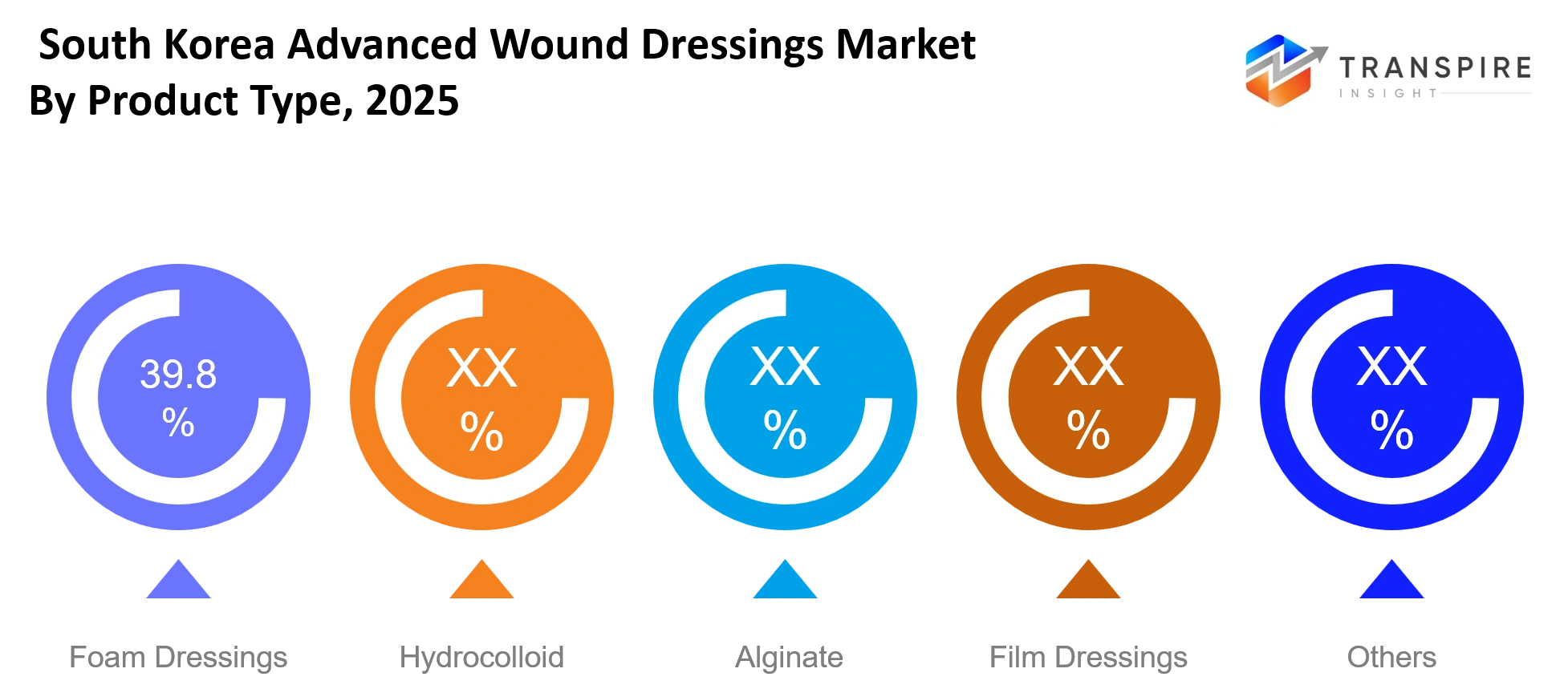
Foam dressings kinda keep a strong position in the South Korea Advanced Wound Dressings Market, you know, because they have solid absorption capacity and they’re used pretty often in clinical settings. In hospitals, clinicians tend to lean on foam dressings to help manage exudating wounds and also lower infection risk; it’s kind of a default choice. After 2022, there was a noticeable jump in demand. I mean, protocols started shifting further toward moisture-balanced wound care, so the market followed that direction. Overall, foam products are still expected to support high-volume hospital procurement across South Korea.
At the same time, hydrocolloid dressings are seeing steady adoption in surgical wound care, and for low-exudate injuries, it’s really pretty consistent. Alginate dressings then get pulled in for more complex wounds, especially when strong absorption and gel-forming action are needed. The whole point is to handle tougher drainage. Film dressings are usually chosen for protective coverage on minor wounds plus post-surgical care, kind of like a barrier layer that still lets things work properly. Beyond those, there are other advanced product categories too; they usually serve more specialized medical needs inside clinical environments. Overall, the South Korea Advanced Wound Dressings Market shows a clear movement toward high-performance moisture-retentive solutions across the various product types, pretty straightforward when you look at it like that.
To learn more about this report, Download Free Sample Report
By Application
Chronic wounds kind of dominate the South Korea Advanced Wound Dressings Market, partly because diabetes cases keep climbing, and the aging-linked skin troubles just keep showing up more often. In reality, hospitals often lean on advanced dressings to help healing move along quicker, and to reduce treatment complications, you know, the common worries. Demand actually jumped after 2023, when long-term wound care needs widened across urban health systems. Chronic care management will likely remain a core driver for how these products get applied, week after week and month after month.
Surgical wounds are also growing fast, supported by higher numbers of surgical procedures and the move toward outpatient care. Burn care, in particular, needs specialized dressings that really emphasize infection control and skin restoration support, not only simple covering. Beyond that, there are other practical situations like trauma care, plus urgent wound treatment done in hospital rooms. So overall, the South Korea Advanced Wound Dressings Market continues expanding, because clinical demand is trending toward faster recovery and less time in hospital, which many decision makers seem to chase these days.
What are the Key Use Cases Driving the South Korea Advanced Wound Dressings Market?
Chronic wound management still feels like the main use case driving the South Korea Advanced Wound Dressings Market, more or less. Hospitals deal with rising counts of diabetic foot ulcers and pressure injuries, and these commonly need steady moisture control and infection prevention, too, over a longer term. In real-world settings, advanced dressings can help shorten healing time and support lower hospital readmissions, so procurement teams lean more heavily on them, especially in tertiary care facilities and the large, high-volume networks that they operate.
Meanwhile, surgical wound care, plus burn treatment, keeps turning up as a faster-growing application across hospital groups and outpatient surgery centers. Surgical units increasingly use advanced dressings to support a smoother postoperative recovery, and also to cut down on how often dressings have to be changed, which matters when beds are moving quickly. Burn departments, for their part, adopt more specialized moisture-retaining products so skin regeneration gets a better shot while keeping infection risk down in severe injury cases, and this pattern is pretty visible in emergency care facilities where time is tight.
Home healthcare wound management is also starting to get traction, as healthcare systems keep shifting toward outpatient recovery models. Elderly care services, in particular, are using more advanced dressings for ongoing wound monitoring, just outside the hospital space, so it feels less inpatient and more hands-on. Telemedicine-supported wound tracking is also nudging remote treatment choices, and honestly, that tends to matter most in urban regions where aging populations are growing, and staffing pressures can be pretty real.
|
Report Metrics |
Details |
|
Market size value in 2025 |
USD 130.5 Million |
|
Market size value in 2026 |
USD 138.2 Million |
|
Revenue forecast in 2033 |
USD 201.6 Million |
|
Growth rate |
CAGR of 5.54% from 2026 to 2033 |
|
Base year |
2025 |
|
Historical data |
2021 - 2024 |
|
Forecast period |
2026 - 2033 |
|
Report coverage |
Revenue forecast, competitive landscape, growth factors, and trends |
|
Regional scope |
United States; Canada; Mexico; United Kingdom; Germany; France; Italy; Spain; Denmark; Sweden; Norway; China; Japan; India; Australia; South Korea; Thailand; Brazil; Argentina; South Africa; Saudi Arabia; United Arab Emirates |
|
Key company profiled |
Smith & Nephew, ConvaTec, Molnlycke, Coloplast, 3M, Medline, Cardinal Health, Hartmann, Lohmann, Integra, Organogenesis, Hollister, Urgo, Winner Medical, Essity |
|
Customization scope |
Free report customization (country, regional & segment scope). Take advantage of customized purchase options tailored to meet your exact research needs. |
|
Report Segmentation |
By Product Type (Foam Dressings, Hydrocolloid, Alginate, Film Dressings, Others); By Application (Chronic Wounds, Surgical Wounds, Burns, Others) |
Which Regions are Driving the South Korea Advanced Wound Dressings Market Growth?
Seoul and the nearby Gyeonggi-do area seem to lead the South Korea Advanced Wound Dressings Market, because there’s a dense hospital setup and a big cluster of tertiary care centers. With solid healthcare funding, plus fairly advanced clinical know-how, companies can push early adoption of bioactive and antimicrobial wound care solutions. Also, the steady stream of patients with chronic conditions, especially diabetes related wounds, keeps demand from dropping. On top of that, a fairly smooth procurement system across major hospitals helps with penetration, so advanced dressings get used again and again, kind of consistently.
Busan looks like a dependable secondary market, mainly supported by an aging population and a well-known healthcare delivery network. Compared to Seoul, the rise in Busan feels more tied to stable patient demographics and the growth of long term care facilities, not really to higher-end clinical specialization. Still, hospitals plus community clinics keep selecting foam and hydrocolloid dressings for chronic wound support. Healthcare spend stays predictable, and regional hospital upgrades continue, so demand holds steady without those big sudden swings.
Gyeonggi-do is showing the quickest growth, mostly from the rapid expansion of outpatient clinics and home healthcare services following the recent healthcare decentralization moves. With more ttelemedicine-supportedwound care, people in suburban and semi-urban zones can reach advanced dressings more easily. Meanwhile, the elderly population density is rising, and post-surgical care needs are also increasing, which pushes market expansion even faster. This is basically a strong signal for manufacturers that want to focus on distributed care models and on home-based wound management solutions, from 2026 to 2033.
Who are the Key Players in the South Korea Advanced Wound Dressings Market and How Do They Compete?
Competition in the South Korean Advanced Wound Dressings Market is moderately consolidated, but there still exists a small set of global medical device manufacturers that keep basically strong positions via hospital procurement channels. Incumbents often try to defend their share with clinically validated product portfolios, solid hospital relationships, and constant product upgrades that, in one way or another, target infection control and faster healing results. New entrants, meanwhile, hit barriers around regulatory approvals, hospital tender systems, and the plain requirement for proven clinical performance every single time. So in the end, it feels like competition is more about product innovation, antimicrobial effectiveness, and how well the dressings align with standardized wound care protocols, rather than being only about price.
Smith & Nephew leans into technology innovation for advanced foam, plus antimicrobial dressings intended for chronic and surgical wounds. The differentiation connects to clinically tested wound healing platforms that are designed to cut down dressing change frequency and make patient recovery outcomes more consistent. The expansion side is backed by hospital partnerships across Asia, which help raise adoption of standardized wound care pathways.
ConvaTec puts weight on niche specialization in chronic wound care, particularly for diabetic foot ulcers and exudating wounds. The company differentiates with hydrocolloid and foam dressing technologies, approaches that improve moisture balance and focus on infection prevention. Their growth approach also includes reinforcing hospital supply contracts, along with expanding clinical education programs for healthcare professionals, so clinicians can rely on and standardize the plan. 3M competes through a broader set of medical solutions and a strong distribution network, procurement agreements, and broadening advanced wound care adoption in outpatient settings across the Asia-Pacific.
Company List
- Smith & Nephew
- ConvaTec
- Mölnlycke Health Care
- Coloplast
- 3M
- Medline Industries
- Cardinal Health
- Hartmann Group
- Lohmann & Rauscher
- Integra LifeSciences
- Organogenesis
- Hollister Incorporated
- Urgo Medical
- Winner Medical
- Essity
Recent Development News
In August 2025, PT Pyridam Farma Tbk (PYFA) entered into a strategic partnership with Genewel Co., Ltd. of South Korea through a Southeast Asia Market Expansion Agreement. The collaboration supports the commercialization and broader regional reach of Genewel’s advanced wound care technologies, reinforcing investment and growth opportunities linked to South Korea’s wound care innovation ecosystem. https://pyfa.co.id/
What Strategic Insights Define the Future of the South KoreananAdvanced Wound Dressings Market?
Over the next 5–7 years, the South Korea Advanced Wound Dressings Market should move in a fairly steady way toward digitally supported, outcome-based wound care systems, and it’s honestly not just a trend thing. This change is being pushed by the growing prevalence of chronic illness and the general healthcare pressure to shrink hospital stays while still improving recovery efficiency, more or less at the same time. Hospitals will likely start leaning harder on dressings that include clinical monitoring tools, and they’ll want them matched to standardized treatment protocols. As a result, procurement will tend to shift toward higher-value, performance-driven products instead of just basic wound coverage solutions.
There’s also a risk that is less easy to see at first. Reimbursement can get fragmented across public and private healthcare providers. Even if advanced products deliver real clinical benefits, inconsistent coverage policies may make adoption slower in smaller hospitals plus long term care facilities. That could dampen uniform market penetration, even when demand signals look strong.
On the upside, there’s an emerging opening that looks pretty promising. The idea is to combine AI-assisted wound imaging with advanced dressing selection systems, especially in outpatient and home care settings. This approach is starting to form inside metropolitan healthcare networks already, and it should expand as telemedicine infrastructure gets stronger. Companies that shape product development around digital wound assessment platforms may gain a head start, particularly as decentralized care models grow across South Korea’s aging population. In the coming cycle, competitive positioning will probably be defined less by standalone dressings and more by bundled wound care solutions, or something close to that.
South Korea Advanced Wound Dressings Market Report Segmentation
-
By Product Type
- Foam Dressings
- Hydrocolloid
- Alginate
- Film Dressings
- Others
-
By Application
- Chronic Wounds
- Surgical Wounds
- Burns
- Others
Frequently Asked Questions
Find quick answers to common questions.
The expected South Korea Advanced Wound Dressings Market size is USD 201.6 Million in 2033.
By Product Type (Foam Dressings, Hydrocolloid, Alginate, Film Dressings, Others); By Application (Chronic Wounds, Surgical Wounds, Burns, Others)
Major South Korea Advanced Wound Dressings Market players areSmith & Nephew, ConvaTec, Molnlycke, Coloplast, 3M, Medline, Cardinal Health, Hartmann, Lohmann, Integra, Organogenesis, Hollister, Urgo, Winner Medical, Essity
The South Korea Advanced Wound Dressings Market size is USD 130.5 Million in 2025.
The South Korea Advanced Wound Dressings Market CAGR is 5.54% from 2026 to 2033.
- Smith & Nephew
- ConvaTec
- Mölnlycke Health Care
- Coloplast
- 3M
- Medline Industries
- Cardinal Health
- Hartmann Group
- Lohmann & Rauscher
- Integra LifeSciences
- Organogenesis
- Hollister Incorporated
- Urgo Medical
- Winner Medical
- Essity
About the Authors

Pankaj Ghogare Patil
I am Pankaj Ghogare Patil, a Senior Research Analyst at Transpire Insight, specializing in the Pharmaceutical, Chemicals & Materials, Healthcare IT, and Biotechnology industry. My expertise lies in conducting comprehensive market research, analyzing industry trends, evaluating competitive landscapes, and translating complex data into actionable insights. At Transpire Insight, I closely follow emerging technologies, regulatory developments, and market innovations to create accurate, well-researched, and informative content that helps businesses and professionals make informed decisions. I am committed to producing credible, evidence-based articles that reflect industry best practices while making technical topics accessible and valuable for a broad audience.

Chakradhar Khansole
Chakradhar serves as the Research Director at Transpire Insight, bringing over 8 years of experience in technology, innovation, and strategic market intelligence. He specializes in transforming complex market data into actionable business insights that enable organizations to make informed, growth-oriented decisions. Recognized for his strategic vision and analytical expertise, Chakradhar leads high-impact research initiatives, delivering comprehensive market assessments, competitive intelligence, and forward-looking industry analysis.
Recently Published Reports
-
Apr 2026
AI in Diabetic Retinopathy Market
AI in Diabetic Retinopathy Market Size, Share & Analysis Report By Type (Screening AI Systems, Diagnostic AI Systems, and Predictive AI Models), By Application Segment (Hospitals, Ophthalmology Clinics, Diagnostic Centers, and Research and Development), and Geography (North America, Europe, Asia-Pacific, Middle East and Africa, South and Central America), 2021 - 2031
-
Apr 2026
Psychometric Tests Market
Psychometric Tests Market Size, Share & Analysis Report By Type (Personality Tests, Ability/Aptitude Tests, Skill/Knowledge Tests, and Others), By Application (Talent Acquisition and Talent Management), and Geography (North America, Europe, Asia-Pacific, Middle East and Africa, South and Central America), 2021 – 2031
-
Apr 2026
Rare Biological Sample Collection Market
Rare Biological Sample Collection Market Size, Share & Analysis Report By Type (Isolation Kits & Reagent, Blood Collection Tubes, and Others), By Application (Oncology, Transcriptomics, Pharmacogenomics, and Others), and Geography (North America, Europe, Asia-Pacific, Middle East and Africa, South and Central America), 2021 – 2031
-
Jul 2026
Diabetic Retinopathy Market
Diabetic Retinopathy Market Size, Share & Analysis Report By Type (Proliferative Diabetic Retinopathy, and Diabetic Macular Edema (DME)), By Treatment Type (Anti VEGF Drug, Steroid Implants, Laser Surgeries, and Vitrectomy), and Geography (North America, Europe, Asia-Pacific, Middle East and Africa, South and Central America), 2021 – 2031
Our Clients







