
Smart Home As A Service Market Summary:
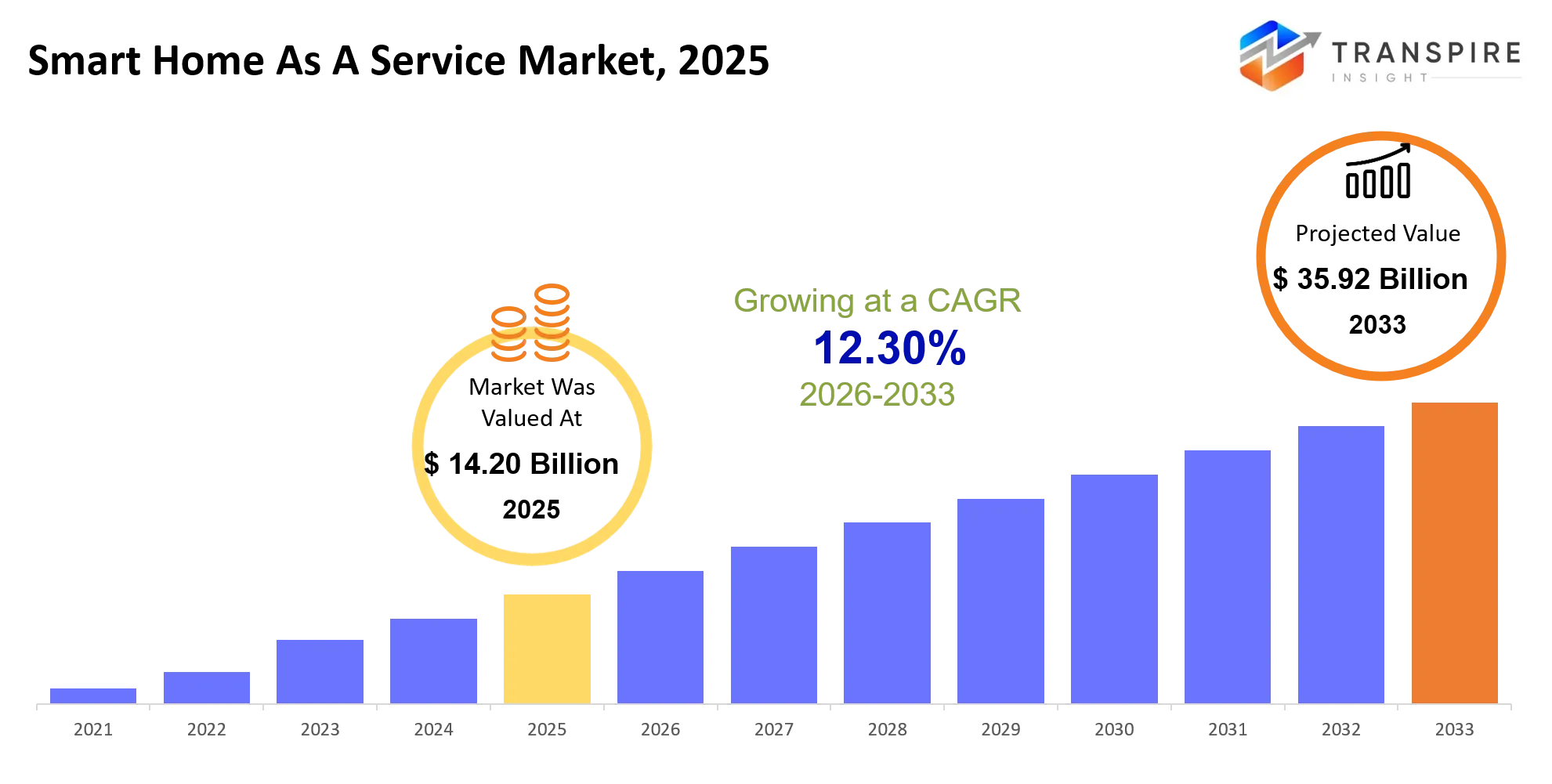
As per the Transpire Insight Analysis, The Smart Home As A Service Market size is estimated at USD 14.20 billion in 2025 and is anticipated to reach USD 35.92 billion by 2033, growing at a CAGR of 12.30% from 2026 to 2033.
The model of buying individual devices for individual rooms is giving way to professionally delivered, subscription-based smart homes. Service providers are bundling together security, automation, connectivity, maintenance, and remote monitoring as part of recurring service packages, reducing the need for homeowners to purchase a multitude of devices from separate vendors with multiple platforms. The market has grown in the last three to five years from single apps controlling lighting and cameras into more integrated platforms that connect security, energy management, and household devices. A clear structural change can be observed with the roll-out of interconnected devices such as Matter, which enables interoperability between competing vendors and reduces the fragmentation of smart home ecosystems. The key driver for the shift is security concerns, rising energy costs, and an ageing population that needs remote monitoring, thus providing opportunities for providers to bundle monitoring and predictive maintenance, in addition to automation, into monthly subscriptions.
Smart Home As A Service Market Size & Forecast:
- Market Size 2025: USD 14.20 Billion
- Expected Market Value (2033): USD 35.92 Billion
- Forecast CAGR (2026–2033): 12.30%
- Leading Region in 2025: Asia Pacific
- Fastest Growing Region: North America
- Key Company Profiles: ADT, Comcast, Amazon, Google, Apple, Samsung, Vivint, Alarm.com, Resideo, Johnson Controls, Schneider Electric, ABB, Lutron Electronics, Verizon, AT&T.
Key Smart Home As A Service Market Insights:
The market is moving from owning devices to having managed and interoperable home services, which include selling installation, monitoring, energy efficiency, and service provisioning. The progress of interoperability is breaking the bind and shifting the focus to the quality of services, intelligence, and trust that providers can offer, instead of their separate ecosystems.
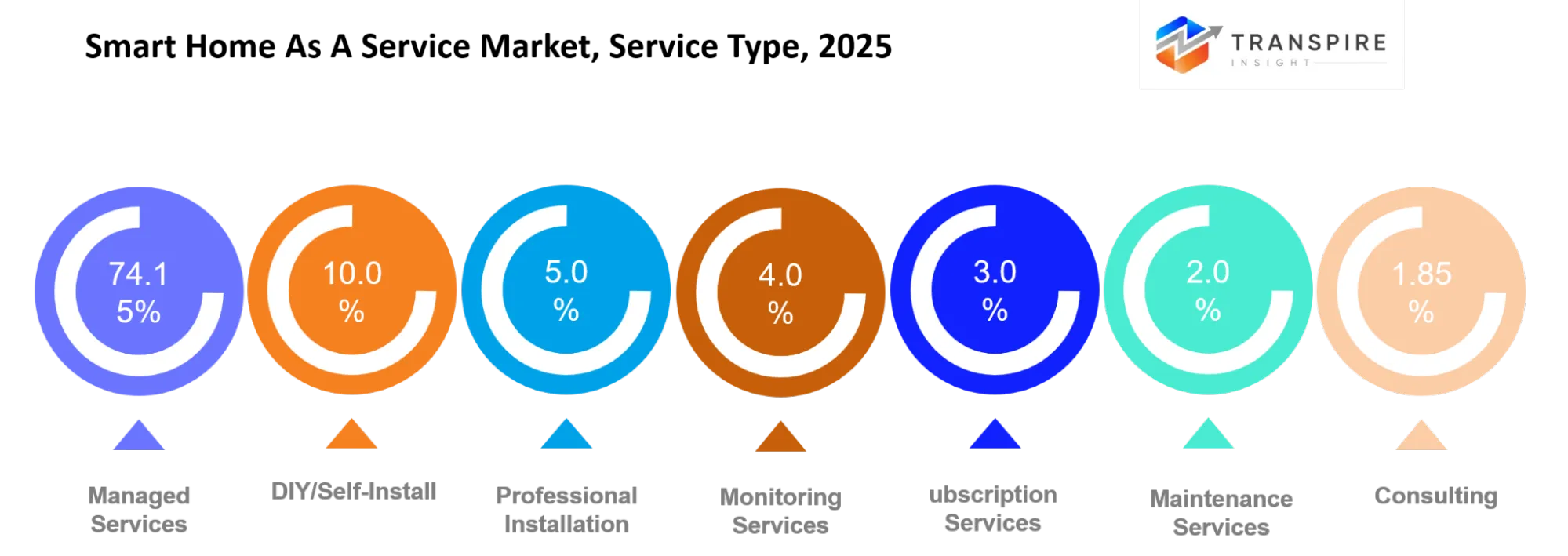
- Managed services make up 74.15% of the service-type market, as providers are preferred by households for their installation, monitoring, and support.
- The 19.6% of DIY/self-install users is another significant category that prioritises flexibility but lacks more streamlined onboarding and self-diagnosis options.
- Professional installation provides support to 10.0%, where the providers provide a mix of hardware, configuration, integration, and technician support.
- Subscription services account for 3.0% of monitoring services, and the recurring services are proportionally small.
- Maintenance services are 2.0% of the total, while consulting is 1.85% of the total, representing an emerging opportunity for predictive diagnostics and advisory-based deployments.
- Amazon has expanded Matter support and made more than 100 million of its Echo and Eero devices become Matter hubs, thereby bolstering its platform-centric distribution approach.
- Samsung upgraded the SmartThings app to Matter 1.6 and introduced the local device control feature, setting a foundation for low-latency automation and appliance integration.
- Apple is continuing to diversify its ecosystem with a new home hub, a new Apple HomePod mini, Apple TV, and a rumoured partnership with LG on home cameras, locks, thermostats, and doorbells.
- Matter 1.6 added features like Joint Fabric, NFC pairing, and context-aware thermostat controls, shifting the industry from device interoperability to ecosystem-level interoperability.
What are the Key Drivers, Restraints, and Opportunities in the Smart Home As A Service Market?
Driver:
Managed-service demand and lower adoption friction. Households increasingly prefer provider-managed installation, monitoring, troubleshooting, and upgrades because multi-device homes have become operationally complex. The trigger is the proliferation of connected cameras, locks, thermostats, sensors, and appliances that require reliable integration. This supports recurring revenue through subscriptions, professional installation, monitoring, and maintenance rather than one-time hardware sales; managed services represent 74.15% of the service-type mix, while DIY/self-install accounts for 19.6% and professional installation 10.0%.
Restraint:
High installation costs, recurring subscription charges, and fragmented device compatibility continue to restrict adoption. Older properties often require infrastructure upgrades, while inconsistent connectivity and dependence on cloud platforms complicate service delivery. Privacy concerns surrounding cameras, occupancy monitoring and household data also discourage some customers. These issues persist because providers must maintain compatibility, cybersecurity and technical support across different device generations.
Opportunity:
Energy optimisation, AI-enabled monitoring and senior-care applications offer opportunities to expand beyond conventional security subscriptions. Utilities and energy service companies can integrate smart thermostats, connected meters, solar systems and battery management into managed residential packages. Matter-enabled interoperability can support these deployments, particularly in digitally developing Asian markets. Providers that combine measurable energy savings, remote assistance, and reliable maintenance can improve subscription conversion and customer lifetime value.
Smart Home as a Service Market – Driver Impact Analysis
|
Driver |
Relative Impact on Growth (%) |
Geographic Relevance |
Impact Timeline |
Demand Strength |
Growth Mechanism |
Key Beneficiaries |
Major Constraint |
|
Rising Demand for Subscription-Based Home Security and Remote Monitoring |
26% |
North America, Europe, Asia-Pacific |
Short-term (≤2 years) |
High |
Recurring monitoring subscriptions strengthen household security adoption |
Security providers, device manufacturers, monitoring service operators |
Privacy concerns and recurring subscription expenses |
|
Increasing Adoption of Smart Energy Management and Utility Optimization Services |
23% |
North America, Europe, Asia-Pacific |
Medium-term (2–4 years) |
High |
Smart thermostats optimize consumption and reduce electricity expenses |
Utilities, energy management providers, smart device manufacturers |
High installation costs and limited utility integration |
|
Expansion of Telecom and Broadband-Based Smart Home Subscription Bundles |
20% |
North America, Europe, Asia-Pacific |
Short-term (≤2 years) |
High |
Bundled connectivity packages accelerate subscription-based household adoption |
Telecom operators, broadband providers, smart home platforms |
Network dependency and competitive pricing pressures |
|
Advancements in AI, IoT, Cloud Computing and Interoperable Smart Home Ecosystems |
17% |
North America, Asia-Pacific, Europe |
Long-term (≥4 years) |
High |
AI-driven automation improves interoperability and personalized experiences |
Technology vendors, platform developers, device manufacturers |
Cybersecurity vulnerabilities and ecosystem fragmentation |
|
Growing Smart Residential Infrastructure and Multi-Dwelling Property Integration |
14% |
North America, Asia-Pacific, Europe, Middle East |
Medium-term (2–4 years) |
Medium |
Integrated property services increase multi-household subscription penetration |
Property developers, facility managers, service providers |
Retrofitting complexity and property investment requirements |
|
Total |
100% |
— |
— |
— |
— |
— |
What has the Impact of Artificial Intelligence been on the smart home as a service market?
AI is also evolving into a smart-home service platform, turning the smart home from a remote-control concept into a household-optimisation service. Business models include edge and cloud models that use sensor and environmental data-motion, video, appliance loads, occupancy-to automate various tasks, such as turning lights, heating, locks, and security modes on and off, depending on whether people are home or not and what time of day it is.
AI's predictive and early-warning capabilities are especially appealing in smart-home energy management and maintenance. An AI engine can predict consumption patterns and provide early warnings for appliances that are not working normally, batteries that are ageing, leaks, or security breaches before they turn into expensive malfunctions. In addition, local edge processing can review cameras' footage for people, pets, and cars, reducing bandwidth and preventing unnecessary data from being sent to the cloud. From a service provider perspective, AI can be used for remote diagnostics, ticket triage, and proactive device health notifications and technician dispatch. This reduces the need for repeat visits and improves first-time fix rates, as well as lowering support costs and increasing the value of home subscriptions-consumers have no problem receiving proactive rather than reactive service.
In November 2026, Resideo Technologies launched Pro-IQ™ Predict, an AI-powered predictive maintenance service integrated into its latest Honeywell Home smart thermostats that analyses connected-device insights to detect over 80 developing HVAC issues early and automatically notify partnering contractors. https://www.prnewswire.com/news-releases/resideo-launches-pro-iq-predict-bringing-ai-powered-predictive-intelligence-to-hvac-302934278.html
Key Smart Home As A Service Market Trends:
The market is moving from smart devices to provider-managed, interoperable residential ecosystems where the value is in automation, energy savings, security, and continued support.
- Individual devices are being replaced by provisioned, managed bundles of hardware, installation, monitoring, and support.
- Matter is driving away vendor lock-in, allowing for multi-brand automation and making managed services more deliverable in diverse homes.
- As households are increasingly installing solar panels, batteries, EV chargers, heat pumps, and smart meters, energy management is becoming a key factor in their purchase decisions.
- Edge AI is moving sensitive video and occupancy processing on-premises, which boosts response time and privacy perception.
- Smart-home packages are helping telecom and cable companies strengthen broadband ties and cut churn.
- Insurers are tying connected monitoring to risk reduction, claims prevention and differentiated household policies.
- New housing, rental portfolios and senior living communities are incorporating smart infrastructure.
- As regulators increase their demands for updates, handling vulnerabilities, and secure connected products, Cybersecurity is becoming a purchase criterion.
- Non-technical users are also gaining access to automation, thanks to voice and ambient interfaces, and thus extending the use of automation beyond the early adopters.
Smart Home As A Service Market Segmentation
Service Type:
Market share for technologies as Households and property operators favour installation, remote monitoring, updating, and troubleshooting as part of a managed relationship for 74.15% of the total. DIY/self-install accounts for 19.6% of the market, drawing consumers who want to keep costs down, but who also want greater scheduling flexibility. Professional installation accounts for 10.0%, while monitoring makes up 4.0%, subscription 3.0%, maintenance 2.0%, and consulting 1.85%. Managed services will maintain their major share of the market, while self-install will depend on ease of installation; maintenance and monitoring will see the biggest growth as installed bases age.
Solution:
Security and surveillance remain the anchor use case, supported by connected cameras, access control, alarms, and professional monitoring. Energy and utility management is emerging as a strategic growth area as Matter 1.4 expands support for solar systems, batteries, heat pumps and water heaters. Home automation, connected lighting, entertainment and smart appliances broaden service adoption, while elderly care creates additional opportunities through remote supervision, automated alerts and fall-detection technologies.
Component:
Hardware provides the initial deployment foundation, but software platforms, connectivity, sensors, gateways, services and analytics determine long-term commercial value. Cloud-based architectures enable remote monitoring, software updates, and predictive maintenance across distributed device networks. As providers manage increasingly diverse device portfolios, gateways and analytics become important for maintaining interoperability, identifying equipment issues and generating recurring revenue through managed services rather than standalone hardware sales.
End User:
Single-family residential properties represent the established customer base, while multi-family developments, rental properties, new housing, luxury homes and senior living create additional deployment opportunities. New housing projects enable pre-installed connectivity and standardised automation platforms, reducing installation complexity. Existing homes require wireless retrofit solutions to avoid expensive infrastructure modifications. Senior living presents a distinct opportunity through safety monitoring, remote assistance, activity detection and connected care services.
Sales Channel:
Telco and cable MSOs, utilities and ESCOs, home-security providers, OEMs, retailers, property developers and online platforms provide different routes to market. Utilities can integrate smart thermostats, connected meters and energy-management subscriptions into existing customer relationships. Telecom operators can bundle broadband, security and technical support, while security providers leverage established monitoring networks. Property developers offer another opportunity by incorporating connected-home infrastructure into residential projects before occupancy.
Connectivity:
Wi-Fi remains important for high-bandwidth applications such as cameras and video monitoring, while Zigbee and Z-Wave support low-power device communication. Bluetooth simplifies device pairing, whereas Thread provides low-power mesh connectivity. Matter improves interoperability across compatible manufacturers, reducing ecosystem fragmentation and integration costs. Cellular connectivity offers an alternative communication pathway and backup for critical monitoring services, particularly where broadband reliability is inconsistent.
What are the Key Use Cases Driving the Smart Home As A Service Market?
Managed security is the core use case, aligning with the dominance of Managed Services. Providers combine intrusion detection, video monitoring, smart locks, and remote response into monthly packages, giving households protection without managing systems. ADT’s 2026 acquisition of Origin AI highlights the move toward camera-free presence detection and contextual alarm verification.
Energy and convenience applications are expanding through thermostats, lighting, appliances and utility-management platforms. These services automate consumption and allow providers or utilities to offer optimisation alongside broadband and security.
Emerging applications include ageing-in-place monitoring, predictive appliance maintenance and multi-dwelling property management. Senior living operators and landlords can use occupancy insights, alerts and controls to improve resident safety and oversight.
|
Report Metrics |
Details |
|
Market size value in 2025 |
USD 14.20 Billion |
|
Market size value in 2026 |
USD 15.95 Billion |
|
Revenue forecast in 2033 |
USD 35.92 Billion |
|
Growth rate |
CAGR of 12.30% from 2026 to 2033 |
|
Base year |
2025 |
|
Historical data |
2021 - 2024 |
|
Forecast period |
2026 - 2033 |
|
Report coverage |
Revenue forecast, competitive landscape, growth factors, and trends |
|
Regional scope |
United States; Canada; Mexico; United Kingdom; Germany; France; Italy; Spain; Denmark; Sweden; Norway; China; Japan; India; Australia; South Korea; Thailand; Brazil; Argentina; South Africa; Saudi Arabia; United Arab Emirates |
|
Key companies profiled |
ADT, Comcast, Amazon, Google, Apple, Samsung, Vivint, Alarm.com, Resideo, Johnson Controls, Schneider Electric, ABB, Lutron Electronics, Verizon, AT&T. |
|
Customization scope |
Free report customization (country, regional & segment scope). Available customized purchase options to meet your exact research needs. |
|
Report Segmentation |
Service Type (Managed Services, DIY/Self-Install, Professional Installation, Monitoring Services, Subscription Services, Maintenance Services, Consulting); Solution (Security & Surveillance, Energy & Utility Management, Home Automation, Entertainment, Smart Appliances, Elderly Care, Connected Lighting); Component (Hardware, Software/Platforms, Connectivity, Sensors, Gateways, Services, Analytics); End User (Single-Family Residential, Multi-Family/MDU, Senior Living, Luxury Homes, Rental Properties, New Housing, Existing Homes); Sales Channel (Telco/Cable MSO, Utilities & ESCOs, Home Security Providers, OEMs, Retailers, Property Developers, Online Platforms); Connectivity (Wi-Fi, Zigbee, Z-Wave, Bluetooth, Thread, Matter, Cellular) |
Which Regions are Driving the Smart Home As A Service Market Growth?
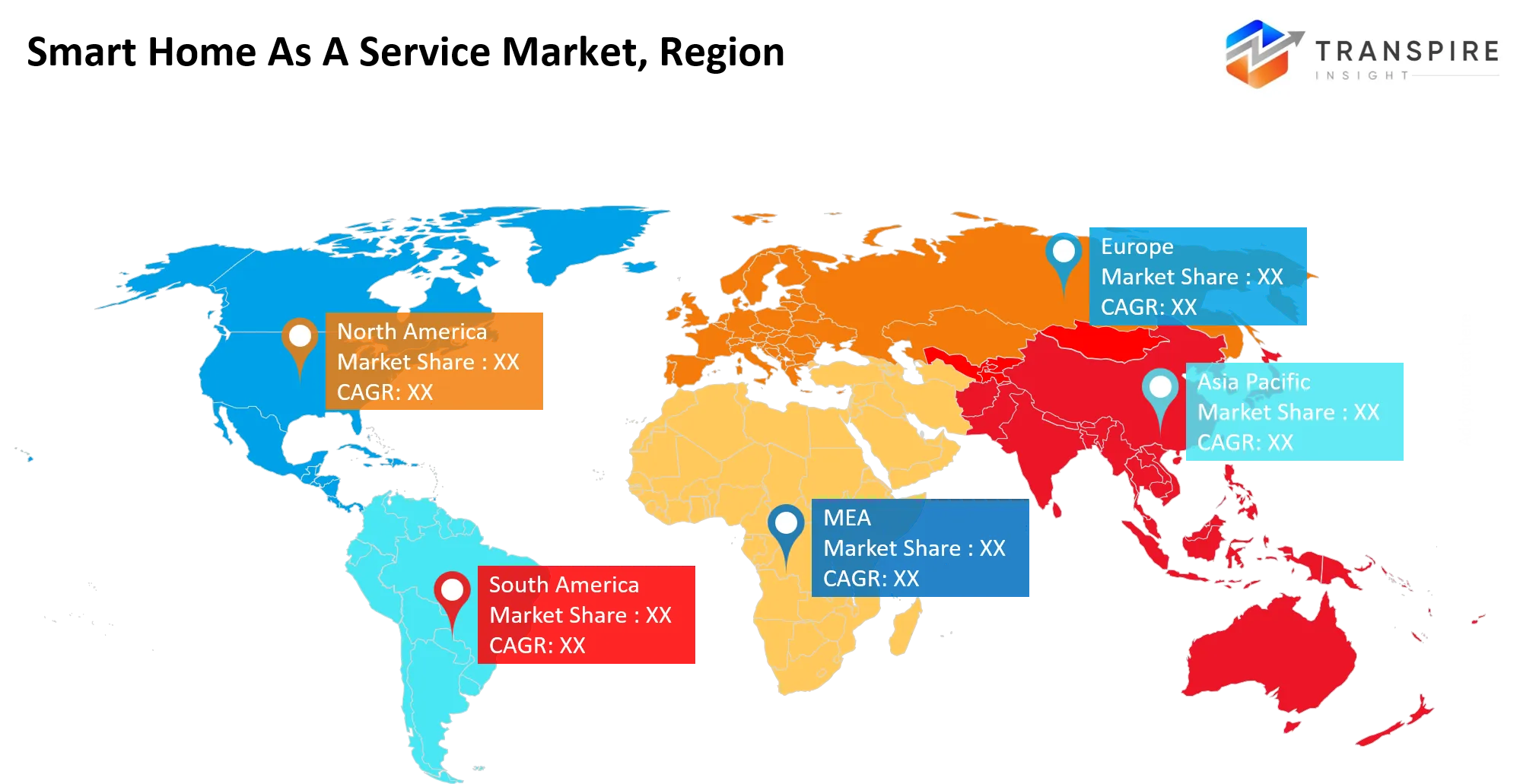
North America maintains the largest share of the in-home monitoring service market at 42.20%, driven by dense broadband adoption, mature security and telecommunications channels, and high consumer readiness to purchase managed service bundles. Providers including ADT, Comcast, Vivint, Verizon, and AT&T can embed connectivity, monitoring, installation, and support into ongoing customer relationships. Likewise, policy emphasis on connected-product cybersecurity and the insurance industry's focus on prevention-based home services also reinforce the service-oriented model.
In November 2026, AT&T integrated Google's Gemini for Home capabilities into its AT&T Connected Life smart home security service. This product update adds AI-powered video event descriptions, natural-language footage search, daily activity summaries, and automatic proximity-based arming to its $29.99 monthly professional monitoring tier.https://about.att.com/blogs/2026/connected-life-home-security.html
Europe makes up 25.0% of the market and demonstrates a more stability-focused market profile than North America. Europe's market growth is driven by energy-efficiency legislation, building refurbishments, data-security policies, and demand for vendor-lock-in-reduction architecture that offers out-of-the-box interoperability. Matter's energy-monitoring features align well with European drivers for decarbonisation and electrification, and local processing and transparent data controls are driven by European privacy legislation.
In March 2026, ABB Group launched the System Access Point 3.0 Wireless at Light + Building 2026 to expand its ABB-free@home ecosystem with native Matter and Thread compatibility. This launch strengthens cross-brand interoperability for residential energy management and lets European households integrate connected devices locally without relying on a single vendor.https://new.abb.com/news/detail/133736/abb-launches-new-wireless-smart-home-control
Asia Pacific, which has a 22.0% market share and has grown at a 17.7% CAGR, is the fastest-growing region. The rapid growth in urban dwellings, the rise of mobile-first digital environments, and greater attention to security have been the key drivers of adoption. Growth opportunities in the future are likely to include high-rise residential developments, where developers could deploy common smart infrastructure in advance and monetise it through property management.
In September 2026, Asia-Pacific smart-building startup CircoLife raised $4.5 million in seed funding led by Bharat Jaisinghani to expand its subscription-based, IoT-connected air-conditioning systems featuring AI-driven monitoring, energy analytics, and predictive maintenance.https://newmarketpitch.com/blogs/news/proptech-list-deals
Who are the Key Players in the smart home as a service market, and how do they compete?
The competition is around platform access, subscriptions, and the delivery network of connected home services, not just hardware pricing. ADT and Vivint exemplify this as premier suppliers of professionally monitored security services; Comcast and Verizon rely on broadband services. Amazon, Google, and Apple compete through voice assistant capability, ecosystem deployment, and the ability to easily control devices; Samsung adds to this mix by offering an interoperable SmartThings platform.
Samsung, ABB, Johnson Controls, Schneider Electric, and Lutron Electronics, mainly for those who prefer total whole-home solutions. Resideo is focused on connected comfort and climate control, while Alarm.com is a software-as-a-service solution through third-party professional service providers, opening up the potential for recurring revenues. AT&T has the opportunity to compete with a connectivity-based distribution approach, while affordable offerings from Comcast can reach the masses. Their expansion strategies include: ecosystem and device collaborations; platform improvements; and channel partnerships. AT&T and Comcast are also moving away from device competition towards an emphasis on the connectivity, installation, security, and subscription price benefits that they deliver to the market.
Key Players are:
- ADT
- Comcast
- Amazon
- Apple
- Samsung
- Vivint
- Alarm.com
- Resideo
- Johnson Controls
- Schneider Electric
- ABB
- Lutron Electronics
- Verizon
- AT&T
Smart Home As A Service Market — Enhanced Competitive Benchmarking
|
Company |
Est. Revenue Share Range |
Key Offerings |
Strategic Positioning |
Geographic Strength |
Technology Focus |
|
ADT Inc. |
8–12% (Estimated) |
ADT+; professional security monitoring; smart cameras; smart locks and thermostats |
Established security leader with integrated subscription services |
North America |
AI security analytics, cloud monitoring, connected-device automation |
|
Vivint Smart Home (NRG Energy) |
6–9% (Estimated) |
Vivint Smart Home platform; Smart Hub; video doorbells; smart locks and thermostats |
Premium integrated security, automation, and energy services |
North America |
AI-enabled automation, machine learning, cloud-connected home management |
|
Verisure |
4–7% (Estimated) |
Professionally monitored alarms; smart cameras; video verification; connected security services |
Premium professional monitoring with strong recurring subscriptions |
Europe, Latin America |
Video verification, intelligent sensors, connected alarm monitoring |
|
Comcast Corporation (Xfinity Home) |
3–5% (Estimated) |
Xfinity Smart Home; security cameras; video monitoring; smart locks and lighting |
Telecom-bundled home services leveraging broadband relationships |
North America |
Broadband-connected IoT, cloud video, app-based home automation |
|
Alarm.com Holdings, Inc. |
3–5% (Estimated) |
Alarm.com platform; video analytics; intelligent security; energy management |
B2B platform leadership through service-provider partnerships |
North America, Europe, Asia Pacific |
Cloud IoT, AI video analytics, predictive automation |
|
Ring (Amazon.com, Inc.) |
2–4% (Estimated) |
Ring Protect; Ring Alarm; video doorbells; Virtual Security Guard |
Scalable subscription ecosystem built around affordable devices |
North America, Europe |
AI-powered alerts, cloud video storage, intelligent monitoring |
|
SimpliSafe, Inc. |
2–4% (Estimated) |
Home security systems; professional monitoring; smart cameras; intrusion detection |
Flexible DIY security with optional professional monitoring |
North America |
Wireless sensors, video analytics, cloud-based security monitoring |
|
Brinks Home Security |
2–3% (Estimated) |
Home security monitoring; smart home automation; intrusion detection; video surveillance |
Established monitored-security provider with dealer distribution |
North America |
Remote security management, connected sensors, smart home integration |
|
Google LLC (Google Nest) |
1–3% (Estimated) |
Google Home Premium; Nest cameras; Nest Doorbells; intelligent home automation |
AI-led ecosystem monetization through connected-home subscriptions |
North America, Europe, Asia Pacific |
Gemini AI, cloud video intelligence, voice-enabled automation |
|
TELUS Corporation (TELUS SmartHome Security) |
1–3% (Estimated) |
SmartHome Security; connected cameras; intrusion monitoring; smart home controls |
Telecom-led managed security and bundled home services |
North America |
IoT connectivity, remote monitoring, connected-home automation |
Recent Development News
- In February 2026, ADT acquired Origin AI for $170 million in cash, integrating its camera-free AI sensing technology into ADT’s smart home ecosystem. The acquisition is expected to strengthen intelligent home monitoring, improve alarm verification, reduce false alerts, and enable new subscription-based security and ageing-in-place services.https://newsroom.adt.com/corporate-news/adt-acquires-origin-ai-to-power-ai-sensing-and-ambient-intelligence-for-the-home
- In July 2026, Brilliant NextGen launched Brilliant Max, a subscription-based smart home service offering intelligent automation, continuous optimization of connected devices, premium technical support and hardware upgrade opportunities. The launch shifts Brilliant's business model beyond standalone smart home control hardware toward recurring service revenues and managed home automation experiences.https://finance.yahoo.com/technology/articles/brilliant-nextgen-launches-subscription-transforms-200000358.html
- In September 2026, NAGRAVISION and Plume announced a partnership to integrate NAGRA Scout Threat Intelligence into Plume's connected-home security platform, extending AI-powered network protection to more than 30 million subscribers. The collaboration strengthens the cybersecurity component of managed connected-home services and creates opportunities for internet service providers to monetize advanced security subscriptions.https://www.nagra.com/nagravision-and-plume-strengthen-connected-home-security-30-million-subscribers-worldwide
What Strategic Insights Define the Future of the Smart Home As A Service Market?
The market is shifting towards service-based household management, and subscription services will increasingly be based on a quantifiable customer value proposition rather than always relying on the number of connected devices. Providers that combine security, energy management, and predictive maintenance will be better positioned to retain subscriptions and value from services.
Cybersecurity, service downtime, or complete vendor and software support can put customer trust in jeopardy, as reliance on cloud infrastructure and third-party device ecosystems increases. The EU Cyber Resilience Act reporting obligations make lifecycle security a more and more important competitive factor. AI-enhanced energy management and ageing-in-place solutions are even more relevant given the growing residential buildout in the APAC region. Product and solution providers should focus on interoperable Matter-compatible platforms and privacy-sensitive monitoring alongside any partnerships with utilities, telcos, and property developers. Financially, flexible subscription tiers, visible savings, and solid post-sales support should be a priority: the competitive differential is going to be a managed home experience, not just device build.
Key Segmentations are:
Service Type
- Managed Services
- DIY/Self-Install
- Professional Installation
- Monitoring Services
- Subscription Services
- Maintenance Services
- Consulting
Solution
- Security & Surveillance
- Energy & Utility Management
- Home Automation
- Entertainment
- Smart Appliances
- Elderly Care
- Connected Lighting
Component
- Hardware
- Software/Platforms
- Connectivity
- Sensors
- Gateways
- Services
- Analytics
End User
- Single-Family Residential
- Multi-Family/MDU
- Senior Living
- Luxury Homes
- Rental Properties
- New Housing
- Existing Homes
Sales Channel
- Telco/Cable MSO
- Utilities & ESCOs
- Home Security Providers
- OEMs
- Retailers
- Property Developers
- Online Platforms
Connectivity
- Wi-Fi
- Zigbee
- Z-Wave
- Bluetooth
- Thread
- Matter
- Cellular
By Regional Analysis
North America
- US
- Canada
- Mexico
Europe
- Germany
- UK
- France
- Italy
- Spain
- Russia
- Rest of Europe
Asia Pacific
- China
- Japan
- India
- South Korea
- Australia
- Rest of Asia Pacific
South America
- Brazil
- Argentina
- Rest of South America
Middle East & Africa
- UAE
- Saudi Arabia
- Qatar
- South Africa
- Rest of the Middle East & Africa
Frequently Asked Questions
Find quick answers to common questions.
The smart home as a service market size was valued at USD 14.20 billion in 2025 and is poised to reach USD 35.92 billion by 2033, expanding at a 12.30% CAGR.
Key segments for the smart home as a service market are Service Type (Managed Services, DIY/Self-Install, Professional Installation, Monitoring Services, Subscription Services, Maintenance Services, Consulting); Solution (Security & Surveillance, Energy & Utility Management, Home Automation, Entertainment, Smart Appliances, Elderly Care, Connected Lighting); Component (Hardware, Software/Platforms, Connectivity, Sensors, Gateways, Services, Analytics); End User (Single-Family Residential, Multi-Family/MDU, Senior Living, Luxury Homes, Rental Properties, New Housing, Existing Homes); Sales Channel (Telco/Cable MSO, Utilities & ESCOs, Home Security Providers, OEMs, Retailers, Property Developers, Online Platforms); Connectivity (Wi-Fi, Zigbee, Z-Wave, Bluetooth, Thread, Matter, Cellular).
Growth is primarily driven by rising adoption of subscription-based home security, increasing demand for energy management, expansion of connected-home ecosystems, AI-enabled automation, remote monitoring requirements, and growing adoption of smart living solutions in residential and senior-care facilities.
The smart home as a service market is led by major manufacturers including ADT, Comcast, Amazon, Google, Apple, Samsung, Vivint, Alarm.com, Resideo, Johnson Controls, Schneider Electric, ABB, Lutron Electronics, Verizon, and AT&T.
North America dominates the market with a 42.20% share, supported by established home-security providers, widespread broadband connectivity, strong adoption of subscription-based services, advanced smart home infrastructure, and the presence of major technology companies and service providers.
Commercial opportunities include AI-powered home security, energy management subscriptions, ageing-in-place solutions, predictive maintenance, Matter-enabled interoperability, and partnerships with telecom operators, utilities, and residential property developers.
- ADT
- Comcast
- Amazon
- Apple
- Samsung
- Vivint
- Alarm.com
- Resideo
- Johnson Controls
- Schneider Electric
- ABB
- Lutron Electronics
- Verizon
- AT&T
About the Authors

Mayur Shinde
I am Mayur Shinde, a Senior Research Analyst at Transpire Insight, specializing in the Automotive & Transportation and Information & Communication Technology (ICT) Industry. My work focuses on analyzing emerging market trends, technological advancements, competitive landscapes, and industry developments to deliver accurate, data-driven insights. I am passionate about transforming complex market information into clear, actionable content that helps businesses, professionals, and decision-makers stay informed and make confident strategic decisions.

Chakradhar Khansole
Chakradhar serves as the Research Director at Transpire Insight, bringing over 8 years of experience in technology, innovation, and strategic market intelligence. He specializes in transforming complex market data into actionable business insights that enable organizations to make informed, growth-oriented decisions. Recognized for his strategic vision and analytical expertise, Chakradhar leads high-impact research initiatives, delivering comprehensive market assessments, competitive intelligence, and forward-looking industry analysis.
Recently Published Reports
-
Apr 2026
3D Optical Profiler Market
3D Optical Profiler Market Size, Share & Analysis Report By Type (Desktop 3D Optical Profiler, and Portable 3D Optical Profiler), By Technology (Confocal Technology, and White Light Interference), By End-Use Industry (Manufacturing, Research Institutions, Automotive, Aerospace and Defense, Medical Devices, and Other), and Geography (North America, Europe, Asia-Pacific, Middle East and Africa, South and Central America), 2021 - 2031
-
Apr 2026
Depth Sensor Market
Depth Sensor Market Size, Share & Analysis Report By Type (Infrared Depth Sensors, Time-of-Flight (ToF) Sensors, Stereo Vision Sensors, Structured Light Sensors, Ultrasonic Depth Sensors), By Application (Automotive, Robotics, Gaming, Consumer Electronics, Industrial Automation, Healthcare, Security & Surveillance, Others), By End Users (Automotive Manufacturers, Consumer Electronics Companies, Healthcare Providers, Industrial Companies, Security Agencies, Gaming Companies, Robotics Companies, Others), and Geography (North America, Europe, Asia-Pacific, Middle East and Africa, South and Central America), 2021 – 2031
-
Apr 2026
Digital Manufacturing Market
Digital Manufacturing Market Size, Share & Analysis Report By Component (Hardware, Software, and Services), By Technology (Robotics, 3D Printing, Internet of Things (IoT), and Others), By Application (Automotive and Transportation, Aerospace and Defense, Consumer Electronics, Industrial Machinery, and Others), By Process Type (Computer-Based Designing, Computer-Based Simulation, Computer 3D Visualization, Analytics, and Others), and Geography (North America, Europe, Asia-Pacific, Middle East and Africa, South and Central America), 2021 – 2031
-
Apr 2026
Digital Visa Services Market
Digital Visa Services Market Size, Share & Analysis Report By Type (Individual Travelers, Group Travelers), By Application (Tourism, Business Travel, Others), and Geography (North America, Europe, Asia-Pacific, Middle East and Africa, South and Central America), 2021 – 2031