
South Korea Smart Meter Market Summary:
According to Transpire Insights, a detailed research report on the South Korea Smart Electric Meter Market reflects that the smart electricity meter segment dominates the market, supported by large-scale AMI deployment, utility modernization, residential energy monitoring, and increasing smart-grid integration. The South Korea Smart Electric Meter Market was valued at approximately USD 148.5 million in 2025 and is projected to reach USD 349.2 million by 2033, expanding at a CAGR of 11.24% from 2026 to 2033. NuriFlex Co., Ltd. represents a significant domestic AMI participant, with its AMI solutions accounting for approximately 45% of Power IoT revenue in 2025, supported by extensive deployments for Korean utility customers and capabilities spanning intelligent metering infrastructure, AMI platforms, energy-management systems, and distributed-energy solutions. These developments position advanced AMI deployment, smart-grid modernization, real-time energy monitoring, data-driven demand management, and connected energy infrastructure as key contributors to the South Korea Smart Meter Market's development, technological innovation, deployment expansion, and future growth dynamics.
Market Snapshot
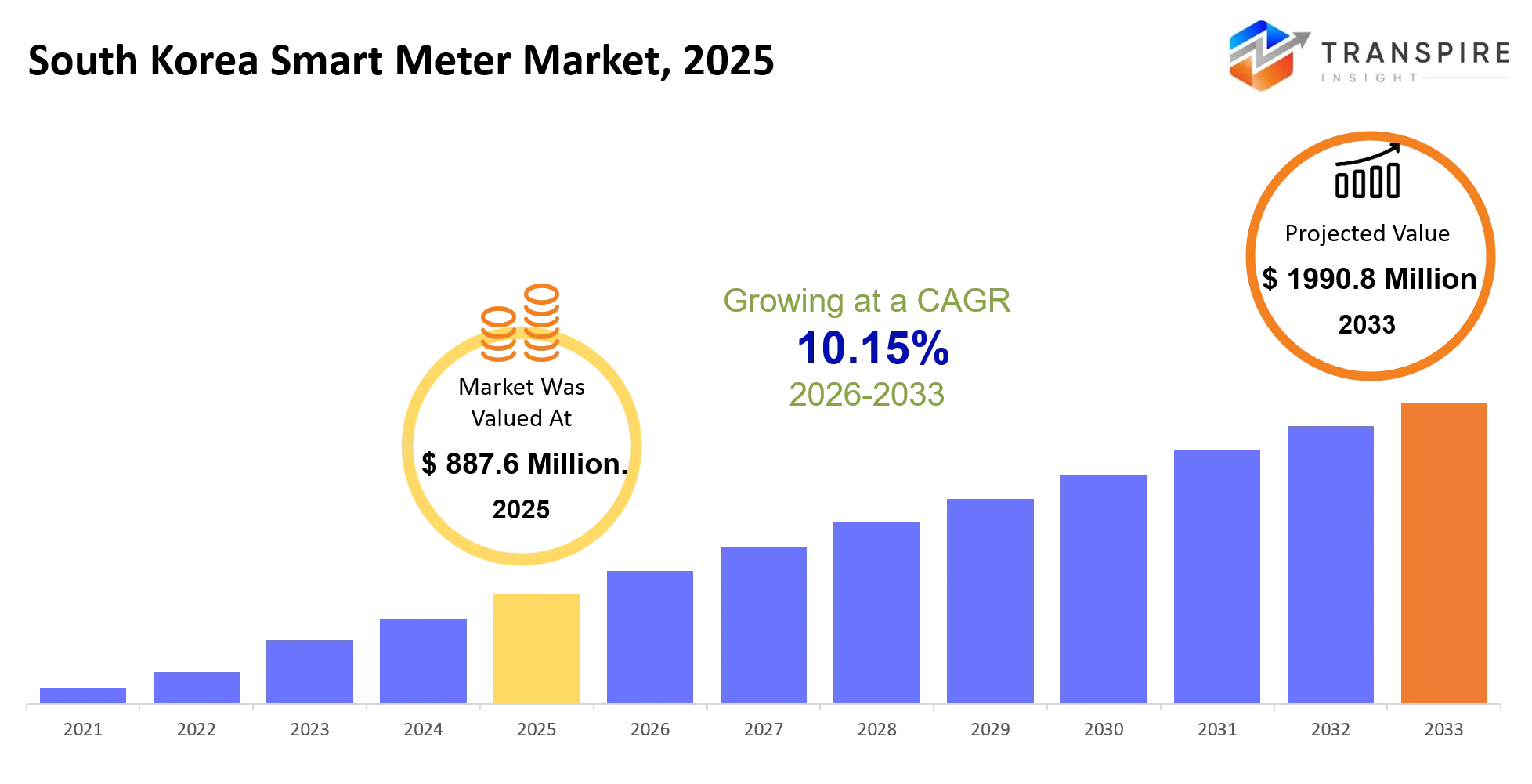
- Market Value (2025): USD 887.6 Million.
- Expected Market Value (2026): USD 1012.0 Million.
- Estimated Market Value (2033): USD 1990.8 Million.
- Forecast CAGR (2026–2033): 10.15%.
Introduction
South Korea Smart Meter Market is related to the designing, installation and maintenance of digital metering technologies for automated measurement, communication and control of electricity consumption. Smart meters utilize advanced metering infrastructure (AMI) to give utilities more visibility, and to help customers manage their energy use . This infrastructure includes intelligent meters, two-way communications networks, and meter-data management systems. Smart metering in South Korea enables automated data collection, remote monitoring, outage detection, demand-side management, and more efficient operation of the grid. The technology also enables the integration of distributed renewable energy sources, electric vehicle charging, energy storage and new virtual power plant applications. The power sector’s growing digitalization and a push for more flexible, data-driven electricity networks are fueling demand for smart metering solutions. Therefore, AMI modernization, real-time energy management, grid optimization, renewable integration, and advanced demand-response capabilities are still major factors in the South Korea Smart Meter Market.
Key Market Highlights: -
- By Meter Type, theSmart Electricity Metersdominated the market and holds approximately 49 % share in 2025 and is projected to grow at a substantial CAGR during the forecast period.
- By Communication, the RF Mesh dominated the market and holds approximately 50.3 % share in 2025 and is projected to grow at a substantial CAGR during the forecast period.
- By Component, the Metering Units Manufacturers segment dominated the market and holds approximately 78 % share in 2025 and is projected to grow at a substantial CAGR during the forecast period.
- The South Korean smart meter market is developing due to AMI modernization, apartment information, grid management using artificial intelligence, demand response systems, electric vehicles, and energy-data applications for grid digitalization.
How is Technology Driving Growth in the South Korea Smart Meter Market?
The South Korea Smart Meter Market is driven by technology. Advanced AMI, IoT connectivity, PLC, cellular communications, AI analytics, and digital-grid integration are accelerating the market. Smart meters provide automated data collection, remote monitoring, outage detection and more efficient demand management. In residential, commercial and industrial applications, PLC and cellular networks enable reliable two-way communications, while AI and advanced analytics enable better consumption forecasting, anomaly detection, predictive maintenance and load optimization. Smart-meter functionality is being extended via integration with EV charging, distributed renewable generation, energy storage and demand-response platforms. South Korea’s sophisticated electronics and semiconductor ecosystem also supports innovation in intelligent metering hardware, communications modules and grid-edge technologies, furthering the country’s transition to a more connected, data-driven energy infrastructure.
Market Drivers
The South Korea Smart Meter Market is influenced by initiatives towards the development of smart-grid infrastructure, carbon neutrality plans, adoption of renewable energy sources, and rising demands for effective electricity management. The installation of AMI allows for automatic data gathering, remote monitoring, outage management, and enhanced utility performance. The rise in the adoption of solar power and distributed energy resources is leading to the need for two-way meters and demand management. Residential, commercial, and industrial consumers are also using detailed consumption data for improved energy efficiency and electricity demand management. Moreover, Internet of Things (IoT) connectivity, PLC, cellular connectivity, cloud analytics, and intelligent metering are improving smart meters and reducing operational needs.
Restrain
High installation and replacement costs will continue to act as an important limitation for the South Korea Smart Meter Market, especially with respect to AMI upgrading, communications, and grid improvement projects. Further, utilities have limited budgets and long purchase cycles, along with high costs of recovery. Moreover, cyber security concerns, data protection, interoperability, and advanced communication technologies raise system integration and R&D costs.
|
Driver |
Relative Impact on Growth (%) |
Geographic Relevance |
Impact Timeline |
Demand Strength |
Growth Mechanism |
Key Beneficiaries |
Major Constraint |
|
AI-enabled AMI analytics and next-generation smart meters |
27% |
Nationwide; Seoul, Gyeonggi, major metropolitan areas |
Short-term |
High |
AI converts meter data into predictive grid insights |
Meter manufacturers, AI vendors, utilities, large consumers |
Data-security and interoperability requirements |
|
Grid modernization and distributed-energy integration |
23% |
Nationwide; renewable-rich and grid-constrained regions |
Medium-term |
High |
AMI improves visibility for distributed energy resources |
KEPCO, grid technology vendors, DER operators |
Grid investment and integration complexity |
|
Demand response, TOU pricing and flexible consumption |
20% |
Nationwide; residential and commercial clusters |
Short-term |
High |
Real-time consumption data enables automated demand management |
Utilities, aggregators, consumers, software providers |
Customer participation and tariff adoption |
|
EV charging and electrification-driven load management |
16% |
Seoul Capital Area and major urban/industrial centers |
Medium-term |
High |
Smart meters monitor EV loads and support peak management |
Meter vendors, EV operators, utilities, charging firms |
Rapidly changing load profiles and infrastructure costs |
|
Integrated smart-city and multi-utility AMI services |
14% |
Urban municipalities and smart-city projects |
Long-term |
Medium |
Shared AMI infrastructure expands metering applications |
Utilities, municipalities, IoT vendors, system integrators |
Cross-utility standards and deployment costs |
Analysis of Prices and Consumer Behaviour
High-quality advanced smart meters constitute the majority market segment of South Korea (68% total market; mainly because of the demand generated by modernizing utilities, energy management and smart-grid applications). The cost of high quality and advanced smart meter with advanced communication and monitoring capabilities is expected to be 35% higher compared to the other products, since it will consist of advanced technology, quality components and accurate measurement. Around 45% of total units sold of smart meters are digitally integrated smart meters. The volume of sales is influenced by the versatility of usage of smart metering solutions in various applications and the long lifetime of the smart metering system. Residential, commercial and industrial segments constitute about 70% of the applications demand. The buying behavior of utilities and consumers shows that 55% consider measurement accuracy, reliability and advanced data management capabilities to be of the most important aspects. Another 33% of buyers prefer buying their products via bulk or long term agreement, as they try to minimize the cost of procurement of smart metering systems and to ensure the constant supply of their products to customers in South Korea.
|
Company |
Est. Revenue Share Range |
Key Offerings |
Strategic Positioning |
Geographic Strength |
Technology Focus |
|
NuriFlex Co., Ltd. |
10–16% |
AMI systems; smart electricity meters; HES software; DCU/repeaters |
Domestic AMI leadership and data-platform expansion |
South Korea; Asia; Africa |
AMI, IoT, PLC, RF, HES, energy-data analytics |
|
LS ELECTRIC Co., Ltd. |
8–13% |
Smart meters; AMI systems; AMI modems/DCUs; smart-power platforms |
Integrated smart-grid and utility-solution strategy |
South Korea; Southeast Asia; North America |
AMI, digital grid, automation, energy platforms |
|
I&C Technology Co., Ltd. |
7–11% |
AMIGO Power Meter; PLC modems; LTE modems; DCUs |
Communication-chip and AMI infrastructure specialization |
South Korea; selected overseas markets |
PLC, Wi-SUN, LTE, communication semiconductors |
|
CNU Global Co., Ltd. |
4–7% |
AMI smart meters; PLC modems; DCUs; apartment AMI systems |
Apartment AMI and PLC-based specialization |
South Korea; Asia |
IoT-PLC, PLC communications, AMI servers |
|
Seochang Electric & Telecommunications Co., Ltd. |
3–6% |
Smart meters; AMI communication devices; AMI hardware |
Domestic hardware specialization with export expansion |
South Korea; emerging overseas markets |
Smart metering, communications, AMI hardware |
|
Itron, Inc. |
2–5% |
Smart electricity meters; AMI networks; meter-data solutions; grid-edge solutions |
Global AMI technology and software specialization |
North America; Europe; Asia Pacific |
AMI, IoT, edge intelligence, data analytics |
|
Landis+Gyr Group AG |
2–5% |
Smart electricity meters; AMI networks; grid-edge platforms; lifecycle services |
Advanced metering and grid-intelligence differentiation |
Asia Pacific; North America; Europe |
Next-gen AMI, RF, edge intelligence, IoT |
|
Siemens AG |
1–4% |
Digital meters; SENTRON metering; power monitoring; grid automation |
Premium integrated electrification and digital-grid solutions |
Europe; Asia Pacific; North America |
Digital metering, automation, power monitoring |
|
Schneider Electric SE |
1–3% |
PowerLogic meters; ION9000; PM8000; EcoStruxure energy management |
Premium energy-management ecosystem integration |
Europe; Asia Pacific; North America |
Power analytics, IoT, cloud, cybersecurity |
|
Honeywell International Inc. |
1–3% |
Smart electricity meters; connected utility platforms; AMI solutions; Honeywell Forge |
End-to-end connected utility modernization strategy |
North America; Middle East; Asia Pacific |
Cellular AMI, analytics, cloud, cybersecurity |
Who are the Key Players in the South Korea Smart Meter Market and how do they compete?
Competitiveness in the international market for South Korea Smart Meter Market can be achieved through those companies that focus on technological innovation, specialization and development of distribution network at the international level. Competing not in price but rather in terms of durable equipment, innovative metering technology, smart and connected solutions, integration with digital platform and utility operations, this competitive strategy will ensure continuous improvement of the products, and also improve productivity, efficiency, resource optimization and operations visibility of the organization.
By providing the company with intelligent solutions in terms of smart metering systems, AMI solutions, connected technology and grid management solutions, LS ELECTRIC strengthens its market position. Providing innovative solutions in terms of smart metering and energy management solutions for residential, commercial, industrial and utility customers allows Itron to differentiate itself from other companies. The competitive advantage of Landis+Gyr is that the company provides integrated solutions in terms of smart metering, AMI, automation and intelligent energy management.
Top Companies in the South Korea Smart Meter Market
- LS ELECTRIC
- Itron
- Landis+Gyr
- Honeywell
- Siemens
- Schneider Electric
- ABB
- Toshiba Energy Systems
- Kamstrup
- EDMI
- Sensus
- Aclara
- NURI Telecom
- Iljin Electric
- OSAKI Electric
South Korea Smart Meter Market Segmentation
The South Korea Smart Meter Market share is divided into six categories: By Meter Type, By Communication, By Component, By Application, By Technology, By End User.
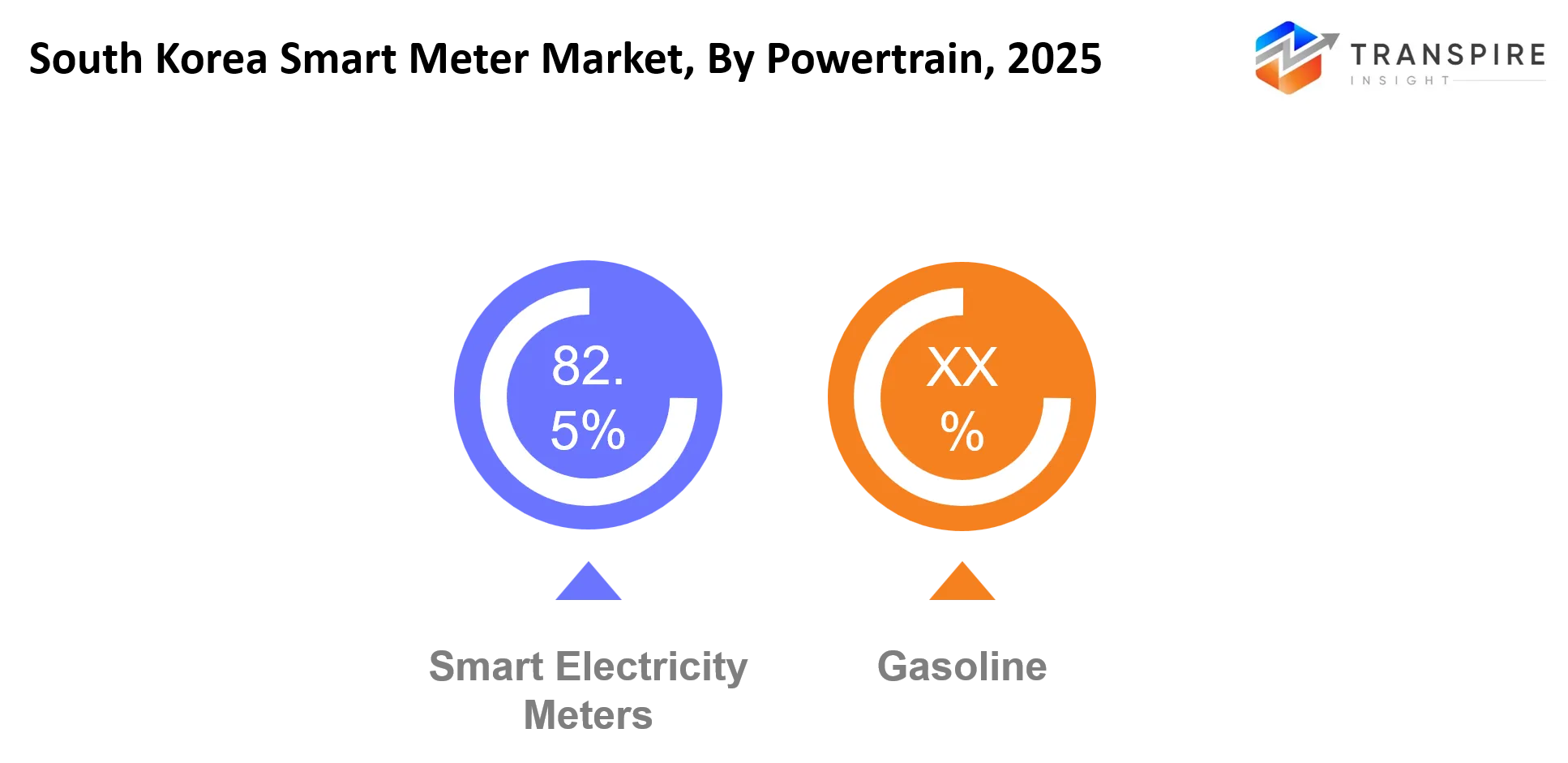
The Smart Electricity Meters dominated the market, accounting for nearly 49 % in 2025 and is expected to rise at a significant CAGR during the forecast period.
The South Korea Smart Meter Market is segmented by meter type into smart electricity meter, smart gas meters, smart water meters, smart heat meters, smart prepaid meters, smart industrial meters, smart commercial meters, multi-utility meters. Among these, theSmart Electricity Meterssegment dominated the market, accounting for nearly 49 % in 2025 and expected to increase at a significant CAGR during the forecast period. This section leads on account of the broad usage of utilities, energy automation, grid modernization, and high demands for efficient electrical power management in South Korea.
The RF Mesh dominated the market, accounting for nearly 50.3 % in 2025, and is expected to rise at a significant CAGR during the forecast period.
The South Korea Smart Meter Market is segmented by communication into rf mesh, cellular, wi-fi, zigbee, lorawan, nb-iot, plc, ethernet. Among these, the RF Mesh dominated the market, accounting for nearly 50.3 % in 2025 and expected to increase at a significant CAGR during the forecast period. RF Mesh leads owing to the robust two-way communication system, scalable AMI connection system, extensive grid coverage, and efficient data transmission in the smart metering systems of South Korea.
The Metering Units dominated the market, accounting for nearly 78 % in 2025 and is expected to rise at a significant CAGR during the forecast period.
The South Korea Smart Meter Market is segmentedby component into metering units, communication modules, sensors, displays, controllers, software, data concentrators, gateways. Among these, the Metering Units dominated the market, accounting for nearly 78 % in 2025 and expected to increase at a significant CAGR during the forecast period. Metering units lead owing to extensive AMI implementation, precise consumption measurement, automated data collection, remote monitoring, and increasing utility modernization in South Korea.
Future Market Trends for the South Korea Smart Meter Market: -
AMI Modernization and Intelligent Metering: Future AMIs will be increasingly capable of real-time monitoring, intelligent analysis, remote diagnosis, cybersecurity, and grid-edge intelligence in South Korea’s power network.
AI-Based Energy Management: AI-based techniques will improve the data analysis process of smart meters, demand response, forecasting, prediction, and energy efficiency services for individual customers and power plants.
Renewables and EV Integration: Future smart meter installations will become increasingly involved in integrating renewable energy, EVs, demand management, V2G operations, and integrated energy systems.
Recent Development
In June 28, 2026: South Korea adopted the Wise Electricity Life scheme, effective July 1 and using AMI data in rewards for peak solar energy usage by consumers.
In May 25, 2026: X2M Connect Limited unveiled South Korea’s first separable smart water meter featuring cellular technology and artificial intelligence data processing.
In July 2026: The smart meter market in South Korea underwent a replacement period, where utilities replaced their first generation of smart meters with more advanced meters.
Market Segmentation
This study forecasts revenue at Japan, regional and country levels from 2020 to 2033. Transpire Insights has segmented the South Korea Smart Meter Market based on the below-mentioned segments:
South Korea Smart Meter Market, By Meter Type
- Smart Electricity Meters
- Smart Gas Meters
- Smart Water Meters
- Smart Heat Meters
- Smart Prepaid Meters
- Smart Industrial Meters
- Smart Commercial Meters
- Multi-Utility Meters
South Korea Smart Meter Market, By Communication
- RF Mesh
- Cellular
- Wi-Fi
- Zigbee
- LoRaWAN
- NB-IoT
- PLC
- Ethernet
South Korea Smart Meter Market, By Component
- Metering Units
- Communication Modules
- Sensors
- Displays
- Controllers
- Software
- Data Concentrators
- Gateways
South Korea Smart Meter Market, By Application
- Residential
- Commercial
- Industrial
- Utilities
- Smart Buildings
- Smart Cities
- Renewable Energy
- Microgrids
South Korea Smart Meter Market, By Technology
- AMI
- AMR
- IoT
- Advanced Metering Infrastructure
- Remote Meter Reading
- Demand Response
- Grid Monitoring
- Real-Time Monitoring
South Korea Smart Meter Market, By End User
- Electric Utilities
- Gas Utilities
- Water Utilities
- Commercial Buildings
- Industrial Facilities
- Households
- Government Agencies
- Energy Service Companies
Frequently Asked Questions
Find quick answers to common questions.
Government smart-grid initiatives, AMI modernization, renewable integration, energy efficiency, demand management, and digitalization are driving smart meter adoption nationwide.
Smart electricity meters dominate, accounting for nearly 49% in 2025, supported by utility modernization and efficient electricity management requirements.
RF Mesh dominates with approximately 50.3% share in 2025, supported by scalable connectivity, extensive coverage, reliable communication, and efficient transmission.
Metering units dominate with nearly 78% share in 2025, driven by AMI implementation, accurate measurement, automated collection, and remote monitoring.
Key trends include AMI modernization, AI-based energy management, renewable integration, EV charging, demand response, V2G operations, and integrated systems.
- LS ELECTRIC
- Itron
- Landis+Gyr
- Honeywell
- Siemens
- Schneider Electric
- ABB
- Toshiba Energy Systems
- Kamstrup
- EDMI
- Sensus
- Aclara
- NURI Telecom
- Iljin Electric
- OSAKI Electric
About the Authors

Avinash Kumar
I’m Avinash Kumar, a Senior Research Analyst at Transpire Insight, with expertise in the Electronics and Semiconductor and Energy & Power industry. My work focuses on analyzing emerging technologies, market trends, industry developments, and innovation across these sectors. I specialize in transforming complex technical and market insights into clear, research-backed content that helps professionals, businesses, and decision-makers stay informed. Through continuous industry research and data-driven analysis, I strive to deliver accurate, reliable, and practical perspectives on the latest advancements shaping the semiconductor and energy landscape.

Chakradhar Khansole
Chakradhar serves as the Research Director at Transpire Insight, bringing over 8 years of experience in technology, innovation, and strategic market intelligence. He specializes in transforming complex market data into actionable business insights that enable organizations to make informed, growth-oriented decisions. Recognized for his strategic vision and analytical expertise, Chakradhar leads high-impact research initiatives, delivering comprehensive market assessments, competitive intelligence, and forward-looking industry analysis.
Recently Published Reports
-
Apr 2026
Active Power Filter Market
Active Power Filter Market Size, Share & Analysis Report By Type (Shunt Active Power Filters, Series Active Power Filter, Hybrid Active Power Filter), By Application (Harmonics Mitigation, Reactive Power Compensation, Voltage Regulation, Power Factor Correction), By Phase (Single Phase, Three Phase), By End-User Industry (Manufacturing, Healthcare, Commercial, Automotive, Oil and Gas, Others), and Geography (North America, Europe, Asia-Pacific, Middle East and Africa, South and Central America), 2021 - 2031
-
Apr 2026
Electrical Transformer Market
Electrical Transformer Market Size, Share & Analysis Report By Core (Closed, Shell, and Berry), By Insulation (Gas, Oil, Solid, Air, and Other), By Phase (Single, and Three), By Rating (100 MVA to 500 MVA, 501 MVA to 800 MVA, and 801 MVA to 1200 MVA), and Geography (North America, Europe, Asia-Pacific, Middle East and Africa, South and Central America), 2021 – 2031
-
Apr 2026
Hydraulic Piston Pumps Market
Hydraulic Piston Pumps Market Size, Share & Analysis Report By Type (Axial Piston Pumps, Radial Piston Pumps), By Operating Pressure (Low Pressure, Medium Pressure, High Pressure), By Application (Construction, Mining, Agriculture, Automotive, Oil & Gas, Industrial Machinery, Others), By End-User (OEMs, Aftermarket), and Geography (North America, Europe, Asia-Pacific, Middle East and Africa, South and Central America), 2021 – 2031
-
Apr 2026
Laboratory Gas Generators Market
Laboratory Gas Generators Market Size, Share & Analysis Report By Product (Nitrogen Gas Generator, Hydrogen Gas Generator, Zero Air Gas Generator, Purge Gas Generator, TOC Gas Generators, Others), By Application (Gas Chromatography, Liquid Chromatography-mass Spectrometry (LC-MS), Gas Analyzers, Others), By End-user (Life Science, Chemical & Petrochemical, Food & Beverage, Others), and Geography (North America, Europe, Asia-Pacific, Middle East and Africa, South and Central America), 2021 – 2031