
Single Use Pallet Market Summary:
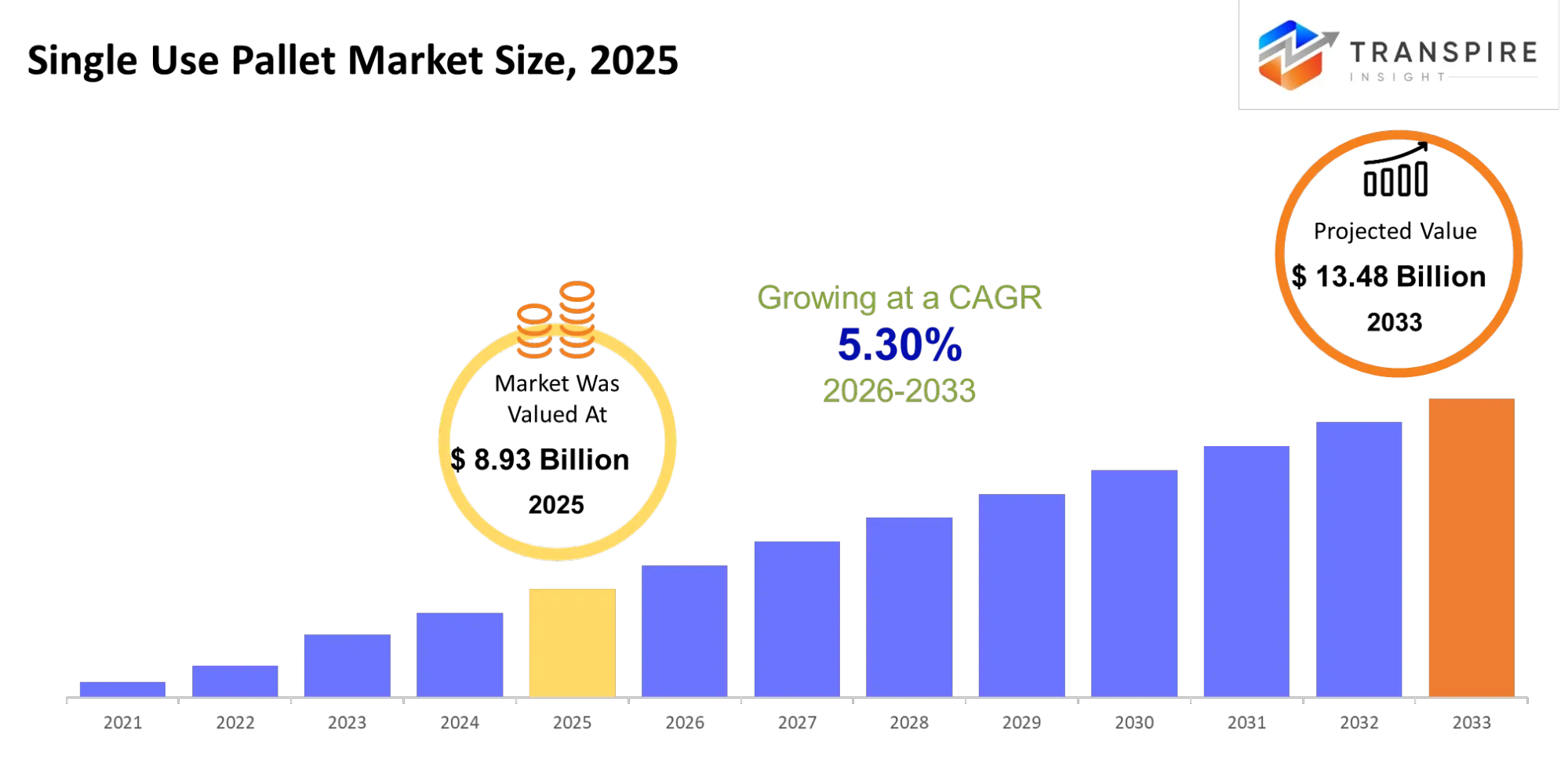
As per the Transpire Insight Analysis, the Single Use Pallet Market size is estimated at USD 8.93 billion in 2025 and is anticipated to reach USD 13.48 billion by 2033, growing at a CAGR of 5.30% from 2026 to 2033.
The single-use pallet market provides lightweight, disposable platforms that transport goods through the supply chain, then are discarded or recycled, emphasizing hygienic standards, regulatory compliance, and one-way logistics at the expense of asset recovery.
In the last 3-5 years, purchasing moved from cost-based procurement to compliance-based procurement. A structural shift occurred as governments reinforced their sustainability regulations. This saw the Packaging and Packaging Waste Regulation by the EU or California’s SB 54 re-categorize transport packaging and set recyclability objectives from 2026. A trigger in the industry was the implementation of the PPWR. This required exporters and logistics organizations to have the ability to track pallet recyclability, traceability, and end-of-life disposal.
Growth in the market is driven by the increasing need for contamination-free and lightweight pallets by e-commerce and pharma logistics, avoiding return logistics and adhering to stringent hygiene standards. With increasing compliance costs of reusable pallets, companies are moving towards single-use corrugated and press-wood pallets, which reduce documentation and ISPM-15 treatment requirements, thus increasing revenue in the disposable segment.
Single Use Pallet Market Size & Forecast:
- Market Size 2025: USD 8.93 Billion
- Expected Market Value (2033): USD 13.48 Billion
- Forecast CAGR (2026–2033): 5.30%
- Leading Region in 2025: Asia Pacific
- Fastest Growing Region: Europe
- Key Company Profiles: CHEP, LOSCAM, Craemer Group, CABKA, Litco International, PECO Pallet, Brambles, Schoeller Allibert, Millwood Inc., Greystone Logistics, Falkenhahn AG, UFP Industries, ORBIS Corporation, PalletOne, Nefab.
Key Single Use Pallet Market Insights:
The market is moving away from low-cost disposable transport solutions to sustainable logistics assets that cut transportation costs and ease export compliance. Innovation in materials, digital supply chain planning, and compliance with regulations are gaining more competitive power than just production volumes.
- Wooden pallets account for 52%, with Millwood and UFP Industries' ISPM-15-certified, EUDR-exempt export designs gaining ground.
- Corrugated paper pallets at 12% are expanding at 16.4% CAGR, with Nefab and ORBIS using AI-driven optimized fibre patterns to reduce weight by 15%.
- Craemer and CABKA have invested in recycled-HDPE mono-material platforms, as plastic pallets are on the path to meeting PPWR's 30% PCR target by 2030.
- Presswood pallets at 8% are gaining pharma traction while Litco and Greystone are providing ISPM-15-free, hygienic molded-fiber options.
- Asia-Pacific holds 41% market share, and India's adoption of recyclable pallet-pad is projected at 8.4% CAGR, due to e-commerce automation.
- The 28% share in Europe is moving towards compliance-driven procurement, at 17.2% CAGR in single-use as PPWR traceability rules come into effect.
- North America's 24% is supported by food/pharma hygiene, and CHEP and PECO are developing disposable plastic SKUs for FSMA compliance.
- Lightweight export pallets at 2% are seeing air-freight uptake, as Falkenhahn and Schoeller Allibert introduce carbon-reporting-ready designs.
- Digital compliance documentation brings together purchasing, and more than 60% of procurement is now done via direct sales or online B2B.
What are the Key Drivers, Restraints, and Opportunities in the Single Use Pallet Market?
Driver:
Regulatory pressures are compelling solutions where more regulatory requirements diminish the feasibility of reusable pallet programs and enhance hygiene standards in food, pharma, and e-commerce supply chains. The strongest pressure is the implementation of the Packaging and Packaging Waste Regulation (PPWR) and the EU Deforestation Regulation, which impose more rules on reusable wooden and plastic pallets. Therefore, many companies are leaning toward disposable corrugated paper and press-wood pallets due to their lighter weight, easier documentation, regulatory compliance, and export.
Restraint:
The growth is limited by increasing costs of corrugated fibre and the uneven recycling infrastructure, especially in the developing economies. The problem is that single-use pallets depend on the availability of stable paper supply chains and effective collection infrastructure, which are still uneven in each region. Consequently, the producers have to deal with unstable input costs and limited end-of-life recovery efficiency.
Opportunity:
Additional emerging developments in AI-facilitated pallet design and sophisticated ultra-lightweight composite materials will open new market opportunities. Driving investments in nano-cellulose technology and recycled polymer combinations in the Asia-Pacific region can lower raw material requirements while enhancing structural integrity. These breakthroughs assist producers in adhering to Packaging and Packaging Waste Regulation (PPWR) recyclability standards, cut transportation expenses by utilising lighter pallets, and establish enduring competitiveness by maintaining market export and logistics leadership.
What Has the Impact of Artificial Intelligence Been on the Single-Use Pallet Market?
AI is transforming the single-use pallet market by providing demand forecasting and automating pallet design optimization. Using data mining, ML models predict pack-out characteristics from past shipment data to design the optimal pallet dimensions, including minimizing material usage by up to 15% and freight costs via weight and cube efficiency.
In operations, an AI warehouse management system automates optimal pallet loading patterns, leading to 36% higher cube utilizations and 21% lower damage rates by taking into consideration weight distribution, fragility, and stackability. Predictive analytics accurately forecast spikes in pallet demand associated with e-commerce seasonality with 94% accuracy and are able to support just-in-time production and lower inventory holding costs by 19%. This results in the ability to adapt production rapidly and optimize supply chain accordingly, with 30% lower stockouts in e-commerce. The main drawback, however, is the cost of integration & the accuracy chasm for smaller logistics players-few MTs/SMEs have the data infrastructure for real-time telemetry, SKU master data, promotion calendar, etc., to feed the models, resulting in weaker recommendations or manual overrides, and a slower adoption rate.
In June 2026, Doosan Robotics introduced its AI-powered palletizing solution, PalletizHD+, at the Automate 2026 exhibition. The machine-learning-driven software removes traditional programming complexity and makes mixed-case palletizing faster.
Key Single Use Pallet Market Trends:
The market is changing from transport packaging to intelligent, regulation-compliant logistics solutions, which enhance export efficiency and sustainability. Innovation in materials, digital logistics, and circular economy projects is changing procurement processes in value chains.
- The uptake of corrugated pallets increased after 2023, driven by the need for lightweight, PPWR-compliant alternatives to wood pallets.
- Presswood pallets became popular in the pharma industry due to their consistent hygiene profile and ISPM-15 certification.
- E-commerce logistics moved to disposable pallets to eliminate the complexity of return flows and contamination risk.
- AI-based design tools have cut material consumption by 10–15% via load-pattern optimization.
- The recycled fibre content in corrugated pallets increased to comply with SB 54 and PPWR recyclability requirements by 2026.
- The use of lightweight export pallets instead of heavy wood for air freight reduced fuel costs and carbon reporting burden.
- To meet the PPWR traceability requirements for transport packaging, digital pallet tracking with QR codes came into existence.
- Despite the cost benefits, Southeast Asia's recycling infrastructure was a major obstacle to the uptake of single-use pallets.
Single Use Pallet Market Segmentation
By Product Type:
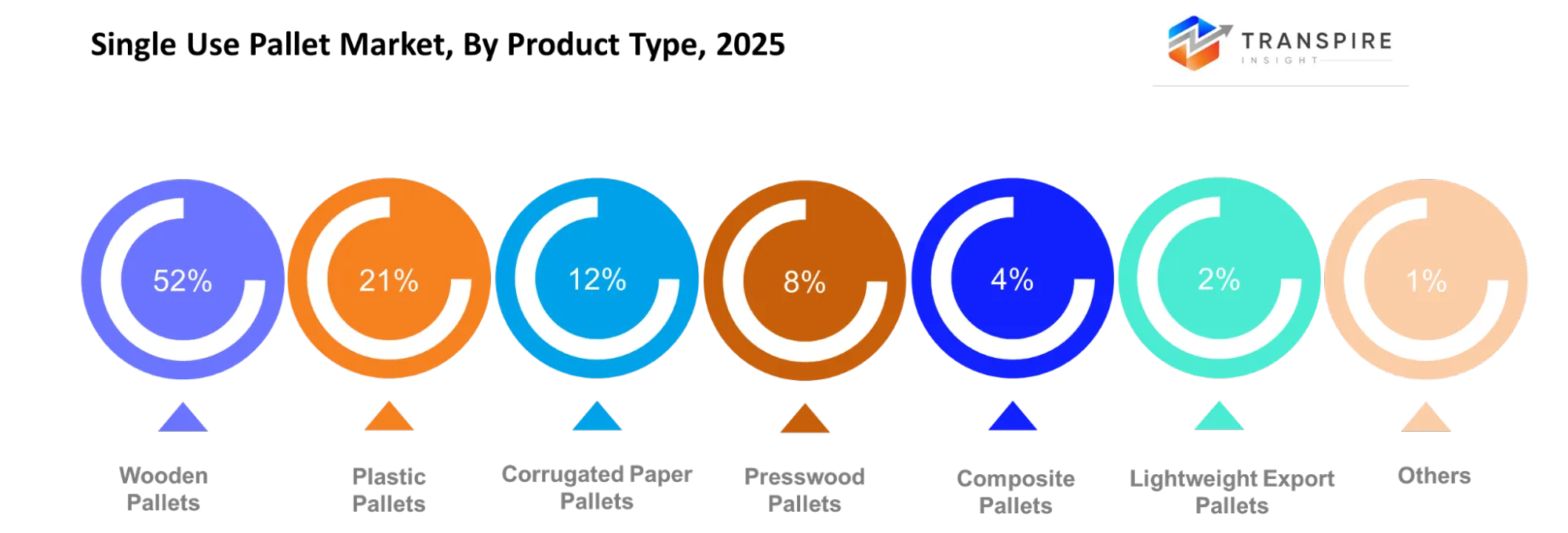
Wooden pallets account for 52% of the market because they offer the best balance between affordability, structural strength, and universal acceptance across export logistics. Plastic pallets hold 21%, supported by hygiene-sensitive industries requiring moisture resistance, while corrugated paper pallets represent 12% and record the fastest CAGR of 16.4% as companies prioritize recyclable, lightweight shipping solutions. Presswood pallets contribute 8% through ISPM-compliant exports, whereas composite pallets capture 4%, lightweight export pallets 2%, and others 1%, reflecting specialised logistics requirements. Future growth increasingly favors recyclable engineered materials that reduce freight costs and environmental impact.
By Application:
Food & beverage stays the top user as its having a disposable pallet, making contamination in distribution less likely. Pharmaceuticals keep growing with their use in sterile shipping overseas, but consumer products and e-commerce now demand lighter export packaging to speed up the supply process. Chemicals, the agricultural industry, electronics, and other manufacturers grow their demand with one-way logistics that lower pallet return costs and increase flexibility.
By End User:
Manufacturers will continue to be the largest buyers because of the volumes of outbound shipments. Logistics companies will continue to buy more because transport systems are competing on the basis of operating costs, but retailers, exporters, warehousing companies and FMCG companies will be introducing disposable pallets to reduce outbound reverse logistics, streamline warehouse operations and improve international transit performance.
By Load Capacity:
Medium duty pallets are the most commonly used in commercial transport due to their balance of strength, ease of handling and costs among the different industries supply chains. Light duty, ultra-lightweight pallets are being increasingly used in export packaging to reduce the weight of the freight, with heavy duty pallets essential for heavy-duty industrial machinery, chemical and other heavy load industries that require structural strength.
By Distribution Channel:
In direct sales, various channels can be identified. Large end users tend to negotiate tailor-made contracts directly with suppliers. Packaging distributors reinforce the countrywide availability, online B2B portals facilitate the procurement process, OEM providers implement pallets into packaging systems, and wholesalers and other outlets maintain their presence to serve the needs of small industrial customers.
What are the Key Use Cases Driving the Single Use Pallet Market?
Main applications are one-way export and e-commerce fulfilment, with wooden and corrugated pallets widely predominant due to ISPM 15 compliance and lighter-weight cost benefits. Wooden export pallets entail heat treatment and IPPC markings for foreign consignments, but corrugated substitutes avoid biosecurity regulations and weigh less.
Broader usage covers pharma cold-chain and food-grade logistics, where press-wood and plastic single-use pallets fulfil hygiene and contamination-control requirements not enabling asset recovery. They are moisture-resistant, surviving temperature cycling, while also fulfilling GMP/FDA requirements for temperature-sensitive medicines and perishable foods.
New use-cases in development include AI-optimized single trip pallets for airfreight and lightweight export, and digitally tracked corrugated platforms to meet PPWR traceability & recyclability reporting requirements for EU trade corridors.
|
Report Metrics |
Details |
|
Market size value in 2025 |
USD 8.93 Billion |
|
Market size value in 2026 |
USD 9.39 Billion |
|
Revenue forecast in 2033 |
USD 13.48 Billion |
|
Growth rate |
CAGR of 5.30% from 2026 to 2033 |
|
Base year |
2025 |
|
Historical data |
2021 - 2024 |
|
Forecast period |
2026 - 2033 |
|
Report coverage |
Revenue forecast, competitive landscape, growth factors, and trends |
|
Regional scope |
United States; Canada; Mexico; United Kingdom; Germany; France; Italy; Spain; Denmark; Sweden; Norway; China; Japan; India; Australia; South Korea; Thailand; Brazil; Argentina; South Africa; Saudi Arabia; United Arab Emirates |
|
Key companies profiled |
CHEP, LOSCAM, Craemer Group, CABKA, Litco International, PECO Pallet, Brambles, Schoeller Allibert, Millwood Inc., Greystone Logistics, Falkenhahn AG, UFP Industries, ORBIS Corporation, PalletOne, Nefab |
|
Customization scope |
Free report customisation (country, regional & segment scope). Avail customised purchase options to meet your exact research needs. |
|
Report Segmentation |
By Product Type (Wooden Pallets, Plastic Pallets, Corrugated Paper Pallets, Presswood Pallets, Composite Pallets, Lightweight Export Pallets, Recycled Material Pallets, Others); By Application (Food & Beverage, Pharmaceuticals, Consumer Goods, Chemicals, E-commerce, Agriculture, Electronics, Others); By End User (Manufacturers, Logistics Companies, Retailers, Exporters, Warehousing Companies, FMCG Companies, Others); By Load Capacity (Light-duty, Medium-duty, Heavy-duty, Ultra-lightweight, Others); By Distribution Channel (Direct Sales, Packaging Distributors, Online B2B Platforms, OEM Suppliers, Wholesalers, Others) |
Which Regions are Driving the Single Use Pallet Market Growth?
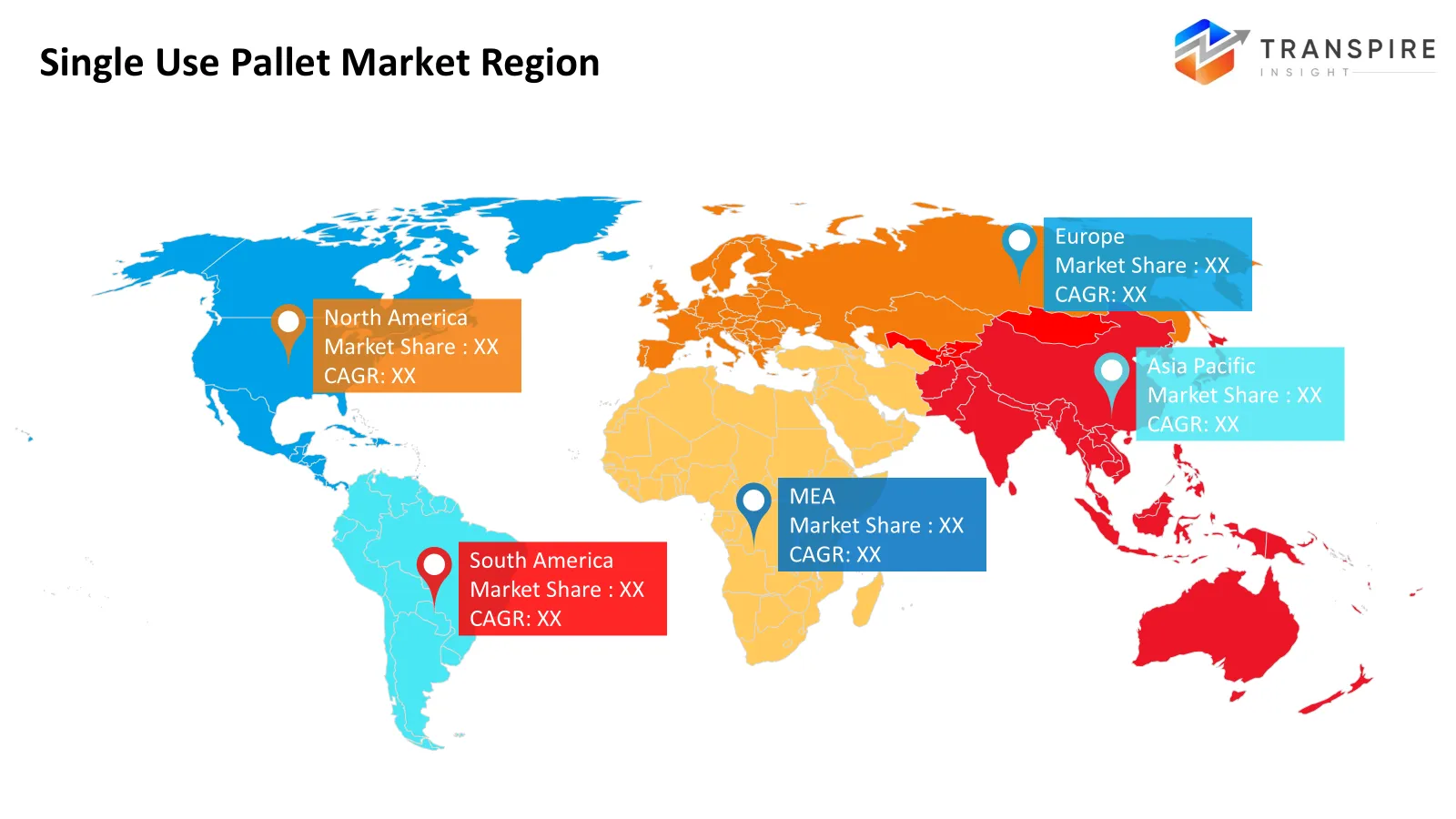
Asia-Pacific accounts for 41% of worldwide demand for single-use pallets, driven by export-driven manufacturing and e-commerce fulfilment centres based in China and India. The region's leadership reflects fast-paced industrial development, governmental logistics programs, and rising cold-chain capacity that boost lightweight, disposable platforms. A solid recycled-fibre availability and rising packaging plant investments encourage corrugated and press-wood pallet penetration. ISPM-15 compliance and rising intra-APAC exports are the main factors that support compliant, one-way pallets for this region.
North America accounts for 24% of the market, driven by stable FSMA and pharma cold-chain regulations that reinforce hygienic disposable plastics and press-wood pallets. North American consumption is supported by long-standing migration to automation in logistics and warehousing robotics, driving demand for dimensionally unified pallets. A highly evolved ecosystem of pooling solutions like CHEP and PECO backs up a multitude of disposable SKUs. Clear regulation and well-developed recycling systems stabilize single-use market penetration in hygiene-sensitive sectors.
Europe holds a 28% share and is the fastest-growing region with a 17.2% CAGR, due to the recent PPWR and EUDR implementation deadline. While compliance costs are forcing shifts away from reusable wood towards compliant single-use corrugated and press-wood pallets, new opportunities for European suppliers can be found in AI-supported pallet design and recycled blends of polymers that achieve PPWR's 30% PCR goal. When compliance costs become prohibitively high, European logistics companies are turning to single-use pallets to cut paperwork and prevent repalletizing fees. In March 2026, Tosca partnered with Cabka to launch a standardised circular pallet designed to comply with evolving EU regulations and automation demands.
Who are the Key Players in the Single Use Pallet Market and how do they Compete?
The market for single-use pallets is scattered among diverse companies, shifting the focus from price wars over logistics suppliers to a new race involving compliance and material innovation under pressures of the PPWR and the EUDR.
CHEP and Brambles have utilized pooling scale and are increasingly growing disposable SKUs targeting hygiene-critical pharma and food segments by providing ISPM-15-compliant corrugated EPC (electronically traceable) packaging. Craemer Group and CABKA provide recycled-HDPE mono-material plastic pallets competing against the EU's 30% PCR requirement by closed-loop production with sustainability in Europe. Litco International and Greystone Logistics provide ISPM-15-free, hygienic molded-fiber press-wood pallets for pharma cold-chain and electronics export. Millwood and UFP Industries retain wooden pallet dominance, providing EUDR-exempt certified supply chain and lightweight export pallets suitable for air freight.
Nefab and ORBIS provide AI-optimized corrugated platforms reducing material use by 15%. Schoeller Allibert and Falkenhahn AG address lightweight export and carbon-reporting-ready export pallets aimed at EU trade corridors. As the 40% reuse PPWR goal becomes effective for transport packaging, players are weighing the transient benefits of disposable hygiene against long-term investments into reusable systems. Those who adopt AI-enabled design, digital traceability, and recycled content certification will turn regulatory burden into a sustainable competitive advantage, particularly along the EU and North American corridors with implementation.
Key Players are:
- CHEP
- LOSCAM
- Craemer Group
- CABKA
- Litco International
- PECO Pallet
- Brambles
- Schoeller Allibert
- Millwood Inc.
- Greystone Logistics
- Falkenhahn AG
- UFP Industries
- ORBIS Corporation
- PalletOne
- Nefab
Recent Development News
- In April 2026, Tosca partnered with Cabka to launch the Euro-sized Tosca Circular Pallet (CP 1208). This next-generation, PPWR-compliant product optimizes automated supply chains and enhances environmental efficiency over traditional single-use packaging.
- In February 2026, KraftPal finalized an agreement to establish its seventh high-tech corrugated cardboard manufacturing facility in Montenegro. This deployment scales up local production of lightweight, 100% recyclable alternatives to single-use wooden pallets across the European supply chain.
What Strategic Insights Define the Future of the Single-Use Pallet Market?
The single-use pallet market is evolving from low-cost, throwaway disposables to compliance-engineered, AI-infused smart solutions that emphasize traceability, recyclability, and lightweight efficiency to meet 2026-2028 PPWR and EUDR deadlines. An unanticipated risk is fibre supply instability and recycling infrastructure shortfalls in emerging markets that could impede corrugated pallet adoption despite attractive regulatory tailwinds and booming e-commerce adoption. A nascent opportunity is novel recycled polymer blends and nano-cellulose reinforced composites that fulfil PPWRs 30% post-consumer recycled content target, while arbitraging raw material costs for plastic and press-wood pallets. Forward-looking market participants should strategically target developments in AI-enabled pallet design, demand forecasting, and digital traceability solutions to adapt to evolving PPWR and EUDR mandates and turn compliance into a durable cost and service advantage across EU and North American trading routes.
Key Segmentations are:
By Product Type
- Wooden Pallets
- Plastic Pallets
- Corrugated Paper Pallets
- Presswood Pallets
- Composite Pallets
- Lightweight Export Pallets
- Recycled Material Pallets
- Others
By Application
- Food & Beverage
- Pharmaceuticals
- Consumer Goods
- Chemicals
- E-commerce
- Agriculture
- Electronics
- Others
By End User
- Manufacturers
- Logistics Companies
- Retailers
- Exporters
- Warehousing Companies
- FMCG Companies
- Others
By Load Capacity
- Light-duty
- Medium-duty
- Heavy-duty
- Ultra-lightweight
- Others
By Distribution Channel
- Direct Sales
- Packaging Distributors
- Online B2B Platforms
- OEM Suppliers
- Wholesalers
- Others
Regional Analysis
North America
- United States
- Canada
- Mexico
Europe
- Germany
- United Kingdom
- France
- Spain
- Italy
- Rest of Europe
Asia Pacific
- Japan
- China
- Australia & New Zealand
- South Korea
- India
- Rest of Asia Pacific
South America
- Brazil
- Argentina
- Rest of South America
Middle East & Africa
- Saudi Arabia
- United Arab Emirates
- South Africa
- Rest of the Middle East & Africa
Frequently Asked Questions
Find quick answers to common questions.
The single use pallet market size was valued at USD 8.93 billion in 2025 and is poised to reach USD 13.48 billion by 2033, expanding at a 5.30% CAGR.
Key segments for the single use pallet market are By Product Type (Wooden Pallets, Plastic Pallets, Corrugated Paper Pallets, Presswood Pallets, Composite Pallets, Lightweight Export Pallets, Recycled Material Pallets, Others); By Application (Food & Beverage, Pharmaceuticals, Consumer Goods, Chemicals, E-commerce, Agriculture, Electronics, Others); By End User (Manufacturers, Logistics Companies, Retailers, Exporters, Warehousing Companies, FMCG Companies, Others); By Load Capacity (Light-duty, Medium-duty, Heavy-duty, Ultra-lightweight, Others); By Distribution Channel (Direct Sales, Packaging Distributors, Online B2B Platforms, OEM Suppliers, Wholesalers, Others).
Growth is primarily driven by e-commerce demand for lightweight, one-way pallets; pharma and food hygiene rules favoring disposable plastic and presswood; ISPM-15 and EUDR compliance pushing certified wood or corrugated options; and cost savings from avoiding return logistics and repalletization in cross-border trade.
The single use pallet market is led by major manufacturers including CHEP, LOSCAM, Craemer Group, CABKA, Litco International, PECO Pallet, Brambles, Schoeller Allibert, Millwood Inc., Greystone Logistics, Falkenhahn AG, UFP Industries, ORBIS Corporation, PalletOne, Nefab.
Asia Pacific holds 41% of demand, driven by export manufacturing, industrialization, and e-commerce growth in China and India, supported by expanding cold-chain, rising FMCG volumes, and adoption of automation-ready, ISPM-15-compliant pallets.
Opportunities include AI-optimized corrugated and presswood pallets for e-commerce and pharma cold-chain; recycled polymer and nano-cellulose composites to meet PPWR’s 30% PCR target; digital traceability platforms for EU compliance; and lightweight export pallets for air freight carbon reduction.
- CHEP
- LOSCAM
- Craemer Group
- CABKA
- Litco International
- PECO Pallet
- Brambles
- Schoeller Allibert
- Millwood Inc.
- Greystone Logistics
- Falkenhahn AG
- UFP Industries
- ORBIS Corporation
- PalletOne
- Nefab
About the Authors

Kartik bhong
I am Kartik Bhong, a Senior Research Analyst at Transpire Insight, specializing in the Packaging, Manufacturing, and Construction industry. My work focuses on analyzing market trends, emerging technologies, industry regulations, and competitive landscapes to deliver accurate, data-driven insights. I am passionate about transforming complex industry information into clear, practical content that helps businesses, professionals, and decision-makers stay informed and make confident strategic decisions. Through continuous research and a strong commitment to accuracy, I strive to create reliable, well-researched content that reflects the latest developments across these dynamic industries and supports the vision of Transpire Insight in delivering valuable market intelligence.

Chakradhar Khansole
Chakradhar serves as the Research Director at Transpire Insight, bringing over 8 years of experience in technology, innovation, and strategic market intelligence. He specializes in transforming complex market data into actionable business insights that enable organizations to make informed, growth-oriented decisions. Recognized for his strategic vision and analytical expertise, Chakradhar leads high-impact research initiatives, delivering comprehensive market assessments, competitive intelligence, and forward-looking industry analysis.
Recently Published Reports
-
Apr 2026
Pharmaceutical Cold Chain Packaging Market
Pharmaceutical Cold Chain Packaging Market By Material (Plastic,(Polyethylene (PE), Polypropylene (PP), Polyethylene Terephthalate (PET), Expanded Polystyrene (EPS), Polyurethane (PU),Others), Paper, Metal, Others), By Product (Small Boxes, Pallets, Large Sized Pallet Containers, Others), By End Use (Biopharmaceutical Companies, Clinical Research Organizations, Hospitals, Research Institutes, Logistics and Distribution Companies, Others)”, By Industry Analysis, Size, Share, Growth, Trends, and Forecasts 2026-2033
-
Apr 2026
Active & Intelligent Packaging Market
Active & Intelligent Packaging Market By Type (Active Packaging, Smart Packaging), By Material (Polymer-Based, Paper & Board-Based, Metal-Based, Glass-Based), By Technology (Time-Temperature Indicators, Freshness Indicators, RFID, Antimicrobial Packaging, Modified Atmosphere Packaging), By Application (Food & Beverages, Pharmaceutical, Cosmetics & Personal Care, Electronics & Consumer Goods, Others), By Industry Analysis, Size, Share, Growth, Trends, and Forecasts 2026-2033
-
Apr 2026
Biodegradable Cut Flower Packaging Market
Biodegradable Cut Flower Packaging Market By Material Type (Paper & Paperboard, Biodegradable Plastics, Natural Fibers, Molded Pulp, Others), By Product Type (Sleeves, Wraps, Boxes & Cartons, Bags & Pouches, Inserts & Holders), By Application (Roses, Carnations, Tulips, Chrysanthemums, Mixed Flowers, Others) and By Distribution Channel (Direct Sales, Distributors & Wholesalers, Online Channels), By Industry Analysis, Size, Share, Growth, Trends, and Forecasts 2026-2033
-
May 2026
Pharmaceutical Packaging Market
Pharmaceutical Packaging Market By Material Type (Plastic, Glass, Metal, Paper & Paperboard, Others), By Packaging Type (Bottles, Blister Packs, Vials, Ampoules, Pouches & Sachets, Others) and By End User (Hospitals & Clinics, Retail Pharmacies, Online Pharmacies, Pharmaceutical Manufacturers), By Industry Analysis, Size, Share, Growth, Trends, and Forecasts 2026-2033