
Single-use Bioprocessing Market Summary:
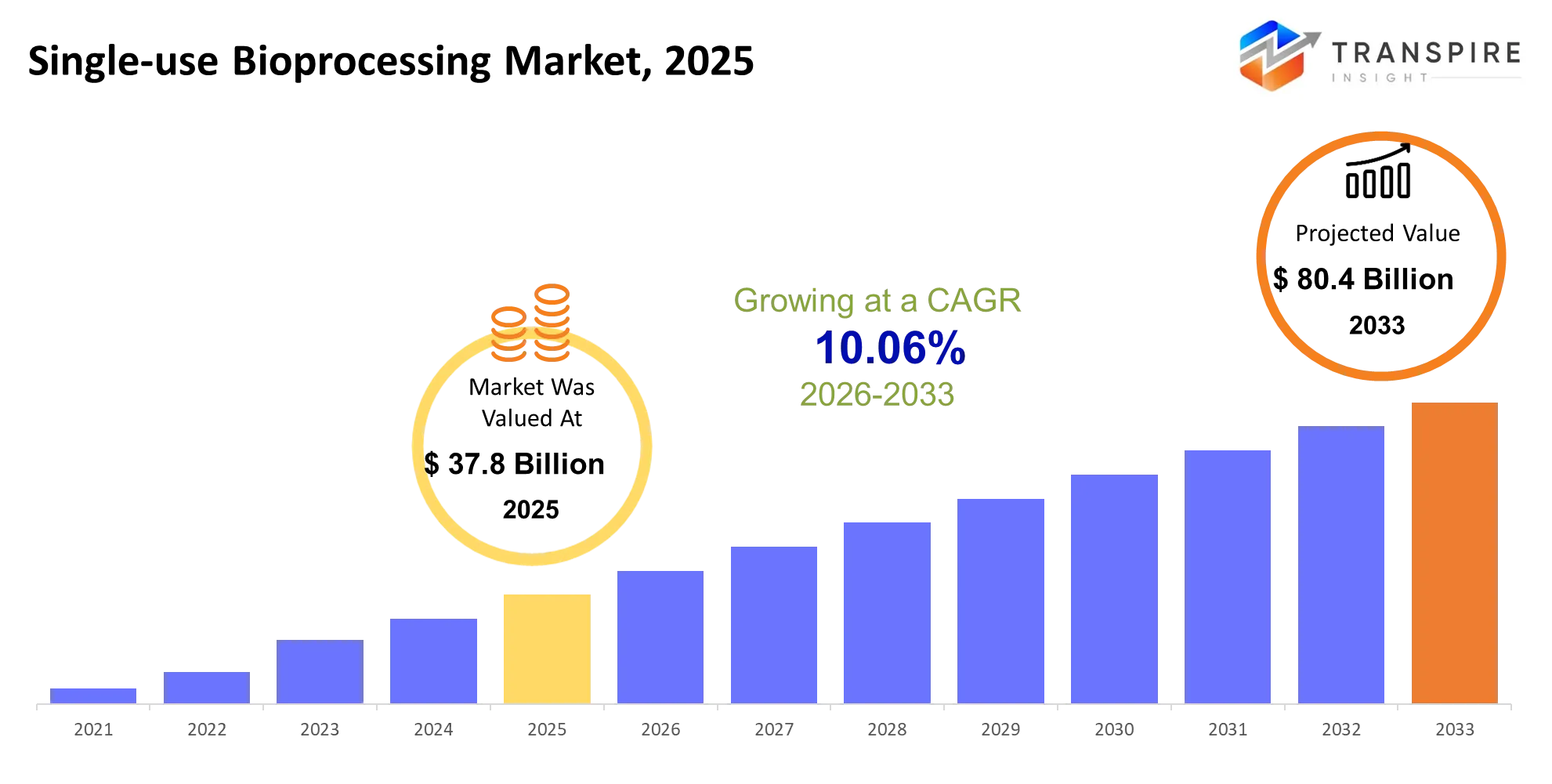
As per Transpire Insight, The Single-use Bioprocessing Market size is estimated at USD 37.8 billion in 2025 and is anticipated to reach USD 80.4 billion by 2033, growing at a CAGR of 10.06% from 2026 to 2033.
The Single Use Bioprocessing Market provides drug producers the capacity to manufacture biologics with disposable bags, tubing, filters, connectors, and bioreactor modules as opposed to traditionally reusable stainless-steel instrumentation. Over the last 3-5 years, biomanufacturers have increasingly turned towards modular, easy-to-clean production trains to speed manufacturing changeover, reduce cleaning time, and support a greater variety of smaller batches. The industry is moving towards modular, flexible, and integrated manufacturing platforms for monoclonal antibody and vaccine production, as well as novel cell and gene therapies. The recent investments in regional biomanufacturing capacity and advanced therapies production are highlighting the need for flexible, contamination-controlled manufacturing technology. Several pharmaceutical companies are increasingly turning towards integrated single-use assemblies that reduce the need for technology transfer, speed up small-scale pilot and early-stage clinical manufacturing, and facilitate facility construction. However, the deployment of products depends on both candidates passing extractables tests, maintaining material compatibility, and ensuring a stable supply chain.
Single-use Bioprocessing Market Size & Forecast:
- Market Size 2025: USD 37.8 Billion
- Expected Market Value (2033): USD 80.4 Billion
- Forecast CAGR (2026–2033): 10.06%
- Leading Region in 2025: North America
- Fastest Growing Region: Asia Pacific
- Key Company Profiles: Thermo Fisher Scientific, Sartorius, Danaher, Merck KGaA, Repligen, Avantor, Corning, Cytiva, Eppendorf, Lonza, Meissner Filtration, Pall Corporation, Saint-Gobain, Parker Hannifin, Getinge.
Key Single-use Bioprocessing Market Insights:
The market is moving from a single-use disposable part to connected and validated manufacturing systems, which will enhance process flexibility. Reliability of supply, material qualification, and equipment integration throughout the production process are becoming key components of competitive advantage.
- Upstream workflows represent 58.40% of the market, while Thermo Fisher's acquisition of the Solventum purification and filtration business expands its capacity to provide connected upstream-to-downstream fluid-management solutions.
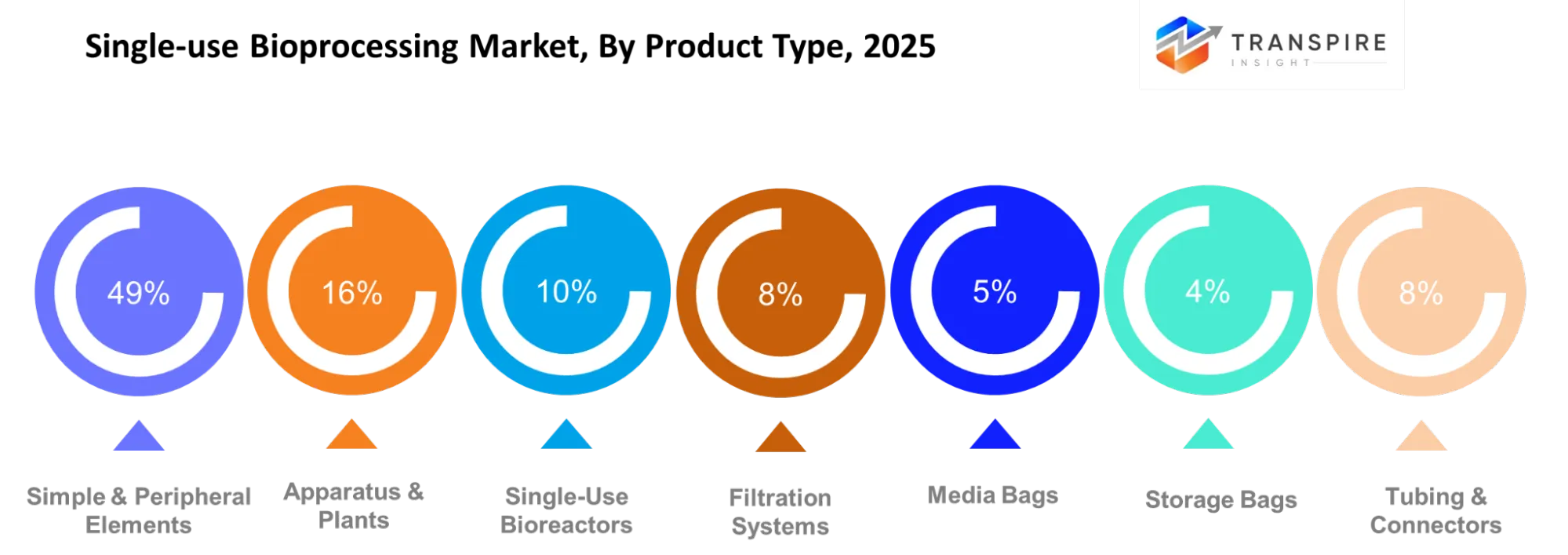
- Simple and peripheral elements make up 48.90%, with the Masterflex portfolio being consolidated by Avantor in April 2026 to serve customers who are looking for standardised pumps, tubing and engineered assemblies from development to commercial production.
- Demand for closed purification, formulation and fill-finish assemblies that minimise manual handling is driving growth in downstream and advanced single-use systems, which are projected to grow at a 10.10% CAGR.
- Single-use bioreactors account for 10.00%, and Sartorius is progressing with bio-circular filters and fluid-management technologies launched in January 2026, which meet lower fossil-plastic procurement expectations.
- The filtration systems make up 8.00%, and Merck KGaA's filtration and life-science portfolio competes via material science, validation documentation and supply reliability.
- Media bags account for 5.00% and storage bags for 4.50%, with suppliers aiming for higher barrier films, improved temperature stability and serialised cold-chain-ready bags.
- Tubing and connectors account for 4.00%, and Repligen stands out with dedicated fluid-management products and single-use solutions for the manufacture of biologics and advanced therapies.
- Sampling systems account for 3.60% of sampling, while Corning, Eppendorf and Parker Hannifin are moving forward with sterile sampling, fluid control and connecting the lab to the process.
- Asia Pacific is the fastest-growing region with growing capacity in China and India for biologics, biosimilars, vaccines, and CDMO manufacturing.
What are the Key Drivers, Restraints, and Opportunities in the Single-use Bioprocessing Market?
Driver:
Biopharmaceutical manufacturers are shifting toward flexible, contamination-controlled production as monoclonal antibodies, vaccines, recombinant proteins, and cell and gene therapies move through crowded pipelines. The trigger is the rise of smaller, higher-value batches and outsourced manufacturing: CDMOs need to serve multiple clients without cross-contamination or long cleaning downtime. Pre-sterilized single-use assemblies reduce cleaning validation, accelerate facility commissioning, and enable faster product changeovers, directly improving capacity utilization and shortening revenue timelines.
Restraint:
Growth remains constrained by extractables and leachables, scalability limits for very large-volume production, and plastic-waste management. These issues persist because single-use systems depend on multi-layer polymer films and complex supply chains; replacing them requires extensive material qualification, supplier audits, and disposal infrastructure. Regulatory scrutiny is especially strong as disposables enter fill-finish and other high-sensitivity applications.
Opportunity:
Integrated, automation-ready systems offer manufacturers a route to improve throughput while maintaining process consistency. Investments in local biomanufacturing capacity across Asia-Pacific could expand adoption as producers seek shorter supply chains and regional manufacturing capabilities. Suppliers that combine validated disposable assemblies, real-time sensors, traceable materials, and recycling or waste-treatment partnerships can differentiate their offerings and address operational and environmental concerns.
Driver Impact Analysis – Single-use Bioprocessing Market
|
Driver |
Relative Impact on Growth (%) |
Geographic Relevance |
Impact Timeline |
Demand Strength |
Growth Mechanism |
Key Beneficiaries |
Major Constraint |
|
Rising demand for biologics, monoclonal antibodies, and vaccines |
30% |
North America, Europe, Asia Pacific |
Short-term (≤2 years) |
High |
Expanding biologics pipelines increase disposable equipment and consumables demand. |
Biopharma manufacturers, bioreactor suppliers, filtration technology providers |
Complex biologics require stringent process validation and contamination controls. |
|
Expansion of contract development and manufacturing organizations (CDMOs) |
22% |
North America, Europe, China, India |
Medium-term (2–4 years) |
High |
Outsourced production increases flexible, multi-product manufacturing capacity requirements. |
CDMOs, disposable assembly manufacturers, integrated system suppliers |
Capacity utilization uncertainty and dependence on outsourcing investment cycles. |
|
Lower capital expenditure and faster facility deployment |
19% |
Asia Pacific, North America, Europe |
Short-term (≤2 years) |
High |
Reduced cleaning and validation needs accelerate facility commissioning and production turnaround. |
Emerging biomanufacturers, facility engineering firms, single-use equipment vendors |
Recurring consumable costs can outweigh savings at large production scales. |
|
Growth in cell and gene therapies and personalized medicine |
17% |
North America, Europe, Asia Pacific |
Long-term (≥4 years) |
High |
Small-batch therapies favor closed, flexible, contamination-controlled processing platforms. |
Advanced therapy developers, specialized CDMOs, single-use system innovators |
Limited commercial volumes and complex therapy-specific manufacturing requirements. |
|
Advancements in automation, process integration, and regulatory-compliant materials |
12% |
North America, Europe, Asia Pacific |
Medium-term (2–4 years) |
Medium |
Integrated sensors and qualified materials improve monitoring, consistency, and process control. |
Automation vendors, sensor developers, polymer suppliers, bioprocess equipment manufacturers |
Extractables concerns, plastic waste, and compatibility testing increase adoption costs. |
|
Total |
100% |
— |
— |
— |
— |
— |
— |
What Has the Impact of Artificial Intelligence Been on the Single-use Bioprocessing Market?
AI is providing the foundation for transforming single-use bioprocessing from a disposable-centric market into a powerful, connected manufacturing platform. In upstream, machine-learning algorithms interpret sensor data from single-use bioreactors, including dissolved oxygen, pH, temperature, agitation, and metabolites, to optimise feeding strategies and standardise cell-culture conditions, reducing batch variation and allowing operators to identify problems before they affect yields. Scope for more advanced use is significant as well: AI algorithms can predict filter fouling, tubing stress, bag integrity issues, and equipment failure, enabling preventative maintenance and minimizing the chance of unplanned batch losses.
AI-driven workflows, such as digital twins and automation-enabled process-control systems, enable scale-up modelling, purification-step optimisation, and technology transfer reduction. Electronic batch records and AI-enabled vision systems reduce sterile-assembly inspection time, support documentation completeness, and improve deviation management. For CDMOs managing multiple products, these capabilities improve the throughput of rapid changeovers and facilitate real-time release. But existing single-use sensors and legacy manufacturing-execution systems were not built for advanced analytics, so issues such as data quality, cybersecurity, validation, and implementation costs can slow AI implementation. Additionally, AI suggestions require scientific validation before they can impact GMP decisions.
In January 2026, WuXi Biologics launched PatroLab™, a state-of-the-art bioprocess digital twin platform that integrates real-time process monitoring with Raman-based Process Analytical Technology (PAT) and predictive in-silico modelling.
Key Single-use Bioprocessing Market Trends:
Single-use bioprocessing is transitioning from disposable equipment to integrated, data-connected manufacturing platforms. Buyers are making decisions that consider both production flexibility and contamination control, material qualification, supply resilience, and environmental impact.
- The trend is to move away from bags and tubing and towards closed fluid-path assemblies, which minimise manual handling and exposure to contamination.
- Fixed stainless-steel facilities are being replaced by modular bioprocessing suites, which enable facilities to increase or repurpose capacity as product pipelines evolve.
- The manufacture of cell and gene therapy products is driving the need for small-volume, patient batch-oriented systems that have dedicated disposable flow paths.
- More and more CDMOs are adopting a single-use platform with clients to speed up technology transfer and minimise downtime from cleaning.
- Suppliers are creating more and more customised filling, mixing and sterile-transfer assemblies rather than selling commodity components.
- Sustainability is emerging as a procurement criterion, leading to the use of recyclable films, lower plastic intensity and better end-of-life waste management.
- To ensure batch-to-batch uniformity and predictive maintenance, disposable systems are being integrated with digital sensors, process analytical technology, and AI-based analytics.
- The regulatory focus on extractables, leachables, and material qualification is leading to increased transparency in supplier documentation and risk-based validation.
- Regional manufacturing localisation is providing an incentive for suppliers to develop regional assembly, testing and supply chains to mitigate logistics and tariff risk.
Single-use Bioprocessing Market Segmentation
Product Type:
A modest majority, simple and peripheral components hold a 48.90% market share because of the common application of tubing, connectors, filters, and assemblies in production and their successive replacement due to wear and tear. Equipment and plant have a 16.00% market share and include those products and services that relate to investment in modular skids, mixers, and integrated processing systems. Single-use bioreactors have a 10.00% share, just below the midway point, indicative of demand for flexible biologics manufacturing techniques. Filtration systems account for an 8.00% share, media bags 5.00%, storage bags 4.50%, tubing and connectors 4.00%, and sampling systems 3.60%.
Workflow:
Upstream processing dominates the market at 58.40%, supported by cell culture, cell expansion, and bioreactor operations where contamination control and scalable production are essential. Downstream and advanced single-use systems are projected to grow at a 10.10% CAGR as manufacturers improve purification efficiency and automate product recovery. Media preparation, buffer preparation, cell harvesting, formulation, and fill-finish are also moving toward closed processing systems. This transition helps reduce manual handling, simplify changeovers, and maintain consistent manufacturing conditions across multiple biologic products.
Material:
Polyethene and polypropylene remain important materials because they offer flexibility, chemical compatibility, and cost-effective manufacturing. PVC supports fluid-transfer applications, while elastomers and thermoplastic elastomers provide sealing and connection flexibility. Fluoropolymers serve specialised applications requiring chemical resistance and controlled fluid contact. Future material selection will increasingly depend on extractables and leachables profiles, sterilisation compatibility, mechanical performance, and supply reliability. Manufacturers are also evaluating recyclable designs and alternative polymers to address waste-management pressures without compromising product safety or regulatory compliance.
End User:
Biopharmaceutical manufacturers and contract manufacturing organisations (CDMOs) represent major demand centres because they require reliable systems for clinical and commercial biologics production. Pharmaceutical manufacturers also adopt disposable assemblies to simplify multiproduct operations. Cell and gene therapy companies need specialised, closed processing solutions for smaller, sensitive production batches. Meanwhile, academic and clinical research institutes, contract research organisations, and diagnostic laboratories use single-use technologies to reduce equipment preparation and support flexible experimentation. Future adoption will depend on system scalability, supplier qualification, and the availability of application-specific components.
Application:
Monoclonal antibodies remain a major application because their production requires controlled cell culture, harvesting, and purification operations. Vaccines, recombinant proteins, biosimilars, and blood products further support demand for disposable processing equipment. Cell and gene therapies create additional opportunities because their manufacturing processes often involve specialised handling, smaller batches, and stringent contamination controls. As these therapies advance through clinical development, manufacturers require flexible systems that support process changes without extensive facility modifications. Integrated assemblies and closed fluid pathways can improve operational consistency while helping producers manage complex manufacturing requirements.
Process Stage:
Clinical and commercial manufacturing generate sustained demand because disposable systems support repeated production runs and reduce cleaning-related downtime. Research and development and preclinical activities benefit from smaller, adaptable setups that allow process conditions to change during experimentation. During clinical manufacturing, standardised assemblies can simplify technology transfer and improve batch reproducibility. Fill-finish operations use sterile fluid pathways to reduce contamination risks, while quality control and storage rely on appropriate sampling, containment, and material compatibility. As biologics pipelines expand, coordinated single-use solutions across development and production stages can improve operational flexibility and manufacturing continuity.
What are the Key Use Cases Driving the Single-use Bioprocessing Market?
The core use case is upstream biologics manufacturing, especially monoclonal antibody and recombinant-protein production. Single-use bioreactors, media bags, tubing assemblies, and filters allow manufacturers to expand cell-culture capacity quickly while avoiding cleaning campaigns and cross-contamination. This aligns with the upstream segment’s 58.40% market position.
Expanding applications include downstream purification, buffer and media preparation, sterile filtration, formulation, and fill-finish. CDMOs use these systems to manage multiple client products in shared facilities, while vaccine and biosimilar producers benefit from faster changeovers and lower capital intensity.
Emerging use cases centre on cell and gene therapy, where small, patient-specific batches require closed single-use flow paths to prevent cross-contamination. Automated filling assemblies, cryogenic storage interfaces, and digitally monitored bioreactors are extending single-use technology into higher-value, precision-manufacturing settings.
|
Report Metrics |
Details |
|
Market size value in 2025 |
USD 37.8 Billion |
|
Market size value in 2026 |
USD 41.1 Billion |
|
Revenue forecast in 2033 |
USD 80.4 Billion |
|
Growth rate |
CAGR of 10.06% from 2026 to 2033 |
|
Base year |
2025 |
|
Historical data |
2021 - 2024 |
|
Forecast period |
2026 - 2033 |
|
Report coverage |
Revenue forecast, competitive landscape, growth factors, and trends |
|
Regional scope |
United States; Canada; Mexico; United Kingdom; Germany; France; Italy; Spain; Denmark; Sweden; Norway; China; Japan; India; Australia; South Korea; Thailand; Brazil; Argentina; South Africa; Saudi Arabia; United Arab Emirates |
|
Key companies profiled |
Thermo Fisher Scientific, Sartorius, Danaher, Merck KGaA, Repligen, Avantor, Corning, Cytiva, Eppendorf, Lonza, Meissner Filtration, Pall Corporation, Saint-Gobain, Parker Hannifin, Getinge. |
|
Customization scope |
Free report customization (country, regional & segment scope). Available customised purchase options to meet your exact research needs. |
|
Report Segmentation |
Product Type (Simple & Peripheral Elements, Apparatus & Plants, Single-Use Bioreactors, Filtration Systems, Media Bags, Storage Bags, Tubing & Connectors, Sampling Systems); Workflow (Upstream, Downstream, Fill-Finish, Media Preparation, Buffer Preparation, Cell Harvesting, Formulation); Material (Polyethylene, Polypropylene, PVC, Elastomers, Fluoropolymers, Thermoplastic Elastomers, Other Polymers); End User (Biopharmaceutical Manufacturers, Pharmaceutical Manufacturers, Academic & Clinical Research Institutes, Contract Manufacturing Organizations, Contract Research Organizations, Diagnostic Laboratories, Cell & Gene Therapy Companies); Application (Monoclonal Antibodies, Vaccines, Recombinant Proteins, Cell Therapy, Gene Therapy, Blood Products, Biosimilars, Other Biologics); Process Stage (Research & Development, Preclinical, Clinical Manufacturing, Commercial Manufacturing, Fill-Finish, Quality Control, Storage). |
Which Regions are Driving the Single-use Bioprocessing Market Growth?
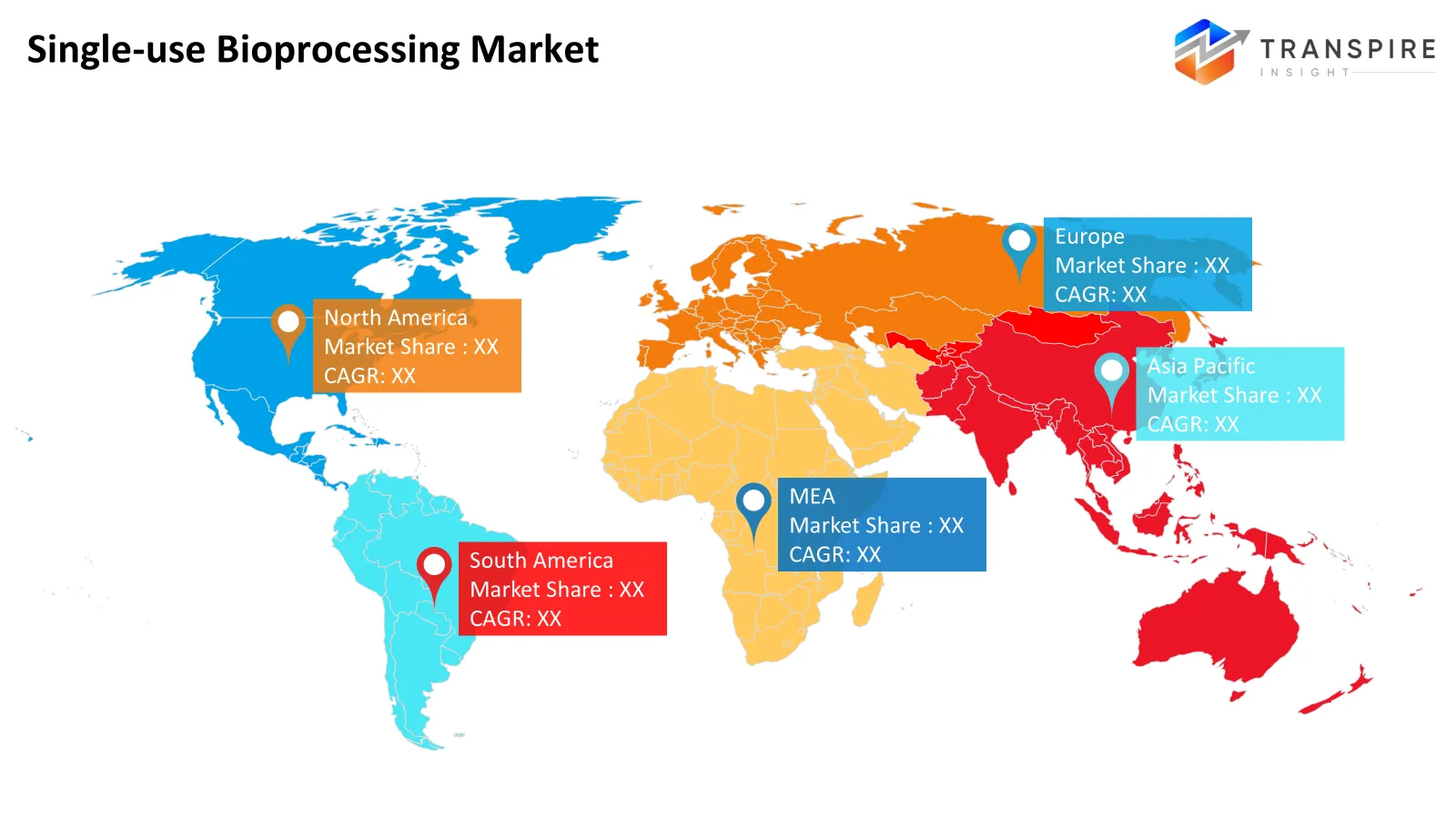
North America currently accounts for 34.70% of the world market and is the leading region due to the large number of biopharmaceutical companies, CDMOs, and cell/gene therapy companies, and a favourable regulatory environment. This is a testament to the region's early adoption of single-use technology and its use in monoclonal antibody, vaccine, and advanced therapy production, where a stringent FDA-quality system is in place and venture and public funding for biologics are robust, as well as a mature network of supplier presence in North America for high-value and customised assemblies.
In October 2026, Catalent entered a commercial supply agreement with Mantra™ for its single-serve oral gel portfolio. This partnership expands consumer health manufacturing capacity at Catalent's St. Petersburg, Florida facility.
Europe comprises 27.20% of the market and has the strength of an established pharmaceutical manufacturing base, advanced biotechnology companies, and stringent quality standards. European manufacturing networks consistently focus on process efficiency, environmental performance, and quality. Sartorius' work in integrated continuous processing highlights European innovation focused on enabling upstream productivity and resource efficiency, and the ability to be adopted by manufacturers looking for better process integration without compromising quality.
In September 2026, Sartorius partnered with the National Institute for Bioprocessing Research and Training (NIBRT) to establish a dedicated training centre for intensified and continuous bioprocessing.
Asia Pacific accounts for 25.00% of the market and is the fastest-growing area. Recent investments in the development of advanced bioprocess design capabilities in the region, such as Thermo Fisher Scientific's Hyderabad centre, and expansions in Singapore and South Korea, are also supporting the increase in regional technical support. Growth of biologics manufacturing capacity in the region and the development of supply networks are creating opportunities for disposable systems at new and expanding facilities. Latin America and the Middle East and Africa, meanwhile, account for 7.00% and 6.10%, respectively, with opportunities arising from localised vaccine production and emerging biomanufacturing infrastructure.
In June 2026, WuXi Biologics completed the modular topping-out of its Singapore drug product facility, designed to produce around 100 million units of pre-filled syringes and vials annually, reinforcing the region's rapid expansion into integrated drug-substance and finished-dose supply.
https://www.wuxibiologics.com/press-release/wuxi-biologics-singapore-crdmo-hub-completes-modular-topping-out-of-drug-product-facility/
Who are the Key Players in the Single-use Bioprocessing Market, and how do they compete?
Competitive differentiation is centred on portfolio breadth, component reliability, process documentation and the ability to support clients from development to commercial manufacturing. Thermo Fisher Scientific combines integrated bioprocessing services with scalable equipment, including its DynaDrive bioreactors. Sartorius emphasises process integration and productivity, while Danaher, through Cytiva and Pall, sells filtration, fluid management and connected process equipment.
Merck KGaA combines filtration, process materials and single-use technologies in order to address complex manufacturing requirements. Repligen builds niche bioprocessing components and process-intensification technologies. Avantor relies on critical materials, distribution and supply chain support. Corning leverages materials science; Eppendorf centres on lab-scale and development applications; and Lonza offers contract manufacturing that links process development to manufacturing. Meissner Filtration markets filtration and fluid-management assemblies; Saint-Gobain and Parker Hannifin offer engineered tubing, polymers and fluid-handling components; and Getinge provides a place to assemble and integrate facility and process equipment. Under such strategies, suppliers continue to expand technical collaborations, bolster component traceability, and develop compatible assemblies. Providers that can provide reliable supply, validated materials, and automation-compatible designs are more likely to be awarded long-term manufacturing contracts.
Key Players are:
- Thermo Fisher Scientific
- Sartorius
- Danaher
- Merck KgaA
- Repligen
- Avantor
- Corning
- Cytiva
- Eppendorf
- Lonza
- Meissner Filtration
- Pall Corporation
- Saint-Gobain
- Parker Hannifin
- Getinge
Single-use Bioprocessing Market — Enhanced Competitive Benchmarking
|
Company |
Est. Revenue Share Range |
Key Offerings |
Strategic Positioning |
Geographic Strength |
Technology Focus |
|
Sartorius AG |
Estimated 12–16% |
BIOSTAT STR bioreactors, Flexsafe bags, Flexel assemblies, Ambr systems |
Integrated upstream platforms with strong consumables ecosystem |
North America, Europe, Asia Pacific |
Scalable bioreactors, sterile fluid paths, process automation |
|
Danaher Corporation (Cytiva and Pall) |
Estimated 15–20% |
Xcellerex bioreactors, Allegro bags, single-use mixers, sterile filtration systems |
Broad workflow integration across upstream and downstream processing |
North America, Europe, Asia Pacific |
Single-use mixing, filtration, process control, integrated platforms |
|
Thermo Fisher Scientific Inc. |
Estimated 9–13% |
DynaDrive bioreactors, HyPerforma systems, BioProcess containers, fluid-transfer assemblies |
End-to-end bioproduction solutions with service support |
North America, Europe, Asia Pacific |
Scalable bioreactors, automated controls, disposable flow paths |
|
Merck KGaA (MilliporeSigma) |
Estimated 8–12% |
Mobius bioreactors, Mobius bags, Flexware assemblies, filtration products |
Materials expertise, regulatory support, integrated process solutions |
North America, Europe, Asia Pacific |
Advanced polymer films, sterile filtration, perfusion technologies |
|
Avantor Inc. |
Estimated 4–7% |
Single-use assemblies, tubing, connectors, fluid-management solutions |
Customized flow paths with supply-chain and distribution strength |
North America, Europe, Asia Pacific |
Engineered assemblies, cleanroom manufacturing, flow-path standardization |
|
Repligen Corporation |
Estimated 2–4% |
XCell ATF systems, KrosFlo TFF systems, single-use filtration components |
Specialized intensification and high-value downstream technologies |
North America, Europe, Asia Pacific |
Alternating tangential flow, TFF, perfusion process intensification |
|
Corning Incorporated |
Estimated 2–4% |
Single-use bioprocess bags, tubing configurations, tank liners, custom assemblies |
Materials-led differentiation and application-specific consumables |
North America, Europe, Asia Pacific |
Polymer films, container integrity, customized fluid-contact materials |
|
Entegris Inc. |
Estimated 1–3% |
Bioprocess tubing, fluid-handling components, connectors and assemblies |
Precision fluid-management components for demanding processes |
North America, Europe, Asia Pacific |
High-purity fluid handling, polymer compatibility, contamination control |
|
Saint-Gobain Life Sciences |
Estimated 1–3% |
Bioprocess tubing, molded components, fluid-transfer assemblies |
Materials specialization and engineered component supply |
North America, Europe, Asia Pacific |
High-purity polymers, tubing performance, chemical compatibility |
|
Meissner Filtration Products Inc. |
Estimated 1–3% |
Sterile filtration products, single-use assemblies, filtration systems |
Filtration-focused specialization and customised process solutions |
North America, Europe, Asia Pacific |
Sterilizing filtration, aseptic assemblies, fluid-path integrity |
Recent Development News
- In August 2026, Cobetter launched its Lifecask™ RT Single-Use Bioreactor Bags for biological upstream processing. The product expands its single-use portfolio and provides biopharmaceutical manufacturers with a scalable option to support flexible production, supply reliability, and cost-efficient bioprocessing operations. https://cobetter.com/product-launch/lifecask-rt-singleuse-bioreactor-bags-now-officially-launched.html
- In July 2026, CPC Biotech, part of PSG and Dover, launched the RevolveSD™ Series, a one-inch single-use sterile disconnect for bioprocessing applications. The product enables faster sterile tubing disconnections without specialized equipment, helping reduce setup time, minimize fluid leakage, and lower the risk of contamination during biopharmaceutical manufacturing. https://investors.dovercorporation.com/node/29191
- In March 2026, Cytiva launched a strategic collaboration with the San Raffaele Telethon Institute for Gene Therapy. This partnership accelerates the development of next-generation genomic medicine platforms by streamlining translational bioprocessing workflows and enhancing single-use manufacturing precision. https://www.cytivalifesciences.com/en/us/about-us/newsroom
What Strategic Insights Define the Future of the Single-use Bioprocessing Market?
The market's evolution is towards integrated automation-ready platforms for connecting upstream cultivation, downstream purification, and sterile transfer, rather than capturing single-component disposables as a standalone purchase. Suppliers with reproducible performance, material compatibility, and dependable delivery will have a distinct advantage as biomanufacturers ramp up complex biologics and next-generation therapies.
The number of qualified vendors with critical consumables is likely to be a small cluster; there's a risk of component changes and requalification requirements leading to increased compliance costs and slowing down production. Meanwhile, regulatory oversight and guidance are tightening; USP General Chapter 665 will be official from 1 May 2026, requiring qualified plastic parts used in biomanufacturing. Emerging opportunities include the APAC region's move toward local, in-country technical support and new manufacturing site development, reducing dependence on remote suppliers. Over time, it will become essential to focus on dual sourcing qualification, lifecycle waste management policies, and interoperable digital monitoring to get the best balance of flexible production with assured quality, resilience, and sustainability for the future.
Key Segmentations are:
Product Type
- Simple & Peripheral Elements
- Apparatus & Plants
- Single-Use Bioreactors
- Filtration Systems
- Media Bags
- Storage Bags
- Tubing & Connectors
- Sampling Systems
Workflow
- Upstream
- Downstream
- Fill-Finish
- Media Preparation
- Buffer Preparation
- Cell Harvesting
- Formulation
Material
- Polyethene
- Polypropylene
- PVC
- Elastomers
- Fluoropolymers
- Thermoplastic Elastomers
- Other Polymers
End User
- Biopharmaceutical Manufacturers
- Pharmaceutical Manufacturers
- Academic & Clinical Research Institutes
- Contract Manufacturing Organisations
- Contract Research Organisations
- Diagnostic Laboratories
- Cell & Gene Therapy Companies
Application
- Monoclonal Antibodies
- Vaccines
- Recombinant Proteins
- Cell Therapy
- Gene Therapy
- Blood Products
- Biosimilars
- Other Biologics
Process Stage
- Research & Development
- Preclinical
- Clinical Manufacturing
- Commercial Manufacturing
- Fill-Finish
- Quality Control
- Storage
By Regional Analysis
North America
- US
- Canada
- Mexico
Europe
- Germany
- UK
- France
- Italy
- Spain
- Russia
- Rest of Europe
Asia Pacific
- China
- Japan
- India
- South Korea
- Australia
- Rest of Asia Pacific
South America
- Brazil
- Argentina
- Rest of South America
Middle East & Africa
- UAE
- Saudi Arabia
- Qatar
- South Africa
- Rest of the Middle East & Africa
Frequently Asked Questions
Find quick answers to common questions.
The single-use bioprocessing market was valued at USD 37.8 billion in 2025 and is expected to reach USD 80.4 billion by 2033, growing at a 10.06% CAGR.
Key segments for the single-use bioprocessing market are Product Type (Simple & Peripheral Elements, Apparatus & Plants, Single-Use Bioreactors, Filtration Systems, Media Bags, Storage Bags, Tubing & Connectors, Sampling Systems); Workflow (Upstream, Downstream, Fill-Finish, Media Preparation, Buffer Preparation, Cell Harvesting, Formulation); Material (Polyethylene, Polypropylene, PVC, Elastomers, Fluoropolymers, Thermoplastic Elastomers, Other Polymers); End User (Biopharmaceutical Manufacturers, Pharmaceutical Manufacturers, Academic & Clinical Research Institutes, Contract Manufacturing Organizations, Contract Research Organizations, Diagnostic Laboratories, Cell & Gene Therapy Companies); Application (Monoclonal Antibodies, Vaccines, Recombinant Proteins, Cell Therapy, Gene Therapy, Blood Products, Biosimilars, Other Biologics); Process Stage (Research & Development, Preclinical, Clinical Manufacturing, Commercial Manufacturing, Fill-Finish, Quality Control, Storage).
Growth is primarily driven by the expansion of biologics manufacturing, rising adoption of monoclonal antibodies and cell and gene therapies, demand for flexible production facilities, reduced cleaning and validation requirements, and advancements in integrated disposable processing systems.
The single-use bioprocessing market is led by major manufacturers, including Thermo Fisher Scientific, Sartorius, Danaher, Merck KGaA, Repligen, Avantor, Corning, Cytiva, Eppendorf, Lonza, Meissner Filtration, Pall Corporation, Saint-Gobain, Parker Hannifin, and Getinge.
North America holds a 34.70% market share, supported by established biopharmaceutical manufacturing infrastructure, strong biotechnology research, extensive CDMO networks, advanced biologics pipelines, and stringent quality requirements.
Key opportunities include integrated single-use assemblies, automated downstream processing, advanced therapy manufacturing, regional biomanufacturing expansion in Asia Pacific, and sustainable disposable materials and waste-management solutions.
- Thermo Fisher Scientific
- Sartorius
- Danaher
- Merck KgaA
- Repligen
- Avantor
- Corning
- Cytiva
- Eppendorf
- Lonza
- Meissner Filtration
- Pall Corporation
- Saint-Gobain
- Parker Hannifin
- Getinge
About the Authors

Pankaj Ghogare Patil
I am Pankaj Ghogare Patil, a Senior Research Analyst at Transpire Insight, specializing in the Pharmaceutical, Chemicals & Materials, Healthcare IT, and Biotechnology industry. My expertise lies in conducting comprehensive market research, analyzing industry trends, evaluating competitive landscapes, and translating complex data into actionable insights. At Transpire Insight, I closely follow emerging technologies, regulatory developments, and market innovations to create accurate, well-researched, and informative content that helps businesses and professionals make informed decisions. I am committed to producing credible, evidence-based articles that reflect industry best practices while making technical topics accessible and valuable for a broad audience.

Chakradhar Khansole
Chakradhar serves as the Research Director at Transpire Insight, bringing over 8 years of experience in technology, innovation, and strategic market intelligence. He specializes in transforming complex market data into actionable business insights that enable organizations to make informed, growth-oriented decisions. Recognized for his strategic vision and analytical expertise, Chakradhar leads high-impact research initiatives, delivering comprehensive market assessments, competitive intelligence, and forward-looking industry analysis.
Recently Published Reports
-
Apr 2026
Cord Blood Banking Services Market
Cord Blood Banking Services Market Size, Share & Analysis Report By Type of Service (Collection, Processing, Storage), By Bank Type (Private Banks, Public Banks, and Hybrid Banks), By Component (Cord Blood, and Cord Tissue), By End User (Hospitals, Research Institutions, Biotechnology Companies, and Others) and Geography (North America, Europe, Asia-Pacific, Middle East and Africa, South and Central America), 2021 - 2031
-
Apr 2026
ELISA Processors Market
ELISA Processors Market Size, Share & Analysis Report By Type (Optical Filter ELISA Analyzer, and Optical Grating ELISA Analyzers), By Mode (Automated ELISA Analyzers, and Semi-Automated ELISA Analyzers), By Applications (Immunology, Vaccine development, Drug Monitoring, and Others), By End Users (Biotechnology Companies, Pharmaceutical Companies, Contract Research Organization, and Diagnostic Laboratories) and Geography (North America, Europe, Asia-Pacific, Middle East and Africa, South and Central America), 2021 - 2031
-
May 2026
Microscope Slide Scanner Market
Microscope Slide Scanner Market Size, Share & Analysis Report By Type (Portable Microscope Slide Scanner, and Desktop Microscope Slide Scanner), By Application (Biological Research, Medicine, Veterinary, and Other) and Geography (North America, Europe, Asia-Pacific, Middle East and Africa, South and Central America), 2021 - 2031
-
Apr 2026
Microwave Cookware Market
Microwave Cookware Market Size, Share & Analysis Report By Material Type (Plastic, Glass, Ceramic, Silicone, and Metal), By Application (Cooking, Reheating, and Defrosting), By End User (Household, Commercial (Restaurants, Hotels, and Cafes), and Food Service Industry), By Sales Channel (Online Retail, Offline Retail (Supermarkets, Hypermarkets, Specialty Stores), and Direct Sales (Company Outlets)) and Geography (North America, Europe, Asia-Pacific, Middle East and Africa, South and Central America), 2021 - 2031