

Secure Code Review Platforms Market Summary:
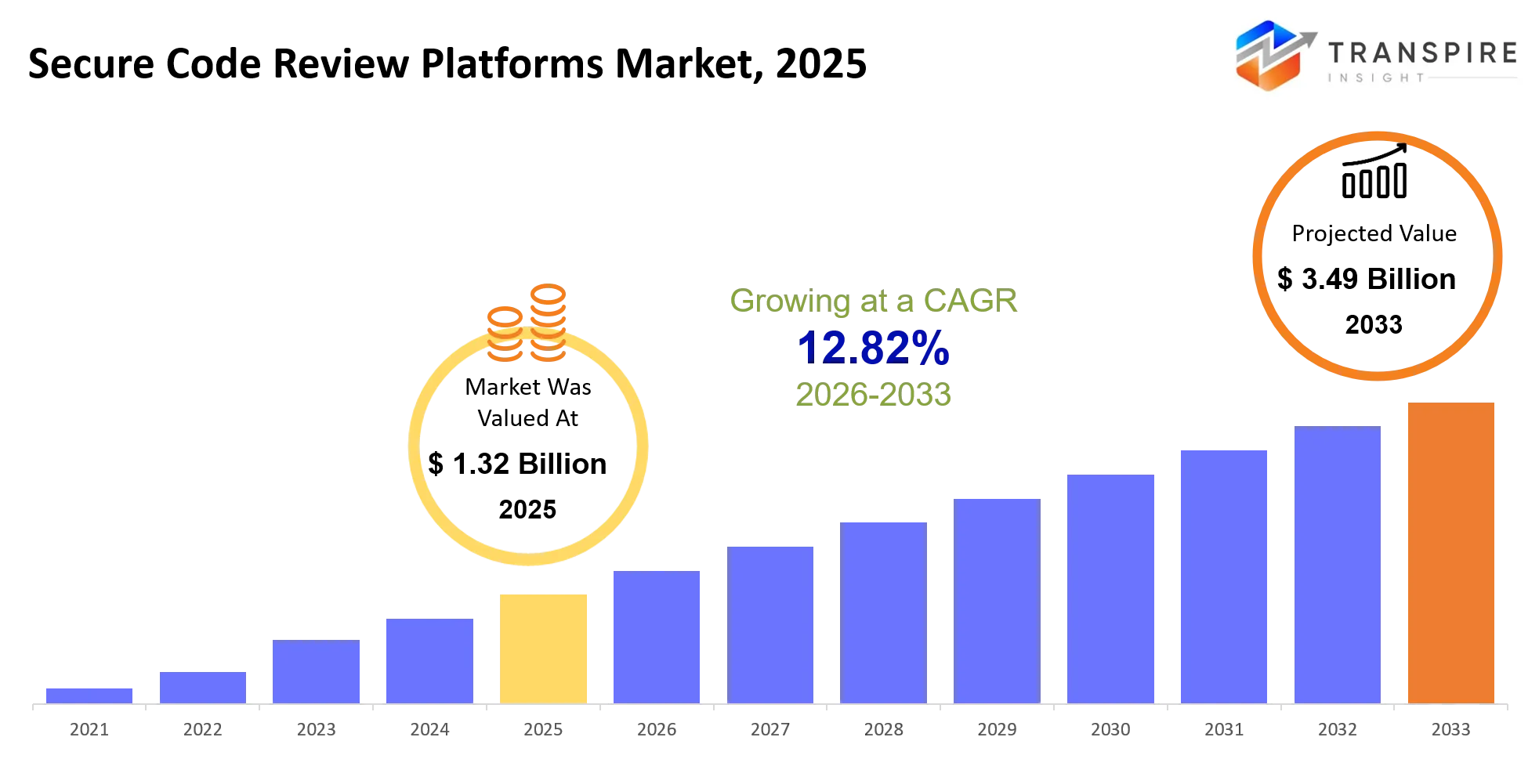
As per the Transpire Insight Analysis, The Secure Code Review Platforms Market size is estimated at USD 1.32 billion in 2025 and is anticipated to reach USD 3.49 billion by 2033, growing at a CAGR of 12.82% from 2026 to 2033.
secure code review platforms help dev teams identify app code security flaws before it ships. The platforms embed security into repositories, IDEs, and continuous integration/continuous delivery processes instead of relying on audits during the latter phases of delivery. In the past three-to-five years, the market has matured from rule-based static scanning to now include AI-assisted, context-aware reviews that can prioritise findings, explain the severity and risks of security flaws, and recommend remediations. The structural shift in the market means this is a convergence of security testing, dev flow, and AI-based generation. One relevant direct trigger is the fast-growing supply of AI-generated code, 45% of which failed security tests and presented OWASP Top 10 vulnerabilities in the 2025 analysis, Veracode noted. Overall, the growth is fueled by a causal relationship: faster AI-assisted development drives more code, more untested risks, and thus the need for enterprises to automate secure reviews earlier in the software lifecycle.
Secure Code Review Platforms Market Size & Forecast:
- Market Size 2025: USD 1.32 Billion
- Expected Market Value (2033): USD 3.49 Billion
- Forecast CAGR (2026–2033): 12.82%
- Leading Region in 2025: North America
- Fastest Growing Region: Asia Pacific
- Key Company Profiles: Epic Systems, Oracle Health, MEDITECH, Veradigm, eClinicalWorks, NextGen Healthcare, athenahealth, GE HealthCare, Siemens Healthineers, Philips, Allscripts, CPSI, Greenway Health, InterSystems, Tietoevry.
Key Secure Code Review Platforms Market Insights:
The market is shifting from a standalone vulnerability scanning tool to an integrated, AI-powered secure development platform that integrates detection, prioritisation, and remediation. The new competitive advantage is to minimise developer friction, demonstrate compliance readiness, and ensure AI-generated code.
- Static application security testing accounts for 36.8% of review-type demand, and Synopsys' Fortify portfolio is growing with enterprise-scale SAST and software composition analysis.
- AI-assisted review is 11% of the market and is growing at 20.4% CAGR, with Sonar focusing on AI Code Assurance and automated remediation.
- Cloud deployment is the preferred adoption model, and GitHub has integrated security controls directly into developer repositories and pull-request workflows.
- GitLab is tackling an integrated DevSecOps approach, standing out with its comprehensive source code management, CI/CD, dependency scanning, and security policy enforcement capabilities.
- Checkmarx differentiates itself by its application security innovation, which includes contextual code analysis and developer-centric remediation.
- Veracode's business model is a managed-service and risk-prioritisation approach to helping enterprises translate the scan results into actionable remediation programs.
- Snyk and Black Duck are beefing up the security of supply chains with dependency intelligence, open-source risk visibility and developer workflow integration.
- Mend.io keeps rolling out new languages and vulnerabilities: In October 2026, it expanded its SAST coverage to include detection of sensitive-cookie and externally controlled critical-state-data risks in Python and Java.
- Secure Code Warrior is standing out by focusing on behaviour modification: It connects insights gained from Fortify, Black Duck, and Snyk to language-specific secure-coding training.
What are the Key Drivers, Restraints, and Opportunities in the Secure Code Review Platforms Market?
Driver:
The main growth driver is the acceleration of AI-assisted software development, which increases code output and places pressure on security teams to review changes without slowing releases. Automated pull-request checks, vulnerability prioritisation, and suggested fixes help developers resolve problems earlier, reducing expensive post-release remediation. The US National Institute of Standards and Technology's draft update to its Secure Software Development Framework reinforced the importance of structured software security practices. This supports adoption among organisations seeking repeatable, auditable review processes.
Restraint:
Integration complexity remains a significant barrier. Large enterprises often operate multiple repositories, legacy applications, programming languages, and development pipelines, making consistent policy enforcement difficult. False positives and poorly contextualised findings also consume developer time, while licensing, infrastructure, and specialist staffing costs can discourage smaller businesses. These issues persist because security tools must understand application architecture and business context, not merely flag suspicious code patterns.
Opportunity:
AI-assisted remediation, private deployments, and software supply-chain governance offer substantial opportunities. For example, organisations serving European customers can invest in review platforms that maintain vulnerability records, document remediation decisions, and connect findings with reporting workflows following the EU Cyber Resilience Act's changes. Vendors that combine explainable findings, policy controls, and integrations with existing developer tools can improve enterprise adoption and generate recurring revenue through premium security capabilities and managed services.
What Has the Impact of Artificial Intelligence Been on the Secure Code Review Platforms Market?
AI shifts secure code review from an advanced pattern matcher to a sophisticated layer of decision support. Automation models are already used to review pull requests, detect vulnerable coding paths, classify severity, and suggest patches inside developer tooling-a trend further underscored by Sonar's 2025 announcement of AI Code Assurance and AI Code Fix for one-click remediation. Predictively, AI models mapping code change events against historic vulnerabilities, dependency threats, runtime intelligence, and actor behaviour enable prioritisation of "likely-to-be-exploited" issues. Operationally, it reduces the need for manual triaging, shortens remediation lifecycles, and allows security teams to scale review across large repo estates and continuous delivery pipelines. The impact is amplified by the deluge of code coming from AI. Veracode's research found that 45% of its sample set of AI-written code failed its scan checks, creating an absolute imperative to validate machine-authored logic. However, AI hasn't solved the accuracy gap altogether. False positives, inability to detect business logic defects, narrow visibility into vast legacy codebases, and the cost of maintaining, patching, and tooling up models with existing DevSecOps infrastructure continue to create drag for enterprise uptake. Therefore, we are seeing the market gravitate to hybrid workflows: where AI accelerates the initial, and humans validate the impact.
In March 2026, Snyk launched its new Agent Security solution and announced the general availability of Snyk Evo AI-SPM. This deployment governs autonomous coding agents from development through production, turning AI policy into enforceable controls across the agentic lifecycle.
https://snyk.io/news/snyk-launches-agent-security-solution/
Key Secure Code Review Platforms Market Trends:
The market is heading towards security systems that are always running during delivery, not as standalone scanning tools. Contextual accuracy, automated remediation, and governance of human-written and AI-generated code are becoming key factors in competitive differentiation.
- The use of AI-assisted review has increased from 22% of developers in 2024 to 47% in 2025, and is now part of their standard workflow.
- Vendors are integrating SAST, SCA, secrets detection, and remediation into a single application security platform.
- AI-generated code is generating a new review category to validate machine-written logic and to ensure that there are no insecure defaults.
- Findings are becoming a standard part of the developer's workflow, not just a part of a security dashboard.
- As teams look for actionable, context-rich results, false positive management is emerging as a growing purchasing priority.
- Regulatory forces are forcing vendors to meet the demand for audit trails, vulnerability-handling documentation, and documentation of secure development.
- The EU Cyber Resilience Act is driving up dependency and vulnerability review needs.
- Businesses are associating code vulnerabilities with cloud, runtime, and API context to prioritise vulnerabilities that can be exploited.
- Automated suggestions for fixes are changing expectations for buyers from detection-only to measurable remediation outcomes.
Secure Code Review Platforms Market Segmentation
By Offering:
Software remains the market’s core revenue contributor as organisations invest in scanning engines, developer plug-ins, and policy modules integrated with repositories and CI/CD pipelines. Services, consulting, managed review, integration, support, and training complement these tools by helping enterprises configure detection rules, remediate legacy vulnerabilities, and maintain compliance evidence. As security requirements become more complex, purchasing is shifting from standalone software deployments toward recurring service contracts that provide continuous monitoring, implementation expertise, and ongoing security optimisation.
By Review Type:
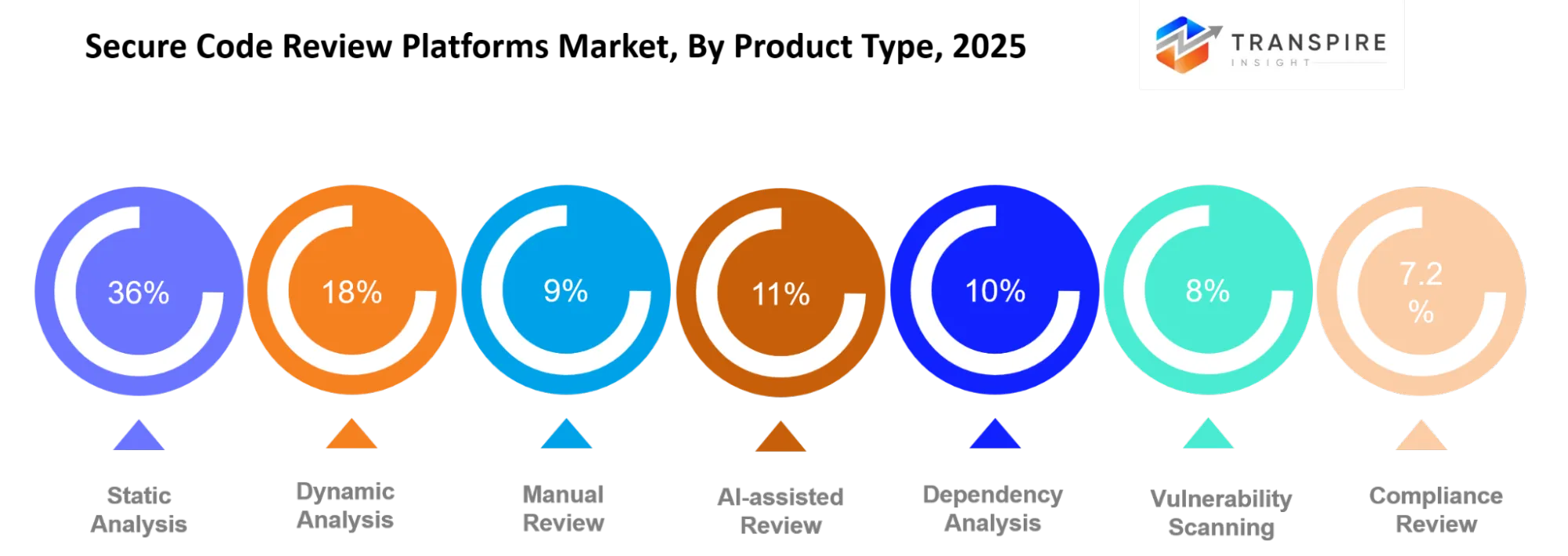
For static application security testing (SAST), which tops the list at 36.8%, code vulnerabilities are detected before the app runs to facilitate DevSecOps processes and compliance audits. For 18%, dynamic analysis is used to check that the app runs. Manual review plays a part for 9%, still useful for more complex business-logic bugs; AI-assisted review accounts for 11% and is set to grow at a CAGR of 20.4%, in part thanks to contextual analysis, automated triage, and remediation guidance. Dependency analysis makes up 10%, vulnerability scanning 8%, compliance review 4%, and everything else 3.2%, in part due to more attention paid to software supply-chain security and audit-readiness.
By Deployment:
Static application security testing leads with 36.8% because it inspects source code early in the development cycle, before deployment, making it well suited to DevSecOps and compliance-driven industries. Dynamic analysis holds 18% by validating running applications, while manual review accounts for 9% and remains essential for identifying complex business-logic risks. AI-assisted review, at 11%, is the fastest-moving category with a 20.4% CAGR, supported by automated triage, contextual analysis, and remediation guidance. Dependency analysis represents 10%, vulnerability scanning 8%, compliance review 4%, and others 3.2%, reflecting growing focus on supply-chain security and audit readiness.
By Enterprise Size:
Large enterprises remain the primary revenue contributors because complex application portfolios, regulatory exposure, and extensive development teams require centralised security controls. SMEs and startups increasingly adopt SaaS platforms because lower upfront costs and automated reviews reduce dependence on in-house application-security specialists. Financial institutions prioritise protection of sensitive transactions, while technology companies require continuous code validation. Government organisations also invest in secure development processes to strengthen accountability, protect critical systems, and meet applicable cybersecurity requirements.
By Application:
Web applications and APIs remain major adoption areas as organisations expand digital services, interconnected platforms, and machine-to-machine communication. Mobile applications and cloud applications require continuous testing as frequent releases introduce new vulnerabilities. Enterprise software benefits from centralised review across interconnected business systems, while embedded software security is gaining importance in connected devices and industrial products. DevOps integration enables earlier detection throughout development. The EU Cyber Resilience Act further strengthens incentives for manufacturers to manage vulnerabilities across connected products and their software lifecycles.
By Language:
Java, JavaScript, Python, C/C++, and C# remain important because they support enterprise applications, web services, cloud platforms, and embedded systems. Python adoption is benefiting from AI and data engineering, while JavaScript remains essential for web development. C/C++ continues to require specialised analysis because memory-safety weaknesses can affect automotive, industrial, and connected-device security. Go is gaining relevance in cloud-native infrastructure, while Ruby retains application-development use cases. Broader language coverage helps enterprises apply consistent security policies across diverse repositories and development environments.
What are the Key Use Cases Driving the Secure Code Review Platforms Market?
The primary use case is pre-release vulnerability detection through static analysis, the leading review category at 36.8%. Teams scan source code and pull requests for injection flaws, insecure authentication, exposed secrets, and unsafe coding patterns before deployment, reducing remediation costs.
Expanding applications include API security, mobile application testing, cloud-native development, and dependency validation. BFSI and healthcare organisations use these capabilities to strengthen controls over sensitive data, while technology companies embed reviews into CI/CD pipelines to maintain release speed.
Emerging use cases include security validation of AI-generated code, automated patch verification, and governance of autonomous coding agents. These workflows help organizations identify risky changes, enforce approved coding policies, and retain evidence for audits as software production becomes increasingly automated.
|
Report Metrics |
Details |
|
Market size value in 2025 |
USD 1.32 Billion |
|
Market size value in 2026 |
USD 1.5 Billion |
|
Revenue forecast in 2033 |
USD 3.49 Billion |
|
Growth rate |
CAGR of 12.82% from 2026 to 2033 |
|
Base year |
2025 |
|
Historical data |
2021 - 2024 |
|
Forecast period |
2026 - 2033 |
|
Report coverage |
Revenue forecast, competitive landscape, growth factors, and trends |
|
Regional scope |
United States; Canada; Mexico; United Kingdom; Germany; France; Italy; Spain; Denmark; Sweden; Norway; China; Japan; India; Australia; South Korea; Thailand; Brazil; Argentina; South Africa; Saudi Arabia; United Arab Emirates |
|
Key companies profiled |
Synopsys, Checkmarx, Veracode, GitLab, GitHub, Snyk, Sonar, Semgrep, Fortify, Contrast Security, Secure Code Warrior, Mend.io, Black Duck, Invicti, OpenText |
|
Customization scope |
Free report customization (country, regional & segment scope). Available customised purchase options to meet your exact research needs. |
|
Report Segmentation |
By Offering (Software, Services, Platforms, Consulting, Managed Services, Integration, Support, Training); By Review Type (Static Analysis, Dynamic Analysis, Manual Review, AI-assisted Review, Dependency Analysis, Vulnerability Scanning, Compliance Review, Others); By Deployment (Cloud, On-premise, Hybrid, SaaS, Private Cloud, Public Cloud, Hosted, Others); By Enterprise Size (Large Enterprises, SMEs, Startups, Mid-sized, Government, Financial Institutions, Technology Companies, Others); By Application (Web Applications, Mobile Applications, APIs, Cloud Applications, Enterprise Software, Embedded Software, DevOps, Others); By Language (Java, Python, JavaScript, C/C++, C#, Go, Ruby, Others); By End User (BFSI, IT & Telecom, Healthcare, Government, Retail, Manufacturing, Media, Others). |
Which Regions are Driving the Secure Code Review Platforms Market Growth?
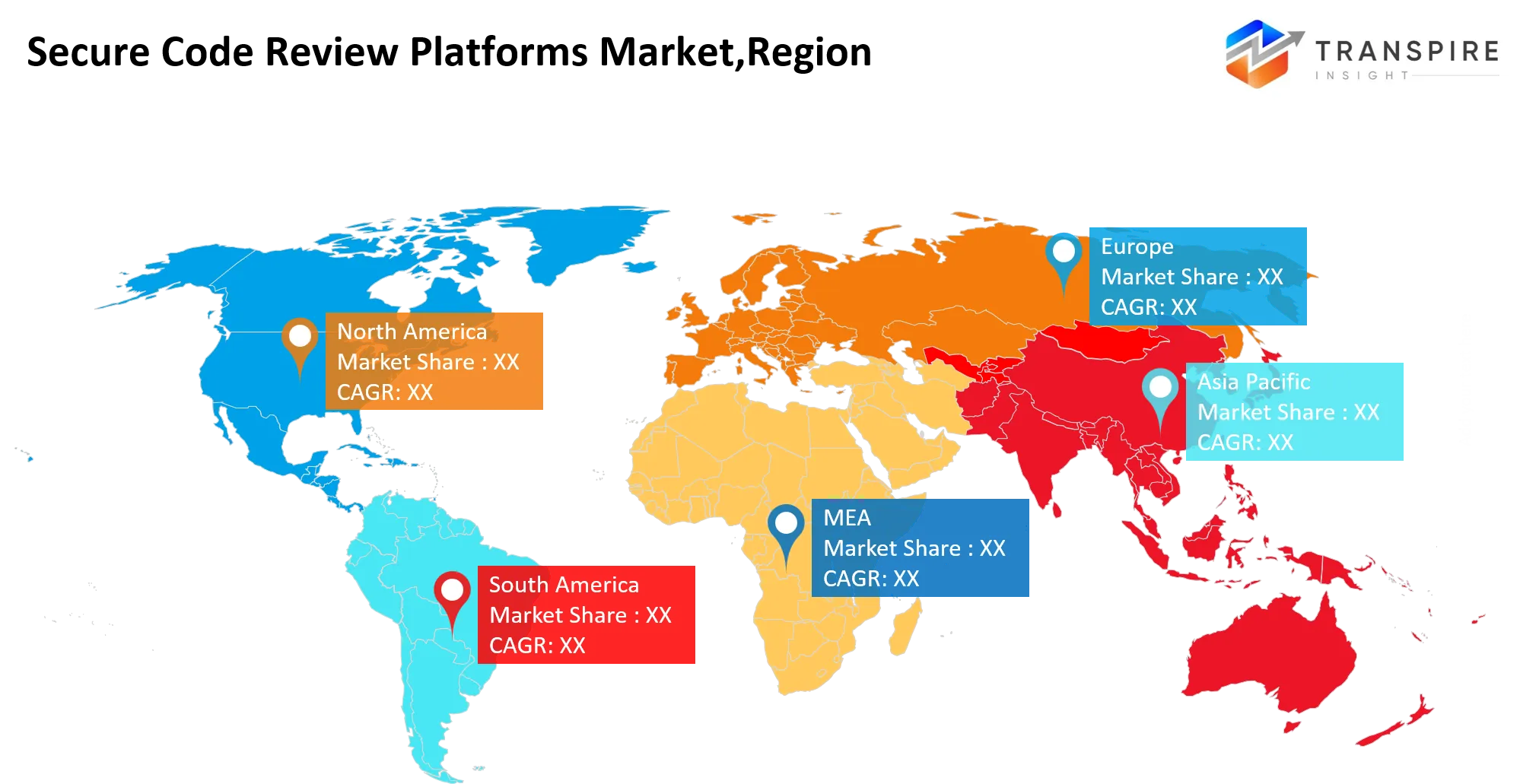
North America has been a historically dominant market, representing 43.5% of market share, driven by its large number of software vendors, cloud-native companies, and highly regulated financial and healthcare institutions. Well-funded cybersecurity programs, mature DevSecOps approaches, and requirements from enterprise purchase cycles make secure code review a natural gate in the software development process. North America benefits from the leading security vendor community and the market's first movers on AI-assisted coding, creating the need for automated security flaw detection, automated remediation, and ongoing software assurance.
In February 2026, Anthropic launched Claude Code Security. This product launch introduces specialised application security capabilities into the development lifecycle, utilising its Claude 4.6 framework to autonomously scan production environments.
https://www.mindfort.ai/blog/best-code-security-tools
Europe accounts for 28% of the market, where demand is driven more by regulatory accountability and the governance of software supply chains than by the advantage of North America's technology spend. The European Union Cyber Resilience Act and the NIS2 framework validate the focus on vulnerability management, secure-by-design development and demonstrable remediation. Financial services, manufacturing and enterprise software companies are demanding ever more proof that security issues are actively detected and corrected, which supports regular demand for platforms to provide audit trails, managed deployment and integration into current governance processes.
In October 2026, the EU-backed initiative SECURE launched its second cascade funding call, allocating €11.5 million in grants to help European micro, small, and medium-sized enterprises (SMEs) adapt to the regulatory requirements of the European Union Cyber Resilience Act.
The Asia Pacific market contributes 22% and is forecast to grow at a CAGR of 19.2%, the fastest-growing market globally. Increased adoption of software outsourcing, migration to the cloud, digital banking, and AI-assisted development is driving greater volumes of code that require security review. Countries including India, Japan, South Korea, and Australia have the potential to adopt this technology, as organisations build their application-security function to support clients. Vendors that can provide affordable deployment options, localised handholding, and scale-up AI-assisted review will address the needs of growing developer teams and businesses that are digital-first.
In October 2026, HCLTech signed a Premier Partnership with Anthropic to establish a dedicated Anthropic Business Unit and integrate Claude and Claude Code into its software engineering systems.
Who are the Key Players in the Secure Code Review Platforms Market, and how do they compete?
The paradigm is shifting from scanner accuracy to workflow ownership. Vendors are competing to be the default security layer in repositories, IDEs, and CI/CD pipelines. And vendors are consolidating-integrating the ability to do all of it, with SAST, software composition analysis, secrets detection, and even Remediation, into a single, all-encompassing application-security platform.
Enterprise-platform approach, highlighting Fortify's static analysis strengths, ability to support a regulated large-scale software footprint. Checkmarx: Innovation in developer-centric application security, utilising contextual analysis and remediation guidance to reduce friction in fast-moving engineering organisations. Veracode: Managed application security and risk prioritisation, allowing for broadening beyond scanning and reporting to help enterprises operationalise findings. GitHub vs. Git Lab - Competition between platform integration: GitHub embeds security into the world's largest developer community collaboration platform, while Git Lab takes advantage of one platform for all DevSecOps tools to reduce tool sprawl. Snyk, Black Duck, and Mend.io focus on the open source and supply chain space, where dependency risk and license visibility are important. Sonar and Semgrep focus on inexpensive, developer-first adoption; Contrast Security has a distinctive runtime application self-protection feature; Secure Code Warrior uses training-led prevention to connect to scanner results.
Key players are:
- Synopsys
- Checkmarx
- Veracode
- GitLab
- GitHub
- Snyk
- Sonar
- Semgrep
- Fortify
- Contrast Security
- Secure Code Warrior
- Mend.io
- Black Duck
- Invicti
- OpenText
Recent Development News
In September 2026, Qodo launched its Agentic Toolbox, a suite of AI agent tools designed to integrate independent code review and governance into AI-assisted development workflows. The launch enables engineering teams to assess code changes before pull requests, identify potential risks, enforce organizational coding standards, and address review findings earlier in the development process.
http://finance.yahoo.com/technology/ai/articles/qodo-launches-first-agent-agent-130000467.html
In May 2026, Sonar acquired Gitar, an AI-native code review platform, to integrate automated code review with its code verification capabilities. The acquisition strengthens continuous code quality and security checks, helping development teams identify and resolve vulnerabilities in AI-generated code earlier in the software development lifecycle.
https://www.sonarsource.com/company/press-releases/sonar-acquires-gitar/
In September 2026, Carahsoft Technology Corp. expanded its partnership with Sonar. This distribution alignment scales the commercial availability of the SonarQube validation platform across North American markets, empowering enterprise teams to enforce zero-trust code verification and contain security risks within agentic development workflows.
What Strategic Insights Define the Future of the Secure Code Review Platforms Market?
The market is evolving towards a new paradigm of secure development assurance - with platforms assessed by verified, reduced security workload, and audit-ready evidence of human and AI coding. The inherent danger is falling back into tool reliance without the proper context - with enterprises adding more scanners that create alert fatigue, duplicate findings, and slip releases. We are not gaining better security outcomes. However, AI-code assurance presents a new opportunity for vendors to confidently audit AI-generated code, assign risk owners, and automate safe remediation. As AI coding tools accelerate software development, enterprises need trusted controls that maintain speed and productivity but preserve security and even reduce risk. Platform vendors should focus on deep integration with developer workflows, improved false positive elimination, and clear remediation audit trails. Enterprise buyers should consider verified outcomes such as time-to-remediate and easy-to-track improvements in risks exposed and productivity. Evidence aligned to the EU Cyber Resilience Act will give additional platforms a worthiness challenge. Those vendors who safely combine automation, context, and governance will have a better chance of long-term enterprise success.
Key Segmentations are:
By Offering
- Software
- Services
- Platforms
- Consulting
- Managed Services
- Integration
- Support
- Training
By Review Type
- Static Analysis
- Dynamic Analysis
- Manual Review
- AI-assisted Review
- Dependency Analysis
- Vulnerability Scanning
- Compliance Review
- Others
By Deployment
- Cloud
- On-premises
- Hybrid, SaaS
- Private Cloud
- Public Cloud
- Hosted
- Others
By Enterprise Size
- Large Enterprises
- SMEs
- Startups
- Mid-sized
- Government
- Financial Institutions
- Technology Companies
- Others
By Application
- Web Applications
- Mobile Applications
- APIs
- Cloud Applications
- Enterprise Software
- Embedded Software
- DevOps
- Others
By Language
- Java
- Python
- JavaScript
- C/C++
- C#
- Go
- Ruby
- Others
By End User
- BFSI
- IT & Telecom
- Healthcare
- Government
- Retail
- Manufacturing
- Media
- Others
Frequently Asked Questions
Find quick answers to common questions.
The secure code review platforms market size was valued at USD 1.32 billion in 2025 and is poised to reach USD 3.49 billion by 2033, expanding at a 12.82% CAGR
Key segments for the secure code review platforms market are By Offering (Software, Services, Platforms, Consulting, Managed Services, Integration, Support, Training); By Review Type (Static Analysis, Dynamic Analysis, Manual Review, AI-assisted Review, Dependency Analysis, Vulnerability Scanning, Compliance Review, Others); By Deployment (Cloud, On-premise, Hybrid, SaaS, Private Cloud, Public Cloud, Hosted, Others); By Enterprise Size (Large Enterprises, SMEs, Startups, Mid-sized, Government, Financial Institutions, Technology Companies, Others); By Application (Web Applications, Mobile Applications, APIs, Cloud Applications, Enterprise Software, Embedded Software, DevOps, Others); By Language (Java, Python, JavaScript, C/C++, C#, Go, Ruby, Others); By End User (BFSI, IT & Telecom, Healthcare, Government, Retail, Manufacturing, Media, Others).
Growth is primarily driven by AI-assisted software development, rising cybersecurity threats, DevSecOps adoption, stricter regulatory requirements, and increasing demand for automated vulnerability detection and remediation.
The market is led by major manufacturers, including Synopsys, Checkmarx, Veracode, GitLab, GitHub, Snyk, Sonar, Semgrep, Fortify, Contrast Security, Secure Code Warrior, Mend.io, Black Duck, Invicti, and OpenText.
North America dominates with a 43.5% share, supported by strong cybersecurity spending, mature DevSecOps adoption, established technology vendors, and stringent enterprise security requirements.
Key opportunities include AI-powered code review, automated remediation, software supply-chain security, managed security services, and compliance-focused solutions.
About the Authors

Mayur Shinde
I am Mayur Shinde, a Senior Research Analyst at Transpire Insight, specializing in the Automotive & Transportation and Information & Communication Technology (ICT) Industry. My work focuses on analyzing emerging market trends, technological advancements, competitive landscapes, and industry developments to deliver accurate, data-driven insights. I am passionate about transforming complex market information into clear, actionable content that helps businesses, professionals, and decision-makers stay informed and make confident strategic decisions.

Chakradhar Khansole
Chakradhar serves as the Research Director at Transpire Insight, bringing over 8 years of experience in technology, innovation, and strategic market intelligence. He specializes in transforming complex market data into actionable business insights that enable organizations to make informed, growth-oriented decisions. Recognized for his strategic vision and analytical expertise, Chakradhar leads high-impact research initiatives, delivering comprehensive market assessments, competitive intelligence, and forward-looking industry analysis.
Recently Published Reports
-
Apr 2026
3D Optical Profiler Market
3D Optical Profiler Market Size, Share & Analysis Report By Type (Desktop 3D Optical Profiler, and Portable 3D Optical Profiler), By Technology (Confocal Technology, and White Light Interference), By End-Use Industry (Manufacturing, Research Institutions, Automotive, Aerospace and Defense, Medical Devices, and Other), and Geography (North America, Europe, Asia-Pacific, Middle East and Africa, South and Central America), 2021 - 2031
-
Apr 2026
Depth Sensor Market
Depth Sensor Market Size, Share & Analysis Report By Type (Infrared Depth Sensors, Time-of-Flight (ToF) Sensors, Stereo Vision Sensors, Structured Light Sensors, Ultrasonic Depth Sensors), By Application (Automotive, Robotics, Gaming, Consumer Electronics, Industrial Automation, Healthcare, Security & Surveillance, Others), By End Users (Automotive Manufacturers, Consumer Electronics Companies, Healthcare Providers, Industrial Companies, Security Agencies, Gaming Companies, Robotics Companies, Others), and Geography (North America, Europe, Asia-Pacific, Middle East and Africa, South and Central America), 2021 – 2031
-
Apr 2026
Digital Manufacturing Market
Digital Manufacturing Market Size, Share & Analysis Report By Component (Hardware, Software, and Services), By Technology (Robotics, 3D Printing, Internet of Things (IoT), and Others), By Application (Automotive and Transportation, Aerospace and Defense, Consumer Electronics, Industrial Machinery, and Others), By Process Type (Computer-Based Designing, Computer-Based Simulation, Computer 3D Visualization, Analytics, and Others), and Geography (North America, Europe, Asia-Pacific, Middle East and Africa, South and Central America), 2021 – 2031
-
Apr 2026
Digital Visa Services Market
Digital Visa Services Market Size, Share & Analysis Report By Type (Individual Travelers, Group Travelers), By Application (Tourism, Business Travel, Others), and Geography (North America, Europe, Asia-Pacific, Middle East and Africa, South and Central America), 2021 – 2031