

Content Services Platforms Market Summary:
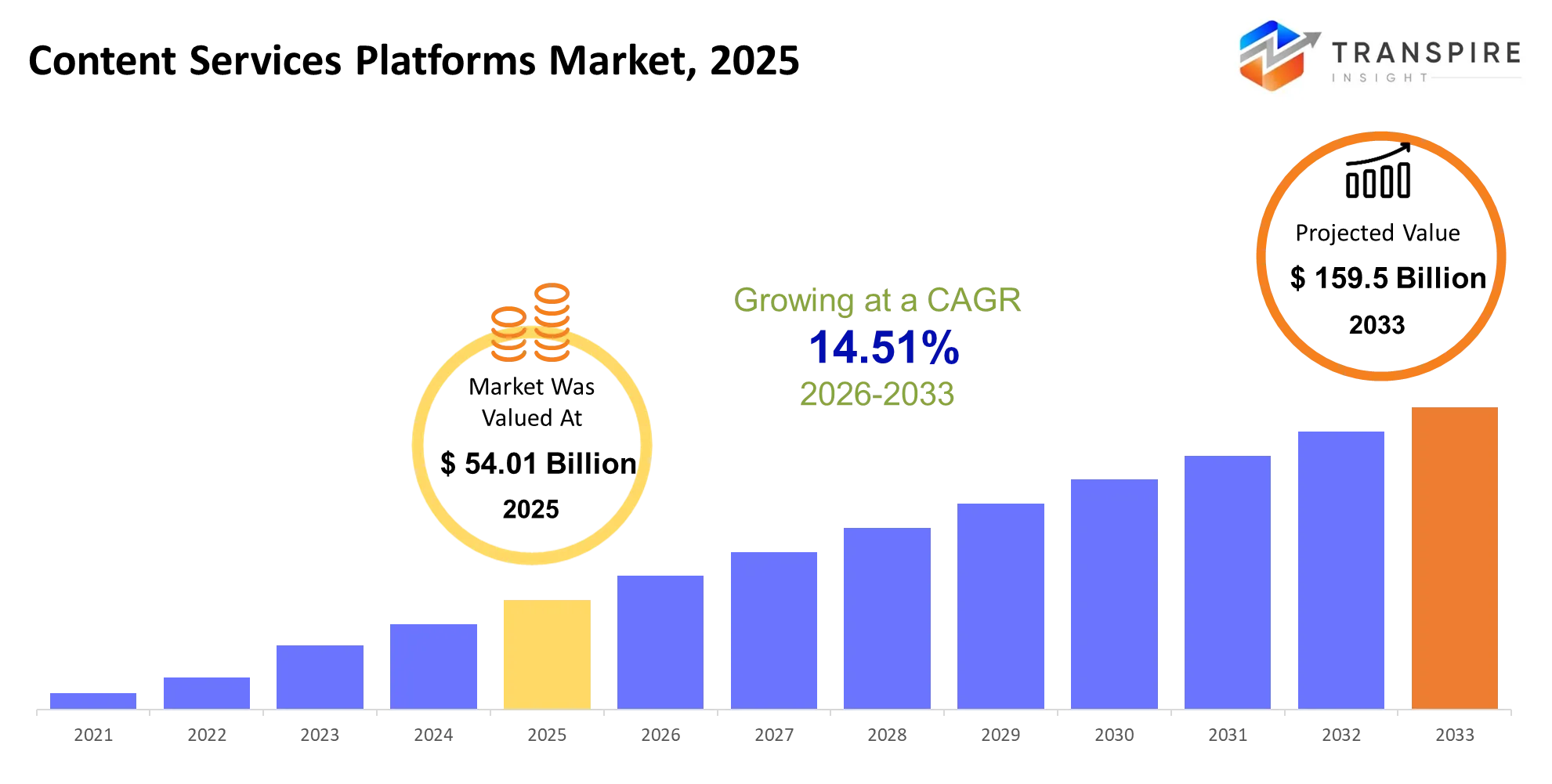
As per the Transpire Insight Analysis, The Content Services Platforms Market size is estimated at USD 54.01 billion in 2025 and is anticipated to reach USD 159.5 billion by 2033, growing at a CAGR of 14.51% from 2026 to 2033.
Content services platforms ly enable organisations to capture, organise, secure, find, govern and route business content, contracts, claim files, invoices, customer records, emails, images, videos. More than repositories or repositories of documents, content platforms connect content to workflows, business systems, retention schedules and audit trails. Over the past three to five years, the hybrid workforce, cloud migration, and the proliferation of unstructured data have contributed to buyers' shift in focus from capacity to content intelligence.
Structural change is occurring with the migration to AI-ready, cloud-native, and federated content models versus migrating a full repository. The real-world driver was providing a means for secure collaboration and compliant access in a distributed workforce. With the volume of content, legal evidence, and process delays increasing, organizations are using automation to reduce time to find content, manual steps, and compliance risk, and improve the return on enterprise platform subscriptions, integration costs, and recurring services revenue.
Content Services Platforms Market Size & Forecast:
- Market Size 2025: USD 54.01 Billion
- Expected Market Value (2033): USD 159.5 Billion
- Forecast CAGR (2026–2033): 14.51%
- Leading Region in 2025: North America
- Fastest Growing Region: Asia-Pacific
- Key Company Profiles: Microsoft, OpenText, IBM, Box, Hyland, Oracle, SAP, Adobe, Laserfiche, M-Files, DocuWare, SER Group, Newgen Software, Nuxeo, Alfresco.
Key Content Services Platforms Market Insights:
Content services platforms are moving from repository-centric software to governed intelligence layers, which bridge content, processes, AI models, and compliance controls. The shift from individual document storage towards interoperable cloud ecosystems, trusted AI outputs, and industry-specific workflow depth is underway.
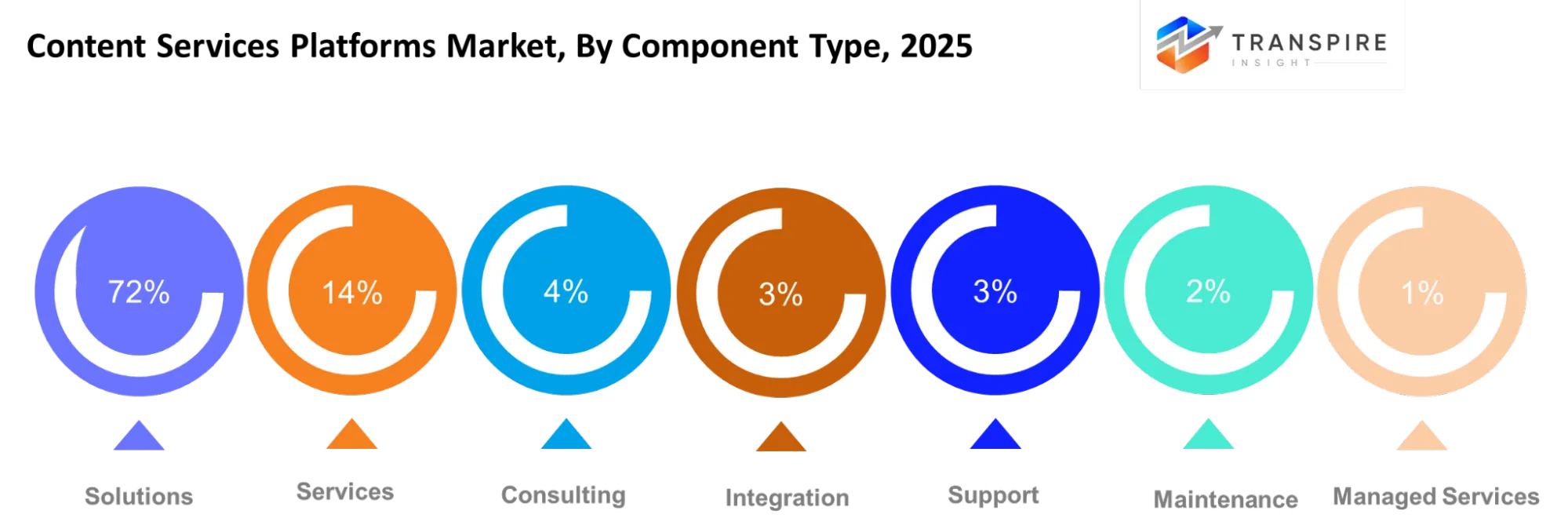
- Solutions account for 72%, with Microsoft adding SharePoint Premium and Copilot-driven content automation to users of Microsoft 365.
- Services account for 14%, and OpenText expands its migration, governance, and managed information services for complex legacy environments.
- Consulting is responsible for 4% of the growth, with IBM's advisory services helping to transform regulated content architectures and AI-ready data estates.
- Integration represents 3%, and Hyland's federation capability allows for OnBase and SharePoint repositories to be connected without migration.
- Support is 3%, with customers needing ongoing security patching, retention updates, and AI-model monitoring.
- Maintenance is 2%, since the organizations keep hybrid estates and gradually replace their customized on-premises repositories.
- Managed services make up 1% and are an option for smaller businesses to gain access to records governance without having to establish specialist in-house teams.
- Other offerings account for 1%, such as niche connectors, compliance add-ons, and vertical workflow extensions.
- The distributed team model is increasingly the preferred purchase approach as it demands secure access, swift updates, and embedded AI.
What are the Key Drivers, Restraints, and Opportunities in the Content Services Platforms Market?
Driver:
Regulatory scrutiny and document-heavy operations are driving adoption, particularly in BFSI, healthcare, government, and manufacturing. Privacy laws, retention obligations, audit requests, and rising volumes of digital correspondence have made spreadsheets and shared drives operational liabilities. The trigger is not merely more content; it is the cost of proving who accessed, changed, approved, or retained a record. Content services platforms convert fragmented files into governed workflows with version control, automated routing, records classification, and searchable audit evidence. This reduces cycle times for claims, onboarding, invoices, and case management, encouraging larger enterprise contracts and recurring cloud revenue.
Restraint:
Legacy-system complexity remains the main adoption barrier. Critical content is often distributed across ERP, CRM, SharePoint, departmental drives, archives, and industry-specific applications. Migration can disrupt records integrity, while API gaps, metadata inconsistency, security reviews, and change-management resistance extend implementation timelines. This structural fragmentation persists because organisations cannot easily retire systems that support regulated or mission-critical processes.
Opportunity:
The next growth pool is federated, AI-governed content intelligence, allowing enterprises to use AI across fragmented repositories without expensive, high-risk migrations. Platforms can connect existing systems, enrich metadata, apply sensitive-data redaction, enforce access permissions, and deliver controlled semantic search, document intelligence, and workflow automation. Hyland’s Content Federation Service demonstrates this approach by securely connecting OnBase and Microsoft SharePoint 365 Online to its Content Innovation Cloud. This lets organisations activate AI, knowledge discovery, and automation while retaining content in its original repository.
What Has the Impact of Artificial Intelligence Been on the Content Services Platforms Market?
Content services platforms have moved from storing documents aligned with specific rules to process orchestration and artificial intelligence. Artificial intelligence in content services now includes optical character recognition, machine learning, and natural-language processing that enable intelligent document processing to automatically classify incoming documents, extract fields from invoices or forms, identify entities, and route exceptions to the appropriate employee. Such capabilities remove manual indexing and reduce turnaround time for claims, lending, procurement, and citizen service processes.
Additionally, artificial intelligence capabilities enable discovery and decision support. For example, semantic search capabilities can discover relevant contract, policy, email, and record information without requiring specific keyword searches; prediction models can find lost documents, anticipate bottlenecks, retention issues, or cases where human input is needed, and generative artificial intelligence assistants can document lengthy files or compose responses with the proper source attribution and rights enabled. The key obstacle is implementation quality. Artificial intelligence requires properly sourced metadata, secure links to repositories, role-based permissions, and domain validation, or the output can be inaccurate, unsupported artificial intelligence answers, creating compliance challenges. Accordingly, artificial intelligence integration, model governance, and human validation are among the remaining high-cost adoption barriers.
In May 2026, Coupa acquired Rossum to integrate AI-first intelligent document processing across its platform. This move scaled automated invoice extraction into an end-to-end autonomous spend management workflow. https://www.prnewswire.com/news-releases/coupa-acquires-rossum-to-accelerate-end-to-end-autonomous-spend-management-302768948.html
Key Content Services Platforms Market Trends:
The market is moving from content storage to content intelligence, and platforms are expected to understand content, link it to workflows, and deliver governed access to AI. The nature and deployment of content infrastructure is evolving as cloud adoption and agentic AI transform the way enterprises operate. The cloud and agentic AI are transforming the way enterprises deploy and utilise content infrastructure.
- The migration to the cloud is no longer limited to hosting, but has expanded to SaaS content hubs that are constantly updated, have scalable storage, and are distributed and accessible with controls.
- Instead of consolidating repositories, enterprises are beginning to federate content, enabling them to connect legacy systems without expensive migrations.
- AI is moving beyond document classification to agentic workflow support, where governed agents can retrieve, summarise, and act on approved enterprise content.
- Intelligent document processing is moving OCR beyond just contextless extraction, exception handling, and accuracy monitoring of operational documents.
- Semantic and conversational search is taking the place of folder-based search, enabling employees to find knowledge in unstructured content.
- AI applications demand tagged, governed, and context-rich enterprise information, making metadata enrichment increasingly critical.
- Compliance is becoming more dynamic, with automated redaction, privacy controls, lineage and auditable policy enforcement taking the place of static retention schedules.
- Integration with ERP, CRM, collaboration and industry applications is increasingly expected by buyers, and is an area where vendors can differentiate themselves with APIs and prebuilt connectors.
- Hybrid deployments are still relevant for regulated workloads where organisations are trying to find the right balance between agility and data residency, security and archival requirements.
- Documents are not the only content that is coming under the same governance umbrella: video, images, emails, and web content are also joining the fray, driving a demand for multimodal content intelligence.
Content Services Platforms Market Segmentation
By Component:
Solutions accounted for 72%, making document, records, workflow, collaboration, and content-management capabilities the market’s commercial foundation. Services represented 14%, while Consulting, Integration, Support, Maintenance, Managed Services, and Others accounted for 4%, 3%, 3%, 2%, 1%, and 1%, respectively. The Services segment is projected to register a 19.3% CAGR, supported by migration, integration, governance, customisation, and AI-readiness requirements. This structure shows that software remains the primary revenue base, while service capabilities increasingly determine successful enterprise deployment and long-term platform adoption.
By Deployment:
Cloud platforms are gaining strategic importance as enterprises prioritise scalable infrastructure, faster implementation, remote accessibility, and integration with AI services. On-premises deployments remain relevant where organisations face strict data-residency, security, or legacy-system requirements. Hybrid architectures provide a transition path by connecting existing repositories with newer cloud environments. Private-cloud models appeal to regulated enterprises requiring greater control, while public-cloud adoption benefits from flexible consumption economics. Multi-cloud strategies are also expanding as organisations seek resilience, interoperability, and reduced dependence on individual infrastructure providers.
By Enterprise Size:
Large enterprises remain major adopters because they manage extensive document estates, complex workflows, multiple repositories, and stringent governance requirements. Mid-sized enterprises are increasingly adopting cloud-based platforms to modernise content operations without substantial infrastructure investment. SMEs benefit from subscription models, low-code configuration, and simplified implementation, lowering entry barriers. Startups favour API-driven platforms that can scale with business growth. Government, education, and nonprofits are also adopting controlled repositories and auditable workflows to improve information governance, operational transparency, and compliance across distributed organisational environments.
By Application:
Document Management and Records Management remain foundational because organisations require controlled capture, storage, retrieval, retention, and auditing of business information. Workflow Management is expanding platforms into operational processes by automating approvals, routing, and task assignments. Digital Asset Management supports growing volumes of multimedia content, while Collaboration enables distributed teams to access shared information securely. Content Analytics helps organisations extract operational insights from repositories, and Compliance applications strengthen retention, access, audit, and regulatory controls. Together, these applications shift platforms from passive repositories toward active enterprise-process infrastructure.
By End User:
BFSI and Healthcare emphasise controlled access, auditability, retention, and regulatory compliance because their operations generate sensitive information. Government organizations prioritize records governance, transparency, and secure information exchange across departments. IT & Telecom companies use content platforms to coordinate technical documentation, contracts, and service workflows. Retail organisations increasingly connect content with customer and merchandising processes, while Manufacturing uses platforms for engineering, quality, and operational documentation. Education adopts centralised repositories for administrative and academic records, creating varied deployment priorities across industries.
By Content Type:
Documents remain the core content category because contracts, invoices, reports, forms, and records continue to support essential business workflows. However, Images, Video, Audio, Email, Web Content, and Records are increasingly managed within unified platforms as enterprises consolidate fragmented information sources. This shift is expanding platform capabilities beyond traditional document repositories toward multimodal content management. Organisations are also using centralised controls to improve accessibility, version management, retention, security, and retrieval across diverse content formats, supporting more consistent information governance.
By Technology:
AI, Machine Learning, NLP, OCR, Automation, Cloud Computing, and Analytics are increasingly integrated to make enterprise content searchable, interpretable, and actionable. AI and NLP help identify context, summarise information, classify documents, and support natural-language retrieval, while OCR converts scanned documents into machine-readable data. Automation then connects extracted information with business workflows, reducing repetitive processing. Cloud Computing provides scalable infrastructure, while Analytics helps organisations identify patterns, monitor content operations, and improve workflow performance across distributed enterprise environments.
What are the Key Use Cases Driving the Content Services Platforms Market?
The main use case is in document and workflow management, which accounts for the bulk of the Solutions segment (72%). Organizations are capturing, classifying, storing, retrieving, approving, routing documents, and keeping them alive by providing permission and version control and an audit trail, reducing manual movement and silos.
Broader use cases include records management, compliance, collaboration, digital asset management, and content analytics. Management of controlled records is important to the BFSI and government, while content workflows are used for patient, administrative, and regulatory documents in healthcare.
Identified use cases include future AI knowledge retrieval and agentic workflows. Search, extraction, summarization, recommendations, and AI agents allow end-user employees to more directly leverage enterprise content for faster decisions and more automation.
|
Report Metrics |
Details |
|
Market size value in 2025 |
USD 54.01 Billion |
|
Market size value in 2026 |
USD 61.8 Billion |
|
Revenue forecast in 2033 |
USD 159.5 Billion |
|
Growth rate |
CAGR of 14.51% from 2026 to 2033 |
|
Base year |
2025 |
|
Historical data |
2021 - 2024 |
|
Forecast period |
2026 - 2033 |
|
Report coverage |
Revenue forecast, competitive landscape, growth factors, and trends |
|
Regional scope |
United States; Canada; Mexico; United Kingdom; Germany; France; Italy; Spain; Denmark; Sweden; Norway; China; Japan; India; Australia; South Korea; Thailand; Brazil; Argentina; South Africa; Saudi Arabia; United Arab Emirates |
|
Key companies profiled |
Microsoft, OpenText, IBM, Box, Hyland, Oracle, SAP, Adobe, Laserfiche, M-Files, DocuWare, SER Group, Newgen Software, Nuxeo, Alfresco. |
|
Customization scope |
Free report customization (country, regional & segment scope). Available customized purchase options to meet your exact research needs. |
|
Report Segmentation |
By Component (Solutions, Services, Consulting, Integration, Support, Maintenance, Managed Services, Others); By Deployment (Cloud, On-premises, Hybrid, Private Cloud, Public Cloud, Multi-cloud, Edge, Others); By Enterprise Size (Large Enterprises, SMEs, Mid-sized Enterprises, Startups, Government, Education, Nonprofits, Others); By Application (Document Management, Records Management, Workflow Management, Digital Asset Management, Collaboration, Content Analytics, Compliance, Others); By End User (BFSI, Healthcare, Government, IT & Telecom, Retail, Manufacturing, Education, Others); By Content Type (Documents, Images, Video, Audio, Email, Web Content, Records, Others); By Technology (AI, Machine Learning, NLP, OCR, Automation, Cloud Computing, Analytics, Others) |
Which Regions are Driving the Content Services Platforms Market Growth?
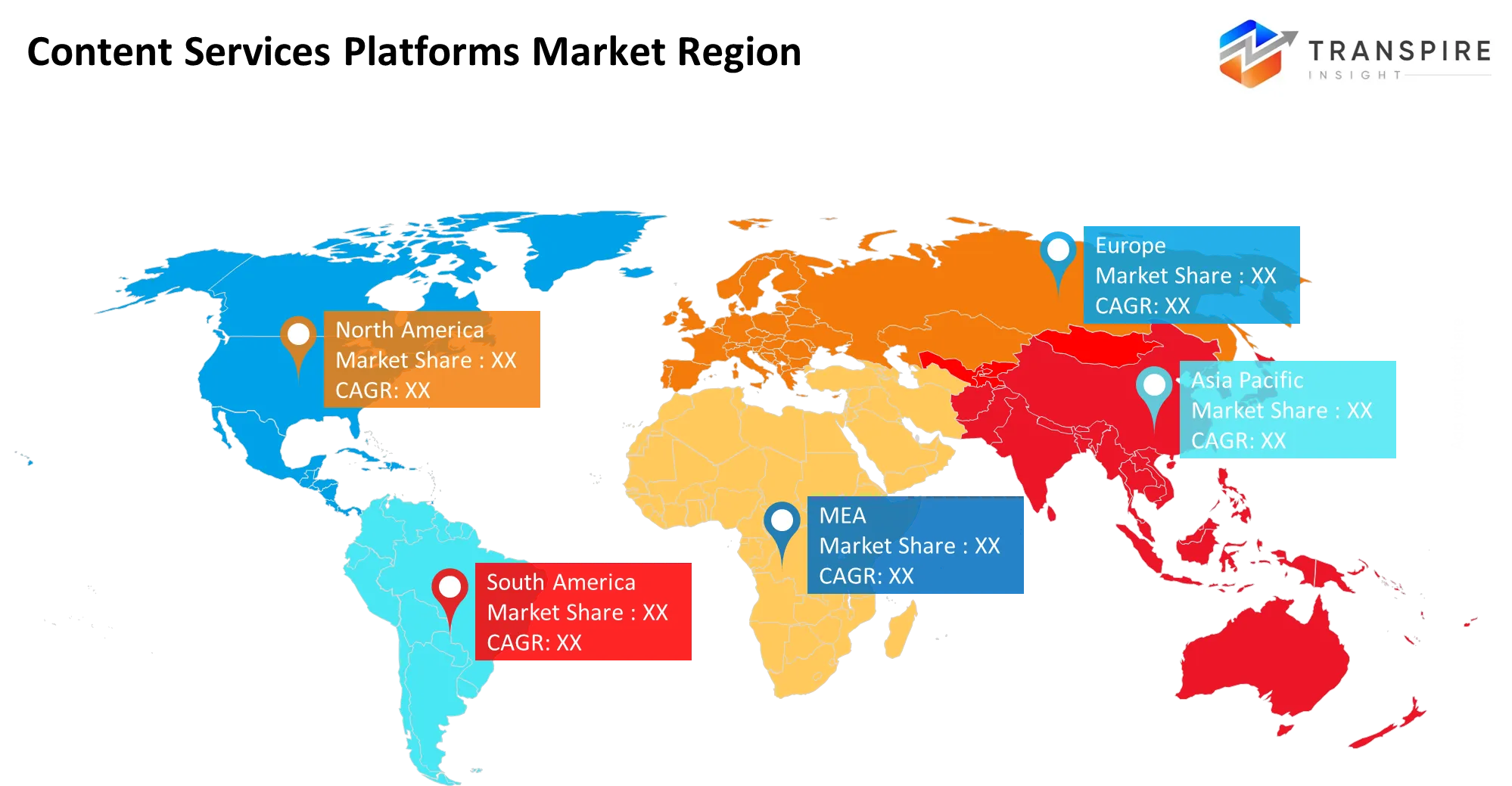
North America accounts for 36% of the market, building on the foundation of enterprise-software familiarity in the United States and the concentration of Cloud Service Provider vendors. Business pain points are highest in the banking, financial services, and insurance segments, as well as in healthcare, legal, government, and telecom industries that demand high levels of records retention, auditability, and secure collaboration. Hard compliance frameworks such as HIPAA, SEC recordkeeping laws, and industry-specific privacy regulations increase the costs of boutique content silos. Cloud infrastructure, hyperscaler partnerships, and early generative AI experimentation also help cement North America's lead.
- In February 2026, cloud software provider Intapp launched Intapp Celeste, a specialized generative and agentic artificial intelligence platform designed for professional firms.https://erp.today/enterprise-software-ai-acquisitions-execution-layer/
- Europe accounts for 25% of platform spend and is second only to North America, but a very consistent compliance-driven demand occurs in parallel. GDPR, DORA, eIDAS 2.0, and EU Data Act make information governance a boardroom necessity, not a discretionary productivity investment. European buyers focus on data residency, transparent automation, and retention controls, empowering regional and sovereign-cloud vendors to compete. This policy-driven purchasing generates ongoing modernisation demand, despite the relatively slow pace of discretionary IT budgets.
- In January 2026, Amazon Web Services (AWS) officially announced the general availability of its AWS European Sovereign Cloud, an independent infrastructure completely located and operated within the EU. This launch empowers heavily regulated enterprises and public sector organisations to fulfil stringent European data residency laws.https://press.aboutamazon.com/aws/2026/1/aws-launches-aws-european-sovereign-cloud-and-announces-expansion-across-europe
- Asia Pacific is the fastest-growing region at 30% as digital public services, mobile-first enterprises and regional cloud investment are making content operations more prevalent. India, China, Japan, South Korea, Australia and Southeast Asia are digitising large volumes of workflows in banking, government, healthcare, retail and manufacturing. Prior to the recent advent of AI, the outlook for Latin America was 5%, while the Middle East and Africa collectively were 4% of the opportunity, with longer-term upside from public-sector digital transformation and cloud adoption. This is driving regional language search and scanning, new use of intelligent capture and AI automation, as well as the use of private cloud in regulated industries.
- In September 2026, Digital Realty published a regional survey revealing that more than half of Asia Pacific enterprises plan to increase their artificial intelligence investments by over 25%. This surge in planned capital allocation accelerates regional demand for high-capacity cloud infrastructure, automated document processing, and localized data-residency solutions across high-volume digital workflows.https://finance.yahoo.com/technology/ai/articles/digital-realty-survey-finds-more-060000616.html
Who are the Key Players in the Content Services Platforms Market, and how do they compete?
This industry segment remains moderately concentrated. Market incumbents such as Microsoft, OpenText, IBM, Oracle, Adobe, Box, and Hyland can capitalize on their ecosystem scale and enterprise integrations. At the same time, niche specialists differentiate through vertical domain focus, deployment options, and lower usability hurdles. No clear industry leader emerges, making AI governance, interoperability, and workflows the key battlegrounds for applications.
Microsoft primarily targets its Microsoft 365 installed base with SharePoint Premium and Copilot, lowering adoption hurdles with integrated collaboration. Open Text targets content cloud, information governance, and Aviator AI at complex, regulated enterprises. IBM targets FileNet in high-control environments, aligning content with hybrid-cloud and AI-modernization roadmaps. Box employs cloud-native collaboration and secure external sharing. Hyland targets OnBase, Nuxeo, and Alfresco-based content innovation. Oracle and SAP target process-centric users via ERP-led connective tissue. Adobe targets digital asset and experience workflows. Laserfiche, M-Files, DocuWare, SER Group, and Newgen Software focus on low-code automation through regional channels and verticalized deployments. Nuxeo and Alfresco appeal where open architectures, asset volume, or lower suite governance is paramount.
Key Players are:
- Microsoft
- OpenText
- IBM
- Box
- Hyland
- Oracle
- SAP
- Adobe
- Laserfiche
- M-Files
- DocuWare
- SER Group
- Newgen Software
- Nuxeo
- Alfresco
Recent Development News
- In June 2026, Salesforce signed a definitive agreement to acquire Contentful. This strategic move integrates Contentful's composable content infrastructure into Salesforce’s Headless 360 and Agentforce frameworks. The acquisition establishes an enterprise-grade content layer that unifies structured customer data with cross-channel digital experience creation, thereby positioning the combined platform to deliver scale-ready agentic web operations.https://www.salesforce.com/in/news/stories/salesforce-signs-definitive-agreement-to-acquire-contentful/
- In September 2026, Adobe established a strategic technology partnership with Jet2. This deployment introduces enterprise content supply chain tools, Adobe Brand Intelligence, and custom generative models via Adobe Firefly Foundry into Jet2's client experience framework. The integration accelerates automated, brand-compliant content production while enabling real-time, personalized destination messaging across digital customer portfolios.https://news.adobe.com/news/2026/09/adobe-jet2-partner-deliver-agentic-ai-powered-personalised-experiences
- In June 2026, PTFS partnered with Carahsoft to make its Knowvation content services and document intelligence solutions available to U.S. government agencies through Carahsoft’s reseller network and public-sector contract vehicles. The partnership expands access to enterprise content management, search, indexing, and workflow capabilities across government organisations.https://www.carahsoft.com/news/ptfs-and-carahsoft-partner-to-bring-content-services-and-library-software-to-public-sector-2026
What Strategic Insights Define the Future of the Content Services Platforms Market?
The market is heading toward federated content intelligence, where most platforms will at least meld repositories, enforce policy controls, and enable AI assistants without full migration. The unseen risk is that botched AI could leak sensitive data, return answers without validation, or weaken the evidential integrity of a trust record. This will heighten demand for access-aware search, source-aware results, model management and immutable digital audit logs. The strongest emerging opportunity will be AI-ready content federation, especially for organisations that have decades of files stored in ERP, CRM, SharePoint, archives and domain applications. Hyland's fusion of OnBase and Microsoft SharePoint 365 demonstrates the revenue benefits of establishing content connectivity before systems replace. Vendors should emphasise open APIs, semantic content models, metadata fidelity, and quantifiable workflows-fewer manual reviews or faster claims payouts-over promoting frothy copilots. Buyers should select platforms that remain portable, safe, and humans-in-the-loop at decision points.
Key Segmentations are:
By Component
- Solutions
- Services
- Consulting
- Integration
- Support
- Maintenance
- Managed Services
- Others
By Deployment
- Cloud
- On-premises
- Hybrid
- Private Cloud
- Public Cloud
- Multi-cloud
- Edge
- Others
By Enterprise Size
- Large Enterprises
- SMEs
- Mid-sized Enterprises
- Startups
- Government
- Education
- Nonprofits
- Others
By Application
- Document Management
- Records Management
- Workflow Management
- Digital Asset Management
- Collaboration
- Content Analytics
- Compliance
- Others
By End User
- BFSI
- Healthcare
- Government
- IT & Telecom
- Retail
- Manufacturing
- Education
- Others
By Content Type
- Documents
- Images
- Video
- Audio
- Web Content
- Records
- Others
By Technology
- AI
- Machine Learning
- NLP
- OCR
- Automation
- Cloud Computing
- Analytics
- Others
By Regional Analysis
North America
- US
- Canada
- Mexico
Europe
- Germany
- UK
- France
- Italy
- Spain
- Russia
- Rest of Europe
Asia Pacific
- China
- Japan
- India
- South Korea
- Australia
- Rest of Asia Pacific
South America
- Brazil
- Argentina
- Rest of South America
Middle East & Africa
- UAE
- Saudi Arabia
- Qatar
- South Africa
- Rest of the Middle East & Africa
Frequently Asked Questions
Find quick answers to common questions.
The content services platforms market size was valued at USD 54.01 billion in 2025 and is poised to reach USD 159.5 billion by 2033, expanding at a 14.51% CAGR.
Key segments for the content services platforms market are By Component (Solutions, Services, Consulting, Integration, Support, Maintenance, Managed Services, Others); By Deployment (Cloud, On-premises, Hybrid, Private Cloud, Public Cloud, Multi-cloud, Edge, Others); By Enterprise Size (Large Enterprises, SMEs, Mid-sized Enterprises, Startups, Government, Education, Nonprofits, Others); By Application (Document Management, Records Management, Workflow Management, Digital Asset Management, Collaboration, Content Analytics, Compliance, Others); By End User (BFSI, Healthcare, Government, IT & Telecom, Retail, Manufacturing, Education, Others); By Content Type (Documents, Images, Video, Audio, Email, Web Content, Records, Others); By Technology (AI, Machine Learning, NLP, OCR, Automation, Cloud Computing, Analytics, Others).
Growth is primarily driven by AI-enabled content automation, cloud migration, enterprise workflow modernisation, regulatory compliance, and integration of fragmented content repositories.
The content services platforms market is led by major manufacturers, including Microsoft, OpenText, IBM, Box, Hyland, Oracle, SAP, Adobe, Laserfiche, M-Files, DocuWare, SER Group, Newgen Software, Nuxeo, and Alfresco.
North America holds 36% of the market, supported by mature cloud infrastructure, enterprise AI adoption, strong technology ecosystems, and early investment in content automation and governance.
Key opportunities include agentic AI, content federation, AI-powered knowledge retrieval, regulated-industry solutions, cloud modernisation, and managed content services.
- Microsoft
- OpenText
- IBM
- Box
- Hyland
- Oracle
- SAP
- Adobe
- Laserfiche
- M-Files
- DocuWare
- SER Group
- Newgen Software
- Nuxeo
- Alfresco
About the Authors

Mayur Shinde
I am Mayur Shinde, a Senior Research Analyst at Transpire Insight, specializing in the Automotive & Transportation and Information & Communication Technology (ICT) Industry. My work focuses on analyzing emerging market trends, technological advancements, competitive landscapes, and industry developments to deliver accurate, data-driven insights. I am passionate about transforming complex market information into clear, actionable content that helps businesses, professionals, and decision-makers stay informed and make confident strategic decisions.

Chakradhar Khansole
Chakradhar serves as the Research Director at Transpire Insight, bringing over 8 years of experience in technology, innovation, and strategic market intelligence. He specializes in transforming complex market data into actionable business insights that enable organizations to make informed, growth-oriented decisions. Recognized for his strategic vision and analytical expertise, Chakradhar leads high-impact research initiatives, delivering comprehensive market assessments, competitive intelligence, and forward-looking industry analysis.
Recently Published Reports
-
Apr 2026
3D Optical Profiler Market
3D Optical Profiler Market Size, Share & Analysis Report By Type (Desktop 3D Optical Profiler, and Portable 3D Optical Profiler), By Technology (Confocal Technology, and White Light Interference), By End-Use Industry (Manufacturing, Research Institutions, Automotive, Aerospace and Defense, Medical Devices, and Other), and Geography (North America, Europe, Asia-Pacific, Middle East and Africa, South and Central America), 2021 - 2031
-
Apr 2026
Depth Sensor Market
Depth Sensor Market Size, Share & Analysis Report By Type (Infrared Depth Sensors, Time-of-Flight (ToF) Sensors, Stereo Vision Sensors, Structured Light Sensors, Ultrasonic Depth Sensors), By Application (Automotive, Robotics, Gaming, Consumer Electronics, Industrial Automation, Healthcare, Security & Surveillance, Others), By End Users (Automotive Manufacturers, Consumer Electronics Companies, Healthcare Providers, Industrial Companies, Security Agencies, Gaming Companies, Robotics Companies, Others), and Geography (North America, Europe, Asia-Pacific, Middle East and Africa, South and Central America), 2021 – 2031
-
Apr 2026
Digital Manufacturing Market
Digital Manufacturing Market Size, Share & Analysis Report By Component (Hardware, Software, and Services), By Technology (Robotics, 3D Printing, Internet of Things (IoT), and Others), By Application (Automotive and Transportation, Aerospace and Defense, Consumer Electronics, Industrial Machinery, and Others), By Process Type (Computer-Based Designing, Computer-Based Simulation, Computer 3D Visualization, Analytics, and Others), and Geography (North America, Europe, Asia-Pacific, Middle East and Africa, South and Central America), 2021 – 2031
-
Apr 2026
Digital Visa Services Market
Digital Visa Services Market Size, Share & Analysis Report By Type (Individual Travelers, Group Travelers), By Application (Tourism, Business Travel, Others), and Geography (North America, Europe, Asia-Pacific, Middle East and Africa, South and Central America), 2021 – 2031