

Law Enforcement Software Market Summary:
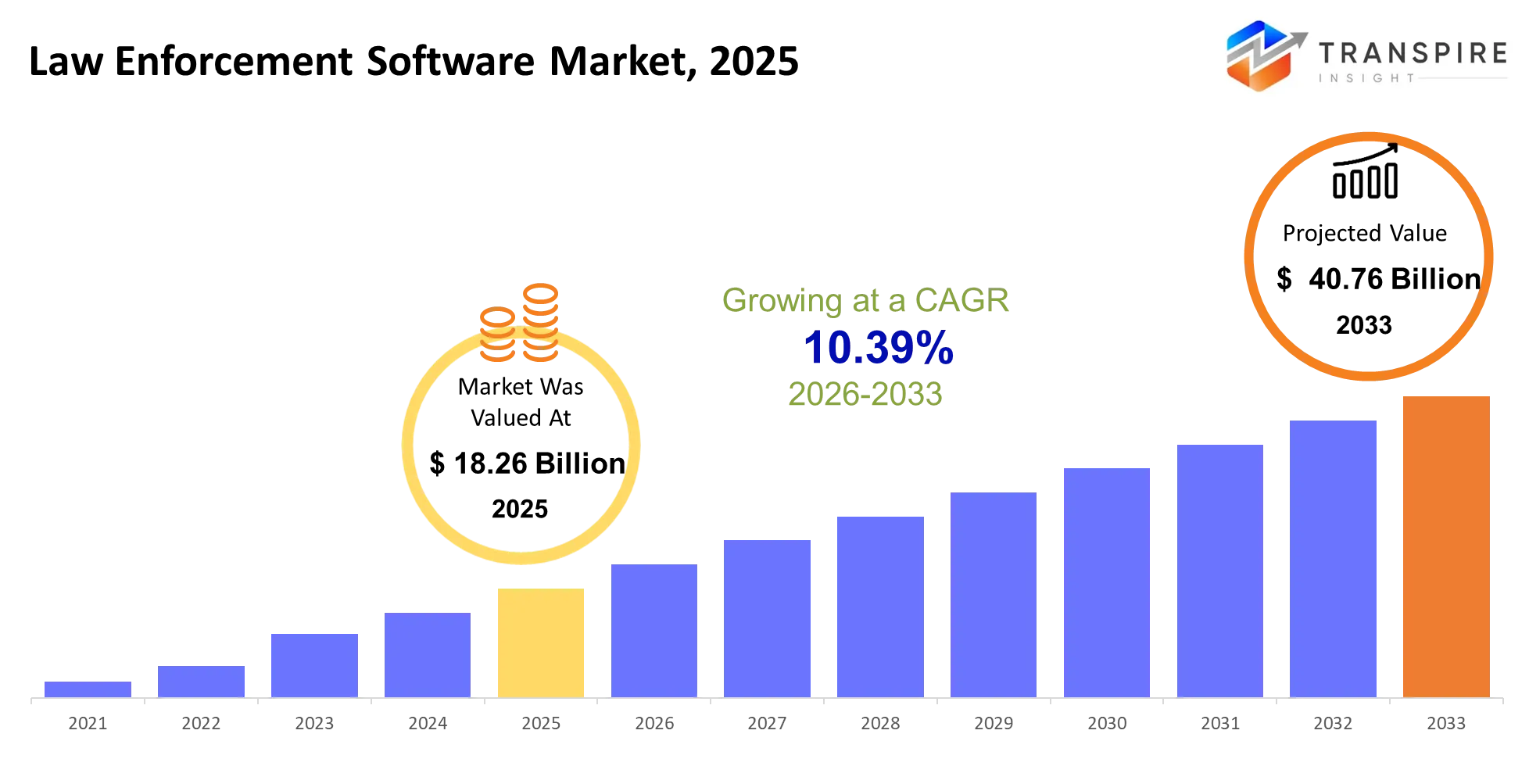
As per the Transpire Insight Analysis, The Law Enforcement Software Market size is estimated at USD 18.26 billion in 2025 and is anticipated to reach USD 40.76 billion by 2033, growing at a CAGR of 10.39% from 2026 to 2033.
The law enforcement software market equips agencies with essential tools for leading teams in the field, consolidating data silos, managing digital evidence, launching regional responses, and converting incident data into cases. The market has shifted in the past three to five years from standalone dispatch and records platforms to cloud-connected operational ecosystems that incorporate body-worn camera footage, evidence chains, analytics, mobile reporting, and cross-agency workflows. The single biggest driver of platform upgrades is the explosive growth in digital video evidence, which has been accelerated by US body-worn camera and evidence-integration funding. Market growth follows a simple cause-and-effect: as the volume of data increases, the need for faster, auditable decisions makes manual, disconnected workflows outdated. Agencies therefore seek integrated software to lower friction in response, improve evidentiary integrity and auditability, and increase transparency. Meanwhile, increased focus on AI governance is shaping procurement decisions, especially for biometric and predictive tools.
Law Enforcement Software Market Size & Forecast:
- Market Size 2025: USD 18.26 Billion
- Expected Market Value (2033): USD 40.76 Billion
- Forecast CAGR (2026-2033): 10.39%
- Leading Region in 2025: North America
- Fastest Growing Region: Asia-Pacific
- Key Company Profiles: Motorola Solutions, Axon Enterprise, Tyler Technologies, Mark43, CentralSquare Technologies, Hexagon, Nuance Communications, IBM, Palantir Technologies, NICE, NEC Corporation, Genetec, Spillman Technologies, SunGard Public Sector, LexisNexis Risk Solutions.
Key Law Enforcement Software Market Insights:
The market is evolving from department-specific software to public-safety connected, evidence-based systems that integrate dispatch, records, video, analytics, and field operations. Secure deployment, interoperability, and the ability to turn growing volumes of evidence into defensible operational decisions are becoming key to competitive advantage.
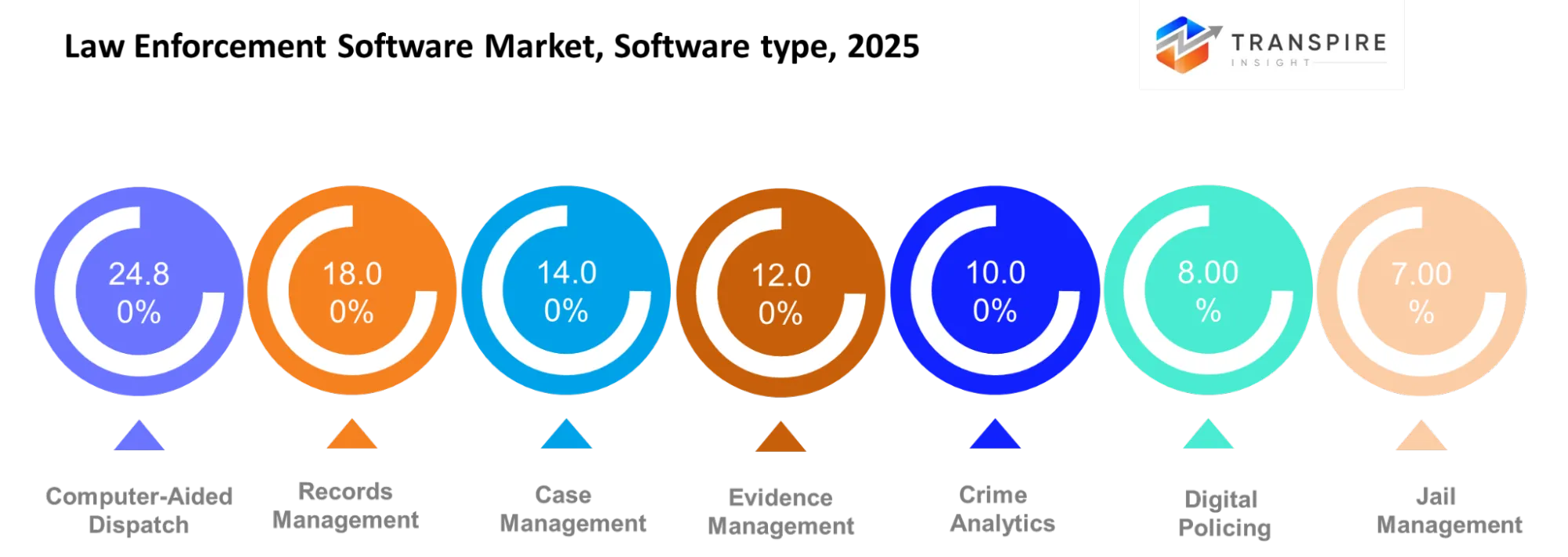
- Motorola Solutions' hybrid-cloud 911 handling is moving forward with AI transcription and translation, mapping and cyber-resilient failover, achieving a 24.80% CAD share.
- 18.00% records management share as Tyler Technologies and CentralSquare work to improve the fragmented records of agencies with public sector workflows that are configurable and cloud-based.
- Mark43's cloud-native reporting and investigator collaboration differentiate the company, minimising duplicate data entry across cases, to capture 14.00% of the case management share.
- 12.00% evidence management share as Axon is taking Evidence further with third-party video support and AI-assisted narrative drafting from body-camera audio.
- 10.00% crime analytics, not dashboards, as Palantir and IBM battle it out with data fusion, entity analysis and investigation intelligence.
- 8.00% digital policing share, as mobile reporting is replacing station-bound administration to search, document and update incidents in the field.
- 7.00% jail management share, as correctional workflows shift toward integrated inmate records, court coordination and compliance-driven data controls.
- 6.20% predictive policing share, as regulation is shifting the adoption toward risk analysis, rather than profiling-only automated decisions.
- AI and predictive analytics are growing at 15.60% CAGR, as Genetec's cloud-based vehicle-investigation platform demonstrates a shift toward searchable, vehicle-centric intelligence.
What are the Key Drivers, Restraints, and Opportunities in the Law Enforcement Software Market?
Driver:
The main growth driver is the operational need to unify dispatch, records, officer-generated video, digital evidence, and investigation workflows. A single major incident can now generate calls, GPS trails, body-camera footage, CCTV clips, photographs, forensic files, and reports. Agencies are replacing fragmented applications because disconnected systems delay case preparation and increase the risk of incomplete evidence trails. Body-worn camera programmes have accelerated this transition: U.S. federal initiatives explicitly support camera deployment and digital-evidence integration demonstrations, encouraging agencies and prosecutors to invest in platforms that can ingest, retain, redact, share, and audit video evidence. This expands software revenue beyond initial licences into storage, workflow automation, managed services, and recurring cloud subscriptions.
Restraint:
Budget fragmentation remains a structural limitation. Many municipal and smaller agencies operate with ageing systems, limited IT staff, lengthy procurement cycles, and local data-retention requirements. Migration is difficult because historical records, evidence metadata, criminal-justice interfaces, and chain-of-custody processes cannot be disrupted. AI adoption also faces procurement scrutiny over bias, explainability, accuracy, privacy, and legal admissibility.
Opportunity:
Federated cloud platforms with governed AI can unlock broader modernisation. The UK's 2026 PoliceAI program, backed by £75 million over three years, illustrates public investment in centrally tested AI capabilities. Similar investments across national and state agencies can accelerate shared analytics, digital evidence processing, and predictive decision support while spreading development and governance costs across multiple forces. Vendors that provide migration tools and standards-based APIs can therefore convert integration complexity into recurring modernisation revenue. This encourages longer-term contracts.
What Has the Impact of Artificial Intelligence Been on the Law Enforcement Software Market?
AI is also evolving law enforcement software from record-keeping systems to a sophisticated decision-support platform. In dispatch centres, AI can set call priorities by evaluating incident context and location, historic trends, and unit availability to help an operator speed response in busy call periods. In investigations, machine learning solutions can search and classify long-form video, audio, file, image, and device data to reduce the manual effort required to identify relevant evidence.
AI can also improve operational workflows through automatic interview and radio transcription, multilingual translation, redaction help, report generation, duplicate record detection, anomaly detection, and entity-link analysis of cases. Predictive models can point to likely repeat offloading locations, trendsetting crimes, or hotspots to help agencies more intentionally deploy resources for patrol or prevention. However, as with any new technology, concerns about accuracy and governance threaten adoption. Inadequate source data, irregular enforcement statistics, false positives, and explainability concerns could erode confidence or create legal liabilities. As in the European Union's forthcoming AI Act, restrictions on predictive policing based on profiling, bans on specific types of facial scraping, and consent requirements for real-time biometric use are expected to force vendors to embed human review, audit trails, bias testing, access controls, and transparent governance into AI solutions.
In September 2026, Mark43 acquired ForceMetrics, an AI-driven data integration platform designed for law enforcement. This acquisition will embed ForceMetrics’ data analytics capabilities directly into Mark43’s computer-aided dispatch (CAD) and records management systems (RMS).https://www.govtech.com/biz/mark43-acquires-public-safety-software-company-forcemetrics
Key Law Enforcement Software Market Trends:
The market is moving from being based on stand-alone administrative applications to being based on connected, intelligence-driven platforms where software value is increasingly defined by automation, interoperability, and governance. Procurement is also moving to outcomes of measurable productivity, security, and compliance rather than feature counts.
- Dispatch platforms are moving from call logs to real-time command capabilities, with location, unit status, maps, and incident intelligence.
- Digital evidence systems are evolving from video storage to lifecycle management, redaction, sharing, retention, and courtroom-ready audit trails.
- The adoption of cloud is growing as agencies look to scalable evidence storage for body-camera, CCTV, drone, and mobile evidence.
- AI is transitioning from experimental analytics to limited automation (transcription, translation, report help, evidence triage).
- The redesign of predictive tools is driven by the need for human validation, given regulators' limitations on profiling-only predictive policing. Regulators' limitations on profiling-only predictive policing are leading to the redesign of predictive tools around human validation.
- European deployments of biometric software are becoming more cautious, with rights-impact assessments, authorisation, and traceability influencing the procurement process.
- Mobile-first policing is growing, and officers have access to records, can make reports, and collect evidence without going back to the station.
- Interoperability is becoming a priority as police, prosecutors, corrections, and border agencies need controlled information exchange.
- Operational systems are increasingly storing sensitive investigative and personal information that is becoming a purchasing requirement for cybersecurity and CJIS-aligned data controls.
- To meet the IT staffing limitations of agencies, vendors are offering more recurring SaaS, managed storage, and implementation services.
Law Enforcement Software Market Segmentation
Software Type:
Computer-Aided Dispatch comprises the largest subsegment of Software Types at 24.80%, highlighting its criticality to intake, prioritization, routing, and dispatch, and likely to be augmented by artificial intelligence (AI)-based triage; Records Management represents 18.00% and will benefit from growing compliance demands for record keeping; Case Management constitutes 14.00% and is being improved by digital investigations and digitized evidence management workflows; Evidence Management follows at 12.00% with forecasted increase as volumes of digital evidence grows; Crime Analytics at 10.00% and Digital Policing at 8.00% leverage connected data; Jail Management at 7.00% support custodial workflows, and Predictive Policing at 6.20% is subject to validation and governance.
Deployment:
Cloud models are gaining traction as agencies seek scalable infrastructure, centralised updates, and easier integration across geographically distributed operations. Hybrid deployment remains relevant where sensitive criminal records and evidence require tighter control while selected workloads benefit from cloud flexibility. SaaS models reduce upfront infrastructure requirements for smaller agencies, while private and public clouds address different security and sovereignty priorities. Edge deployment is gaining importance for real-time applications such as mobile policing, biometric identification, surveillance analytics, and emergency response, where low-latency processing is critical.
Application:
Crime Investigation and Emergency Response remain core operational applications because they directly support incident resolution, evidence handling, and resource deployment. Evidence Management is expanding as agencies manage growing volumes of video, images, documents, and digital records. Traffic Management is adopting analytics and automated monitoring to improve enforcement and incident response. Intelligence applications increasingly connect information across cases and databases, while Dispatch and Records Management are becoming more integrated, allowing agencies to share information faster and reduce repetitive data entry.
End User:
Police Departments and Sheriff's Offices represent the principal operational base because they require integrated systems for dispatch, investigations, records, evidence, and field operations. Federal Agencies increasingly require advanced intelligence, interoperability, and cross-jurisdictional data capabilities. State Agencies support statewide information-sharing and coordinated public-safety operations, while Municipal Agencies prioritise cost-efficient platforms. Correctional Facilities require specialised custody and inmate-management workflows, whereas Border Agencies increasingly use biometrics, identity verification, surveillance, and intelligence technologies to strengthen monitoring and response capabilities.
Organization Size:
Large Agencies account for complex software deployments because their operations require extensive CAD, records, evidence, analytics, and interoperability capabilities across multiple departments. Medium Agencies are increasingly adopting modular platforms that can expand as operational requirements grow. Small Agencies benefit from SaaS and cloud-based models that reduce infrastructure, maintenance, and implementation costs. Federal and State organisations require broader data-sharing capabilities, while Municipalities typically emphasise affordability and rapid deployment. Special Units create targeted demand for investigation, intelligence, biometrics, and specialised analytical tools.
Technology:
AI and Machine Learning are reshaping law enforcement software by automating document analysis, identifying patterns, supporting investigations, and improving operational prioritisation. Predictive Analytics and GIS enable agencies to interpret spatial and historical information for resource planning and intelligence workflows. Cloud Computing provides scalable infrastructure, while IoT connects cameras, sensors, vehicles, and field devices. Facial Recognition and Biometrics strengthen identification capabilities, although accuracy, privacy, and governance requirements influence adoption. These technologies are increasingly combined into integrated platforms rather than deployed as isolated applications.
What are the Key Use Cases Driving the Law Enforcement Software Market?
Computer-Aided Dispatch is 24.80% and is the core use case, providing the dispatch, prioritisation, routing, and deployment of resources for emergency intake. The use value of Computer-Aided Dispatch increases when data from Computer-Aided Dispatch feed records, apps, and intelligence, thereby minimising handoff lag.
The expansion of use cases for applications lies in Crime Investigation, Evidence Management, Traffic Management, Intelligence, and Records Management. AI-powered evidence review, automation of reporting, GIS analysis, and combined digital records allow investigators to process a larger quantity of information without a corresponding increase in staff.
Future use cases include predictive deployment of resources, AI-powered post-call intelligence extraction, biometric ID, and AI-enabled traffic enforcement. These advancements push software use beyond record-keeping and documentation to ongoing operational analysis, where governance, auditability, and human supervision are necessary.
|
Report Metrics |
Details |
|
Market size value in 2025 |
USD 18.26 Billion |
|
Market size value in 2026 |
USD 20.41 Billion |
|
Revenue forecast in 2033 |
USD 40.76 Billion |
|
Growth rate |
CAGR of 10.39% from 2026 to 2033 |
|
Base year |
2025 |
|
Historical data |
2021 - 2024 |
|
Forecast period |
2026 - 2033 |
|
Report coverage |
Revenue forecast, competitive landscape, growth factors, and trends |
|
Regional scope |
United States; Canada; Mexico; United Kingdom; Germany; France; Italy; Spain; Denmark; Sweden; Norway; China; Japan; India; Australia; South Korea; Thailand; Brazil; Argentina; South Africa; Saudi Arabia; United Arab Emirates |
|
Key companies profiled |
Motorola Solutions, Axon Enterprise, Tyler Technologies, Mark43, CentralSquare Technologies, Hexagon, Nuance Communications, IBM, Palantir Technologies, NICE, NEC Corporation, Genetec, Spillman Technologies, SunGard Public Sector, LexisNexis Risk Solutions. |
|
Customization scope |
Free report customisation (country, regional & segment scope). Available customised purchase options to meet your exact research needs. |
|
Report Segmentation |
Software Type (Computer-Aided Dispatch, Records Management, Case Management, Evidence Management, Crime Analytics, Digital Policing, Jail Management, Predictive Policing); Deployment (Cloud, On-Premise, Hybrid, SaaS, Private Cloud, Public Cloud, Edge); Application (Crime Investigation, Emergency Response, Evidence Management, Traffic Management, Intelligence, Dispatch, Records Management); End User (Police Departments, Sheriff Offices, Federal Agencies, State Agencies, Municipal Agencies, Correctional Facilities, Border Agencies); Organization Size (Large Agencies, Medium Agencies, Small Agencies, Federal Agencies, State Agencies, Municipalities, Special Units); Technology (AI, Machine Learning, Predictive Analytics, Cloud Computing, IoT, Facial Recognition, Biometrics, GIS). |
Which Regions are Driving the Law Enforcement Software Market Growth?
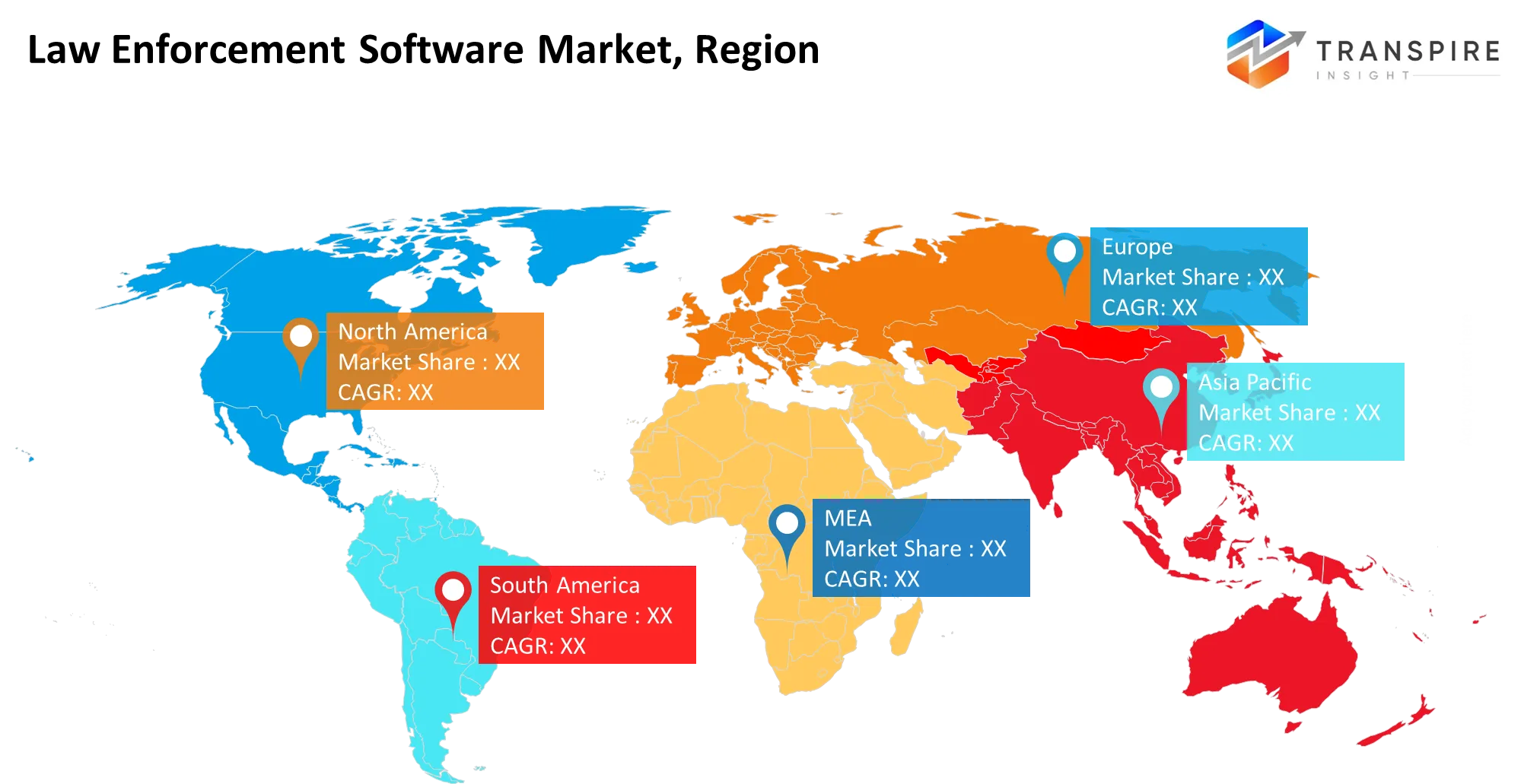
North America dominates the market with a 46.20% share, driven by maturity of the early response environment, widespread adoption of body cameras, and large installed bases of CAD, RMS, and digital-evidence systems. Agencies in the U.S. are increasingly seeking to modernise ageing 911 systems while adding live-mapping, AI-supported call processing, and cloud failover. VESTA Hybrid from Motorola Solutions, which integrates 911 workflow applications, AI, mapping, cybersecurity monitoring, and cloud failover, is a good example of this. Federal funding, CJIS-aligned security requirements, and the presence of an established vendor ecosystem are continuing to support replacement/expansion expenditures.
In September 2026, cloud-native public safety vendor Mark43 completed its acquisition of ForceMetrics. This transaction directly integrates ForceMetrics' data unification and search tools into Mark43's cloud-based Computer-Aided Dispatch (CAD) and Records Management Systems (RMS) stack.https://www.tipranks.com/news/private-companies/mark43-acquires-forcemetrics-to-deepen-real-time-public-safety-data-intelligence
Europe has a 25.00% share of the market and is executing a strategy of growth through expanding equipment and evidence. Europe is inspired by cross-border intelligence needs, digital forensic capabilities, lawful data access, and procurement for compliance. The European Commission is planning a strategy across six domains: data retention, lawful interception, decryption, digital forensics, standards, and AI for law enforcement, and the EU AI Act sets auditability, human oversight, and lifecycle monitoring as procurement requirements for high-risk systems.
In September 2026, the European Commission launched a €6.5 million funding call under the Internal Security Fund (ISF) to co-fund specialised projects focused on digital investigations and standardising data formats for law enforcement.https://www.bakermckenzie.com/en/insight/publications/2026/03/european-union-european-criminal-law-enforcement-is-stepping-up
Asia Pacific has a 20.00% share in the market and is expected to grow at a CAGR of 12.80% and mark the fastest regional opportunity. The trends of rapidly urbanising nations, smart-city initiatives, increased cloud availability, and public safety digitisation are forcing agencies to shift from manual, disconnected infrastructure to integrated systems. Countries including India, China, Japan, South Korea, and Australia are investing in cloud-enabled AI law enforcement solutions. In addition, India's cloud-enabled AI police-cyborg pilot project is driving development for technology-aided monitoring in crowded public locations. Meanwhile, Latin America and the Middle East & Africa constitute 5.00% and 3.80% market share, respectively, focused on opportunities in urban surveillance, border security and mobile policing.
In June 2026, Appian and Deloitte expanded their alliance to launch a suite of AI-powered policing solutions for the UK sector. This initiative helps police forces modernise operations and transition from fragmented legacy systems to integrated, data-driven platforms.https://appian.com/about/explore/press-releases/2026/appian-and-deloitte-deliver-new-ai-powered-policing-solutions
Who are the Key Players in the Law Enforcement Software Market, and how do they compete?
The competition now extends to platform breadth, execution ability, security value, and digital-evidence workflow management. In integrated offerings, Motorola Solutions and Axon compete on integrated operational ecosystems; cloud-native and analytics-based providers target agencies seeking flexibility, interoperability, or specific knowledge-intensive offerings. On the civilian side, the combination of acquisitions and end-to-end integration of communications, CAD, records, video, drones, and AI capabilities is driving competition, with a focus on operational continuity, assisted dispatch and police, recent FedRAMP milestones, and a camera-to-evidence cycle.
Motorola Solutions goes into new operational markets through acquisition, extending end-to-end scope, including action across CAD, records, video, drones, artificial intelligence (AI) and communications, and utilising vehicle-mounted cameras and connected vehicles to create new market space; recently announced Assist tools can help dispatchers and police in their work, while recent FedRAMP points for agency-cloud deployments bolster the company's federal cloud strategy. Axon is attacking police organisations with a device-to-evidence strategy, turning body-camera adoption into a recurring cycle of software, storage and workflow revenue; Draft One further extends this ecosystem to a driver's seat AI-supported report story.
Key Players are:
- Motorola Solutions
- Axon Enterprise
- Tyler Technologies
- Mark43
- CentralSquare Technologies
- Hexagon
- Nuance Communications
- IBM
- Palantir Technologies
- NICE
- NEC Corporation
- Genetec
- Spillman Technologies
- SunGard Public Sector
- LexisNexis Risk Solutions
Recent Development News
- In April 2026, Vector Solutions launched AccrediTrack, a law enforcement accreditation management platform. The platform connects policy, training, documentation, and compliance workflows in one system, helping agencies manage accreditation activities from initial documentation through reaccreditation while reducing administrative workload.https://www.vectorsolutions.com/resources/newsroom/vector-solutions-launches-accreditrack-to-help-law-enforcement-agencies-manage-the-full-accreditation-lifecycle-in-one-unified-platform/
- In June 2026, Cellebrite announced the general availability of Cellebrite Genesis, a purpose-built agentic AI software solution for public safety investigations. This rollout allows digital forensics and investigative professionals to conversationally query complex mobile phone extractions, transforming dense forensic data into actionable insights within minutes while preserving strict evidence guardrails.https://cellebrite.com/en/resources/press-releases/cellebrite-launches-the-new-age-of-investigations-with-genesis-now-generally-available/
- In May 2026, Axon introduced Brief One, a generative AI capability embedded natively within its public safety ecosystem and redesigned digital evidence platform. This launch automates transcript summaries and isolates critical incident timestamps, significantly minimising video review bottlenecks for investigators and accelerating case closure workflows.https://www.fool.com/earnings/call-transcripts/2026/05/06/axon-axon-q1-2026-earnings-call-transcript/
What Strategic Insights Define the Future of the Law Enforcement Software Market?
The industry is evolving toward integrated public safety operating platforms consolidating computer-aided dispatch, records management, evidence management, communications, and analytics within a governed data layer. Beyond artificial intelligence bias, the fundamental risk is vendor lock-in, where evidence, historic records, cloud storage, and workflow regulations are entrenched in a proprietary platform. The inherent opportunity is automating high-volume, low-discretion tasks like transcription, redaction, translation, report generation, evidence categorisation, and cross-file searches. This can deliver tangible officer-time savings and decision support without pushing for algorithmic enforcement. Artificial intelligence regulation will reward vendors providing audit trails, model controls, human validation steps, and a transparent chain of evidence. From a strategic perspective, vendors should promote open integrations and incremental cloud migration rather than "rip and replace," and promote tangible operational outcomes like shorter call resolution times, faster report writing, and grounds for defence, with artificial intelligence functionalities built around privacy controls, accuracy testing, and accountable human review.
Key Segmentations are:
Software Type
- Computer-Aided Dispatch
- Records Management
- Case Management
- Evidence Management
- Crime Analytics
- Digital Policing
- Jail Management
- Predictive Policing
Deployment
- Cloud
- On-Premise
- Hybrid
- SaaS
- Private Cloud
- Public Cloud
- Edge
Application
- Crime Investigation
- Emergency Response
- Evidence Management
- Traffic Management
- Intelligence
- Dispatch
- Records Management
End User
- Police Departments
- Sheriff Offices
- Federal Agencies
- State Agencies
- Municipal Agencies
- Correctional Facilities
- Border Agencies
Organization Size
- Large Agencies
- Medium Agencies
- Small Agencies
- Federal Agencies
- State Agencies
- Municipalities
- Special Units
Technology
- AI
- Machine Learning
- Predictive Analytics
- Cloud Computing
- IoT
- Facial Recognition
- Biometrics
- GIS
By Regional Analysis
North America
- US
- Canada
- Mexico
Europe
- Germany
- UK
- France
- Italy
- Spain
- Russia
- Rest of Europe
Asia Pacific
- China
- Japan
- India
- South Korea
- Australia
- Rest of Asia Pacific
South America
- Brazil
- Argentina
- Rest of South America
Middle East & Africa
- UAE
- Saudi Arabia
- Qatar
- South Africa
- Rest of the Middle East & Africa
Frequently Asked Questions
Find quick answers to common questions.
The law enforcement software market size was valued at USD 18.26 billion in 2025 and is poised to reach USD 40.76 billion by 2033, expanding at a 10.39% CAGR.
Key segments for the law enforcement software market are Software Type (Computer-Aided Dispatch, Records Management, Case Management, Evidence Management, Crime Analytics, Digital Policing, Jail Management, Predictive Policing); Deployment (Cloud, On-Premise, Hybrid, SaaS, Private Cloud, Public Cloud, Edge); Application (Crime Investigation, Emergency Response, Evidence Management, Traffic Management, Intelligence, Dispatch, Records Management); End User (Police Departments, Sheriff Offices, Federal Agencies, State Agencies, Municipal Agencies, Correctional Facilities, Border Agencies); Organization Size (Large Agencies, Medium Agencies, Small Agencies, Federal Agencies, State Agencies, Municipalities, Special Units); Technology (AI, Machine Learning, Predictive Analytics, Cloud Computing, IoT, Facial Recognition, Biometrics, GIS).
Growth is primarily driven by AI-enabled workflow automation, cloud migration, digital evidence management, integrated CAD and records systems, predictive analytics, and the need for faster data sharing across law enforcement agencies.
The law enforcement software market is led by major manufacturers including Motorola Solutions, Axon Enterprise, Tyler Technologies, Mark43, CentralSquare Technologies, Hexagon, Nuance Communications, IBM, Palantir Technologies, NICE, NEC Corporation, Genetec, Spillman Technologies, SunGard Public Sector, LexisNexis Risk Solutions.
North America holds 46.20% of the law enforcement software market, supported by mature public-safety infrastructure, established CAD and records systems, strong cloud adoption, digital evidence requirements, and substantial investment in AI-enabled policing technologies.
Commercial opportunities include AI-powered investigation and evidence analysis, cloud-based public-safety platforms, interoperable data systems, predictive analytics, biometric technologies, and privacy-focused AI solutions.
- Motorola Solutions
- Axon Enterprise
- Tyler Technologies
- Mark43
- CentralSquare Technologies
- Hexagon
- Nuance Communications
- IBM
- Palantir Technologies
- NICE
- NEC Corporation
- Genetec
- Spillman Technologies
- SunGard Public Sector
- LexisNexis Risk Solutions
About the Authors

Mayur Shinde
I am Mayur Shinde, a Senior Research Analyst at Transpire Insight, specializing in the Automotive & Transportation and Information & Communication Technology (ICT) Industry. My work focuses on analyzing emerging market trends, technological advancements, competitive landscapes, and industry developments to deliver accurate, data-driven insights. I am passionate about transforming complex market information into clear, actionable content that helps businesses, professionals, and decision-makers stay informed and make confident strategic decisions.

Chakradhar Khansole
Chakradhar serves as the Research Director at Transpire Insight, bringing over 8 years of experience in technology, innovation, and strategic market intelligence. He specializes in transforming complex market data into actionable business insights that enable organizations to make informed, growth-oriented decisions. Recognized for his strategic vision and analytical expertise, Chakradhar leads high-impact research initiatives, delivering comprehensive market assessments, competitive intelligence, and forward-looking industry analysis.
Recently Published Reports
-
Apr 2026
3D Optical Profiler Market
3D Optical Profiler Market Size, Share & Analysis Report By Type (Desktop 3D Optical Profiler, and Portable 3D Optical Profiler), By Technology (Confocal Technology, and White Light Interference), By End-Use Industry (Manufacturing, Research Institutions, Automotive, Aerospace and Defense, Medical Devices, and Other), and Geography (North America, Europe, Asia-Pacific, Middle East and Africa, South and Central America), 2021 - 2031
-
Apr 2026
Depth Sensor Market
Depth Sensor Market Size, Share & Analysis Report By Type (Infrared Depth Sensors, Time-of-Flight (ToF) Sensors, Stereo Vision Sensors, Structured Light Sensors, Ultrasonic Depth Sensors), By Application (Automotive, Robotics, Gaming, Consumer Electronics, Industrial Automation, Healthcare, Security & Surveillance, Others), By End Users (Automotive Manufacturers, Consumer Electronics Companies, Healthcare Providers, Industrial Companies, Security Agencies, Gaming Companies, Robotics Companies, Others), and Geography (North America, Europe, Asia-Pacific, Middle East and Africa, South and Central America), 2021 – 2031
-
Apr 2026
Digital Manufacturing Market
Digital Manufacturing Market Size, Share & Analysis Report By Component (Hardware, Software, and Services), By Technology (Robotics, 3D Printing, Internet of Things (IoT), and Others), By Application (Automotive and Transportation, Aerospace and Defense, Consumer Electronics, Industrial Machinery, and Others), By Process Type (Computer-Based Designing, Computer-Based Simulation, Computer 3D Visualization, Analytics, and Others), and Geography (North America, Europe, Asia-Pacific, Middle East and Africa, South and Central America), 2021 – 2031
-
Apr 2026
Digital Visa Services Market
Digital Visa Services Market Size, Share & Analysis Report By Type (Individual Travelers, Group Travelers), By Application (Tourism, Business Travel, Others), and Geography (North America, Europe, Asia-Pacific, Middle East and Africa, South and Central America), 2021 – 2031