

Facility Management Software Market Summary:
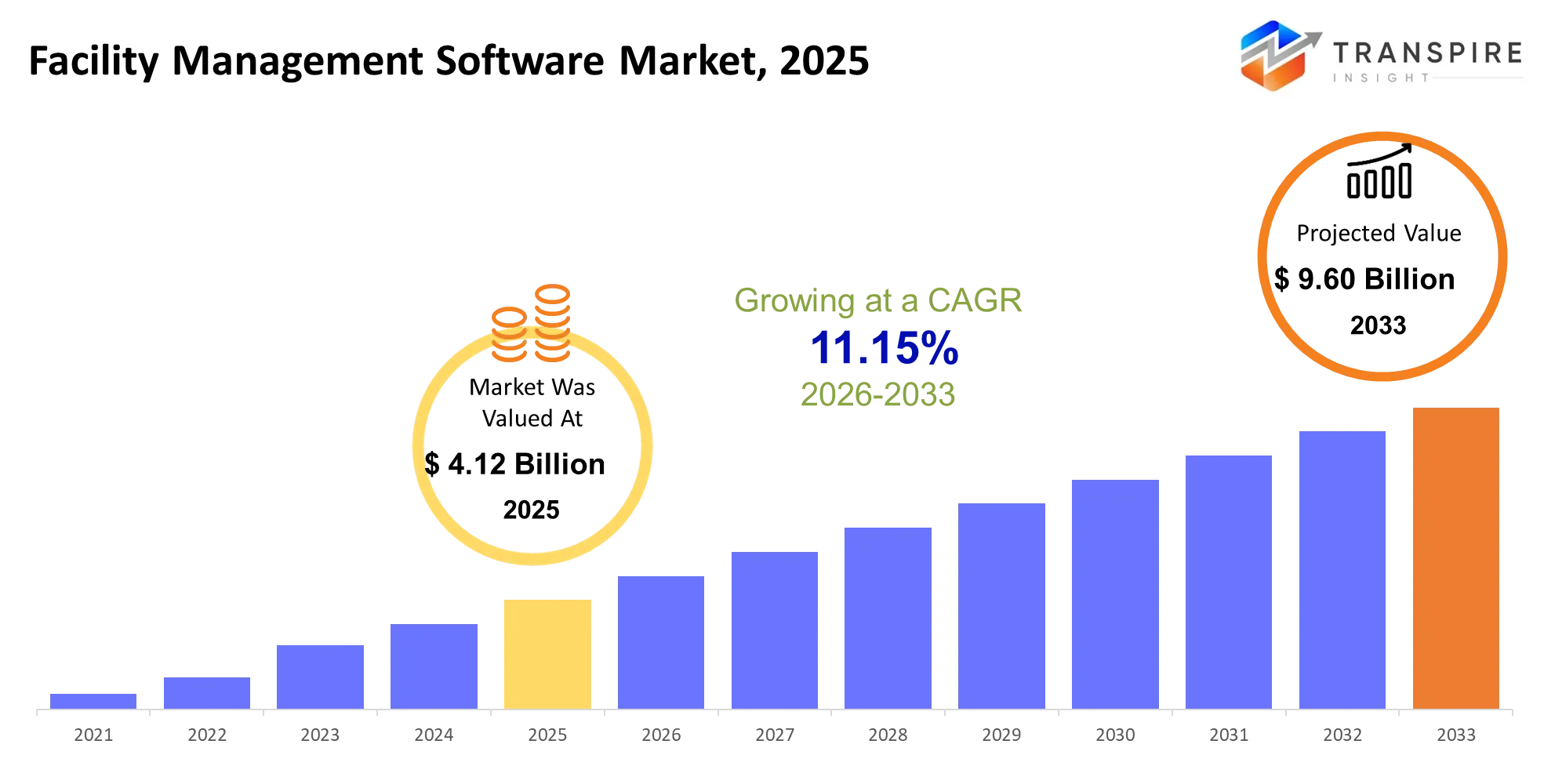
As per Transpire Insight Analysis, the Facility Management Software Market size is estimated at USD 4.12 billion in 2025 and is anticipated to reach USD 9.60 billion by 2033, growing at a CAGR of 11.15% from 2026 to 2033.
The facility management software market is changing. It supports organisations in managing buildings, maintenance, assets, space, energy and workplace services using connected systems. In use, this replaces scattered spreadsheets, manual work orders and disconnected records with shared operational data. Managers can then plan work and control costs effectively. Over the last three to five years, the market has moved from maintenance management to an integration platform. This integration is between IWMS, the cloud, analytics, mobility, IoT, and AI. Currently, there is a massive trend of moving towards data-based facility management. In parallel, the reality of hybrid working has created practical reasons for improved space utilisation and monitoring. The market is growing due to the connectivity of the software that enables the facility management team to see what is going on. They can perform automation of certain tasks and even predict future needs for maintenance.
Facility Management Software Market Size & Forecast:
- Market Size 2025: USD 4.12 Billion
- Expected Market Value (2033): USD 9.60 Billion
- Forecast CAGR (2026–2033): 11.15%
- Leading Region in 2025: North America
- Fastest Growing Region: Asia Pacific
- Key Company Profiles: IBM, Planon, MRI Software, Archibus, ServiceNow, FM:Systems, SAP, Oracle, MRI, Accruent, Trimble, Facilio, Spacewell, iOFFICE, Eptura
Key Market Insights:
The market is moving from simple facility management to platforms that integrate maintenance, office, asset, and building management. The greatest opportunity for the market is moving towards software that can leverage operations data for better decision-making.
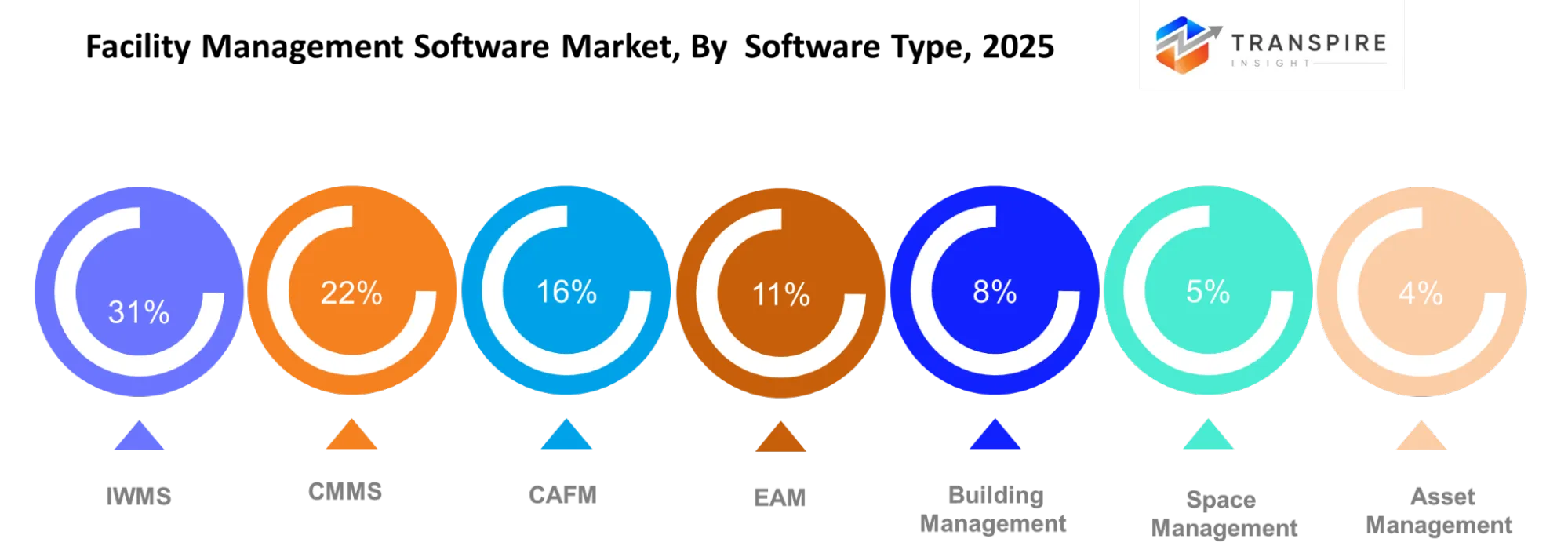
- IWMS constitutes 31% of the marketplace, indicating ongoing need for systems that combine all data related to workplaces, properties, spaces, and facilities. Suppliers are now linking these functions, as opposed to separating them in different software.
- CMMS makes up 22%, driven by the ongoing transition from paper maintenance logs to digital work orders and mobile technicians and asset tracking.
- CAFM holds at 16%, since facility managers are now relying more on centralised data to synchronise space usage, facility requests, maintenance procedures, and workplaces.
- Building Management Systems make up 8%, while sensors and other building data are pushing facility management towards automated monitoring and optimisation.
- Space Management systems account for 5%, because hybrid workplaces are making the collection of occupancy, room usage, workplace, and flexible space data more relevant.
What are the Key Drivers, Restraints, and Opportunities in the Facility Management Software Market?
Drivers
The growth is driven by the need to manage facilities without using any manual system or visibility. The shift towards using cloud-based solutions has facilitated integrating information about maintenance, space, assets, energy, and workplace rather than maintaining all data separately. Hybrid working models have affected planning of facilities since companies now require information about occupancy and bookings in order to determine the space needed. This enhances software implementation since higher efficiency might affect real estate cost considerations.
Restraints
The difficulty of combining facility platforms with legacy systems used in the building, enterprise systems, sensors, and inconsistent asset databases. It remains an issue because in large companies, there usually is a mixed environment of technology developed through the years. Before any integration happens, it takes effort on the side of technical, data cleaning, training, and change management.
Opportunities
Opportunity for vendors is associated with the transition from responsive facility management to predictive management using artificial intelligence. Software vendors are working on developing assistants that use natural language, predictive maintenance tools, connected analytics, and automation tools. Eptura is building on the use of artificial intelligence in facilities and workplace operations, as well as in asset, visitor and real estate operations, while Planon is developing AI-based maintenance planning and digital workplaces.
What Has the Impact of Artificial Intelligence Been on the Facility Management Software Market?
AI is changing the way facility management software goes beyond mere recording of activities into recommending actions and performing operational activities automatically. The AI tool can look at maintenance history, condition of assets, occupancy, work order, and energy information and detect anomalies. Predictive algorithms will assist the team in prioritising the equipment that needs attention before it fails, instead of being dependent on regular maintenance schedules only. The use of natural language will also simplify the software interface for employees and technicians to request, find information, or perform activities using conversational interfaces. There are some limitations with the adoption of AI. Implementation would need reliable data and even more funding, while inaccurate data would decrease the quality of recommendations.
Instance
In April 2026, ServiceChannel introduced ServiceChannel AI, which integrates AI agents into its facility management software to automate work order generation, triage, escalation, and analytics. This development illustrates how AI is assisting facility management teams to automate their processes.https://servicechannel.com/press/servicechannel-launches-servicechannel-ai-for-facilities-management/
Key Market Trends:
Market trends are moving from software that was primarily used for tracking activities in facilities to systems that help make decisions during operations. This transformation is taking place due to the increasing presence of cloud computing, building connectivity, hybrid workplace, analytics, and AI.
- Facility software has progressed from independent maintenance tracking software solutions to integrated platform solutions that integrate buildings, assets, workplace services, and other operational data.
- Cloud software solution implementation has become more relevant as enterprises strive to gain better accessibility, uniform updates, and workflows across facilities.
- Maintenance is evolving from reactive repair work to condition-based and predictive maintenance utilising sensor and historical asset data.
- Mobile access is becoming more crucial as technicians require work orders, asset data, maintenance history, and other updates while being on-site.
- AI is changing the facility operation process through automation of recommendations, predictive alerts, intelligent ticketing, and information searches.
- Energy consumption monitoring has become more integrated with facility software as enterprises try to gain operational efficiency.
Facility Management Software Market Segmentation
By Software Type
IWMS dominates with a share of 31%, CMMS accounts for 22%, CAFM is 16%, EAM is 11%, BMS is 8%, Space Management is 5%, Asset Management is 4%, and the rest account for 3%. IWMS will remain the same because companies prefer a unified software solution for all kinds of data related to their facilities, properties, workplaces, and spaces, whereas CMMS will continue to provide solutions for maintenance-related functions. As far as the future is concerned, there will be an increased convergence among facility management technologies, especially AI-driven facility management.
By Deployment
Cloud computing is becoming more significant as companies have multiple locations and need access, updates, and management of the data. On-premises solutions are still applicable to those companies that have the infrastructure and requirements for control, whereas hybrid solutions give the path for those firms that can’t migrate all of their facility applications at once. The SaaS solution makes the deployment faster and provides a recurring supply of software. Private cloud, public cloud, and multi-cloud enable businesses to choose infrastructure according to their security needs.
By Application
Asset Management, Maintenance Management, Space Management, Energy Management, Workplace Management, Security Management, Cleaning Management and other applications target various facility management needs. Maintenance becomes very important due to its direct impact on equipment availability and thus operations. Space and Workplace applications become increasingly significant as companies reevaluate their office space usage. The need for Energy Management is also growing as companies are getting more interested in their building's consumption. These applications can be even more interconnected using the capabilities of AI to understand relationships between assets' conditions, occupancy and energy consumption.
By End-User
Commercial, Residential, Healthcare, Educational, Manufacturing, Government, Retail and other end-users implement facility management software according to their operational needs. Commercial organisations tend to concentrate mainly on workplace and property optimisation, whereas Healthcare and Manufacturing environments need to pay particular attention to their assets' reliability and maintenance. Education and Government organisations may benefit from centralised management of distributed facilities. Retail users require systems capable of integrating operations at several facilities. As the number of facilities grows, end-users are becoming more interested in configuring platforms rather than applications.
By Enterprise Size
Enterprises of all sizes, including large enterprises, mid-size enterprises, SMEs, startups, government bodies, institutions, property managers, and other firms comprise the enterprise-size environment. Large organizations typically need many integrations, multi-site visibility, reporting, and governance capabilities. Mid-size organisations and SMEs are becoming increasingly interested in cloud/SaaS solutions as these may help minimise the organization’s infrastructure needs. Property managers and institutions also need increasing amounts of information about their assets and spaces. The vendors that offer scalable packages are well suited to cater to the needs of various budgets and complexities.
By Service
Implementation services, consultancy, integration services, support services, managed services, training services, upgrades, and others are some of the service areas needed to implement and continue to work with facility management software platforms. The integration service area becomes especially important if the new software needs to be integrated with the existing ERP, building, IoT, or workplace systems. The consulting services are used by organizations to redesign workflows, and training services assist in adopting the software. The managed services can provide ongoing operational support.
By Facility Type
Office buildings continue to be one of the important sectors for the use of BMS applications due to the close relationship between workplace management, occupancy, maintenance, and space planning. Hospital facility management involves proper maintenance, asset management, compliance, and operational procedures, but schools and industrial facilities have their own demands when it comes to buildings, equipment, and services. The need for multiple sites and consistency in service delivery in retail shops, airports, and hotels is a must.
What are the Key Use Cases Driving the Facility Management Software Market?
The use case is facility and maintenance management, which is a highly related IWMS category. The organization utilizes centralized software to manage its assets, work order management, space data, service requests, and building activities. New use cases would include occupancy management, workplace management, energy management, mobile maintenance management, vendor management, and asset management throughout the lifecycle. Such features will be increasingly interconnected as companies look for one operational view. New emerging use cases are AI-powered predictive maintenance, automated ticketing, intelligent facility assistant, anomaly detection based on sensors, and data-driven space planning.
|
Report Metrics |
Details |
|
Market size value in 2025 |
USD 4.12 Billion |
|
Market size value in 2026 |
USD 4.58 Billion |
|
Revenue forecast in 2033 |
USD 9.60 Billion |
|
Growth rate |
CAGR of 11.15% from 2026 to 2033 |
|
Base year |
2025 |
|
Historical data |
2021 - 2024 |
|
Forecast period |
2026 - 2033 |
|
Report coverage |
Revenue forecast, competitive landscape, growth factors, and trends |
|
Regional scope |
United States; Canada; Mexico; United Kingdom; Germany; France; Italy; Spain; Denmark; Sweden; Norway; China; Japan; India; Australia; South Korea; Thailand; Brazil; Argentina; South Africa; Saudi Arabia; United Arab Emirates |
|
Key company profiled |
IBM, Planon, MRI Software, Archibus, ServiceNow, FM:Systems, SAP, Oracle, MRI, Accruent, Trimble, Facilio, Spacewell, iOFFICE, Eptura |
|
Customization scope |
Free report customization (country, regional & segment scope). Avail customized purchase options to meet your exact research needs. |
|
Report Segmentation |
By Software Type (IWMS, CMMS, CAFM, EAM, Building Management Software, Space Management, Asset Management, Others); By Deployment (Cloud, On-premise, Hybrid, SaaS, Private Cloud, Public Cloud, Multi-cloud, Others); By Application (Asset Management, Maintenance Management, Space Management, Energy Management, Workplace Management, Security Management, Cleaning Management, Others); By End User (Commercial, Residential, Healthcare, Education, Manufacturing, Government, Retail, Others); By Enterprise Size (Large Enterprises, Mid-sized Enterprises, SMEs, Startups, Government Agencies, Institutions, Property Managers, Others); By Service (Implementation, Consulting, Integration, Support, Managed Services, Training, Upgrades, Others); By Facility Type (Office Buildings, Hospitals, Schools, Industrial Facilities, Retail Stores, Airports, Hotels, Others) |
Which Regions are Driving the Facility Management Software Market Growth?
North America
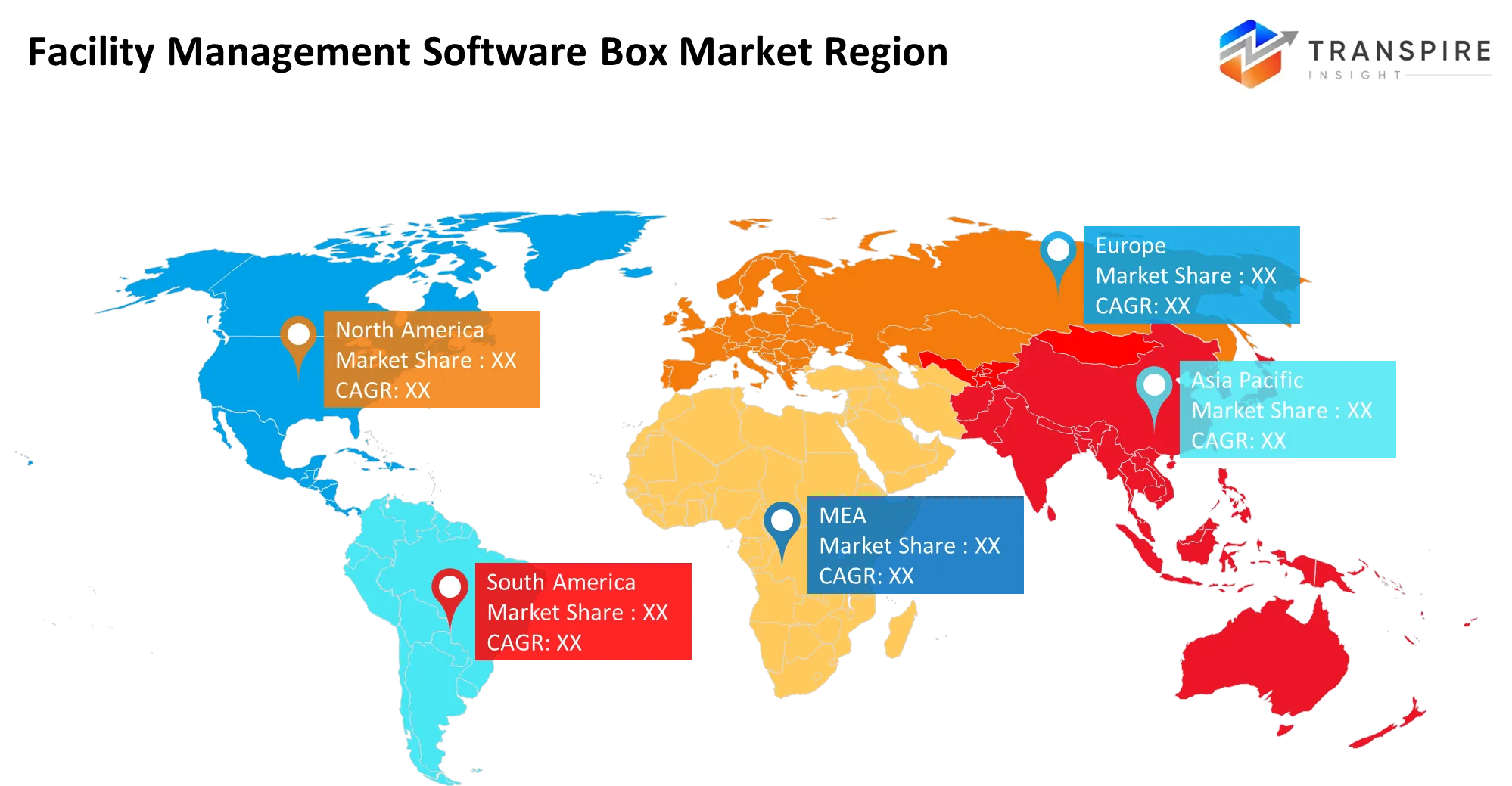
North America holds a 37.46% market share due to its adoption of enterprise software solutions, facility management approaches, and technologies that facilitate a connected workplace environment. Enterprises in the region have significantly capitalised on cloud solutions, building automation, workplace systems, and technology-driven operations. The region has the availability of leading software vendors and technology partners that help deploy the solutions across large properties.
In August 2026, Ecotrak announced Ecotrak Energy driven by Entouch, bringing together energy intelligence enabled through IoT with facility management software to offer consolidated asset, work order, and energy management solutions.https://www.prnewswire.com/news-releases/ecotrak-launches-ecotrak-energy-powered-by-entouch-uniting-facilities-and-energy-management-in-one-intelligent-platform-302858806.html
Europe
Europe holds 29% of the market share and has a well-developed market characterised by sustainability concerns, efficiency demands, and existing commercial property infrastructure. In comparison to North America, European demand is largely associated with energy efficiency, environmental issues, workplace efficiency, and regulatory considerations. The region also has a developed network of facility management service providers and software companies. Further investments in smart building solutions and efficiency contribute to the stability of software solutions.
In April 2026, Brightly Software teamed up with AppyWay to incorporate digital traffic order technology into their Confirm asset management system, facilitating the operation of digitised infrastructure in the United Kingdom.https://www.assetmanagement.siemens.com/news
Asia-Pacific
Asia-Pacific has 24% of the market share and is the fastest-growing regional market with a 26.30% CAGR forecast. The rapid growth of commercial buildings, industrial facilities, technological infrastructure, and workplaces offers new opportunities in digital facility management. As more and more organisations adopt cloud-based solutions and connected technologies in the process of expanding their facility networks, there is an opportunity for vendors that can offer scalable platforms suitable for multi-facility management.
In April 2025, JLL teamed up with ServiceNow, combining JLL's extensive experience in real estate and facilities management with ServiceNow's cloud-based Workplace Service Delivery platform.https://www.jll.com/en-in/newsroom/jll-and-service-now-join-forces-to-revolutionize-the-workplace
Who are the Key Players in the Facility Management Software Market and how do they compete?
Facility management software competition is becoming platform-based, integrating, AI-enabled, implementation-supported, and enabling connections between facility management operations and broader enterprise operations. Businesses are evolving from maintenance tools to platforms that revolve around asset connection, workplace data, analytics, automation, and workflow processes. This creates space for enterprise technology companies as well as for facility management vendors. The IBM competitive strategy revolves around innovation, especially with its Maximo portfolio. The company focuses on innovation around asset management, maintenance, reliability, AI, and workflows. The differentiation of the company lies in enterprise technologies, analytics, automation, and asset-related capabilities. The expansion strategy of IBM relies on further embedding AI into asset-intensive operations and on linking operational intelligence with daily maintenance tasks. Planon employs the strategy of a specialised facility and real estate software product. Differentiation of Planon is achieved through integrated building, workplace, property, and facility processes. The SAP partnership makes Planon extend its reach within enterprises and opens another channel for penetrating organizations that use SAP systems.
Facility Management Software Market companies
- IBM
- Planon
- MRI Software
- Archibus
- ServiceNow
- FM:Systems
- SAP
- Oracle
- MRI
- Accruent
- Trimble
- Facilio
- Spacewell
- iOFFICE
- Eptura
Recent Development News
In March 2026, Planon launched Planon for Data Centers that extends the CMMS functionality of Planon into mission-critical areas. The offering integrates maintenance, compliance, asset management, and energy workflows related to decentralised data centre locations.https://planonsoftware.com/us/news/planon-introduces-platform-for-data-centers/
In June 2025, Honeywell launched its new product called Connected Solutions that is powered by artificial intelligence and provides a building management system allowing for integration of the building software, services, and devices via a single portal.https://www.facilitiesdive.com/news/honeywell-launches-connected-solutions-to-link-building-systems/750310/
What Strategic Insights Define the Future of the Facility Management Software Market?
The market for facility management software is moving towards operational platforms, which will enable maintenance, workplace, assets, energy, space, and building data to be managed by less integrated processes. AI will play an increasingly important role in the field as its application will move from being a nice-to-have analytical feature to one of predictive maintenance, prioritisation of service requests, asset management, and facility questions. The silent danger here is poor-quality data – the company will spend money on advanced AI while old building systems, lack of accurate asset information, and non-compatible applications will reduce the quality of information used by the AI. One of the new opportunities is linking facility software with IoT infrastructure and enterprise software platforms to deliver operational data to workflows directly. In this case, vendors need to focus not only on the AI but also on integration, data governance, and operational results. Providers who can make the integration easier and show savings on the portfolio can become more successful.
By Software Type
- IWMS
- CMMS
- CAFM
- EAM
- Building Management Software
- Space Management
- Asset Management
By Deployment
- Cloud
- On-premise
- Hybrid
- SaaS
- Private Cloud
- Public Cloud
- Multi-cloud
By Application
- Asset Management
- Maintenance Management
- Space Management
- Energy Management
- Workplace Management
- Security Management
- Cleaning Management
By End User
- Commercial
- Residential
- Healthcare
- Education
- Manufacturing
- Government
- Retail
By Enterprise Size
- Large Enterprises
- Mid-sized Enterprises
- SMEs
- Startups
- Government Agencies
- Institutions
- Property Manager
By Service
- Implementation
- Consulting
- Integration
- Support
- Managed Services
- Trainin
- Upgrades
By Facility Type
- Office Buildings
- HospitalsS
- Schools
- Industrial Facilities
- Retail Stores
- Airports
- Hotels
By Regional Analysis
North America
- US
- Canada
- Mexico
Europe
- Germany
- UK
- France
- Italy
- Spain
- Russia
- Rest of Europe
Asia Pacific
- China
- Japan
- India
- South Korea
- Australia
- Rest of Asia Pacific
South America
- Brazil
- Argentina
- Rest of South America
Middle East & Africa
- UAE
- Saudi Arabia
- Qatar
- South Africa
Frequently Asked Questions
Find quick answers to common questions.
The facility management software market size was valued at USD 4.12 billion in 2025 and is poised to reach USD 9.60 billion by 2033, expanding at an 11.15% CAGR.
Key segments for the facility management software market are By Software Type (IWMS, CMMS, CAFM, EAM, Building Management Software, Space Management, Asset Management, Others); By Deployment (Cloud, On-premise, Hybrid, SaaS, Private Cloud, Public Cloud, Multi-cloud, Others); By Application (Asset Management, Maintenance Management, Space Management, Energy Management, Workplace Management, Security Management, Cleaning Management, Others); By End User (Commercial, Residential, Healthcare, Education, Manufacturing, Government, Retail, Others); By Enterprise Size (Large Enterprises, Mid-sized Enterprises, SMEs, Startups, Government Agencies, Institutions, Property Managers, Others); By Service (Implementation, Consulting, Integration, Support, Managed Services, Training, Upgrades, Others); By Facility Type (Office Buildings, Hospitals, Schools, Industrial Facilities, Retail Stores, Airports, Hotels, Others)
Growth is primarily driven by increasing use of cloud technologies, greater interest in facility automation, increased reliance on IoT systems, requirement of predictive maintenance, and increased focus on smart buildings.
The market is led by major manufacturers including IBM, Planon, MRI Software, Archibus, ServiceNow, FMSystems, SAP, Oracle, MRI, Accruent, Trimble, Facilio, Spacewell, iOFFICE, and Eptura
North America represents 37.46% of the world market of facility management software. This market strength can be attributed to the widespread use of cloud technology, the presence of advanced digital infrastructure, high demand for automated facilities and the presence of software vendors. Increased investments in smart buildings have also contributed to the growth of the market.
The commercial opportunities that the facility management software market holds are the use of cloud-based technology, integration of IoT and AI into facility management, the need for predictive maintenance, and growth in mobile-based facility management. Another opportunity that the facility management software market holds is increasing investments in smart buildings.
- IBM
- Planon
- MRI Software
- Archibus
- ServiceNow
- FM:Systems
- SAP
- Oracle
- MRI
- Accruent
- Trimble
- Facilio
- Spacewell
- iOFFICE
- Eptura
About the Authors

Avinash Kumar
I’m Avinash Kumar, a Senior Research Analyst at Transpire Insight, with expertise in the Electronics and Semiconductor and Energy & Power industry. My work focuses on analyzing emerging technologies, market trends, industry developments, and innovation across these sectors. I specialize in transforming complex technical and market insights into clear, research-backed content that helps professionals, businesses, and decision-makers stay informed. Through continuous industry research and data-driven analysis, I strive to deliver accurate, reliable, and practical perspectives on the latest advancements shaping the semiconductor and energy landscape.

Chakradhar Khansole
Chakradhar serves as the Research Director at Transpire Insight, bringing over 8 years of experience in technology, innovation, and strategic market intelligence. He specializes in transforming complex market data into actionable business insights that enable organizations to make informed, growth-oriented decisions. Recognized for his strategic vision and analytical expertise, Chakradhar leads high-impact research initiatives, delivering comprehensive market assessments, competitive intelligence, and forward-looking industry analysis.
Recently Published Reports
-
Apr 2026
Fiber Optic Faceplates Market
Fiber Optic Faceplates Market Size, Share & Analysis Report By Type (< 300 mm2, 300-350 mm2, and > 350 mm2, By Application (Night Vision, Holographic Imaging, Medical, and Others), and Geography (North America, Europe, Asia-Pacific, Middle East and Africa, South and Central America), 2021 - 2031
-
Apr 2026
High Temperature Superconductors Market
High Temperature Superconductors Market Size, Share & Analysis Report By Type (1G HTS, and 2G HTS), By Application (Power Cable, Fault Current Limiter, and Transformer), and Geography (North America, Europe, Asia-Pacific, Middle East and Africa, South and Central America), 2021 - 2031
-
Apr 2026
Industrial Plugs and Socket Market
Industrial Plugs and Socket Market Size, Share & Analysis Report By Type (Industrial Plugs, Industrial Sockets), By Current (Up to 32 A, 32 to 125 A, Above 125 A), By Protection (Dustproof and Splash Proof, Waterproof, Explosion Proof), By End User (Heavy Industries, Oil and Gas, Chemicals and Pharmaceuticals, Power Generation, Others), and Geography (North America, Europe, Asia-Pacific, Middle East and Africa, South and Central America), 2021 - 2031
-
Apr 2026
InGaAs Avalanche Photodiodes Market
InGaAs Avalanche Photodiodes Market Size, Share & Analysis Report By Type (1100 - 1700 nm, and 1000 - 1600 nm), By Application (Missile Warning System, Muzzle Flash Detection, Wafer Defect Inspection, Laser Rangefinders, and Others), and Geography (North America, Europe, Asia-Pacific, Middle East and Africa, South and Central America), 2021 - 2031