
Integrated Workplace Management System (IWMS) Market Summary:
According to Transpire Insights, a detailed research report on the market reflects that the facility management application segment dominates the Integrated Workplace Management System (IWMS) Market, accounting for approximately 32% of the total market share worldwide. IBM Corporation leads the market with approximately (around USD 62.8 billion) in annual revenue and an estimated significant global market share, making it an important contributor to market development, innovation, advanced IWMS solutions, expanding software capabilities, and growth dynamics.
Market Snapshot
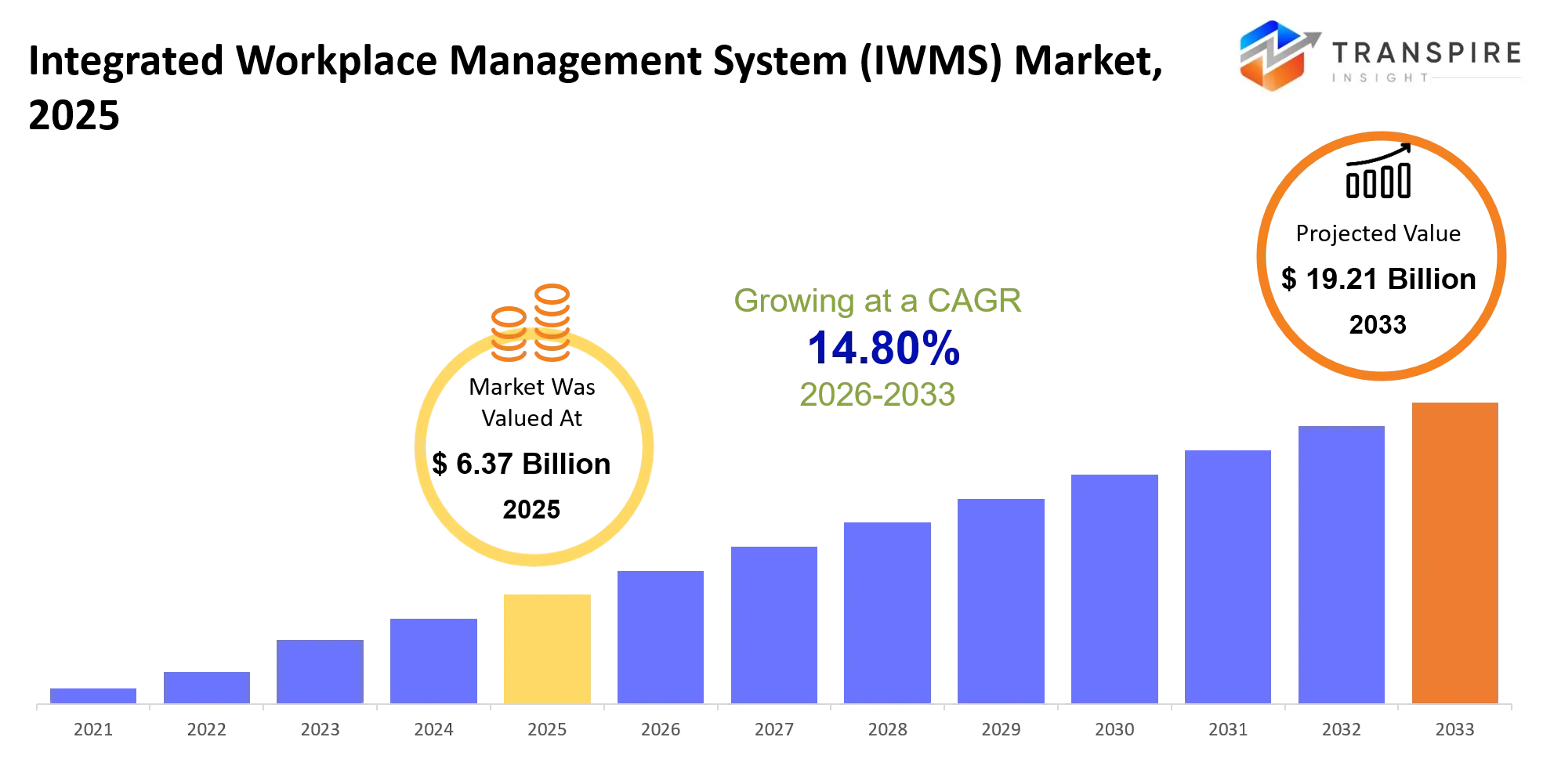
- Global Market Value (2025): USD 6.37 Billion.
- Expected Market Value (2026): USD 7.31 Billion.
- Estimated Market Value (2033): USD 19.21 Billion.
- Forecast CAGR (2026–2033): 14.80%
- Leading Region in 2025: North America
- Second-largest Region: Europe
- Fastest Growing Region: Asia Pacific
Introduction
An Integrated Workplace Management System (IWMS) is a type of software system that incorporates several real estate and facilities management features into one database. Business organizations can use an IWMS instead of different systems for lease management, planning for space, and managing maintenance of facilities. IWMS is defined as an overall solution merger for multiple business processes such as managing real estate portfolio, lease management, space management and utilization, facility maintenance, and sustainability. As defined first by Gartner in 2004, the IWMS eliminates physical separate silos of maintenance and space planning, among others. Integrated Workplace Management Systems (IWMS) offer major advantages through increased workplace efficiency, cost savings, and improved operational visibility. These solutions are able to increase space utilization by as much as 40% and decrease facility maintenance costs by around 14%. IWMS platforms enable the integration of all relevant data relating to real estate, leases, assets, and their maintenance so the processes can be optimized and based on data-driven decision-making. They also provide resources for active sustainability efforts and effective energy management because they make it possible to monitor resource utilization, enhances energy performance of buildings and support carbon reducing programs. In addition, options for desk hoteling, room booking, and real-time tracking of occupancy allow companies to enjoy hybrid flexibility and optimize their management processes and resources as well as improve employees’ experience.
For instance:-As businesses are utilizing cloud systems, AI-based space optimization, and intelligent building technologies to implement permanent hybrid working structures, the North American Integrated Workplace Management System (IWMS) market investment is witnessing a significant increase.
Market Highlights: -
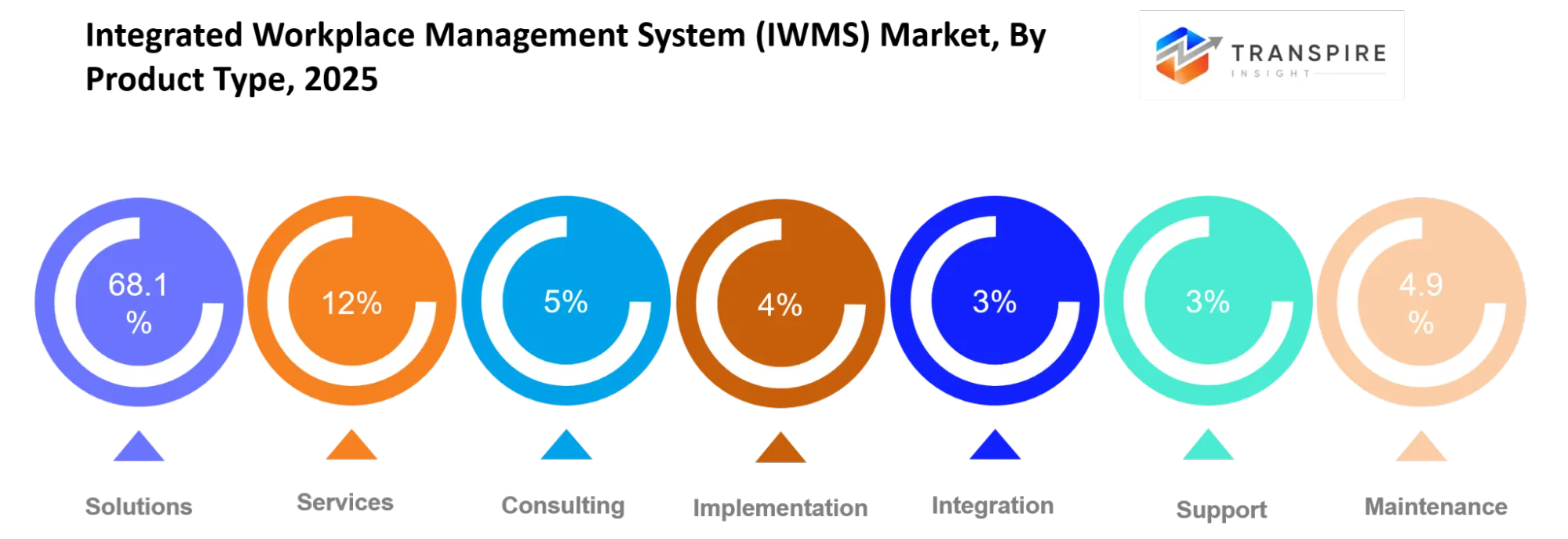
- North America is anticipated to hold roughly 32% share of the Integrated Workplace Management System (IWMS) Market over the predicted timeframe.
- Europe is expected to grow at a rapid CAGR in the Integrated Workplace Management System (IWMS) Market by holding roughly25% of the share during the forecast period.
- Asia Pacific is anticipated to hold roughly20% share of the Integrated Workplace Management System (IWMS) Market over the predicted timeframe.
- By deployment, the Public Cloud segment dominated the market and holds nearly 52% share in 2025 and is projected to grow at a substantial CAGR during the forecast period.
- By application, the Real Estate Management segment dominated the market and holds nearly 30% share in 2025 and is projected to grow at a substantial CAGR during the forecast period.
- By end user, the BFSI segment dominated the market and holds nearly 24% share in 2025 and is projected to grow at a substantial CAGR during the forecast period.
- Smart Cities and Digital Technology: The rise of smart cities, interconnected buildings, and digital systems are leading to increased IWMS acceptance via enhancements in facility management, maximizing the use of space, optimizing asset efficiency, conserving energy and promoting accountability in operations.
How is Technology Driving Growth in the Integrated Workplace Management System (IWMS) Market?
The Integrated Workplace Management System (IWMS) Market is changing due to advanced digital technologies that improve the efficiency, automation, and sustainability of workplaces. Technology based on the cloud allows for centralized management of facilities, access to data in real time, and the use of scalable solutions that have lower infrastructure requirements. Solutions that operate with Artificial Intelligence (AI) and Machine Learning allow for automation of processes, predictive maintenance, and optimization of the work area. The integration of IoT allows for assessment of usage, condition, and energy consumption.
|
Report Metrics |
Details |
|
Market size value in 2025 |
USD 6.37 Billion |
|
Market size value in 2026 |
USD 7.31 Billion |
|
Revenue forecast in 2033 |
USD 19.21 Billion |
|
Growth rate |
CAGR of 14.80% from 2026 to 2033 |
|
Base year |
2025 |
|
Historical data |
2021 - 2024 |
|
Forecast period |
2026 - 2033 |
|
Report coverage |
Revenue forecast, competitive landscape, growth factors, and trends |
|
Regional scope |
United States; Canada; Mexico; United Kingdom; Germany; France; Italy; Spain; Denmark; Sweden; Norway; China; Japan; India; Australia; South Korea; Thailand; Brazil; Argentina; South Africa; Saudi Arabia; United Arab Emirates |
|
Key company profiled |
IBM, MRI Software, Planon, Archibus, Trimble, Accruent, Tango, FM:Systems, ServiceNow, SAP, Oracle, iOFFICE, Spacewell, Eptura, MRI Software |
|
Customization scope |
Free report customization (country, regional & segment scope). Avail customized purchase options to meet your exact research needs. |
|
Report Segmentation |
By Offering (Solutions, Services, Consulting, Implementation, Integration, Support, Maintenance, Others); By Deployment (Cloud, On-premise, Hybrid, Hosted, SaaS, Private Cloud, Public Cloud, Others); By Application (Real Estate Management, Facilities Management, Space Management, Maintenance Management, Environmental Sustainability, Lease Management, Workplace Management, Others); By Enterprise Size (Large Enterprises, SMEs, Mid-sized Enterprises, Startups, Government, Institutions, Multinationals, Others); By End User (IT & Telecom, BFSI, Manufacturing, Healthcare, Retail, Government, Education, Others); By Function (Asset Management, Space Planning, Energy Management, Lease Administration, Work Order Management, Portfolio Management, Analytics, Others); By Technology (AI, IoT, Cloud Computing, Mobile, Digital Twin, Analytics, Automation, Others) |
Market Drivers
The Integrated Workplace Management System (IWMS) Market is growing due to the increased uptake of hybrid work models along with the rising need for dynamic desk booking, meeting room allocation, and occupancy assessment. Businesses are turning to IWMS solutions not only to enhance efficiency but also to increase workplace utilization, reduce costs on real estate, and streamline the process of facility management. The increasing drive for sustainability and energy management will also push corporations to track the performance of buildings and decrease energy usage. In addition, the rise of cloud-based platforms and IoT technologies allows companies to conduct real-time monitoring of their workplaces and utilize smart buildings, predictive maintenance, and data-driven decision-making along with scaling of the digital workplace transformation. Integrated Workplace Management Systems (IWMS) yield considerable advantages in terms of better operational efficiency, cost savings, and performance at the workplace. Cost Savings: Facilities data saved in the IWMS can provide savings of about 15% on maintenance costs and up to 25% on the entire real estate budget. Space Usage Optimization: Efficient space management system can increase utilization of the space up to 40%, which is very useful for hybrid offices. Automation: With the help of IWMS companies can increase automation of service requests, renewals by lease agreements, and preventive works. Data-Driven Solutions: Thanks to the data analytics and IoT capabilities IWMS allows companies to gain information about the efficiency of their properties, the number of occupied premises and the level of energy consumption. Regulatory Compliance: IWMS integrates different tracking systems allowing for certification compliance and environmental reporting within a complex office portfolio.
For Instance: - Foreign software investments are greatly decreased in Russia as a result of the ongoing sanctions and the withdrawal of technology companies from the country. This forces Russian companies to turn to local solutions for facility management and to seek homegrown technology solutions.
The market for Integrated Workplace Management System (IWMS) in Europe is heavily driven by the need for rigorous climate regulations such as the Corporate Sustainability Reporting Directive. Specifically, organizations in Europe, especially those in Germany, Netherlands, and Nordic countries, give importance to cloud-based technology and the integration of IoT to facilitate net-zero retrofits and provide automatic energy efficiency solutions.
Restrain
The Integrated Workplace Management System (IWMS) industry is dealing with difficulties such as high costs of implementation and switching, difficult integration with ERP, HR, and legacy systems and increasing cybersecurity and data privacy concerns. A lack of domain knowledge can create delays in implementation as well as higher consulting fees. In addition, resistance to change within organizations can prevent the system from being adopted, especially among people who previously used only manual procedures and had experience in facility management using traditional practices.
|
Driver |
Relative Impact on Growth (%) |
Geographic Relevance |
Impact Timeline |
Demand Strength |
Growth Mechanism |
Key Beneficiaries |
Major Constraint |
|
Hybrid Workplace and Space Optimization |
27% |
North America, Europe, Asia Pacific |
Short-term |
High |
Optimizes occupancy, desks, rooms, and workplace utilization |
IWMS vendors, facility managers, corporate enterprises |
Employee adoption and workplace policy variability |
|
Cloud-Based IWMS Adoption |
22% |
North America, Europe, Asia Pacific |
Short-term |
High |
Enables scalable, centralized, subscription-based workplace management |
Cloud vendors, IWMS providers, SMEs, multinational enterprises |
Cybersecurity, data sovereignty, and integration concerns |
|
AI, IoT and Advanced Workplace Analytics |
20% |
North America, Asia Pacific, Europe |
Medium-term |
High |
Automates decisions using real-time occupancy and asset data |
Technology vendors, IWMS providers, facility operators |
Data quality and legacy-system integration challenges |
|
Sustainability and Building-Efficiency Regulations |
17% |
Europe, North America, Asia Pacific |
Medium-term |
High |
Drives energy monitoring, carbon reporting, and compliance |
Building owners, sustainability providers, IWMS vendors |
Regulatory complexity and implementation costs |
|
Enterprise Integration and Operational Efficiency |
14% |
Global, especially North America and Europe |
Long-term |
Medium |
Connects facilities, assets, leases, and enterprise workflows |
Large enterprises, service providers, technology vendors |
High integration costs and organizational resistance |
|
Total |
100% |
— |
— |
— |
— |
— |
— |
Analysis of Prices and Consumer Behaviour
The market for the Integrated Workplace Management System (IWMS) is primarily constituted by the Facilities and Space Management segment, which is estimated to cover around 27.05% of the entire market in 2025. This segment is estimated to generate around USD 1.67 billion in 2025, owing to the demand for space optimization, facility operations, and work efficiency. The cloud deployment segment is expected to cover almost 55% of the total market, which shows increased adoption of flexible and affordable cloud-based IWMS platforms. Large enterprises are expected to cover roughly 66.80% of the market in 2025 due to their large operating portfolios of workplaces and demand for a centralized system for managing real estate and facilities. The IT and Telecom sector is expected to constitute around 24.10% of the market revenues in 2025 due to high demand for digital management and operational transparency in the workplace. It is shown that organizations prefer IWMS solutions that can be integrated and scaled easily and provide real-time information and analytics. Organizations are increasingly opting for cloud-based solutions because of the lower implementation time, centralized operation, and fast working in multiple workplaces.
|
Investment Factor |
Why It Matters to Investors |
Opportunity |
Investment Implication |
|
Cloud-Based IWMS Expansion |
Recurring SaaS models improve scalability and revenue visibility |
Develop subscription-based workplace and facilities platforms |
Supports scalable, recurring-revenue business models |
|
AI, IoT and Automation |
Intelligent workflows increase operational efficiency and differentiation |
Invest in predictive maintenance, occupancy analytics, and AI automation |
Creates technology-led differentiation opportunities |
|
Hybrid Workplace Management |
Flexible workplaces require continuous space and occupancy optimization |
Expand desk booking, room scheduling, and workplace analytics |
Supports sustained enterprise software demand |
|
Sustainability and Energy Management |
Decarbonization requirements increase demand for measurable building performance |
Integrate energy, carbon, ESG, and sustainability analytics |
Creates compliance-driven long-term demand |
|
Asia-Pacific Expansion |
Rapid urbanization and smart-building adoption expand addressable customers |
Target digitally transforming enterprises and commercial properties |
Provides geographic diversification and expansion potential |
|
Enterprise Integration |
Integration connects IWMS with ERP, HR, BMS, and collaboration systems |
Build interoperable APIs and enterprise workflow capabilities |
Strengthens customer retention and platform stickiness |
|
Investment Risk |
Complex implementations and cybersecurity requirements can delay adoption |
Prioritize secure, modular, implementation-light solutions |
Requires disciplined product and deployment investment |
Who are the Key Players in the Integrated Workplace Management System (IWMS) Market and how do they compete?
The competitiveness of Integrated Workplace Management System companies in global markets is determined by their expertise in innovations in workplace technologies, industry-specific solutions, cloud systems, and global service networks. The companies’ competitiveness is driven by complex management of facilities, utilization of spaces, leasing administration, workplace analytics, sustainable development, and integration with enterprise software, which helps organizations to enhance efficiency in operation, use of assets, and make workplaces more transparent.
IBM boosts its competitiveness by developing integrated facility management solutions and cloud-based IWMS systems. The companies stand out for their innovative scalable solutions in workplace management for corporate, commercial, healthcare, and public sectors. Planon strengthens its position by providing integrated solutions in facility, real estate, workplace, and sustainability management giving support to organizations that centralize their operations and make data-informed business decisions.
Top Companies in the Integrated Workplace Management System (IWMS) Market
- IBM
- MRI Software
- Planon
- Archibus
- Trimble
- Accruent
- Tango
- FM:Systems
- ServiceNow
- SAP
- Oracle
- iOFFICE
- Spacewell
- Eptura
- MRI Software
|
Company |
Est. Revenue Share Range |
Key Offerings |
Strategic Positioning |
Geographic Strength |
Technology Focus |
|
IBM |
8–12% |
TRIRIGA, real estate management, facilities management, workplace planning |
Enterprise-scale platform and AI-enabled transformation |
North America, Europe, Asia Pacific |
AI, cloud, analytics, automation |
|
Planon |
7–11% |
Planon Universe, real estate management, facility management, workplace management |
Integrated cloud IWMS and ecosystem strategy |
Europe, North America, Asia Pacific |
Cloud, IoT, AI, workplace analytics |
|
MRI Software |
7–10% |
MRI IWMS, workplace management, facilities management, energy management |
Flexible ecosystem and interoperable IWMS platform |
North America, Europe, Asia Pacific |
Cloud, analytics, AI, integrations |
|
Trimble |
6–9% |
Manhattan IWMS, space management, facilities management, asset management |
Connected real estate and operational technology platform |
North America, Europe, Asia Pacific |
Cloud, IoT, BIM, analytics |
|
Eptura |
5–8% |
Eptura Workplace, asset management, space management, visitor management |
Unified workplace experience and facilities platform |
North America, Europe, Asia Pacific |
AI, automation, analytics, cloud |
|
Accruent |
5–8% |
EMS, Maintenance Connection, Lucernex, facilities management |
Broad workplace and asset-management portfolio |
North America, Europe, Asia Pacific |
Cloud, IoT, analytics, automation |
|
FM |
4–7% |
FM, workplace management, space planning, facility management |
Workplace-centric specialization and enterprise integration |
North America, Europe, Asia Pacific |
AI, occupancy analytics, cloud |
|
SAP |
3–6% |
SAP Real Estate Management, asset management, lease management |
ERP-integrated real estate management ecosystem |
Europe, North America, Asia Pacific |
Cloud ERP, analytics, AI, automation |
|
Oracle |
3–6% |
Oracle Real Estate Management, lease management, facilities capabilities |
Enterprise cloud suite and financial integration |
North America, Europe, Asia Pacific |
Cloud, AI, analytics, automation |
|
ServiceNow |
2–5% |
Workplace Service Delivery, reservations, space mapping, workplace maintenance |
Workflow-led workplace service platform expansion |
North America, Europe, Asia Pacific |
AI agents, automation, IoT, workflows |
Market Segmentation
The Integrated Workplace Management System (IWMS) Market share is divided into seven categories: By offering, deployment, application, enterprise size, end user, function and technology.
The Public Cloud dominated the market, accounting for nearly 52% in 2025 and is expected to rise at a significant CAGR during the forecast period.
The Integrated Workplace Management System (IWMS) Market is segmented by deployment into Cloud, On-premise, Hybrid, Hosted, SaaS, Private Cloud, Public Cloud, Others. Among these, the Public Cloud segment dominated the market, accounting for nearly 52% in 2025 and expected to increase at a significant CAGR during the forecast period. The Public Cloud sector is propelled by the growing need for flexible, scalable and economical Integrated Workplace Management System (IWMS) deployments. The public cloud solutions help minimize the need for infrastructure, make workplace data available in real-time, facilitate software updates, and give the possibility of managing several facilities. Another factor for quicker deployment of IWMS in the Public Cloud segment is the growing popularity of hybrid work and its digital transformation.
The Real Estate Management dominated the market, accounting for nearly 30% in 2025, and is expected to rise at a significant CAGR during the forecast period.
The Integrated Workplace Management System (IWMS) Market is segmented by application into Real Estate Management, Facilities Management, Space Management, Maintenance Management, Environmental Sustainability, Lease Management, Workplace Management, Others. Among these, the Real Estate Management segment dominated the market, accounting for nearly 30% in 2025 and expected to increase at a significant CAGR during the forecast period. The rise in demand for comprehensive property management, lease management, portfolio optimization, and asset lifecycle management drives growth in the real estate management sector. In order to maximize space use, minimize real estate expenditure, speed up lease execution and provide real-time data through analytics plus integrated workplace information, companies choose Integrated Workplace Management Systems (IWMS).
The BFSI dominated the market, accounting for nearly 24% in 2025 and is expected to rise at a significant CAGR during the forecast period.
The Integrated Workplace Management System (IWMS) Market is segmented by end user into IT & Telecom, BFSI, Manufacturing, Healthcare, Retail, Government, Education, Others. Among these, the BFSI segment dominated the market, accounting for nearly 24% in 2025 and expected to increase at a significant CAGR during the forecast period. The BFSI section is growing because of the rising need for secure, efficient, and centralized workplace and facility management across banking organizations, financial service providers, and insurance companies. Integrated Workplace Management Systems or IWMS are known to support space optimization, asset tracking, maintenance scheduling, compliance, energy monitoring, and real-time analytics to help BFSI players manage complicated property portfolios at various locations at the same time.
Regional Segment Analysis of the Integrated Workplace Management System (IWMS) Market:
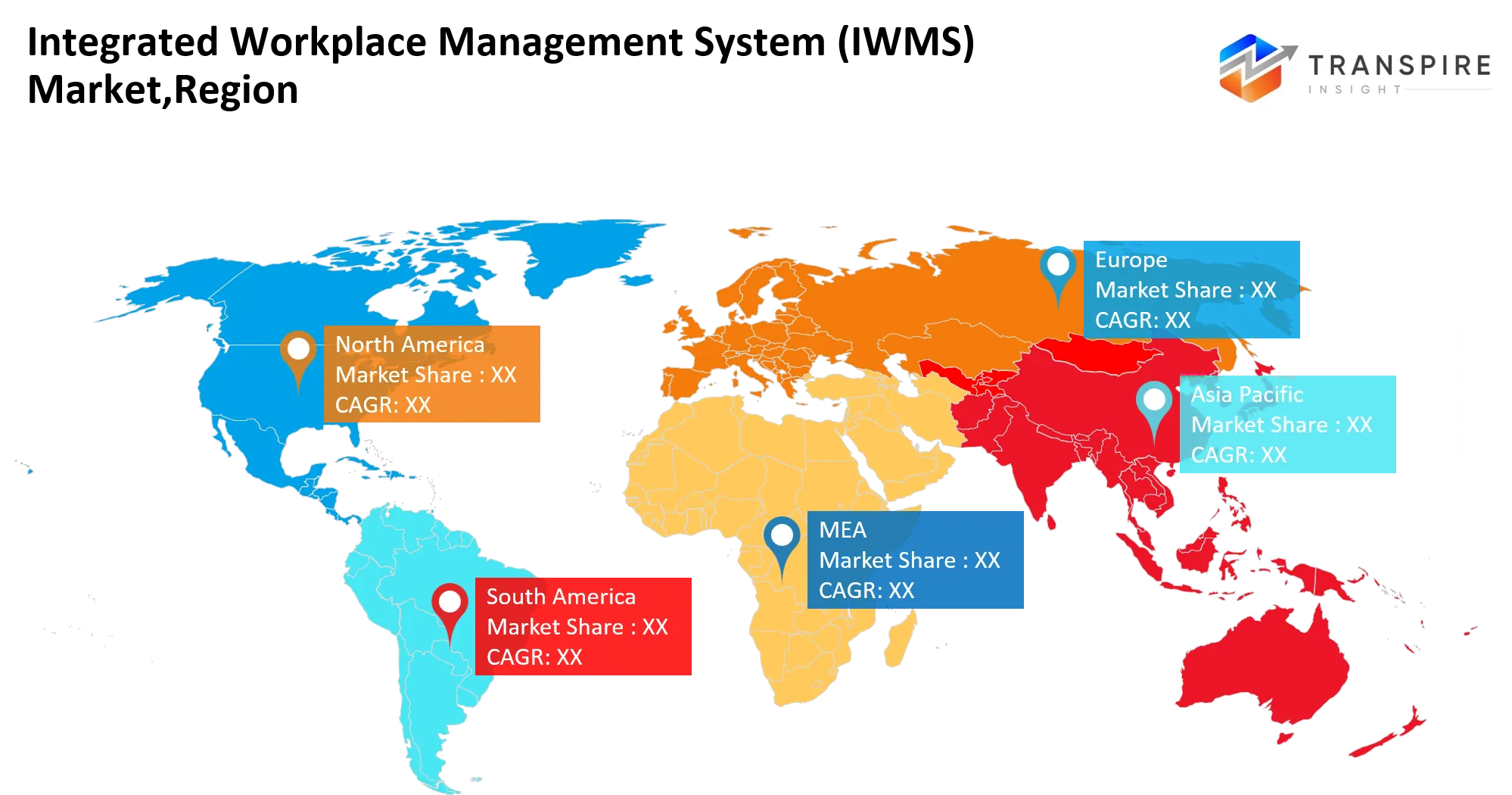
- North America (U.S., Canada, Mexico)
- Europe (Germany, France, U.K., Italy, Spain, Rest of Europe)
- Asia-Pacific (China, Japan, India, Rest of APAC)
- South America (Brazil and the Rest of South America)
- The Middle East and Africa (UAE, South Africa, Rest of MEA)
North America is the fastest-growing region in the Integrated Workplace Management System (IWMS) Market during the period, holding roughly 32% share.
North America is expected to grow at a rapid CAGR in the Integrated Workplace Management System (IWMS) Market holding roughly 32% share during the forecast period. North America’s robust position in the Integrated Workplace Management System (IWMS) Market is driven by speedily increasing adoption of cloud-based workplace technologies, hybrid work models, smart buildings solutions, and advanced solutions for facility management. The rising demand for space optimization, operational efficiency, sustainability management, IoT integration, and real-time workplace analytics further propels the adoption of IWMS in enterprises and commercial properties.
Europe is expected to grow at a rapid CAGR in theIntegrated Workplace Management System (IWMS) Market, holding roughly 25% of the share during the forecast period.
Europe is expected to grow at a rapid CAGR in the Integrated Workplace Management System (IWMS) Market holding roughly 25% share during the forecast period. The growth of the Integrated Workplace Management System (IWMS) market in Europe will be driven by the strict implementation of sustainability laws, demand for energy-efficient buildings, wider deployment of hybrid offices, and digital transformation in the commercial property industry. Organizations across Europe will amplify their focus on optimizing space, reducing carbon emissions, smart building technologies, analytics, and regulatory compliance.
Asia Pacific is the fastest-growing region in the Integrated Workplace Management System (IWMS) Market during the period, holding roughly 20% share.
Asia Pacific is the fastest-growing region in the Integrated Workplace Management System (IWMS) Market during the forecast period, holding roughly 20% share during the forecast period. The rapidly growing Integrated Workplace Management System (IWMS) Market in Asia Pacific region is the result of urbanization, growing commercial real estate, development of smart buildings, and digital transformation. Moreover, the rise in hybrid workplaces, cloud-based facility management systems, IoT technologies, and sustainability initiatives trigger the organizations for improving their space utilization, energy efficiency, asset performance, and workplace operations.
Strategies for Market Growth in Non-Leading Regions:
The implementation of the effective and adaptable Integrated Workplace Management System (IWMS) technologies would lead to the growth of the underdeveloped areas. The local application of cloud-based IWMS systems together with the creation of regional workplace technology capabilities will reduce reliance on outdated expensive systems and cut technology management costs. Development of strategic partnerships with facility management companies, real estate agencies, technology firms and office-service providers will allow IWMS service providers to enter the inflexible market easily. In order to raise the awareness concerning workplace optimization, space planning and facility operations, sustainability, analytics and IWMS application, it is of utmost importance to conduct training courses and skill development initiatives. At the same time, reasonable ways of financing, long-term software contracts and managed-service models will make IWMS systems affordable and motivate organizations to implement this type of technology. Collaboration with governments, real estate industry stakeholders and smart building projects will facilitate the entrance into the IWMS market and support its development.
Future Market Trends for the Integrated Workplace Management System (IWMS) Market: -
- 1.Optimization of Hybrid Work & Dynamic Space Management: Companies are implementing flexible workspace management, desk hoteling and real-time tracking of occupancy in order to support hybrid working practices and enhance their employees’ work-life balance.
- Integration of AI and IoT: Conjunction of artificial intelligence, machine learning, and IoT (Internet of Things) sensors leads to predictive maintenance, management of smart buildings and asset control.
- Cloud-first and subscription model: Cloud availability reduces the time of deployment, while subscription pricing (software as a service) reduces the cost of entry which allows rapid adoption by medium-sized and small businesses.
- Increased Attention to ESG and Sustainability: Increased regulatory pressure and goals for becoming net-zero companies have led to increased demand for carbon tracking, energy saving and environmental modules for reporting.
- Emergence of Workplace Experience Disruptors: The competition of the traditional software platforms with the new software solutions and market disruptors like Microsoft Places and ServiceNow emphasizing end-user experience and low-code extensibility.
Recent Development
- In June 2026: Planon announced the integration of its Integrated Workplace Management System (IWMS) with Microsoft Places, which allows for an interaction between workplace data and processes concerning collaboration and bookings. Integration enables reservation of desks, scheduling of conference rooms, space utilization, and workplace analytics, which boosts the efficiency of the digital workplace, improves the experience of employees, and enhances acceptance of integrated technologies in the area of workplace management.
- In June 2026: MRI Software unveiled the MRI Agora Intelligence and MRI Agora Orchestrator products, which boast powerful features. Some of these new features are AI-powered portfolio insights, automatic workflow execution, and proactive recommendations. These features enhance the use of IWMS technology as they increase workplace intelligence, workflow automation, operational efficiency, data-oriented decision-making, and portfolio management in property management and facilities operations.
- In March 2026: Accruent emphasized the latest IWMS technology like the AI booking assistant, real-time occupancy intelligence, digital twins, and ESG tracking. These technologies will promote the implementation of the IWMS by enhancing space utilization, automation in workplaces, visibility of buildings and facilities' assets, energy management, sustainability reporting, operational efficiency, and data-driven management of different facilities.
This study forecasts revenue at global, regional and country levels from 2020 to 2033. Transpire Insights has segmented the Integrated Workplace Management System (IWMS) Market based on the below-mentioned segments:
Integrated Workplace Management System (IWMS) Market, By Offering
- Solutions
- Services
- Consulting
- Implementation
- Integration
- Support
- Maintenance
- Others
Integrated Workplace Management System (IWMS) Market, By Deployment
- Cloud
- On-premise
- Hybrid
- Hosted
- SaaS
- Private Cloud
- Public Cloud
- Others
Integrated Workplace Management System (IWMS) Market, By Application
- Real Estate Management
- Facilities Management
- Space Management
- Maintenance Management
- Environmental Sustainability
- Lease Management
- Workplace Management
- Others
Integrated Workplace Management System (IWMS) Market, By Enterprise Size
- Large Enterprises
- SMEs
- Mid-sized Enterprises
- Startups
- Government
- Institutions
- Multinationals
- Others
Integrated Workplace Management System (IWMS) Market, By End User
- IT & Telecom
- BFSI
- Manufacturing
- Healthcare
- Retail
- Government
- Education
- Others
Integrated Workplace Management System (IWMS) Market, By Function
- Asset Management
- Space Planning
- Energy Management
- Lease Administration
- Work Order Management
- Portfolio Management
- Analytics
- Others
Integrated Workplace Management System (IWMS) Market, Technology
- AI
- IoT
- Cloud Computing
- Mobile
- Digital Twin
- Analytics
- Automation
- Others
Integrated Workplace Management System (IWMS) Market, By Regional Analysis
North America
- US
- Canada
- Mexico
Europe
- Germany
- UK
- France
- Italy
- Spain
- Russia
- Rest of Europe
Asia Pacific
- China
- Japan
- India
- South Korea
- Australia
- Rest of Asia Pacific
South America
- Brazil
- Argentina
- Rest of South America
Middle East & Africa
- UAE
- Saudi Arabia
- Qatar
- South Africa
- Rest of the Middle East & Africa
Frequently Asked Questions
Find quick answers to common questions.
IWMS integrates real estate, facilities, space, maintenance, lease, workplace, and sustainability management through centralized digital platforms.
Hybrid work, cloud adoption, IoT integration, workplace automation, sustainability requirements, and demand for real-time analytics drive market growth.
Public Cloud dominated deployment with nearly 52% share, supported by scalability, accessibility, flexibility, and lower infrastructure requirements.
Asia Pacific shows strong growth due to urbanization, smart buildings, digital transformation, cloud adoption, IoT, and commercial real estate expansion.
AI, IoT, digital twins, hybrid workplace optimization, cloud platforms, subscription models, predictive maintenance, and ESG management are key trends.
- IBM
- MRI Software
- Planon
- Archibus
- Trimble
- Accruent
- Tango
- FM:Systems
- ServiceNow
- SAP
- Oracle
- iOFFICE
- Spacewell
- Eptura
- MRI Software
About the Authors

Mayur Shinde
I am Mayur Shinde, a Senior Research Analyst at Transpire Insight, specializing in the Automotive & Transportation and Information & Communication Technology (ICT) Industry. My work focuses on analyzing emerging market trends, technological advancements, competitive landscapes, and industry developments to deliver accurate, data-driven insights. I am passionate about transforming complex market information into clear, actionable content that helps businesses, professionals, and decision-makers stay informed and make confident strategic decisions.

Chakradhar Khansole
Chakradhar serves as the Research Director at Transpire Insight, bringing over 8 years of experience in technology, innovation, and strategic market intelligence. He specializes in transforming complex market data into actionable business insights that enable organizations to make informed, growth-oriented decisions. Recognized for his strategic vision and analytical expertise, Chakradhar leads high-impact research initiatives, delivering comprehensive market assessments, competitive intelligence, and forward-looking industry analysis.
Recently Published Reports
-
Apr 2026
3D Optical Profiler Market
3D Optical Profiler Market Size, Share & Analysis Report By Type (Desktop 3D Optical Profiler, and Portable 3D Optical Profiler), By Technology (Confocal Technology, and White Light Interference), By End-Use Industry (Manufacturing, Research Institutions, Automotive, Aerospace and Defense, Medical Devices, and Other), and Geography (North America, Europe, Asia-Pacific, Middle East and Africa, South and Central America), 2021 - 2031
-
Apr 2026
Depth Sensor Market
Depth Sensor Market Size, Share & Analysis Report By Type (Infrared Depth Sensors, Time-of-Flight (ToF) Sensors, Stereo Vision Sensors, Structured Light Sensors, Ultrasonic Depth Sensors), By Application (Automotive, Robotics, Gaming, Consumer Electronics, Industrial Automation, Healthcare, Security & Surveillance, Others), By End Users (Automotive Manufacturers, Consumer Electronics Companies, Healthcare Providers, Industrial Companies, Security Agencies, Gaming Companies, Robotics Companies, Others), and Geography (North America, Europe, Asia-Pacific, Middle East and Africa, South and Central America), 2021 – 2031
-
Apr 2026
Digital Manufacturing Market
Digital Manufacturing Market Size, Share & Analysis Report By Component (Hardware, Software, and Services), By Technology (Robotics, 3D Printing, Internet of Things (IoT), and Others), By Application (Automotive and Transportation, Aerospace and Defense, Consumer Electronics, Industrial Machinery, and Others), By Process Type (Computer-Based Designing, Computer-Based Simulation, Computer 3D Visualization, Analytics, and Others), and Geography (North America, Europe, Asia-Pacific, Middle East and Africa, South and Central America), 2021 – 2031
-
Apr 2026
Digital Visa Services Market
Digital Visa Services Market Size, Share & Analysis Report By Type (Individual Travelers, Group Travelers), By Application (Tourism, Business Travel, Others), and Geography (North America, Europe, Asia-Pacific, Middle East and Africa, South and Central America), 2021 – 2031