

Scintillator Detectors Market Summary:
As per the Transpire Insights Analysis, the Scintillator Detectors Market size is estimated at USD 781.4 million in 2025 and is anticipated to reach USD 1293.2 million by 2033, growing at a CAGR of 6.50% from 2026 to 2033.
The Global Scintillator Detectors Market provides radiation-detection hardware that translates X-ray, gamma-ray, neutron, and charged-particle energies into signals, used in applications like PET, Cargo inspection, and reactor measurement. The evolution over the last three to five years has been from various single-crystal-photomultiplier combinations to integrated, digitised systems utilizing silicon photomultiplier, embedded electronics, and data interpretation software. With SiPMs, low-voltage, magnetic-field-immune designs for PET/MRI, portable security devices, and measurement, the most recent catalyst is the IAEA's 2025 nuclear-security agenda, with its loan of 428 radiation-detection systems to 5 member states. The structural move is from replacement purchase to performance-oriented upgrade: higher temporal resolution and smaller size allow more scanning, easier mobile inspection, even penetration of constricted spaces. Healthcare and security needs are for faster, more sensitive measurements; better materials and readouts fulfil the requirements, and OEMs are building into their imaging, inspection and measurement infrastructure.
Scintillator Detectors Market Size & Forecast:
- Global Market Size 2025: USD 781.4 Million
- Expected Market Value (2033): USD 1293.2 Million
- Forecast CAGR (2026–2033): 6.50%
- Leading Region in 2025: North America(40%)
- Fastest Growing Region: Asia Pacific(25% & CAGR 19.2%)
- Key Company Profiles: Saint-Gobain Crystals, Hamamatsu Photonics, Mirion Technologies, Kromek Group, Scionix, Rexon Components, Hilger Crystals, Berkeley Nucleonics, Dynasil Corporation, EPIC Crystal, Hitachi, Toshiba, ORTEC, CAEN, Thermo Fisher Scientific.

Key Scintillator Detectors Market Insights:
The market is moving away from selling components and towards selling an integrated detection platform (material performance, SiPM electronics, calibration and analytics). While crystal dominance is ever crucial, digital readouts and portable security systems are reshaping value creation.
- The crystal scintillator detectors are retained at 40%, assisted by PET, SPECT and gamma spectroscopy upgrades.
- Plastic detectors account for 22% of the market, increasing in large area, fast response border, and industrial screening.
- Inorganic materials make up 16%, and they have high-temperature and high-radiation applications.
- Organic scintillators account for 10%, and continue to be useful in applications where low cost, flexibility, and speed of detection are important.
- SiPM-based systems make up 8%, but their low-voltage, compact design is progressing much faster than the traditional PMT design.
- Liquid scintillators are used in 2% of applications, including in special neutron and low-background applications.
- Other technologies make up 2% and are becoming more and more based on fiber, hybrid, and application-specific detector formats.
- With its CSPevo family, Mirion demonstrates the competition between suppliers, not just in the detector hardware, but in the light-readout technology.
- The modular, multi-threat nature of Kromek's NaI, CZT and alpha-beta probes is indicative of a trend in the market.
What are the Key Drivers, Restraints, and Opportunities in the Scintillator Detectors Market?
Driver:
Medical-imaging improvements and nuclear-security initiatives are progressing to higher-value systems with greater detector content. PET/SPECT needs increased sensitivity and finer timing; border, plant, and emergency agencies want portable radiation fingerprinting, and machine-learning enhancement resolves noise and resolution issues. This redistributes buying from spare parts into integrated modules, increasing system worth and prompting OEM investment. The merger of healthcare workload-recovery, nuclear expansion and tougher safety standards-that powerful trio-results in shorter replacement periods and more detectors within each certificated system.
Restraint:
Performance remains limited by material cost, crystal-growth complexity, temperature dependence and calibration. The need for high purity crystals and specialised electronics requires tight manufacturing control, while hospitals and government buyers face slow validation and service cycles. This continues because radiation performance, ruggedisation and regulatory traceability cannot be compromised to bring in cheaper electronics; certified platform integration takes years.
Opportunity:
Modular SiPM, hybrid and all-digital architectures could enable more volume applications. SiPMs offer the small footprint, low-voltage operation, rapid timing, and magnetic field immunity to enable PET/MRI, drones, and hand-held survey instrumentation. Investment in Asian nuclear infrastructure and local manufacturing of medical-imaging systems could help enable regional production centers. AI-enabled modules could also drive ongoing revenue in calibration, data analytics, and software, enabling suppliers to move from one-time hardware sales to integrated, services-driven business models.
What Has the Impact of Artificial Intelligence Been on the Scintillator Detectors Market?
Artificial intelligence is transforming scintillator detectors from signal collection tools into intelligent measurement systems for clinicians, security officials, and plant engineers. In PET and SPECT, machine-learning algorithms denoise the reconstructed images, correct for low counts and enhance quantitative image quality, opening the possibility of faster scans or lower activity injections. At the detector level, AI identifies individual pulses and discounts noise events, predicts optimal energy and time corrections, and raises alarms when detector drift occurs before calibration failure. In nuclear security and industrial inspection, pattern recognition detects anomalies and targets suspicious spectra or under-checked defects, automating the non-destructive evaluation process and streamlining countermeasures. Predictive algorithms forecast temperature, count-rate, and electronics telemetry to optimize service and minimize costly downtime. The challenge is deployment: training data are unique to each site, infrequent events are underrepresented, and algorithms must interface with legacy electronics and tightly regulated workflows. Hardware, cybersecurity, validation, and dependability costs remain high, while accuracy can differ between materials or patient sizes, preventing full automation.
Key Scintillator Detectors Market Trends:
The market is moving from analogue instruments to small, software-controlled detection platforms. The value is shifting from the scintillator material to timing, calibration, connectivity and interpretation.
- In PET systems where size, voltage and magnetic immunity are important, SiPM readouts are on the path to becoming the mainstream technology.
- Time, resolution, toxicity, manufacturability and radiation hardness are now in play, alongside light yield, in crystal engineering.
- Medical OEMs integrate AI reconstruction and denoising, linking hardware upgrades with throughput and diagnostic certainty.
- Nuclear-security buyers are moving from fixed portals to handheld, vehicle-mounted and drone-carried systems.
- Industrial users are using scintillation in conjunction with digital radiography and analytics to get traceable defect data.
- More and more research facilities are replacing dedicated analogue acquisition with modular digital acquisition.
- Environmental monitoring is becoming autonomous, with nodes that send out spectra without human input and at low power.
- There are increased demands for calibration records, cybersecurity and lifecycle support, and procurement is increasingly compliance-driven.
Scintillator Detectors Market Segmentation
By Product Type:
Crystal scintillator detectors have a 40% share, since dense, high-light-output scintillators provide the stopping for PET, SPECT, gamma spectrometry, and industrial radiography. Plastic scintillators have 22% through fast response and cost-effective large-area screening. Inorganic scintillators have 16% because of their energy resolution at high photon flux, and organic scintillators 10%, for fast timing and neutron counts. Liquid scintillators have 2% for specialised research and monitoring. Hybrid, fibre, and other can be 10%. Because "crystal" overlaps with "inorganic", vendor datasets should normalise product and technology classifications before the forecast.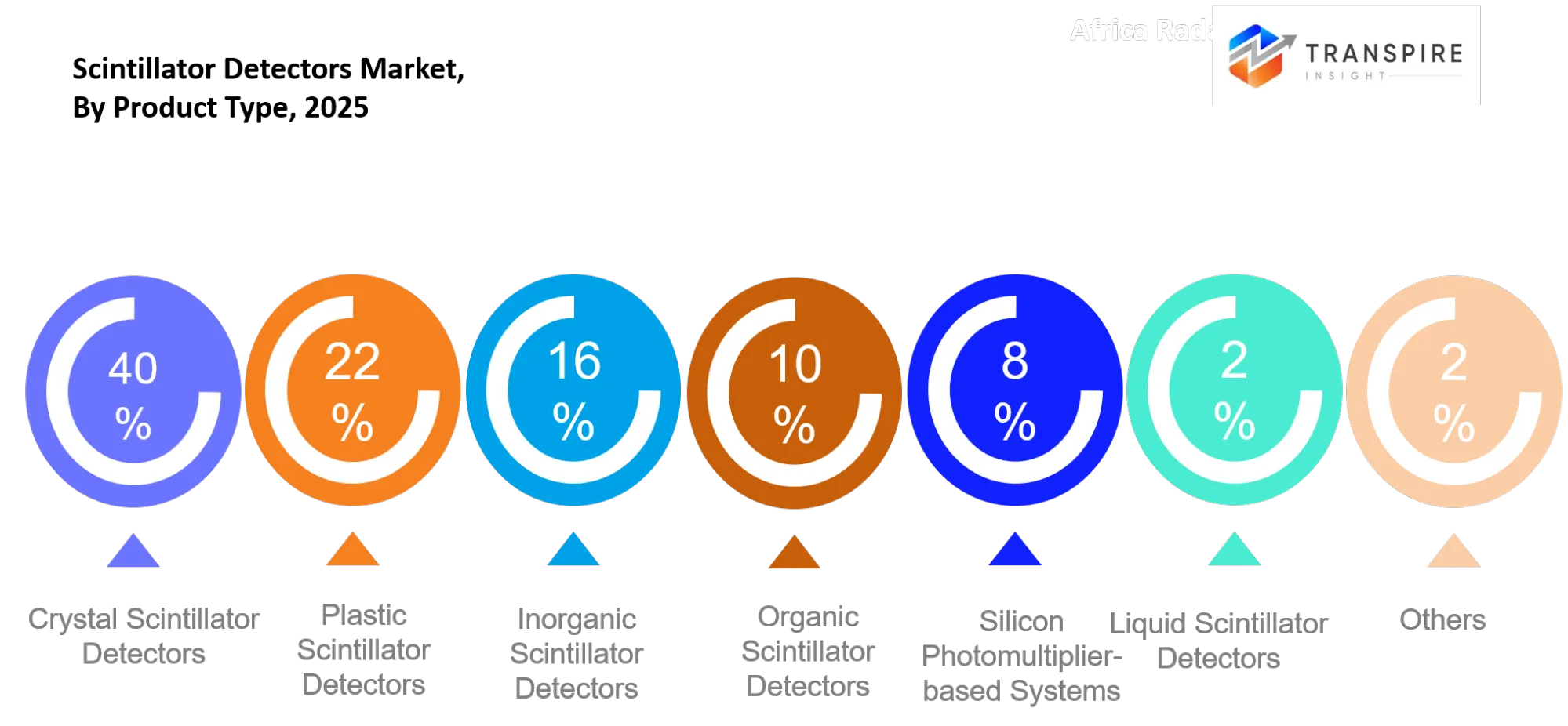
By Application:
Medical imaging through PET, SPECT and X-ray systems are delivering better timing and sensitivity, enabling an increase in throughput and image quality. Nuclear security and scientific research now demand specialist equipment, while industrial inspection, oil and gas, environmental monitoring and high-energy physics offer broader opportunities for rugged, portable and spectroscopic systems.
By End User:
Hospitals dominate OEM purchases, as PET, SPECT and X-ray platform detectors need to be replaced or upgraded. Research institutions focus on resolution, timing and tailor-made set-ups for experiments. Nuclear plants, defence organisations and government bodies buy systems for safeguards, interdiction and emergency services according to protection standards. Industrial enterprises emphasise non-destructive examination, process control and monitoring and prefer sturdy modules.
By Technology:
PMT systems maintain installed-base advantage since most of the contributed-3rd party infrastructure serving hospitals, labs and nuclear facilities is already mature. SiPM systems hold an 8% share and supplied 18.6% CAGR2, driven by compact, low-voltage, fast-timing and MRI-compatible formats. Hybrid, digital and AI-enabled architectures could win as semi-automated correction, predictive calibration and remote diagnostics become the norm for all detector sets.
By Distribution Channel:
The majority of hospital, government and research sales are direct, as customers require technical validation, systems integration and long-term support. Distributors benefit laboratories, while OEM suppliers integrate detectors within full instrumentation. Exporters extend the reach across new markets through regional partners. Service, calibration, software integration and training will drive channel preferences in the future, generating recurring revenue aside from hardware shipments.
What are the Key Use Cases Driving the Scintillator Detectors Market?
The main use case for crystal scintillator detectors still exists because stopping power and energy resolution capabilities support PET, SPECT, gamma cameras, and X-ray detection, and the segmentation provided gives them 40%. Hospitals use them to increase diagnostic throughput and image quality.
Expanding applications are nuclear-security portals, handheld isotope identifiers, reactor-monitoring, and industrial non-destructive testing. Plastic scintillators are ideal for fast screening over large areas, point sources, and harsh environments for research, defence, and industry.
New applications meld SiPMs 8% penetration with 18.6% CAGR offered and AI analytics for drone surveys, environmental grids, PET/MRI and proactive maintenance. Their small-footprint, low-voltage, magnetic-field-resistant architecture allows operation where traditional PMTs are limited.
|
Report Metrics |
Details |
|
Market size value in 2025 |
USD 781.4 Million |
|
Market size value in 2026 |
USD 832.2 Million |
|
Revenue forecast in 2033 |
USD 1293.2 Million |
|
Growth rate |
CAGR of 6.50% from 2026 to 2033 |
|
Base year |
2025 |
|
Historical data |
2021 - 2024 |
|
Forecast period |
2026 - 2033 |
|
Report coverage |
Revenue forecast, competitive landscape, growth factors, and trends |
|
Regional scope |
United States; Canada; Mexico; United Kingdom; Germany; France; Italy; Spain; Denmark; Sweden; Norway; China; Japan; India; Australia; South Korea; Thailand; Brazil; Argentina; South Africa; Saudi Arabia; United Arab Emirates |
|
Key companies profiled |
Saint-Gobain Crystals, Hamamatsu Photonics, Mirion Technologies, Kromek Group, Scionix, Rexon Components, Hilger Crystals, Berkeley Nucleonics, Dynasil Corporation, EPIC Crystal, Hitachi, Toshiba, ORTEC, CAEN, Thermo Fisher Scientific. |
|
Customization scope |
Free report customization (country, regional & segment scope). Avail customized purchase options to meet your exact research needs. |
|
Report Segmentation |
By Product Type (Inorganic Scintillator Detectors, Organic Scintillator Detectors, Plastic Scintillator Detectors, Liquid Scintillator Detectors, Crystal Scintillator Detectors, Hybrid Scintillator Detectors, Fiber Scintillator Detectors, Others); By Application (Medical Imaging, Nuclear Security, Scientific Research, Industrial Inspection, Oil & Gas Exploration, Environmental Monitoring, High Energy Physics, Others); By End User (Hospitals, Research Institutes, Nuclear Facilities, Defense Organizations, Industrial Companies, Government Agencies, Others); By Technology (Photomultiplier Tube-based, Silicon Photomultiplier-based, Hybrid Detection Systems, Digital Scintillation Systems, AI-enabled Detection, Others); By Distribution Channel (Direct Sales, Scientific Equipment Distributors, OEM Suppliers, Exporters, Others) |
Which Regions are Driving the Scintillator Detectors Market Growth?
North America holds a 40% share as it has the balance of advanced nuclear medicine and successful defence procurement programs, research laboratories and proven detector OEMs. Its ecosystem is spurred by high PET/SPECT spend, national-security initiatives and proven calibration infrastructure. Federal support for radiation preparedness and nuclear research sustains demand beyond hospital replacement cycles. Regional commercialisation of SiPM, AI reconstruction and high-resolution spectroscopy currently outpaces other markets. In July 2026, Positron Corporation secured multiple orders for its 64-slice PET-CT systems accompanied by multi-year service agreements from leading nuclear cardiology practices. This commercial expansion highlights accelerating adoption and sustained demand for advanced molecular imaging technology in cardiovascular diagnostics.
The European market accounts for 28% of the world market, underpinned by dense research networks, nuclear power and high radiation safety standards. Its demand is more compliance-driven, with public laboratories and industrial inspection users demanding traceable, energy-efficient equipment. EU-funded research and cross-border scientific infrastructure offer stability through the unpredictable medical equipment cycles. European players also compete on specialized crystals, spectroscopy components and sustainable product design.
Asia Pacific holds a 25% share and continues to grow rapidly, with a stated CAGR of 19.2%. Advances in hospital expansion, nuclear-power investment and the growing domestic electronics manufacturing base are translating into procurement of locally assembled detector systems, rather than imported instruments. China, Japan, South Korea and India represent unique demand pools for imaging, security and research markets. The challenge is in establishing regional SiPM, crystal-processing and service ecosystems which enable rapid production for export. In January 2026, Hamamatsu Photonics announced the expansion of its semiconductor manufacturing facilities dedicated to silicon photomultipliers (SiPM) to support regional high-speed opto-semiconductor packaging in Asia. This capacity scaling directly bolsters local medical and high-energy physics instrumentation supply chains.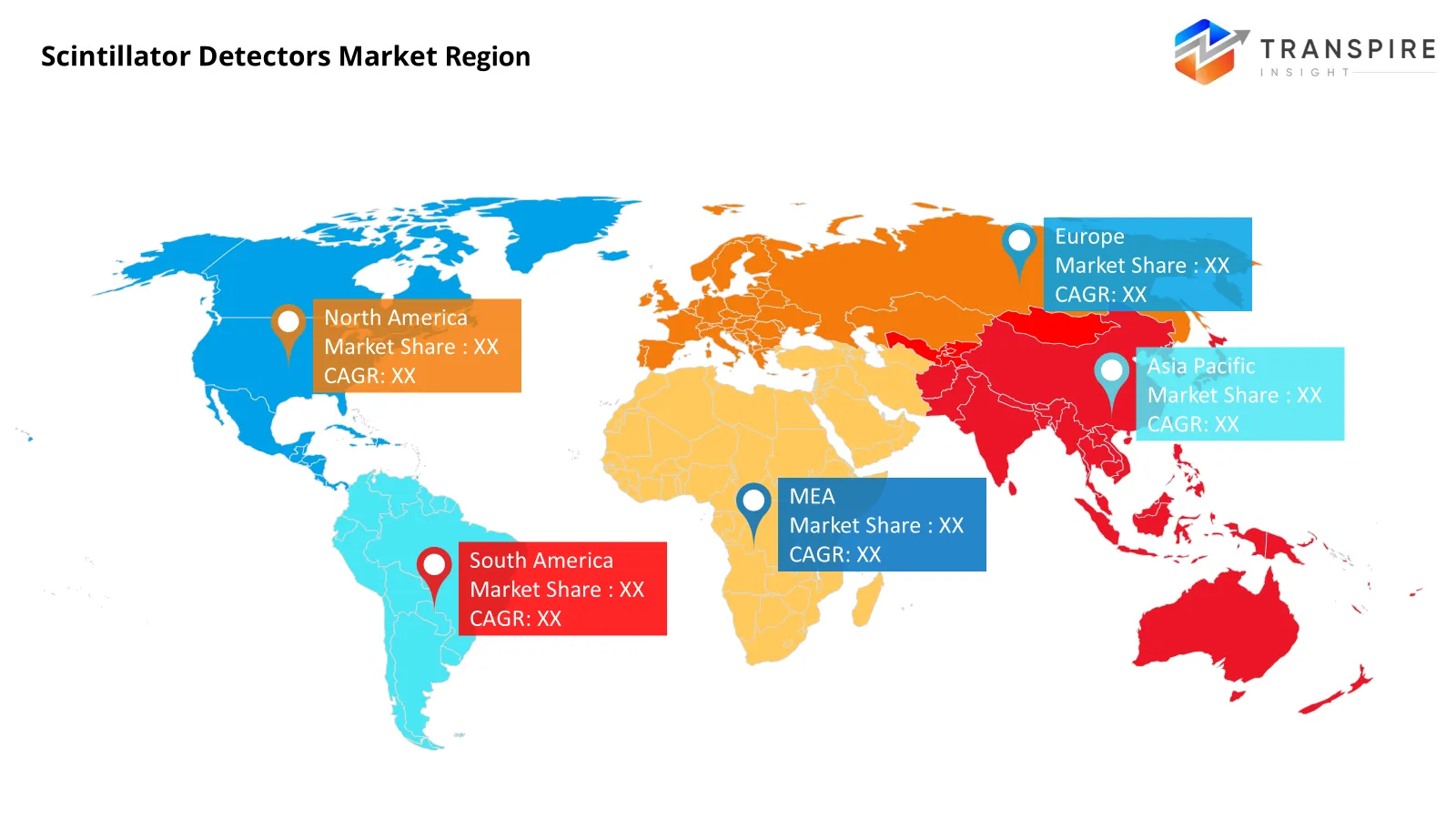
Who are the Key Players in the Scintillator Detectors Market and how do they Compete?
The competition is splitting crystal experts, radiation-instrument producers, photonics players and scientific-electronics integrators. The strategic centre of gravity is shifting away from just light output, toward timing resolution, mobility, ruggedness, software compatibility and lifecycle support. Nuclear-security purchasing favours validated, mobile and easily serviceable units, whereas medical OEMs look for system integration and regulatory paperwork.
Saint-Gobain Crystals, Hilger Crystals, Scionix, Rexon Components, EPIC Crystal and Dynasil differentiate on crystal formulation, custom geometry and application-specific supply. Their materials advantage, optical coupling, and short-run engineering sustain growth in medical imaging, spectroscopy, research, and export OEM markets. Hamamatsu Photonics competes through SiPM, photodetectors, and readout with innovation, employing the photonics scale to reach compact digital modules. Mirion Technologies and Kromek compete with differentiated radiation-security platforms: Kromek, licensed technology, emphasis on interchangeable probes and handheld threat ID. Mirion, extending detector architecture beyond conventional laboratory and mission-specific instruments with LightLink and CSPevo. Berkeley Nucleonics, ORTEC, CAEN and Thermo Fisher International compete with portable instrumentation, digital acquisition, spectroscopy and laboratory ecosystems. Hitachi and Toshiba integrate medical imaging, installed hospital assets and system-level expansion. The other manufacturers occupy niches with custom electronics and science distribution and services rather than volume pricing.
Key Players are:
- Saint-Gobain Crystals
- Hamamatsu Photonics
- Mirion Technologies
- Kromek Group
- Scionix
- Rexon Components
- Hilger Crystals
- Berkeley Nucleonics
- Dynasil Corporation
- EPIC Crystal
- Hitachi
- Toshiba
- ORTEC
- CAEN
- Thermo Fisher Scientific
Recent Development News
- In February 2026, LabLogic and PI Medical announced a distribution partnership for the Netherlands covering radiopharmacy quality-control solutions. The agreement expands local access to liquid-scintillation and radioisotope measurement equipment, supporting decentralised radiopharmaceutical testing and shortening the service channel for European laboratories.
- In January 2026, Dürr NDT launched the D-DR 2430 NDT portable digital X-ray detector using a GOS Plus scintillator for high-energy gamma radiography. The product extends scintillator adoption in field-based non-destructive testing through wireless operation, IP67 protection, and improved absorption efficiency for industrial inspection.
- In February 2026, Excelitas Technologies completed its acquisition of Luxium Solutions, a supplier of high-performance scintillation materials, optical components and detection technologies. The transaction strengthens vertical integration from crystal materials to photonic detection systems, expanding Excelitas’ capabilities across medical, industrial and defense applications.
What Strategic Insights Define the Future of the Scintillator Detectors Market?
The industry is moving toward modular, AI-enabled detector platforms rather than standalone scintillator parts. SiPM adoption will accelerate where magnetic-field immunity, low power, and small form factor enhance PET/MRI, handheld security, and distributed monitoring economics. The unspoken threat is that data and calibration disaggregation models developed for one crystal, temperature, or acquisition path may fail elsewhere, presenting validation liabilities and expensive service exceptions. Regulation demands traceability; cybersecurity and human intervention may also inhibit "plug-and-play" rollouts. The nascent opportunity is to build regional manufacturing sites for crystals, SiPM modules, and analytical tools in APAC, where hospital expansion and nuclear investments can drive volume and exports. OEMs should bet on platform reference designs, conformant digital interfaces, calibration-as-a-service, and purpose-built AI rather than competing solely on detector sensitivity. Alliances with OEMs, hospitals, research organisations, and governments will accelerate validation and convert sales into consumable software and maintenance revenue.
Key Segmentations are:
By Product Type
- Inorganic Scintillator Detectors
- Organic Scintillator Detectors
- Plastic Scintillator Detectors
- Liquid Scintillator Detectors
- Crystal Scintillator Detectors
- Hybrid Scintillator Detectors
- Fiber Scintillator Detectors
- Others
By Application
- Medical Imaging
- Nuclear Security
- Scientific Research
- Industrial Inspection
- Oil & Gas Exploration
- Environmental Monitoring
- High Energy Physics
- Others
By End User
- Hospitals
- Research Institutes
- Nuclear Facilities
- Defense Organizations
- Industrial Companies
- Government Agencies
- Others
By Technology
- Photomultiplier Tube-based
- Silicon Photomultiplier-based
- Hybrid Detection Systems
- Digital Scintillation Systems
- AI-enabled Detection
- Others
By Distribution Channel
- Direct Sales
- Scientific Equipment Distributors
- OEM Suppliers
- Exporters
- Others
Regional Outlook
North America
- US
- Canada
- Mexico
Europe
- Germany
- UK
- France
- Italy
- Spain
- Russia
- Rest of Europe
Asia Pacific
- China
- Japan
- India
- South Korea
- Australia
- Rest of Asia Pacific
South America
- Brazil
- Argentina
- Rest of South America
Middle East & Africa
- UAE
- Saudi Arabia
- Qatar
- South Africa
- Rest of the Middle East & Africa
Frequently Asked Questions
Find quick answers to common questions.
The Scintillator Detectors Market size was valued at USD 781.4 million in 2025 and is poised to reach USD 1293.2 million by 2033, expanding at a 6.50% CAGR.
Key segments for the Scintillator Detectors Market are By Product Type (Inorganic Scintillator Detectors, Organic Scintillator Detectors, Plastic Scintillator Detectors, Liquid Scintillator Detectors, Crystal Scintillator Detectors, Hybrid Scintillator Detectors, Fiber Scintillator Detectors, Others); By Application (Medical Imaging, Nuclear Security, Scientific Research, Industrial Inspection, Oil & Gas Exploration, Environmental Monitoring, High Energy Physics, Others); By End User (Hospitals, Research Institutes, Nuclear Facilities, Defense Organizations, Industrial Companies, Government Agencies, Others); By Technology (Photomultiplier Tube-based, Silicon Photomultiplier-based, Hybrid Detection Systems, Digital Scintillation Systems, AI-enabled Detection, Others); By Distribution Channel (Direct Sales, Scientific Equipment Distributors, OEM Suppliers, Exporters, Others).
Growth is primarily driven by PET/SPECT and X-ray imaging upgrades, nuclear-security and radiation-monitoring programmes, industrial inspection, high-energy research, SiPM adoption, improved scintillator materials and AI-enabled signal processing.
The Scintillator Detectors Market is led by major manufacturers including Saint-Gobain Crystals, Hamamatsu Photonics, Mirion Technologies, Kromek Group, Scionix, Rexon Components, Hilger Crystals, Berkeley Nucleonics, Dynasil Corporation, EPIC Crystal, Hitachi, Toshiba, ORTEC, CAEN, Thermo Fisher Scientific.
North America holds 40% and leads through advanced nuclear medicine, defense procurement, research laboratories, established OEMs, federal radiation-preparedness funding, high PET/SPECT spending, and mature calibration infrastructure.
Opportunities include modular SiPM and all-digital systems, AI-enabled calibration and analytics, portable nuclear-security detectors, Asian nuclear-infrastructure manufacturing hubs, PET/MRI upgrades, industrial inspection and recurring software, service, and maintenance revenue.
- Saint-Gobain Crystals
- Hamamatsu Photonics
- Mirion Technologies
- Kromek Group
- Scionix
- Rexon Components
- Hilger Crystals
- Berkeley Nucleonics
- Dynasil Corporation
- EPIC Crystal
- Hitachi
- Toshiba
- ORTEC
- CAEN
- Thermo Fisher Scientific
About the Authors

Avinash Kumar
I’m Avinash Kumar, a Senior Research Analyst at Transpire Insight, with expertise in the Electronics and Semiconductor and Energy & Power industry. My work focuses on analyzing emerging technologies, market trends, industry developments, and innovation across these sectors. I specialize in transforming complex technical and market insights into clear, research-backed content that helps professionals, businesses, and decision-makers stay informed. Through continuous industry research and data-driven analysis, I strive to deliver accurate, reliable, and practical perspectives on the latest advancements shaping the semiconductor and energy landscape.

Chakradhar Khansole
Chakradhar serves as the Research Director at Transpire Insight, bringing over 8 years of experience in technology, innovation, and strategic market intelligence. He specializes in transforming complex market data into actionable business insights that enable organizations to make informed, growth-oriented decisions. Recognized for his strategic vision and analytical expertise, Chakradhar leads high-impact research initiatives, delivering comprehensive market assessments, competitive intelligence, and forward-looking industry analysis.
Recently Published Reports
-
Apr 2026
Fiber Optic Faceplates Market
Fiber Optic Faceplates Market Size, Share & Analysis Report By Type (< 300 mm2, 300-350 mm2, and > 350 mm2, By Application (Night Vision, Holographic Imaging, Medical, and Others), and Geography (North America, Europe, Asia-Pacific, Middle East and Africa, South and Central America), 2021 - 2031
-
Apr 2026
High Temperature Superconductors Market
High Temperature Superconductors Market Size, Share & Analysis Report By Type (1G HTS, and 2G HTS), By Application (Power Cable, Fault Current Limiter, and Transformer), and Geography (North America, Europe, Asia-Pacific, Middle East and Africa, South and Central America), 2021 - 2031
-
Apr 2026
Industrial Plugs and Socket Market
Industrial Plugs and Socket Market Size, Share & Analysis Report By Type (Industrial Plugs, Industrial Sockets), By Current (Up to 32 A, 32 to 125 A, Above 125 A), By Protection (Dustproof and Splash Proof, Waterproof, Explosion Proof), By End User (Heavy Industries, Oil and Gas, Chemicals and Pharmaceuticals, Power Generation, Others), and Geography (North America, Europe, Asia-Pacific, Middle East and Africa, South and Central America), 2021 - 2031
-
Apr 2026
InGaAs Avalanche Photodiodes Market
InGaAs Avalanche Photodiodes Market Size, Share & Analysis Report By Type (1100 - 1700 nm, and 1000 - 1600 nm), By Application (Missile Warning System, Muzzle Flash Detection, Wafer Defect Inspection, Laser Rangefinders, and Others), and Geography (North America, Europe, Asia-Pacific, Middle East and Africa, South and Central America), 2021 - 2031