
Europe Nuclear Battery Market Summary
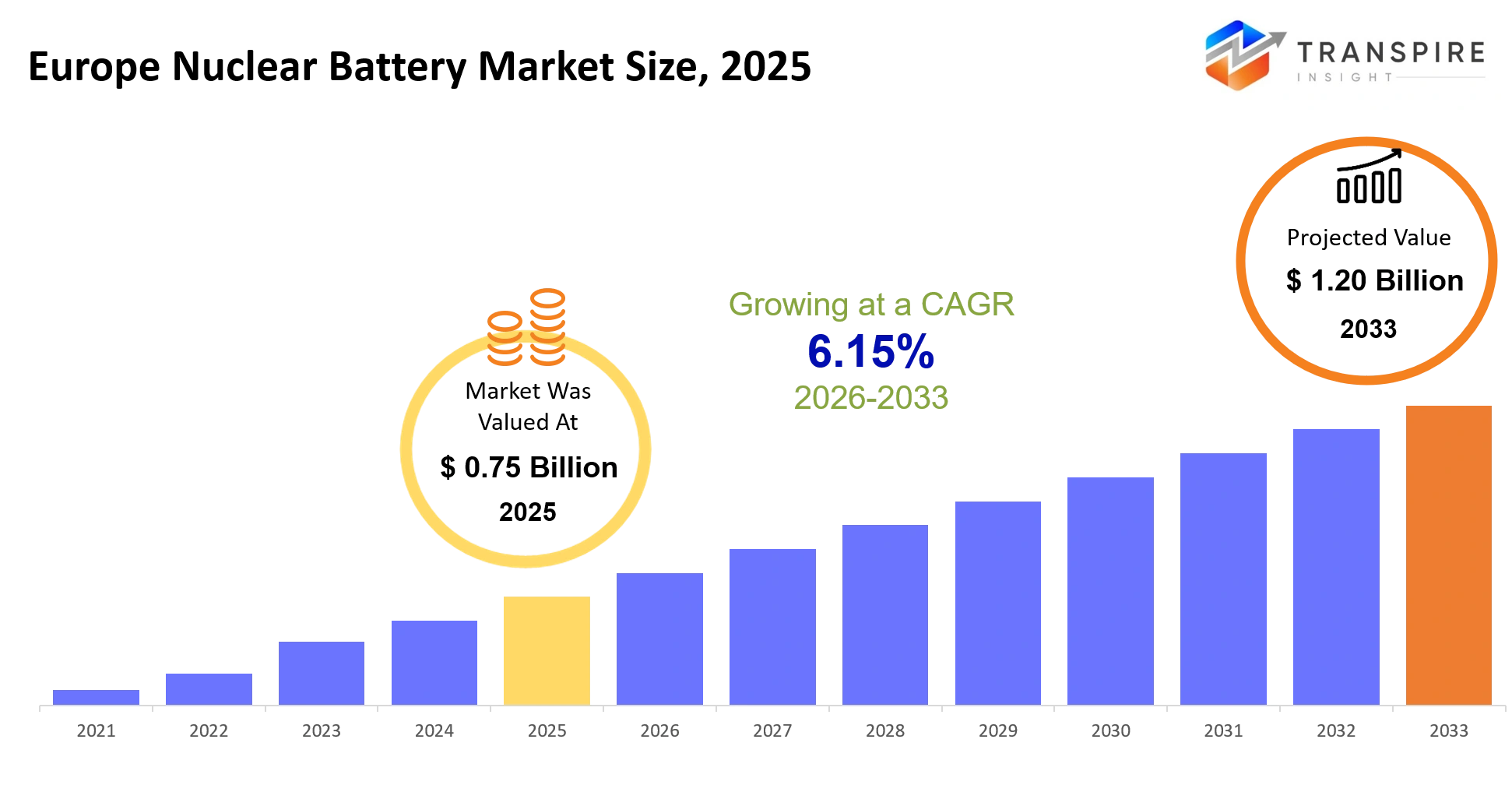
As per Transpire Insight Analysis the Europe Nuclear Battery Market size is estimated at USD 0.75 Billion in 2025 and is anticipated to reach USD 1.20 Billion by 2033, growing at a CAGR of 6.15% from 2026 to 2033.
The Europe Nuclear Battery Market kind of tackles a big problem, where the usual power sources just cannot keep doing reliable, long term energy. Nuclear batteries, meanwhile, keep on giving continuous electricity for remote industrial equipment, space systems, defense assets, scientific instruments, and also for infrastructure that has to work for years, with very little servicing, which lowers the overall cost of maintenance and those annoying operational pauses in hard to reach locations. Over the last five years, the market has moved away from mostly research focused development , and more toward commercialization, with help from improvements in radioisotope materials, semiconductor conversion methods, and long-life micro power design. After the Russia-Ukraine conflict, energy security worries pushed European investment harder into resilient technologies, and into domestic strategic capabilities, so support for advanced nuclear innovation got stronger. This mix of policy backing and technical progress has made industrial users more confident, and it is driving pilot deployments plus longer term procurement plans too. As dependable operation becomes more important than swapping batteries again and again in critical cases, adoption should spread across specialized areas, which, in turn, creates ongoing revenue possibilities for technology developers and component suppliers.
Europe Nuclear Battery Market Size & Forecast:
- Europe Nuclear Battery Market Size 2025: USD 0.75 Billion
- Expected Market Value 2033: USD 1.20 Billion
- Forecast CAGR: 6.15%
- Leading region in 2025: France, Germany, and the United Kingdom
- Fastest Growing region: Sweden, Finland, Norway, and Poland
- Key Profile: City Labs, Arkenlight, Kronos Advanced Technologies, Rosatom, Ultra Safe Nuclear Corporation, BWX Technologies, Toshiba, Exide Technologies, Zeno Power, BetaBatt, Yasheng Group, EnerVenue, Nano Diamond Battery, Qynergy, STC.
Key Market Insights
- Western Europe was basically in the lead for the Europe Nuclear Battery Market, taking in around 46% market share in 2025 ,with help coming from France, Germany, and the United Kingdom , all of them pushing ahead with ongoing nuclear technology investments, in a sort of steady rhythm.
- Northern and Central Europe will, however, stay the quickest expanding regional market from 2025 to 2033, mostly because Sweden, Finland, and Poland are rolling out more advanced energy technology programs, and yeah, it’s getting momentum.
- On the product side, betavoltaic nuclear batteries grabbed the largest portion with roughly 58% market share in 2025, mainly due to better efficiency upgrades and good fit for small industrial electronics, which is kind of the whole point.
- Alphavoltaic nuclear batteries sit as the second-largest segment, supported by gradual adoption in scientific instrumentation, where the need is for stable ultra-low-power output across long operating cycles.
- Micro nuclear batteries are expected to grow the most quickly through 2033, helped by miniaturized electronics , sensors ,and next generation autonomous monitoring platforms that need power in tiny forms, and not much else.
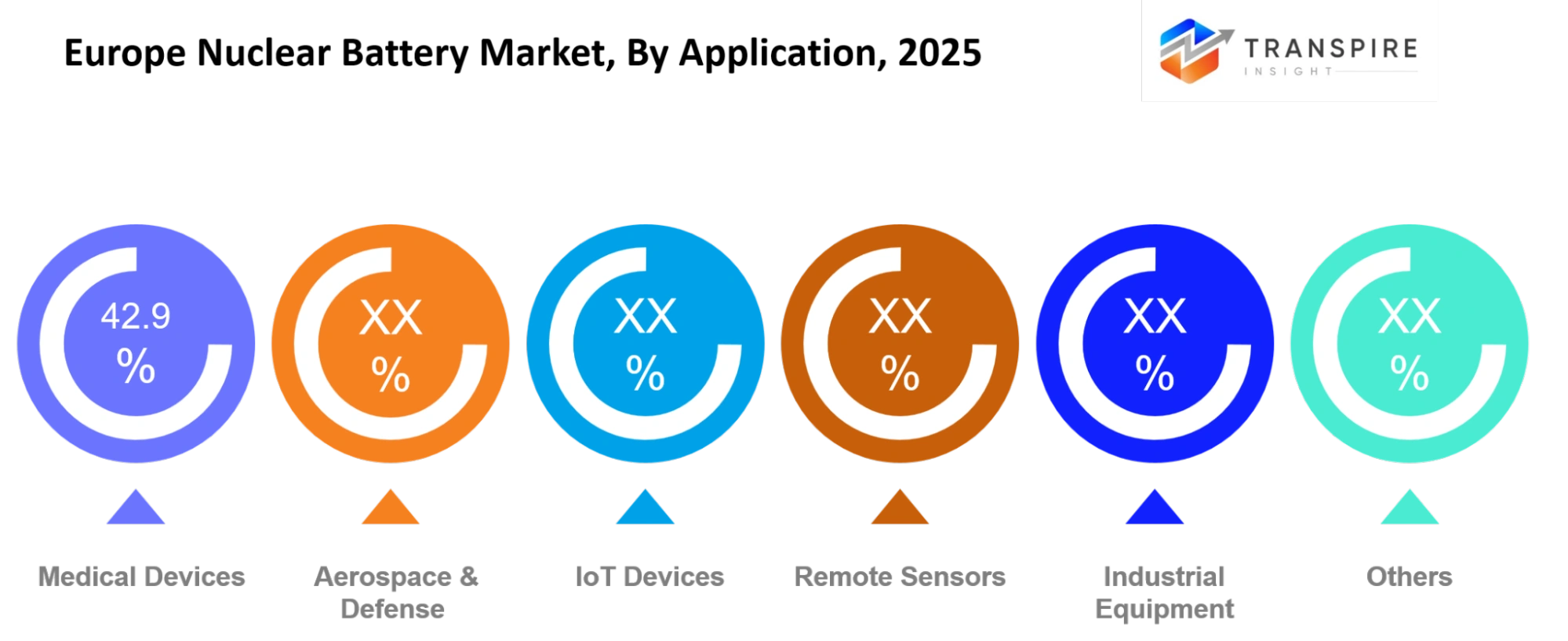
- In terms of applications, aerospace and defense dominated demand with about 42% market share in 2025, because long-duration missions and critical gear really depend on uninterrupted power supplies, no compromise.
- For application growth, industrial remote monitoring will likely show the fastest expansion over the forecast window ,as predictive asset management keeps spreading across energy, mining ,and infrastructure networks.
- For end users, government and defense organizations represented the leading segment with nearly 40% market share in 2025, backed by strategic procurement and national security modernization programs, pretty directly.
- Research institutes plus space agencies are forecast to be the fastest-growing end-user group, since Europe is ramping up spending on advanced space exploration and scientific instrumentation, and this part is accelerating too.
What are the Key Drivers, Restraints, and Opportunities in the Europe Nuclear Battery Market?
The strongest driver is Europe’s focus on strategic energy resilience and long life self powered energy systems. Defense modernization, wider space programs, and public funding for advanced nuclear technologies kinda triggered this shift after energy security priorities shifted across the region. Research budgets sped up commercialization for radioisotope power systems. More pilot demonstrations helped create greater buyer certainty. Industrial operators increasingly went for maintenance free power sources for far off infrastructure, because swapping out regular batteries still stays costly and kind of operationally disruptive. So this chain of investment, verification, and buying keeps widening commercial revenue chances across niche sectors.
The biggest restraint is still the narrow availability of radioisotopes and tight nuclear licensing rules. Production relies on dedicated facilities, that take years for regulatory greenlight and also require major capital spending. The certification steps also vary between European jurisdictions, which ends up slowing down commercialization. Based on a Transpire Insight review of regional procurement releases and launch timing, supply chain concentration stays the main execution risk. These structural limits delay product roll outs , reduce manufacturing scale, and dampen possible revenue even while procurement interest keeps rising from aerospace and defense organizations.
The biggest opportunity seems to be in what comes next, the next generation betavoltaic semiconductor technology, plus the European push for strategic semiconductor manufacturing investment. If conversion efficiency is higher and the material performance improves in a steadier way, then commercial use might grow, not just defense, but also things like industrial sensing, subsea infrastructure, and autonomous monitoring networks.
Meanwhile, countries like France, Germany, Sweden, and Finland keep backing advanced nuclear innovation with research partnerships, and targeted technology funding, even if the details shift by program. As the manufacturing capabilities keep maturing and the regulatory paths become more predictable, the wider commercialization should open up the next phase, of market expansion.
What Has the Impact of Artificial Intelligence Been on the Europe Nuclear Battery Market?
Artificial intelligence is turning into this major enabler for nuclear battery development and lifecycle management all over Europe. AI driven monitoring platforms automate radiation performance tracking, environmental compliance reporting, and the analysis of operating conditions for long duration power systems that get used in aerospace, defense, and industrial infrastructure. Then, machine learning models do the heavy lifting by checking degradation patterns, forecasting maintenance needs for the supporting equipment , and also optimizing production planning by looking at procurement schedules, isotope availability, and component performance histories, kinda end to end. Digital twins help a lot too, they improve engineering validation by simulating how the battery behaves when radiation changes, when temperature shifts, and when mission conditions become different before anything is physically deployed.
All of this tends to cut down engineering iterations, boost operational uptime, and also makes regulatory documentation stronger while reducing inspection workloads a bit. Manufacturers are using predictive analytics as well to get better supply planning for specialized materials, and to improve manufacturing consistency for advanced radioisotope power devices. Even so, wide AI adoption is still kind of constrained, mostly by high integration costs and by limited access to large operational datasets since the commercial deployments are still relatively small. Also, many use cases sit inside classified defense or space programs , which means fewer chances to train really robust machine learning models using real world performance data.
Key Market Trends
- France kinda expanded public investment in advanced nuclear innovation after 2022, and strengthened the commercialization pathways for radioisotope power technologies that back defense too, and the scientific infrastructure bit.
- Between 2023 and 2026, semiconductor improvements really boosted betavoltaic conversion efficiency a lot, so that smaller nuclear battery units became feasible for autonomous sensing applications.
- Across Europe, space programs started to evaluate long-duration radioisotope power technologies more and more, especially for missions that run past the usual battery operating lifetimes, if you know what I mean.
- After 2022, industrial asset operators shifted toward autonomous monitoring systems, and that created stronger demand for maintenance free power sources across those remote infrastructure networks.
- Strategic energy security policies then accelerated domestic isotope research investments after geopolitical disruptions, which in turn reduced reliance on external nuclear technology supply chains.
- Defense procurement programs, between 2024 and 2033, increasingly prioritized resilient long-life energy systems, and it pushed suppliers to expand their advanced battery development capabilities.
- Companies like Airbus, Thales Group, and CEA strengthened research collaborations, to speed up specialized power technologies for aerospace and defense use-cases.
- Sweden, Finland, and Poland increased funding for advanced nuclear research after 2023, positioning Northern and Central Europe as emerging technology development hubs.
- Manufacturers also increasingly invested in digital engineering, plus AI supported design optimization to shorten validation cycles, and to improve long term performance prediction.
Europe Nuclear Battery Market Segmentation
By Product Type :
Betavoltaic batteries kind of held the lead, mainly due to long operational life, a compact size, and stable low-power output, they really matched what aerospace equipment wants, plus industrial monitoring systems and scientific instruments too. With better semiconductor materials , and also more refined energy conversion methods, development moved further into the mainstream commercial world. At the same time, extra investment into advanced energy technologies helped lock in more adoption across those high-value uses.
Alphavoltaic batteries ended up with the second-largest share, mostly because their performance stayed dependable in specialized science and research gear, you know the kind that can't really afford surprises. Thermophotovoltaic batteries grabbed attention for the coming high-efficiency conversion approach, and radioisotope thermoelectric generators stayed relevant for space exploration and defense missions, where dependable long-term power is non negotiable. A bunch of other emerging options kept showing up too, they supported ongoing product innovation and made room for more niche , tailored applications.
By Radioisotope :
Nickel-63 kinda ended up taking the biggest slice really, mainly because the long half life, stable energy release, and kind of reassuring safety profile helped commercial battery development move along. It felt especially a good fit for low power electronics, industrial sensors, and medical gear, so more people looked into it, then manufacturing activity followed, somewhat. And yeah, the growing excitement for maintenance free energy systems kept feeding the whole technology progress.
Then Tritium showed up as the second largest part, because its compact power generation actually matched those specialized sensing and monitoring uses. Plutonium-238 stayed basically important for the deeper space missions, even with limited supply, and Carbon-14 started getting more attention for the next generation long life battery work. As for the other radioisotopes, they kept getting pulled into research programs aimed at boosting efficiency, raising durability, and expanding the range of applications, overall and without much fanfare.
By Application :
In aerospace and defense, the largest revenue share showed up because long-duration missions needed non stop power, not all those constant checkups or battery swaps. There was also a steady, kind of continuous investment in strategic technologies, which then let companies roll out these solutions in a wider way, across satellites, surveillance setups, and more sophisticated defense gear. Plus the government backing helped, and that basically reinforced the long term purchasing activities too.
Remote sensors, and even industrial equipment, kept growing at a steady pace as infrastructure operators moved toward autonomous monitoring. That happened across energy, mining , and transportation sites. In medicine, adoption stayed stable, since dependable long-life energy sources improved how reliably devices could run day to day. And then IoT devices, along with other focused uses, opened up more growth pathways, driven by nonstop progress in smaller, miniaturized electronic systems.
By End User :
Defense stayed as the leading end user segment, mainly because national security programs needed dependable power systems to run for extended stretches under tough, demanding situations. Over the long term, procurement plans, and modernization drives kind of nudged people toward more investment in newer nuclear battery technologies. At the same time , steady public budgets helped with product trials and the validation of the tech, you know.
Space agencies looked like the fastest growing category because Europe bumped up its spending on deep space exploration and satellite building programs. Industrial firms also pushed adoption for remote supervision and the operation of critical infrastructure, while research institutes kept backing material improvements and performance upgrades. In healthcare, progress kept moving but at a gradual pace, through specialized medical gear that needs reliable long duration power, without surprises.
By Power Output :
Low power batteries really took over the market, since those compact electronic devices , like sensors and various monitoring systems, needed dependable energy for long-ish operating stretches. The drive toward smaller designs in industrial automation, medical technology, and aerospace gear pushed this even more. Folks also liked the stable output, and that kind of lower upkeep, it made businesses feel comfortable, so expansion kept going.
Medium power systems then got more traction in industrial equipment plus certain defense use cases, where you actually need more energy capacity. Meanwhile high power technologies stayed mostly aimed at the toughest aerospace and scientific missions, where reliable operation mattered more than the manufacturing cost. The other power categories kept showing up too, helping manufacturers diversify their lines, with application specific energy solutions, kind of tailored to the use-case.
What are the Key Use Cases Driving the Europe Nuclear Battery Market?
Aerospace and defense are still the core application, basically because long-duration missions need nonstop power, where swapping batteries is kind of a pain and, frankly, often impractical. Defense groups, satellite makers, and government space programs buy these systems to keep things running reliably in remote , and sometimes high-risk places, so it turns into the biggest commercial pull overall.
On the other side, industrial remote monitoring and research work keep growing, especially across energy plants, transportation networks and environmental observation systems. A bunch of research institutes also lean on long-life power sources for scientific gear that runs out in isolation , where regular maintenance causes headaches both operationally and financially.
Meanwhile, medical implants are looking interesting, and so are next generation autonomous IoT platforms as future uses. The momentum here comes from better compact radioisotope technologies , plus more strict reliability expectations for critical infrastructure monitoring. If regulatory approvals, material availability, and manufacturing capabilities keep improving through the forecast period, then wider adoption should follow.
|
Report Metrics |
Details |
|
Market size value in 2025 |
USD 0.75 Billion |
|
Market size value in 2026 |
USD 0.79 Bllion |
|
Revenue forecast in 2033 |
USD 1.20 Billion |
|
Growth rate |
CAGR of 6.15% from 2026 to 2033 |
|
Base year |
2025 |
|
Historical data |
2021 - 2024 |
|
Forecast period |
2026 - 2033 |
|
Report coverage |
Revenue forecast, competitive landscape, growth factors, and trends |
|
Country scope |
Europe (Germany, United Kingdom, France, Italy, Spain and Rest of Europe) |
|
Key company profiled |
City Labs, Arkenlight, Kronos Advanced Technologies, Rosatom, Ultra Safe Nuclear Corporation, BWX Technologies, Toshiba, Exide Technologies, Zeno Power, BetaBatt, Yasheng Group, EnerVenue, Nano Diamond Battery, Qynergy, STC. |
|
Customization scope |
Free report customization (country, regional & segment scope). Avail customized purchase options to meet your exact research needs. |
|
Report Segmentation |
By Product Type (Betavoltaic Batteries, Alphavoltaic Batteries, Thermophotovoltaic Batteries, Radioisotope Thermoelectric Generators (RTGs), Others); By Radioisotope (Nickel-63, Tritium, Plutonium-238, Carbon-14, Others); By Application (Medical Devices, Aerospace & Defense, IoT Devices, Remote Sensors, Industrial Equipment, Others); By End User (Healthcare, Defense, Space Agencies, Industrial, Research Institutes, Others); By Power Output (Low Power, Medium Power, High Power, Others). |
Which Regions are Driving the Europe Nuclear Battery Market Growth?
Western Europe made up around 46% of the regional market in 2025, so it is basically the leading regional cluster, or at least that’s how it reads. The whole thing is supported by nuclear research policies that are strong, regulatory frameworks already well set, and years of investment in advanced energy technologies, kind of like a steady base under it. France, Germany, and the United Kingdom also lean on experienced research organizations, plus aerospace manufacturers, defense contractors, and specialized nuclear supply chains, which help speed up technology development without too much friction. With continued public funding, expanding defense programs, and ongoing innovation partnerships, the region should keep its lead across the forecast period.
Southern Europe is positioned as the second biggest regional contributor. This happens because steady industrial modernization, along with scientific research investments, builds a dependable commercial base, not the kind of rapid growth you might see elsewhere. Italy and Spain keep consistent regulatory oversight, while backing advanced manufacturing, aerospace projects, and research infrastructure that makes gradual technology adoption feel more normal. Stable economic conditions, and then continuous participation in European research initiatives, also improve procurement confidence across specialized industries. Overall this balanced investment pattern delivers reliable revenue chances, without the usual wobble tied to early-stage commercialization, even if some people expect volatility.
Northern and Central Europe will likely see the fastest growth from 2026 to 2033, as Sweden, Finland, and Poland expand their investment in advanced nuclear tech and strategic energy security. Recent public backing for innovation , semiconductor research and more resilient industrial infrastructure has sped up commercialization in high-value use cases. More coordination between research institutes and industrial manufacturers is forming stronger development pipelines for next generation radioisotope power technologies. In turn, this energy push will generate appealing opportunities for technology developers, component suppliers and investors who want exposure to specialized long-life energy options.
Who are the Key Players in the Europe Nuclear Battery Market and How Do They Compete?
Competition still looks pretty consolidated, mostly because technical know-how, the whole regulatory compliance side , and access to specialized radioisotopes act like a kind of hard wall for newcomers. So the “how good is your tech” factor stays front and center for competition, but then the real commercial outcomes hinge on long product durability , how efficiently energy gets converted, plus material expertise, in other words it’s not only the concept but also the execution. At the same time, established players keep beefing up research muscle while newer developers tend to chase narrower, niche technologies that fit very specialized industrial, defense , and scientific uses.
Airbus pushes long duration space power technologies by steadily investing in satellite and exploration programs , which gives them a practical edge in the toughest aerospace environments. Thales Group leans into defense related resilience, backed by advanced engineering capabilities and long standing government relationships, that helps their specialized product development keep moving. CEA, on its part, differentiates via advanced nuclear research, semiconductor innovation, and working with industrial partners in a way that speeds up commercialization.
Tractebel widens its engineering services and technical collaborations, supporting advanced nuclear technology rollout across Europe, and that tends to improve project execution confidence. City Labs meanwhile zeroes in on radioisotope battery innovation and focused long-life power solutions, building differentiation through proprietary technology development aimed at medical, industrial, and scientific applications. Ongoing spending on research partnerships, product development, and strategic cooperation helps these companies reinforce their competitive position while also encouraging wider commercial adoption in the broader market.
Company List
- City Labs
- Arkenlight
- Kronos Advanced Technologies
- Rosatom
- Ultra Safe Nuclear Corporation
- BWX Technologies
- Toshiba
- Exide Technologies
- Zeno Power
- BetaBatt
- Yasheng Group
- EnerVenue
- Nano Diamond Battery
- Qynergy
- STC
Recent Development News
In July 2026, Airbus launched the LEIA (Large Scale Integration Demonstrator of Hybrid Electrical Architecture) project with European partners under the Clean Aviation Joint Undertaking. Although focused on hybrid-electric aircraft, the investment strengthens Europe's advanced long-life electrical power ecosystem and creates future opportunities for specialized high-reliability energy technologies, including nuclear battery research.
Source: https://www.airbus.com/
In April 2026, Zeno Power completed the Final Design Review for its Harmonia space nuclear battery under NASA's Artemis Tipping Point program. The milestone advanced the technology into the build phase and demonstrated continued commercial progress for radioisotope power systems used in long-duration aerospace applications relevant to European space programs.
Source: https://www.zenopower.com/
What Strategic Insights Define the Future of the Europe Nuclear Battery Market?
The Europe Nuclear Battery Market will shift toward a more selective commercialization phase over the next five to seven years , mainly because new advanced semiconductor materials, domestic isotope production plans ,and long-life power needs are changing what buyers prioritize across aerospace, defense, industrial automation, and scientific research. In the future, growth will depend less on pure lab wins and more on the ability to scale manufacturing, speed up certification processes ,and maintain dependable regional supply chains that actually deliver on time.
There is also a less visible risk, kind of under the radar ,in how radioisotope production and specialized processing facilities are concentrated. With only a few sourcing options, commercialization can get pushed back even when customer demand stays strong, and that mismatch can be frustrating for everyone involved. At the same time, smaller betavoltaic devices for autonomous sensing, critical infrastructure tracking, and next generation medical technologies are a meaningful growth opening , especially as performance keeps improving and the regulatory route starts to look more straightforward.
Market players will likely do better by moving early on strategic isotope supply agreements , building collaborative research partnerships, and launching qualification programs that reduce product approval timelines , while also supporting long-term competitiveness for the higher-value applications across Europe.
Europe Nuclear Battery Market Report Segmentation
By Product Type
- Betavoltaic Batteries
- Alphavoltaic Batteries
- Thermophotovoltaic Batteries
- Radioisotope Thermoelectric Generators (RTGs)
By Radioisotope
- Nickel-63
- Tritium
- Plutonium-238
- Carbon-14
By Application
- Medical Devices
- Aerospace & Defense
- IoT Devices
- Remote Sensors
- Industrial Equipment
By End User
- Healthcare
- Defense
- Space Agencies
- Industrial
- Research Institutes
By Power Output
- Low Power
- Medium Power
- High Power
Frequently Asked Questions
Find quick answers to common questions.
The expected Europe Nuclear Battery Market size for the market will be USD 1.20 Billion in 2033.
Key segments for the Europe Nuclear Battery Market are By Product Type (Betavoltaic Batteries, Alphavoltaic Batteries, Thermophotovoltaic Batteries, Radioisotope Thermoelectric Generators (RTGs), Others); By Radioisotope (Nickel-63, Tritium, Plutonium-238, Carbon-14, Others); By Application (Medical Devices, Aerospace & Defense, IoT Devices, Remote Sensors, Industrial Equipment, Others); By End User (Healthcare, Defense, Space Agencies, Industrial, Research Institutes, Others); By Power Output (Low Power, Medium Power, High Power, Others).
Major Europe Nuclear Battery Market players are City Labs, Arkenlight, Kronos Advanced Technologies, Rosatom, Ultra Safe Nuclear Corporation, BWX Technologies, Toshiba, Exide Technologies, Zeno Power, BetaBatt, Yasheng Group, EnerVenue, Nano Diamond Battery, Qynergy, STC.
The Europe Nuclear Battery Market size is USD 0.75 Billion in 2025.
The Europe Nuclear Battery Market CAGR is 6.15% from 2026 to 2033.
- City Labs
- Arkenlight
- Kronos Advanced Technologies
- Rosatom
- Ultra Safe Nuclear Corporation
- BWX Technologies
- Toshiba
- Exide Technologies
- Zeno Power
- BetaBatt
- Yasheng Group
- EnerVenue
- Nano Diamond Battery
- Qynergy
- STC
About the Authors

Avinash Kumar
I’m Avinash Kumar, a Senior Research Analyst at Transpire Insight, with expertise in the Electronics and Semiconductor and Energy & Power industry. My work focuses on analyzing emerging technologies, market trends, industry developments, and innovation across these sectors. I specialize in transforming complex technical and market insights into clear, research-backed content that helps professionals, businesses, and decision-makers stay informed. Through continuous industry research and data-driven analysis, I strive to deliver accurate, reliable, and practical perspectives on the latest advancements shaping the semiconductor and energy landscape.

Chakradhar Khansole
Chakradhar serves as the Research Director at Transpire Insight, bringing over 8 years of experience in technology, innovation, and strategic market intelligence. He specializes in transforming complex market data into actionable business insights that enable organizations to make informed, growth-oriented decisions. Recognized for his strategic vision and analytical expertise, Chakradhar leads high-impact research initiatives, delivering comprehensive market assessments, competitive intelligence, and forward-looking industry analysis.
Recently Published Reports
-
Apr 2026
Active Power Filter Market
Active Power Filter Market Size, Share & Analysis Report By Type (Shunt Active Power Filters, Series Active Power Filter, Hybrid Active Power Filter), By Application (Harmonics Mitigation, Reactive Power Compensation, Voltage Regulation, Power Factor Correction), By Phase (Single Phase, Three Phase), By End-User Industry (Manufacturing, Healthcare, Commercial, Automotive, Oil and Gas, Others), and Geography (North America, Europe, Asia-Pacific, Middle East and Africa, South and Central America), 2021 - 2031
-
Apr 2026
Electrical Transformer Market
Electrical Transformer Market Size, Share & Analysis Report By Core (Closed, Shell, and Berry), By Insulation (Gas, Oil, Solid, Air, and Other), By Phase (Single, and Three), By Rating (100 MVA to 500 MVA, 501 MVA to 800 MVA, and 801 MVA to 1200 MVA), and Geography (North America, Europe, Asia-Pacific, Middle East and Africa, South and Central America), 2021 – 2031
-
Apr 2026
Hydraulic Piston Pumps Market
Hydraulic Piston Pumps Market Size, Share & Analysis Report By Type (Axial Piston Pumps, Radial Piston Pumps), By Operating Pressure (Low Pressure, Medium Pressure, High Pressure), By Application (Construction, Mining, Agriculture, Automotive, Oil & Gas, Industrial Machinery, Others), By End-User (OEMs, Aftermarket), and Geography (North America, Europe, Asia-Pacific, Middle East and Africa, South and Central America), 2021 – 2031
-
Apr 2026
Laboratory Gas Generators Market
Laboratory Gas Generators Market Size, Share & Analysis Report By Product (Nitrogen Gas Generator, Hydrogen Gas Generator, Zero Air Gas Generator, Purge Gas Generator, TOC Gas Generators, Others), By Application (Gas Chromatography, Liquid Chromatography-mass Spectrometry (LC-MS), Gas Analyzers, Others), By End-user (Life Science, Chemical & Petrochemical, Food & Beverage, Others), and Geography (North America, Europe, Asia-Pacific, Middle East and Africa, South and Central America), 2021 – 2031