

Neutron Detectors Market Summary:
As per Transpire Insight Analysis, the Neutron Detectors Market size is estimated at USD 438.6 Million in 2025 and is anticipated to reach USD 709.8 Million by 2033, growing at a CAGR of 6.2% from 2026 to 2033. The growth is fueled by rising demand for radiation measurement, nuclear safety, border security, and improvements in detection technology.
The global neutron detectors industry is really important these days. Governments and research organisations are paying a lot of attention to radiation monitoring and reactor safety. They are also concerned about border security and scientific research. Neutron detectors have changed a lot in the past five years. They used to rely on helium-3 technologies. Now they use other materials like boron-10 and semiconductor-based systems. This is because helium-3 is not always available and detector design has improved.
Many companies are investing in energy projects. There are also security rules, and more research facilities are being built. All of this has increased the use of neutron detectors in various areas. People are using neutron detectors in different ways, such as in industrial inspection, defence, and healthcare. They like to use powerful detection systems. Neutron detectors are getting better and better. They are more accurate and reliable. This means that companies are replacing their equipment with new neutron detectors. This will help the neutron detectors industry to keep growing. The neutron detectors industry will continue to expand because of technologies and improved infrastructure. The neutron detectors industry is expected to grow as neutron detectors become more advanced.
Neutron Detectors Market Size & Forecast:
- Global Market Size 2025: USD 438.6 Million
- Expected Market Value (2033): USD 709.8 Million
- Forecast CAGR (2026–2033): 6.2%
- Leading Region in 2025: North America
- Fastest Growing Region: Asia Pacific
- Key Company Profiles: Mirion Technologies, Thermo Fisher Scientific, ORTEC, Centronic, Kromek Group, Arktis Radiation Detectors, Radiation Watch, Saint-Gobain Crystals, CAEN, Hamamatsu Photonics, Toshiba, Hitachi, Fuji Electric, Canberra Industries, Berthold Technologies

Key Market Insights:
This industry is experiencing consistent growth due to the evolution from traditional equipment to cutting-edge detection equipment in the field of nuclear, defence, and science. Innovations in products, materials, and digital monitoring are influencing the competition within this industry.
- Helium-3 Detectors occupy 34% of the total market share as the companies work towards increasing the efficiency and longevity of their products.
- Boron-10 Detectors occupy 23% of the total market share as companies introduce more affordable versions than those using Helium-3.
- Scintillation Neutron Detectors occupy 17% of the total market share due to developments in high-speed radiation detectors and signal processing technologies.
- Lithium Detectors occupy 11% of the total market share as the companies introduce newer and improved products that are smaller in size.
- Semiconductor Neutron Detectors occupy 10% of the total market share and are expected to have the highest CAGR at 18.1% due to their miniaturisation and intelligent electronics design.
- Gas-filled Neutron Detectors occupy 3% of the total market share as they continue to enjoy demand in speciality industrial and scientific applications.
- Other types of detectors occupy 2% of the total market share as companies introduce new hybrid detection concepts.
- The leading companies have introduced digital diagnostics and automation to improve the detection process.
What are the Key Drivers, Restraints, and Opportunities in the Neutron Detectors Market?
Drivers
The growth of the neutron detectors market can be attributed to an increase in investment in nuclear energy, strict regulation concerning radiation safety, and rising demand for security screening systems. There are governments and companies making investments in the construction of nuclear facilities, research laboratories, and border security systems that use advanced technologies for detecting neutrons. There is now an increased focus on prolonging the lifetime of nuclear reactors as well as improving the country’s security systems, which has led to the upgrading of outdated equipment with more effective systems.
Restraints
Despite the positive momentum in the market, there exist several structural challenges in the industry. Among the major restraints is the scarcity and relatively high prices of helium-3, which is one of the key raw materials needed in traditional neutron detectors. Scarcity has prompted research into alternative detection materials, but most alternatives need further validation and greater initial investments.
Opportunities
The opportunity is the increasing usage of semiconductor-based and hybrid neutron detectors. Constant investments in developing compact and highly sensitive detectors for use in medical research, industrial inspections, and next-generation reactors have created new business opportunities in the market. Increased investments in research and development in the Asia Pacific region and advanced radiation monitoring infrastructure are expected in the coming years.
What Has the Impact of Artificial Intelligence Been on the Neutron Detectors Market?
The use of artificial intelligence has also enhanced neutron detection systems' ability to acquire, process, and interpret data in relation to radiation through nuclear facilities, laboratories and checkpoints. Using AI algorithms, neutron detection can quickly distinguish between neutrons and background radiation to ensure accurate identification of the former, thus eliminating any false alarms. The algorithms also play an important role in predictive maintenance, helping in analysing and predicting equipment performance, thus identifying any risks that may affect the operation.
The use of AI technology in automation has improved data analysis and decision-making processes in high-risk environments. In today's neutron detection systems, artificial intelligence is used together with digital control systems to enhance calibration of detectors and processing of radiation data. Despite the benefits associated with the use of AI, its adoption in neutron detection technology is faced with various limitations such as high cost of implementation, compatibility of AI with old detection systems, and a large amount of data needed to develop good algorithms. In April 2025, the U.S. National Institute of Standards and Technology (NIST) Centre for Neutron Research (NCNR) introduced a project entitled "Large Language Models and AI Applications to Neutron Scattering," showing how AI technology could be beneficial for scientists who work in the field of neutrons by searching for experimental information, categorising papers, and selecting appropriate neutron devices.
Key Market Trends:
The market for neutron detectors is experiencing constant development through innovations in materials, digitisation, and application fields. There is a trend of improvement of the detectors' performance, miniaturisation of systems, and usage of intelligent monitoring tools that contribute to wider implementation of the detectors in various industries.
- There is a trend in the industry from excessive usage of helium-3 neutron detectors to other types, including boron-10 detectors and semiconductor detectors due to material shortage problems.
- Digitisation of the detectors is one of the main tendencies as it leads to improvements in the precision of detections, speed of responses, and reliability of detectors.
- Miniature neutron detection systems are getting widely used to be included in portable security devices and research instruments.
- Nuclear power plants are implementing new high-performance detection systems to replace old radiation detection systems.
- Scientific research institutions are using new highly sensitive detectors for future scientific work and research with materials.
- AI technology is becoming popular among detection systems as it provides advanced data analytics and predictive maintenance opportunities
- Collaboration between producers of detectors, research institutions, and governments is developing rapidly.
Neutron Detectors Market Segmentation
By Product Type
Helium-3 detectors dominate the market with a share of 34% owing to the existing application of the product in the areas of nuclear security, research labs, and reactors requiring reliable neutron detection. The share of Boron-10 detectors is 23% owing to their usefulness as an effective alternative to helium-3 amid its shortages. Scintillation Neutron detectors comprise 17% owing to the growing demand for fast radiation detection in the industrial and scientific segments. The share of Lithium detectors is 11%, while semiconductor neutron detectors constitute 10%. They are expected to show the highest CAGR of 18.1% because of their small size, low power consumption, and compatibility with electronic systems. The share of gas detectors is 3%. Others hold 2% share.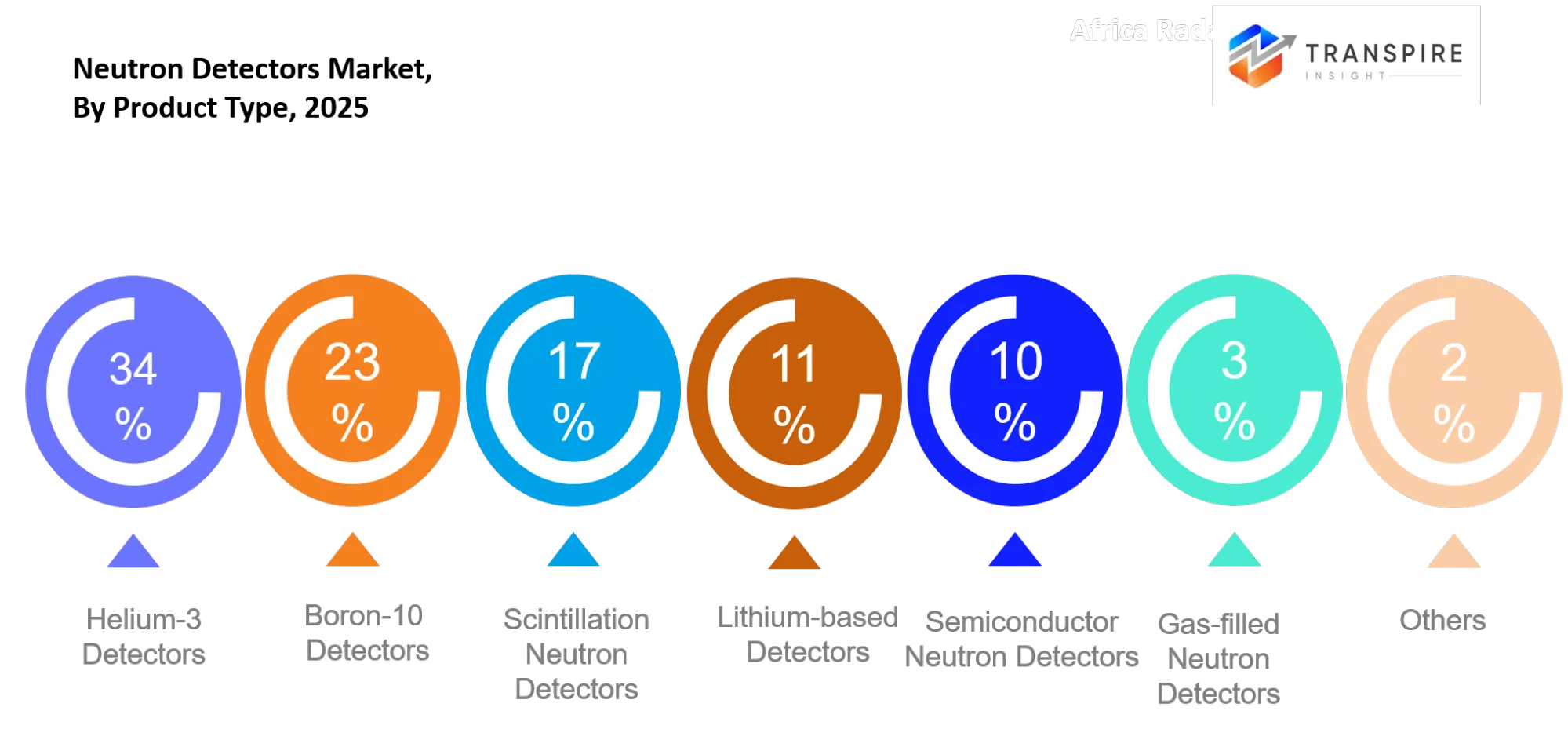
By Application
Nuclear power plants are the leading application segment because of the requirement of reliable neutron detection systems for continuous monitoring of radiation as well as reactor safety. Homeland security organisations are becoming more interested in the use of neutron detectors for surveillance at borders and inspection of cargo, as well as detection of any illegal radioactive materials. There is continued development of better neutron detectors by research laboratories for neutron scattering and materials science research purposes. In addition, the healthcare sector and industry are showing growth in the application of the technology in imaging and industrial inspection areas.
By End User
Government organisations and nuclear plants are the main end user segments on account of the stringent regulations and national security initiatives. There are increasing numbers of installations of detectors in research institutes to conduct research related to physics and nuclear sciences. Defence organisations are using the technology in surveillance as well as threat detection applications. Healthcare organisations are adopting neutron detectors for research and medical purposes. Industrial organisations are showing increasing interest in monitoring radiation.
By Technology
The gas-filled detection systems still play a dominant role due to their reliable performance. The scintillation detection technology is becoming increasingly popular owing to its quick response and high-performance capabilities. Semiconductor detection is developing at the highest rate thanks to the emphasis made by producers on producing small-size energy-efficient equipment with high detection accuracy. In addition, solid-state detection and hybrid detection systems become more interesting for investors due to their increased sensitivity, durability and compatibility with digital monitoring platforms.
By Distribution Channel
Direct sales are still regarded as the most popular way to distribute radiation detection systems, as they involve customisation services for complex government, defence, and nuclear applications. The scientific equipment distributors help enlarge the market reach as they provide research institutions and universities with special detection equipment. The OEM suppliers still work with system manufacturers, providing them with neutron detectors for radiation monitoring platforms. The exporters promote penetration into the international market, providing regions with advanced detection technologies.
What are the Key Use Cases Driving the Neutron Detectors Market?
Neutron detectors are mainly used in nuclear power plants as part of Helium-3 Detectors, which account for a significant portion of the product segment. These detectors have high accuracy and longevity and therefore are important for keeping operations safe and adhering to regulations.
Applications of neutron detectors have now spread to homeland security, scientific research, industrial inspection, and oil and gas exploration. Agencies that deal with border security use neutron detectors to trace illicit radioactive substances, while research organisations utilise more sophisticated detection systems in neutron scattering, material analysis, and particle physics experiments. Emerging applications of neutron detectors include medical research, defence, and small radiation detectors. The increasing use of semiconductor detectors in portable and digital detection systems is opening up new opportunities for neutron detectors.
|
Report Metrics |
Details |
|
Market size value in 2025 |
USD 438.6 Million |
|
Market size value in 2026 |
USD 465.8 Million |
|
Revenue forecast in 2033 |
USD 709.8 Million |
|
Growth rate |
CAGR of 6.2% from 2026 to 2033 |
|
Base year |
2025 |
|
Historical data |
2021 - 2024 |
|
Forecast period |
2026 - 2033 |
|
Report coverage |
Revenue forecast, competitive landscape, growth factors, and trends |
|
Regional scope |
United States; Canada; Mexico; United Kingdom; Germany; France; Italy; Spain; Denmark; Sweden; Norway; China; Japan; India; Australia; South Korea; Thailand; Brazil; Argentina; South Africa; Saudi Arabia; United Arab Emirates |
|
Key company profiled |
Mirion Technologies, Thermo Fisher Scientific, ORTEC, Centronic, Kromek Group, Arktis Radiation Detectors, Radiation Watch, Saint-Gobain Crystals, CAEN, Hamamatsu Photonics, Toshiba, Hitachi, Fuji Electric, Canberra Industries, Berthold Technologies |
|
Customization scope |
Free report customization (country, regional & segment scope). Avail customized purchase options to meet your exact research needs. |
|
Report Segmentation |
By Product Type (Helium-3 Detectors, Boron-10 Detectors, Lithium-based Detectors, Scintillation Neutron Detectors, Semiconductor Neutron Detectors, Gas-filled Neutron Detectors, Hybrid Neutron Detectors, Others); By Application (Nuclear Power Plants, Homeland Security, Scientific Research, Medical Imaging, Oil & Gas Exploration, Industrial Inspection, Defense, Others); By End User (Government Agencies, Research Institutes, Nuclear Facilities, Defense Organizations, Healthcare Institutions, Industrial Companies, Others); By Technology (Gas-filled Detection, Scintillation Detection, Semiconductor Detection, Solid-state Detection, Hybrid Detection Systems, Others); By Distribution Channel (Direct Sales, Scientific Equipment Distributors, OEM Suppliers, Exporters, Others) |
Which Regions are Driving the Neutron Detectors Market Growth?
North America
North America is the leading region that accounts for 41% of the market because of the presence of a developed nuclear industry, efficient defence programs, and investments in scientific research. This region has effective modernisation of nuclear power plants, safety measures concerning radiation, as well as continuous funding of homeland security programs. Research labs and developers of technologies contribute to the use of efficient neutron detectors.
Europe
The share of Europe in the global market is 29%. In this region, there is an emphasis on nuclear safety, cooperation in scientific research, as well as quality control in industries. In contrast to North America, this region concentrates on scientific cooperation across borders and regulation, which results in the development of radiation measurement technologies. Research centres and modernisation of nuclear infrastructure provide stable growth in the market. In September 2025, CERN suggested advanced methods to minimise the neutron background noise during experiments with the help of CIEMAT (Spain), TU Wien (Austria), INFN (Italy) and Universitat Politècnica de Catalunya in developing the TOF (Neutron Time-of-Flight) facility. This initiative would further improve the performance and accuracy of the neutron detector system in nuclear sciences and materials research.
Asia Pacific
The Asia Pacific region, which holds a market share of 23%, is expected to witness the highest CAGR of 18.8%. The rise in nuclear energy projects, increased governmental investments in research facilities, and industrialisation have been the key drivers driving the neutron detection market in the Asia Pacific region. Countries like China, India, Japan, and South Korea have been investing in modern radiation monitoring technology to improve their energy security and scientific capabilities.In November 2025, the Asia-Oceania Neutron Scattering Association (AONSA) organised the 14th AONSA Neutron School in the Materials and Life Science Experimental Facility (MLF), J-PARC (Japan), where experts from J-PARC (Japan), CSNS (China), CARR (China), JRR-3 (Japan), and ANSTO (Australia), among others, participated in the school.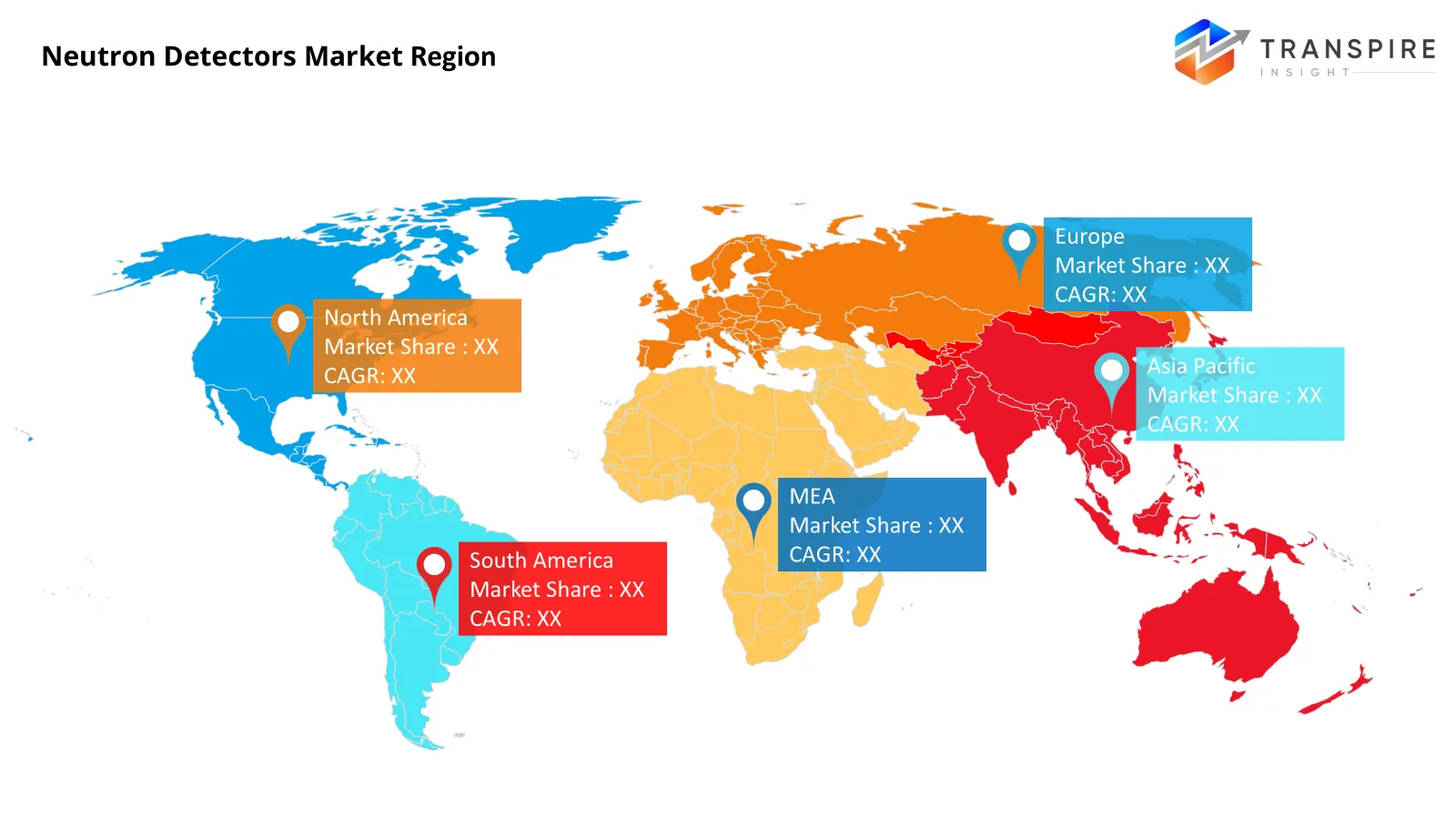
Who are the Key Players in the Neutron Detectors Marketand how do they Compete?
The competition within the international neutron detectors market comes from technology advancements, the development of specific product lines, as well as partnerships with government bodies, research organisations, and nuclear plants. The competition is based on the improvement of detectors' sensitivity, reduction in the size of the equipment, enhancement in the level of digitisation, and provision of specific solutions for defence, nuclear power, homeland security, and research purposes. The companies compete not on the price level but by providing high-quality detectors that are safe and reliable.
The major players, including Mirion Technologies, Thermo Fisher Scientific, Baker Hughes, Kromek Group plc, and Arktis Radiation Detectors, can be differentiated by their specific product lines and active investments in research and development. In particular, Mirion Technologies concentrates on developing integrated radiation monitoring systems, whereas Thermo Fisher Scientific increases its competitive advantages by producing advanced analytical devices and providing global services. Baker Hughes uses its experience in the field of energy and industrial technologies for neutron detection solutions in oil and gas exploration.
Neutron Detectors Marketcompanies
- Mirion Technologies
- Thermo Fisher Scientific
- ORTEC
- Centronic
- Kromek Group
- Arktis Radiation Detectors
- Radiation Watch
- Saint-Gobain Crystals
- CAEN
- Hamamatsu Photonics
- Toshiba
- Hitachi
- Fuji Electric
- Canberra Industries
- Berthold Technologies
Recent Development News
In July 2025, Mirion Technologies introduced the Vital® Platform, which is a digital platform designed to enhance the management of radiological instrument data, workflow, and visibility within nuclear installations. This introduction promotes efficient radiation monitoring and digital transformation in the nuclear industry.
In March 2026, Kromek Group collaborated with Argon Electronics to design a simulator for the D5 RIID portable radiation detector. The simulator allows real radiological search training exercises without the use of actual radioactive materials.
What Strategic Insights Define the Future of the Neutron Detectors Market?
Future growth trends for the Neutron Detectors Market include the evolution towards small-sized and highly sensitive neutron detection technologies providing better performance, less need for maintenance, and easy integration with digital monitoring systems. With increased investments in nuclear power, homeland security, and scientific research, manufacturers producing semiconductor neutron detectors and hybrid neutron detectors will have many opportunities to benefit from further development in this market. Yet one of the unseen obstacles faced by producers includes the industry's reliance on specialty raw materials and certification of new detection technologies, which needs to be done.
Further development of radiation monitoring systems in developing countries and next-generation nuclear reactors will create new market opportunities for companies willing to innovate in materials and analytics technologies used in neutron detection. Those enterprises that invest in material science innovations, artificial intelligence analytics, and collaboration with research institutions and government bodies will have a good chance to enhance their market positions.
By Product Type
- Helium-3 Detectors
- Boron-10 Detectors
- Lithium-based Detectors
- Scintillation Neutron Detectors
- Semiconductor Neutron Detectors
- Gas-filled Neutron Detectors
- Hybrid Neutron Detectors
By Application
- Nuclear Power Plants
- Homeland Security
- Scientific Research
- Medical Imaging
- Oil & Gas Exploration
- Industrial Inspection
- Defense
By End User
- Government Agencies
- Research Institutes
- Nuclear Facilities
- Defense Organizations
- Healthcare Institutions
- Industrial Companies
By Technology
- Gas-filled Detection
- Scintillation Detection
- Semiconductor Detection
- Solid-state Detection
- Hybrid Detection Systems
By Distribution Channel
- Direct Sales
- Scientific Equipment Distributors
- OEM Suppliers
- Exporters
Regional Outlook
North America
- US
- Canada
- Mexico
Europe
- Germany
- UK
- France
- Italy
- Spain
- Russia
- Rest of Europe
Asia Pacific
- China
- Japan
- India
- South Korea
- Australia
- Rest of Asia Pacific
South America
- Brazil
- Argentina
- Rest of South America
Middle East & Africa
- UAE
- Saudi Arabia
- Qatar
- South Africa
- Rest of the Middle East & Africa
Frequently Asked Questions
Find quick answers to common questions.
The Neutron Detectors Market size was valued at USD 438.6 Million in 2025 and is poised to reach USD 709.8 Million by 2033, expanding at a 6.2% CAGR.
Key segments for the Neutron Detectors Market are By Product Type (Helium-3 Detectors, Boron-10 Detectors, Lithium-based Detectors, Scintillation Neutron Detectors, Semiconductor Neutron Detectors, Gas-filled Neutron Detectors, Hybrid Neutron Detectors, Others); By Application (Nuclear Power Plants, Homeland Security, Scientific Research, Medical Imaging, Oil & Gas Exploration, Industrial Inspection, Defense, Others); By End User (Government Agencies, Research Institutes, Nuclear Facilities, Defense Organizations, Healthcare Institutions, Industrial Companies, Others); By Technology (Gas-filled Detection, Scintillation Detection, Semiconductor Detection, Solid-state Detection, Hybrid Detection Systems, Others); By Distribution Channel (Direct Sales, Scientific Equipment Distributors, OEM Suppliers, Exporters, Others).
Growth is primarily driven by increasing investment in nuclear security, increased usage of nuclear power production, rising demands for radiation detection in medical and industrial uses, and increasing research in nuclear science and defence.
The global market is led by major manufacturers including Mirion Technologies, Thermo Fisher Scientific, ORTEC, Centronic, Kromek Group, Arktis Radiation Detectors, Radiation Watch, Saint-Gobain Crystals, CAEN, Hamamatsu Photonics, Toshiba, Hitachi, Fuji Electric, Canberra Industries, Berthold Technologies.
North America accounts for 41% of the worldwide neutron detector market owing to substantial spending on nuclear security, sophisticated research infrastructure, defence initiatives, and the extensive use of radiation detection technologies.
The commercial opportunities in the international market of neutron detectors involve growing need for safe nuclear power plants, increasing homeland security and border surveillance programs, growing use in medical and industrial radiation detectors, and investment in next-generation neutron detectors.
- Mirion Technologies
- Thermo Fisher Scientific
- ORTEC
- Centronic
- Kromek Group
- Arktis Radiation Detectors
- Radiation Watch
- Saint-Gobain Crystals
- CAEN
- Hamamatsu Photonics
- Toshiba
- Hitachi
- Fuji Electric
- Canberra Industries
- Berthold Technologies
About the Authors

Avinash Kumar
I’m Avinash Kumar, a Senior Research Analyst at Transpire Insight, with expertise in the Electronics and Semiconductor and Energy & Power industry. My work focuses on analyzing emerging technologies, market trends, industry developments, and innovation across these sectors. I specialize in transforming complex technical and market insights into clear, research-backed content that helps professionals, businesses, and decision-makers stay informed. Through continuous industry research and data-driven analysis, I strive to deliver accurate, reliable, and practical perspectives on the latest advancements shaping the semiconductor and energy landscape.

Chakradhar Khansole
Chakradhar serves as the Research Director at Transpire Insight, bringing over 8 years of experience in technology, innovation, and strategic market intelligence. He specializes in transforming complex market data into actionable business insights that enable organizations to make informed, growth-oriented decisions. Recognized for his strategic vision and analytical expertise, Chakradhar leads high-impact research initiatives, delivering comprehensive market assessments, competitive intelligence, and forward-looking industry analysis.
Recently Published Reports
-
Apr 2026
Fiber Optic Faceplates Market
Fiber Optic Faceplates Market Size, Share & Analysis Report By Type (< 300 mm2, 300-350 mm2, and > 350 mm2, By Application (Night Vision, Holographic Imaging, Medical, and Others), and Geography (North America, Europe, Asia-Pacific, Middle East and Africa, South and Central America), 2021 - 2031
-
Apr 2026
High Temperature Superconductors Market
High Temperature Superconductors Market Size, Share & Analysis Report By Type (1G HTS, and 2G HTS), By Application (Power Cable, Fault Current Limiter, and Transformer), and Geography (North America, Europe, Asia-Pacific, Middle East and Africa, South and Central America), 2021 - 2031
-
Apr 2026
Industrial Plugs and Socket Market
Industrial Plugs and Socket Market Size, Share & Analysis Report By Type (Industrial Plugs, Industrial Sockets), By Current (Up to 32 A, 32 to 125 A, Above 125 A), By Protection (Dustproof and Splash Proof, Waterproof, Explosion Proof), By End User (Heavy Industries, Oil and Gas, Chemicals and Pharmaceuticals, Power Generation, Others), and Geography (North America, Europe, Asia-Pacific, Middle East and Africa, South and Central America), 2021 - 2031
-
Apr 2026
InGaAs Avalanche Photodiodes Market
InGaAs Avalanche Photodiodes Market Size, Share & Analysis Report By Type (1100 - 1700 nm, and 1000 - 1600 nm), By Application (Missile Warning System, Muzzle Flash Detection, Wafer Defect Inspection, Laser Rangefinders, and Others), and Geography (North America, Europe, Asia-Pacific, Middle East and Africa, South and Central America), 2021 - 2031