
SaaS Enterprise Applications Market Summary:
According to Transpire Insights, a detailed research report on the market reflects that the Software segment dominates the SaaS Enterprise Applications Market, accounting for approximately 60% of the total share worldwide. Microsoft Corporation leads the market with approximately (around USD 281 billion) in annual revenue and an estimated 15-18% market share, making it the leading contributor to market development, innovation, advanced SaaS enterprise application solutions, expanding cloud capabilities, and overall market growth dynamics.
Market Snapshot
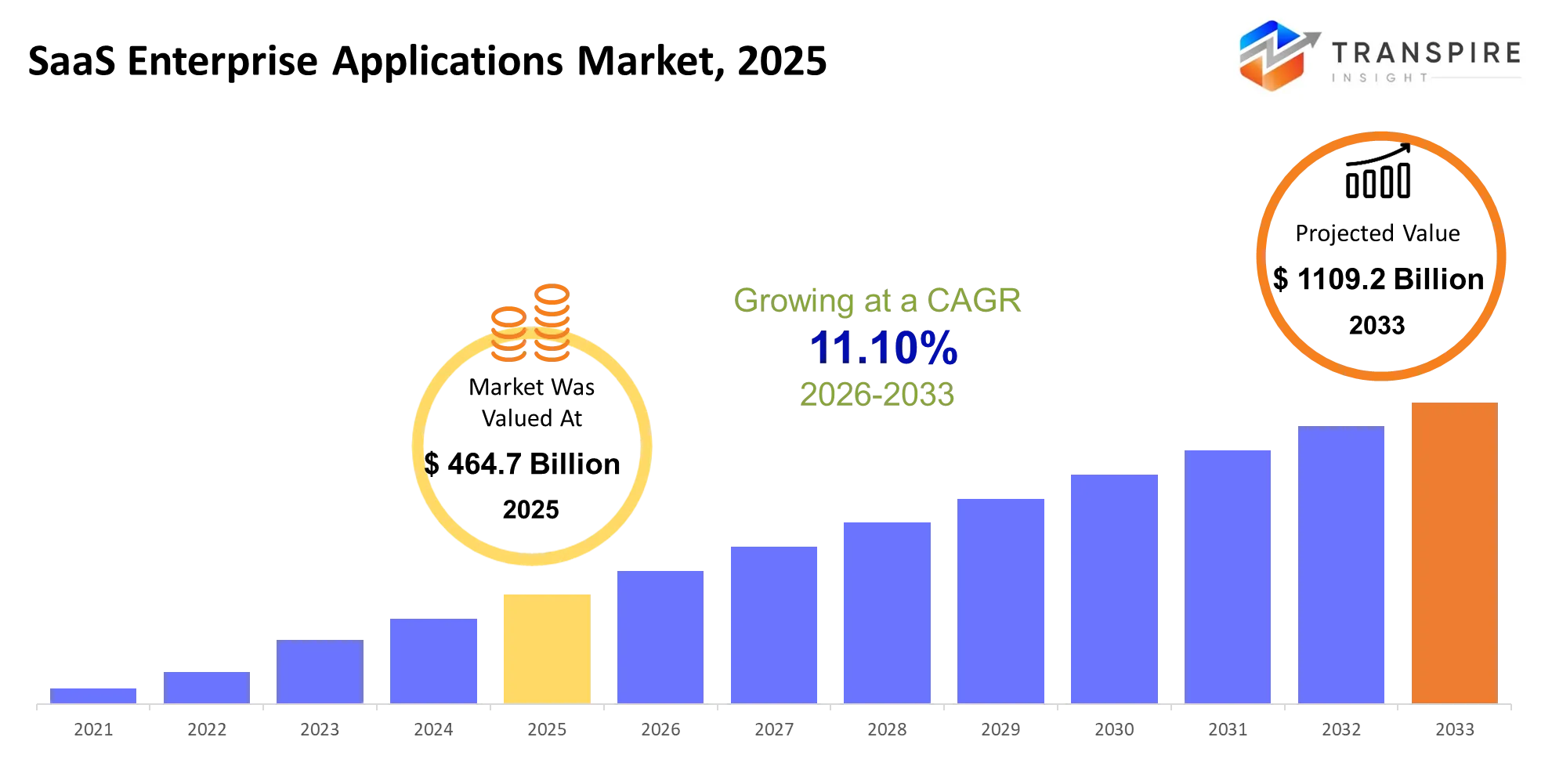
- Market Value (2025): USD 464.7 Billion.
- Expected Market Value (2026): USD 530 Billion.
- Estimated Market Value (2033): USD 1109.2 Billion.
- Forecast CAGR (2026-2033): 11.10%.
- Leading Region in 2025: North America
- Second-largest Region: Asia Pacific
- Fastest Growing Region: Europe
Introduction
The SaaS business applications market includes, among other things, subscription-based software (this type of application is hosted in the cloud). The usage of SaaS software does not require a local installation the software can be accessed over the internet by means of browser. Software as a Service (SaaS) means using software on a subscription basis over the internet. This means that users do not have to install any applications locally, they are able to work with their applications through the browser. Enterprise applications are large software systems designed to handle complicated and complex core business processes, including such functions as finance, human resources, supply chain management, and customer interaction. Enterprise applications are huge software systems that are created to take care of the company’s complicated issues connected with the data movement and overall functioning. Customer relationship management software is aimed at keeping and handling all the data connected with customers and already existing customers. Enterprise resource planning (ERP) software is a system of integrated core software used for carrying out everyday business processes. Applications within the SaaS enterprise framework yield overwhelming operational efficiency by cutting capital expenses through predictable subscription pricing schemes which take over the need for expensive hardware and software purchases. The SaaS enterprise solutions allow for seamless scalability of the enterprise through the ability of the companies to adjust the number of users and computing power, as well as the additional functions, based on the changes to the business environment. The automated maintenance function enables transferring the management of infrastructure and security updates to the cloud service provider. The accessibility of these solutions makes it possible to collaborate in a safe manner for all members of the team and work remotely efficiently. Moreover, the built-in compliance frameworks guarantee increased protection of data and provision of the service according to the governmental legislation and regulations (for instance GDPR or SOC 2).
For instance: The UK sector of the worldwide Software-as-a-Service (SaaS) enterprise applications market is home to thousands of specialized businesses supported by billions of dollars in venture funding. Cloud migration, AI integration, and stringent regulatory compliance frameworks are major areas of investment.
Market Highlights: -
- North America is expected to grow at a rapid CAGR in the SaaS Enterprise Applications Market by holding almost 42% of the share during the forecast period.
- Asia Pacific is anticipated to hold almost 26% share of the SaaS Enterprise Applications Market over the predicted time frame.
- Europe is anticipated to hold roughly 22% share of the SaaS Enterprise Applications Market over the predicted time frame.
- By application, the Enterprise Resource Planning segment dominated the market and holds nearly 23% share in 2025 and is projected to grow at a substantial CAGR during the forecast period.
- By deployment, the Public Cloud segment dominated the market and holds nearly 52% share in 2025 and is projected to grow at a substantial CAGR during the forecast period.
- By end user, the IT & Telecom segment dominated the market and holds nearly 18% share in 2025 and is projected to grow at a substantial CAGR during the forecast period.
- India: Initiatives such as the Digital India project and MSME digital transformation processes are speeding up the adoption of technology among local companies by promoting digital infrastructure, cloud-based solutions, and technology readiness initiatives. The result of these initiatives is the ability of SMEs and enterprises to adopt SaaS enterprise solutions, increase efficiency in production, improve productivity and join the digital economy of India.
How is Technology Driving Growth in the SaaS Enterprise Applications Market?
The advanced technologies such as artificial intelligence, agentic workflows, and predictive analytics are the main contributors to the emerging changes in the SaaS Enterprise Applications Market. This is enabling developers to create applications which provide proactive insights and automated decision-making abilities. Thanks to cloud-based architecture, businesses are enjoying the benefits of agility since it allows them to deploy their applications abroad easily. Automating tasks makes the operations much more successful as robots can do simple things effectively. With the help of standardized APIs, developers are able to connect SaaS and other programs effectively as they are being introduced into the digital era. Moreover, hybrid pricing models are aimed at enhancing costs since they correlate the software consumption and expenditures on different programs.
Market Drivers
The SaaS Enterprise Applications Market is expanding rapidly with the rise in popularity of digital transformation initiatives, the increased incorporation of cloud technology into operations, and the drive for scalable software solutions. The fact that businesses are upgrading time-worn legacy systems using flexible cloud platforms is leading to an increased level of agility and effectiveness from the companies operating in this area. Moreover, the incorporation of technologies such as AI/ML/automation is resulting in an increase in overall productivity and decision-making processes in enterprises. Figures confirm that the use of subscription and pay-as-you-go models allows for lower capital costs and better accessibility. Finally, with more companies embracing different types of hybrid work form, the popularity of cloud collaboration tools is skyrocketing. SaaS enterprise applications offer tremendous benefits to organizations through their subscription-based pricing models that remove the need for heavy initial investments on hardware and software. Thanks to the use of cloud solutions, these systems can be deployed swiftly so their use does not take long to organize. SaaS architecture is scaling when companies can easily increase or decrease the number of users, storage capacity, and features of SaaS applications according to the needs of every moment. SaaS solutions help automate maintenance and provide system updates and security, which decreases workload of IT specialists and makes it possible for them to rely on systems without problems. More than that, SaaS solutions can be accessed from everywhere in the world, which means companies are enabled to work remotely. Thus, digital transformation becomes reality for lots of organizations, and the efficiency of the applications is increasing.
For Instance: -
- The SaaS enterprise applications industry is undergoing significant structural changes in Russia as a result of Western software exits. This is driving a strong push toward investments in localized corporate management software, local cloud services, and domestic import replacement.
- With Germany, France, and the UK acting as regional IT hubs, investment trends in the European enterprise SaaS market show a strong emphasis on data sovereignty, compliance, and vertical-specific apps. Use insights on platforms such as Dealroom to monitor startup statistics.
Restrain
The SaaS Enterprise Applications Market has to deal with numerous challenges such as cyber attacks, intricate rules and regulations, integration of older systems, dependence on vendors, and growing concerns over subscription management. Organizations are tasked with mitigating the risks related to data security, changing compliance standards, migration issues, and growing expenses associated with SaaS. These factors impact the strategies of adopting SaaS, streamlining operations, and making business investments.
Analysis of Prices and Consumer Behaviour
The market for SaaS enterprise applications is dominated by cloud-based SaaS solutions, which account for around 60% of the overall market, largely because of the greater enterprise uptake of scalable, subscription-based software solutions for CRM, ERP, HRM, finance and collaboration applications. The cost of advanced SaaS solutions featuring AI, automation and predictive analytics, as well as enhanced cybersecurity, is usually 25%-35% higher than standard SaaS solutions due to the need for advanced infrastructure, continuous software development and high-quality support. Around 55%-60% of enterprises today base their software deployments on cloud and SaaS solutions, gaining advantages from flexibility, remote access and lower IT support costs. Large companies and companies from such sectors as banking, finance, healthcare, retail, and technology make up about 65%-70% of demand for SaaS enterprise software. The recent studies in enterprise purchasing behavior have shown that 55%-60% of companies prefer to consider factors like security, integration, scalability, compliance and cost efficiency when choosing SaaS solutions. In addition, 30%-35% of organizations prefer to use long-term contracts when buying SaaS solutions as a way of optimizing software expenses, ensuring service continuity and establishing reliable digital transformation partners worldwide.
Top Companies in the SaaS Enterprise Applications Market
- Salesforce
- Microsoft
- Oracle
- SAP
- Workday
- ServiceNow
- Adobe
- Zoho
- HubSpot
- Atlassian
- Google Cloud
- Freshworks
- Monday.com
- Zendesk
- Intuit
Market Segmentation
The SaaS Enterprise Applications Market share is divided into five categories: By application, deployment, enterprise size, end user and pricing model.
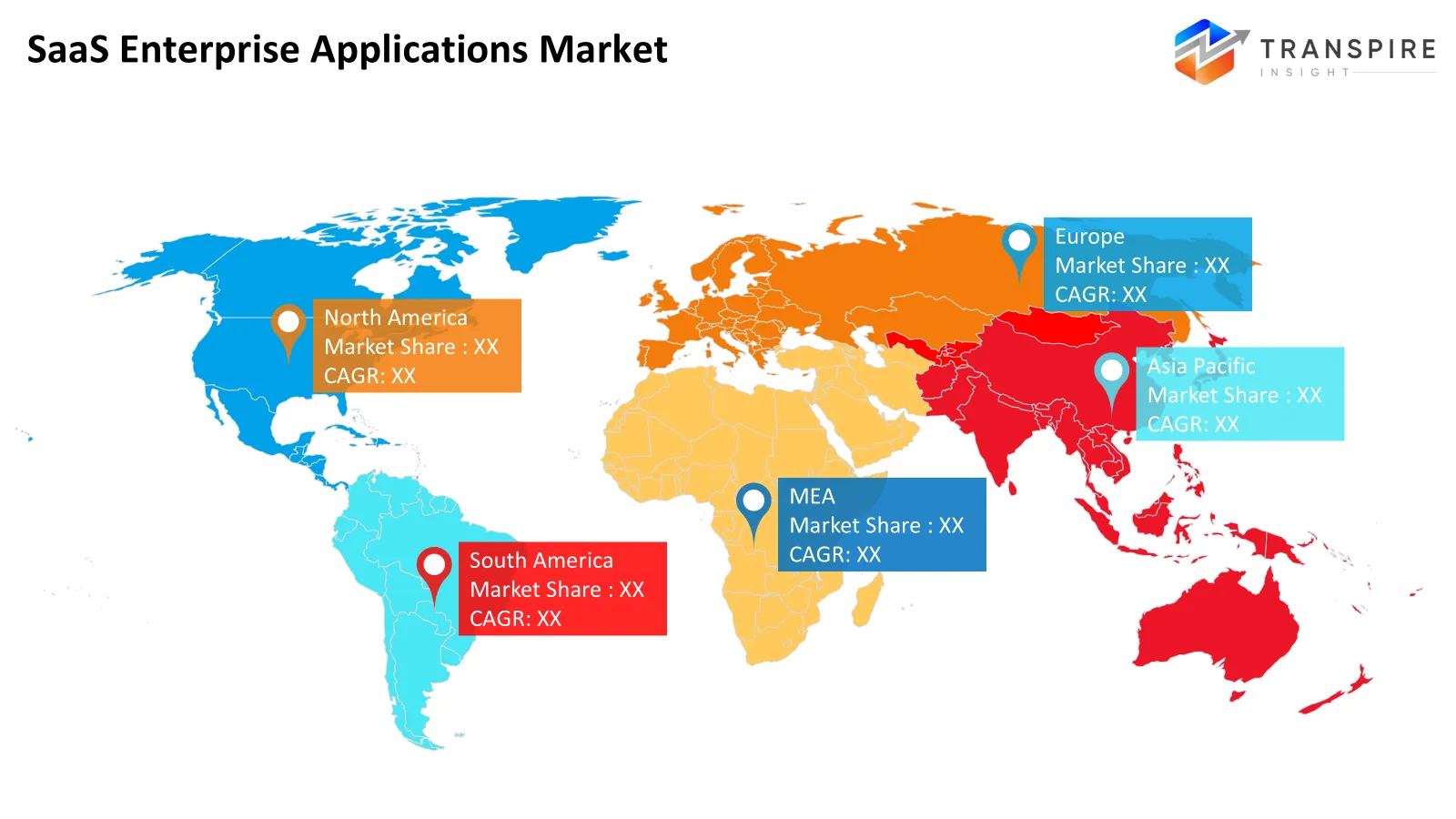
The Enterprise Resource Planning dominated the market, accounting for nearly 23% in 2025 and is expected to rise at a significant CAGR during the forecast period.
The SaaS Enterprise Applications Market is segmented by application into Customer Relationship Management, Enterprise Resource Planning, Human Capital Management, Collaboration Software, Project Management, Supply Chain Management, Financial Management, Others. Among these, the Enterprise Resource Planning segment dominated the market, accounting for nearly 23% in 2025 and expected to increase at a significant CAGR during the forecast period. The sector of enterprise resource planning leads the industry because of rising demand for integrated solutions for business management that improve business processes dealing with finance, supply, roles, and operations. The businesses use SaaS ERP solutions to improve operational efficiency, gain real-time analytics, minimize costs related to the infrastructure and implement digital transformation strategies which results in rapid growth of the sector.
The Public Cloud dominated the market, accounting for nearly 52% in 2025, and is expected to rise at a significant CAGR during the forecast period.
The SaaS Enterprise Applications Market is segmented by deployment into Public Cloud, Private Cloud, Hybrid Cloud, Multi-cloud, Edge Cloud, SaaS-native, Containerized Deployment, Others. Among these, the Public Cloud segment dominated the market, accounting for nearly 52% in 2025 and expected to increase at a significant CAGR during the forecast period. The Public Cloud segment leads the market due to the rise of enterprise use of flexible, affordable, scalable cloud infrastructure. Organizations are using public cloud SaaS solutions to decrease their IT costs, improve their business flexibility, enable remote work, and speed up digital transformation. Advanced security measures, automatic updates, and integration facilitate wide use of the cloud.
The IT & Telecom dominated the market, accounting for nearly 18% in 2025 and is expected to rise at a significant CAGR during the forecast period.
The SaaS Enterprise Applications Market is segmented by end user into IT & Telecom, BFSI, Healthcare, Manufacturing, Retail, Government, Education, Others. Among these, the IT & Telecom segment dominated the market, accounting for nearly 18% in 2025 and expected to increase at a significant CAGR during the forecast period. The IT & Telecom sector leads in the market driven by adoption of cloud-based enterprise applications, automated solutions and advanced digital infrastructure. Companies in this sector need scalable software as a services platform for network and customer operations, data analytics, and cybersecurity. Continuous digital transformation leads to an increase in demand for enterprise SaaS solutions.
Regional Segment Analysis of the SaaS Enterprise Applications Market:
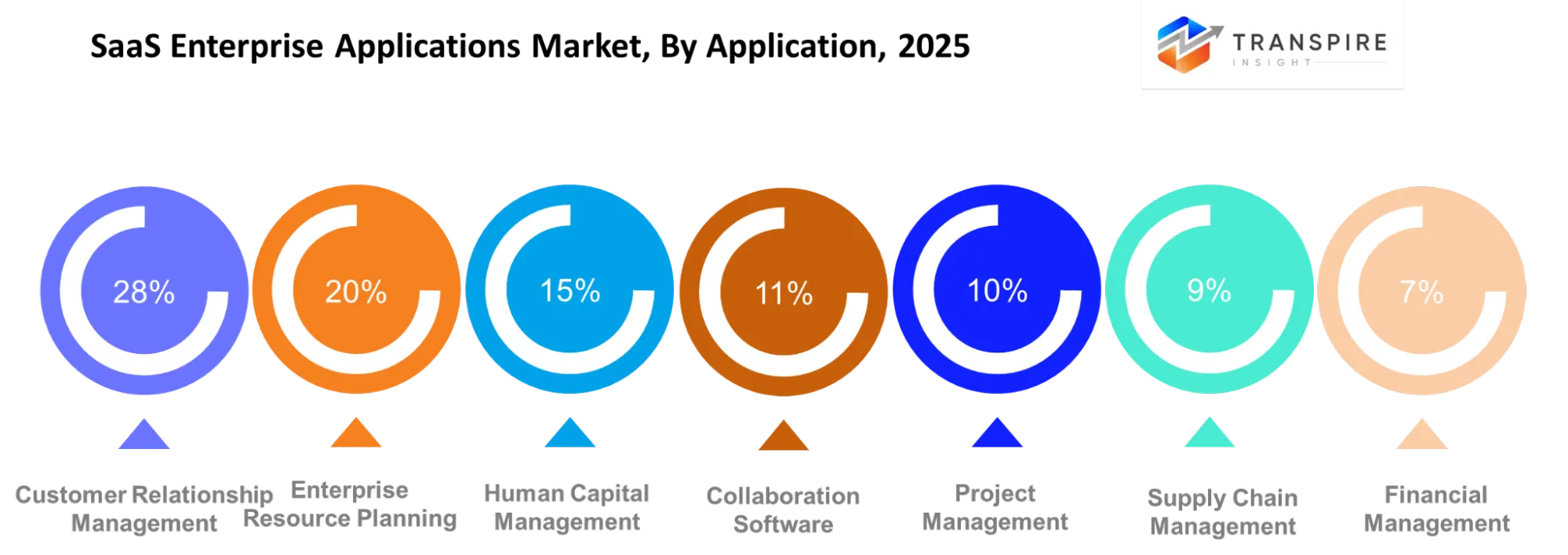
- North America (U.S., Canada, Mexico)
- Europe (Germany, France, U.K., Italy, Spain, Rest of Europe)
- Asia-Pacific (China, Japan, India, Rest of APAC)
- South America (Brazil and the Rest of South America)
- The Middle East and Africa (UAE, South Africa, Rest of MEA)
North America is the fastest-growing region in the SaaS Enterprise Applications Market during the period, holding almost 42% share.
North America is expected to grow at a rapid CAGR in the SaaS Enterprise Applications Market holding almost 42% share during the forecast period. The SaaS Enterprise Applications Market is predominantly led by North America courtesy of the growing enterprise cloud adoption rates, advanced digital infrastructure, and significant investments made into AI and automation technologies. It is evident that the area boasts a technological ecosystem and most prominent SaaS providers leading to greater demands for scalable business applications as well as rapid enterprise digital transformation initiatives.
Asia Pacific is the fastest-growing region in the SaaS Enterprise Applications Market during the period, holding almost 26% share.
Asia Pacific is the fastest-growing region in the SaaS Enterprise Applications Market during the forecast period, holding almost 26% share during the forecast period. The fast expansion of the SaaS Enterprise Applications Market is being experienced in the Asia Pacific region, driven by an increase in cloud usage, greater adoption of digital transformation projects, and more investments in enterprise technologies. Factors such as the extensive development of SMEs, rapid growth in internet penetration, AI implementation, as well as government-sponsored digitization initiatives are acting as positive market drivers for SaaS solutions.
Europe is expected to grow at a rapid CAGR in theSaaS Enterprise Applications Market, holding roughly 22% of the share during the forecast period.
Europe is expected to grow at a rapid CAGR in the SaaS Enterprise Applications Market holding roughly 22% share during the forecast period. Europe is expected to achieve substantial development in the SaaS Enterprise Applications Market thanks to the increasing uptake of cloud computing, the drive towards regulatory digitalization, and the interest of businesses in scalable solutions. Other factors contributing to the growing popularity of SaaS applications in the EU include increased investment in AI applications, cybersecurity solutions, and automated technologies, as well as massive digital transformation that is taking place across sectors.
Strategies for Market Growth in Non-Leading Regions:
The advancement of developing countries using effective and scalable SaaS enterprise application technologies can greatly contribute to small and medium enterprises, software manufacturers, and technology startups. The development of the local cloud infrastructure, expansion of SaaS platforms in different regions, and building the capability to provide software locally can reduce reliance on international vendors and cut costs. The formation of strategic partnerships with cloud service providers, end users of technologies, system integrators, cybersecurity companies, and digital transformation consultants will enable successful promotion of the SaaS applications in the market. The implementation of training programs and technical training will help raise the awareness of cloud adoption, software integration, data security, and application management. In addition to the means described above, the establishment of flexible financing mechanisms, subscription pricing, long-term agreements, and managed services partnerships will help make SaaS solutions affordable and promoted among enterprises. The implementation of joint initiatives with the government, projects focused on digital transformation and technology development, which can be communicated through digital channels, will create opportunities for increasing the accessibility of SaaS enterprise applications and promote the sustainable growth of the world market in developing countries.
Future Market Trends for the SaaS Enterprise Applications Market: -
- Agentic AI Integration: Rather than using only simple chatbots, SaaS applications now come with self-directed artificial intelligence capabilities allowing them to execute complex tasks without human assistance.
- AI-Native Architecture: This type of software is integrated with machine learning technology from the ground up, rather than on old computer programs.
- Semantic Data Layers: The platforms put more emphasis on the usage of semantic data structure for better tracking of context and making real-time decisions.
Recent Development
- In July 2026: According to Grand View Research, the investments in enterprise applications will keep growing due to the increasing adoption of various technologies, including those powered by AI automation, multi-fold agents, cloud-based platforms and digital transformation. These trends cause an increased demand for scalable SaaS enterprise applications that will help companies improve operational efficiency, automate procedures in their workflow, and enhance data-based decision making in different domains.
- In August 2026: Gartner pointed out the rise in the acceptance of generative AI functionalities in business customer service systems, underscoring the need for synergy among AI-powered automation and human representatives. Such developments speed up the process of developing intelligent SaaS corporate applications through enhancing customer involvement, operational efficiency, collaboration automation and personalized service provision.
- In August 2026: The cloud marketplace ecosystem of Microsoft has been enhanced with the introduction of advanced enterprise solutions based on cloud computing, agentic AI, and cybersecurity. Such improvements will contribute to the growth of the SaaS Enterprise Applications Market, because they will provide enterprises with the opportunity to use smart software platforms, implement modern security management in real-time, and boost overall operational efficiency through scalable cloud applications.
Market Segment
This study forecasts revenue at global, regional and country levels from 2020 to 2033. Transpire Insights has segmented the SaaS Enterprise Applications Market based on the below-mentioned segments:
SaaS Enterprise Applications Market, By Application
- Customer Relationship Management
- Enterprise Resource Planning
- Human Capital Management
- Collaboration Software
- Project Management
- Supply Chain Management
- Financial Management
- Others
SaaS Enterprise Applications Market, By Deployment
- Public Cloud
- Private Cloud
- Hybrid Cloud
- Multi-cloud
- Edge Cloud
- SaaS-native
- Containerized Deployment
- Others
SaaS Enterprise Applications Market, By Enterprise Size
- Large Enterprises
- SMEs
- Startups
- Government Organizations
- Educational Institutions
- Healthcare Organizations
- Financial Institutions
- Others
SaaS Enterprise Applications Market, By End User
- IT & Telecom
- BFSI
- Healthcare
- Manufacturing
- Retail
- Government
- Education
- Others
SaaS Enterprise Applications Market, By Pricing Model
- Subscription-based
- Usage-based
- Per-user Licensing
- Enterprise Contracts
- Freemium
- Custom Licensing
- Annual Plans
- Others
SaaS Enterprise Applications Market, By Regional Analysis
North America
- US
- Canada
- Mexico
Europe
- Germany
- UK
- France
- Italy
- Spain
- Russia
- Rest of Europe
Asia Pacific
- China
- Japan
- India
- South Korea
- Australia
- Rest of Asia Pacific
South America
- Brazil
- Argentina
- Rest of South America
Middle East & Africa
- UAE
- Saudi Arabia
- Qatar
- South Africa
- Rest of the Middle East & Africa
Frequently Asked Questions
Find quick answers to common questions.
Cloud adoption, AI automation, digital transformation, and scalable subscription models accelerate enterprise efficiency and software innovation.
ERP dominates due to integrated business management, operational optimization, real-time analytics, and enterprise digital transformation needs.
Public Cloud leads through scalability, cost efficiency, flexibility, security enhancements, and simplified enterprise application deployment.
North America leads due to advanced infrastructure, major SaaS providers, AI investments, and strong enterprise cloud adoption.
Agentic AI, AI-native platforms, semantic data, automation, hybrid cloud, and usage-based pricing will shape future growth.
- Salesforce
- Microsoft
- Oracle
- SAP
- Workday
- ServiceNow
- Adobe
- Zoho
- HubSpot
- Atlassian
- Google Cloud
- Freshworks
- Monday.com
- Zendesk
- Intuit
About the Authors

Mayur Shinde
I am Mayur Shinde, a Senior Research Analyst at Transpire Insight, specializing in the Automotive & Transportation and Information & Communication Technology (ICT) Industry. My work focuses on analyzing emerging market trends, technological advancements, competitive landscapes, and industry developments to deliver accurate, data-driven insights. I am passionate about transforming complex market information into clear, actionable content that helps businesses, professionals, and decision-makers stay informed and make confident strategic decisions.

Chakradhar Khansole
Chakradhar serves as the Research Director at Transpire Insight, bringing over 8 years of experience in technology, innovation, and strategic market intelligence. He specializes in transforming complex market data into actionable business insights that enable organizations to make informed, growth-oriented decisions. Recognized for his strategic vision and analytical expertise, Chakradhar leads high-impact research initiatives, delivering comprehensive market assessments, competitive intelligence, and forward-looking industry analysis.
Recently Published Reports
-
Apr 2026
3D Optical Profiler Market
3D Optical Profiler Market Size, Share & Analysis Report By Type (Desktop 3D Optical Profiler, and Portable 3D Optical Profiler), By Technology (Confocal Technology, and White Light Interference), By End-Use Industry (Manufacturing, Research Institutions, Automotive, Aerospace and Defense, Medical Devices, and Other), and Geography (North America, Europe, Asia-Pacific, Middle East and Africa, South and Central America), 2021 - 2031
-
Apr 2026
Depth Sensor Market
Depth Sensor Market Size, Share & Analysis Report By Type (Infrared Depth Sensors, Time-of-Flight (ToF) Sensors, Stereo Vision Sensors, Structured Light Sensors, Ultrasonic Depth Sensors), By Application (Automotive, Robotics, Gaming, Consumer Electronics, Industrial Automation, Healthcare, Security & Surveillance, Others), By End Users (Automotive Manufacturers, Consumer Electronics Companies, Healthcare Providers, Industrial Companies, Security Agencies, Gaming Companies, Robotics Companies, Others), and Geography (North America, Europe, Asia-Pacific, Middle East and Africa, South and Central America), 2021 – 2031
-
Apr 2026
Digital Manufacturing Market
Digital Manufacturing Market Size, Share & Analysis Report By Component (Hardware, Software, and Services), By Technology (Robotics, 3D Printing, Internet of Things (IoT), and Others), By Application (Automotive and Transportation, Aerospace and Defense, Consumer Electronics, Industrial Machinery, and Others), By Process Type (Computer-Based Designing, Computer-Based Simulation, Computer 3D Visualization, Analytics, and Others), and Geography (North America, Europe, Asia-Pacific, Middle East and Africa, South and Central America), 2021 – 2031
-
Apr 2026
Digital Visa Services Market
Digital Visa Services Market Size, Share & Analysis Report By Type (Individual Travelers, Group Travelers), By Application (Tourism, Business Travel, Others), and Geography (North America, Europe, Asia-Pacific, Middle East and Africa, South and Central America), 2021 – 2031