

Robotics Laser Welding Market Size & Forecast:
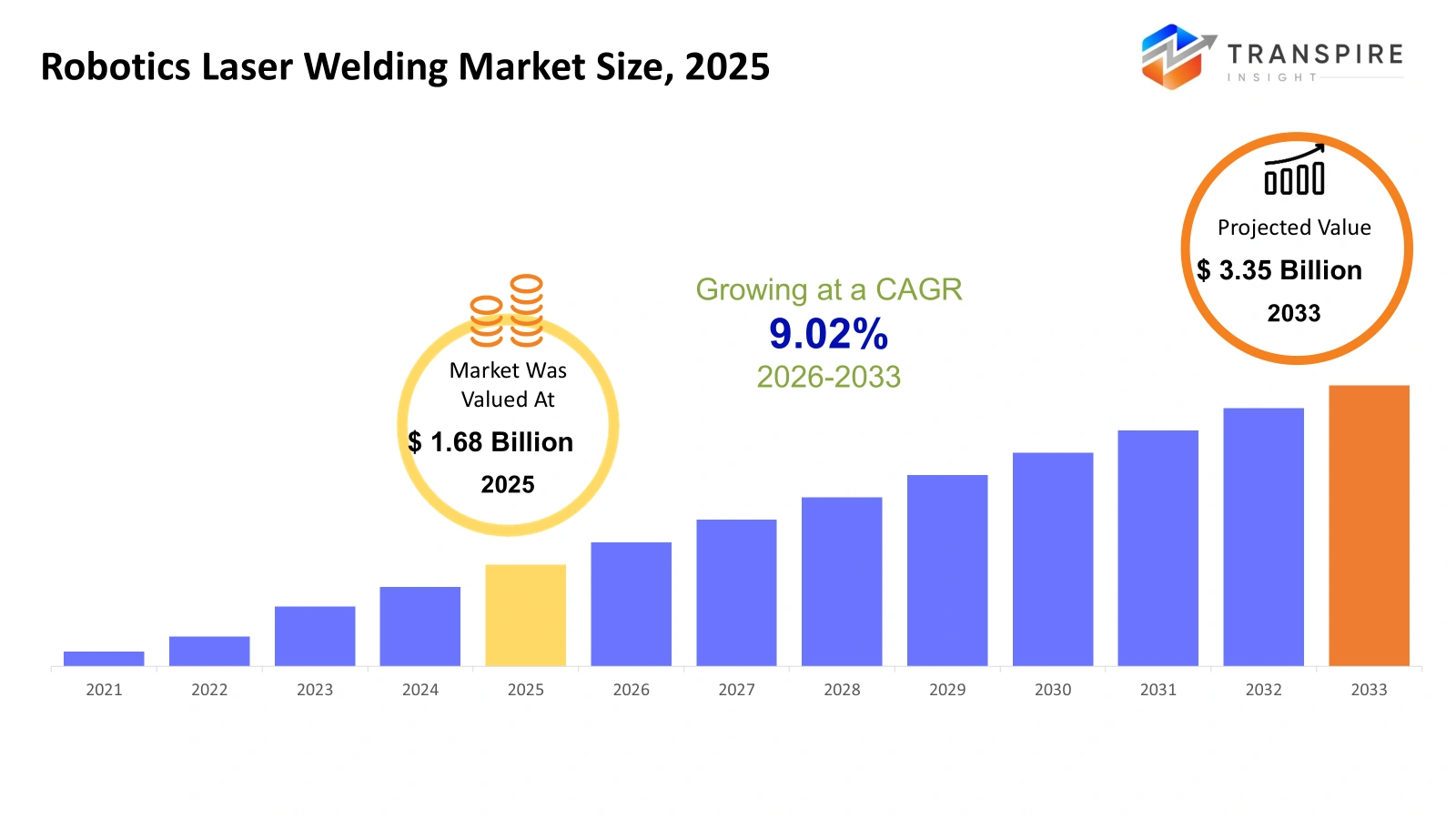
Robotics Laser Welding Market Size 2025: USD 1.68 Billion
Robotics Laser Welding Market Size 2033: USD 3.35 Billion
Robotics Laser Welding Market CAGR: 9.02%
Robotics Laser Welding Market Segments: By Robot Type (Articulated Robots, Cartesian Robots, SCARA Robots), By Laser Type (Fiber Laser, CO₂ Laser, Solid-State Laser), By Application (Automotive Manufacturing, Electronics Manufacturing, Aerospace, Metal Fabrication).
To learn more about this report,  Download Free Sample Report
Robotics Laser Welding Market Summary:
The Robotics Laser Welding Market reached an estimated value of USD 1.68 billion in 2025 and is projected to grow to USD 3.35 billion by 2033, expanding at a CAGR of 9.02% from 2026 to 2033. The process of robotic laser welding uses industrial robots and laser systems to achieve precise, efficient welding results. The technology enables manufacturers to produce welds that meet high-strength, clean-appearance, and tight dimensional-accuracy standards while minimising material distortion, which matters most in industries that handle high-performance tasks.
The adoption of robotic laser welding systems by manufacturers is growing because they help boost productivity while delivering consistent results and better product quality. Robotic welding systems maintain constant operational capacity because their automated features enable precise results with minimal need for human operators. The system provides operational benefits because it decreases mistakes while increasing production consistency which enables enterprises to sustain their product quality requirements during their extensive manufacturing operations.
The control of Robotics Laser Welding Market currently exists under the power of industrial automation, which experiences rapid development within industrial fields. Automated systems function as essential components within the automotive and electronics industries because those industries need to fulfill their demands for high-volume production. The implementation of robotic laser welding systems enables these industries to produce intricate components at high speed while ensuring compliance with rigorous quality standards.
The market experiences another significant growth driver because businesses now seek to create products that use lightweight materials which possess high-strength characteristics. The aerospace and automotive industries have started to adopt high-strength steel and aluminum alloys as their primary advanced material choices. Laser welding delivers the exactness which enables material connections that retain their structural strength during the welding process.
The market experiences expansion because of technological innovations which drive new developments. The current robotic welding systems comes with advanced sensors which enable real-time monitoring and AI-powered control systems. The system equips manufacturers with tools to enhance their welding methods while decreasing production waste and boosting overall operational effectiveness.
Key Market Trends & Insights:
- The Robotics Laser Welding Market is expanding because businesses implement automated systems which enhance their manufacturing processes and operational accuracy.
- The automotive and electronics sectors represent the primary market for robotic laser welding systems.
- The popularity of fiber laser technology continues to rise because it provides users with both outstanding performance and precise results.
- Manufacturers are combining artificial intelligence with intelligent monitoring technologies to develop advanced robotic welding systems.
- The demand for materials which combine light weight properties with high strength capabilities drives the development of modern welding technologies.
Robotics Laser Welding Market Segmentation
By Robot Type
- Articulated Robots: The most common robotic system used in laser welding work consists of articulated robots, which operate with multiple movement axes to execute their advanced welding functions. The robots operate with multiple movement axes, which enable them to execute complex welding operations because of their high operating flexibility. The robots operate with two movement axes, which enable them to execute precise tasks that demand exact control of their movements.
- Cartesian Robots: The design of Cartesian robots enables them to move along two straight paths, which makes them suitable for tasks that need users to move in straight lines. These systems can handle welding tasks that require high precision and exact repeatability, offering simpler operations than articulated robots.
- SCARA Robots: The SCARA (Selective Compliance Assembly Robot Arm) robot system achieves its purpose through its ability to perform high-precision tasks with rapid execution speed. The electronics manufacturing industry uses these components for their welding process, which needs both high-speed operation and precise results when handling small parts.
By Laser Type
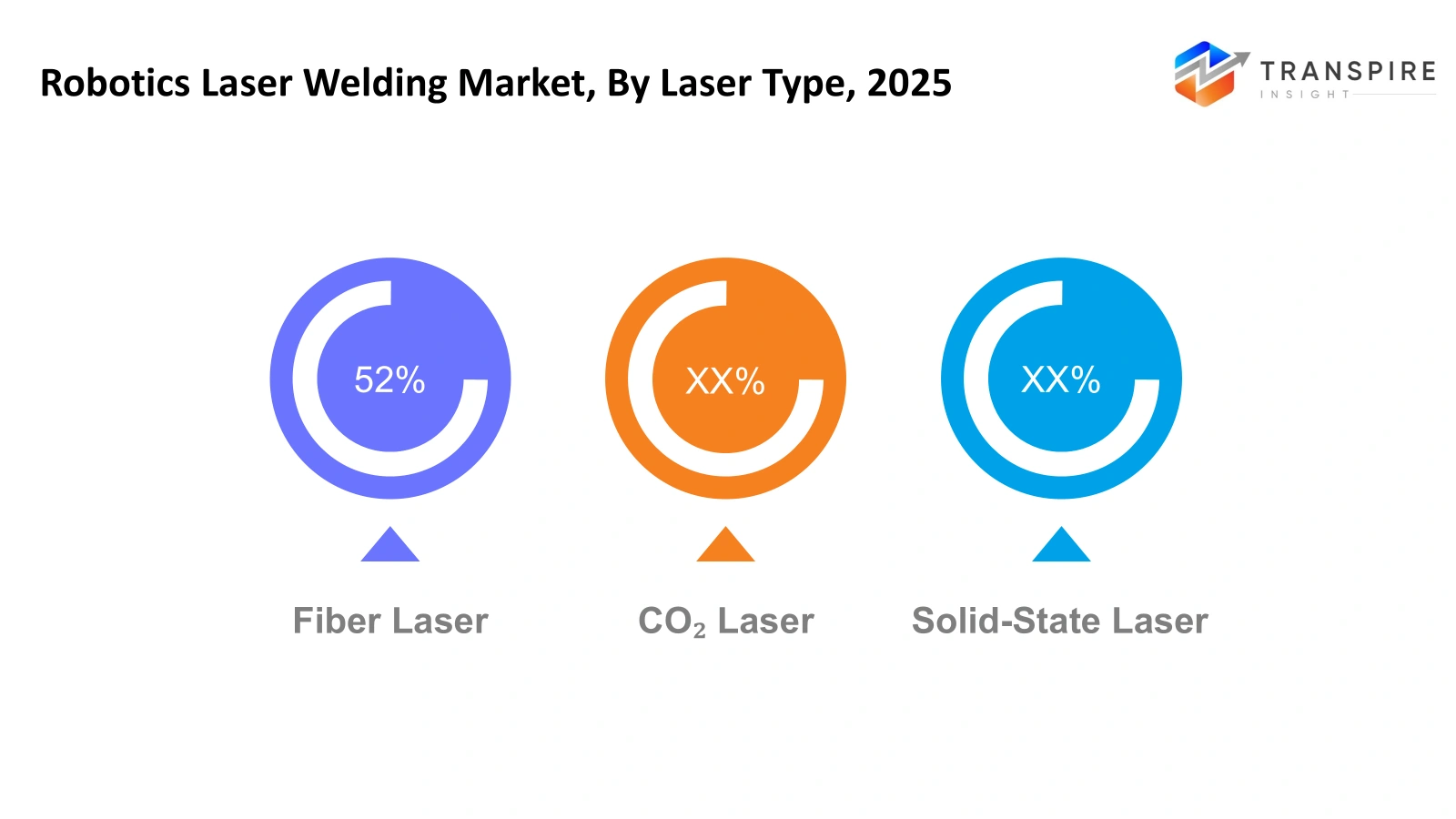
- Fiber Laser: The Robotics Laser Welding Market uses fiber lasers as their primary technology because fiber lasers deliver both high efficiency and precise performance with minimal need for maintenance. The lasers deliver excellent beam quality, enabling the creation of strong, clean welds. The automotive and electronics manufacturing industries extensively utilize these products.
- CO₂ Laser: CO₂ lasers operate in environments that need to create deep welds through their welding process. The equipment can handle thick materials yet fiber lasers have started to take over because they provide better operational performance.
- Solid-State Laser: Solid-state lasers deliver effective industrial solutions through their specific operational capabilities. The equipment provides a dependable welding function, but users choose it less frequently than they select fiber lasers.
To learn more about this report, Download Free Sample Report
By Application
- Automotive Manufacturing: The automotive industry is one of the largest users of robotic laser welding systems. These systems operate at high speed to perform precise welding of car bodies and engine components and structural parts.
- Electronics Manufacturing: Electronics manufacturers use robotic laser welding for assembling small and delicate components. The precision of laser welding ensures minimal damage to sensitive parts.
- Aerospace: The aerospace industry requires extremely precise and reliable welding processes. Robotic laser welding helps produce high-quality components that meet strict safety and performance standards.
- Metal Fabrication: Robotic laser welding systems enable metal fabrication industries to cut and join and shape metal components. The systems enhance efficiency while they decrease the time needed for production.
Country Insights
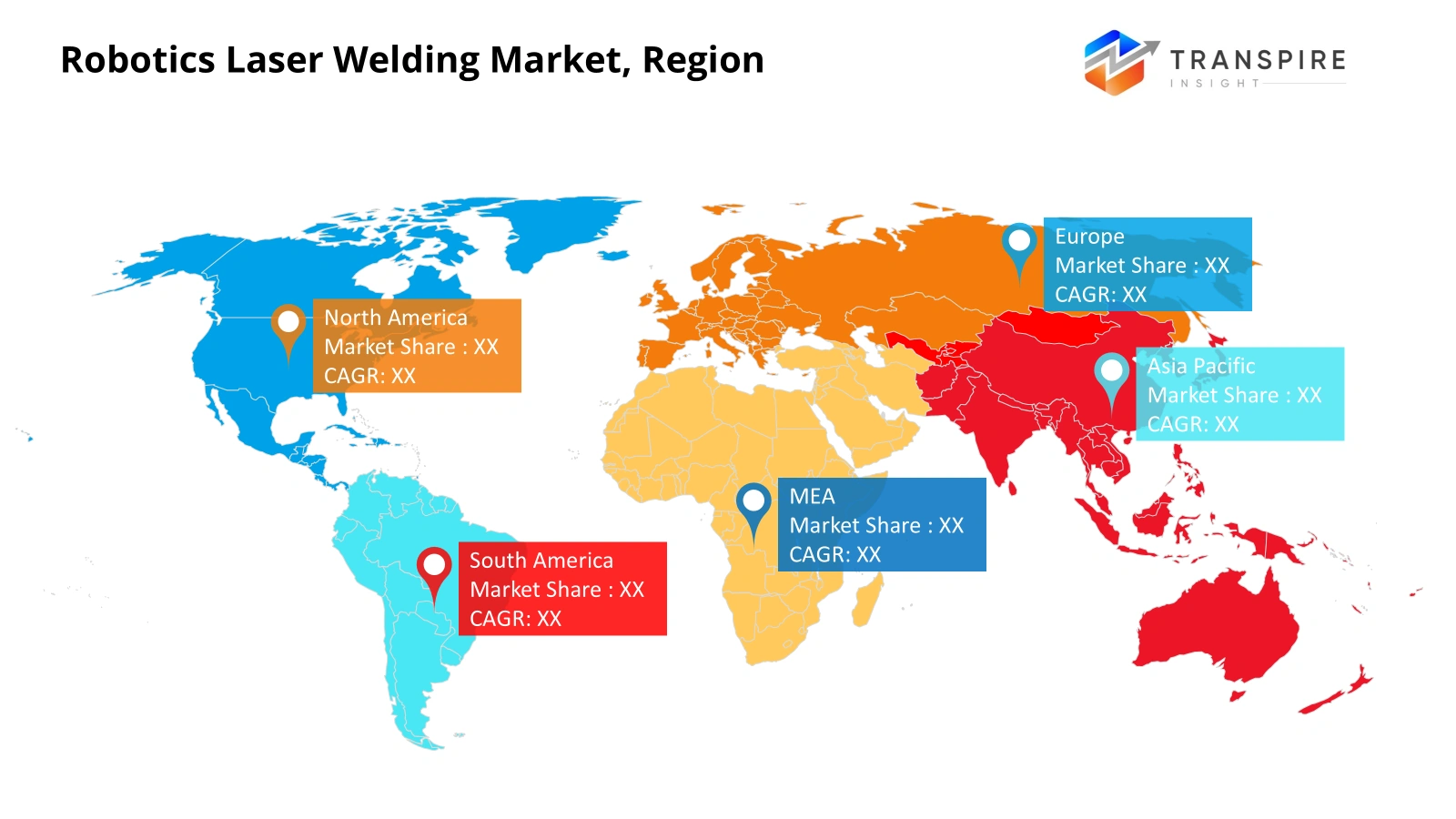
The Robotics Laser Welding Market is expanding globally as industries move toward advanced manufacturing technologies. North America, Europe and the Asia-Pacific regions, which have established industrial bases, are currently leading the implementation of robotic welding systems.
Asia-Pacific serves as a primary growth area because its countries, China, Japan and South Korea have developed major manufacturing centers and experienced rapid industrial growth. The countries in this region allocate substantial resources toward automation technologies which help them achieve production efficiency while maintaining their position in global markets.
North America maintains strong demand for products driven by technological advances in the automotive and aerospace sectors. The companies within this area work on implementing advanced manufacturing technologies, which will help them create better products at lower expenses.
Europe plays a vital role in the market, serving the automotive and industrial manufacturing sectors. Robot laser welding systems gain traction in this area because the region prioritizes precision engineering and advanced production methods.
The industrial sector will experience increased demand for robotic laser welding technologies which will rise as companies implement automation systems and advanced material technologies.
To learn more about this report, Download Free Sample Report
Recent Development News
Companies are developing advanced robotic laser welding systems with AI-based control and real-time monitoring to improve precision and efficiency.
Manufacturers are also focusing on integrating smart sensors and automation technologies to enhance welding accuracy and reduce operational costs.
|
Report Metrics |
Details |
|
Market size value in 2025 |
USD 1.68 Billion |
|
Market size value in 2026 |
USD 1.83 Billion |
|
Revenue forecast in 2033 |
USD 3.35 Billion |
|
Growth rate |
CAGR of 9.02% from 2026 to 2033 |
|
Base year |
2025 |
|
Historical data |
2021 - 2024 |
|
Forecast period |
2026 - 2033 |
|
Report coverage |
Revenue forecast, competitive landscape, growth factors, and trends |
|
Country scope |
Global |
|
Key company profiled |
FANUC Corporation, ABB Ltd., KUKA AG, Yaskawa Electric Corporation, Mitsubishi Electric Corporation, Panasonic Corporation, Kawasaki Robotics Inc., Universal Robots A/S, Comau S.p.A., Nachi-Fujikoshi Corp., DENSO Corporation, Stäubli International AG, Omron Corporation, Epson Robots, Hyundai Robotics. |
|
Customization scope |
Free report customization (country, regional & segment scope). Avail customized purchase options to meet your exact research needs. |
|
Report Segmentation |
By Robot Type (Articulated Robots, Cartesian Robots, SCARA Robots), By Laser Type (Fiber Laser, CO₂ Laser, Solid-State Laser), By Application (Automotive Manufacturing, Electronics Manufacturing, Aerospace, Metal Fabrication). |
Key Robotics Laser Welding Company Insights
The Robotics Laser Welding Market includes leading industrial automation and robotics companies that specialize in advanced welding solutions. These companies focus on developing high-performance robotic systems that combine precision, speed, and reliability.
Manufacturers invest heavily in research and development to improve laser technology, robotic control systems, and automation capabilities. They aim to create solutions that can handle complex welding tasks while maintaining high efficiency.
Companies also collaborate with automotive, aerospace, and electronics manufacturers to develop customized solutions that meet specific production requirements. These partnerships help drive innovation and expand market reach.
As competition increases, companies are focusing on integrating smart technologies such as AI, IoT, and real-time monitoring into their systems. These advancements allow manufacturers to improve productivity, reduce downtime, and maintain high-quality standards.
Overall, the Robotics Laser Welding Market is expected to continue growing as industries demand more advanced, efficient, and precise manufacturing technologies.
Company List
- FANUC Corporation
- ABB Ltd.
- KUKA AG
- Yaskawa Electric Corporation
- Mitsubishi Electric Corporation
- Panasonic Corporation
- Kawasaki Robotics Inc.
- Universal Robots A/S
- Comau S.p.A.
- Nachi-Fujikoshi Corp.
- DENSO Corporation
- Stäubli International AG
- Omron Corporation
- Epson Robots
- Hyundai Robotics
Robotics Laser Welding Market Report Segmentation
By Robot Type
- Articulated Robots
- Cartesian Robots
- SCARA Robots
By Laser Type
- Fiber Laser
- CO₂ Laser
- Solid-State Laser
By Application
- Automotive Manufacturing
- Electronics Manufacturing
- Aerospace
- Metal Fabrication
Frequently Asked Questions
Find quick answers to common questions.
The Robotics Laser Welding Market is expected to reach approximately USD 3.35 billion by 2033.
Key segments include Robot Type (Articulated Robots, Cartesian Robots, SCARA Robots), Laser Type (Fiber Laser, CO₂ Laser, Solid-State Laser), and Application (Automotive Manufacturing, Electronics Manufacturing, Aerospace, Metal Fabrication).
Major players include FANUC Corporation, ABB Ltd., KUKA AG, Yaskawa Electric Corporation, Mitsubishi Electric Corporation, Panasonic Corporation, Kawasaki Robotics Inc., Universal Robots A/S, Comau S.p.A., Nachi-Fujikoshi Corp., DENSO Corporation, Stäubli International AG, Omron Corporation, Epson Robots, and Hyundai Robotics.
The current market size of the Robotics Laser Welding Market is approximately USD 1.68 billion in 2025.
The Robotics Laser Welding Market is expected to grow at a CAGR of 9.02% from 2026 to 2033.
- FANUC Corporation
- ABB Ltd.
- KUKA AG
- Yaskawa Electric Corporation
- Mitsubishi Electric Corporation
- Panasonic Corporation
- Kawasaki Robotics Inc.
- Universal Robots A/S
- Comau S.p.A.
- Nachi-Fujikoshi Corp.
- DENSO Corporation
- Stäubli International AG
- Omron Corporation
- Epson Robots
- Hyundai Robotics
Recently Published Reports
-
Apr 2026
Fiber Optic Faceplates Market
Fiber Optic Faceplates Market Size, Share & Analysis Report By Type (< 300 mm2, 300-350 mm2, and > 350 mm2, By Application (Night Vision, Holographic Imaging, Medical, and Others), and Geography (North America, Europe, Asia-Pacific, Middle East and Africa, South and Central America), 2021 - 2031
-
Apr 2026
High Temperature Superconductors Market
High Temperature Superconductors Market Size, Share & Analysis Report By Type (1G HTS, and 2G HTS), By Application (Power Cable, Fault Current Limiter, and Transformer), and Geography (North America, Europe, Asia-Pacific, Middle East and Africa, South and Central America), 2021 - 2031
-
Apr 2026
Industrial Plugs and Socket Market
Industrial Plugs and Socket Market Size, Share & Analysis Report By Type (Industrial Plugs, Industrial Sockets), By Current (Up to 32 A, 32 to 125 A, Above 125 A), By Protection (Dustproof and Splash Proof, Waterproof, Explosion Proof), By End User (Heavy Industries, Oil and Gas, Chemicals and Pharmaceuticals, Power Generation, Others), and Geography (North America, Europe, Asia-Pacific, Middle East and Africa, South and Central America), 2021 - 2031
-
Apr 2026
InGaAs Avalanche Photodiodes Market
InGaAs Avalanche Photodiodes Market Size, Share & Analysis Report By Type (1100 - 1700 nm, and 1000 - 1600 nm), By Application (Missile Warning System, Muzzle Flash Detection, Wafer Defect Inspection, Laser Rangefinders, and Others), and Geography (North America, Europe, Asia-Pacific, Middle East and Africa, South and Central America), 2021 - 2031