Germany Automotive Aftermarket Industry Market Size & Forecast:
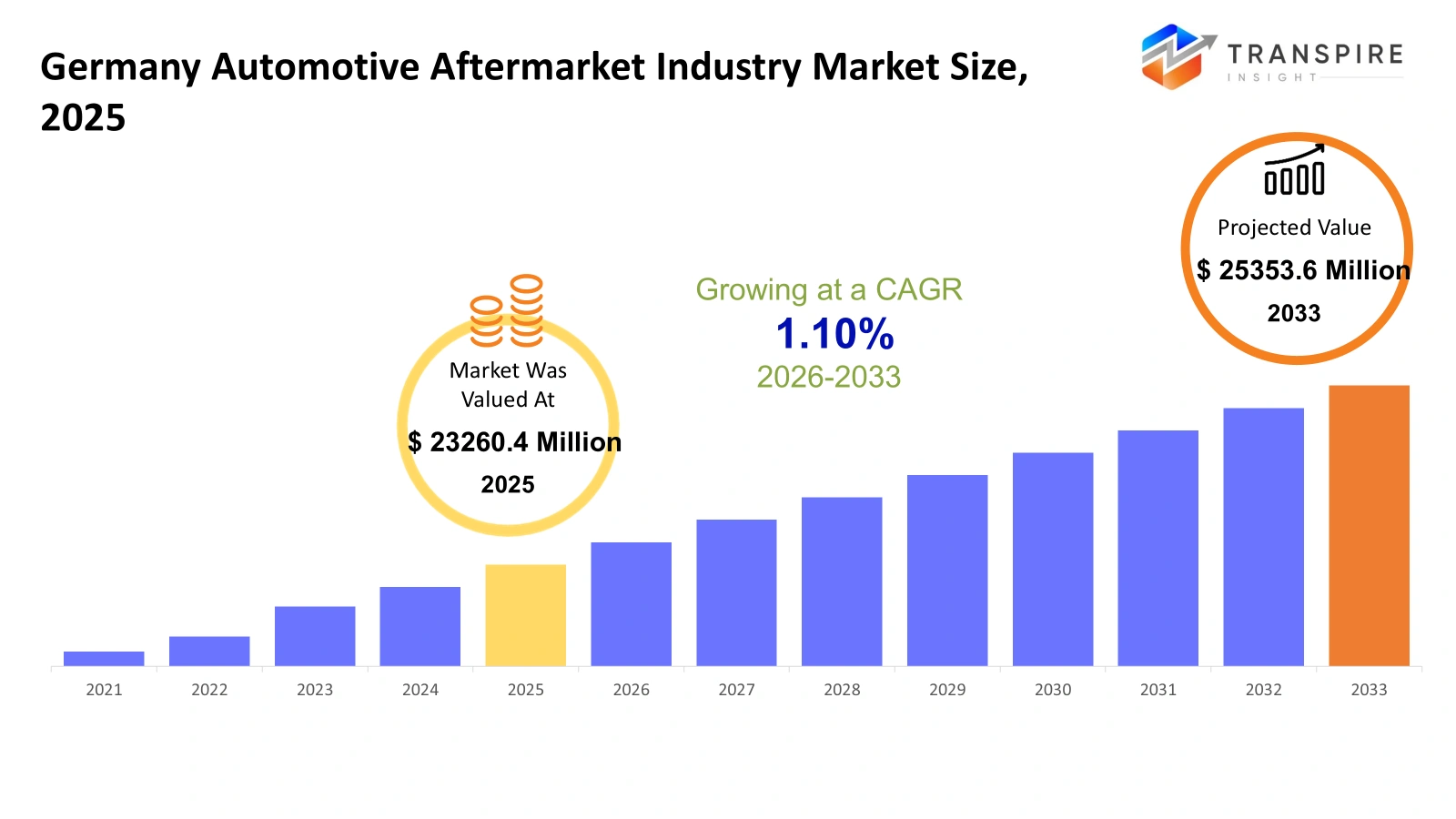
- Germany Automotive Aftermarket Industry Market Size 2025: USD 23260.4 Million
- Germany Automotive Aftermarket Industry Market Size 2033: USD 25353.6 Million
- Germany Automotive Aftermarket Industry Market CAGR: 1.10%
- Germany Automotive Aftermarket Industry Market Segments: By Replacement Parts (Engine Parts, Brake Parts, Filters, Lighting Components), By Distribution Channel (Retailers, Wholesalers & Distributors, Online Platforms), By Service Channel (DIY, DIFM, OE Service).
To learn more about this report,  Download Free Sample Report
Germany Automotive Aftermarket Industry Market Summary:
The Germany Automotive Aftermarket Industry Market size was estimated at USD 23260.4 Million in 2025 and is anticipated to reach USD 25353.6 Million by 2033, growing at a CAGR of 1.10 % from 2026 to 2033. The German automotive industry post-World War II conducts its operations between two main sectors which include automotive services and the replacement parts business. Mechanic shops and parts distributors, together with service centers will run their daily business through activities which involve fixing vehicles and performing upkeep, together with replacing components. The demand for vehicle parts, which include filters, braking systems, lighting units and electronic modules, will remain constant because the ageing vehicle fleet across Germany needs these parts to maintain operational status without needing immediate replacement. Customers now expect businesses to deliver services more quickly while providing them with clear service costs and trustworthy product standards. The combination of digital booking systems together with diagnostic tools will change workshop operations because it enables technicians to discover faults at an earlier stage while they can make quicker parts requests. People who use electric vehicles will create new demands for vehicle maintenance because vehicles will require batteries and software calibration devices and electronic control units for their regular servicing. The German regulatory framework will direct emissions control efforts through vehicle safety assessments and the use of eco-friendly materials for replacement parts. Environmental regulations will drive the development of recycling operations which will handle battery, tyre, and metal assembly parts. The distribution system will develop to use physical storage centers together with online product directories, which will help workshops find suitable parts while their daily operations continue to function across all service areas.
Key Market Trends & Insights:
- The market demonstrates continuous changes which began after supply chain disruptions and semiconductor shortages. The current production planning process requires manufacturers to establish better component procurement methods and regional production facilities. The production choices businesses make will depend on electrical mobility funding and digital automotive system development. The automotive industry market in Germany experiences ongoing transformation through industrial restructuring and technology partnerships, which determine its future development path.
- The automotive sector in Germany is now directing its resources toward developing electric vehicles, battery technologies, and connected mobility systems. The expansion of charging infrastructure, together with policy support, creates conditions which enable people to adopt low-emission transportation systems. The automotive market in Germany is changing as supplier networks develop new manufacturing methods, helping businesses achieve their electrification goals while implementing new technologies.
- The German automotive industry possesses strong engineering talent and manufacturing competencies which can be seen throughout its automotive centres, according to industry research. The industry development path will remain guided by businesses who allocate their funds toward developing automated systems and automotive software solutions and transportation services. The manufacturing sector will establish technology partnerships with research organizations to maintain its competitive edge throughout the Germany automotive aftermath industry market.
Germany Automotive Aftermarket Industry Market Segmentation
By Replacement Parts
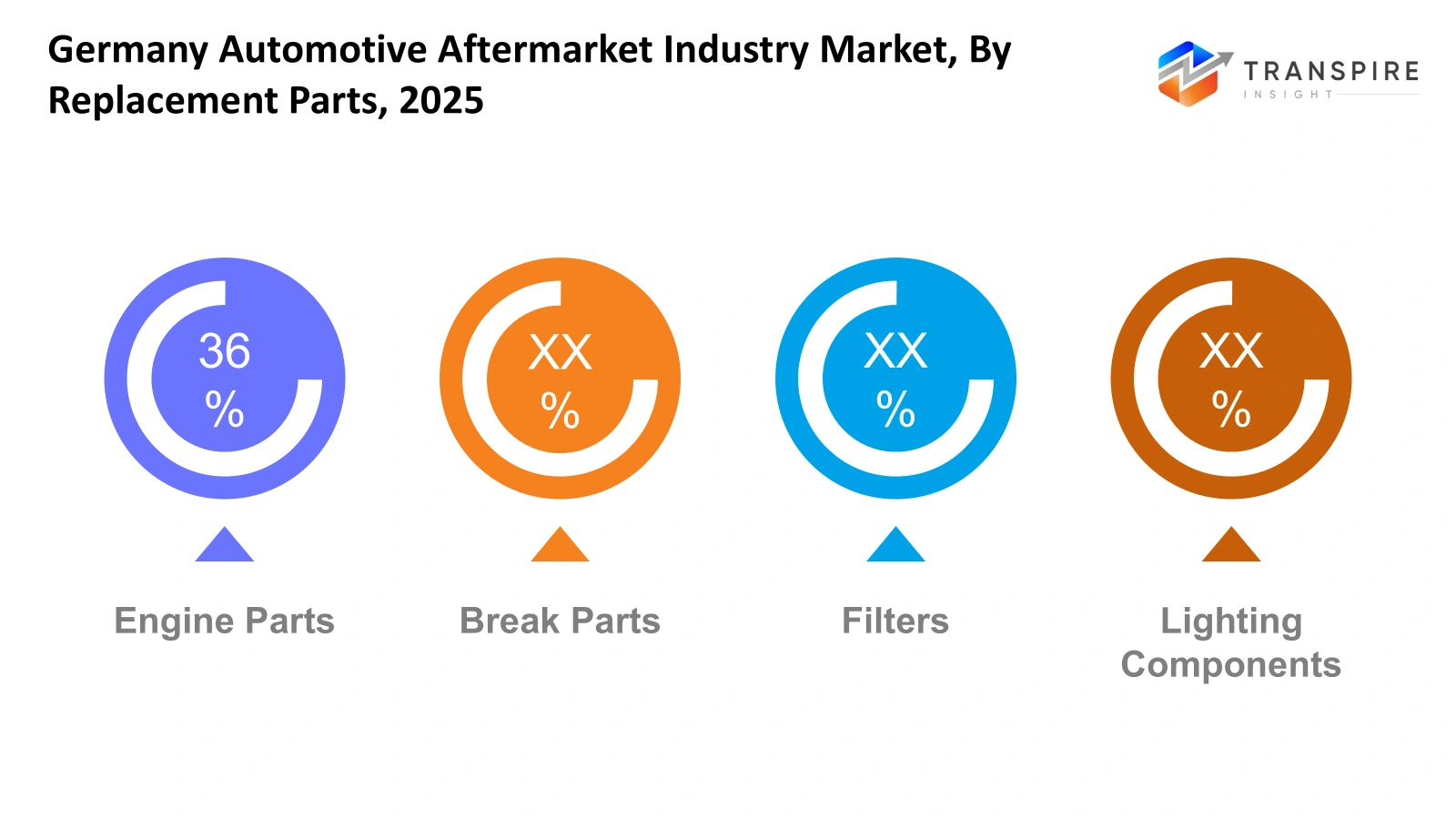
Engine Parts :The engine components which belong to Replacement Parts categorize as essential elements which technicians use to repair vehicles throughout German automotive service networks. The demand for engine servicing and part replacement will continue because the existing vehicle population today consists of vehicles which need engine maintenance work. The automotive engineering standards which Germany establishes will create ongoing engine component distribution operations throughout the German automotive industry market.
Break Parts :The automotive industry depends on brake components which need inspection and replacement to keep vehicles safe for road use. The German automotive industry remains active because automotive service centers and repair workshops require brake pads and discs and their associated parts.
Filters :The automotive industry depends on air filters, oil filters and fuel filters, which German automotive service centers need to support their regular maintenance work. Vehicle owners who know when to maintain their vehicles create a consistent market demand for filter products throughout the German automotive market.
Lighting Components: The automotive industry uses them to enhance vehicle safety by improving road visibility. The need for replacement products exists because products have suffered from both electrical failures and physical damage and accidents. German automotive workshops and spare parts suppliers have established a continuous network for distributing headlights and tail lights and interior lighting products throughout the automotive market.
To learn more about this report, Download Free Sample Report
By Distribution Channel
Retailers :Retail automotive parts stores throughout Germany function as vital components of vehicle maintenance supply chains. Retail stores enable repair shops and vehicle owners to access spare parts and accessories needed for their work. The availability of local parts combined with support from retail employees creates ongoing sales opportunities in the German automotive industry market.
Wholesalers and Distributors: Wholesalers and distributors enable manufacturers to transfer automotive parts to repair service networks through their distribution channels. The system maintains dependable product distribution throughout Germany by controlling inventory across numerous distribution sites. The organized distribution systems create product availability while they protect supply chain stability in the German automotive industry market.
Online Platforms:Digital automotive parts platforms receive increasing attention because online shopping becomes more popular. Digital marketplaces enable vehicle owners and repair businesses to compare prices and search for specific components. The German automotive industry market continues to grow due to expanding e-commerce logistics and digital catalog development.
By Service channel
DIY: The Service Channel provides two options for auto maintenance which include DIY and professional services for vehicle repairs and part installations. The approach to vehicle maintenance requires access to spare parts which customers can obtain from both retail stores and online shopping websites. Vehicle owners in Germany can use technical guides and product instructions to perform basic vehicle repairs which exist in the automotive industry market.
DIFM: The Service Channel provides its DIFM services through professional repair workshops which deliver both installation and maintenance services to vehicle owners. The process of performing complex repairs demands skilled technicians who use specialized tools and diagnostic systems to complete their work. The German automotive industry maintains steady demand for services through its extensive network of workshop facilities which operate throughout the country.
OE Service: The OE service channels function through authorized dealership service centers which follow manufacturer standards for all repair and maintenance tasks. Official networks use genuine spare parts and trained technicians who operate certified diagnostic tools to provide vehicle servicing in the Germany automotive market.
Country Insights
Germany's automotive production heritage enables the country to maintain industrial strength for an extended period. The country has established a stable operational framework which enables its automotive industry to recover and grow after experiencing supply chain interruptions and economic downturns. The automotive industry in Germany will expand through three factors which include policy backing, technological development and electric mobility initiatives.
Industrial transition toward electric vehicles, digital manufacturing and sustainable mobility solutions drives automotive development in Germany. The three major automotive hubs of Wolfsburg Stuttgart and Munich continue their work on advanced vehicle technology development and manufacturing modernization which helps their automotive industry to maintain stability while experiencing gradual growth.
Recent Development News
German automotive production shows a gradual recovery after supply chain disruption and semiconductor shortages that affected vehicle manufacturing across Europe. Manufacturing plants continue to adjust through supply diversification, digital production monitoring, and electric vehicle investment. Production planning improvements and supplier collaboration will support stability and gradual expansion across the Germany automotive industry Market.
Investment in electric vehicle production and battery technology remains a key industry response to earlier production challenges. The Volkswagen Group announced continued expansion of electric vehicle manufacturing capacity across German facilities to strengthen supply resilience and long-term automotive production growth.
|
Report Metrics |
Details |
|
Market size value in 2025 |
USD 23260.4 Million |
|
Market size value in 2026 |
USD 23491.9 Million |
|
Revenue forecast in 2033 |
USD 25353.6 Million |
|
Growth rate |
CAGR of 1.10% from 2026 to 2033 |
|
Base year |
2025 |
|
Historical data |
2021 – 2024 |
|
Forecast period |
2026 – 2033 |
|
Report coverage |
Revenue forecast, competitive landscape, growth factors, and trends |
|
Country scope |
Germany |
|
Key company profiled |
Bosch Automotive Aftermarket, Continental AG, ZF Friedrichshafen, Denso Corporation, Valeo SA, Mahle GmbH, Magna International, Hella GmbH, Delphi Technologies, Tenneco Inc., Schaeffler Group, Federal-Mogul (Tenneco), Brembo SpA, NGK Spark Plug, MANN+HUMMEL. |
|
Customization scope |
Free report customization (country, regional & segment scope). Avail customized purchase options to meet your exact research needs. |
|
Report Segmentation |
By Replacement Parts (Engine Parts, Brake Parts, Filters, Lighting Components), By Distribution Channel (Retailers, Wholesalers & Distributors, Online Platforms), By Service Channel (DIY, DIFM, OE Service). |
Key Germany Automotive Aftermarket Industry Company Insights
The automotive industry in Germany is showing signs of recovery, as industrial strength enables the sector to rebuild after supply chain disruptions and economic challenges from previous years. Volkswagen AG, BMW Group, and Mercedes-Benz Group AG continue to fund digital production development and electric mobility expansion and advanced vehicle platform creation. The German automotive industry future development will be shaped by manufacturing modernization projects and battery technology research and software integration methods.
The automotive supply base and technology companies drive fundamental transformations which reshape German automotive production systems. Robert Bosch GmbH, Continental AG, and ZF Friedrichshafen AG shift their business operations to concentrate on electric vehicle parts and intelligent transportation solutions and self-driving vehicle technology. The German automotive industry market develops its ability to innovate and maintain production operations through industrial partnerships which connect manufacturers with suppliers and research organizations.
Company List
- Bosch Automotive Aftermarket
- Continental AG
- ZF Friedrichshafen
- Denso Corporation
- Valeo SA
- Mahle GmbH
- Magna International
- Hella GmbH
- Delphi Technologies
- Tenneco Inc.
- Schaeffler Group
- Federal-Mogul (Tenneco)
- Brembo SpA
- NGK Spark Plug
- MANN+HUMMEL
Germany Automotive Aftermarket Industry Market Report Segmentation
By Replacement Parts
- Engine Parts
- Brake Parts
- Filters
- Lighting Components
By Distribution Channel
- Retailers
- Wholesalers & Distributors
- Online Platforms
By Service Channel
- DIY
- DIFM
- OE Service
Frequently Asked Questions
Find quick answers to common questions.
The approximate Germany Automotive Aftermarket Industry Market size for the market will be USD 25353.6 Million in 2033.
The key segments of the Germany Automotive Aftermarket Industry Market are By Replacement Parts (Engine Parts, Brake Parts, Filters, Lighting Components), By Distribution Channel (Retailers, Wholesalers & Distributors, Online Platforms), By Service Channel (DIY, DIFM, OE Service).
Major players in the Germany Automotive Aftermarket Industry Market are Bosch Automotive Aftermarket, Continental AG, ZF Friedrichshafen, Denso Corporation, Valeo SA, Mahle GmbH, Magna International, Hella GmbH, Delphi Technologies, Tenneco Inc., Schaeffler Group, Federal-Mogul (Tenneco), Brembo SpA, NGK Spark Plug, MANN+HUMMEL.
The current market size of the Germany Automotive Aftermarket Industry Market is USD 23260.4 Million by 2025.
The Germany Automotive Aftermarket Industry Market CAGR is 1.10%.
- Bosch Automotive Aftermarket
- Continental AG
- ZF Friedrichshafen
- Denso Corporation
- Valeo SA
- Mahle GmbH
- Magna International
- Hella GmbH
- Delphi Technologies
- Tenneco Inc.
- Schaeffler Group
- Federal-Mogul (Tenneco)
- Brembo SpA
- NGK Spark Plug
- MANN+HUMMEL
Recently Published Reports
-
Apr 2026
ATV & UTV Market
ATV & UTV Market Size, Share & Analysis Report By Type (ATV, and UTV), By Variants (Less Than 400 CC, 400 CC To 800 CC, and More Than 800 CC), and Geography (North America, Europe, Asia-Pacific, Middle East and Africa, South and Central America), 2021 - 2031
-
Apr 2026
Automotive Central Gateway Module Market
Automotive Central Gateway Module Market Size, Share & Analysis Report By Type (Ethernet Central Gateway Module, CAN Central Gateway Module, LIN Central Gateway Module, and FlexRay), By Application (Powertrain Control, Body Control, Infotainment System, Advanced Driver Assistance Systems (ADAS), and Others), By End User (Passenger Vehicles, and Commercial Vehicles), and Geography (North America, Europe, Asia-Pacific, Middle East and Africa, South and Central America), 2021 - 2031
-
Apr 2026
Automotive Engine Oil Filter Market
Automotive Engine Oil Filter Market Size, Share & Analysis Report By Filter Type (Fuel Filter, Engine Oil Filter, Hydraulic Oil Filter, and Others), By Filter Media (Cellulose, Synthetic, and Micro), By Sales Channel (OEMs, and Aftermarket), By Vehicle Type (Passenger Cars, Light Commercial Vehicles, Heavy Duty Trucks, Buses and Coaches, and Off-road Vehicles), and Geography (North America, Europe, Asia-Pacific, Middle East and Africa, South and Central America), 2021 - 2031
-
Apr 2026
Automotive Parts Aluminium Die Casting Market
Automotive Parts Aluminium Die Casting Market Size, Share & Analysis Report By Production Process (Pressure Die Casting, Vacuum Die Casting, Squeeze Die Casting, Gravity Die Casting), By Application (Body Parts, Engine Parts, Transmission Parts, Battery And Related Components, Other Application Types), and Geography (North America, Europe, Asia-Pacific, Middle East and Africa, South and Central America), 2021 - 2031
Our Clients