

Residential HVAC Market Summary:
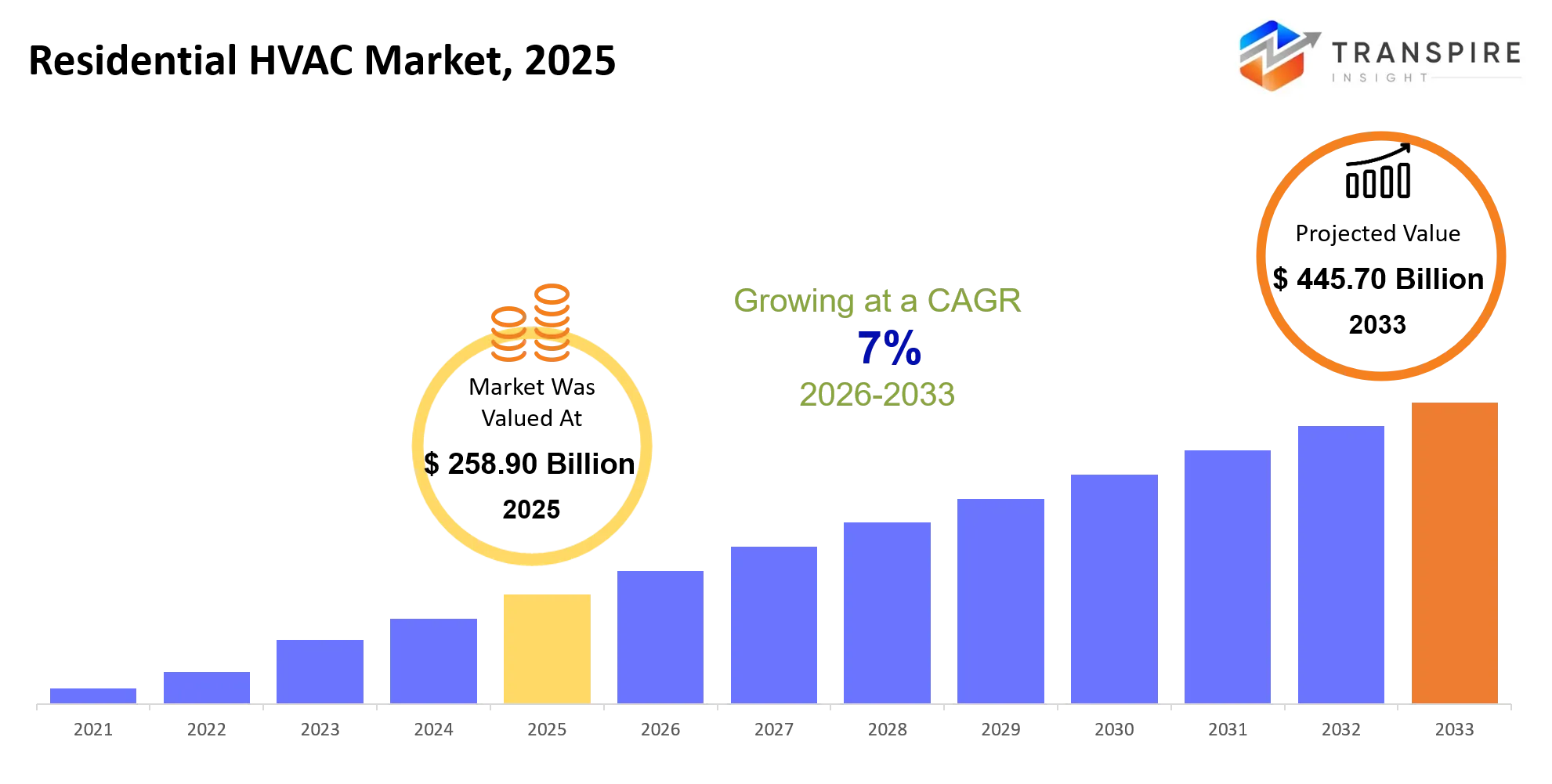
As per Transpire Insight Analysis, the Residential HVAC Market size is estimated at USD 258.90 billion in 2025 and is anticipated to reach USD 445.70 billion by 2033, growing at a CAGR of 7% from 2026 to 2033.
The residential HVAC market is involved in the manufacturing, installation, and servicing of HVAC infrastructure in residential interiors,s which provides thermal comfort, air purification, and humidity control. In the past three years, the market has shifted from replacing old, nonrenewable fossil water-heating systems with intelligent, fully electrified home water-heating systems. The past three years have seen the market move from replacement of legacy fossil-fuel equipment to intelligent, fully electrified home water-heating systems. The main structural change was the requirement for phase-down of high-GWP refrigerants (like R-410A) and building decarbonization policies. At the same time, extreme weather events in North America and Europe, severe heatwaves, were the catalyst for the real-world retrofits of buildings, pushing up emergency residential retrofit uptake. At the same time, the extreme weather events in North America and Europe, severe heatwaves, were the real-world catalyst, driving up emergency residential retrofit uptake. The upswing in market growth therefore has a direct cause-and-effect relationship: the more there are fluctuations in the climate and incentives offered by the state, the more homeowners are prompted to switch from an old, single-stage unit to a high-efficiency variable-speed heat pump.
Residential HVAC Market Size & Forecast:
- Market Size 2025: USD 258.90 Billion
- Expected Market Value (2033): USD 445.70 Billion
- Forecast CAGR (2026–2033): 7%
- Leading Region in 2025: Asia Pacific
- Fastest Growing Region: North America
- Key Company Profiles: Daikin Industries, Carrier , Trane Technologies, Johnson Controls, Lennox International, Rheem, Bosch, LG Electronics, Samsung Electronics, Mitsubishi Electric, Panasonic, Fujitsu General, Haier, Midea, Gree Electric Appliances
Key Market Insights:
The residential HVAC market is transforming from a passive control space to an intelligent, electrified space controller, with replacement retrofits being the fuel for the majority of the markets.
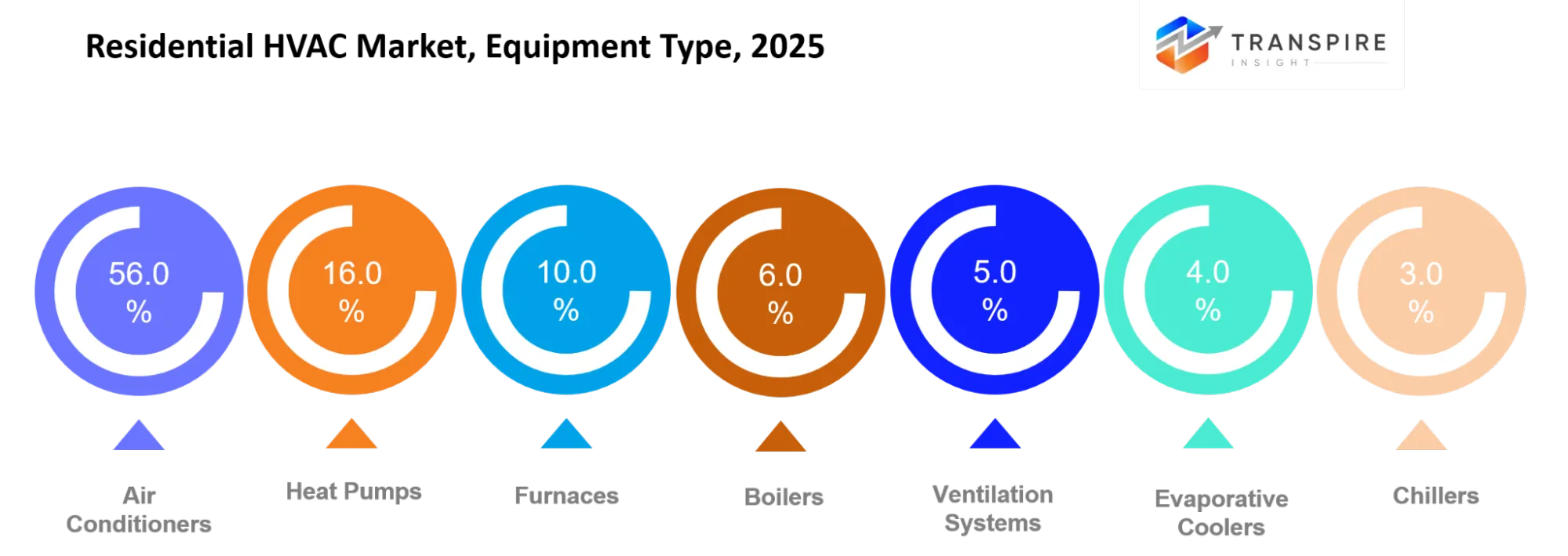
- Air Conditioners (56.0%) include Daikin advanced high-efficiency split systems with R-32 low-GWP refrigerants to meet growing cooling needs in large urban and temperate regions.
- Heat Pumps are the fastest-growing market segment (9.5% CAGR) with 16.0% of market share, and are expanding modular, quick-connect heat pump market offerings as home retrofit and high consumer demand for fossil-fuel replacement opportunities are driving the market.
- Lennox entered into the furnace market with high-efficiency condensing unit series to maintain replacement market share in colder climates and added hybrid controls to run dual-fuel heat pumps.
- Boilers represent 6.0% of the total revenue, with Bosch adding hydrogen-ready and hybrid boiler configurations to meet the strict regional building decarbonisation requirements in most markets in Europe and North America.
- Ventilation Systems include an Energy Recovery Ventilator (ERV) built by Panasonic that offers continuous monitoring of the indoor air quality (IAQ) with automatic fresh air exchange, without compromising thermal efficiency and representing 5.0% of total equipment.
- Evaporative Coolers take up 4.0% of market share, while Symphony and Portacool bring to market Inverter Direct-Evaporative Coolers with built-in IoT features for low-humidity arid climates with ultra-low electricity operational costs.
- Chillers account for 3.0% of equipment demand, and Johnson Controls' Johnson Micro Chillers are compact, low-GWP micro-chillers designed for use in hydronic underfloor heating and radiant cooling applications.
What are the Key Drivers, Restraints, and Opportunities in the Residential HVAC Market?
Drivers
The money-back subsidy initiatives of governments and the coming of more rigorous energy-efficiency regulations encourage consumers to invest in an energy-efficient heat pump system rather than in a traditional fossil-fuel system. The money-back incentives offered by governments and the increasingly strict energy-efficiency regulations push consumers towards the replacement of their legacy fossil-fuel systems with a modern heat pump system. In addition, the extra cooling demand caused by extreme climate variability around the world contributes to the demand for high SEER2 inverter technology, and the increased costs of electricity in homes also provide an incentive.
Restraints
Initial hardware and installation costs are high, and this may hinder the immediate uptake, especially among consumers with limited budgets. Further complicating structural retrofits in older residential housing is the fact that there are limited equipment options because of the complex nature of the structures, particularly with regard to ductwork and electrical panel capacity, which lengthens consumer payback periods.
Opportunities
Faster integration of smart home IoT protocols will allow HVAC systems to directly enter into utility demand-response programs. In addition, there are substantial opportunities for these low-GWP refrigerant retrofit projects and specific cold climate heat pump installations in markets that have previously not been developed in the north.
|
Driver |
Relative Impact on Growth (%) |
Geographic Relevance |
Impact Timeline |
Demand Strength |
Growth Mechanism (5–10 words) |
Key Beneficiaries (5–10 words) |
Major Constraint (5–10 words) |
|
Rising temperatures and increasing residential cooling demand |
28% |
Asia Pacific, Middle East, North America, Africa |
Short-term (≤2 years) |
High |
Increases household demand for residential air-conditioning systems |
Air conditioner manufacturers, compressor suppliers, HVAC distributors |
High electricity consumption and household affordability constraints |
|
Rapid urbanization, expanding residential construction, and rising household incomes |
20% |
Asia Pacific, Latin America, Middle East & Africa |
Medium-term (2–4 years) |
High |
Expands residential installations through new housing developments |
HVAC manufacturers, real estate developers, installation contractors |
Construction cost inflation and limited household purchasing power |
|
Stringent energy-efficiency regulations and replacement of aging HVAC equipment |
20% |
North America, Europe, China, Japan |
Short-term (≤2 years) |
High |
Accelerates replacement with energy-efficient residential HVAC equipment |
HVAC manufacturers, component suppliers, retrofit contractors, technology providers |
High upfront equipment costs and inconsistent financial incentives |
|
Growing adoption of electrification and residential heat pump systems |
18% |
Europe, North America, China, Japan |
Long-term (≥4 years) |
High |
Replaces conventional heating systems with efficient electric heat pumps |
Heat pump manufacturers, compressor suppliers, HVAC installers |
High installation costs and inadequate electrical infrastructure |
|
Technological advancements and transition toward low-GWP refrigerants |
14% |
Europe, Asia Pacific, North America |
Medium-term (2–4 years) |
Medium–High |
Improves system efficiency through smart controls and refrigerant innovation |
HVAC manufacturers, refrigerant producers, IoT vendors, component suppliers |
R&D expenses and refrigerant safety compliance requirements |
|
Total |
100% |
What Has the Impact of Artificial Intelligence Been on the Spinal Fusion Devices Market?
Artificial Intelligence has revolutionized residential HVAC systems from a reactive equipment system to a proactive home energy management system. The embedded machine learning algorithms use weather predictions, occupancy, and electricity prices to provide the optimal runtimes of the compressors, while conserving living comfort for household occupants and minimizing electricity consumption. With AI-based predictive diagnostics, systems can continuously track system metrics such as refrigerant pressure and electrical draw, and alert to component degradation that may eventually lead to complete failure, preventing an emergency outage and prolonging equipment life. In addition, grid-interactive AI software synchronizes with electric utilities to move thermal loads off peak pricing hours, enabling automatic savings on the grid rebate for consumers.
Instance
March 2025: Carrier partnered with Google Cloud to integrate WeatherNext AI models with residential HVAC units for dynamic home energy grid management. https://developers.google.com/weathernext
Key Market Trends:
Numerous trends are emerging in the residential HVAC market. A few of the trends are given below.
- Variable-speed compressors are becoming standard, shifting systems away from inefficient single-stage cycling to precise 25–100% capacity modulation.
- Manufacturers are aggressively phasing out R-410A in favor of A2L low-GWP alternatives like R-32 and R-454B to meet regional environmental mandates.
- Engineering breakthroughs enable efficient heat pump performance at ambient temperatures below -20°F, replacing traditional gas furnaces in colder regions.
- Utilities are co-subsidizing connected thermostats that automatically throttle residential HVAC draw during regional grid strain.
- Service providers are shifting from scheduled maintenance to continuous, remote sensor monitoring that alerts contractors to early system anomalies.
- Residential systems are increasingly bundling HEPA filtration, UV-C purification, and energy recovery ventilators (ERVs) directly into air handlers.
- Property developers are increasingly deploying ductless multi-split systems in multi-family projects to simplify sub-metering and lower installation overhead.
Residential HVAC Market Segmentation
By Equipment
The type of equipment refers to the equipment involved in the thermal control and indoor climate of buildings. Air conditioners have the largest share of the market (56.0%), and heat pumps are the fastest-growing segment (9.5% CAGR). Additionally, 10.0% of furnaces, 6.0% of boilers, 5.0% of ventilation systems, 4.0% of evaporative coolers, and 3.0% of chillers.
By Product
Product type is the physical configuration and installation architecture applied to a residential building. Central HVAC systems or packaged systems produce centralised air conditioning through ducting. Split systems, ductless mini-splits, window and portable ACs, and rooftop units allow multiple zones, high capacity and multi-family buildings, and ease of use with spot cooling.
By Technology
Technology records the operation and effectiveness of the parts of the system. The conventional fixed-speed systems use single-stage cycling, while variable-speed inverter systems dynamically reduce power output to save energy. Smart IoT-connected systems, heat pump, hybrid, and geothermal systems use advanced algorithms and renewable energy to optimize performance.
By Fuel/Energy Source
Primary power sources are those that are used to generate thermal power, and they are known as fuel and energy sources. Electric heat pumps, chillers, and air conditioners are used for electricity. Clean energy sources such as natural gas, LPG, and heating oil combustion furnaces and boilers, solar thermal, geothermal ground loops, and hybrid systems help reduce emissions during operation.
By Application
Application outlines the main functional goals achieved in living areas. Systems provide controlled space heating, cooling, or continuous ventilation to achieve thermal comfort. Homeowners can customize living spaces and control air quality, humidity, and other functions inside the home through dedicated air quality filtration systems, humidity control, and multi-function zoning.
By Distribution Channel
Distribution channel is the path that HVAC equipment takes to get to its end users. Professional installation and replacement projects are performed by HVAC contractors and specialty dealers. Equipment is supplied directly to contractors and consumers by OEM dealers, regional distributors, home improvement stores, online retail sites, and direct sales.
What are the Key Use Cases Driving the Residential HVAC Market?
Single-family home retrofits, new housing construction, and energy efficiency upgrades are all propelling the residential HVAC market. When replacing old furnaces and air conditioners in older houses with high-efficiency inverter heat pumps, power usage and costs are reduced. New residential developments focus on built-in multi-zone cooling systems and integrating smart thermostats to satisfy rigorous building codes. Extreme weather conditions lead to quick installation of supplemental ductless mini-splits for homes that don't have ductwork, and compact, low-maintenance heat pump systems are used for individual unit temperature control in urban multi-family housing projects.
|
Report Metrics |
Details |
|
Market size value in 2025 |
USD 258.90 Billion |
|
Market size value in 2026 |
USD 277.80 Billion |
|
Revenue forecast in 2033 |
USD 445.70 Billion |
|
Growth rate |
CAGR of 7% from 2026 to 2033 |
|
Base year |
2025 |
|
Historical data |
2021 - 2024 |
|
Forecast period |
2026 - 2033 |
|
Report coverage |
Revenue forecast, competitive landscape, growth factors, and trends |
|
Regional scope |
United States; Canada; Mexico; United Kingdom; Germany; France; Italy; Spain; Denmark; Sweden; Norway; China; Japan; India; Australia; South Korea; Thailand; Brazil; Argentina; South Africa; Saudi Arabia; United Arab Emirates |
|
Key company profiled |
Daikin Industries, Carrier , Trane Technologies, Johnson Controls, Lennox International, Rheem, Bosch, LG Electronics, Samsung Electronics, Mitsubishi Electric, Panasonic, Fujitsu General, Haier, Midea, Gree Electric Appliances |
|
Customization scope |
Free report customization (country, regional & segment scope). Avail customized purchase options to meet your exact research needs. |
|
Report Segmentation |
Equipment Type (Air Conditioners, Heat Pumps, Furnaces, Boilers, Ventilation Systems, Evaporative Coolers, Chillers); Product Type (Central HVAC, Split Systems, Ductless Mini-Splits, Window AC, Portable AC, Rooftop Units, Packaged Systems); Technology (Conventional, Inverter, Variable-Speed, Heat Pump, Smart HVAC, Geothermal, Hybrid); Fuel/Energy Source (Electricity, Natural Gas, LPG, Oil, Solar, Geothermal, Hybrid); Application (Heating, Cooling, Ventilation, Air Quality, Humidity Control, Multi-Function, Zoning); Distribution Channel (HVAC Contractors, Specialty Dealers, Home Improvement Stores, Online Retail, OEM Dealers, Distributors, Direct Sales) |
Which Regions are Driving the Residential HVAC Market Growth?
Asia Pacific
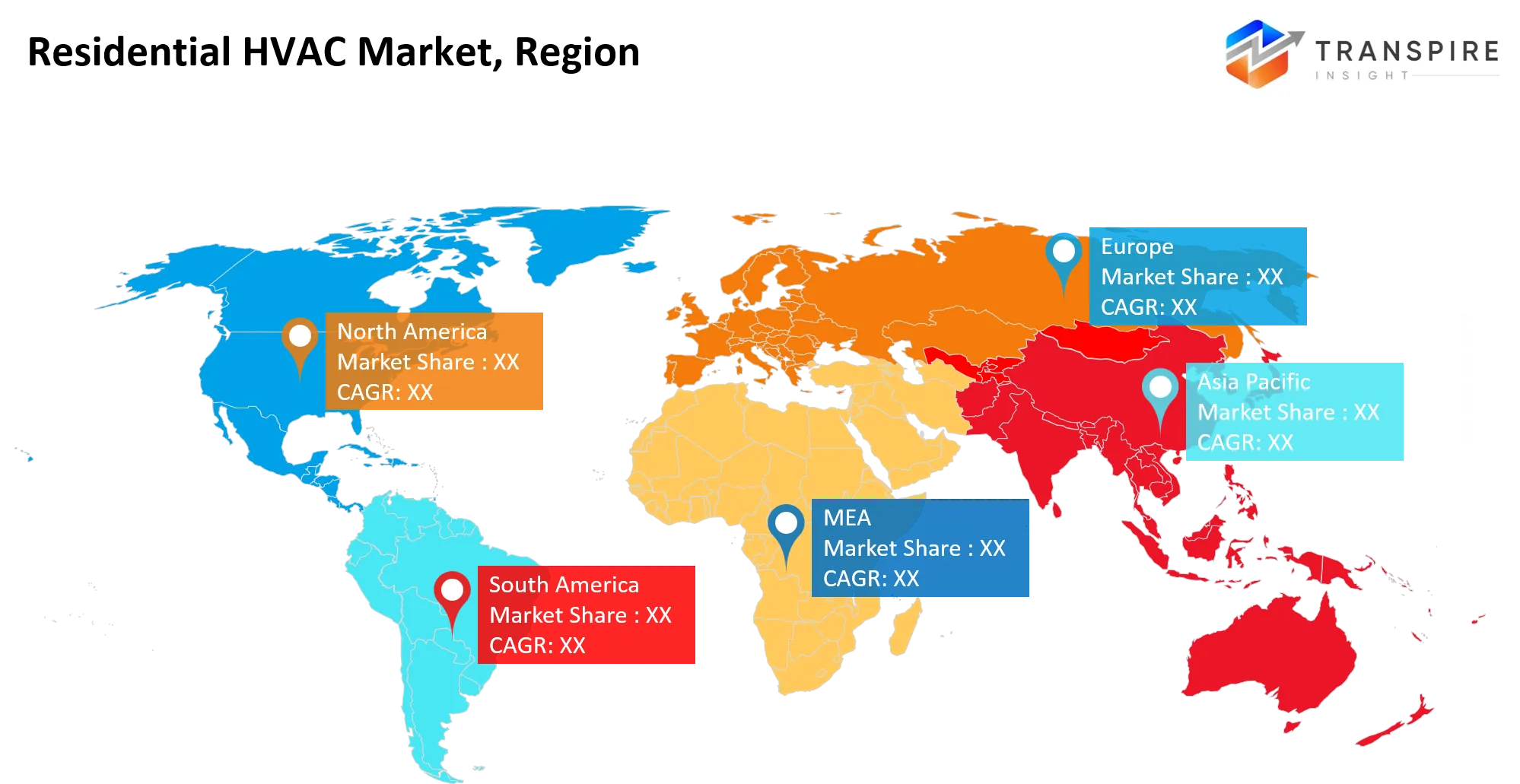
Asia Pacific accounts for 44.0% of the residential HVAC market as urbanization increases, the disposable income of the middle class grows, and extreme heatwaves occur in China and India. As residential development continues to grow and ductless room units are increasingly popular, this market position is reinforced. Some of the key players in this region are Gree Electric, Midea Group, Daikin Industries, LG Electronics, and Samsung Electronics.
March 2025: LG Electronics launched its DUALCOOL AI residential air conditioner equipped with AI Core-Tech to dynamically optimize airflow and cooling efficiency based on indoor occupancy. https://www.marknteladvisors.com/research-library/asia-pacific-air-conditioners-market-report.html
North America
North America is the second largest region and is also the fastest-growing region with a CAGR of 8.0%. The momentum of the market is supported by replacing old housing infrastructure, federal decarbonization tax credits, and consumer momentum toward high-efficiency heat pumps and smart, connected thermostats. Few of the key players in this market are Carrier , Trane Technologies, Lennox International, Rheem Manufacturing, and Johnson Controls.
February 2026: earned ENERGY STAR Most Efficient certification for its 24 SEER2 ductless mini-split lineup designed for North American home electrification retrofits. https://www.mordorintelligence.com/industry-reports/north-america-air-conditioning-equipment-market
Who are the Key Players in the Residential HVAC Market and how do they compete?
The residential HVAC market is driven by major players including Daikin Industries, Carrier , Trane Technologies, Johnson Controls, Lennox International, Rheem, Bosch, LG Electronics, Samsung Electronics, Mitsubishi Electric, Panasonic, Fujitsu General, Haier, Midea, and Gree Electric Appliances. Competition centers on energy efficiency ratings (SEER2/SCOP), inverter motor advancements, and low-GWP refrigerant integration (such as R-32 and R-454B). Japanese and Asian brands (Daikin, Mitsubishi, Midea, Gree) lead in variable refrigerant flow (VRF) and ductless mini-split innovation for high-density living. Western players (Carrier, Trane, Lennox, Rheem, JCI) dominate single-family ducted retrofits and leverage proprietary IoT smart thermostat platforms to capture recurring software and service revenue.
Residential HVAC companies
- Daikin Industries
- Carrier
- Trane Technologies
- Johnson Controls
- Lennox International
- Rheem
- Bosch
- LG Electronics
- Samsung Electronics
- Mitsubishi Electric
- Panasonic
- Fujitsu General
- Haier
- Midea
- Gree Electric Appliances
|
Company |
Est. Revenue Share Range |
Key Offerings |
Strategic Positioning |
Geographic Strength |
Technology Focus |
|
Daikin Industries, Ltd. |
8-11% |
Split ACs, VRV systems, residential heat pumps, air purifiers |
leadership through diversified premium |
Asia Pacific, Europe, North America |
Inverter compressors, R-32 refrigerants, intelligent |
|
Midea Group |
5-8% |
Split ACs, ductless systems, residential heat pumps, smart air conditioners |
Cost leadership supported by extensive manufacturing scale |
Asia Pacific, Europe, Latin America, Middle East |
AI-enabled controls, inverter technology, smart connectivity |
|
Carrier Corporation |
4–6% |
Central air conditioners, heat pumps, furnaces, ductless systems |
Premium positioning through integrated home comfort solutions |
North America, Europe, Asia Pacific |
Variable-speed compressors, Greenspeed Intelligence, connected thermostats |
|
Gree Electric Appliances |
4–6% |
Residential split ACs, inverter ACs, heat pumps, multi-split systems |
High-volume leadership through vertically integrated manufacturing |
Asia Pacific, Latin America, Middle East |
G10 inverter technology, variable-frequency compressors, intelligent controls |
|
Trane Technologies plc |
3–5% |
Residential air conditioners, heat pumps, furnaces, air handlers |
Premium differentiation through energy-efficient residential systems |
North America, Europe, Asia Pacific |
Variable-speed systems, low-GWP refrigerants, connected diagnostics |
|
Mitsubishi Electric Corporation |
3–4% |
Mini-split ACs, ductless heat pumps, multi-zone systems, ventilation |
Technology leadership in advanced ductless climate solutions |
Asia Pacific, North America, Europe |
Hyper-heating inverter technology, zoning controls, advanced filtration |
|
Bosch Home Comfort Group |
2–4% |
Residential heat pumps, furnaces, air conditioners, ductless systems |
Portfolio expansion through strategic acquisitions and brands |
Europe, North America, Asia Pacific |
Inverter heat pumps, hybrid heating, low-GWP refrigerants |
|
LG Electronics |
2–4% |
DUALCOOL ACs, ARTCOOL systems, residential heat pumps, multi-split ACs |
Innovation-led differentiation through smart residential climate products |
Asia Pacific, North America, Europe |
AI Dual Inverter, ThinQ connectivity, intelligent airflow control |
|
Rheem Manufacturing Company |
1.5–3% |
Residential ACs, heat pumps, furnaces, air handlers |
Strong regional positioning through diversified home comfort products |
North America, Australia |
Variable-speed compressors, EcoNet controls, high-efficiency heat pumps |
|
Lennox International Inc. |
1.5–3% |
Central ACs, heat pumps, furnaces, ductless mini-splits |
Premium specialization in high-efficiency residential HVAC equipment |
North America |
Variable-capacity compressors, smart thermostats, advanced system controls |
Recent Development News
In February 2026, Daikin Industries expanded its residential air-to-air heat pump lineup with integrated Daikin Cloud Service diagnostics for dynamic remote monitoring and preventive maintenance. (https://www.daikin-ce.com/en_us/press-releases/2026/stylish-five-new-designs.html)
In October 2026, Carrier reported over 30% revenue growth in its Americas residential division, driven by surging consumer demand for low-GWP refrigerant heat pump systems. (Carrier Corporate Press Release)
What Strategic Insights Define the Future of the Spinal Fusion Devices Market?
Key players in the residential HVAC market are Daikin Industries, Carrier , Trane Technologies, Johnson Controls, Lennox International, Rheem, Bosch, LG Electronics, Samsung Electronics, Mitsubishi Electric, Panasonic, Fujitsu General, Haier, Midea, and Gree Electric Appliances. Competition focuses on energy efficiency ratings (SEER2/SCOP), inverter motor improvements, and the use of low-GWP refrigerants (including R-32 and R-454B). Japanese and Asian brands (Daikin, Mitsubishi, Midea, Gree) dominate the variable refrigerant flow (VRF) and ductless mini-split innovation in the realm of high-density living. Single-family ducted retrofits are heavily dominated by Western companies, which also use proprietary Iocted smart thermostat platforms to generate software and services revenue.
Equipment Type
- Air Conditioners
- Heat Pumps
- Furnaces
- Boilers
- Ventilation Systems
- Evaporative Coolers
- Chillers
Product Type
- Central HVAC
- Split Systems
- Ductless Mini-Splits
- Window AC
- Portable AC
- Rooftop Units
- Packaged Systems
Technology
- Conventional
- Inverter
- Variable-Speed
- Heat Pump
- Smart HVAC
- Geothermal
- Hybrid
Fuel/Energy Source
- Electricity
- Natural Gas
- LPG
- Oil
- Solar
- Geothermal
- Hybrid
Application
- Heating
- Cooling
- Ventilation
- Air Quality
- Humidity Control
- Multi-Function
- Zoning
Distribution Channel
- HVAC Contractors
- Specialty Dealers
- Home Improvement Stores
- Online Retail
- OEM Dealers
- Distributors
- Direct Sales
By Regional Analysis
North America
- US
- Canada
- Mexico
Europe
- Germany
- UK
- France
- Italy
- Spain
- Russia
- Rest of Europe
Asia Pacific
- China
- Japan
- India
- South Korea
- Australia
- Rest of Asia Pacific
South America
- Brazil
- Argentina
- Rest of South America
Middle East & Africa
- UAE
- Saudi Arabia
- Qatar
- South Africa
- Rest of the Middle East & Africa
Frequently Asked Questions
Find quick answers to common questions.
The residential HVAC market size was valued at USD 258.90 billion in 2025 and is poised to reach USD 445.70 billion by 2033, expanding at a 7% CAGR.
Key segments for the residential HVAC market are Equipment Type (Air Conditioners, Heat Pumps, Furnaces, Boilers, Ventilation Systems, Evaporative Coolers, Chillers); Product Type (Central HVAC, Split Systems, Ductless Mini-Splits, Window AC, Portable AC, Rooftop Units, Packaged Systems); Technology (Conventional, Inverter, Variable-Speed, Heat Pump, Smart HVAC, Geothermal, Hybrid); Fuel/Energy Source (Electricity, Natural Gas, LPG, Oil, Solar, Geothermal, Hybrid); Application (Heating, Cooling, Ventilation, Air Quality, Humidity Control, Multi-Function, Zoning); Distribution Channel (HVAC Contractors, Specialty Dealers, Home Improvement Stores, Online Retail, OEM Dealers, Distributors, Direct Sales).
Growth is primarily driven by decarbonization policies, extreme climate events, aging housing upgrades, high utility costs, and heat pump adoption
The market is led by major manufacturers, such as Daikin Industries, Carrier , Trane Technologies, Johnson Controls, Lennox International, Rheem, Bosch, LG Electronics, Samsung Electronics, Mitsubishi Electric, Panasonic, Fujitsu General, Haier, Midea, and Gree Electric Appliances
The Asia Pacific region accounts for a share of 44% of the residential HVAC market volume through rapid urbanization, expanding middle-class adoption, severe heatwaves, and major manufacturing scale across China and India
The commercial opportunities are increased interest in smart IoT demand-response integration, low-GWP refrigerant retrofits, continuous remote predictive maintenance, and cold-climate heat pump expansion.
- Daikin Industries
- Carrier
- Trane Technologies
- Johnson Controls
- Lennox International
- Rheem
- Bosch
- LG Electronics
- Samsung Electronics
- Mitsubishi Electric
- Panasonic
- Fujitsu General
- Haier
- Midea
- Gree Electric Appliances
About the Authors

Mayur Shinde
I am Mayur Shinde, a Senior Research Analyst at Transpire Insight, specializing in the Automotive & Transportation and Information & Communication Technology (ICT) Industry. My work focuses on analyzing emerging market trends, technological advancements, competitive landscapes, and industry developments to deliver accurate, data-driven insights. I am passionate about transforming complex market information into clear, actionable content that helps businesses, professionals, and decision-makers stay informed and make confident strategic decisions.

Chakradhar Khansole
Chakradhar serves as the Research Director at Transpire Insight, bringing over 8 years of experience in technology, innovation, and strategic market intelligence. He specializes in transforming complex market data into actionable business insights that enable organizations to make informed, growth-oriented decisions. Recognized for his strategic vision and analytical expertise, Chakradhar leads high-impact research initiatives, delivering comprehensive market assessments, competitive intelligence, and forward-looking industry analysis.
Recently Published Reports
-
Apr 2026
3D Optical Profiler Market
3D Optical Profiler Market Size, Share & Analysis Report By Type (Desktop 3D Optical Profiler, and Portable 3D Optical Profiler), By Technology (Confocal Technology, and White Light Interference), By End-Use Industry (Manufacturing, Research Institutions, Automotive, Aerospace and Defense, Medical Devices, and Other), and Geography (North America, Europe, Asia-Pacific, Middle East and Africa, South and Central America), 2021 - 2031
-
Apr 2026
Depth Sensor Market
Depth Sensor Market Size, Share & Analysis Report By Type (Infrared Depth Sensors, Time-of-Flight (ToF) Sensors, Stereo Vision Sensors, Structured Light Sensors, Ultrasonic Depth Sensors), By Application (Automotive, Robotics, Gaming, Consumer Electronics, Industrial Automation, Healthcare, Security & Surveillance, Others), By End Users (Automotive Manufacturers, Consumer Electronics Companies, Healthcare Providers, Industrial Companies, Security Agencies, Gaming Companies, Robotics Companies, Others), and Geography (North America, Europe, Asia-Pacific, Middle East and Africa, South and Central America), 2021 – 2031
-
Apr 2026
Digital Manufacturing Market
Digital Manufacturing Market Size, Share & Analysis Report By Component (Hardware, Software, and Services), By Technology (Robotics, 3D Printing, Internet of Things (IoT), and Others), By Application (Automotive and Transportation, Aerospace and Defense, Consumer Electronics, Industrial Machinery, and Others), By Process Type (Computer-Based Designing, Computer-Based Simulation, Computer 3D Visualization, Analytics, and Others), and Geography (North America, Europe, Asia-Pacific, Middle East and Africa, South and Central America), 2021 – 2031
-
Apr 2026
Digital Visa Services Market
Digital Visa Services Market Size, Share & Analysis Report By Type (Individual Travelers, Group Travelers), By Application (Tourism, Business Travel, Others), and Geography (North America, Europe, Asia-Pacific, Middle East and Africa, South and Central America), 2021 – 2031