

Residential Construction Market Summary:
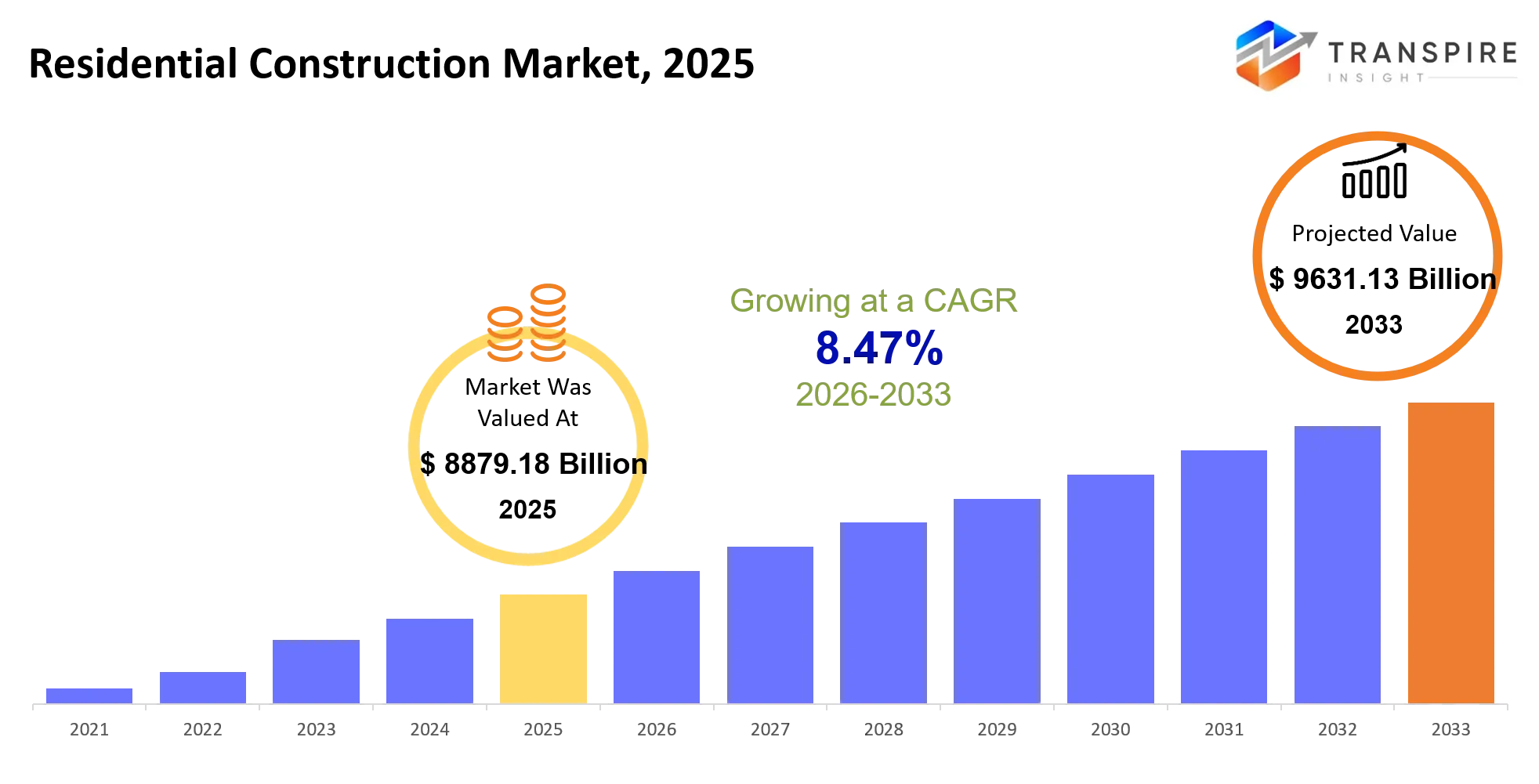
As per the Transpire Insight Analysis, The Residential Construction Market size is estimated at USD 8879.18 billion in 2025 and is anticipated to reach USD 17010.04 billion by 2033, growing at a CAGR of 8.47% from 2026 to 2033.
Residential construction converts housing requirements into saleable homes, rental properties and long-term residential assets. Over the past three to five years, the industry has shifted from conventional, labour-intensive building toward digitally coordinated, energy-conscious and increasingly factory-assisted development. Higher borrowing costs, pandemic-era supply disruptions and persistent housing affordability pressures have reshaped project economics, while smaller households and urban migration continue to influence housing requirements. A major structural change is the integration of energy-performance regulations into residential design, making efficiency and climate resilience important investment considerations. The European Union’s revised Energy Performance of Buildings Directive, adopted, reinforces this transition through stricter requirements for new buildings. Meanwhile, housing shortages and constrained urban land encourage developers to pursue apartments, rental communities and redevelopment. Growth therefore reflects a practical supply response: builders expand or modernise housing delivery to capture unmet demand, improve project feasibility and meet evolving buyer expectations.
Residential Construction Market Size & Forecast:
- Market Size 2025: USD 8879.18 Billion
- Expected Market Value (2033): USD 17010.04 Billion
- Forecast CAGR (2026–2033): 8.47%
- Leading Region in 2025: Asia Pacific
- Fastest Growing Region: Middle East and Africa
- Key Company Profiles: Lennar, D.R. Horton, PulteGroup, NVR, Taylor Morrison, KB Home, Sekisui House, Daiwa House, China State Construction Engineering, Country Garden, Vanke, Bouygues Construction, Skanska, Lendlease, Turner Construction.
Key Residential Construction Market Insights:
Capital efficiency, affordability engineering and quicker delivery are supplanting land ownership and building scale as the competitive edge in residential construction. Those builders with disciplined land strategies and who have standardised construction and a focus on the buyer of their homes are better positioned to preserve margins during housing cycles.
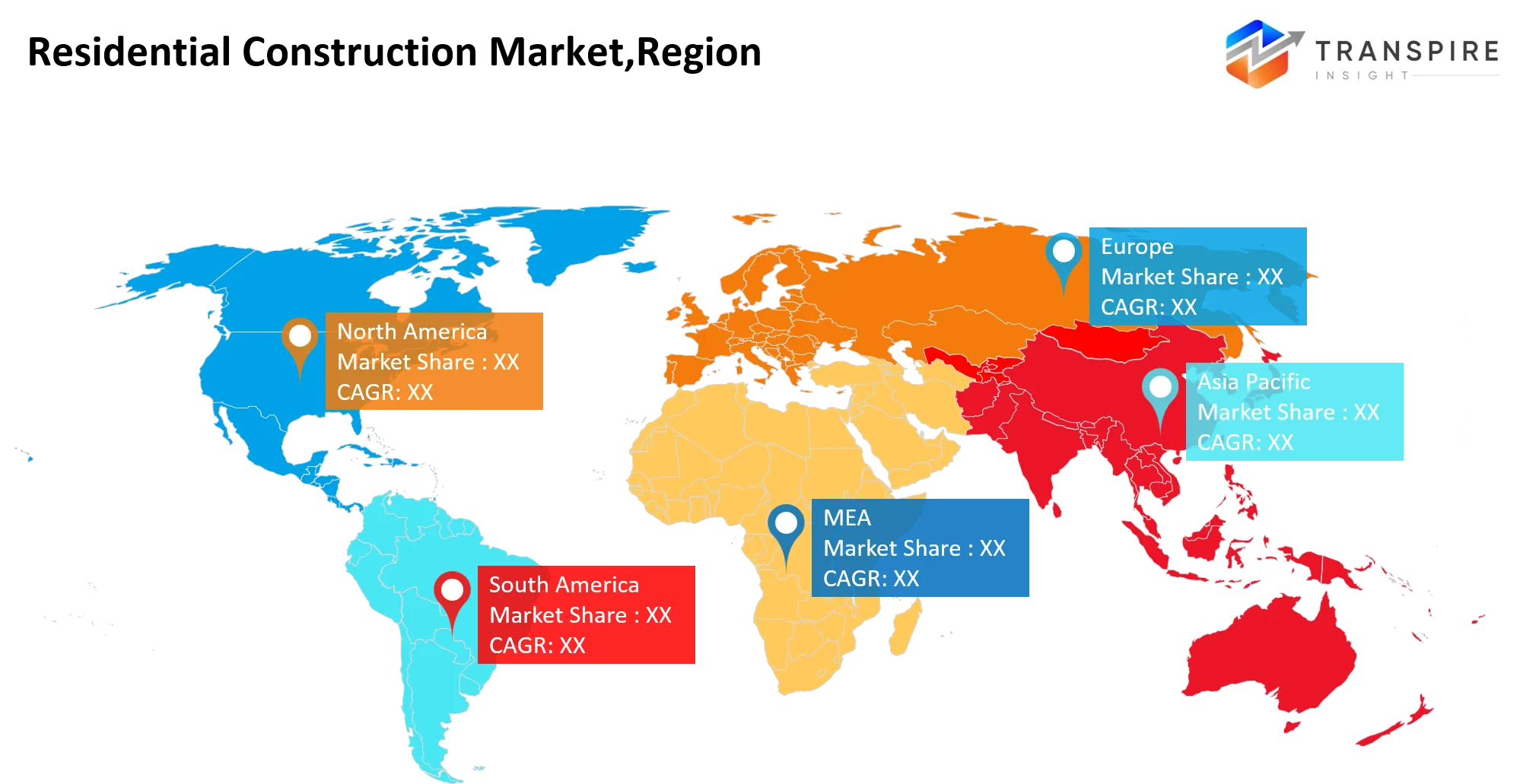
- Asia Pacific is expected to see 35.0% of residential construction, driven by urbanisation, infrastructure programs and growing demand for middle-class residential housing.
- North America accounts for 29.0% and continues to see builders provide mortgage rate buydowns and incentives to keep sales moving despite affordability challenges.
- Europe accounts for 19.0%, while renovation and energy-retrofit activities have increased in importance due to the increased efficiency requirements for ageing housing stock.
- 9.0% of Latin America and 8.0% from the Middle East & Africa, with the latter being the fastest-growing region.
- Migrants continued to flow into cities, and state-supported housing delivery is also fueling Asia Pacific's expansion of 21.3%.
- Latin America is growing at 4.8% with infrastructure investment and unmet urban housing needs.
- Growth in the Middle East & Africa is expected to reach 4.24%, as spurred by population growth, urbanisation and foreign investment.
- Lennar has transitioned to an asset-light business model with 98% of its homesites held by a third party and build times down to 116 days.
- NVR's land-option model with pre-sale minimises the risk of inventory, and KB Home and PulteGroup are ramping up build-to-order personalisation to preserve margins.
- With financing costs high, buyers are looking for move-in-ready homes, lower-priced formats and energy-efficient features.
What are the Key Drivers, Restraints, and Opportunities in the Residential Construction Market?
Driver:
Structural housing deficits and public-backed delivery. Chronic undersupply in markets such as Spain, the Netherlands, Australia, and parts of Asia-Pacific continues to support construction even when private demand weakens. Government housing programmes now provide developers with longer planning visibility, particularly for affordable and mixed-tenure schemes, shifting revenue from purely speculative sales toward contracted, policy-linked pipelines. This supports adoption of higher-density and rental-led models because developers can underwrite projects against public demand rather than immediate owner-occupier purchases.
Restraint:
Affordability, capital costs, and delivery capacity. High mortgage rates reduce buyer purchasing power, while elevated financing costs raise developers’ hurdle rates and delay projects. The constraint persists because it is structural: regulatory compliance, land costs, labour shortages, and materials inflation raise the cost floor of new homes; in the U.S., regulation represents 26.4% of a new home’s price. Consequently, builders rely more on incentives than volume growth, compressing margins.
Opportunity:
Modern methods of construction and AI-enabled delivery. Prefabricated, modular, and panelised systems can compress schedules and reduce exposure to on-site labour shortages, making them especially attractive for multifamily and affordable housing. AI-based estimating, progress monitoring, and predictive scheduling can further improve cost control; for example, Japan’s i-Construction policy supports robotics and digital workflows to offset an ageing workforce. Regions combining housing shortages with policy support, such as South America and South and Southeast Asia, offer the strongest opening for scaled, technology-enabled residential delivery.
Driver Impact Analysis for the Residential Construction Market
|
Driver |
Relative Impact on Growth (%) |
Geographic Relevance |
Impact Timeline |
Demand Strength |
Growth Mechanism |
Key Beneficiaries |
Major Constraint |
|
1. Rapid Urbanization and Household Formation |
28% |
Asia-Pacific, Africa, Middle East |
Long-term (≥4 years) |
High |
Urban migration increases demand for residential units. |
Developers, contractors, building-material suppliers, housing buyers |
Land scarcity, infrastructure bottlenecks, and rising construction costs. |
|
2. Government Affordable Housing Programs and Infrastructure Investment |
24% |
Asia-Pacific, North America, Europe |
Medium-term (2–4 years) |
High |
Housing subsidies and public investment stimulate construction activity. |
Affordable housing developers, contractors, cement manufacturers, low-income households |
Budgetary limitations, land acquisition delays, and administrative bottlenecks. |
|
3. Rising Household Incomes and Homeownership Aspirations |
18% |
Asia-Pacific, North America, Latin America |
Medium-term (2–4 years) |
High |
Income growth expands homeownership and residential purchasing capacity. |
Residential developers, mortgage providers, real estate agencies, homeowners |
High mortgage rates, affordability pressures, and household debt. |
|
4. Modular Construction, Prefabrication, and Digital Construction Technologies |
16% |
North America, Europe, Asia-Pacific |
Medium-term (2–4 years) |
Medium |
Prefabrication accelerates project delivery and improves construction productivity. |
Modular manufacturers, technology vendors, contractors, residential developers |
High initial investment, skilled-labor shortages, and standardization challenges. |
|
5. Sustainable Housing, Energy Efficiency, and Climate-Resilient Construction |
14% |
Europe, North America, Asia-Pacific |
Long-term (≥4 years) |
Medium |
Green building standards encourage efficient and resilient residential development. |
Green-material manufacturers, sustainable developers, technology providers, homeowners |
Higher upfront costs, limited financing, and inconsistent regulatory enforcement. |
|
Total |
100% |
— |
— |
— |
— |
— |
— |
What Has the Impact of Artificial Intelligence Been on the Residential Construction Market?
AI is shifting residential delivery from a reactive approach to one of prediction. During design and preconstruction, generative layout tools, automated takeoffs, and AI-assisted estimating allow developers to evaluate density, cost, and compliance scenarios before they invest capital into the project.
On-site, computer vision and three-dimensional scanning systems compare reality to the digital design, enabling early defect detection and better safety management. Predictive algorithms evaluate data on costs, weather, procurement, and labour for insights into schedule and cost risks that enable crews to re-sequence work or purchase materials earlier. The greatest gains in operations are happening in repetitive housing types, like multifamily buildings, prefabs, and factory-based modular construction. AI-powered production lines and robotics are focused on off-site fabrication while site crews handle assembly, quality checks, and finishing-especially relevant as labour shortages and increases in rates are now the greatest constraints to delivery. However, most homebuilders and speciality trades are still using disparate software, inconsistent site conditions, and small subcontractor pools. AI needs a clean history of project data to perform well, and application startup and automation costs may deter smaller projects with thin margins.
In May 2026, Nemetschek Group launched Bluebeam Max globally, a suite of premium software tools integrated into the Nemetschek Intelligence Platform. This development addresses preconstruction data formatting barriers by automating drawing markups, extracting quantity takeoffs from documents, and utilizing a "Smart Review" functionality to automatically identify design discrepancies and missing information across conflicting construction drawing sets.
Key Residential Construction Market Trends:
Affordability and efficiencies of delivery and development, in addition to housing volumes, are becoming increasingly important attributes of residential construction. The industry is making a transition towards integrated planning, flexible house formats, and digitally coordinated project execution.
- The constraints of affordability are driving a change in builders' sales from a price-led approach to an incentive-led approach.
- Multifamily activity is moderating in some markets experiencing oversupply, and single-family starts are evidencing a selective recovery.
- With a shortage of manpower, developers are turning to modular and prefab approaches to reduce schedules.
- The role of public funding is becoming more significant when private buyers are having to pay high interest rates for their loans.
- Efficient building systems are being driven by energy rules into new home construction and retrofits.
- AI-powered scheduling, estimating, and progress tracking are scaling from pilots to regular project controls.AI tools for scheduling, estimating, and progress tracking are transitioning from pilots to everyday project controls.
- The use of robotics is growing first in automated repetitive multifamily tasks and factories, where the economics of automation are more favourable.
- As the availability of borrowing has narrowed, buyers are opting for downtrends in the form of apartments, townhouses and lower-priced homes.
- Renovation and retrofit are taking a bigger share of value with the ageing housing stock and increasing stringency of efficiency rules.
Residential Construction Market Segmentation
Type:
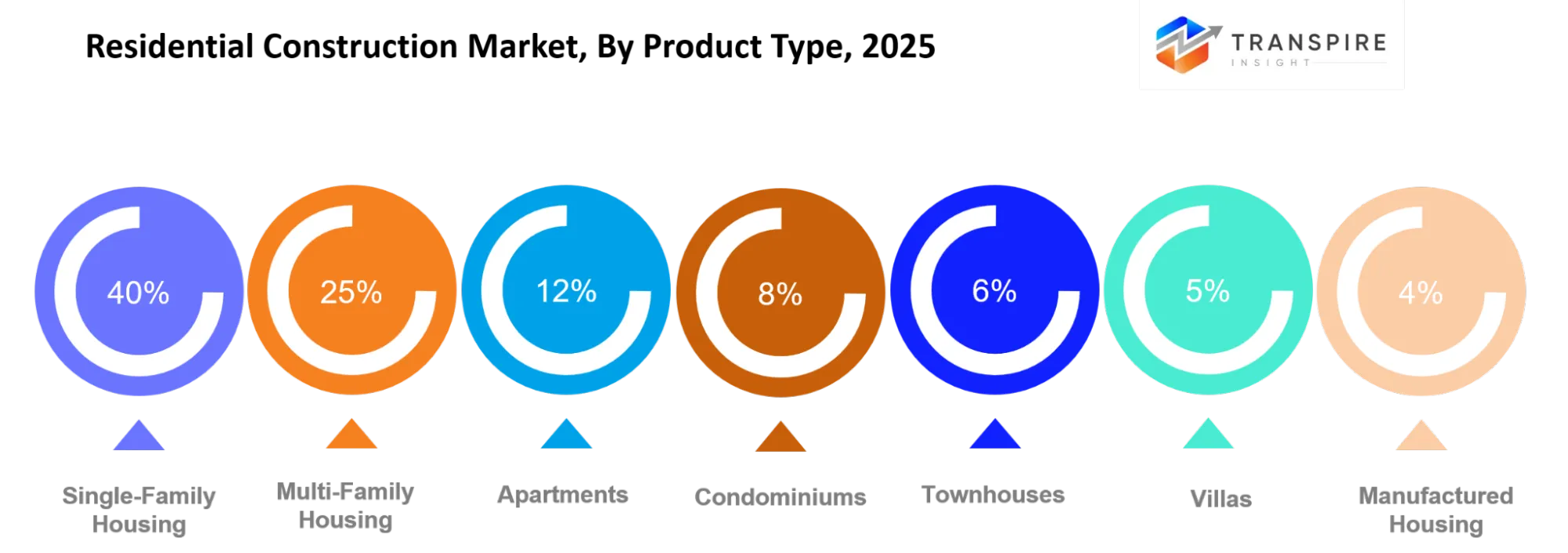
Single-family housing is still the market leader at 40.0%. Contributing factors include household formation, access to land, and owner-occupier preferences. However, the growth path of single-family housing will now be through build-to-rent communities, smaller footprints, and factory-built components. While single-family housing is growing at an estimated CAGR of 7.0%, multi-family housing is growing at an estimated CAGR of 7.0% and is driven by land constraints and the need for a rental market. In this segment, apartments are 12.0%, condominiums 8.0%, townhouses 6.0%, villas 5.0%, and manufactured housing 4.0%. Manufactured housing is positioned as an affordable housing option, due to the fact that factory-produced buildings create less waste and require less on-site labour.
Project:
New construction dominates with a 65.7% market share, supported by greenfield urban expansion, housing shortages and affordable-housing programmes. Renovation represents the fastest-scaling adjacent opportunity, recording a 5.52% CAGR, as ageing properties, energy-efficiency requirements and relocation costs encourage owners to upgrade existing homes. Remodelling, redevelopment, reconstruction, maintenance and expansion increasingly generate value in mature cities where land availability limits new development. These activities allow developers to improve existing assets, extend building lifecycles and address evolving residential requirements without depending entirely on additional land acquisition.
Construction Method:
On-site construction retains an 83.4% share, reflecting established contractor networks, design flexibility and familiarity with conventional building practices. However, prefabricated, modular, panelised, precast, 3D-printed and hybrid methods are gaining traction, supported by a 5.91% CAGR. Their appeal lies in greater schedule predictability, reduced weather exposure, lower site-labour dependency, and improved material utilisation. Factory-based production also enables repetitive housing designs to be delivered more consistently. Although 3D-printed construction remains commercially emerging, affordable-housing pilots and technology investments are encouraging wider experimentation.
Price Range:
Mass/economy, affordable and social housing are gaining strategic importance as affordability increasingly determines project feasibility and purchasing decisions. Mid-market developments face pressure from construction inflation, financing costs and buyers’ constrained budgets, requiring developers to reconsider layouts, materials and pricing strategies. Premium and ultra-luxury housing remain comparatively resilient in supply-constrained locations, where affluent buyers value exclusivity, amenities and customisation. However, these segments depend more heavily on margins and differentiated product positioning than on broad volume growth. Developers increasingly balance premium projects with attainable housing to diversify demand exposure and improve portfolio resilience.
Building Height:
Low-rise, detached and semi-detached housing remains important in suburban markets where land availability supports private residential layouts. Mid-rise and high-rise construction increasingly serves urban locations where land costs, transport accessibility and planning reforms favour density. Mixed residential developments combine housing with amenities and services, improving land utilisation and supporting integrated communities. Super high-rise projects remain selective because they require substantial capital, specialised engineering and premium demand. Future development patterns will increasingly depend on infrastructure capacity, zoning flexibility and the economic trade-off between land efficiency and construction complexity.
End User:
Individual buyers remain foundational, while developers, housing associations, governments, institutional buyers and rental operators increasingly influence project pipelines. Individual ownership supports conventional homebuilding, whereas government and housing associations prioritise affordability, social provision and public procurement. Institutional investors and rental operators favour multifamily and build-to-rent developments because professionally managed housing generates recurring income and standardised assets. Developers are consequently adapting project design, financing structures and property management strategies to accommodate multiple ownership models. This diversification creates opportunities for long-term residential investment while strengthening the role of rental housing in markets where homeownership affordability remains constrained.
What are the Key Use Cases Driving the Residential Construction Market?
The core use case is new-build housing delivery for sale and rent, led by single-family communities and multifamily apartments. Developers use standardised designs, phased construction, and build-to-rent models to convert housing shortages into investable pipelines, particularly where public programmes support affordable or mixed-tenure supply.
An expanding application is renovation, retrofit, and redevelopment of existing homes and ageing housing estates. Energy-efficiency requirements, high moving costs, and limited urban land are shifting spending toward upgrades, extensions, and conversion of underused buildings into residential assets.
Emerging use cases include factory-built affordable housing, 3D-printed homes, and AI-managed modular communities. These models link construction technology with public housing policy and institutional rental capital, aiming to deliver homes faster while controlling labour and material costs.
|
Report Metrics |
Details |
|
Market size value in 2025 |
USD 8879.18 Billion |
|
Market size value in 2026 |
USD 9631.13 Billion |
|
Revenue forecast in 2033 |
USD 17010.04 Billion |
|
Growth rate |
CAGR of 8.47% from 2026 to 2033 |
|
Base year |
2025 |
|
Historical data |
2021 - 2024 |
|
Forecast period |
2026 - 2033 |
|
Report coverage |
Revenue forecast, competitive landscape, growth factors, and trends |
|
Regional scope |
United States; Canada; Mexico; United Kingdom; Germany; France; Italy; Spain; Denmark; Sweden; Norway; China; Japan; India; Australia; South Korea; Thailand; Brazil; Argentina; South Africa; Saudi Arabia; United Arab Emirates |
|
Key companies profiled |
Lennar, D.R. Horton, PulteGroup, NVR, Taylor Morrison, KB Home, Sekisui House, Daiwa House, China State Construction Engineering, Country Garden, Vanke, Bouygues Construction, Skanska, Lendlease, Turner Construction |
|
Customization scope |
Free report customization (country, regional & segment scope). Available customized purchase options to meet your exact research needs. |
|
Report Segmentation |
Type (Single-Family Housing, Multi-Family Housing, Apartments, Condominiums, Townhouses, Villas, Manufactured Housing); Project (New Construction, Renovation, Remodeling, Redevelopment, Expansion, Reconstruction, Maintenance); Construction Method (On-Site Construction, Prefabricated Construction, Modular Construction, Panelized Construction, Precast Construction, 3D-Printed Construction, Hybrid Construction); Price Range (Mass/Economy, Mid-Market, Premium, Luxury, Affordable Housing, Social Housing, Ultra-Luxury); Building Height (Low-Rise, Mid-Rise, High-Rise, Super High-Rise, Detached, Semi-Detached, Mixed Residential); End User (Individual Buyers, Investors, Developers, Housing Associations, Government, Institutional Buyers, Rental Operators) |
Which Regions are Driving the Residential Construction Market Growth?
Asia Pacific dominates the market with a share of 35.0%. The well-established urban population, increasing middle-class households, and great demand for housing have fuelled the growth of the market in the region. China, India, and Southeast Asia have emerged as the drivers of such growth with the development of urban centres, investment in residential infrastructure, and adoption of government-led housing schemes. The growing urbanisation and land scarcity are expected to drive the growth of apartment construction, dense communities, and redevelopment on the side of conventional home building, with a projected growth indicator of 21.3%. But the financing conditions and affordability across countries seem to be fluctuating.
In July 2026, Aurum PropTech announced the acquisition of Housing.com for ₹458 crore. This transaction integrates consumer real estate demand with advanced technology to build an AI-native Real Estate Operating System that simplifies the residential property journey amid India's rapid urbanization.
North America makes up 29.0% of the market, Europe 19.0%, Latin America 9.0%, and the Middle East and Africa 8.0%. Contrary to the urbanisation-led growth in Asia Pacific, the North American construction industry is supported by mature mortgage markets, sustained demand for suburban housing, and large national builders. Europe's construction industry is supported by renovation requirements, energy-efficiency policies, and a stable residential infrastructure. Latin America's 4.8% growth index is positive, but credit access issues and economic instability may hamper growth.
In June 2026, Berkshire Hathaway agreed to acquire Taylor Morrison Home for $6.8 billion. This acquisition consolidates a major player in the North American homebuilder network, capitalising on suburban housing demand despite a complex macroeconomic backdrop.
https://themortgagepoint.com/2026/07/30/acquisitions-on-the-rise-among-home-builders/
Middle East and Africa have been identified as the fastest-growing areas, primarily due to urbanisation, housing schemes, and capital investment in infrastructure. The housing and urban-development programmes in Saudi Arabia, as well as residential projects in the Gulf, are now causing a boom in construction activity. Africa's emerging cities are also creating opportunities in the future for affordable housing, producing local materials and infrastructure-connected development. However, be aware that the supplied fastest-growing indicator of 4.24% should be understood independently from the fastest-growing designation, as the indicator's original forecast parameters are not provided.
In November 2026, the Saudi Fund for Development signed six concessional development loan agreements worth over $403 million with the Syrian Arab Republic. This funding supports post-war recovery through the rehabilitation of essential infrastructure, including the Aleppo Thermal Power Plant, public health centres, and up to 10,000 damaged housing units.
Who are the Key Players in the Residential Construction Market, and how do they compete?
Competition is fragmented across regional homebuilders, diversified construction groups, and vertically integrated developers. Companies differentiate on land, construction, product positioning, financing ability, and geographic presence rather than being differentiated mainly by the size of their buildings. North American builders compete on affordability and efficiency, Asian developers compete by balancing the scale of the homes with technology, and European groups compete by applying engineering and sustainability practices.
Lennar focuses on land-light operations and production efficiencies to keep capital spending low; D.R. Horton concentrates Warehousing on high-volume construction and targeting a broad range of buyers; Pulte Group offers first-time buyers, move-up and active-adult housing; NVR emphasizes disciplined land investment and operating efficiency; Taylor Morrison sells to customers with specific needs and regional focus; and KB Home targets attainable housing. Sekisui House and Daiwa House combine Japanese homebuilding expertise with growth and differentiated home portfolios. China State Construction Engineering, Country Garden and Vanke vie on scale of development, strong pan-China project capabilities and local market share. Bouygues Construction and Skanska differentiate in engineering and sustainability credentials and deliver complex projects; Lendlease draws together residential development and urban regeneration; Turner Construction is mainly a project management provider rather than a residential homebuilder.
Key Players are
-
Lennar
D.R. Horton
PulteGroup
NVR
Taylor Morrison
KB Home
Sekisui House
Daiwa House
China State Construction Engineering
Country Garden
Vanke
Bouygues Construction
Skanska
Lendlease
Turner Construction
Residential Construction Market — Enhanced Competitive Benchmarking
|
Company |
Est. Revenue Share Range |
Key Offerings |
Strategic Positioning |
Geographic Strength |
Technology Focus |
|
D.R. Horton, Inc. |
Estimated: 0.2–0.5% |
Entry-level homes, move-up housing, single-family homes, residential communities |
Volume-led homebuilding with integrated land development |
North America, particularly the United States |
Standardised construction, digital sales, land and supply-chain optimisation |
|
Lennar Corporation |
Estimated: 0.2–0.5% |
Single-family homes, townhomes, master-planned communities, residential land development |
Large-scale community development and cost-efficient production |
North America, particularly the United States |
Digital homebuilding, construction standardisation, technology-enabled purchasing |
|
PulteGroup, Inc. |
Estimated: 0.1–0.3% |
Entry-level homes, move-up housing, luxury residences, active-adult communities |
Multi-brand segmentation targeting diverse buyer demographics |
North America, particularly the United States |
Smart-home integration, construction process optimisation, digital customer experience |
|
Sekisui House, Ltd. |
Estimated: 0.1–0.4% |
Custom-built homes, rental housing, residential communities, multifamily development |
Premium housing quality, sustainability, and international expansion |
Asia Pacific, North America, Australia |
Industrialised construction, energy-efficient housing, smart-home technologies |
|
Daiwa House Industry Co., Ltd. |
Estimated: 0.1–0.4% |
Detached homes, rental apartments, residential communities, prefabricated housing |
Diversified housing development supported by industrialised construction |
Asia Pacific, North America |
Modular construction, prefabrication, robotics, ICT-enabled construction |
|
China State Construction Engineering Corporation (CSCEC) |
Estimated: 0.2–0.8% |
Residential high-rises, housing complexes, urban residential developments, large-scale housing projects |
Scale-driven construction leadership and integrated project execution |
Asia Pacific, Middle East & Africa |
Building information modelling (BIM), smart construction, prefabrication, digital project management |
|
China Vanke Co., Ltd. |
Estimated: 0.1–0.4% |
Urban residential communities, high-rise apartments, housing development, property services |
Large-scale urban housing development with quality and delivery-focused execution |
Asia Pacific, particularly China |
Digital construction management, smart-site monitoring, standardised quality control |
|
Country Garden Holdings |
Estimated: 0.1–0.4% |
Residential communities, high-rise housing, suburban developments, large-scale housing projects |
High-volume residential development and delivery-led market positioning |
Asia Pacific, particularly China |
Industrialised construction, prefabricated building systems, smart construction |
|
Taylor Morrison, Inc. |
Estimated: Below 0.2% |
Single-family homes, townhomes, master-planned communities, active-adult housing |
Lifestyle-focused housing and differentiated community development |
North America, particularly the United States |
Digital home design, construction workflow optimisation, customer-centric platforms |
|
NVR, Inc. |
Estimated: Below 0.2% |
Single-family homes, townhomes, residential communities, mortgage services |
Asset-efficient homebuilding and disciplined land acquisition |
North America, particularly the United States |
Lot-purchase strategy, standardised construction, digital operational management |
Recent Development News
In September 2026, Daiwa House agreed to acquire an approximately 30% minority stake in Miller Homes from Apollo Funds. The strategic investment is expected to support Miller Homes’ expansion across the UK residential construction sector, strengthen its development capabilities, and help advance its target of delivering 7,000 homes annually.
In August 2026, Builders FirstSource partnered with Digs through a $25.3 million Series A financing and a five-year commercial agreement to advance AI-powered homebuilding solutions. The collaboration aims to streamline construction workflows, improve project coordination, reduce manual work, and enhance efficiency throughout the residential building lifecycle.
In November 2026, HDFC Capital Advisors and DivyaSree Developers partnered to establish a ₹1,500 crore residential development platform in India. The funding arrangement will support residential project acquisitions and development across Bengaluru, Hyderabad, and Chennai over the next three to four years, strengthening institutional investment in urban housing construction.
What Strategic Insights Define the Future of the Residential Construction Market?
The residential development sector is moving towards more industrialised, capital-light delivery models, and alternative use of land is paramount to building sustainable, scalable solutions. Cost efficiencies and operational efficiencies are central to this, and developer efficiency is crucial to where value can be created in the future. With land-light/debt-light models, there is a certain set of contractual risks: rigid land-take-down cycles and market-led sales structures that hold volumes flat but stress margins. Modular manufacturing, enabled by AI, is providing opportunities for affordable housing, multi-family projects and activities in the Middle East and Africa, where speed to market and severe labour shortages serve as incentives for industrialised construction. Digital design, automated fabrication and building with standardised, tested modules will streamline construction schedules, reduce rework and improve predictability. Industrialised construction can reduce construction timeframes, minimise initial investment, and de-risk project delivery. However, technology investments should be carefully sized to actual market demand, local manufacturing capacity, transport economics, and issues around local regulation.
Key Segmentations are:
Type
- Single-Family Housing
- Multi-Family Housing
- Apartments
- Condominiums
- Townhouses
- Villas
- Manufactured Housing
Project
- New Construction
- Renovation
- Remodelling
- Redevelopment
- Expansion
- Reconstruction
- Maintenance
Construction Method
- On-Site Construction
- Prefabricated Construction
- Modular Construction
- Panelized Construction
- Precast Construction
- 3D-Printed Construction
- Hybrid Construction
Price Range
- Mass/Economy
- Mid-Market
- Premium
- Luxury
- Affordable Housing
- Social Housing
- Ultra-Luxury
Building Height
- Low-Rise
- Mid-Rise
- High-Rise
- Super High-Rise
- Detached
- Semi-Detached
- Mixed Residential
End User
- Individual Buyers
- Investors
- Developers
- Housing Associations
- Government
- Institutional Buyers
- Rental Operators
Frequently Asked Questions
Find quick answers to common questions.
The residential construction market size was valued at USD 8879.18 billion in 2025 and is poised to reach USD 17010.04 billion by 2033, expanding at an 8.47% CAGR.
Key segments for the residential construction market are Type (Single-Family Housing, Multi-Family Housing, Apartments, Condominiums, Townhouses, Villas, Manufactured Housing); Project (New Construction, Renovation, Remodeling, Redevelopment, Expansion, Reconstruction, Maintenance); Construction Method (On-Site Construction, Prefabricated Construction, Modular Construction, Panelized Construction, Precast Construction, 3D-Printed Construction, Hybrid Construction); Price Range (Mass/Economy, Mid-Market, Premium, Luxury, Affordable Housing, Social Housing, Ultra-Luxury); Building Height (Low-Rise, Mid-Rise, High-Rise, Super High-Rise, Detached, Semi-Detached, Mixed Residential); End User (Individual Buyers, Investors, Developers, Housing Associations, Government, Institutional Buyers, Rental Operators).
Growth is primarily driven by rapid urbanization, population growth, rising household formation, housing shortages, increasing disposable incomes, government-backed affordable housing initiatives, and demand for energy-efficient homes.
The residential construction market is led by major manufacturers including Lennar, D.R. Horton, PulteGroup, NVR, Taylor Morrison, KB Home, Sekisui House, Daiwa House, China State Construction Engineering, Country Garden, Vanke, Bouygues Construction, Skanska, Lendlease, and Turner Construction.
Asia Pacific dominates the residential construction market with a 35.0% share, supported by rapid urbanisation, population growth, expanding housing demand, government-led housing initiatives, and infrastructure development across China, India, and Southeast Asia.
Key opportunities include modular and industrialised construction, energy-efficient housing, public-private affordable housing partnerships, renovation and retrofit projects, and urban housing expansion across India and Southeast Asia.
Lennar
D.R. Horton
PulteGroup
NVR
Taylor Morrison
KB Home
Sekisui House
Daiwa House
China State Construction Engineering
Country Garden
Vanke
Bouygues Construction
Skanska
Lendlease
Turner Construction
About the Authors

Kartik bhong
I am Kartik Bhong, a Senior Research Analyst at Transpire Insight, specializing in the Packaging, Manufacturing, and Construction industry. My work focuses on analyzing market trends, emerging technologies, industry regulations, and competitive landscapes to deliver accurate, data-driven insights. I am passionate about transforming complex industry information into clear, practical content that helps businesses, professionals, and decision-makers stay informed and make confident strategic decisions. Through continuous research and a strong commitment to accuracy, I strive to create reliable, well-researched content that reflects the latest developments across these dynamic industries and supports the vision of Transpire Insight in delivering valuable market intelligence.

Chakradhar Khansole
Chakradhar serves as the Research Director at Transpire Insight, bringing over 8 years of experience in technology, innovation, and strategic market intelligence. He specializes in transforming complex market data into actionable business insights that enable organizations to make informed, growth-oriented decisions. Recognized for his strategic vision and analytical expertise, Chakradhar leads high-impact research initiatives, delivering comprehensive market assessments, competitive intelligence, and forward-looking industry analysis.
Recently Published Reports
-
Apr 2026
Handling and Lifting Equipment Market
Handling and Lifting Equipment Market Size, Share & Analysis Report By Product (Cranes and Hoists, Forklifts, Conveyor Systems, Aerial Work Platforms, Others), By Application (E-Commerce, Automotive and Railway, Food and Beverages, Aviation, Others), and Geography (North America, Europe, Asia-Pacific, Middle East and Africa, South and Central America), 2021 - 2031
-
Nov 2026
HVAC Equipment Market
HVAC Equipment Market Size, Share & Analysis Report By Heating Equipment Type (Boilers and Furnaces, Heat Pumps, and Unitary Heaters), By Ventilation Equipment (Air Handling Units, Humidifiers and Dehumidifiers, Air Filters, and Fan Coiling Units), By Air Conditioning Equipment (Unitary Air Conditioners, Room Air Conditioners, Packaged Terminal Air Conditioners, and Chillers), By End User (Commercial, Residential, Industrial, and others), and Geography (North America, Europe, Asia-Pacific, Middle East and Africa, South and Central America), 2021 – 2031
-
Apr 2026
Refrigeration Valves Market
Refrigeration Valves Market Size, Share & Analysis Report By Type (Solenoid Valves, Expansion Valves, Check Valves, Service Valves, Others), By Application (Commercial Refrigeration, Industrial Refrigeration, Transport Refrigeration, Residential Refrigeration, Air Conditioning Systems), By End User (Food and Beverage Industry, Pharmaceutical Industry, HVAC Industry, Chemical Industry, Others), and Geography (North America, Europe, Asia-Pacific, Middle East and Africa, South and Central America), 2021 – 2031
-
Apr 2026
E-Commerce Packaging Materials Market
E-Commerce Packaging Materials Market By Material Type (Corrugated Boxes, Paper & Paperboard, Foam & Cushioning Materials, Plastic Packaging, Flexible Packaging, Protective Packaging, Others), By Product(Primary Packaging, Secondary Packaging, Tertiary Packaging), By Packaging Function (Protective Packaging, Branding & Presentation Packaging, Transit & Logistic Packaging, Sustainable Packaging, Tamper Evidence Packaging), By End-User (Retail & Consumer Goods, Electronic Appliances, Food & Beverages, Healthcare & Pharmaceutical, Fashion & Apparel, Home & Furnishing, Others); By Industry Analysis, Size, Share, Growth, Trends, and Forecasts 2021-2033