

Engineering, Procurement, And Construction Management (EPCM) Market Summary:
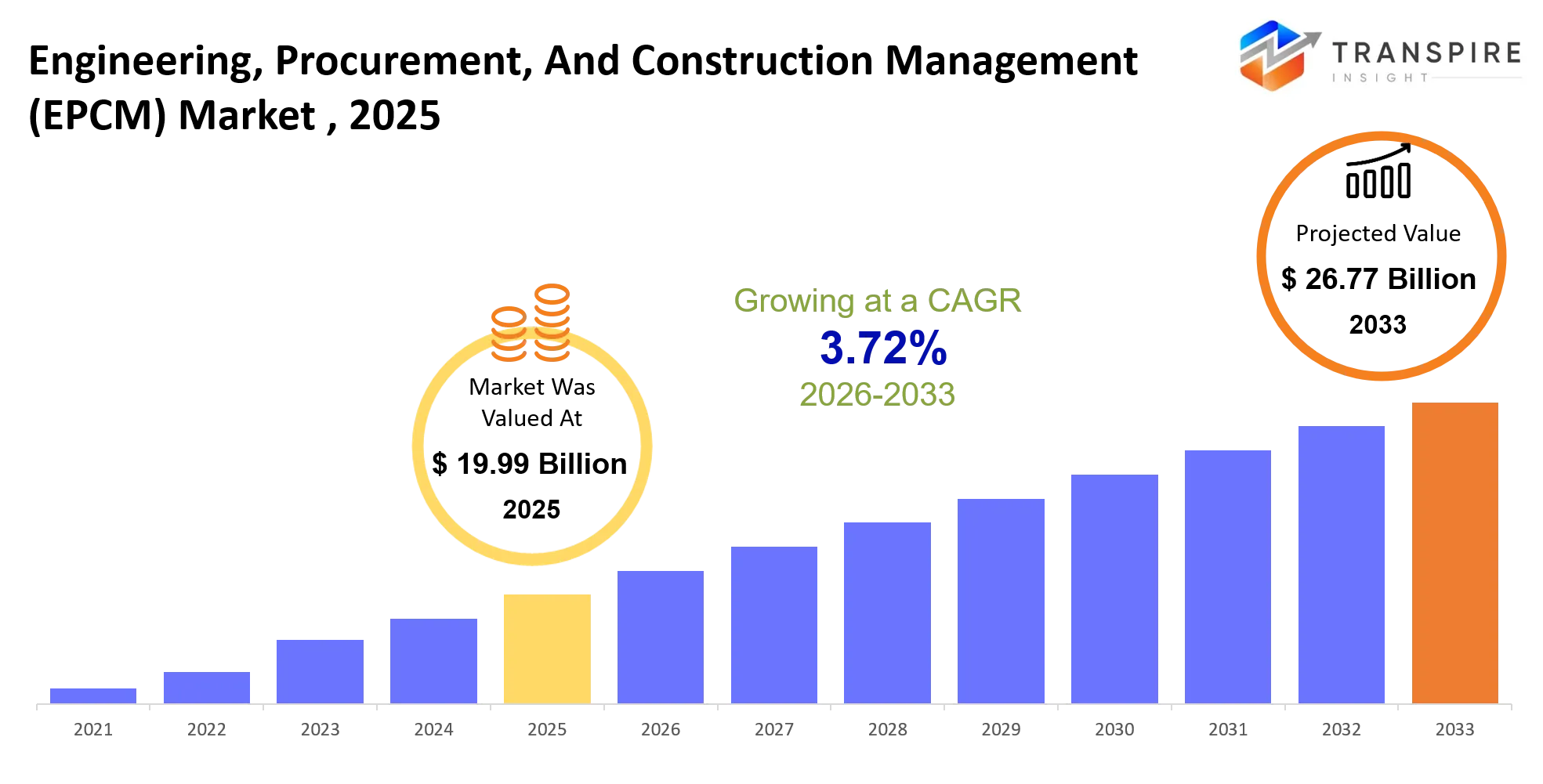
As per the Transpire Insight Analysis, The Engineering, Procurement, and Construction Management (EPCM) Market size is estimated at USD 19.99 billion in 2025 and is anticipated to reach USD 26.77 billion by 2033, growing at a CAGR of 3.72% from 2026 to 2033.
The Engineering, Procurement and Construction Management (EPCM) industry helps project owners realise complex industrial and infrastructure projects by harmonising engineering design, supplier selection, scope control, construction management, and commissioning. Over the last three to five years, projects have become increasingly interconnected, with firmed delivery windows, supply-chain risk, and an increased focus on capital expenditure. A key industry shift is the movement away from document-led project execution to digitally enabled project delivery, through the use of building information modelling, digital twins and cloud-enabled project controls, supported by growth in the scale of AI data centres, energy infrastructure, and industrial assets. Large data centre developments require coordinated engineering, procurement, construction, and commissioning work. Project owners increasingly rely on EPCM firms to coordinate interfaces among contractors, suppliers, and regulatory agencies instead of transferring all construction risk through a single turnkey contract; this creates scope for recurring advisory, engineering, and project-management revenue.
Engineering, Procurement, And Construction Management (EPCM) Market Size & Forecast:
- Market Size 2025: USD 19.99 Billion
- Expected Market Value (2033): USD 26.77 Billion
- Forecast CAGR (2026–2033): 3.72%
- Leading Region in 2025: Asia Pacific
- Fastest Growing Region: North America
- Key Company Profiles: Bechtel, Fluor, Jacobs, Worley, Wood, AECOM, KBR, Technip Energies, Saipem, McDermott, AtkinsRéalis, Tetra Tech, Hatch, SNC-Lavalin, Turner Construction.
Key Market Insights:
The EPCM competition is moving away from just engineering execution and towards integrated risk management, digital visibility of the project, and reliable delivery of capital projects. The best opportunities go to companies that bring together technical expertise, robust procurement processes, AI-driven controls, and quantifiable lifecycle performance.
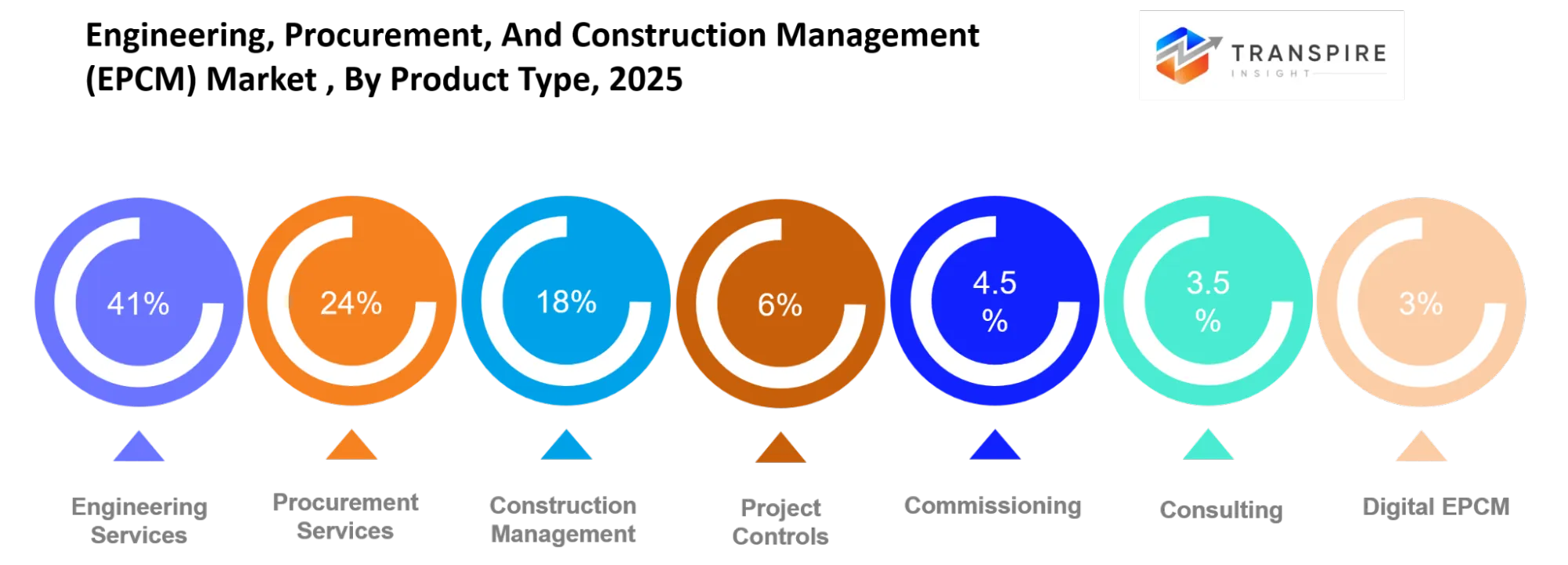
- Engineering services will continue as the underpinning of the market at 41.0%, and companies will be integrating AI-driven design review, constructability, and 3D prefabrication to minimise redesign at the end of the project.
- Cloud platforms, single-source project data and automated progress reporting are driving the growth of Digital EPCM, which today holds a 2.0% market share and is growing at a 9.8% CAGR, as the owner would prefer such a solution.
- Bechtel is streamlining AI, robotics and automation through an enterprise EPC-transformation strategy, directly connecting design changes to robotic site equipment.
- Fluor is prioritizing advanced technology, semiconductor, data-centre, mining, and nuclear-fuel projects, and nearly three-quarters of its 2025 awards are geared toward urban solutions.
- Worley is rolling out an internal AI knowledge-sharing platform to clients that will provide engineers the ability to access design decisions and lessons learned from all industrial projects.
- With EPCM experience, Jacobs is bringing a 1-GW Texas AI campus to life where the grid rules, utility planning and hyperscale power requirements are changing the project design.
- AtkinsRéalis is pairing up CANDU nuclear power with Nvidia-powered digital-twin planning to create nuclear-powered AI data centres.
- Tracking of real-time supplier performance, lead times, and exposure to material prices is driving procurement services (24.0%) toward an analytics-driven approach.
- Construction management is becoming more modular (18.0%) and adopting more advanced work packaging to minimise reliance on field labour and to reduce delays.
What are the Key Drivers, Restraints, and Opportunities in the Engineering, Procurement, And Construction Management (EPCM) Market?
Driver:
Capital-intensive projects are driving EPCM adoption because owners need stronger coordination between design, long-lead equipment procurement, and site execution. The expansion of AI computing infrastructure and associated power systems has created a specific trigger: projects must bring electrical capacity, cooling, grid connections, and buildings online within tightly linked schedules. Deloitte identifies data centres and energy infrastructure as important sources of construction activity in 2026. This complexity increases the value of integrated project controls, supplier coordination, and engineering oversight, supporting demand for specialist EPCM contracts and related services.
Restraint:
Cost escalation, skilled-labour shortages, and uncertain equipment lead times constrain project delivery. Tariffs and volatile material prices can undermine procurement budgets, while fragmented contractor systems make it difficult to maintain consistent cost and schedule forecasts. These issues persist because projects span multiple jurisdictions, suppliers, and contractual responsibilities. Delays can defer client revenue and expose EPCM providers to disputes, rework, and additional management costs.
Opportunity:
Digital EPCM offers scope for differentiation through connected project data, predictive scheduling, modular design, and automated procurement workflows. In India, AI-driven computing expansion and data-localisation requirements are encouraging investment in data-centre infrastructure, creating opportunities for coordinated engineering, regulatory planning, and commissioning. Providers that combine technical expertise with reliable digital reporting can improve project visibility, strengthen client retention, and secure higher-value assignments.
Driver Impact Analysis: Engineering, Procurement, and Construction Management (EPCM) Market
|
Driver |
Relative Impact on Growth (%) |
Geographic Relevance |
Impact Timeline |
Demand Strength |
Growth Mechanism |
Key Beneficiaries |
Major Constraint |
|
Large-scale energy, industrial, and infrastructure investments |
28% |
North America, Asia-Pacific, Middle East |
Short-term (≤2 years) |
High |
Expands demand for integrated engineering and project management |
EPCM firms, infrastructure developers, industrial operators |
Financing costs and project approval delays |
|
Energy transition and decarbonization projects |
24% |
Europe, North America, Asia-Pacific |
Medium-term (2–4 years) |
High |
Drives engineering for renewables, hydrogen, and carbon capture |
EPCM consultants, renewable developers, technology suppliers |
Policy uncertainty and clean-energy financing gaps |
|
Digitalization, AI, and digital twin adoption |
19% |
North America, Europe, Asia-Pacific |
Medium-term (2–4 years) |
High |
Improves design coordination, procurement visibility, and project controls |
Digital engineering firms, software vendors, EPCM providers |
Integration costs and limited digital expertise |
|
Complex mining, chemicals, and energy megaprojects |
16% |
Australia, Latin America, Middle East, North America |
Long-term (≥4 years) |
High |
Increases demand for specialized engineering and supply-chain coordination |
Mining companies, process engineering firms, equipment suppliers |
Commodity price volatility and skilled-labor shortages |
|
Stricter environmental, safety, and project-compliance requirements |
13% |
Europe, North America, Asia-Pacific |
Medium-term (2–4 years) |
Medium |
Requires environmental assessments, compliance engineering, and lifecycle monitoring |
EPCM consultants, compliance specialists, asset owners |
Regulatory fragmentation and compliance expenses |
|
Total |
100% |
Global |
— |
— |
— |
— |
— |
What Has the Impact of Artificial Intelligence Been on the Engineering, Procurement, And Construction Management (EPCM) Market?
AI is reshaping all the phases of Engineering, Procurement, and Construction Management (EPCM) by bringing the delivery discipline from a monitoring function to a predictive one: through design iteration, clash detection, constructability checks, and scope verification engines, for engineering; through predicting supplier execution performance, lead times, and cost trajectories for procurement; through scheduling delays with historical data, weather data, site data, and productivity metrics for construction management; through project scheduling and cost prediction based on historical schedule and cost pattern recognition, for project controls. The new capability makes optimal resource allocation, sequencing, and critical-path control possible in project controls. Digital twin enables the combination of design, field observation, IoT sensor data, and drone capture as a live model to monitor progress and predict points of failure during commissioning.
AI reduces latency of information transfer between engineering hubs and construction sites, automates review of contractual and regulatory documents, minimizes risks with computer vision and remote sensing technologies, and further improves safety. Adoption of AI remains constrained by associated costs of system integration, legacy data infrastructures and the unpredictable quality of AI's schedule and cost forecast, which depends on the ability to generate comprehensive and standardised historical data from projects.
In April 2026, Slate Technologies forged a strategic partnership with the major residential real estate developer DRA. This collaboration introduces predictive, data-driven construction intelligence directly into live infrastructure and housing projects.
Key Engineering, Procurement, And Construction Management (EPCM) Market Trends:
The EPCM service is shifting from coordination-based to data-driven project delivery. The ability to identify risks and contingencies for execution, garnering key supplies, and the ability to incorporate engineering decisions with project performance in real time are all becoming keys to competitive advantage.
- Due to tight schedule requirements, owners are transitioning to an overlapping engineering, procurement, and construction process from a sequential design-bid-build process.
- BIM is moving beyond the design-coordination function and is becoming 4D/5D Project Controls, integrating time, cost, progress, and clash detection.
- The use of digital twins and drone-based reality capture has produced continually updated as-built models to enable quicker commissioning and reduced rework.
- AI is shifting from pilot to predicting delays, cost exposure, and supplier risk in project management.
- Procurement is increasingly driven by analytics and includes automated supplier evaluation, material logistics tracking, and real-time tracking of market prices.
- Modularisation and offsite fabrication are growing in use, especially in the manufacture of e-houses, skid-mounted utilities, pipe racks and data-hall blocks.
- The energy-transition projects are driving a transition of EPCM demand from traditional oil and gas towards renewables, storage, grid reinforcement, hydrogen, and carbon-capture retrofits.
- Integrated demand for EPCM is emerging in data centre and power delivery projects with respect to engineering, cooling, electrical infrastructure, and connectivity.
- The introduction of complexity and interconnection queues is forcing EPCM companies to engineer the regulatory, environmental and grid impacts.
- Both integrated project delivery and collaborative contracting are growing in popularity as owners demand transparency and shared accountability.
Engineering, Procurement, And Construction Management (EPCM) Market Segmentation
Service Type:
Engineering services hold a 41.0% share, reflecting their role in establishing project scope via design, feasibility, process engineering, detailed engineering, etc., before procurement and construction. Their growth is driven by the rising complexity of decarbonization, electrification, and industrial projects requiring specialised multidisciplinary engineering. Procurement services are at 24.0% because of supply chain disruptions and supplier-risk management needs. Construction management is at 18.0%, with project controls at 6.0%, commissioning at 4.5%, consulting at 3.5%, and other at 1.0%. Digital EPCM at 2.0% is growing at the fastest rate-CAGR of 9.8%-as project owners are turning to cloud platforms, Building Information Modelling, artificial intelligence analytics, and digital twins for visibility and to minimise rework.
Project Type:
Infrastructure, industrial, energy, and transportation projects continue to dominate with long project delivery timelines, permitting processes, and many different contractors involved. Energy is playing an ever-larger role as renewables, storage, grid upgrades, and hydrogen projects now broaden the pipeline of project types. Oil and gas projects are still large, but focusing more on debottlenecking, emissions compliance, and carbon-capture retrofits rather than greenfield expansions. Mining and utilities have benefited from investments in electrification, water management, and grid reliability. Commercial projects are starting to be more data-centred and logistics-driven, with rising importance.
End User:
Public-sector agencies, infrastructure owners, utilities, oil and gas companies, mining companies, manufacturing companies, and private-sector investors all choose Engineering, Procurement, and Construction Management (EPCM) to retain oversight but leverage delivery expertise. Large companies and multinational companies are the main customers since they manage globally dispersed, capital-heavy portfolios. Government agencies are key drivers of demand for transportation, water, and public infrastructure. Utility and energy project developers are increasingly requesting EPCM support for interconnection, substation, and storage projects. SMEs and local contractors participate mainly through subcontracting, local construction, and professional services.
Contract Type:
Various contractual types such as cost-plus, time-and-material, guaranteed maximum price, target-cost, unit-price, fixed-price, and framework contracts have different allocations of risk. The fixed-price contracts are more common where the scope is certain; however, rising costs of steel, copper, and equipment are prompting owners and contractors to agree to cost-plus, target-cost, and guaranteed maximum price contracts. The framework contracts are becoming popular with utilities, governments and hyperscale providers where there is demand for a steady delivery capacity between many sites.
Application :
The oil and gas, mining, power, infrastructure, chemicals, manufacturing, transportation, and water and wastewater are still the main areas of demand. Power, infrastructure and data centre applications are gaining pace due to investment in the digital economy and electrification. Water and wastewater are gaining traction due to climate resilience, reuse and enhancements in treatment capacity, which are drawing infrastructure investment from both public and industrial entities.
Enterprise Size:
Large enterprises outperform by leveraging multidisciplinary teams, incorporating local economies of scale for long design-build project cycles, and investing in digital platforms to control projects. Mid-sized enterprises outperform by drawing on regional specialization and niche engineering competencies. SME's outperform through detailed design, inspection, commissioning, and local construction supervision. Engineering firms and regional general contractors are partnering with EPCM service providers to leverage local execution expertise and enterprise project controls.
What are the Key Use Cases Driving the Engineering, Procurement, And Construction Management (EPCM) Market?
The core use case is coordinating engineering, procurement, and site execution for complex industrial and energy projects. Engineering services, representing 41.0% of service-type revenue, support design integrity, technical specifications, and equipment selection, while procurement and construction management connect plans with actual delivery.
Expanding applications include data centres, power infrastructure, manufacturing plants, mining developments, transportation networks, and water-treatment facilities. These projects require synchronized equipment purchasing, contractor oversight, commissioning, and regulatory documentation to reduce schedule slippage.
Emerging use cases involve AI-enabled schedule forecasting, digital twins, modular facility design, automated supplier-risk monitoring, and predictive maintenance planning. Digital EPCM, projected to grow at a 9.8% CAGR, offers opportunities to connect project execution with asset operations, improving cost visibility and supporting more reliable handover.
|
Report Metrics |
Details |
|
Market size value in 2025 |
USD 19.99 Billion |
|
Market size value in 2026 |
USD 20.73 Billion |
|
Revenue forecast in 2033 |
USD 26.77 Billion |
|
Growth rate |
CAGR of 3.72% from 2026 to 2033 |
|
Base year |
2025 |
|
Historical data |
2021 - 2024 |
|
Forecast period |
2026 - 2033 |
|
Report coverage |
Revenue forecast, competitive landscape, growth factors, and trends |
|
Regional scope |
United States; Canada; Mexico; United Kingdom; Germany; France; Italy; Spain; Denmark; Sweden; Norway; China; Japan; India; Australia; South Korea; Thailand; Brazil; Argentina; South Africa; Saudi Arabia; United Arab Emirates |
|
Key companies profiled |
Bechtel, Fluor, Jacobs, Worley, Wood, AECOM, KBR, Technip Energies, Saipem, McDermott, AtkinsRéalis, Tetra Tech, Hatch, SNC-Lavalin, Turner Construction. |
|
Customization scope |
Free report customization (country, regional & segment scope). Available customized purchase options to meet your exact research needs. |
|
Report Segmentation |
Service Type (Engineering Services, Procurement Services, Construction Management, Project Controls, Commissioning, Consulting, Digital EPCM, Others)Project Type (Infrastructure, Industrial, Commercial, Energy, Mining, Oil & Gas, Utilities, Transportation)End User (Public Sector, Private Sector, Oil & Gas Companies, Mining Companies, Utilities, Manufacturing Companies, Infrastructure Developers, Others)Contract Type (Fixed Price, Cost Plus, Time & Material, Unit Price, Target Cost, Guaranteed Maximum Price, Framework, Others)Application (Oil & Gas, Mining, Power, Infrastructure, Chemicals, Manufacturing, Transportation, Water & Wastewater)Enterprise Size (Large Enterprises, Mid-Sized Enterprises, SMEs, Government Organizations, Multinational Corporations, Regional Contractors, Engineering Firms, Others). |
Which Regions are Driving the Engineering, Procurement, And Construction Management (EPCM) Market Growth?
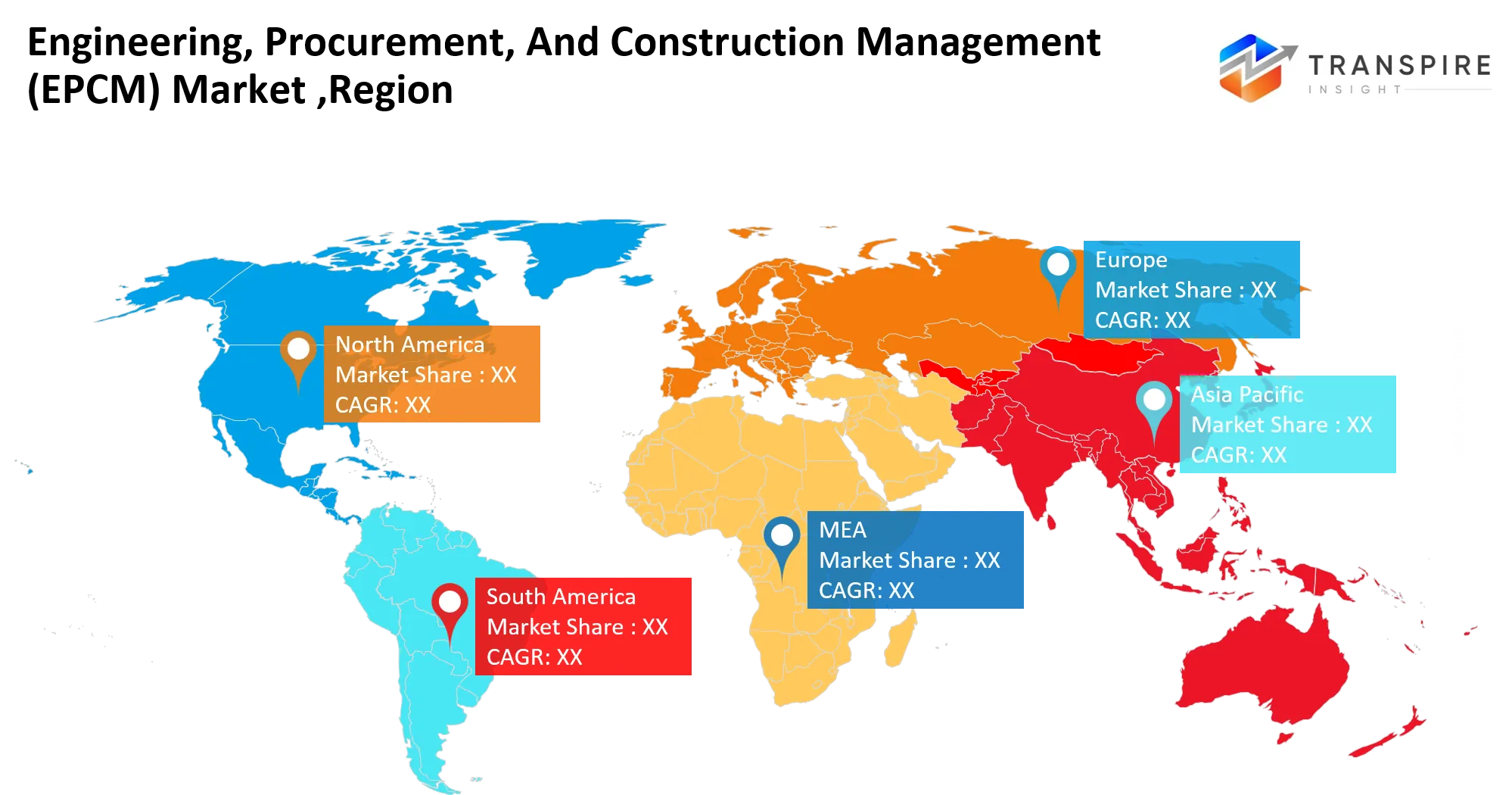
Asia Pacific leads with 44.0%, as it combines the world's largest pipeline of urban, industrial, transport and power projects with ever-growing manufacturing capacity. Multi-year EPCM demand is driven by government-backed infrastructure and industrial projects, through water security and industrial relocation investments, and by electrification. The region's supplier network, engineering talent and modular fabrication framework also allow a faster move from design to delivery than many Western jurisdictions.
In October 2026, ABB signed a joint venture agreement with Mitsubishi Electric to carve out its low-voltage power distribution product business. This partnership establishes a $495 million investment to transform ABB's electrification footprint and scale up low-voltage power distribution infrastructure across key growth markets in the Asia-Pacific region.
Europe has 16.5% market share, based on depth of regulation, quality of engineering and implementation of energy transition (not individual project volumes). Demand focuses on grid modernisation, offshore wind, hydrogen, decarbonising industry and renovating old utility assets. The Middle East and Africa has 6.2%, driven by energy, petrochemical, water and large project investments. Latin America makes up 4.3%, where mining, transmission and renewables projects deliver a more certain demand footprint, because the market is more steady through long-cycle public infrastructure and resource sector programmes, even during boom-and-bust private-sector investment cycles.
In July 2026, Nexans entered a long-term five-year agreement with Hydro to secure a supply of approximately 85,000 tonnes of low-carbon aluminium wire rod. This partnership directly addresses rising European infrastructure needs by utilizing 100% renewable energy-produced aluminium from Norway to build medium-voltage power grids, overhead transmission lines, and subsea high-voltage systems.
North America is 29.0% and the fastest growing at 14.2% CAGR, driven by a recent confluence of artificial intelligence data centre buildout, power demand, nuclear renaissance, liquefied natural gas, and recent reshoring of advanced manufacturing through projects such as Jacobs' 1-gigawatt Texas AI campus and AtkinsRéalis' nuclear-powered AI data centre collaboration with Nvidia, all of which require 'deep knowledge' of integrated power, cooling, grid, and digital delivery. Opportunities to come in grid interconnection, on-site generation, storage, and fast-track EPCM for hyperscale and semiconductor facilities.
In March 2026, AtkinsRéalis announced a partnership with technology company NVIDIA to explore the integration of AI-driven digital twin architectures and accelerated computing to design nuclear-powered, gigawatt-scale AI factories.
Who are the Key Players in the Engineering, Procurement, and Construction Management (EPCM) Market, and how do they compete?
Competition now focuses on a new set of engineering and project delivery companies capable of leveraging technical capabilities with sourcing scale and execution credibility. Cost per hour has given way to mobilization of hard-to-find specialists, supply chain risk management, and schedule certainty enabled through the use of digital project controls.
Bechtel's innovation strategy includes AI, robotics and automation as part of an EPC transformation program to reduce design-to-field time and rework. Its 'integrated execution at scale' is differentiating. Fluor has a portfolio-niche strategy across five key markets: liquefied natural gas, mining, nuclear fuels, semiconductors and data centres. Its key differentiator is modular delivery and low-carbon engineering, with growth focused on advanced technology and critical minerals markets. Worley competes on energy transition and digital delivery, with AI-enabled full-project delivery and advanced work packaging leveraging predictability. Jacobs competes on complex infrastructure and AI campus delivery, while KBR, Technip Energies, Saipem, and McDermott compete on process, energy, offshore, and technology-intensive projects. AECOM, AtkinsRéalis, Tetra Tech, Hatch, SNC-Lavalin, and Turner Construction compete on infrastructure, nuclear, sustainability advisory, mining, and regional execution capability; AtkinsRéalis is expanding through investments in nuclear, AI infrastructure, and U.S. engineering services.
Key Players are:
- Bechtel
- Fluor
- Jacobs
- Worley
- Wood
- AECOM
- KBR
- Technip Energies
- Saipem
- McDermott\
- AtkinsRéalis
- Tetra Tech
- Hatch
- SNC-Lavalin
- Turner Construction
Engineering, Procurement, and Construction Management (EPCM) Market — Enhanced Competitive Benchmarking
|
Company |
Est. Revenue Share Range |
Key Offerings |
Strategic Positioning |
Geographic Strength |
Technology Focus |
|
Worley |
Estimated 3–6% |
FEED; EPCM; procurement management; asset lifecycle services |
Energy transition and complex industrial project integration |
Asia Pacific; North America; Middle East |
AI-enabled engineering, digital delivery, automation |
|
Fluor Corporation |
Estimated 2–5% |
Engineering design; EPCM; project controls; construction management |
Large-scale industrial projects with disciplined risk management |
North America; Middle East; Asia Pacific |
Advanced project controls, modularization, digital engineering |
|
Bechtel |
Estimated 2–5% |
Project management; engineering; procurement; construction oversight |
Mega-project delivery supported by integrated technical expertise |
North America; Middle East; Asia Pacific |
Digital project execution, modular construction, advanced analytics |
|
Jacobs Solutions |
Estimated 1–4% |
Capital project consulting; engineering; program management; infrastructure delivery |
High-value consulting and complex capital program management |
North America; Europe; Asia Pacific |
Digital twins, data analytics, model-based engineering |
|
KBR |
Estimated 1–3% |
FEED; engineering services; project management; process technology integration |
Technology-led delivery for energy and industrial projects |
North America; Middle East; Asia Pacific |
Process engineering, digital solutions, advanced project controls |
|
Technip Energies |
Estimated 1–3% |
LNG project engineering; EPCM; process design; carbon capture project delivery |
Specialized process engineering and energy transition projects |
Europe; Middle East; Asia Pacific |
Process simulation, carbon capture, modular process systems |
|
Wood |
Estimated 1–3% |
Engineering design; EPCM; project management; asset optimization |
Brownfield expertise across energy and industrial facilities |
Europe; North America; Middle East |
Digital engineering, asset performance analytics, automation |
|
Larsen & Toubro |
Estimated 1–3% |
Engineering consultancy; procurement; project management; industrial engineering |
Integrated engineering capability with strong regional execution |
Asia Pacific; Middle East; Africa |
BIM, digital construction, engineering automation |
|
JGC Holdings |
Estimated 1–2% |
LNG engineering; process plant EPCM; FEED; procurement services |
Specialized process plant engineering and LNG project delivery |
Asia Pacific; Middle East; North America |
Process simulation, modularization, digital project engineering |
|
Saipem |
Estimated 1–2% |
Engineering services; offshore project management; procurement; energy infrastructure delivery |
Offshore engineering expertise and complex energy project execution |
Europe; Middle East; Latin America |
Subsea engineering, digital project management, offshore automation |
Recent Development News
In July 2026, Halliburton secured an EPCM and integrated field management services contract from Basra Oil Company for the development of the Bin Umar and Sindbad oil and gas fields in southern Iraq. The award combines engineering and project execution with digital planning and production optimization, supporting more coordinated field development and improved operational decision-making.
In May 2026, Jacobs secured an engineering, procurement, and construction management (EPCM) contract from Hut 8 to deliver its second AI data center campus, Beacon Point, in Texas. The contract strengthens Jacobs’ position in large-scale digital infrastructure projects, with digital twin technology supporting commissioning risk reduction and faster deployment of AI computing capacity.
In October 2026, Technip Energies secured a major Engineering, Procurement, and Construction (EPC) contract from Hindustan Petroleum Corporation Limited (HPCL) for its Lube Modernisation and Bottom Upgradation (LMBU) project at the Mumbai Refinery. This project will modernise HPCL's production capabilities by integrating a 550 KTA Integrated Hydrocracker and Catalytic Dewaxing unit alongside an 850 KTA Solvent Deasphalting unit to optimise automotive and industrial lubricant base stock manufacturing.
What Strategic Insights Define the Future of the Engineering, Procurement, And Construction Management (EPCM) Market?
The EPCM market is moving toward digitally integrated delivery models, where competitive advantage is based on managing project interfaces, and not hours of engineering effort. EPCMs with procurement analytics, predictive scheduling and life-cycle data will be better positioned to manage complex industrial and infrastructure projects. A hidden cost driver is the widening gap between aggressive schedules and the availability of specialist labour, electrical equipment and commodities - even sophisticated digital models can't fully address physical supply chain constraints. Other issues are the wide variation in data quality by contractors, which can skew AI forecasting and create blind spots in pricing. A new opportunity is in the emerging digital hub for AI, grid modernization, nuclear and carbon-capture infrastructure, which demands cross-disciplinary collaboration. EPCMs should prioritise interoperable data platforms, supplier-risk monitoring and modular engineering standards, as well as stronger regional ties. Owners should evaluate providers based on risk awareness, schedule durability and life-cycle performance, not just initial rates.
Key Segmentations are:
Service Type
- Engineering Services
- Procurement Services
- Construction Management
- Project Controls
- Commissioning
- Consulting
- Digital EPCM
- Others
Project Type
- Infrastructure
- Industrial
- Commercial
- Energy
- Mining
- Oil & Gas
- Utilities
- Transportation
End User
- Public Sector
- Private Sector
- Oil & Gas Companies
- Mining Companies
- Utilities
- Manufacturing Companies
- Infrastructure Developers
- Others
Contract Type
- Fixed Price
- Cost Plus
- Time & Material
- Unit Price
- Target Cost
- Guaranteed Maximum Price
- Framework
- Others
Application
- Oil & Gas
- Mining, Power
- Infrastructure
- Chemicals
- Manufacturing
- Transportation
- Water & Wastewater
Enterprise Size
- Large Enterprises
- Mid-Sized Enterprises
- SMEs
- Government Organizations
- Multinational Corporations
- Regional Contractors
- Engineering Firms
- Others
Frequently Asked Questions
Find quick answers to common questions.
The engineering, procurement, and construction management (EPCM) market size was valued at USD 19.99 billion in 2025 and is poised to reach USD 26.77 billion by 2033, expanding at a 3.72% CAGR.
Key segments for the engineering, procurement, and construction management (EPCM) market are Service Type (Engineering Services, Procurement Services, Construction Management, Project Controls, Commissioning, Consulting, Digital EPCM, Others)Project Type (Infrastructure, Industrial, Commercial, Energy, Mining, Oil & Gas, Utilities, Transportation)End User (Public Sector, Private Sector, Oil & Gas Companies, Mining Companies, Utilities, Manufacturing Companies, Infrastructure Developers, Others)Contract Type (Fixed Price, Cost Plus, Time & Material, Unit Price, Target Cost, Guaranteed Maximum Price, Framework, Others)Application (Oil & Gas, Mining, Power, Infrastructure, Chemicals, Manufacturing, Transportation, Water & Wastewater)Enterprise Size (Large Enterprises, Mid-Sized Enterprises, SMEs, Government Organizations, Multinational Corporations, Regional Contractors, Engineering Firms, Others)
Growth is primarily driven by large-scale infrastructure development, energy-transition investments, AI data-centre construction, industrial modernization, complex procurement requirements, and the adoption of digital project-management technologies
The market is led by major manufacturers, including Bechtel, Fluor, Jacobs, Worley, Wood, AECOM, KBR, Technip Energies, Saipem, McDermott, AtkinsRéalis, Tetra Tech, Hatch, SNC-Lavalin, Turner Construction
Asia Pacific holds 44.0% of the market, supported by manufacturing expansion, government infrastructure investment, industrial development, energy projects, and growing demand for integrated engineering and procurement services.
- Bechtel
- Fluor
- Jacobs
- Worley
- Wood
- AECOM
- KBR
- Technip Energies
- Saipem
- McDermott\
- AtkinsRéalis
- Tetra Tech
- Hatch
- SNC-Lavalin
- Turner Construction
About the Authors

Kartik bhong
I am Kartik Bhong, a Senior Research Analyst at Transpire Insight, specializing in the Packaging, Manufacturing, and Construction industry. My work focuses on analyzing market trends, emerging technologies, industry regulations, and competitive landscapes to deliver accurate, data-driven insights. I am passionate about transforming complex industry information into clear, practical content that helps businesses, professionals, and decision-makers stay informed and make confident strategic decisions. Through continuous research and a strong commitment to accuracy, I strive to create reliable, well-researched content that reflects the latest developments across these dynamic industries and supports the vision of Transpire Insight in delivering valuable market intelligence.

Chakradhar Khansole
Chakradhar serves as the Research Director at Transpire Insight, bringing over 8 years of experience in technology, innovation, and strategic market intelligence. He specializes in transforming complex market data into actionable business insights that enable organizations to make informed, growth-oriented decisions. Recognized for his strategic vision and analytical expertise, Chakradhar leads high-impact research initiatives, delivering comprehensive market assessments, competitive intelligence, and forward-looking industry analysis.
Recently Published Reports
-
Apr 2026
Handling and Lifting Equipment Market
Handling and Lifting Equipment Market Size, Share & Analysis Report By Product (Cranes and Hoists, Forklifts, Conveyor Systems, Aerial Work Platforms, Others), By Application (E-Commerce, Automotive and Railway, Food and Beverages, Aviation, Others), and Geography (North America, Europe, Asia-Pacific, Middle East and Africa, South and Central America), 2021 - 2031
-
Nov 2026
HVAC Equipment Market
HVAC Equipment Market Size, Share & Analysis Report By Heating Equipment Type (Boilers and Furnaces, Heat Pumps, and Unitary Heaters), By Ventilation Equipment (Air Handling Units, Humidifiers and Dehumidifiers, Air Filters, and Fan Coiling Units), By Air Conditioning Equipment (Unitary Air Conditioners, Room Air Conditioners, Packaged Terminal Air Conditioners, and Chillers), By End User (Commercial, Residential, Industrial, and others), and Geography (North America, Europe, Asia-Pacific, Middle East and Africa, South and Central America), 2021 – 2031
-
Apr 2026
Refrigeration Valves Market
Refrigeration Valves Market Size, Share & Analysis Report By Type (Solenoid Valves, Expansion Valves, Check Valves, Service Valves, Others), By Application (Commercial Refrigeration, Industrial Refrigeration, Transport Refrigeration, Residential Refrigeration, Air Conditioning Systems), By End User (Food and Beverage Industry, Pharmaceutical Industry, HVAC Industry, Chemical Industry, Others), and Geography (North America, Europe, Asia-Pacific, Middle East and Africa, South and Central America), 2021 – 2031
-
Apr 2026
E-Commerce Packaging Materials Market
E-Commerce Packaging Materials Market By Material Type (Corrugated Boxes, Paper & Paperboard, Foam & Cushioning Materials, Plastic Packaging, Flexible Packaging, Protective Packaging, Others), By Product(Primary Packaging, Secondary Packaging, Tertiary Packaging), By Packaging Function (Protective Packaging, Branding & Presentation Packaging, Transit & Logistic Packaging, Sustainable Packaging, Tamper Evidence Packaging), By End-User (Retail & Consumer Goods, Electronic Appliances, Food & Beverages, Healthcare & Pharmaceutical, Fashion & Apparel, Home & Furnishing, Others); By Industry Analysis, Size, Share, Growth, Trends, and Forecasts 2021-2033