

Pneumatic Equipment Market Summary:
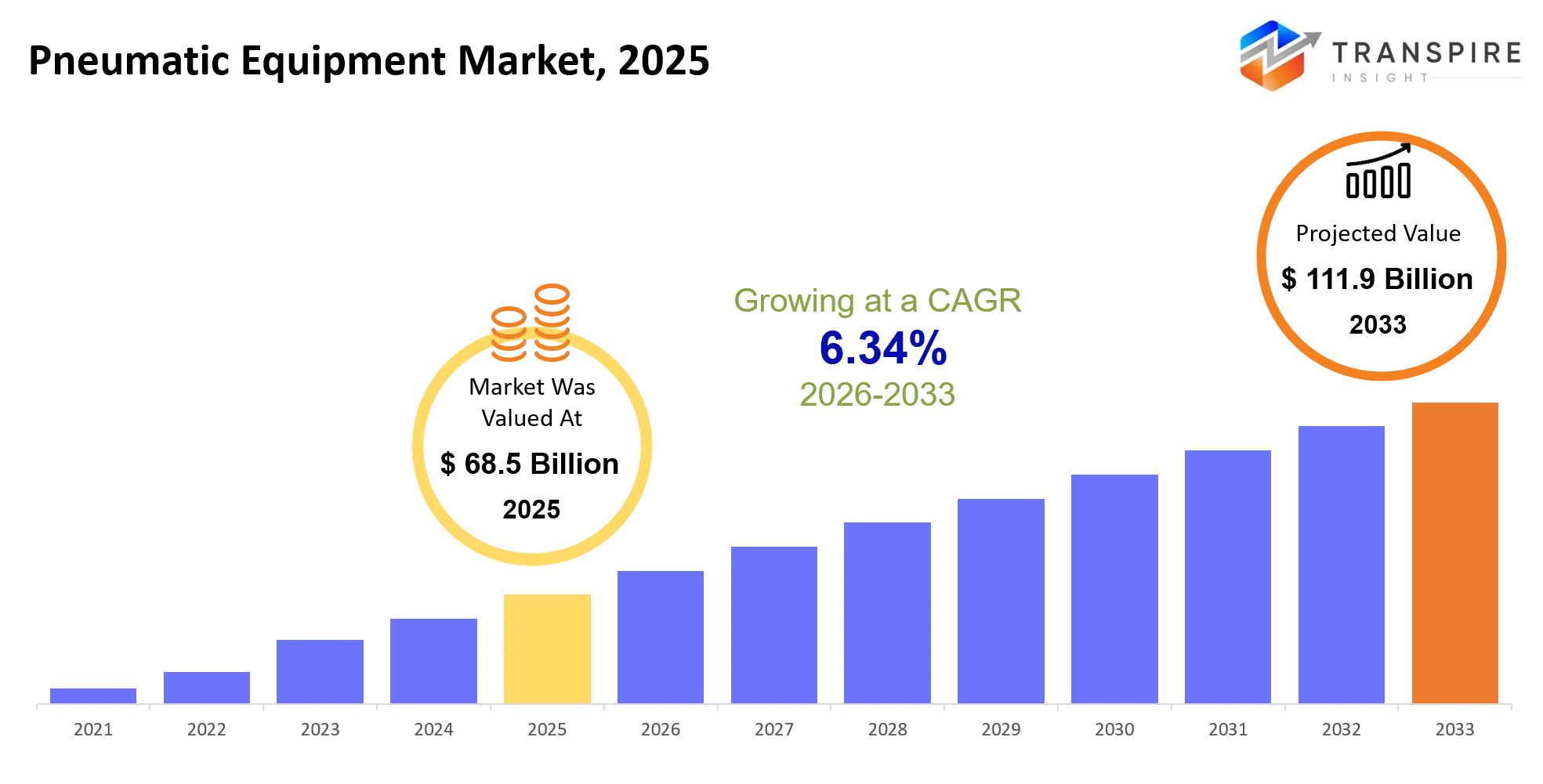
As per Transpire Insight Analysis, the Pneumatic Equipment Market size is estimated at USD 68.5 billion in 2025 and is anticipated to reach USD 111.9 billion by 2033, growing at a CAGR of 6.34% from 2026 to 2033.
The pneumatic equipment market plays a role in factory operations. It uses compressed air to power valves, actuators, cylinders, gripping tools and other machinery parts. These systems help manufacturers move materials, control production steps and perform tasks with reliable and consistent results. Over the last three to five years, the trend has been towards smaller and more compact parts. There is an emphasis on connected monitoring systems and pneumatic equipment that uses less compressed air. This is because of the increasing number of automated production lines. Also, there have been labour shortages that make automation more important. A big step has been the addition of sensors and electronic control systems into pneumatic systems. This enables operators to monitor the performance of equipment. It also helps them detect inefficiencies in their processes early enough. Whenever problems arise, they are able to correct them immediately. Avoid downtime. The investment in equipment has increased in industries such as semiconductor manufacturing, packaging and automobile manufacturing. These industries require precise and reliable movement. They require equipment that can function continuously without making mistakes. As manufacturers continue to look for ways of improving productivity and reducing costs, pneumatic equipment continues to be an option. This is because of the motion control, material handling and speed of repetitive actions.
Pneumatic Equipment Market Size & Forecast:
- Market Size 2025: USD 68.5 Billion
- Expected Market Value (2033): USD 111.9 Billion
- Forecast CAGR (2026–2033): 6.34%
- Leading Region in 2025: Asia Pacific
- Fastest Growing Region: North America
- Key Company Profiles: SMC, Festo, Parker Hannifin, Emerson, IMI, Bosch Rexroth, Norgren, Aventics, Camozzi, CKD, Airtac, Metal Work, Janatics, PneuTech, Atlas Copco
Key Market Insights
The market is moving towards automation components consisting of both traditional pneumatic components and electronic components and functions, including sensors.
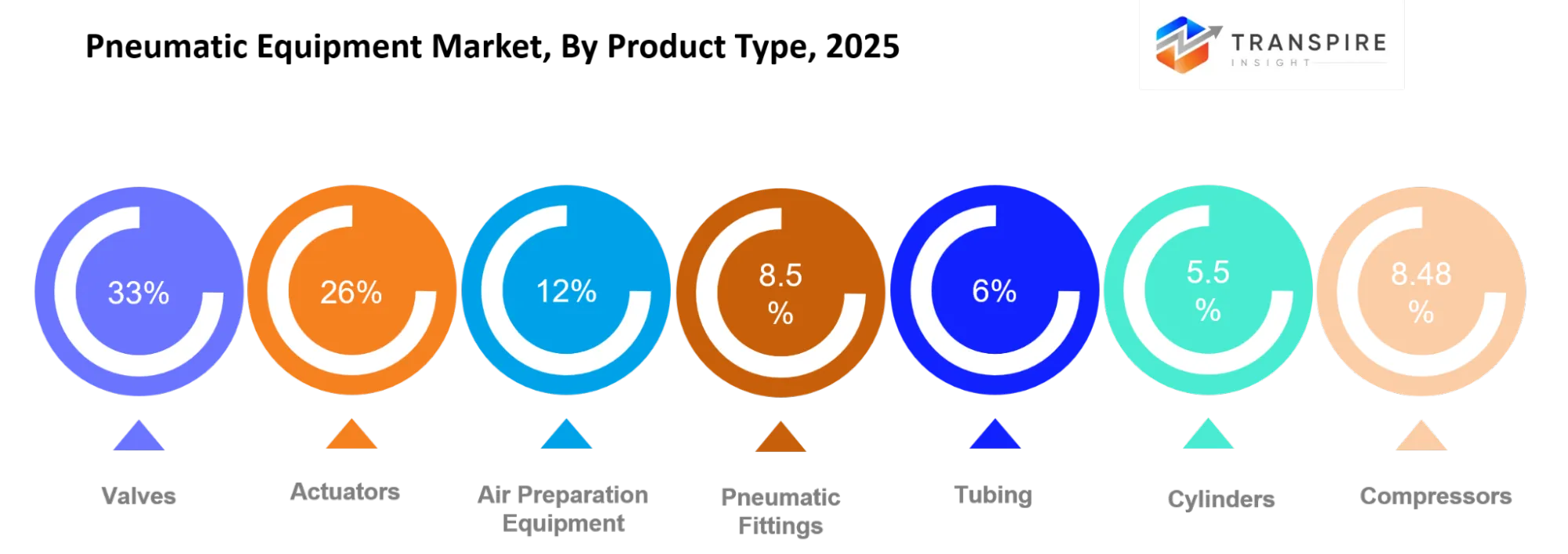
- The valves account for 33.02% of the market because of their role in controlling the flow of air and allowing precise control in automated machinery.
- The actuators constitute 26.0% of the market, although their expected CAGR of 7.46% implies that there are many opportunities for actuator automation.
- There is air preparation equipment making up 12.5% of the market because of demand for reliable supply of air through filtration and pressure control.
- The pneumatic fittings make up 8.5% of the market due to compact connection design and ease of assembly in the equipment production process.
- The tubing constitutes 6.0% of the market since manufacturers use light and sturdy air lines for modern small-scale machinery.
- Cylinders constitute 5.5% of the market for repetitive linear movement in industries.
- Compressors account for 5.0% of the market, while users are encouraged to consider energy consumption in the evaluation of compressor efficiency.
What are the Key Drivers, Restraints, and Opportunities in the Pneumatic Equipment Market?
Drivers
The automation of manufacturing operations is increasing the demand for pneumatic machinery. Pneumatic valves, cylinders, and actuators are used in the automotive, electronics, and packaging industries to carry out repeated motions at the pace of production. A shortage of labour and the need to maintain constant production have provided considerable motivation for manufacturers to automate their manual processes.
Restraints
Energy consumption is a critical issue since compressing air is costly, particularly in cases where there is leakage, air is vented to a pressure that is not required, or when the system is left idle. This may render pneumatics unattractive in applications that require a lot of small and precise motions. Initial investment and skill required to add sensors, energy-efficient equipment, and controls to existing systems are some of the issues that could lead to reluctance from many of the smaller manufacturers.
Opportunities
Opportunities lie in intelligent pneumatics, predictive maintenance, and system design. The use of sensors will allow users to identify pressure fluctuations, leaks, and malfunctioning components before they lead to production stoppage. Investment in new pharma plants, semiconductor facilities, and advanced packaging lines provides an opportunity for vendors of application-specific solutions. Providers who combine pneumatic technology with sensor monitoring, energy-efficient air treatment, and support will be able to distinguish themselves through lower costs and higher uptime.
|
Driver |
Relative Impact on Market Growth (%) |
Geographic Relevance |
Impact Timeline |
Demand Strength |
Growth Mechanism (5–10 words) |
Key Beneficiaries (5–10 words) |
Major Constraint (5–10 words) |
|
Industrial Automation and Smart Manufacturing Adoption |
28% |
Asia Pacific, North America, Europe |
Short/Medium-term |
High |
Automates repetitive operations and improves production efficiency. |
Pneumatic component manufacturers, automation integrators, industrial end users. |
High initial investment and integration complexity limit adoption. |
|
Expansion of Automotive and Electronics Manufacturing |
23% |
Asia Pacific, North America, Europe |
Short/Medium-term |
High |
Supports assembly lines, precision handling, and component manufacturing. |
Automotive suppliers, electronics manufacturers, pneumatic equipment vendors. |
Manufacturing slowdowns and capital expenditure fluctuations restrict demand. |
|
Growth in Food, Beverage, and Pharmaceutical Processing |
19% |
North America, Europe, Asia Pacific |
Medium/Long-term |
High |
Enables hygienic processing, packaging, filling, and material handling. |
Food processors, pharmaceutical companies, packaging equipment manufacturers. |
Strict sanitation requirements and specialized equipment costs constrain adoption. |
|
Energy Efficiency and Compressed-Air System Optimization |
16% |
Europe, North America, Asia Pacific |
Medium/Long-term |
High |
Reduces compressed-air losses and lowers industrial operating costs. |
Energy-efficient equipment suppliers, facility operators, maintenance service providers. |
Leakage, inefficient installations, and retrofit costs delay improvements. |
|
Adoption of Smart Pneumatic Components and Predictive Maintenance |
14% |
North America, Europe, Asia Pacific |
Medium/Long-term |
Medium |
Integrates sensors and analytics to predict equipment failures. |
Smart component manufacturers, industrial IoT vendors, maintenance providers. |
Legacy system compatibility and skills shortages slow implementation. |
|
Total |
100% |
— |
— |
— |
— |
— |
— |
What Has the Impact of Artificial Intelligence Been on the Pneumatic Equipment Market?
The use of artificial intelligence technology is opening up possibilities for the enhancement of monitoring, maintenance and control of pneumatic equipment in automated production facilities. Coupled with pressure sensors, flow meters, temperature sensors and machine control systems, the analysis of operating data with the help of analytical software may reveal anomalies in air consumption, pressure inconsistency and actuator performance. This information will allow maintenance teams to check for faults prior to causing long equipment shutdowns. Predictive maintenance with the help of AI can also take into account historical operating data. In packaging and automotive assembly industries, such an approach will allow maintenance teams to schedule servicing based on production schedule rather than solely on fixed maintenance intervals. The success of using AI in this case depends on having reliable data, proper sensors and compatibility of equipment with current machines. Old pneumatic systems will need extra hardware and effort to collect useful data. Predictions made by AI can be inaccurate in cases where equipment lacks sufficient maintenance history and operating conditions have changed significantly. That is why manufacturers should not regard AI as a replacement for engineering and maintenance decisions but as an aid.
Instance
In November 2025, Automation manufacturer Festo, headquartered in Germany, launched an AI-driven AX Motion Insights Pneumatic system to analyse pneumatic cylinders' performance and anomalies. It evaluates cylinder status using machine data and assists maintenance personnel in pinpointing issues before breakdowns take place. It is a predictive maintenance solution that minimises the risk of unplanned downtime.
Key Market Trends:
Market trends have been shifting from standalone compressed air elements toward smart energy-efficient automation systems.
- Pneumatics are increasingly connected with electronic controllers to facilitate monitoring of individual element operation and rapid reaction to production needs.
- There has been increased interest in energy saving, encouraging users to discover leaks in compressed air supply, decrease pressure and better control of the system.
- There has been growing demand for predictive maintenance to help plants detect abnormal pressure, leaks and damage to components before affecting production.
- There are hybrid automation designs with pneumatic components and electric drives employed depending on the precision, speed and power needed in each job.
- Manufacturers of food, beverages and pharmaceuticals consider proper materials, operating environment and gripping technology essential in their business.
Pneumatic Equipment Market Segmentation
By component type
valves have the highest market share of 33.02% as they play a vital role in regulating airflow, directing compressed air and controlling machine movement. Actuators constitute 26.0% of the market and are the fastest-growing components, with a CAGR of 7.46% as they are increasingly used in automated positioning and motion control. Air preparation equipment makes up 12.5%, pneumatic fittings constitute 8.5%, and tubing represents 6.0%. Cylinders have a market share of 5.5%, compressors make up 5.0%, and other components represent 3.48%. These types of components work together, and future demand will depend on equipment reliability, system efficiency and the amount of automation required by end users.
By function
The market consists of motion control, material handling, clamping, positioning, gripping, air treatment, pressure control and other specialised functions. Motion control helps to carry out repetitive movements in production machinery, while material handling and gripping assist in transferring components between manufacturing stages. Clamping and positioning are vital in assembly, where parts need to be held in place for machining or inspection. Air treatment and pressure control ensure reliable operation by maintaining the proper compressed-air conditions. The uploaded data does not show individual market shares
By pressure range
Pneumatic machines may be low pressure, medium pressure, high pressure, ultra-high pressure, vacuum, variable pressure, precision pressure, and many others. Low and medium pressure devices can accomplish a wide range of common automation functions in any ordinary factory. Machines that operate at higher pressures are used where there are tougher expectations of the machine. Vacuum machines are employed to hold, lift, and move work pieces when minimal physical contact is required. Variable and precision pressure devices enable greater control of machinery when there are changing operating conditions.
By application
the market applications of the product range from industrial machines to automobiles, to food and beverage products, to health care, to chemicals, to electronics, etc. Pneumatics is used in industrial machines for the actuation and movement of machines and for clamping; in the automobile industry, pneumatics is used for assembling parts and for transferring parts. For food and beverage and packaging industries, it is important to consider reliable and consistent movement and gripping of the product. Health care and electronics industries require special materials and controlled environment, and the same applies to chemical plants.
By End users
The end users are manufacturing, automotive, oil and gas, health care, food processing, electronics, chemicals, and construction. The use of general manufacturing applications is quite varied due to the nature of most of the activities carried out in the production process that require the use of pneumatic systems. The automotive and electronics manufacturers will be looking for equipment that allows for repetitive and bulk operations, while health care and food processing companies will look for reliability and cleanliness. The oil and gas, and the chemicals industries will be looking for equipment that fits their process needs.
By technology
The pneumatics market today covers conventional pneumatics, electro-pneumatics, smart pneumatics, IoT-enabled products, energy-efficient equipment, servo pneumatics, proportional pneumatics and others. The conventional pneumatics systems still fulfil proven requirements in a number of established industrial applications. Electro-pneumatic products provide a link between the movement of compressed air and electronic controls. Smart and IoT-enabled equipment provides operators with data on operation and better fault detection, while energy-efficient equipment aims at reducing waste air consumption. Servo and proportional pneumatics enable applications with more sophisticated movement or adjustable pressure and flow.
What are the Key Use Cases Driving the Pneumatic Equipment Market?
Pneumatic equipment has use cases in automated motion control, airflow control and repetitive mechanical processes. Valves are an important part of these functions since they enable compressed air to be supplied to cylinders, actuators and other parts. Manufacturing plants use such equipment in their processes of clamping, positioning and controlling machines in order to ensure a reliable production cycle. Important application areas are packaging and automotive assembly since pneumatic equipment enables product transfer, manipulation, gripping and repetitive assembly processes. Food and beverage manufacturing uses appropriate pneumatic equipment for moving products and running machinery, while hygiene considerations may affect the choice of parts. Electronics manufacturing requires small pneumatic systems that can be incorporated into automated manufacturing equipment. New applications include connected pneumatic systems which can provide data on pressure, airflow and the condition of components. Such features can assist operators in detecting air leakages, lowering air consumption and planning maintenance procedures. Pneumatic equipment with specialised gripping and energy-efficient technologies creates new opportunities in pharmaceutical manufacturing.
|
Report Metrics |
Details |
|
Market size value in 2025 |
USD 68.5 Billion |
|
Market size value in 2026 |
USD 72.75 Billion |
|
Revenue forecast in 2033 |
USD 111.9 Billion |
|
Growth rate |
CAGR of 6.34% from 2026 to 2033 |
|
Base year |
2025 |
|
Historical data |
2021 - 2024 |
|
Forecast period |
2026 - 2033 |
|
Report coverage |
Revenue forecast, competitive landscape, growth factors, and trends |
|
Regional scope |
United States; Canada; Mexico; United Kingdom; Germany; France; Italy; Spain; Denmark; Sweden; Norway; China; Japan; India; Australia; South Korea; Thailand; Brazil; Argentina; South Africa; Saudi Arabia; United Arab Emirates |
|
Key company profiled |
SMC, Festo, Parker Hannifin, Emerson, IMI, Bosch Rexroth, Norgren, Aventics, Camozzi, CKD, Airtac, Metal Work, Janatics, PneuTech, Atlas Copco |
|
Customization scope |
Free report customization (country, regional & segment scope). Avail customized purchase options to meet your exact research needs. |
|
Report Segmentation |
Component (Valves, Actuators, Air Preparation Equipment, Pneumatic Fittings, Tubing, Cylinders, Compressors, Others)Function (Motion Control, Material Handling, Clamping, Positioning, Gripping, Air Treatment, Pressure Control, Others)Pressure Range (Low Pressure, Medium Pressure, High Pressure, Ultra-High Pressure, Vacuum, Variable Pressure, Precision Pressure, Others)Application (Industrial Machinery, Automotive, Food & Beverage, Packaging, Healthcare, Chemicals, Electronics, Others)End User (Manufacturing, Automotive, Oil & Gas, Healthcare, Food Processing, Electronics, Chemicals, Construction)Technology (Conventional Pneumatics, Electro-Pneumatics, Smart Pneumatics, IoT-Enabled, Energy-Efficient, Servo Pneumatics, Proportional Pneumatics, Others) |
Which Regions are Driving the Pneumatic Equipment Market Growth?
North America
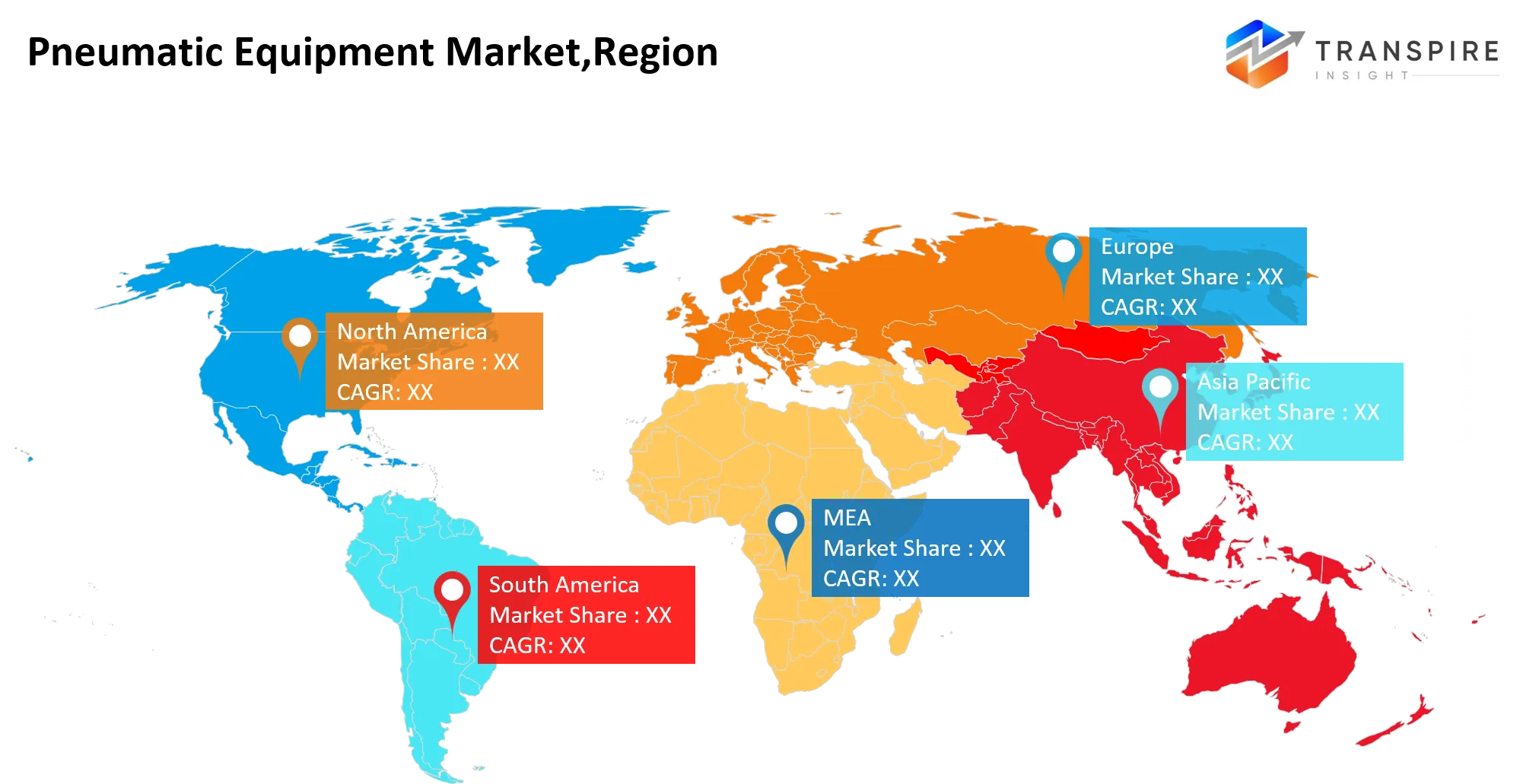
The North American region constitutes 31.24% of the market share for pneumatic equipment and is considered to be the fastest-growing region with a CAGR of 7.66%. Investments made in factory automation and the availability of advanced production and manufacturing equipment help drive regional growth. The existence of well-established providers of industrial technology and the need for maintenance services drive up equipment replacements, which creates avenues for connected pneumatic systems to enhance visibility and eliminate air losses.
In March 2025, SMC launched national open houses for National Pneumatics Day, covering aspects of maintenance of compressed air systems, air leaks and energy savings. Such efforts facilitate the development of demand for pneumatic equipment maintenance and improvements throughout North American manufacturers.
Europe
Europe holds 18.5% of the total pneumatic equipment market share owing to the presence of its well-established industrial base and focus on manufacturing efficiency. Automotive production, industrial machinery, and food processing serve as diverse customer segments for pneumatic equipment. Pneumatic equipment manufacturers are increasingly focusing on their energy consumption, efficiency, and integration with automated production systems.
In April 2025, Festo, based in Germany, introduced new trends in industrial automation that include pneumatics, digitisation, controls and software. The trends indicate the growing use of pneumatic equipment in connection with the automation of the manufacturing process, which allows European companies to optimise their production process.
Asia-Pacific
The Asia-Pacific region leads the pneumatic equipment market by accounting for 42.71%, owing to its huge manufacturing capability and large number of production plants. Demand in the region is driven by automotive manufacturing, electronics assembly, packaging and general industrial investments. The growth in automated plants and production capacity in manufacturing nations provides opportunities for both traditional products and connected pneumatic products. Those manufacturers offering competitive pricing and technical support will benefit from this diverse industrial market in the region.
In November 2025,Hitachi announced the opening of a manufacturing and sales plant in Gandhinagar, Gujarat, India, to manufacture oil-flooded screw air compressors. This move facilitates the availability of compressed air equipment in the area, due to the growing demand from manufacturers and industrial automation.
Who are the Key Players in the Pneumatic Equipment Market and how do they Compete?
The competition in the international pneumatic equipment industry focuses on product dependability, wide range of products, energy efficiency, technical assistance and the ability to cater to various industries. The existing suppliers compete by introducing innovative parts, application engineering and the distribution system, while the specialized manufacturers compete by focusing on specific equipment needs or the cost-conscious customers. The customer considers not only the cost of the product but also the total operating cost, replacement availability and the capability of integration with other machinery.SMC Corporation is competing by its wide variety of products and distribution across the world as well as by automation and energy-efficient products.Festo is competing by automation engineering, pneumatics and electric drives and solutions for improving production efficiency. This approach suits those customers that need an integrated system rather than isolated parts.CKD Corporation and Airtac International Group are some of the other competitors in the pneumatic components and automation equipment industries. In the entire market, the suppliers can improve their positions by localized manufacture, distribution partnerships, product customization and after sales services.
Pneumatic Equipment Market companies
- SMC
- Festo
- Parker Hannifin
- Emerson
- IMI
- Bosch Rexroth
- Norgren
- Aventics
- Camozzi
- CKD
- Airtac
- Metal Work
- Janatics
- PneuTech
- Atlas Copco
|
Company |
Est. Revenue Share Range |
Key Offerings |
Strategic Positioning |
Geographic Strength |
Technology Focus |
|
SMC Corporation |
Estimated 12–18% |
Pneumatic cylinders, solenoid valves, air preparation units, fittings and vacuum equipment |
Broad portfolio leadership through component specialization |
Asia Pacific, North America, Europe |
Energy-efficient, networked pneumatic control |
|
Festo SE & Co. KG |
Estimated 8–13% |
Pneumatic actuators, valve terminals, air preparation systems, pneumatic grippers |
Premium automation solutions with integrated motion control |
Europe, Asia Pacific, North America |
Smart pneumatics and connected automation |
|
Parker-Hannifin Corporation |
Estimated 5–9% |
Pneumatic cylinders, directional valves, air preparation equipment, fittings |
Diversified fluid-power portfolio and application engineering |
North America, Europe, Asia Pacific |
Integrated fluid control and energy efficiency |
|
Emerson Electric Co. |
Estimated 4–7% |
AVENTICS pneumatic valves, cylinders, valve systems, air preparation equipment |
Industrial automation integration and application-specific solutions |
North America, Europe, Asia Pacific |
Connected pneumatics and intelligent valve control |
|
Bosch Rexroth AG |
Estimated 3–6% |
Pneumatic components, valves, actuators, industrial automation solutions |
Integrated factory automation and engineering expertise |
Europe, Asia Pacific, North America |
Mechatronics and networked industrial control |
|
IMI plc (Norgren) |
Estimated 2–4% |
Pneumatic cylinders, air preparation units, valves, pressure regulators |
Precision pneumatics for demanding industrial applications |
Europe, North America, Asia Pacific |
Precision control and application-specific pneumatics |
|
Camozzi Automation S.p.A. |
Estimated 1–3% |
Pneumatic valves, cylinders, air treatment units, fittings |
Customizable components and specialized automation solutions |
Europe, Asia Pacific, Latin America |
Modular pneumatics and proportional control |
|
CKD Corporation |
Estimated 1–3% |
Pneumatic cylinders, solenoid valves, air preparation units, directional control systems |
Precision components for automated manufacturing |
Asia Pacific, North America, Europe |
Compact pneumatics and precision process control |
|
AIRTAC International Group |
Estimated 1–3% |
Pneumatic cylinders, solenoid valves, air treatment units, fittings |
Value-oriented components with scalable manufacturing |
Asia Pacific, Europe, North America |
Cost-efficient components and modular design |
|
Metal Work S.p.A. |
Estimated 0.5–2% |
Pneumatic cylinders, valves, FRL units, fittings and accessories |
Specialized modular systems for machine builders |
Europe, Asia Pacific, Latin America |
Modular pneumatic circuits and compact components |
Recent Development News
In June 2026, Kirloskar Pneumatic launched its A800 centrifugal air compressor in the 600-980 CFM capacity range. It has emphasized the indigenous design and intelligent monitoring and energy efficiency of its product, thus enhancing its product portfolio in compressed air applications.
In January 2025, Atlas Copco declared that the compressed air treatment and on-site gas generation manufacturer Trident Pneumatics in India had become a part of the group. This deal has enhanced its product portfolio in air treatment and gas generation and industrial applications like textiles and food & beverages.
What Strategic Insights Define the Future of the Pneumatic Equipment Market?
The future development trends in the pneumatic equipment market will move toward intelligent and energy-saving automation rather than using just standard compressed-air parts. The share of valves within the industry is which implies that the ability to increase efficiency in terms of airflow control, leakages management and the level of system integration would be critical for the supplier of such solutions. of actuators is another indicator of prospects associated with the implementation of movement automation, position regulation and materials handling. There is also the risk connected with the cost of operation of inefficient compressed-air systems in manufacturing plants despite advanced component solutions. It suggests that suppliers should compete by providing the prospect of reducing lifecycle expenses rather than offering only component price advantages. One of the new opportunities might be in connected pneumatic equipment equipped with sensors, predictive maintenance features and energy consumption measurement capabilities. Solutions like that can prove useful for companies manufacturing parts used in semiconductor production, pharmaceutical facilities and packaging Companies can concentrate on efficient product design, suitable digital control technologies, regional distribution of after-sales services, and evidence of customer savings.
Component
- Valves
- Actuators
- Air Preparation Equipment
- Pneumatic Fittings
- Tubing
- Cylinders
- Compressors
- Others
Function
- Motion Control
- Material Handling
- Clamping
- Positioning
- Gripping
- Air Treatment
- Pressure Control
- Others
Pressure Range
- Low Pressure
- Medium Pressure
- High Pressure
- Ultra-High Pressure
- Vacuum
- Variable Pressure
- Precision Pressure
- Others
Application
- Industrial Machinery
- Automotive
- Food & Beverage
- Packaging
- Healthcare
- Chemicals
- Electronics
- Others
End User
- Manufacturing
- Automotive
- Oil & Gas
- Healthcare
- Food Processing
- Electronics
- Chemicals
- Construction
Technology
- Conventional Pneumatics
- Electro-Pneumatics
- Smart Pneumatics
- IoT-Enabled
- Energy-Efficient
- Servo Pneumatics
- Proportional Pneumatics
- Others
Frequently Asked Questions
Find quick answers to common questions.
The pneumatic equipment market size was valued at USD 68.5 Billion in 2025 and is poised to reach USD 111.9 Billion by 2033, expanding at a 6.34%CAGR.
Key segments for the pneumatic equipment market are Component (Valves, Actuators, Air Preparation Equipment, Pneumatic Fittings, Tubing, Cylinders, Compressors, Others)Function (Motion Control, Material Handling, Clamping, Positioning, Gripping, Air Treatment, Pressure Control, Others)Pressure Range (Low Pressure, Medium Pressure, High Pressure, Ultra-High Pressure, Vacuum, Variable Pressure, Precision Pressure, Others)Application (Industrial Machinery, Automotive, Food & Beverage, Packaging, Healthcare, Chemicals, Electronics, Others)End User (Manufacturing, Automotive, Oil & Gas, Healthcare, Food Processing, Electronics, Chemicals, Construction)Technology (Conventional Pneumatics, Electro-Pneumatics, Smart Pneumatics, IoT-Enabled, Energy-Efficient, Servo Pneumatics, Proportional Pneumatics, Others)
Growth is primarily driven by increasing industrial automation, rising demand for efficient and reliable motion control systems, expanding manufacturing activities, and growing adoption of pneumatic equipment across automotive, electronics, food processing, and packaging industries
The market is led by major manufacturers including SMC, Festo, Parker Hannifin, Emerson, IMI, Bosch Rexroth, Norgren, Aventics, Camozzi, CKD, Airtac, Metal Work, Janatics, PneuTech, Atlas Copco
The Asia Pacific region accounts for 42.71% of the worldwide pneumatic equipment market share due to the fast pace of industrialization along with developments in manufacturing operations in automotive, electronic, and food processing industries in addition to increased spending on industrial infrastructure and cost-effective production.
Business opportunities because of growth in use of industrial automation, increasing demand for energy-efficient pneumatic equipment, and development of smart manufacturing factories. Growth in investments in emerging countries, technological advancement of pneumatic products, and increasing demand for predictive maintenance are some other factors that provide business opportunities to market players.
- SMC
- Festo
- Parker Hannifin
- Emerson
- IMI
- Bosch Rexroth
- Norgren
- Aventics
- Camozzi
- CKD
- Airtac
- Metal Work
- Janatics
- PneuTech
- Atlas Copco
About the Authors

Kartik bhong
I am Kartik Bhong, a Senior Research Analyst at Transpire Insight, specializing in the Packaging, Manufacturing, and Construction industry. My work focuses on analyzing market trends, emerging technologies, industry regulations, and competitive landscapes to deliver accurate, data-driven insights. I am passionate about transforming complex industry information into clear, practical content that helps businesses, professionals, and decision-makers stay informed and make confident strategic decisions. Through continuous research and a strong commitment to accuracy, I strive to create reliable, well-researched content that reflects the latest developments across these dynamic industries and supports the vision of Transpire Insight in delivering valuable market intelligence.

Chakradhar Khansole
Chakradhar serves as the Research Director at Transpire Insight, bringing over 8 years of experience in technology, innovation, and strategic market intelligence. He specializes in transforming complex market data into actionable business insights that enable organizations to make informed, growth-oriented decisions. Recognized for his strategic vision and analytical expertise, Chakradhar leads high-impact research initiatives, delivering comprehensive market assessments, competitive intelligence, and forward-looking industry analysis.
Recently Published Reports
-
Apr 2026
Handling and Lifting Equipment Market
Handling and Lifting Equipment Market Size, Share & Analysis Report By Product (Cranes and Hoists, Forklifts, Conveyor Systems, Aerial Work Platforms, Others), By Application (E-Commerce, Automotive and Railway, Food and Beverages, Aviation, Others), and Geography (North America, Europe, Asia-Pacific, Middle East and Africa, South and Central America), 2021 - 2031
-
Nov 2026
HVAC Equipment Market
HVAC Equipment Market Size, Share & Analysis Report By Heating Equipment Type (Boilers and Furnaces, Heat Pumps, and Unitary Heaters), By Ventilation Equipment (Air Handling Units, Humidifiers and Dehumidifiers, Air Filters, and Fan Coiling Units), By Air Conditioning Equipment (Unitary Air Conditioners, Room Air Conditioners, Packaged Terminal Air Conditioners, and Chillers), By End User (Commercial, Residential, Industrial, and others), and Geography (North America, Europe, Asia-Pacific, Middle East and Africa, South and Central America), 2021 – 2031
-
Apr 2026
Refrigeration Valves Market
Refrigeration Valves Market Size, Share & Analysis Report By Type (Solenoid Valves, Expansion Valves, Check Valves, Service Valves, Others), By Application (Commercial Refrigeration, Industrial Refrigeration, Transport Refrigeration, Residential Refrigeration, Air Conditioning Systems), By End User (Food and Beverage Industry, Pharmaceutical Industry, HVAC Industry, Chemical Industry, Others), and Geography (North America, Europe, Asia-Pacific, Middle East and Africa, South and Central America), 2021 – 2031
-
Apr 2026
E-Commerce Packaging Materials Market
E-Commerce Packaging Materials Market By Material Type (Corrugated Boxes, Paper & Paperboard, Foam & Cushioning Materials, Plastic Packaging, Flexible Packaging, Protective Packaging, Others), By Product(Primary Packaging, Secondary Packaging, Tertiary Packaging), By Packaging Function (Protective Packaging, Branding & Presentation Packaging, Transit & Logistic Packaging, Sustainable Packaging, Tamper Evidence Packaging), By End-User (Retail & Consumer Goods, Electronic Appliances, Food & Beverages, Healthcare & Pharmaceutical, Fashion & Apparel, Home & Furnishing, Others); By Industry Analysis, Size, Share, Growth, Trends, and Forecasts 2021-2033