Middle East and Africa Oxygen Cylinders Market Size & Forecast:
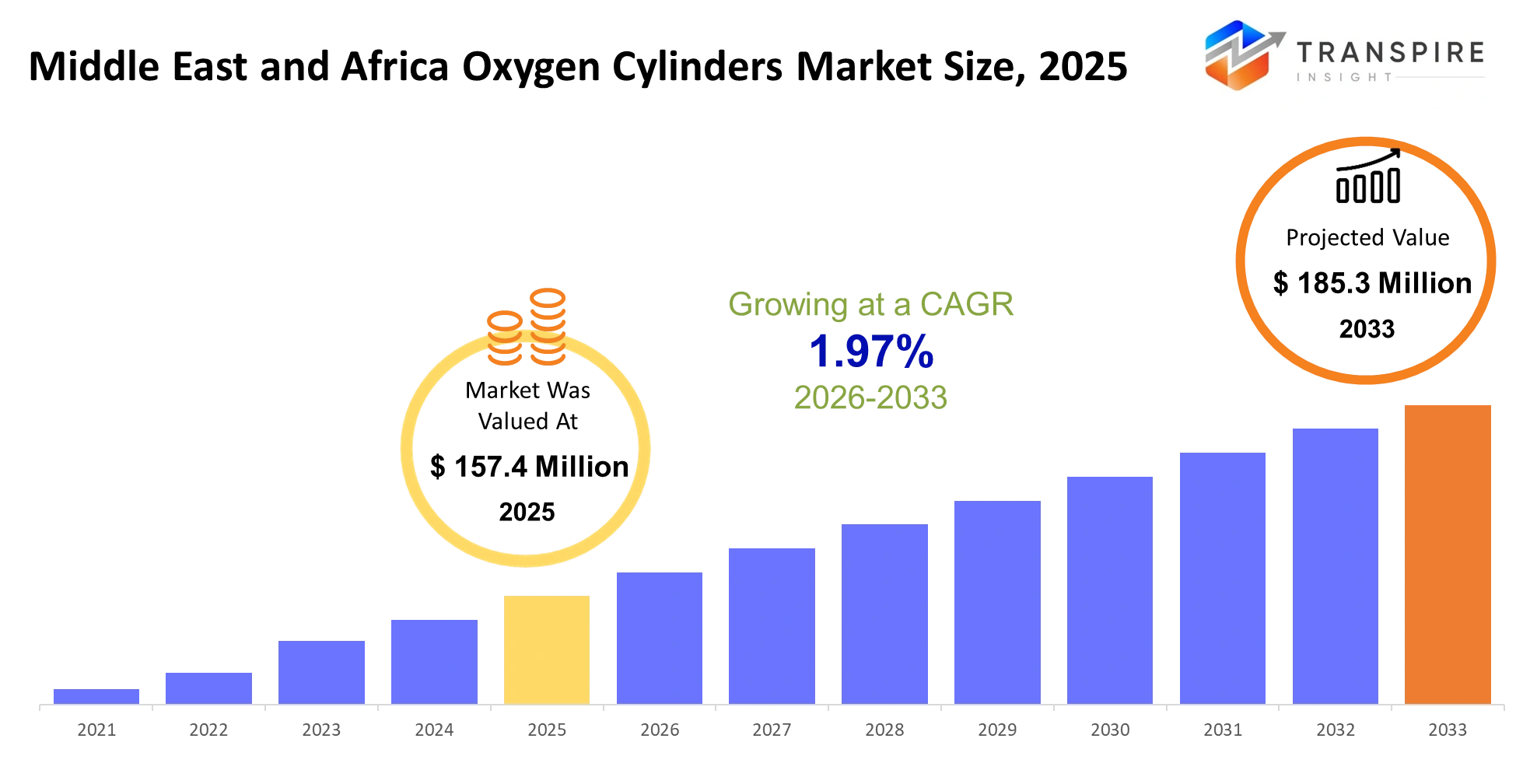
- Middle East and Africa Oxygen Cylinders Market Size 2025: USD 157.4 Million
- Middle East and Africa Oxygen Cylinders Market Size 2033: USD 185.3 Million
- Middle East and Africa Oxygen Cylinders Market CAGR: 1.97%
- Middle East and Africa Oxygen Cylinders Market Segments: By Type (Portable Cylinders, Fixed Cylinders, Liquid Oxygen Systems, Others); By Application (Medical Use, Industrial Use, Emergency Services, Others); By End-User (Hospitals, Clinics, Industrial Firms, Homecare, Emergency Services, Others); By Material (Steel, Aluminum, Composite, Others).
To learn more about this report,  Download Free Sample Report
Middle East and Africa Oxygen Cylinders Market Summary
The Middle East and Africa Oxygen Cylinders Market was valued at USD 157.4 Million 2025. It is forecast to reach USD 185.3 Million by 2033. That is a CAGR of 1.97% over the period.
The Middle East and Africa oxygen cylinders market sort of plays a critical operational role across healthcare, oil and gas, manufacturing, mining, and emergency response systems, where an uninterrupted oxygen supply kind of directly affects worker safety, medical treatment ability, and day to day industrial process continuity. In remote industrial zones and offshore conditions, oxygen cylinders still stay essential, since pipeline infrastructure is often limited, or just economically not worth it. Over the last three to five years, the whole market has moved more toward lightweight composite cylinders and high pressure storage systems, which improves mobility, cuts transportation costs, and also fits tighter workplace safety requirements.
Then COVID-19, it revealed serious weaknesses in the regional medical oxygen setup and it pushed public as well as private investment into oxygen storage and distribution networks. Governments across the Gulf region and parts of Africa expanded hospital capacities, created strategic oxygen reserves, and upgraded emergency preparedness frameworks. All of that raised procurement volumes for medical grade cylinders in a way that looks more or less permanent. Meanwhile, energy and mining operators also increased spending tied to industrial safety compliance, so the commercial customer base got broader too. Overall, this mix of healthcare infrastructure growth and industrial modernization keeps reinforcing replacement demand, plus the longer term service revenue opportunities, too.
Key Market Insights
- Gulf Cooperation Council countries were really dominating the Middle East and Africa Oxygen Cylinders Market, with almost 38% market share in 2025, more or less, because of hospital modernization projects that kept pushing updates.
- Saudi Arabia and the UAE sort of lead the regional oxygen cylinder demand through large scale healthcare investments, plus industrial gas infrastructure expansion that keeps growing steadily.
- Sub-Saharan Africa is seen as the fastest-growing regional market between 2026 and 2033 due to a wider healthcare access, and emergency preparedness initiatives.
- When it comes to materials, steel oxygen cylinders took the lead in 2025 for industry size with more than 52% share, mainly for durability and lower acquisition costs .
- Aluminum oxygen cylinders then held the second-largest market share , largely because portability is better suited for ambulatory healthcare and emergency medical services.
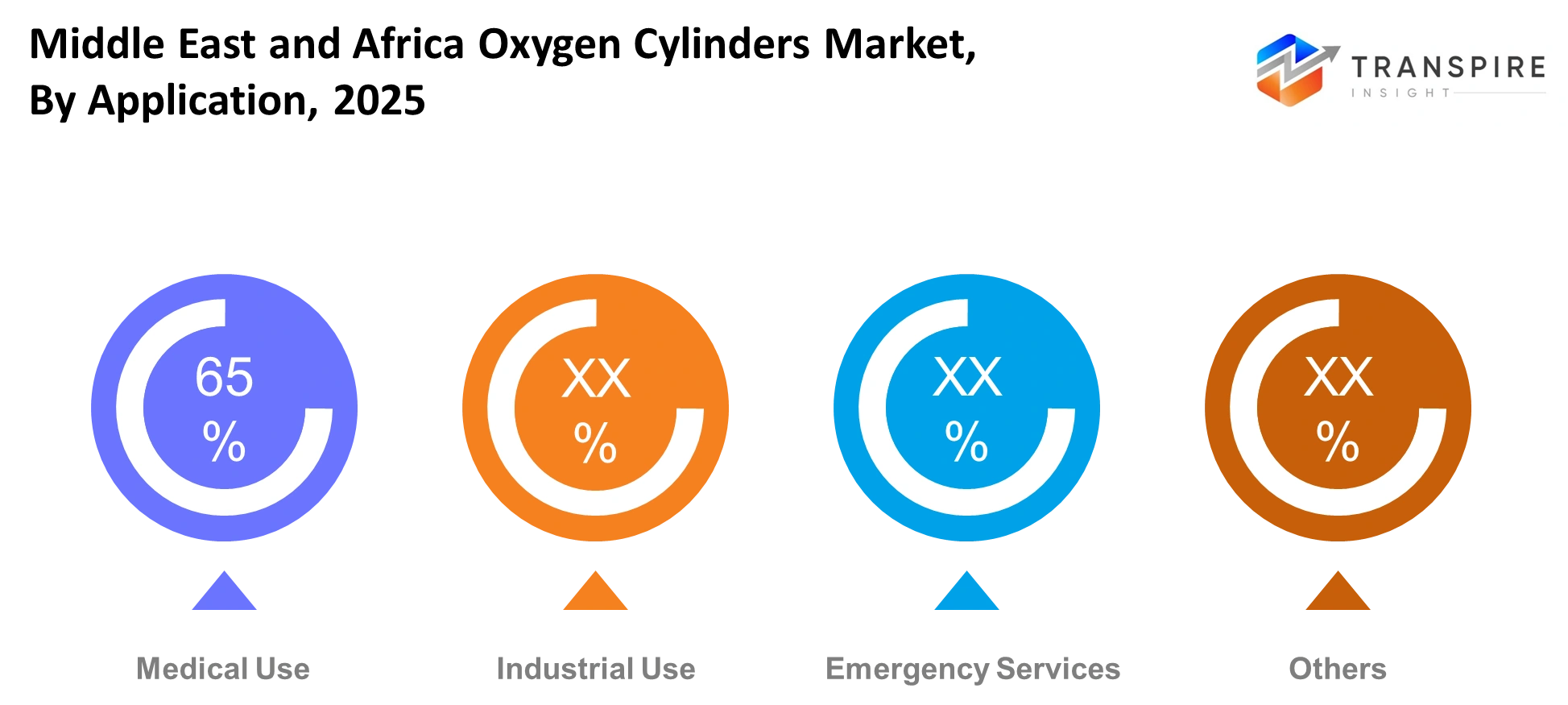
- On the type side , medical oxygen supply accounted for nearly 46% of Middle East and Africa Oxygen Cylinders Market revenue in 2025, driven by expanded hospital capacity and the need for more reliable oxygen availability.
- Industrial applications still keep a meaningful market share across welding, metal fabrication, oil refining, and mining safety operations.
- Meanwhile, emergency response and disaster preparedness applications show the fastest-growing demand trend across the forecast period.
- Also home healthcare oxygen therapy adoption picked up after 2021, helping strengthen recurring cylinder replacement, and distribution service revenue over time.
- For end users, hospitals and healthcare facilities dominated demand with more than 44% market share in 2025 across the regional oxygen storage market, which kind of makes sense given how much volume they handle daily.
What are the Key Drivers, Restraints, and Opportunities in the Middle East and Africa Oxygen Cylinders Market?
The main force pushing the oxygen cylinders market in the Middle East and Africa is the structural reinforcing of healthcare oxygen infrastructure , after pandemic related supply failures. Governments in Saudi Arabia , the UAE, Kenya and Nigeria expanded hospital oxygen capacity and set rules for minimum emergency oxygen reserves. That directly boosted purchasing volumes for medical-grade cylinders. This change also nudged longer-term contracting between hospitals and industrial gas suppliers, more like steady arrangements and recurring income than those one time buys. On top of that industrial safety regulations in oil and gas and mining helped cylinder adoption , because they now require tougher confined space measures and stronger worker protection. so the customer pool got wider than before.
The biggest pushback still comes from fragmented cold-chain type distribution and limited last-mile oxygen logistics especially across rural and peri-urban Africa. A lot of healthcare facilities rely on refill timelines that are inconsistent, mainly because transportation infrastructure is weak, and there is a lack of certified cylinder maintenance hubs. This structural shortcoming cannot be fixed fast , because it depends on wider logistics systems, energy steadiness, and workforce training ecosystems too. As a result, hospitals sometimes overstock or just postpone procurement, which drags down efficient inventory turnover and also makes revenue less predictable for suppliers.
A notable new opportunity is showing up through decentralized oxygen hubs, supported by digital tracking tools and micro refill stations across East Africa. Kenya and Tanzania are piloting localized oxygen filling networks that connect to hospital clusters, plus NGO-funded health systems.These models lessen reliance on centralized gas plants and end up building a scalable demand for lightweight composite cylinders and portable setups, sort of. Firms that invest early in modular oxygen infrastructure and also lean on regional service partnerships can land long term contracts, and really lock in strong positioning for the next growth cycle.
What Has the Impact of Artificial Intelligence Been on the Middle East and Africa Oxygen Cylinders Market?
Artificial intelligence alongside digital monitoring tools are gradually reshaping day to day operational management inside oxygen cylinder supply chains, across healthcare, industrial gas, and emergency response ecosystems, spanning the Middle East and Africa. Hospitals and gas distributors increasingly put IoT-enabled cylinder tracking systems to work, they watch pressure levels, location, and usage cycles in real time, so it cuts down the amount of manual checks ,and it also helps keep inventory numbers more accurate across scattered facilities. At the same time fleet operators rely on automated compliance dashboards to keep cylinder transport and storage habits aligned with safety regulations, especially within Gulf healthcare logistics networks.
Machine learning models now back predictive maintenance by looking at how often cylinders get used, the way pressure degradation patterns unfold, and the timing of refill cycles to foresee failure risks before they turn into operational disruptions. Industrial gas suppliers use these systems to refine refill scheduling, which raises asset utilization rates, and it lowers the need for abrupt emergency replenishments, particularly across mining and oilfield operations. In hospital networks, digital optimization tools have improved oxygen availability steadiness, and they reduce stockout incidents in high-demand emergency units, notably when seasonal respiratory surges arrive.
Still, there are limits. Adoption stays capped by limited interoperability between older cylinder infrastructure and newer digital platforms. A lot of rural healthcare facilities in Sub-Saharan Africa don’t have stable connectivity ,so real-time monitoring doesn’t work as well as it should. Also, high integration costs and not enough localized training data slow down wider rollout of advanced AI-based oxygen management solutions across the broader region.
Key Market Trends
- After 2021 oxygen shortages kind of exposed the hospital supply vulnerabilities, so healthcare providers shifted away from bulk oxygen reliance toward portable cylinder fleets, and yes it happened fairly fast.
- Composite cylinder adoption went up a lot, mainly because hospitals and EMS operators leaned into lightweight corrosion-resistant alternatives over the old traditional steel designs, which honestly were less flexible for field use.
- Between 2023 and 2025, Gulf countries then increased centralized oxygen procurement frameworks, that was done to stabilize hospital supply chains and also cut down distribution delays, in practice it helped.
- In parallel industrial users widened cylinder usage at oil and gas sites, after stricter occupational safety enforcement improved the confined space entry protocols, so access procedures got more reliable.
- Linde plc and Air Liquide also sped up investment in digital cylinder tracking systems, aimed at better supply chain visibility across dispersed African healthcare networks.
- Emergency preparedness programs expanded too, and after the pandemic disruptions , governments ended up stockpiling oxygen cylinders more, especially in Kenya, UAE and Saudi Arabia.
- Homecare oxygen therapy adoption accelerated after 2022, because aging populations pushed up the demand for portable respiratory support outside hospitals, rather than only inside them.
- Regional distributors strengthened last mile logistics networks, this was targeted to cover rural healthcare gaps and shorten oxygen delivery lead times across Sub-Saharan Africa.
- Finally, Worthington and Luxfer expanded composite manufacturing capacity, to keep up with the growing need for high pressure lightweight cylinders used in mobile medical applications.
Middle East and Africa Oxygen Cylinders Market Segmentation
By Type
Portable cylinders keep a dominant spot, mostly because they get used a lot in emergency medical services, homecare oxygen therapy, and remote industrial operations. The demand stays pretty high, since mobility and quick deployment really matter in hospitals that see patient loads changing all the time, and also in field work across oil and mining sites. Fixed cylinders still hold a steady share, backed by centralized hospital oxygen storage systems, plus industrial plants that need continuous supply integration. Liquid oxygen systems are smaller in comparison, but they’re important for high-capacity hospitals, where bulk storage efficiency means fewer refills.
Portable cylinders are showing more growth momentum, it seems, because healthcare delivery keeps moving toward decentralized, and home-based treatment models. Industrial users also like portable units for cramped space safety compliance, so that tends to extend replacement cycles in practice. Fixed systems grow more slowly, mainly due to infrastructure dependency and the installation costs that can be higher than expected. Liquid oxygen systems are getting more attention in tertiary hospitals, as oxygen demand density increases in urban medical centers.
Adoption of portable cylinders is likely to keep expanding, especially as lightweight composite materials improve handling , and also help reduce transport costs. Fixed systems will stay necessary for large hospitals, but they may feel pressure from modular oxygen supply solutions. Liquid oxygen systems will expand gradually in metropolitan healthcare clusters, which creates opportunities for suppliers focused on bulk storage engineering, and maintenance services.
By Application
Medical use tends to lead the whole application picture because there is a nonstop oxygen need in hospitals , surgical work and respiratory care rooms. People are extremely dependent on it , plus healthcare safety procedures are very strict , so procurement happens again and again in both public and private sites. Industrial use sits as a solid second tier , pushed by oil refining, welding , metallurgy and mining routines. Emergency services make up a smaller chunk but it matters a lot, it is backed by disaster response and military medical placements.
These medical applications keep growing, mainly when healthcare infrastructure keeps expanding and when chronic respiratory illness becomes more common. Industrial use stays fairly steady yet it can wobble with commodity cycles , and also when capital spending in heavy industries changes. Emergency services become more noticeable after pandemic driven preparation efforts and civil defense upgrades, which were carried out in several African and Gulf locations. The “other” group stays rather niche, still you can find it in aerospace testing , and also in lab setups.
Going forward , oxygen consumption for medical work will keep pulling demand upward, which nudges suppliers to tighten hospital contracts and to improve distribution channels. Industrial buyers are likely to focus more on cost effectiveness and safety compliance, so they will lean toward durable and reusable cylinders. Emergency services should broaden via government purchasing programs aimed at crisis readiness and mobile healthcare systems.
To learn more about this report, Download Free Sample Report
By End User
Hospitals are kinda the biggest end user group ,mainly because oxygen is used pretty much all the time in intensive care units, emergency departments and surgical wards. Procurement stays pretty well organized through centralized purchasing systems, which basically keeps demand cycles steady. Industrial firms follow fairly close, helped along by ongoing usage in oil and gas, mining, and manufacturing. Clinics and homecare providers are smaller, but they’re also moving fast, like they’re quickly changing their approach over time.
Hospital growth is still moving forward, largely due to new infrastructure build outs and more admissions for respiratory conditions. Industrial demand looks more stable too, supported by safety rules and the need to keep operations running without interruption. Homecare adoption is speeding up as patients move toward long-term oxygen therapy outside the hospital environment, which feels like a real shift. Emergency services keep expanding as governments push harder on disaster readiness, plus the idea of faster deployment systems.
Hospitals should remain the anchor segment for suppliers, especially for those trying to sell longer service contracts and maintenance support. Industrial firms will likely ask for ruggedized cylinders with higher pressure tolerance and also safety certification compliance. Homecare will turn into a main growth engine for portable oxygen solutions, and that’s expected to open doors for distributors and medical device providers.
By Material
Steel cylinders are still in the main position because production cost is relatively low durability is high, and they are easy to find almost everywhere, both in industrial setups and healthcare systems. Aluminum cylinders keep a solid share too, mostly for the lighter weight, plus the transport part is simpler for medical and emergency use. Composite cylinders stay smaller overall, but they are growing quickly as more people shift toward advanced material use and better handling efficiency.
Steel demand stays pretty steady in industrial environments, where cost efficiency is valued more than portability. Aluminum grows in healthcare and mobile applications, especially when transport flexibility makes a real difference. Composite cylinders expand faster because the push for lightweight solutions keeps getting stronger in homecare, emergency response, and offshore operations. Other materials, meanwhile, usually remain limited to specialized uses with niche, sometimes odd requirements.
Steel will probably keep leading in cost sensitive markets, even if some share slowly moves toward advanced materials over time. Aluminum is likely to remain important in hospital and emergency logistics networks. Composite cylinders may see the quickest adoption, as safety standards tighten, and operational efficiency becomes a procurement priority for both healthcare buyers and industrial buyers too.
What are the Key Use Cases Driving the Middle East and Africa Oxygen Cylinders Market?
Hospitals and emergency medical services are basically the main pull behind demand for oxygen cylinders across the Middle East and Africa oxygen cylinders market. Medical oxygen underpins critical care, surgical procedures, and respiratory treatment , especially in areas where pipeline oxygen infrastructure is fairly limited. Public health systems plus private hospitals keep steady cylinder inventories so that patient care doesn’t stop for even a moment.
Industrial applications then kick in as the next demand layer , most notably across oil and gas refineries mining sites , and metal fabrication facilities. In these places oxygen cylinders are used for welding, cutting, and combustion support, plus confined space safety compliance . Also, home healthcare is getting more attention these days, because aging patients and chronic respiratory cases often need portable oxygen outside typical clinical settings.
On top of that, emergency response and disaster preparedness are becoming clearer use cases, helped along by government civil defense programs and humanitarian agencies. Remote field hospitals and military medical units increasingly deploy portable oxygen systems, in rapid deployment situations . Even offshore energy platforms are looking at compact high-pressure cylinders to reinforce onboard medical readiness and keep treatments available.
|
Report Metrics |
Details |
|
Market size value in 2025 |
USD 157.4 Million |
|
Market size value in 2026 |
USD 161.7 Million |
|
Revenue forecast in 2033 |
USD 185.3 Million |
|
Growth rate |
CAGR of 1.97% from 2026 to 2033 |
|
Base year |
2025 |
|
Historical data |
2021 - 2024 |
|
Forecast period |
2026 - 2033 |
|
Report coverage |
Revenue forecast, competitive landscape, growth factors, and trends |
|
Regional scope |
Middle East and Africa (Saudi Arabia, United Arab Emirates, South Africa, Rest of Middle East and Africa) |
|
Key company profiled |
Linde, Air Liquide, Praxair, Messer, Taiyo Nippon Sanso, Worthington Industries, Catalina Cylinders, Luxfer Gas Cylinders, Chart Industries, Air Products, INOX Air Products, Gulf Cryo, Buzwair, Emirates Industrial Gases, National Industrial Gas Plants. |
|
Customization scope |
Free report customization (country, regional & segment scope). Avail customized purchase options to meet your exact research needs. |
|
Report Segmentation |
By Type (Portable Cylinders, Fixed Cylinders, Liquid Oxygen Systems, Others); By Application (Medical Use, Industrial Use, Emergency Services, Others); By End-User (Hospitals, Clinics, Industrial Firms, Homecare, Emergency Services, Others); By Material (Steel, Aluminum, Composite, Others). |
Which Regions are Driving the Middle East and Africa Oxygen Cylinders Market Growth?
The Gulf region kinda leads the Middle East and Africa oxygen cylinders market, mainly because healthcare spending is kinda concentrated there, industrial gas consumption is already huge, and there are pretty strong medical infrastructure expansion programs going on. Saudi Arabia, the UAE , and Qatar continue pouring money into hospital capacity, emergency preparedness systems, and industrial safety compliance across the oil and gas operations. The region also seems to get a boost from supply chains that are more integrated than you’d expect, like local gas production plus cylinder filling facilities, with advanced transportation networks that can handle high volume distribution. On top of that, solid regulatory oversight for workplace safety and medical oxygen storage really keeps long-term procurement activity steady, across both healthcare and industrial sectors, even when budgets shift a bit.
South Africa shows up as the second most significant regional market, but its strength isn’t only about healthcare infrastructure scale. It’s more like industrial diversification and operational steadiness that drive it. Mining, manufacturing, metal fabrication, and chemical processing industries build a fairly consistent oxygen cylinder demand, and that demand is less tied to public healthcare budgets. Compared to the Gulf economies, South Africa leans more on established industrial users and long-running distributor relationships, which in turn keep replacement cycles repeating. Then there’s also stable regulatory enforcement for occupational safety and industrial gas handling, which supports predictable purchasing behavior among bigger commercial operators.
East Africa is emerging as the fastest-growing regional market, because of newer investments in healthcare access, emergency oxygen infrastructure, and more decentralized medical supply systems.Countries like Kenya, Tanzania , and Ethiopia started to accelerate oxygen storage and cylinder procurement programs, after it became clear that medical oxygen supply had some weaknesses during the pandemic period. In parallel, international development funding, plus public private healthcare partnerships, has pushed more cylinder filling stations and those rural distribution pathways into areas that were underserved before. All of this, sort of stacked up—so the growth curve is creating really appealing chances for manufacturers , distributors, and service providers aiming for early market placement between 2026 and 2033. Especially if they focus on mobile oxygen delivery and lower upkeep cylinder technologies.
Who are the Key Players in the Middle East and Africa Oxygen Cylinders Market and How Do They Compete?
The Middle East and Africa oxygen cylinders market stays moderately consolidated , kind of, with multinational industrial gas suppliers going head to head with regional cylinder makers, distributors and so on. In practice, the competition seems to rest more on supply reliability, cylinder safety certification, and local distribution reach than it does on price alone. Big established players are still trying to hold market share using integrated gas production plus refill infrastructure, while smaller regional companies slowly pick up momentum by pitching quicker delivery networks and very tailored assistance for hospitals, oilfields, and mining sites, especially out near remote regions. Meanwhile tech differentiation is getting louder too, since buyers are increasingly leaning toward lightweight composite cylinders, digital cylinder traceability ,and also higher pressure storage systems, which lower day to day operational handling costs.
Air Liquide shows up with vertically integrated medical oxygen supply frameworks. Basically it ties together gas production, cylinder filling, and hospital delivery agreements across Gulf countries and North Africa . Their push into remote monitoring and cylinder tracking tools helps stabilize supply continuity for healthcare organizations that keep emergency oxygen reserves. Linde plc, on the other hand, differentiates via long term industrial gas agreements with petrochemical and manufacturing operators, most notably in energy intensive Gulf economies where uninterrupted supply becomes a real operational priority. Linde also keeps expanding through healthcare infrastructure partnerships and onsite gas generation projects, which reduces how much customers depend on third party distribution channels.
Luxfer Gas Cylinders kind of leans into niche specialization in lightweight composite, and aluminum cylinder technologies built for emergency medical transport plus offshore industrial use. Their cylinders offer corrosion resistance and a lower transportation weight, so the firm gets an advantage in mobile healthcare setups and marine environments too. Worthington Enterprises then, reinforces its position via advanced composite cylinder manufacturing, while also pushing the Ragasco product portfolio wider after a few strategic acquisitions in lightweight gas storage technologies. Gulf Cryo meanwhile, taps into regional distribution infrastructure along with localized refill operations to compete pretty effectively across Middle Eastern healthcare and industrial gas markets, where fast delivery and regulatory familiarity tend to shape procurement choices .
Company List
- Linde
- Air Liquide
- Praxair
- Messer
- Taiyo Nippon Sanso
- Worthington Industries
- Catalina Cylinders
- Luxfer Gas Cylinders
- Chart Industries
- Air Products
- INOX Air Products
- Gulf Cryo
- Buzwair
- Emirates Industrial Gases
- National Industrial Gas Plants
Recent Development News
In June 2025, Worthington Enterprises announced a 5% price increase on Ragasco composite cylinders sold in North America. The pricing action reflected sustained demand for lightweight composite gas storage systems and highlighted continued investment in advanced cylinder manufacturing capabilities relevant to oxygen and specialty gas markets.
Source: https://www.worthingtonenterprises.com
In March 2026, Air Liquide announced supply reallocation measures and operational adjustments following Middle East gas field disruptions affecting helium and industrial gas availability. The company’s response underscored the strategic importance of diversified medical and industrial gas supply infrastructure across the Middle East and Africa oxygen cylinders market.
Source: https://www.reuters.com
What Strategic Insights Define the Future of the Middle East and Africa Oxygen Cylinders Market?
The Middle East and Africa oxygen cylinders market is kind of drifting toward more decentralized oxygen delivery ecosystems, supported by portable storage tech, local refill setups, and cylinder networks that are digitally monitored. In the next five to seven years, healthcare resilience planning and industrial safety modernization will be the main structural pressures that guide purchasing choices, especially in places where centralized gas pipeline infrastructure is still limited. So this change will usually reward suppliers who can link cylinder manufacturing, distribution logistics, and real time inventory management into longer term service contracts, rather than just selling a product here and there.
There is also a less obvious risk though, and it has to do with a growing reliance on imported aluminum and composite materials used for lightweight cylinder production. That could put manufacturers right in the path of raw material price swings and possible supply interruptions. Meanwhile, East Africa looks like an emerging opening, since governments and development agencies are expanding rural healthcare oxygen access programs and also strengthening emergency response capacity. For companies aiming at long term advantage, it makes sense to put money in early regional cylinder filling partnerships and maintenance networks, because after sales service reliability will more and more end up deciding whether contracts stay in place, and whether recurring revenue remains stable.
Middle East and Africa Oxygen Cylinders Market Report Segmentation
By Type
- Portable Cylinders
- Fixed Cylinders
- Liquid Oxygen Systems
- Others
By Application
- Medical Use
- Industrial Use
- Emergency Services
- Others
By End-User
- Hospitals
- Clinics
- Industrial Firms
- Homecare
- Emergency Services
- Others
By Material
- Steel
- Aluminum
- Composite
- Others
Frequently Asked Questions
Find quick answers to common questions.
The Middle East and Africa Oxygen Cylinders Market size is USD 185.3 Million in 2033.
Key segments for the Middle East and Africa Oxygen Cylinders Market are By Type (Portable Cylinders, Fixed Cylinders, Liquid Oxygen Systems, Others); By Application (Medical Use, Industrial Use, Emergency Services, Others); By End-User (Hospitals, Clinics, Industrial Firms, Homecare, Emergency Services, Others); By Material (Steel, Aluminum, Composite, Others).
Major Middle East and Africa Oxygen Cylinders Market players are Linde, Air Liquide, Praxair, Messer, Taiyo Nippon Sanso, Worthington Industries, Catalina Cylinders, Luxfer Gas Cylinders, Chart Industries, Air Products, INOX Air Products, Gulf Cryo, Buzwair, Emirates Industrial Gases, National Industrial Gas Plants.
The Middle East and Africa Oxygen Cylinders Market size is USD 157.4 Million in 2025.
The Middle East and Africa Oxygen Cylinders Market CAGR is 1.97% from 2026 to 2033.
- Linde
- Air Liquide
- Praxair
- Messer
- Taiyo Nippon Sanso
- Worthington Industries
- Catalina Cylinders
- Luxfer Gas Cylinders
- Chart Industries
- Air Products
- INOX Air Products
- Gulf Cryo
- Buzwair
- Emirates Industrial Gases
- National Industrial Gas Plants
Recently Published Reports
-
Apr 2026
AI in Diabetic Retinopathy Market
AI in Diabetic Retinopathy Market Size, Share & Analysis Report By Type (Screening AI Systems, Diagnostic AI Systems, and Predictive AI Models), By Application Segment (Hospitals, Ophthalmology Clinics, Diagnostic Centers, and Research and Development), and Geography (North America, Europe, Asia-Pacific, Middle East and Africa, South and Central America), 2021 - 2031
-
Apr 2026
Psychometric Tests Market
Psychometric Tests Market Size, Share & Analysis Report By Type (Personality Tests, Ability/Aptitude Tests, Skill/Knowledge Tests, and Others), By Application (Talent Acquisition and Talent Management), and Geography (North America, Europe, Asia-Pacific, Middle East and Africa, South and Central America), 2021 – 2031
-
Apr 2026
Rare Biological Sample Collection Market
Rare Biological Sample Collection Market Size, Share & Analysis Report By Type (Isolation Kits & Reagent, Blood Collection Tubes, and Others), By Application (Oncology, Transcriptomics, Pharmacogenomics, and Others), and Geography (North America, Europe, Asia-Pacific, Middle East and Africa, South and Central America), 2021 – 2031
-
Apr 2026
Patient Lift Pendant Market
Patient Lift Pendant Market By Product Type (Wired Pendants, Wireless, Programmable), By Operation Type(Manual, Electric), By End-Users (Healthcare Professionals, Patients), By Application (Hospitals, Homecare, Rehabilitation Centers, Others), By Industry Analysis, Size, Share, Growth, Trends, and Forecasts 2021-2033
Our Clients
.jpg)