

Real Estate & Mortgage Market Summary:
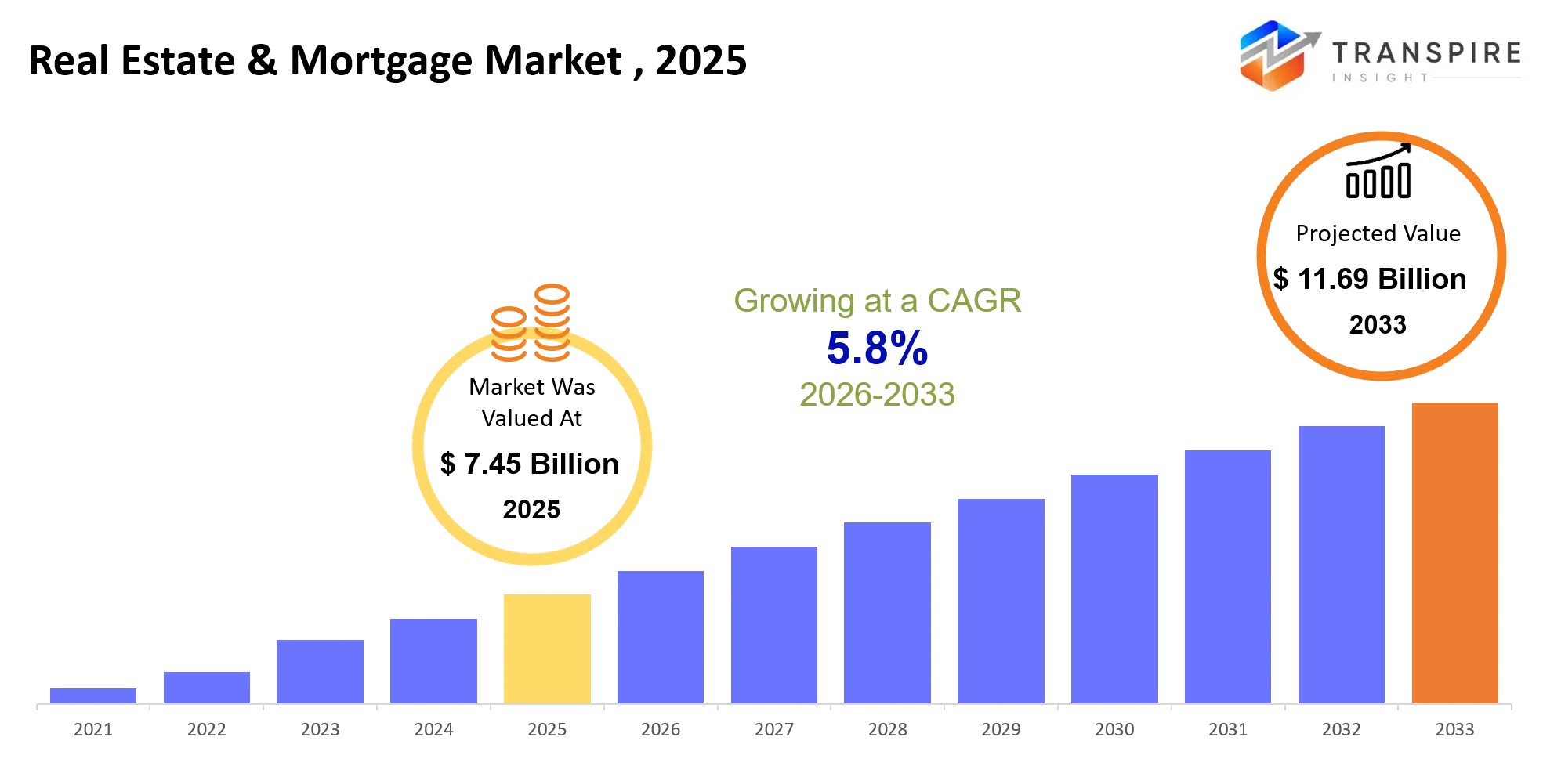
As per Transpire Insight Analysis, the Real Estate & Mortgage Market size is estimated at USD 7.45 trillion in 2025 and is anticipated to reach USD 11.69 trillion by 2033, growing at a CAGR of 5.8% from 2026 to 2033.
The estate and mortgage market provides property ownership, development and investment with the financing needed to finish deals. In the last three to five years, the real estate and mortgage market around the world has had to adjust to increased cost of borrowing, changes in affordability and increasing digitisation of property search and mortgage applications. A structural shift in the real estate and mortgage market includes the increasing use of digital mortgage platforms. Digital mortgage platforms allow customers to apply for mortgages, view various financing options and track their applications without relying on branch operations. One obvious trigger has been the combination of housing prices and changing interest rates. As a result, customers and lenders in the real estate and mortgage market have become more focused on monthly payments, refinancing options and approval periods. This has pushed providers to streamline the underwriting process, improve customer communication and integrate property services with lending. Thus, growth in the real estate and mortgage market is driven not only by increasing property activity but also by attempts to simplify transactions, expand access to finance and offer solutions for buyers, investors and developers through digital services.
Real Estate & Mortgage Market Size & Forecast:
- Market Size 2025: USD 7.45 trillion
- Expected Market Value (2033): USD 11.69 trillion
- Forecast CAGR (2026–2033): 5.8%
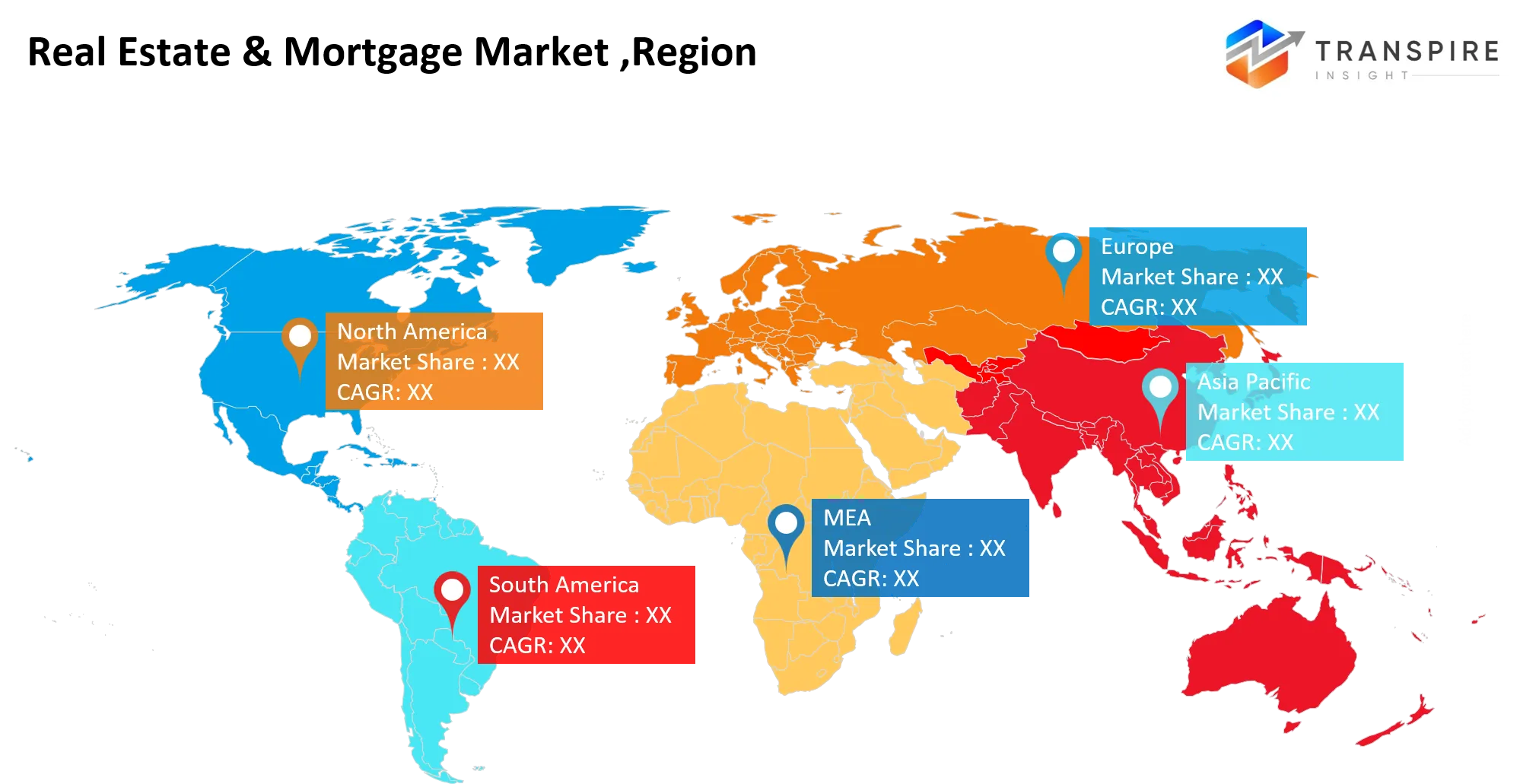
- Leading Region in 2025: North America
- Fastest Growing Region: Asia Pacific
- Key Company Profiles: CBRE, JLL, Cushman & Wakefield, Colliers, Brookfield Properties, Zillow, Redfin, Rocket Mortgage, United Wholesale Mortgage, Better, LoanDepot, Wells Fargo, JPMorgan Chase, Bank of America, Newmark
Key Market Insights:
The market is evolving towards streamlining processes, better financing and data-driven customer services.
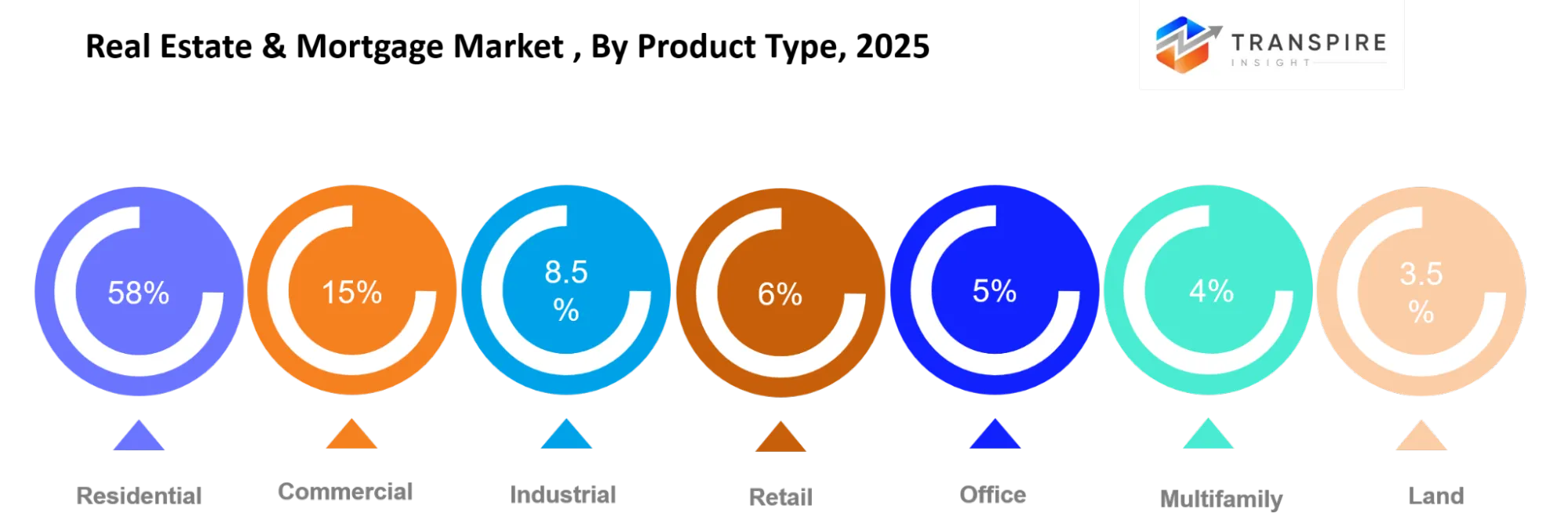
- Residential property constitutes 58.0% of the market breakdown segment mix offered.
- The commercial property constitutes 15.0%. Its transactions are driven by leasing, asset repositioning and financing considerations,
- The industrial segment constitutes 8.5% of the stated breakdown segment mix. It is driven by demands for logistics, warehousing and distribution network-linked
- The retail segment holds 6.0%. Property owners make decisions on property transactions based on footfall,
- The office segment constitutes 5.0%. The development of hybrid work has been driving competitive efforts in this segment in terms of building amenities and renovations.
- The multifamily segment accounts for 4.0%. Investors get the benefit of spreading rental income across several units within the same property.
What are the Key Drivers, Restraints, and Opportunities in the Real Estate & Mortgage Market?
Drivers
The banks along with service providers are working on the digitalized process in order to provide few number of requests for information, approval of applications quickly and less scrolling of lengthy email communication chains to potential homeowners. An online application system, as well as automatic verification checks, will take away all the friction from the mortgage process, allowing the banks to handle more applications without making additional steps manually. Also, increased use of digital property search will give new ways to look at houses for homeowners.
Restraints
Cost is also a structural barrier in that aspects such as affordability of the housing market, interest rates, insurance, taxes, and down payment requirements may pose a problem to some households. Lenders have to comply with different regulations according to each location and deal with different privacy laws and underwriting requirements. Inflexible systems and misaligned borrower data may increase costs related to integration and reduced automation.
Opportunities
Service providers can create integrated solutions that will include property discovery, mortgage pre-qualification, document submission, valuation, and after-sales assistance - a digital-only lender partnering with a real estate agency to help buyers go from the listing process to mortgage acquisition; or an investor who uses analytics to evaluate rental yield and inventory levels. In Asia Pacific, digital-first solutions and housing-finance collaborations might work better in getting access to markets where mobile services are more ubiquitous than they are in service.
|
Driver |
Relative Impact on Growth (%) |
Geographic Relevance |
Impact Timeline |
Demand Strength |
Growth Mechanism |
Key Beneficiaries |
Major Constraint |
|
Housing Demand and Urbanization |
28% |
Asia-Pacific, North America, Middle East |
Long-term |
High |
Urban population growth increases housing purchases and rentals. |
Residential developers, real estate agents, mortgage lenders, homebuyers. |
Housing shortages and rising property prices limit affordability. |
|
Mortgage Accessibility and Financing Conditions |
24% |
North America, Europe, Asia-Pacific |
Short-term |
High |
Improved credit access supports property purchases and refinancing. |
Mortgage banks, brokers, borrowers, housing finance companies. |
High interest rates and strict lending criteria restrict borrowing. |
|
Institutional Investment and Commercial Property Expansion |
20% |
North America, Europe, Asia-Pacific |
Medium-term |
High |
Capital inflows support acquisitions, development, and portfolio expansion. |
Property funds, institutional investors, developers, commercial landlords. |
Economic uncertainty and financing costs delay investment decisions. |
|
Digitalization, AI and Mortgage Technology |
16% |
North America, Europe, Asia-Pacific |
Medium-term |
High |
AI-driven valuation and automation accelerate property transactions and lending. |
Proptech firms, mortgage platforms, lenders, property buyers. |
Data privacy risks and legacy systems slow adoption. |
|
Sustainable Buildings and Government Housing Initiatives |
12% |
Europe, North America, Asia-Pacific |
Long-term |
Medium |
Green financing and housing incentives encourage property development. |
Green builders, lenders, homeowners, affordable housing developers. |
High construction costs and inconsistent policy support hinder implementation. |
|
Total |
100% |
Global |
— |
— |
— |
— |
— |
What Has the Impact of Artificial Intelligence Been on the Real Estate & Mortgage Market?
The use of artificial intelligence in the real estate and mortgage industry via document processing, customer service, and property analysis is becoming noticeable. In mortgage operations, AI-powered systems will classify financial statements, identity documents and property documents, and extract the necessary fields and missing data for further analysis. It will eliminate routine tasks from the loan officers' agenda and help borrowers get timely feedback. At the same time, predictive models may assist in estimating the probability of defaults, detecting suspicious application patterns, predicting property prices and analysing rental or occupancy trends. However, it is worth noting that the effectiveness of such systems depends on the quality of data used and proper human involvement.Historical data can be biased, property documents can have gaps, and the output of the model is not always correct. Integration with the legacy systems, privacy issues and compliance checks will incur extra costs as well. Therefore, AI is more helpful as a support tool for experts rather than as a substitute for their knowledge and experience.
Instance
In October 2026, TD Bank Group developed new AI capabilities to automate document verification and streamline the mortgage funding and disbursement process. The AI is supposed to increase efficiency, decrease processing times and enable employees to work with complicated tasks. This development shows how AI is used in the real estate and mortgage market.
Key Market Trends
The industry is shifting from disjointed processes for property and funding into integrated digital journeys. Meanwhile, affordability challenges are spurring competition in terms of transparency, fast service and innovative financing solutions.
- Property search has moved from being largely a discovery process performed by agents to using online listings, virtual tours and digital lead generation, providing customers with additional information before in-person visits.
- Online portals, e-signing and digitised documentation of mortgage applications reduce the need for multiple visits to branches.
- Financial institutions are evolving past simple digitisation to fully automated document review and AI-driven workflow management, combined with manual exception handling.
- Real estate companies are applying customer data and analytics in segmentation and demand forecasting as well as communication.
- Affordability has created demand for more refinancing, home equity and other alternative financing products where the regulatory environment allows for that.
- Investors take into consideration operating costs and performance, resilience and not just location and rents when valuing property assets.
Real Estate & Mortgage Market Segmentation
By Property Type
Real Estate is dominated by Residential real estate as the major type at 58.0%, facilitated by residential property purchases, household formations, and housing finance needs. Commercial real estate constitutes 15.0% of the supplied market mix, with its performance based on the tenant’s demands, business investment and asset re-positioning. Industrial real estate occupies 8.5% as it comprises warehouses and distribution centres. Retail real estate occupies 6.0%, while Office occupies 5.0%. Both retail and office types are undergoing adaptation due to changes in shopping behaviour and usage of office space. The multifamily properties constitute 4.0% and may be attractive for investors who are looking for rental income from several units. Land occupies 2.5%, and its value is based on planning and development potential.
By Mortgage Type
Standard loans are for borrowers who qualify under typical lending criteria, and all others are for groups qualified under the rules of their relevant programme in the US. We also offer loans to fund higher loan amounts than the applicable conforming limits (jumbo). Payments on fixed-rate mortgages are fixed, and payments on adjustable-rate mortgages can fluctuate with the reference rate and terms of the loan agreement. Commercial mortgage loans are for income-producing properties and other types of loans are for borrowers whose needs may not fall into the other broad categories.
By Transaction Type
Property transactions and new builds generate borrowing for acquisition and development. Refinances enable eligible borrowers to substitute a loan they already have with one that meets their needs; products for owner-occupiers tap into accumulated home equity. Investment property deals are motivated by their likely cash flow, operating costs and market value on resale. Commercial deals for acquisitions and land usually require inspection of cash flow, title, zoning and potential future development costs. The relative attractiveness of each varies with borrowing costs and economic sentiment.
By End User
The need-to-know details for home buyers could be affordability, loan eligibility and loan closing criteria. The investors are concerned about the performance of the investments, exposure of assets and loan compatibility. The developers require loan facilities that suit their project timelines and capitalization. Landlords want solutions that help them with rent collection, maintenance and communication with tenants. Corporates may be looking for property either for their business or as an investment. Public bodies and institutions are there to provide public facilities and subsidized housing.
By Service
Mortgage originations include intake and processing of the loan. Brokerage includes matching property or capital seekers with sellers or lenders. Property management includes leasing, maintenance and tenant management. Valuations include property valuation for transactions, lending and investment decisions. Title includes services that facilitate title searches, title clearance, and closing. Lending includes services that enable borrowing of money. Real estate advisory includes services related to acquisitions, disposals and portfolio strategy. Brokerage services that connect these service lines have the potential to reduce bifurcation of real estate transactions. They face conflict of interest and compliance risks.
By Distribution Channel
Deposits and lending relationships still matter, and specialist mortgage lenders can concentrate on products and underwriting, while brokers play the role of comparison services. Online players compete on the speed of access to opportunities, while credit unions, where members are defined, real estate companies, linking buyers to properties, and direct channels, where providers take complete control of the customer relationship.
What are the Key Use Cases Driving the Real Estate & Mortgage Market?
The buying of residences constitutes a use case due to the fact that the purchaser requires both property searching capabilities and affordability, mortgage and closure comparisons within one single experience. The reason why residential real estate is simplifying home mortgages could actually impact market operations significantly. Some extended use cases include acquiring, investing in or even refinancing commercial real estate, industrial property investments, rental property management and acquisition finance solutions. In this context, the use of business valuation and market information will aid the comparison process of different locations together with tenant demands. Some emerging use cases include artificial intelligence in checking mortgage documents, predictive property analysis services, digital home equity and integrated brokerage-lender solutions. The aim of the mentioned applications is to increase the efficiency of processing time and decision-making support but with adequate privacy measures.
|
Report Metrics |
Details |
|
Market size value in 2025 |
USD 7.45 trillion |
|
Market size value in 2026 |
USD 7.88 Trillion |
|
Revenue forecast in 2033 |
USD 11.69 Trillion |
|
Growth rate |
CAGR of 5.8% from 2026 to 2033 |
|
Base year |
2025 |
|
Historical data |
2021 - 2024 |
|
Forecast period |
2026 - 2033 |
|
Report coverage |
Revenue forecast, competitive landscape, growth factors, and trends |
|
Regional scope |
United States; Canada; Mexico; United Kingdom; Germany; France; Italy; Spain; Denmark; Sweden; Norway; China; Japan; India; Australia; South Korea; Thailand; Brazil; Argentina; South Africa; Saudi Arabia; United Arab Emirates |
|
Key company profiled |
CBRE, JLL, Cushman & Wakefield, Colliers, Brookfield Properties, Zillow, Redfin, Rocket Mortgage, United Wholesale Mortgage, Better, LoanDepot, Wells Fargo, JPMorgan Chase, Bank of America, Newmark |
|
Customization scope |
Free report customization (country, regional & segment scope). Avail customized purchase options to meet your exact research needs. |
|
Report Segmentation |
Property Type (Residential, Commercial, Industrial, Retail, Office, Multifamily, Land, Others)Mortgage Type (Conventional, FHA, VA, Jumbo, Fixed-Rate, Adjustable-Rate, Commercial Mortgage, Others)Transaction Type (Property Purchase, Refinancing, New Construction, Investment Property, Home Equity, Commercial Acquisition, Land Acquisition, Others)End User (Homebuyers, Investors, Developers, Landlords, Corporates, Government, Institutions, Others)Service (Mortgage Origination, Brokerage, Property Management, Valuation, Title Services, Lending, Real Estate Advisory, Others)Distribution Channel (Banks, Mortgage Lenders, Brokers, Online Platforms, Credit Unions, Real Estate Agencies, Direct Sales, Others) |
Which Regions are Driving the Real Estate & Mortgage Market Growth?
North America
North America constitutes 41.5%. This by well-developed mortgage markets, extensive real estate service networks, mature capital markets, and digital lending infrastructure. Moreover, there is an extensive network of brokers, property lenders, and technology players in the region. Its future growth depends partly on affordability, interest rate dynamics, and system modernisation of providers.
In May 2026, TD Bank Group launched an AI model to make mortgage and home equity loan applications faster by cutting pre-underwriting processes that usually take hours to mere minutes. This event is one of the latest examples of how AI technologies are being adopted in North America to speed up mortgage processing.
Europe
Europe constitutes 25.5% of the market under discussion. In comparison to North America, the region functions within a greater number of national housing regimes, mortgage operations, and legal regulations, which makes local expertise vital. Well-developed banking networks, property ownership culture, and professional valuations ensure stability. Requirements for energy efficiency, renovation and distinctions between national housing markets may impact the financing and advisory service demand.
In March 2026 ,The European Commission has unveiled plans to boost financing for energy-efficient renovation projects in the EU. The plan may boost the need for renovation loans.
Asia Pacific
Asia Pacific accounts for 22.0% and is classified as the fastest-growing region with an 8.9% CAGR from the provided data. Changes in property purchasing and financing are being brought about by urbanisation, household formation, infrastructure construction and digital financial services in the region. There are differences in terms of affordability, regulation and access to credit among other factors in different markets within the region.
In April 2026, GXS Bank collaborated with Funding Societies to provide property loans of up to S$2 million to eligible Singaporean small businesses.
Who are the Key Players in the Real Estate & Mortgage Market and how do they compete?
Competition occurs among brokers, listing websites, mortgage lenders, loan-servicing companies and technology companies; hence, one company does not compete across all value chain components. Big businesses have an edge through their brand awareness, customer database and sales network, while digital technology companies try to get ahead with speed and efficiency. The way different businesses compete is based increasingly on the customer experience, reliable data, financing methods and supporting clients after the first deal. Better Home & Finance competes using technology-enabled mortgages and its Tinman artificial intelligence system, which automates parts of the lending process and helps both borrowers and lenders. The growth strategies include wholesale and partnering methods which enable the company to reach customers outside the direct applications process. Blend targets financial institution origination technology, with differentiation happening via workflow technologies which could be integrated by lenders into their business management processes. Big banks and mortgage lenders compete in terms of funding sources, customers and expertise in underwriting and serving customers. For all businesses competing in the industry, partnerships could lead to expansion without disruption; however, they should prove that integration leads to conversion or improvements in other process elements.
Real Estate & Mortgage Market companies
- CBRE
- JLL
- Cushman & Wakefield
- Colliers
- Brookfield Properties
- Zillow
- Redfin
- Rocket Mortgage
- United Wholesale Mortgage
- Better
- LoanDepot
- Wells Fargo
- JPMorgan Chase
- Bank of America
- Newmark
|
Company |
Est. Revenue Share Range |
Key Offerings |
Strategic Positioning |
Geographic Strength |
Technology Focus |
|
CBRE Group |
Estimated: 1–3% |
Property management, leasing, capital markets, real estate advisory |
Integrated commercial real estate services leadership |
North America, Europe, Asia Pacific |
AI-driven property analytics and digital facilities management |
|
JLL (Jones Lang LaSalle) |
Estimated: 1–2.5% |
Leasing advisory, workplace management, investment sales, project management |
Technology-enabled property advisory and integrated workplace solutions |
North America, Europe, Asia Pacific |
AI-powered property intelligence and smart building platforms |
|
Cushman & Wakefield |
Estimated: 0.5–1.5% |
Commercial leasing, property management, valuation, capital markets |
Relationship-led advisory and comprehensive commercial property services |
North America, Europe, Asia Pacific |
Digital property analytics and intelligent workplace management |
|
Colliers |
Estimated: 0.3–1% |
Commercial brokerage, investment management, valuation, engineering advisory |
Entrepreneurial advisory model with diversified professional services |
North America, Europe, Asia Pacific |
Data-driven investment analytics and digital property advisory |
|
Brookfield Corporation |
Estimated: 0.5–2% |
Property ownership, asset management, real estate investment, property development |
Long-term asset ownership and institutional investment specialization |
North America, Europe, Asia Pacific |
Asset performance analytics and technology-enabled property operations |
|
Zillow Group |
Estimated: 0.1–0.5% |
Property listings, Zillow Home Loans, rental marketplace, agent advertising |
Consumer-focused digital property discovery and transaction ecosystem |
North America, particularly the United States |
AI-powered property search and digital mortgage integration |
|
Rocket Companies (Rocket Mortgage) |
Estimated: 0.1–0.5% |
Residential mortgages, refinancing, loan servicing, digital mortgage applications |
Digital-first lending with customer retention and refinancing capabilities |
North America, particularly the United States |
Automated underwriting and digital mortgage processing |
|
United Wholesale Mortgage (UWM) |
Estimated: 0.1–0.5% |
Wholesale mortgages, broker lending platform, loan processing, mortgage fulfillment |
Broker-centric lending and high-volume wholesale origination |
North America, particularly the United States |
Broker automation and technology-enabled loan origination |
|
JPMorgan Chase |
Estimated: 0.5–2% |
Residential mortgages, home equity loans, mortgage servicing, digital home lending |
Banking-led mortgage distribution and relationship-based lending |
North America, particularly the United States |
Digital home lending, credit analytics and automated servicing |
|
Bank of America |
Estimated: 0.3–1.5% |
Residential mortgage lending, home equity products, mortgage servicing, refinancing |
Integrated banking relationships and established residential lending capabilities |
North America, particularly the United States |
Digital mortgage applications, risk analytics and lending automation |
Recent Development News
In March 2026, Better Home & Finance and Coinbase launched the token-backed conforming mortgage offering where eligible consumers can stake the accepted tokens instead of selling them in order to finance a home purchase. The companies explained that their product is based on the conforming mortgage requirements and that the eligibility and product specifications are governed by the lenders.
In September 2025, reAlpha announced an update to their internal AI Loan Officer Assistant by adding the ability to classify documents, extract and validate data from over 75 document types.
What Strategic Insights Define the Future of the Real Estate & Mortgage Market?
There is a shift in the market towards connected property and financing services rather than disconnected listings, brokering, and lending activities. Firms that make applications easy to complete and offer customers information through the process are able to compete both in terms of experience and price. The more subtle danger is that the automation could create issues in the historical data and inconsistent results due to bad integration of systems. Thus, it is essential for firms to balance automation with data management, explanation of the decision process, privacy protection and human intervention. The potential lies in creating partnerships that unite the whole chain from property discovery to pre-qualification, documents collection and post-purchase services, especially if it offers mobile-first access to the new customer segments. In the Asia Pacific region, it would probably be more beneficial to build partnerships and products taking into account the affordability requirements of the region rather than copying the approach used in North America. It makes sense for firms to improve the time of approvals, applications completion rate, customer satisfaction and portfolio quality prior to the widespread use of technology in the company.
Property Type
- Residential
- Commercial
- Industrial
- Retail
- Office
- Multifamily
- Land
- Others
Mortgage Type
- Conventional
- FHA
- VA
- Jumbo
- Fixed-Rate
- Adjustable-Rate
- Commercial Mortgage
- Others
Transaction Type
- Property Purchase
- Refinancing
- New Construction
- Investment Property
- Home Equity
- Commercial Acquisition
- Land Acquisition
- Others
End User
- Homebuyers
- Investors
- Developers
- Landlords
- Corporates
- Government
- Institutions
- Others
Service
- Mortgage Origination
- Brokerage
- Property Management
- Valuation
- Title Services
- Lending
- Real Estate Advisory
- Others
Distribution Channel
- Banks
- Mortgage Lenders
- Brokers
- Online Platforms
- Credit Unions
- Real Estate Agencies
- Direct Sales
- Others
Frequently Asked Questions
Find quick answers to common questions.
The real estate & mortgage market size was valued at USD 7.45 trillion in 2025 and is poised to reach USD 11.69 trillion by 2033, expanding at a 5.8% CAGR.
Key segments for the real estate & mortgage market are Property Type (Residential, Commercial, Industrial, Retail, Office, Multifamily, Land, Others)Mortgage Type (Conventional, FHA, VA, Jumbo, Fixed-Rate, Adjustable-Rate, Commercial Mortgage, Others)Transaction Type (Property Purchase, Refinancing, New Construction, Investment Property, Home Equity, Commercial Acquisition, Land Acquisition, Others)End User (Homebuyers, Investors, Developers, Landlords, Corporates, Government, Institutions, Others)Service (Mortgage Origination, Brokerage, Property Management, Valuation, Title Services, Lending, Real Estate Advisory, Others)Distribution Channel (Banks, Mortgage Lenders, Brokers, Online Platforms, Credit Unions, Real Estate Agencies, Direct Sales, Others)
Growth is primarily driven by increasing urbanisation, rising demand for residential and commercial properties, favourable government housing initiatives, easier access to mortgage financing, growing real estate investments, and the adoption of digital lending platforms
The market is led by major manufacturers including CBRE, JLL, Cushman & Wakefield, Colliers, Brookfield Properties, Zillow, Redfin, Rocket Mortgage, United Wholesale Mortgage, Better, LoanDepot, Wells Fargo, JPMorgan Chase, Bank of America, Newmark
The North American real estate and mortgage market accounts for a share of 41.5% of the total real estate and mortgage market because of its developed real estate sector, mortgage lending systems, financial institutions, higher demand for housing and office buildings, and availability of digital real estate and mortgage options.
Opportunities in the international market of the real estate and mortgage industry are high demand for affordable homes, digitisation of the mortgage industry through online platforms, investments in commercial properties, growth of real estate in emerging markets, and the use of artificial intelligence in the real estate and mortgage industry.
- CBRE
- JLL
- Cushman & Wakefield
- Colliers
- Brookfield Properties
- Zillow
- Redfin
- Rocket Mortgage
- United Wholesale Mortgage
- Better
- LoanDepot
- Wells Fargo
- JPMorgan Chase
- Bank of America
- Newmark
About the Authors

Kartik bhong
I am Kartik Bhong, a Senior Research Analyst at Transpire Insight, specializing in the Packaging, Manufacturing, and Construction industry. My work focuses on analyzing market trends, emerging technologies, industry regulations, and competitive landscapes to deliver accurate, data-driven insights. I am passionate about transforming complex industry information into clear, practical content that helps businesses, professionals, and decision-makers stay informed and make confident strategic decisions. Through continuous research and a strong commitment to accuracy, I strive to create reliable, well-researched content that reflects the latest developments across these dynamic industries and supports the vision of Transpire Insight in delivering valuable market intelligence.

Chakradhar Khansole
Chakradhar serves as the Research Director at Transpire Insight, bringing over 8 years of experience in technology, innovation, and strategic market intelligence. He specializes in transforming complex market data into actionable business insights that enable organizations to make informed, growth-oriented decisions. Recognized for his strategic vision and analytical expertise, Chakradhar leads high-impact research initiatives, delivering comprehensive market assessments, competitive intelligence, and forward-looking industry analysis.
Recently Published Reports
-
Apr 2026
Handling and Lifting Equipment Market
Handling and Lifting Equipment Market Size, Share & Analysis Report By Product (Cranes and Hoists, Forklifts, Conveyor Systems, Aerial Work Platforms, Others), By Application (E-Commerce, Automotive and Railway, Food and Beverages, Aviation, Others), and Geography (North America, Europe, Asia-Pacific, Middle East and Africa, South and Central America), 2021 - 2031
-
Nov 2026
HVAC Equipment Market
HVAC Equipment Market Size, Share & Analysis Report By Heating Equipment Type (Boilers and Furnaces, Heat Pumps, and Unitary Heaters), By Ventilation Equipment (Air Handling Units, Humidifiers and Dehumidifiers, Air Filters, and Fan Coiling Units), By Air Conditioning Equipment (Unitary Air Conditioners, Room Air Conditioners, Packaged Terminal Air Conditioners, and Chillers), By End User (Commercial, Residential, Industrial, and others), and Geography (North America, Europe, Asia-Pacific, Middle East and Africa, South and Central America), 2021 – 2031
-
Apr 2026
Refrigeration Valves Market
Refrigeration Valves Market Size, Share & Analysis Report By Type (Solenoid Valves, Expansion Valves, Check Valves, Service Valves, Others), By Application (Commercial Refrigeration, Industrial Refrigeration, Transport Refrigeration, Residential Refrigeration, Air Conditioning Systems), By End User (Food and Beverage Industry, Pharmaceutical Industry, HVAC Industry, Chemical Industry, Others), and Geography (North America, Europe, Asia-Pacific, Middle East and Africa, South and Central America), 2021 – 2031
-
Apr 2026
E-Commerce Packaging Materials Market
E-Commerce Packaging Materials Market By Material Type (Corrugated Boxes, Paper & Paperboard, Foam & Cushioning Materials, Plastic Packaging, Flexible Packaging, Protective Packaging, Others), By Product(Primary Packaging, Secondary Packaging, Tertiary Packaging), By Packaging Function (Protective Packaging, Branding & Presentation Packaging, Transit & Logistic Packaging, Sustainable Packaging, Tamper Evidence Packaging), By End-User (Retail & Consumer Goods, Electronic Appliances, Food & Beverages, Healthcare & Pharmaceutical, Fashion & Apparel, Home & Furnishing, Others); By Industry Analysis, Size, Share, Growth, Trends, and Forecasts 2021-2033