
Commercial Vehicle Financing Market Summary:
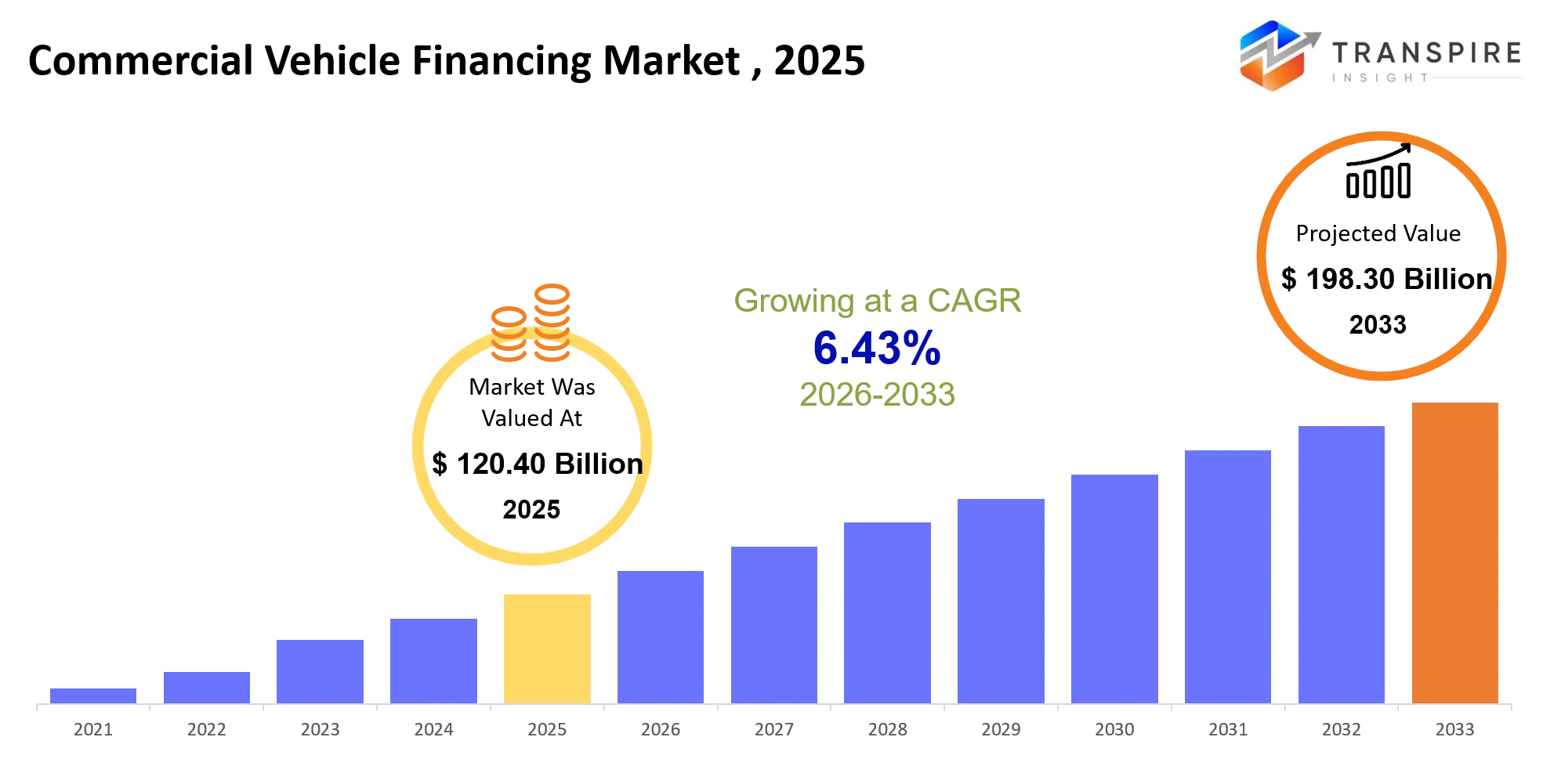
As per Transpire Insight Analysis, the Commercial Vehicle Financing Market size is estimated at USD 120.40 billion in 2025 and is anticipated to reach USD 198.30 billion by 2033, growing at a CAGR of 6.43% from 2026 to 2033.
Commercial vehicle financing supports transport operators, contractors, distributors and public agencies in getting trucks, buses and work vehicles without paying the price right away. In years, the market has changed a lot. It has moved beyond vehicle loans. Now there are leasing options, flexible payment terms, fleet financing and digital credit assessments. One big change is the need to finance commercial vehicles. Buyers face upfront costs, but they also see long-term savings in fuel and maintenance. Government policies promoting transportation, the natural replacement of old fleets and the growth of e-commerce logistics are all shaping buying choices. Daimler Truck Financial Services launched eService Leasing in Germany. This service combines truck leasing with maintenance and support options. It makes it easier for customers to switch to fleets. These types of offers help lower the cost barrier. They also make monthly payments more predictable. Financing companies that connect credit, insurance, maintenance and charging services are in a position. They can keep customers longer. Support future vehicle purchases.
Commercial Vehicle Financing Market Size & Forecast:
- Market Size 2025: USD 120.40 Billion
- Expected Market Value (2033): USD 198.30 Billion
- Forecast CAGR (2026–2033): 6.43%
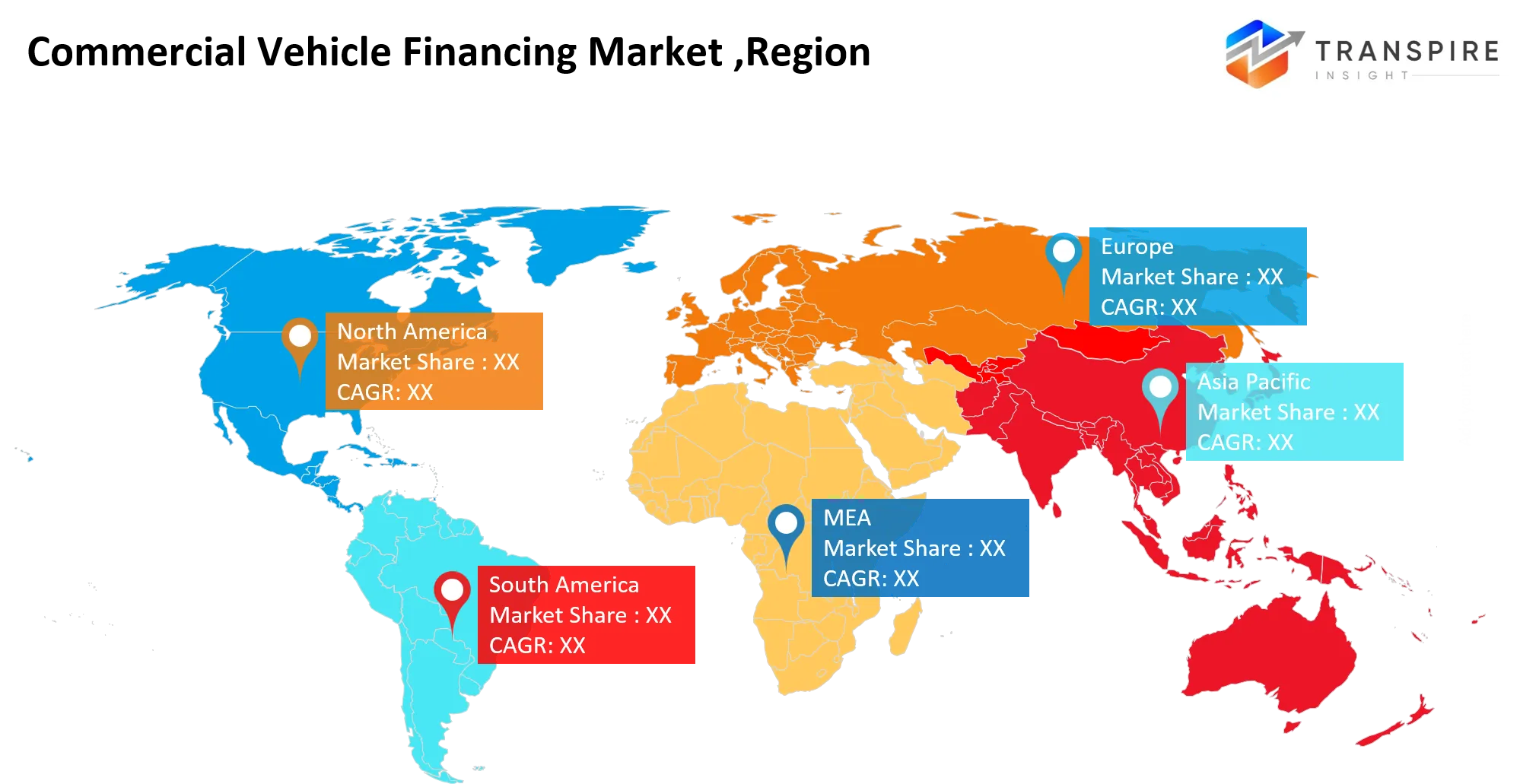
- Leading Region in 2025: North America
- Fastest Growing Region: Asia Pacific
- Key Company Profiles: Daimler Truck Financial Services, Volvo Financial Services, PACCAR Financial, Ford Credit, Toyota Financial Services, Scania Financial Services, MAN Financial Services, CNH Industrial Capital, DLL, Société Générale, BNP Paribas Leasing Solutions, Santander Consumer Finance, Ally Financial, Hitachi Capital, ICBC Leasing
Key Market Insights:
Financing of commercial vehicles is moving away from single credit-based solutions towards more comprehensive ownership of the fleet, which incorporates financing, services, and risk management
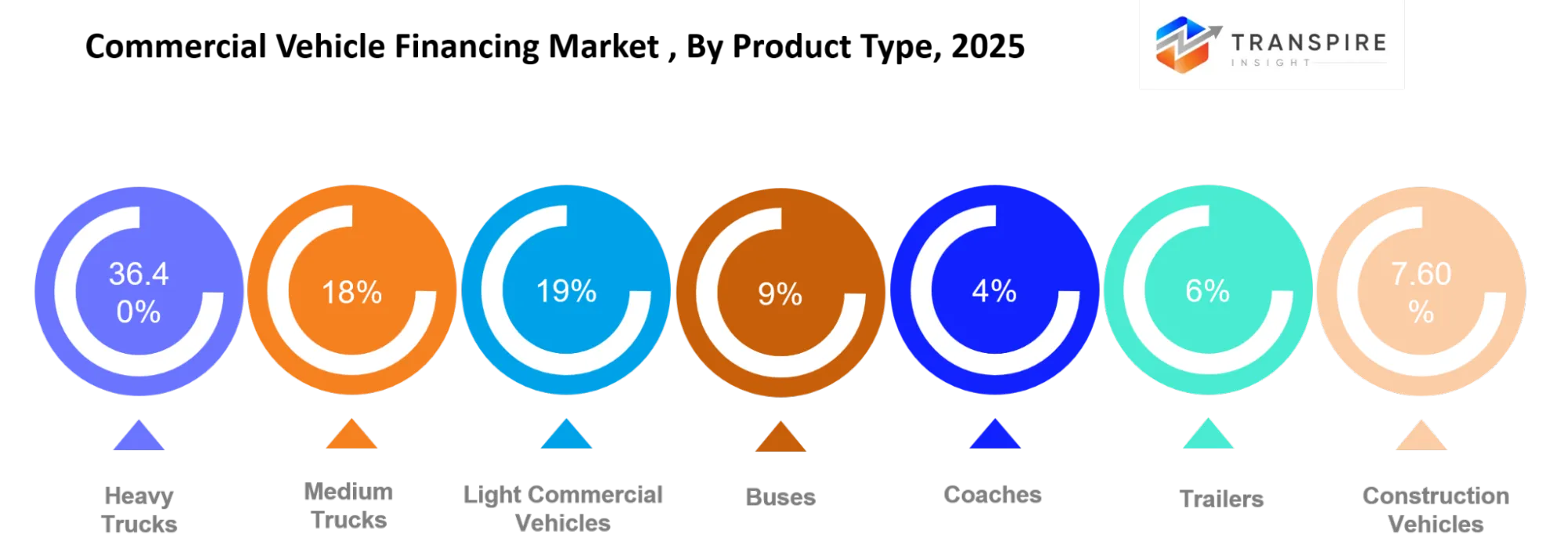
- Trucks in the Heavy Trucks segment constitute 36.40% of the market owing to the expensive nature of the vehicle along with its significant use in long-distance freight.
- The trucks in the Medium Trucks market account for 18.00%, catering to regional transport and smaller firms requiring flexibility with payload.
- The Light Commercial Vehicles category makes up 19.00% owing to last-mile deliveries, services and small enterprises with financial repayment structures.
- Buses make up 9.00% of the market, while Coaches make up 4.00%, depending on public transport finances and tourist demands as well as replacements.
- Trailers make up 6.00% of the market segment with an associated need for asset-based lending and financing solutions to boost capacity without tractor purchases.
- Agricultural Commercial Vehicles holds 2.60%, with repayment needs in relation to seasonal profits and rural financing.
What are the Key Drivers, Restraints, and Opportunities in the Commercial Vehicle Financing Market?
Drivers
Market growth, fleet renewal, and logistics needs make it necessary to provide financing that reflects the cost of vehicles against revenue streams. The need for e-commerce delivery, regional freight movement, and construction activities makes it necessary for companies to acquire more vehicles even before they have enough money to buy them. Loans, leasing, and fleet financing help businesses save on working capital. The adoption of electric trucks is yet another reason why financing is becoming increasingly important, as leasing helps mitigate risks linked to new technology and battery life.
Restraints
The commercial vehicle finance segment is still highly dependent on the interest rate environment, fuel and transport conditions, customers' credit standing, and used car price depreciation. The smaller firms lack financial documents and have volatile revenue streams, so their evaluation is complicated. Moreover, there is a need to take into account risks associated with vehicle depreciation that can occur sooner than planned due to technological and environmental changes.
Opportunities
The Opportunities can diversify their activities via digital underwriting, flexible payment terms, and collaborations with vehicle producers, dealers, and fleet management solutions vendors. The financing deals that cover maintenance, charging, and insurance of electric vehicles will simplify the transaction for consumers. For the Asia Pacific market, the wide logistics network points to potential; however, individual markets in the region have to be studied separately.
|
Driver |
Relatie Impact on Growth (%) |
Geographic Relevance |
Impact Timeline |
Demand Strength |
Growth Mechanism |
Key Beneficiaries |
Major Constraint |
|
Rising commercial vehicle demand and fleet replacement |
28% |
North America, Asia-Pacific, Europe |
Short-term (≤2 years) |
High |
Fleet expansion increases vehicle loan and leasing demand |
Fleet operators, OEMs, banks, captive finance companies |
High borrowing costs and uncertain freight volumes |
|
E-commerce growth and logistics infrastructure investment |
23% |
Asia-Pacific, North America, Middle East |
Medium-term (2–4 years) |
High |
Delivery expansion drives financed van and truck purchases |
Logistics companies, small fleets, NBFCs, leasing providers |
Thin operator margins and volatile delivery demand |
|
Flexible financing options and digital lending adoption |
20% |
North America, Asia-Pacific, Europe |
Short-term (≤2 years) |
High |
Digital underwriting accelerates approvals and expands credit access |
Fintech lenders, banks, dealers, small fleet owners |
Credit defaults and limited borrower data |
|
Electrification and sustainability-linked financing |
17% |
Europe, China, North America, India |
Long-term (≥4 years) |
High |
EV incentives and battery leasing reduce upfront acquisition costs |
Electric truck OEMs, green lenders, fleet operators, charging providers |
High vehicle prices and inadequate charging infrastructure |
|
Government incentives and stricter emission standards |
12% |
Europe, India, North America, China |
Medium-term (2–4 years) |
Medium |
Replacement incentives encourage compliant vehicle purchases |
Commercial vehicle manufacturers, lenders, transport operators |
Policy uncertainty and uneven incentive coverage |
|
Total |
100% |
— |
— |
— |
— |
— |
— |
What Has the Impact of Artificial Intelligence Been on the Commercial Vehicle Financing Market?
The use of Artificial intelligence is aiding commercial vehicle lenders in making quick credit decisions and portfolio management. Automated tools can collect and categorise application documents, detect gaps in the information and process simple applications quickly. Machine learning models can analyse repayment history, cash flow trends, fleet usage, invoicing history and other allowable information to calculate the risk profile of the applicant. It could be particularly helpful in case of fleet operators whose income varies due to seasonality of the contracts or changes in the volume of freight.AI can also be used for predictive monitoring once a loan or lease agreement is established. Warning models can detect delays in payments, unusual vehicle use and decreases in business activity to contact customers in time before the situation becomes serious.AI does not eliminate lending risks. Models can give wrong or biased predictions if data is incomplete, patterns are outdated, and small businesses lack sufficient credit history. Implementation of AI into existing loan processing systems, protection of customer data and compliance with lending regulations might also involve considerable investments.
Instance
In August 2025, Biz2X collaborated with KreditVenture, an NBFC from India, for the launch of a digital lending platform leveraging AI for the financing of used commercial vehicles and loans of other types. This innovation helps to automate the process of credit underwriting and approvals, thereby contributing to the reduction in turnaround time for the decision-making process.
Key Market Trends:
The market trend is changing from financing the purchase of the car to having more such connections between the financing and use of the car. Companies have been working on new digital offerings and solutions based on new powertrain technology.
- Paper-based application systems are slowly making way for online applications, automation of the documentation process and fast credit assessment to make things more convenient for fleet owners.
- There is a growing trend among financial institutions that used to shy away from financing electric trucks to develop specialised financing products.
- Financial institutions are going beyond traditional credit information by leveraging approved business, repayment and vehicle utilisation information in assessing customers.
- Manufacturers of vehicles and financial institutions are increasingly linking loans and leases with maintenance, insurance and other services to increase customer loyalty.
- Firms seeking to reduce initial costs are offering options for used vehicle financing, which encourages lenders to enhance vehicle inspection and valuation process.
Commercial Vehicle Financing Market Segmentation
By Vehicle Type
The market is dominated by heavy trucks at 36.40%, owing to the fact that heavy trucks require significant capital investment, and therefore the cost of acquisition needs to be spread out over several years. Light commercial vehicles and medium trucks make up 19.00% and 18.00%, respectively, with the help of last-mile delivery, regional transport, and service firms. Buses constitute 9.00%, trailers 6.00%, construction vehicles 5.00%, coaches 4.00%, and agricultural commercial vehicles 2.60%.
By Financing Type
Loans are still viable for ownership purchasers, while leasing suits operators concerned about the level of flexibility of payments and ease of vehicle replacements. Hire purchase enables slow acquisition of assets. Operating and finance leasing schemes are differentiated according to the way asset ownership and balance sheet treatment is done in each case. Dealer financing facilitates easy transactions, and there is fleet financing for several vehicles to be financed using the same facility. Subscription financing is also gaining prominence among users who are keen on accessing the vehicle and the related services rather than owning one. No percentages are given here.
By Vehicle Condition
New cars may prove to be good enough for warranty coverage seekers as well as those desirous of the latest technologies in automobiles. Used and certified used cars facilitate small operators entering into the market by enabling them to acquire assets cheaply. Refurbished cars, pre-owned fleet cars and demonstration cars are other types. In the latter categories, lenders would need more inspections to be conducted to value these vehicles. Commercial rentals enable temporary requirements to be met. No condition-wise market shares are given.
By End User
The finance needs of fleet management and logistics will likely support vehicle availability and delivery, while construction companies may have repayment terms linked to project cash flows. Public transportation and governmental fleets will be dependent upon budget cycles and procurement processes. Small businesses will value easy application procedures and flexible instalments, while agricultural businesses may require season-based repayment terms. Rental companies will finance equipment intended for reuse among different customers. The source document does not contain percentages for each end user.
By Provider Type
Banks will use the existing relationship with their customers in both lending and deposits, while captive finance companies will link the financing with the brand of the vehicle they represent. Independent finance companies will be competing through customising the underwriting process, while credit unions will cater to certain member groups. NBFCs and FinTech lenders will provide alternative funding channels or even fast-track digital finance. Dealers will provide financing at the point of sale. Shares by provider type were not part of the provided data set.
By Loan Tenure
Short-term agreements can help shorten the credit exposure period and be appropriate for short-term-use vehicles, while three to five years can be suitable for balancing the size of instalments with the life span of the asset for most companies. Longer tenures can decrease the periodic payments but increase financing cost and expose lenders to changes in vehicle value. Flexible tenures can be useful for cases when income is not consistent. Suitability will depend on the type of vehicle, the characteristics of the borrower, interest rates and utilisation. The source document does not provide the share of loans by tenure.
By Propulsion Type
Diesel-powered vehicles are still used in many established freight businesses, while gas, hybrid, biofuels, and other alternative fuel vehicles represent the range of possibilities depending on the local infrastructure and conditions of operation. Electric commercial vehicle financing is the fastest-growing segment according to the provided data, with a 14.70% CAGR as companies evaluate their emissions goals and operating cost savings. Hydrogen-powered vehicles may become relevant in some heavy-duty transportation cases in the future.
What are the Key Use Cases Driving the Commercial Vehicle Financing Market?
Acquiring heavy trucks is a key use case because long-distance freight companies need expensive trucks to meet contractual obligations, but paying upfront may tie up working capital. Loans, leases, and fleet financing help companies expand their fleets by allowing them to repay based on revenue from freight transportation. Another use case is light and medium commercial vehicle financing for delivery, regional transportation, field work, and business operations of small companies. Such customers usually require flexible loan amounts, the possibility of leasing of used vehicles and repayment plans that fit their irregular cash flows. Bus and coach financing is another example of this type. New emerging use cases include leasing of electric trucks, combined maintenance and charging-related financing solutions and temporary financing through rental/subscription. This could help to test new technologies without making huge upfront investments. Financial solutions for construction and agriculture companies are also required to be tied to seasonal revenue.
|
Report Metrics |
Details |
|
Market size value in 2025 |
USD 120.40 Billion |
|
Market size value in 2026 |
USD 128.10 Billion |
|
Revenue forecast in 2033 |
USD 198.30 Billion |
|
Growth rate |
CAGR of 6.43% from 2026 to 2033 |
|
Base year |
2025 |
|
Historical data |
2021 - 2024 |
|
Forecast period |
2026 - 2033 |
|
Report coverage |
Revenue forecast, competitive landscape, growth factors, and trends |
|
Regional scope |
United States; Canada; Mexico; United Kingdom; Germany; France; Italy; Spain; Denmark; Sweden; Norway; China; Japan; India; Australia; South Korea; Thailand; Brazil; Argentina; South Africa; Saudi Arabia; United Arab Emirates |
|
Key company profiled |
Daimler Truck Financial Services, Volvo Financial Services, PACCAR Financial, Ford Credit, Toyota Financial Services, Scania Financial Services, MAN Financial Services, CNH Industrial Capital, DLL, Société Générale, BNP Paribas Leasing Solutions, Santander Consumer Finance, Ally Financial, Hitachi Capital, ICBC Leasing |
|
Customization scope |
Free report customization (country, regional & segment scope). Avail customized purchase options to meet your exact research needs. |
|
Report Segmentation |
Vehicle Type (Heavy Trucks, Medium Trucks, Light Commercial Vehicles, Buses, Coaches, Trailers, Construction Vehicles, Agricultural Commercial Vehicles); Financing Type (Loans, Leasing, Hire Purchase, Operating Lease, Finance Lease, Dealer Financing, Fleet Financing, Subscription Financing); Vehicle Condition (New Vehicles, Used Vehicles, Certified Used Vehicles, Refurbished Vehicles, Pre-Owned Fleet Vehicles, Demonstration Vehicles, Commercial Rentals); End User (Fleet Operators, Logistics Companies, Construction Companies, Public Transport Operators, Small Businesses, Agricultural Businesses, Government Fleets, Rental Companies); Provider Type (Banks, Captive Finance Companies, Independent Finance Companies, Credit Unions, NBFCs, FinTech Lenders, Dealers); Loan Tenure (Less Than 2 Years, 2–3 Years, 3–5 Years, 5–7 Years, 7–10 Years, Above 10 Years, Flexible Tenure); Propulsion Type (Diesel, Gas, Electric, Hybrid, Hydrogen, Biofuel, Alternative Fuel) |
Which Regions are Driving the Commercial Vehicle Financing Market Growth?
North America
North America has the highest share of 37.20% among tank trucking the provided regional data set. The reason for this is its well-established commercial lending market, along with the vast freight network and large fleet operators, which drive the need for loans, leasing, and financing from dealerships. Digital credit services and vehicle replacements also motivate providers to develop better solutions for fleets.
In September 2026, Daimler Truck Financial Services USA was established with the opening of its new North American office premises in Ballantyne, Charlotte. This office is home to around 350 people and caters to the needs of the financing and leasing of commercial vehicles.
Europe
Europe represents 29.00% of the market represented by the supplied data. Europe's experienced suppliers of trucks and buses, along with cross-border logistics and the drive to produce transportation vehicles with low emissions, provide opportunities for different kinds of funding instruments. In captive finance companies, vehicle financing is provided along with maintenance, insurance and leasing, which enables clients to budget for operations. In contrast to North America, financing decisions made in Europe are affected by government regulations and incentives for using electric transport in each particular country.
In August 2025, Daimler Truck Financial Services became operational in Poland, providing leasing, financing and integrated service solutions for truck and bus financing in the country. Plans were made by Daimler to enter the Czech Republic and Slovakia for further business growth in Central and Eastern Europe regions.
Asia Pacific
Asia Pacific holds 25.00% of the market and is the most rapidly public transportation growing market among those supplied by the dataset, with a 10.30% CAGR. The development of logistics, city deliveries and the development of transport infrastructure lead to financing needs for large fleets and independent firms. Cooperation between producers of commercial vehicles and financiers could expand the availability of financing, especially when the network of dealers and online loans develops.
In July 2026, A partnership between Tata Motors and UCO Bank allowed fleet owners and small-scale companies in India to take advantage of competitive rates, quick approvals and convenient payment terms on commercial vehicle loans.
Who are the Key Players in the Commercial Vehicle Financing Market, and how do they compete?
Commercial vehicle finance competition includes financing from manufacturer-owned financing firms, banks, private lending institutions and recent digital providers. The offerings vary through access to the potential client base, credit appetite, flexibility in agreements and offering financing as well as maintenance, insurance or other fleet services. Manufacturer-related finance companies can leverage their dealerships and vehicle knowledge, while banks and independents compete through larger customer networks and financial products offered. Daimler Truck Financial Services is expanding its reach as well as the range of offerings through bundling of services depending on vehicle usage. Its German eService Leasing offering caters to those customers looking at electric trucks through integration of leasing services with other service offerings. Thus, Daimler Truck differentiates itself based on ownership rather than credit. Volvo Financial Services also leverages its relationship with Volvo Group to link financing for customers with vehicles and equipment. The captive financing companies compete because of the brands and tailored finance offerings, while banks and NBFC/FinTechs compete through multi-branding, online financing applications, as well as niche financing for smaller fleet operations.
Commercial Vehicle Financing Market companies
- Daimler Truck Financial Services
- Volvo Financial Services
- PACCAR Financial
- Ford Credit
- Toyota Financial Services
- Scania Financial Services
- MAN Financial Services
- CNH Industrial Capital
- DLL
- Société Générale
- BNP Paribas Leasing Solutions
- Santander Consumer Finance
- Ally Financial
- Hitachi Capital
- ICBC Leasing
|
Company |
Est. Revenue Share Range |
Key Offerings |
Strategic Positioning |
Geographic Strength |
Technology Focus |
Company |
Est. Revenue Share Range |
Key Offerings |
Strategic Positioning |
Geographic Strength |
|
Daimler Truck Financial Services |
Estimated 2–4% |
Truck loans, leasing, insurance, rentals, charging solutions |
Integrated premium truck lifecycle financing |
Europe, North America, Latin America |
Digital contracts, risk analytics, payment platforms |
Daimler Truck Financial Services |
Estimated 2–4% |
Truck loans, leasing, insurance, rentals, charging solutions |
Integrated premium truck lifecycle financing |
Europe, North America, Latin America |
|
PACCAR Financial Services |
Estimated 2–4% |
Truck loans, finance leases, operating leases, dealer financing |
Captive financing for leading truck brands |
North America, Europe, South America |
Credit scoring, portfolio analytics, digital accounts |
PACCAR Financial Services |
Estimated 2–4% |
Truck loans, finance leases, operating leases, dealer financing |
Captive financing for leading truck brands |
North America, Europe, South America |
|
Volvo Financial Services |
Estimated 2–4% |
Truck financing, leasing, insurance, fleet financial solutions |
captive financing with lifecycle support |
Europe, North America, Asia Pacific |
Digital financing, credit risk, connected services |
Volvo Financial Services |
Estimated 2–4% |
Truck financing, leasing, insurance, fleet financial solutions |
captive financing with lifecycle support |
Europe, North America, Asia Pacific |
|
TRATON Financial Services |
Estimated 2–4% |
Vehicle loans, leasing, insurance, dealer financing |
Multi-brand commercial vehicle financing |
Europe, North America, Latin America |
Digital platforms, portfolio analytics, electrification |
TRATON Financial Services |
Estimated 2–4% |
Vehicle loans, leasing, insurance, dealer financing |
Multi-brand commercial vehicle financing |
Europe, North America, Latin America |
|
Ford Credit / Ford Pro FinSimple |
Estimated 1–3% |
Commercial vehicle loans, fleet leases, commercial credit lines |
Flexible financing integrated with fleet solutions |
North America, Europe |
Online applications, digital accounts, fleet finance tools |
Ford Credit / Ford Pro FinSimple |
Estimated 1–3% |
Commercial vehicle loans, fleet leases, commercial credit lines |
Flexible financing integrated with fleet solutions |
North America, Europe |
Recent Development News
In May 2026, a proposed joint venture between Volvo Financial Services and Eicher Motors for financing and leasing services for the Volvo- and Eicher-branded commercial vehicles was announced by both companies in India. It will enhance financing availability through vehicle dealerships.
In November 2025, a financing solution partnership for the commercial vehicle range by Mahindra Last Mile Mobility was signed with Punjab National Bank. The partnership will help enhance the reach of customised finance schemes for last-mile mobility and electric commercial vehicle adoption through the wide reach of the bank's branch network.
What Strategic Insights Define the Future of the Commercial Vehicle Financing Market?
There has been a shift in the market for financing commercial vehicles from traditional loans to flexible leasing and digital lending and fleet management services. Financiers who incorporate vehicle financing with maintenance, insurance, and fleet management services have a greater chance of building customer loyalty and creating additional sources of income. The financing of electric commercial vehicles could be another option for exploration in the Asia Pacific region, considering the fact that, according to the provided data, the regional market will experience. There is a threat in the gap between the period of loan repayment and the decreased value of the vehicle due to technological change. Should there be any changes in batteries, charging stations, or environmental policies, financiers may incur even higher losses. In order to remain relevant, they should work on improving their digital credit assessment process, tracking residual values, and cooperating with the manufacturers and distributors of the vehicles.
Vehicle Type
- Heavy Trucks
- Medium Trucks
- Light Commercial Vehicles
- Buses
- Coaches
- Trailers
- Construction Vehicles
- Agricultural Commercial Vehicles
Financing Type
- Loans
- Leasing
- Hire Purchase
- Operating Lease
- Finance Lease
- Dealer Financing
- Fleet Financing
- Subscription Financing
Vehicle Condition
- New Vehicles
- Used Vehicles
- Certified Used Vehicles
- Refurbished Vehicles
- Pre-Owned Fleet Vehicles
- Demonstration Vehicles
- Commercial Rentals
End User
- Fleet Operators
- Logistics Companies
- Construction Companies
- Public Transport Operators
- Small Businesses
- Agricultural Businesses
- Government Fleets
- Rental Companies
Provider Type
- Banks
- Captive Finance Companies
- Independent Finance Companies
- Credit Unions
- NBFCs
- FinTech Lenders
- Dealers
Loan Tenure
- Less Than 2 Years
- 2–3 Years
- 3–5 Years
- 5–7 Years
- 7–10 Years
- Above 10 Years
- Flexible Tenure
Propulsion Type
- Diesel
- Gas
- Electric
- Hybrid
- Hydrogen
- Biofuel
- Alternative Fuel
Frequently Asked Questions
Find quick answers to common questions.
The commercial vehicle financing market size was valued at USD 120.40 billion in 2025 and is poised to reach USD 198.30 billion by 2033, expanding at a 6.43%CAGR
Key segments for the commercial vehicle financing market are Vehicle Type (Heavy Trucks, Medium Trucks, Light Commercial Vehicles, Buses, Coaches, Trailers, Construction Vehicles, Agricultural Commercial Vehicles); Financing Type (Loans, Leasing, Hire Purchase, Operating Lease, Finance Lease, Dealer Financing, Fleet Financing, Subscription Financing); Vehicle Condition (New Vehicles, Used Vehicles, Certified Used Vehicles, Refurbished Vehicles, Pre-Owned Fleet Vehicles, Demonstration Vehicles, Commercial Rentals); End User (Fleet Operators, Logistics Companies, Construction Companies, Public Transport Operators, Small Businesses, Agricultural Businesses, Government Fleets, Rental Companies); Provider Type (Banks, Captive Finance Companies, Independent Finance Companies, Credit Unions, NBFCs, FinTech Lenders, Dealers); Loan Tenure (Less Than 2 Years, 2–3 Years, 3–5 Years, 5–7 Years, 7–10 Years, Above 10 Years, Flexible Tenure); Propulsion Type (Diesel, Gas, Electric, Hybrid, Hydrogen, Biofuel, Alternative Fuel)
Growth is primarily driven by increased demand for commercial automobiles, increase in logistics and e-commerce activities, increased fleet expansion, more loan and lease options, and rising investment in transportation infrastructure.
The market is led by major manufacturers including Daimler Truck Financial Services, Volvo Financial Services, PACCAR Financial, Ford Credit, Toyota Financial Services, Scania Financial Services, MAN Financial Services, CNH Industrial Capital, DLL, Société Générale, BNP Paribas Leasing Solutions, Santander Consumer Finance, Ally Financial, Hitachi Capital, ICBC Leasing
North America captures the largest share of the market for commercial vehicle finance at 37.20%, attributed to its robust commercial transport sector, established banking and finance industry, flexible leases, and increasing demand for trucks and fleets. The growth of e-commerce and logistics adds to its market dominance.
Commercial opportunities within the commercial vehicle finance market include the increasing requirement for electric truck finance, flexible leasing solutions, online loan services, and customised solutions for small and medium-sized fleet owners. Expansion in logistics and e-commerce activities can also present opportunities for financing commercial vehicle fleet expansion.
- Daimler Truck Financial Services
- Volvo Financial Services
- PACCAR Financial
- Ford Credit
- Toyota Financial Services
- Scania Financial Services
- MAN Financial Services
- CNH Industrial Capital
- DLL
- Société Générale
- BNP Paribas Leasing Solutions
- Santander Consumer Finance
- Ally Financial
- Hitachi Capital
- ICBC Leasing
About the Authors

Mayur Shinde
I am Mayur Shinde, a Senior Research Analyst at Transpire Insight, specializing in the Automotive & Transportation and Information & Communication Technology (ICT) Industry. My work focuses on analyzing emerging market trends, technological advancements, competitive landscapes, and industry developments to deliver accurate, data-driven insights. I am passionate about transforming complex market information into clear, actionable content that helps businesses, professionals, and decision-makers stay informed and make confident strategic decisions.

Chakradhar Khansole
Chakradhar serves as the Research Director at Transpire Insight, bringing over 8 years of experience in technology, innovation, and strategic market intelligence. He specializes in transforming complex market data into actionable business insights that enable organizations to make informed, growth-oriented decisions. Recognized for his strategic vision and analytical expertise, Chakradhar leads high-impact research initiatives, delivering comprehensive market assessments, competitive intelligence, and forward-looking industry analysis.
Recently Published Reports
-
Apr 2026
ATV & UTV Market
ATV & UTV Market Size, Share & Analysis Report By Type (ATV, and UTV), By Variants (Less Than 400 CC, 400 CC To 800 CC, and More Than 800 CC), and Geography (North America, Europe, Asia-Pacific, Middle East and Africa, South and Central America), 2021 - 2031
-
Apr 2026
Automotive Central Gateway Module Market
Automotive Central Gateway Module Market Size, Share & Analysis Report By Type (Ethernet Central Gateway Module, CAN Central Gateway Module, LIN Central Gateway Module, and FlexRay), By Application (Powertrain Control, Body Control, Infotainment System, Advanced Driver Assistance Systems (ADAS), and Others), By End User (Passenger Vehicles, and Commercial Vehicles), and Geography (North America, Europe, Asia-Pacific, Middle East and Africa, South and Central America), 2021 - 2031
-
Apr 2026
Automotive Engine Oil Filter Market
Automotive Engine Oil Filter Market Size, Share & Analysis Report By Filter Type (Fuel Filter, Engine Oil Filter, Hydraulic Oil Filter, and Others), By Filter Media (Cellulose, Synthetic, and Micro), By Sales Channel (OEMs, and Aftermarket), By Vehicle Type (Passenger Cars, Light Commercial Vehicles, Heavy Duty Trucks, Buses and Coaches, and Off-road Vehicles), and Geography (North America, Europe, Asia-Pacific, Middle East and Africa, South and Central America), 2021 - 2031
-
Apr 2026
Automotive Parts Aluminium Die Casting Market
Automotive Parts Aluminium Die Casting Market Size, Share & Analysis Report By Production Process (Pressure Die Casting, Vacuum Die Casting, Squeeze Die Casting, Gravity Die Casting), By Application (Body Parts, Engine Parts, Transmission Parts, Battery And Related Components, Other Application Types), and Geography (North America, Europe, Asia-Pacific, Middle East and Africa, South and Central America), 2021 - 2031
Our Clients