
Public Sector Consulting And Advisory Services Market Summary:
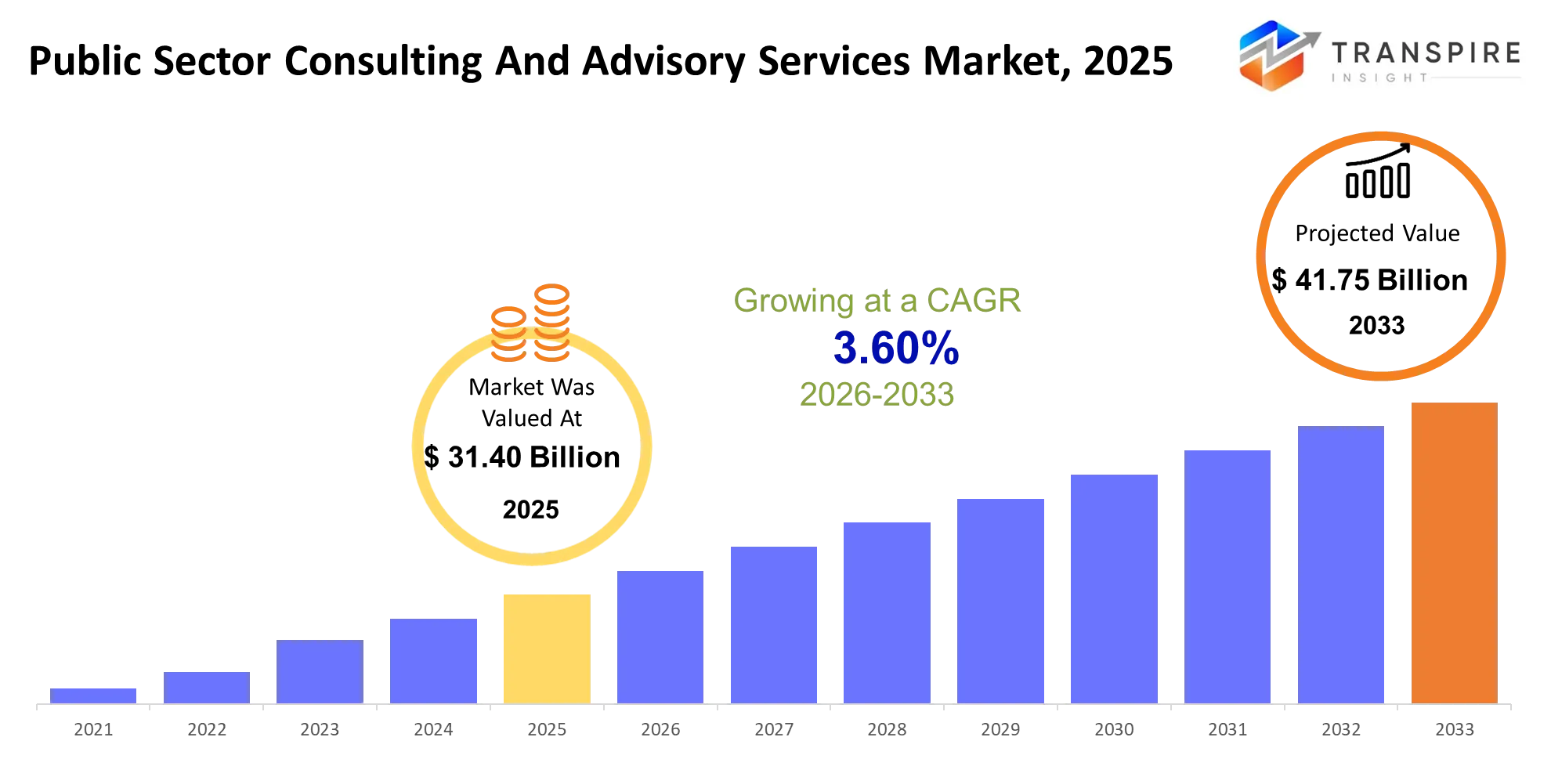
As per Transpire Insight, The Public Sector Consulting and Advisory Services Market size is estimated at USD 31.40 billion in 2025 and is anticipated to reach USD 41.75 billion by 2033, growing at a CAGR of 3.60% from 2026 to 2033.
The public sector consulting and advisory services market helps the government bring policy objectives to life through program development, modernise legacy systems, manage public spending, improve cyber security, and deliver services. Over the last three to five years, a mix of strategy-only work and fully integrated technology rollout, data governance, and measurable results has been shaping up across consulting contracts. This structural shift reveals an inevitable need to align digital investments with accountability, citizen experience and regulation. With generative AI revolutionising government service delivery workflows, the need for decisions around data protection, procurement controls, and responsible automation has become a matter of urgency; the EU AI Act has further increased the importance of AI risk assessment and governance planning for public institutions. Agencies, facing mounting pressure from their ageing infrastructure, disjointed data, skills shortage, and ever more rigorous scrutiny of their expenditures, increasingly look to external consultants to de-risk implementation efforts, build internal capabilities and deliver transformational change programs.
Public Sector Consulting And Advisory Services Market Size & Forecast:
- Market Size 2025: USD 31.40 Billion
- Expected Market Value (2033): USD 41.75 Billion
- Forecast CAGR (2026–2033): 3.60%
- Leading Region in 2025: North America
- Fastest Growing Region: Asia-Pacific
- Key Company Profiles: Accenture, Deloitte, PwC, EY, KPMG, McKinsey & Company, Boston Consulting Group, Bain & Company, Booz Allen Hamilton, Guidehouse, IBM Consulting, Capgemini, CGI, ICF, PA Consulting.
Key Public Sector Consulting And Advisory Services Market Insights:
Public sector consulting is moving away from transformation guidance and towards safe, responsible implementation of AI, identity, cloud and cybersecurity initiatives. Businesses that integrate technology with regulatory assurance are getting the jump on others as governments focus on measurable citizen outcomes.
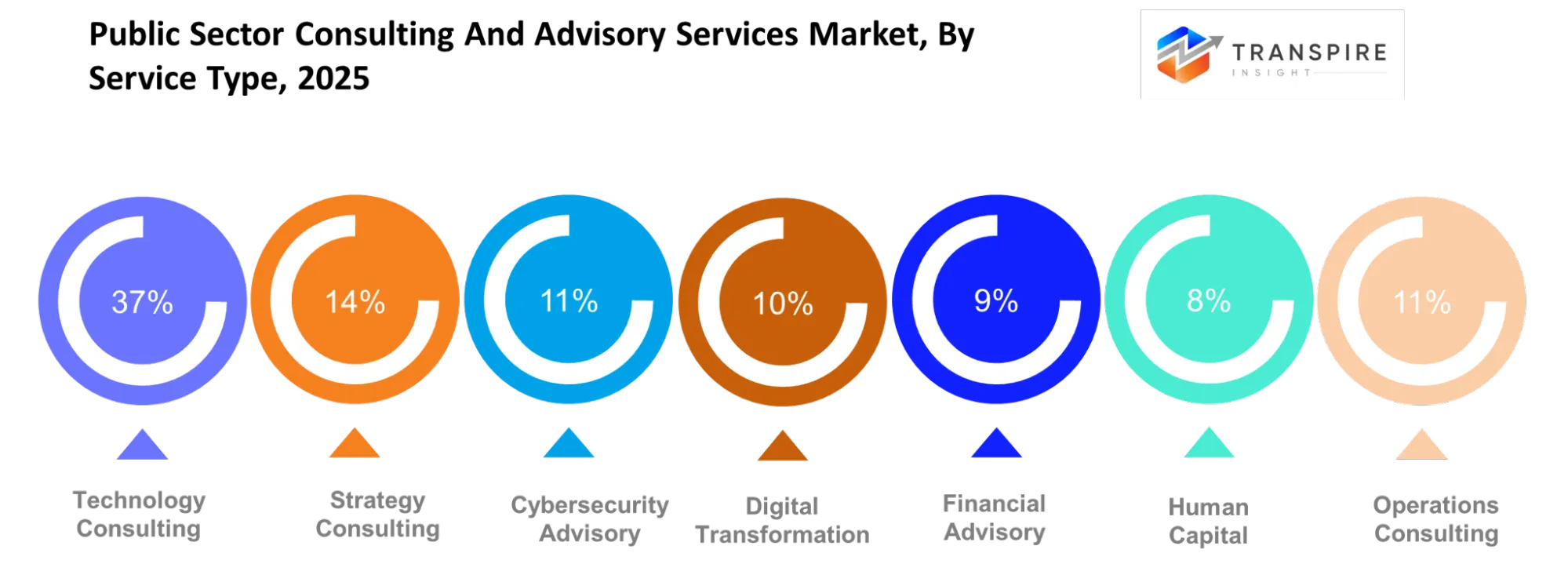
- Technology consulting dominates the category with a 36.50% share and 9.00% CAGR, with Accenture continuing to roll out AI-powered “digital front doors,” repetitive task automation, and workforce redesign for agencies.
- The industry of strategy consulting accounts for 14.00% of the market, with Deloitte reimagining government programs with AI as an agent, a new set of rules, a streamlined workflow, and an operating model that continuously learns.
- Cybersecurity advisory accounts for 11.00%, while Booz Allen Hamilton is differentiated by its defence-grade AI, cyber defence, and secure mission-system delivery.
- Digital transformation is a 10.00% market share, and IBM Consulting is playing in the watsonx-powered hybrid cloud, data governance, and regulated AI deployment.
- Financial advisory accounts for 9.00%, and EY, PwC, and KPMG use audit, risk, tax, and compliance credibility to gain access to AI assurance and public-finance modernisation.
- Human capital consulting is 8.00%; McKinsey's QuantumBlack and BCG X highlight capability building, decision models and organisational redesign in the context of AI.
- Operations consulting accounts for 6.00%, while Capgemini and CGI are seeking to advance systems integration, process modernization and managed public-service delivery.
- Other services account for 5.50%: Guidehouse, ICF and PA Consulting serve niche policy, infrastructure, resilience and program-management requirements.
- Bain & Company is moving toward outcome-based transformation and is tying agency fees to citizen-service outcomes and agency productivity.
What are the Key Drivers, Restraints, and Opportunities in the Public Sector Consulting And Advisory Services Market?
Driver:
Government investment in digital infrastructure, cybersecurity, and service redesign is a primary growth driver. The pandemic accelerated remote administration and digital citizen services, exposing weaknesses in legacy databases, disconnected departments, and manual approvals. As agencies connect these systems, consulting firms gain implementation, integration, compliance, and program-management assignments. Regulatory changes, including the EU AI Act’s implementation, further increase demand for risk assessment and governance support.
Restraint:
Budget rigidity and fragmented procurement continue to delay consulting engagements. Public agencies must balance advisory spending against essential services, while multi-stage tendering, political transitions, and lengthy approvals extend sales cycles. Legacy platforms and incompatible data structures also increase project costs. These constraints persist because technology budgets, operational ownership, and procurement authority frequently sit across separate departments.
Opportunity:
The strongest opportunity lies in implementation-led transformation, particularly AI governance, cloud modernization, and digital public infrastructure. The OECD’s 2026 Digital Government Outlook highlights gaps in centralized support for AI procurement, creating opportunities for specialists in vendor evaluation, contractual safeguards, and responsible deployment. In India, digital identity, integrated citizen services, and AI-enabled administration offer scope for regional consulting engagements. Firms that combine technical delivery with measurable outcomes, staff training, and long-term program oversight can secure broader mandates and recurring advisory revenue.
What Has the Impact of Artificial Intelligence Been on the Public Sector Consulting And Advisory Services Market?
AI is shifting public sector consulting from advisory on documents to delivery driven by data. Consultants use automation to streamline workflows and automate citizen service requests, fraud detection, procurement, and routine administrative tasks. Analytics and predictive models help authorities predict demand for services, plan healthcare capacity, identify taxation risks, schedule infrastructure repairs, and prepare emergency responses. Generative AI and advanced analytics tools improve efficiency by summarising case files, preparing citizen correspondence, accelerating policy research, and providing real-time operational dashboards. As a result, consulting includes data architecture, model validation, responsible AI governance, organizational change, and outcome measurement. Adoption is limited by implementation costs, open architecture, legacy application silos, low-quality data, and accuracy gaps. AI can't be trusted by public authorities without oversight, as bias and misuse can adversely impact social welfare, safety, taxation, and civil rights. Consulting firms must help clients audit the data and model outputs, establish cyber and privacy safeguards, and define accountability procedures to safeguard operations at scale. Some firms are combining analytics expertise with implementation to help clients improve outcomes while managing operational and political risk.
In May 2026, Accenture Federal Services launched a strategic partnership with OpenAI to accelerate secure AI adoption, migration, and mission-scale deployment across U.S. federal agencies.
Key Public Sector Consulting And Advisory Services Market Trends:
The shift from recommendations to accountable delivery, measurable public outcomes, and ongoing digital improvement in government consulting. Partners who can provide technology implementation, policy knowledge, and governance controls are becoming more and more attractive to agencies.
- Agencies are moving beyond digital transformation to ensuring the safe deployment of AI, leading to a need for AI inventories, risk controls, and operating models for governance.
- Zero-trust cybersecurity is transitioning from policy conversation to enterprise architecture, identity management, and ongoing monitoring programs.
- The registration of digital identity is increasingly being driven by regulation, with eIDAS 2.0 bringing deadlines closer and closer to government implementation.
- Cloud spending is moving away from migration and toward rationalization, interoperability, cost control and sovereign-data management.
- Outcome-based contracts are becoming the norm for the government, and they are being used to incentivise measurable service improvements.
- Shared data platforms and data fabrics are taking the place of siloed departmental systems, allowing cross-agency decision-making.
- As climate resilience, energy transition and ESG reporting become public-policy requirements, sustainability advisory is growing.
- Low-code and no-code tools are becoming a hot topic, as agencies look for ways to deliver services quickly while using fewer technical resources.
- Citizen experience is also being made a part of the procurement process, and governments are tracking accessibility, response time, and digital inclusion.
Public Sector Consulting And Advisory Services Market Segmentation
Service Type:
Technology consulting accounts for a 36.50% market share and 9.00% CAGR, benefiting from cloud modernization, zero-trust security, AI governance, and large-scale systems integration. Strategy consulting captures a 14.00% share, supporting reform efforts in policy, spending, and institutional transformation. Cybersecurity consulting makes up an 11.00% share, growing as agencies counter ransomware, critical infrastructure attacks, and AI security concerns. Digital transformation has a 10.00% share, helping with citizen-service platforms and process redesign. Financial advisory accounts for a 9.00% share, while human capital consulting accounts for an 8.00% share, focusing on digital skills, workforce planning, and change management. Operational consulting accounts for a 6.00% share, with other services accounting for 5.50%.
Government Level:
Central governments prioritize national digital infrastructure, defense modernization, fiscal policy, and cross-agency platforms. State governments require consulting support for healthcare, education, transport, and regional development programs. Local governments and municipal bodies focus on citizen portals, urban infrastructure, and efficient service delivery. Regulatory agencies, public authorities, and government-owned enterprises need specialized compliance and operational advice, while defense agencies emphasise security and mission readiness. Future consulting priorities will depend on budget availability, institutional capacity, and the complexity of public service transformation.
Advisory Area:
IT modernization provides the foundation for improving government systems and service delivery. AI governance is gaining importance as agencies establish safeguards for automated decisions, data access, transparency, and accountability. Cloud adoption and digital identity initiatives improve interoperability between departments and citizen-facing platforms. Infrastructure advisory supports resilient public assets, while procurement and risk management strengthen spending oversight. Sustainability consulting helps governments integrate environmental considerations into infrastructure planning, resource allocation, and reporting, creating opportunities for specialized advisory services.
Engagement Type:
Strategy consulting establishes priorities, defines transformation roadmaps, and aligns investments with policy objectives. Implementation and program management translate these plans into operational capabilities, while managed services provide ongoing platform support. Audit and compliance engagements strengthen financial oversight, regulatory adherence, and accountability. Change management and training help employees adopt redesigned workflows and digital tools. Future contracts are likely to combine implementation, continuous monitoring, knowledge transfer, and outcome assessment, enabling agencies to evaluate project effectiveness while developing internal capabilities and reducing long-term dependence on external consultants.
Sector:
Defense agencies require secure technology, cybersecurity, and mission-critical program oversight. Healthcare institutions prioritise interoperable records, resource planning, and reliable digital services, while education authorities focus on accessible learning platforms and administrative modernization. Transportation and energy agencies need infrastructure planning, asset monitoring, and operational resilience. Public safety organizations use analytics for emergency coordination, while finance departments require fraud detection and expenditure controls. Environmental agencies increasingly seek sustainability reporting and climate-risk assessment. Sector-specific expertise will help governments improve service quality, strengthen resilience, and maintain regulatory accountability.
What are the Key Use Cases Driving the Public Sector Consulting And Advisory Services Market?
The core use case is technology-led government modernization, aligned with the dominant technology consulting segment. Agencies engage consultants to modernize legacy platforms, migrate workloads to the cloud, establish zero-trust security, and build data foundations for cross-departmental decision-making.
Expanding applications include AI governance, digital identity rollout, fraud analytics, procurement optimisation, tax administration, healthcare service planning, and transport-demand forecasting. These use cases connect technology consulting with cybersecurity, financial advisory, human capital, and operations services.
Emerging use cases include generative-AI copilots for citizen support, predictive maintenance for public infrastructure, climate-risk modelling, and automated compliance monitoring. Defence, public safety, energy, and municipal authorities are likely to adopt these applications first where data maturity and security controls are stronger.
|
Report Metrics |
Details |
|
Market size value in 2025 |
USD 31.40 Billion |
|
Market size value in 2026 |
USD 32.60 Billion |
|
Revenue forecast in 2033 |
USD 41.75 Billion |
|
Growth rate |
CAGR of 3.60% from 2026 to 2033 |
|
Base year |
2025 |
|
Historical data |
2021 - 2024 |
|
Forecast period |
2026 - 2033 |
|
Report coverage |
Revenue forecast, competitive landscape, growth factors, and trends |
|
Regional scope |
United States; Canada; Mexico; United Kingdom; Germany; France; Italy; Spain; Denmark; Sweden; Norway; China; Japan; India; Australia; South Korea; Thailand; Brazil; Argentina; South Africa; Saudi Arabia; United Arab Emirates |
|
Key companies profiled |
Accenture, Deloitte, PwC, EY, KPMG, McKinsey & Company, Boston Consulting Group, Bain & Company, Booz Allen Hamilton, Guidehouse, IBM Consulting, Capgemini, CGI, ICF, PA Consulting. |
|
Customization scope |
Free report customization (country, regional & segment scope). Available customized purchase options to meet your exact research needs. |
|
Report Segmentation |
Service Type (Technology Consulting, Strategy Consulting, Cybersecurity Advisory, Digital Transformation, Financial Advisory, Human Capital Consulting, Operations Consulting, Others); Government Level (Central Government, State Government, Local Government, Defense Agencies, Regulatory Agencies, Public Authorities, Municipal Bodies, Government-Owned Enterprises); Advisory Area (IT Modernization, AI Governance, Cloud, Digital Identity, Infrastructure, Procurement, Risk Management, Sustainability); Engagement Type (Strategy, Implementation, Managed Services, Program Management, Audit & Compliance, Change Management, Training, Others); Sector (Defense, Healthcare, Education, Transportation, Energy, Public Safety, Finance, Environment). |
Which Regions are Driving the Public Sector Consulting And Advisory Services Market Growth?
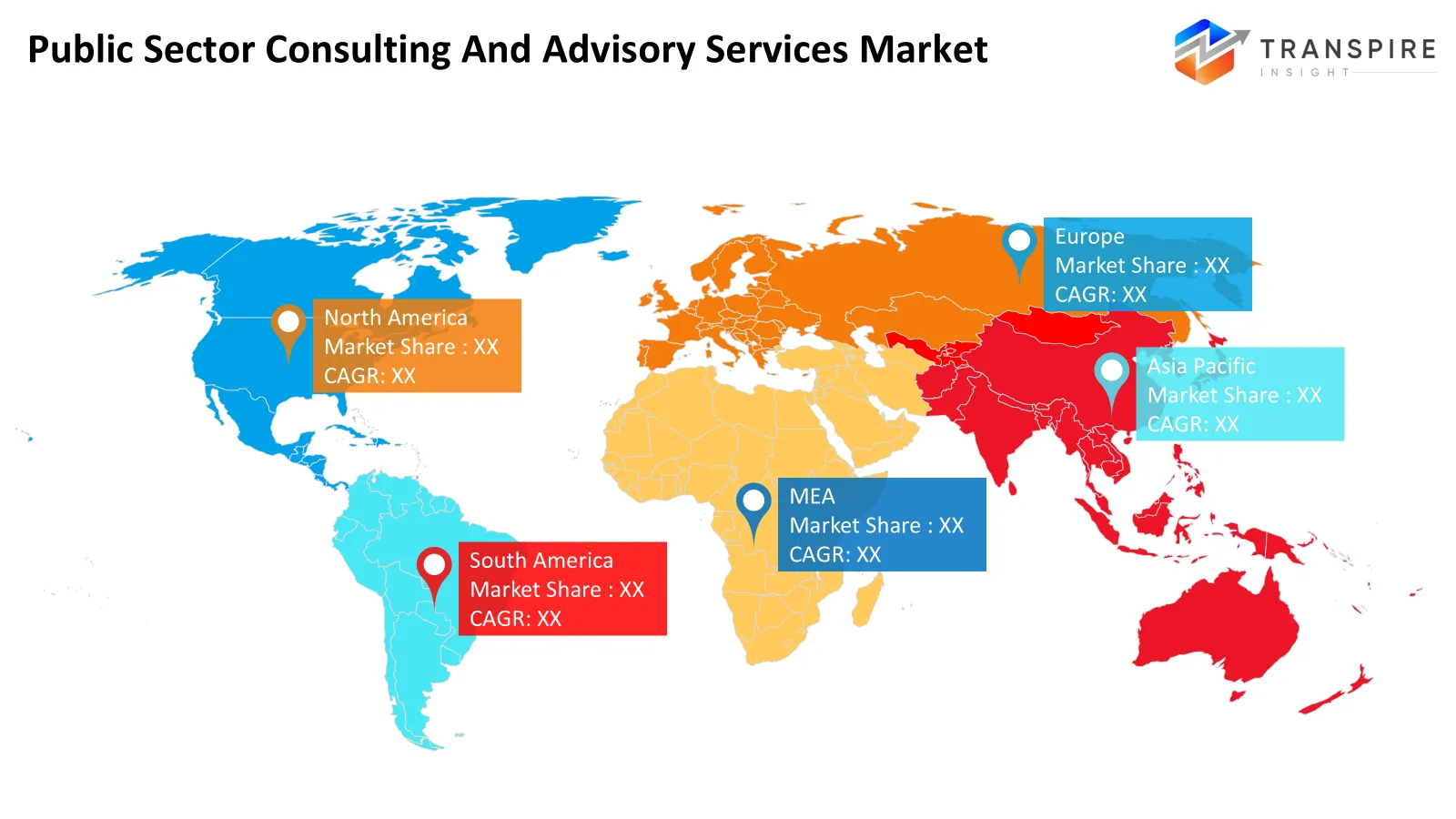
North America has the largest market share at 64.50%, largely because concurrent modernisation of legacy systems, increases in cyber defences, and enabling artificial intelligence are being undertaken by US federal, state, and city agencies. North America's ecosystem boasts large spend on procurement, matured cloud investments, strong defence and intelligence demand, and regulatory bodies' insistence on responsible use of AI. That Booz Allen is a large federal provider of artificial intelligence is a testament to mission-oriented security needs translating to steady demand for consulting work.
In June 2026, Booz Allen Hamilton formed a strategic partnership with OpenAI to promote advanced AI innovation across national security and critical infrastructure missions. This collaboration accelerates the secure deployment of frontier AI models tailored specifically for complex U.S. defence and intelligence operations.
Europe has 17.00% and is expanding under a regulatory paradigm more stringent than North America's. The digital identity, data, AI, and sustainability initiatives in the European Union are providing steady demand for compliance architecture, interoperability, and public-service transformation programs across Germany, France, and the UK. Regulatory certainty on the continent enables both long planning horizons and multi-year engagements that may be smaller than in the US, yet are still time-driven, budget-driven, and scope-driven and scope-optimised.
In June 2026, IDnow launched its comprehensive IDnow Trust Platform. This solution transitions businesses from one-time onboarding to continuous lifecycle trust by orchestrating verification, fraud prevention, and biometric authentication.
https://idnow.io/insights/pr/idnow-launches-idnow-trust-platform/
The Asia-Pacific region leads with the strongest annual compound growth of 17.90%, as national digital-government programs, investments in smart cities, digital payments, and expanding citizen-service expectations are playing a role. Recent investments in cloud infrastructure, digital identity, and AI-enabled public administration are enabling governments in India, Singapore, Australia, Japan, and South Korea to leapfrog traditional modernisation and score the strongest future opportunities for scale-up, managed services, and AI local governance. The market size is 12.00%, Latin America 3.50%, and the Middle East and Africa 3.00%, where digital-government agendas and funding for infrastructure are gradually opening up new advisory markets.
In February 2026, the Indian Government announced a tax holiday till 2047 for eligible foreign cloud service providers operating through India-based data centre infrastructure. This policy choice aims to position India as a hub for AI and cloud infrastructure, lowering the costs of operating at scale and attracting long-term foreign capital.
https://www.pib.gov.in/PressReleseDetailm.aspx?PRID=2227953®=3&lang=1
Who are the Key Players in the Public Sector Consulting And Advisory Services Market, and how do they compete?
The battle is increasingly between integrators delivering large-scale technology programs and specialist firms providing high-assurance government business. Squeezing margins are forcing buyers to adopt a relational model of partner selection based on security credentials, domain expertise, delivery capacity and reputation for outcomes rather than brand scale.
Across the West, each challenger has a different angle to justify its domain to the public sector: Accenture's end-to-end modernisation strategy focused on a combination of cloud partnerships, data platforms and artificial intelligence service provision; its differentiation comes from strategy through managed services; Deloitte brings responsible artificial intelligence governance, audit-grade controls, and public-sector operating-model experience; it is expanding through artificial intelligence research, engineering and regulated-industry advice. Meanwhile, firms like Booz Allen Hamilton maintain a niche, mission-security strategy of defence, intelligence, cybersecurity and federal artificial intelligence deployment, and IBM Consulting and Capgemini differentiate on hybrid cloud, enterprise integration and high-governance artificial intelligence. Others such as CGI promise long-term public-sector systems and managed services, while the strategy-led set of McKinsey, BCG and Bain continue to embed artificial intelligence capability, performance analytics and outcome-based transformation.
Key Players are:
- Accenture
- Deloitte
- PwC
- EY
- KPMG
- McKinsey & Company
- Boston Consulting Group
- Bain & Company
- Booz Allen Hamilton
- Guidehouse
- IBM Consulting
- Capgemini
- CGI
- ICF
- PA Consulting
Recent Development News
- In August 2026, PSJ Consulting partnered with Carahsoft to expand access to its public sector consulting, data modernization, compliance, and project delivery services through government procurement contracts and reseller networks. The partnership is expected to help government agencies and government contractors strengthen operational efficiency, improve data readiness, and enhance accountability in complex programs. https://www.globenewswire.com/news-release/2026/08/06/3340337/0/en/psj-consulting-and-carahsoft-partner-to-bring-mission-focused-consulting-data-compliance-and-project-delivery-modernization-solutions-to-the-public-sector.htmlb
- In April 2026, Rodic Digital & Advisory signed a memorandum of understanding with SatSure to jointly pursue public sector opportunities using Earth observation data and geospatial artificial intelligence. The collaboration is expected to support government digital transformation through improved infrastructure monitoring, natural resource management, regulatory compliance, and data-driven decision-making. https://www.satsure.co/press-release/rodic-digital-advisory-signs-mou-with-satsure-to-bring-earth-observation-intelligence-to-indias-public-sector/
- In September 2026, Accenture launched Accenture Construct, an integrated capital project entity uniting strategic advisory, infrastructure engineering, and project deployment capabilities into a single accountable operating framework. This operational rollout aims to radically modernise fragmented public-sector infrastructure project lifecycles using predictive AI models and data analytics to mitigate severe systemic delays and budget overruns during the current investment supercycle. https://newsroom.accenture.com/news/2026/accenture-launches-accenture-construct-to-reinvent-fragmented-capital-project-delivery-amid-global-investment-supercycle
What Strategic Insights Define the Future of the Public Sector Consulting And Advisory Services Market?
The market is moving toward integrated advisory contracts in policy design and technology deployment, workforce readiness, and measurable public impact. The share of technology consulting at 36.50% reflects implementation expertise, while growth in the APAC region represents opportunities beyond Western procurement markets. There exists a latent risk of governments relying on third-party consultants for key digital capabilities without developing an in-house workforce; this can raise costs in the long term, erode institutional knowledge, and complicate transitions in vendors.
The OECD's 2026 Digital Government Outlook highlights the importance of investing in government capabilities, as the transition from disjointed digital building blocks to integrated, user-centric services plays out. One emerging opportunity is sovereign AI, interoperable digital public infrastructure, and AI assurance for regulated government workflows. Service providers must concentrate on reusable components, transparent costs, assurance and privacy, machine-readable data architecture, and knowledge transfer. Firms that can show step-change in service delivery, cost savings, and institutional capacity will be more likely to win repeat engagements and mandates for longer-term transformation.
Key Segmentations are:
Service Type
- Technology Consulting
- Strategy Consulting
- Cybersecurity Advisory
- Digital Transformation
- Financial Advisory
- Human Capital Consulting
- Operations Consulting
- Others
Government Level
- Central Government
- State Government
- Local Government
- Defense Agencies
- Regulatory Agencies
- Public Authorities
- Municipal Bodies
- Government-Owned Enterprises
Advisory Area
- IT Modernization
- AI Governance
- Cloud
- Digital Identity
- Infrastructure
- Procurement
- Risk Management
- Sustainability
Engagement Type
- Strategy
- Implementation
- Managed Services
- Program Management
- Audit & Compliance
- Change Management
- Training
- Others
Sector
- Defense
- Healthcare
- Education
- Transportation
- Energy
- Public Safety
- Finance
- Environment
By Regional Analysis
North America
- US
- Canada
- Mexico
Europe
- Germany
- UK
- France
- Italy
- Spain
- Russia
- Rest of Europe
Asia Pacific
- China
- Japan
- India
- South Korea
- Australia
- Rest of Asia Pacific
South America
- Brazil
- Argentina
- Rest of South America
Middle East & Africa
- UAE
- Saudi Arabia
- Qatar
- South Africa
- Rest of the Middle East & Africa
Frequently Asked Questions
Find quick answers to common questions.
The public sector consulting and advisory services market size was valued at USD 31.40 billion in 2025 and is poised to reach USD 41.75 billion by 2033, expanding at a 3.60% CAGR.
Key segments for the public sector consulting and advisory services market are Service Type (Technology Consulting, Strategy Consulting, Cybersecurity Advisory, Digital Transformation, Financial Advisory, Human Capital Consulting, Operations Consulting, Others); Government Level (Central Government, State Government, Local Government, Defense Agencies, Regulatory Agencies, Public Authorities, Municipal Bodies, Government-Owned Enterprises); Advisory Area (IT Modernization, AI Governance, Cloud, Digital Identity, Infrastructure, Procurement, Risk Management, Sustainability); Engagement Type (Strategy, Implementation, Managed Services, Program Management, Audit & Compliance, Change Management, Training, Others); Sector (Defense, Healthcare, Education, Transportation, Energy, Public Safety, Finance, Environment).
Growth is primarily driven by government digital transformation, legacy system modernization, cybersecurity investments, AI governance requirements, regulatory compliance, and the need to improve public service efficiency and fiscal accountability.
The public sector consulting and advisory services market is led by major manufacturers, including Accenture, Deloitte, PwC, EY, KPMG, McKinsey & Company, Boston Consulting Group, Bain & Company, Booz Allen Hamilton, Guidehouse, IBM Consulting, Capgemini, CGI, ICF, and PA Consulting.
North America dominates with a 64.50% market share, supported by substantial government procurement budgets, advanced digital infrastructure, defense modernization, cybersecurity spending, and established consulting ecosystems.
Key opportunities include AI governance and assurance, cloud modernization, digital public infrastructure, cybersecurity advisory, integrated citizen services, and implementation-led government transformation programs.
- Accenture
- Deloitte
- PwC
- EY
- KPMG
- McKinsey & Company
- Boston Consulting Group
- Bain & Company
- Booz Allen Hamilton
- Guidehouse
- IBM Consulting
- Capgemini
- CGI
- ICF
- PA Consulting
About the Authors

Mayur Shinde
I am Mayur Shinde, a Senior Research Analyst at Transpire Insight, specializing in the Automotive & Transportation and Information & Communication Technology (ICT) Industry. My work focuses on analyzing emerging market trends, technological advancements, competitive landscapes, and industry developments to deliver accurate, data-driven insights. I am passionate about transforming complex market information into clear, actionable content that helps businesses, professionals, and decision-makers stay informed and make confident strategic decisions.

Chakradhar Khansole
Chakradhar serves as the Research Director at Transpire Insight, bringing over 8 years of experience in technology, innovation, and strategic market intelligence. He specializes in transforming complex market data into actionable business insights that enable organizations to make informed, growth-oriented decisions. Recognized for his strategic vision and analytical expertise, Chakradhar leads high-impact research initiatives, delivering comprehensive market assessments, competitive intelligence, and forward-looking industry analysis.
Recently Published Reports
-
Apr 2026
3D Optical Profiler Market
3D Optical Profiler Market Size, Share & Analysis Report By Type (Desktop 3D Optical Profiler, and Portable 3D Optical Profiler), By Technology (Confocal Technology, and White Light Interference), By End-Use Industry (Manufacturing, Research Institutions, Automotive, Aerospace and Defense, Medical Devices, and Other), and Geography (North America, Europe, Asia-Pacific, Middle East and Africa, South and Central America), 2021 - 2031
-
Apr 2026
Depth Sensor Market
Depth Sensor Market Size, Share & Analysis Report By Type (Infrared Depth Sensors, Time-of-Flight (ToF) Sensors, Stereo Vision Sensors, Structured Light Sensors, Ultrasonic Depth Sensors), By Application (Automotive, Robotics, Gaming, Consumer Electronics, Industrial Automation, Healthcare, Security & Surveillance, Others), By End Users (Automotive Manufacturers, Consumer Electronics Companies, Healthcare Providers, Industrial Companies, Security Agencies, Gaming Companies, Robotics Companies, Others), and Geography (North America, Europe, Asia-Pacific, Middle East and Africa, South and Central America), 2021 – 2031
-
Apr 2026
Digital Manufacturing Market
Digital Manufacturing Market Size, Share & Analysis Report By Component (Hardware, Software, and Services), By Technology (Robotics, 3D Printing, Internet of Things (IoT), and Others), By Application (Automotive and Transportation, Aerospace and Defense, Consumer Electronics, Industrial Machinery, and Others), By Process Type (Computer-Based Designing, Computer-Based Simulation, Computer 3D Visualization, Analytics, and Others), and Geography (North America, Europe, Asia-Pacific, Middle East and Africa, South and Central America), 2021 – 2031
-
Apr 2026
Digital Visa Services Market
Digital Visa Services Market Size, Share & Analysis Report By Type (Individual Travelers, Group Travelers), By Application (Tourism, Business Travel, Others), and Geography (North America, Europe, Asia-Pacific, Middle East and Africa, South and Central America), 2021 – 2031