

Global AI Governance Market Size & Forecast:
- Global AI Governance Market Size 2025: USD 307.9 Million
- Global AI Governance Market Size 2033: USD 3622.93 Million
- Global AI Governance Market CAGR: 36.1%
- Global AI Governance Market Segments: By Component (Software, Services, Platforms), By Application (Risk Management, Compliance, Monitoring, Ethics), By End-User (Enterprises, Government, BFSI, Healthcare)

To learn more about this report,  Download Free Sample Report
Global AI Governance Market Summary:
The Global AI Governance Market size is valued at USD 307.9 Million in 2025 and is expected to achieve a value of USD 3622.93 Million in 2033, powered by the fast-paced commercialization of generative AI, as well as growing regulations on how to deploy AI responsibly. In recent years, companies started shifting their focus from experimenting with AI adoption within the organizations to adopting the technology across all operations. One notable change in this regard is the emergence of regulations led by governments concerning AI, such as the EU AI Act, along with higher requirements for enterprise risk management. The fast-paced deployment of generative AI software tools in wake of OpenAI’s ChatGPT became the actual event that fueled corporate concerns about AI’s tendencies towards hallucination, misuse of data, and automated decisions. AI governance platforms become more relevant as corporations are incorporating the technology into their finance, health care, customer support, and cybersecurity departments to minimize operational risks, increase transparency, and develop user trust.
Global AI Governance Market Insights:
- The Global AI Governance Market is evolving from a compliance-focused niche into a strategic enterprise infrastructure layer supporting trustworthy and scalable AI deployment. Rising adoption of generative AI, autonomous systems, and stricter regulatory oversight is transforming governance platforms into core operational tools across industries.
- North America accounts for over 31% of global market revenue, supported by aggressive investments from companies such as IBM, Microsoft, and Oracle in explainable AI, model auditing, and compliance automation platforms.
- More than 65% of enterprises deploying generative AI are now prioritizing governance frameworks due to growing concerns over hallucinations, privacy leakage, and intellectual property risks in AI-generated outputs.The software segment dominates with nearly 58% market share as organizations increasingly adopt AI lifecycle monitoring, bias detection, and policy management solutions for enterprise-wide governance.
- The financial services industry continues to be one of the earliest adopters, with more than 45% of big banks implementing AI risk surveillance technologies to meet regulatory mandates and increase transparency within decision-making platforms.
- The rapid adoption of AI governance in healthcare comes as hospitals and diagnostic firms implement ethical AI frameworks to avoid bias and meet the data privacy standards associated with patient information.
- Vendors like SAP, Infosys, and NTT Data have increased their AI governance-as-a-service products amid a trend towards a convergence of compliance, cybersecurity, and AI governance services.
- Over 60% of implementations rely on cloud deployment because organizations now prefer governance platforms that allow for real-time oversight of decentralized AI deployments.
- The regulatory changes such as EU AI Act and U.S. Executive AI safety programs are driving companies' investments in auditability, documentation, and AI infrastructure for transparency.
- AI governance platforms are now leveraging behavioral analysis and continuous monitoring features to help organizations identify drift in models, unfairness, and unintended actions by AI systems.
- The small and medium enterprises have become one of the fastest-growing users because of the emergence of subscription services in AI governance platforms.
What are the Key Drivers, Restraints, and Opportunities in the Global AI Governance Market?
Driver
The key factor behind the growth of the Global AI Governance Market lies in the rapid implementation of generative AI and autonomous decision-making solutions in finance, healthcare, retail, and government sectors. The adoption of generative AI and various applications based on its development has led to serious issues around hallucinations, bias in algorithms, security, and abuse of confidential data. As enterprises incorporate AI in areas such as customer support, fraud detection, diagnostic solutions, and operations automation, there is a need to ensure that their activities can be traced, explained, and monitored for regulatory compliance purposes. This has resulted in increased investments in AI governance solutions that positively affect software/cloud-service revenues.
Restraint
One of the limitations that exist is that there are no global standardization efforts in terms of regulations regarding AI governance as well as AI interoperability. Various nations and industries have their own sets of fragmented compliance rules. Moreover, several firms find it difficult to implement AI governance tools because of their existing legacy IT systems along with the use of black box algorithms especially when they involve the use of third party software with minimal transparency.
Opportunity
The other major area where an interesting opportunity exists is in the development of automated real-time AI governance using AI-based monitoring and prediction for risk assessment. Geographical locations like Asia-Pacific should experience substantial adoption rates, with government agencies taking up sovereign AI projects and digital compliance. It seems that investments in AI governance technology that uses cyber security and cloud orchestration will offer new business possibilities in the decade ahead.
What Has the Impact of Artificial Intelligence Been on the Global AI Governance Market?
Artificial Intelligence has completely revolutionized the Global AI Governance Market by providing for automated regulation, constant monitoring, and risk management in AI systems. Contemporary governance solutions rely on machine learning algorithms that can detect AI bias, monitor AI abnormalities, classify the disclosure of sensitive information, and report compliance, resulting in less reliance on manual audits.In March 2026, IBM enhanced watsonx governance offerings to include automated risk monitoring features that will allow enterprises to monitor the behavior and compliance of generative AI models in real time.
The predictive analytics framework is contributing to operational efficiencies in the field as well. With the upgrade, firms were able to spot model drift, erroneous results, and cyber risks before any operations were disrupted. This has helped them better manage their AI deployment cycles, incur less costs related to compliance, and increase accountability over cloud infrastructure. In January 2026, Microsoft further developed its framework of responsible AI governance through implementing predictive compliance in their cloud AI services.
Global AI Governance Market Trends:
- AI Governance industry is moving from reactive compliance management solutions to proactive AI risk orchestration that is built into business processes itself. Firms are becoming more focused on governance as a consistent process instead of a temporary task due to the fast development of generative and autonomous AI technologies.
- From manually performed AI audit to autonomous real-time governance solutions; this transformation indicates an industry trend towards continuous monitoring and autonomous compliance management.
- In the past several years, governance solutions have shifted from just detecting biases to managing the entire AI lifecycle, such as model tracking, explaining, validating cyber security policies, etc.
- Banks are gradually adopting AI governance into their financial services and fraud detection processes, which demonstrates an industry behavioral transition towards trust-first deployment of AI technology.
- Organizations are moving from disjointed governance models to comprehensive cloud-native governance models, where the cybersecurity, data governance, and AI risk management aspects are combined into one.
- The introduction of generative AI starting from 2023 has increased the need for organizations to have systems in place to detect hallucination, verify synthetic content, and monitor IP usage.
- Governments and regulatory bodies are moving from voluntary AI ethics frameworks to mandatory compliance frameworks, thus increasing the pressure on organizations to implement AI governance infrastructure that is auditable and transparent.
- Explainable AI technology is being adopted by enterprises due to the increasing demands for transparency in automated decision-making from executive boards and executives.
- Prediction and behavioral monitoring systems, which can detect potential model drift and operational abnormalities, are being introduced in AI governance platforms.
- Organizations are increasingly forming cross-disciplinary governance teams, with skills ranging from AI engineering to cybersecurity to legal and compliance.
Global AI Governance Market Segmentation:
By Component
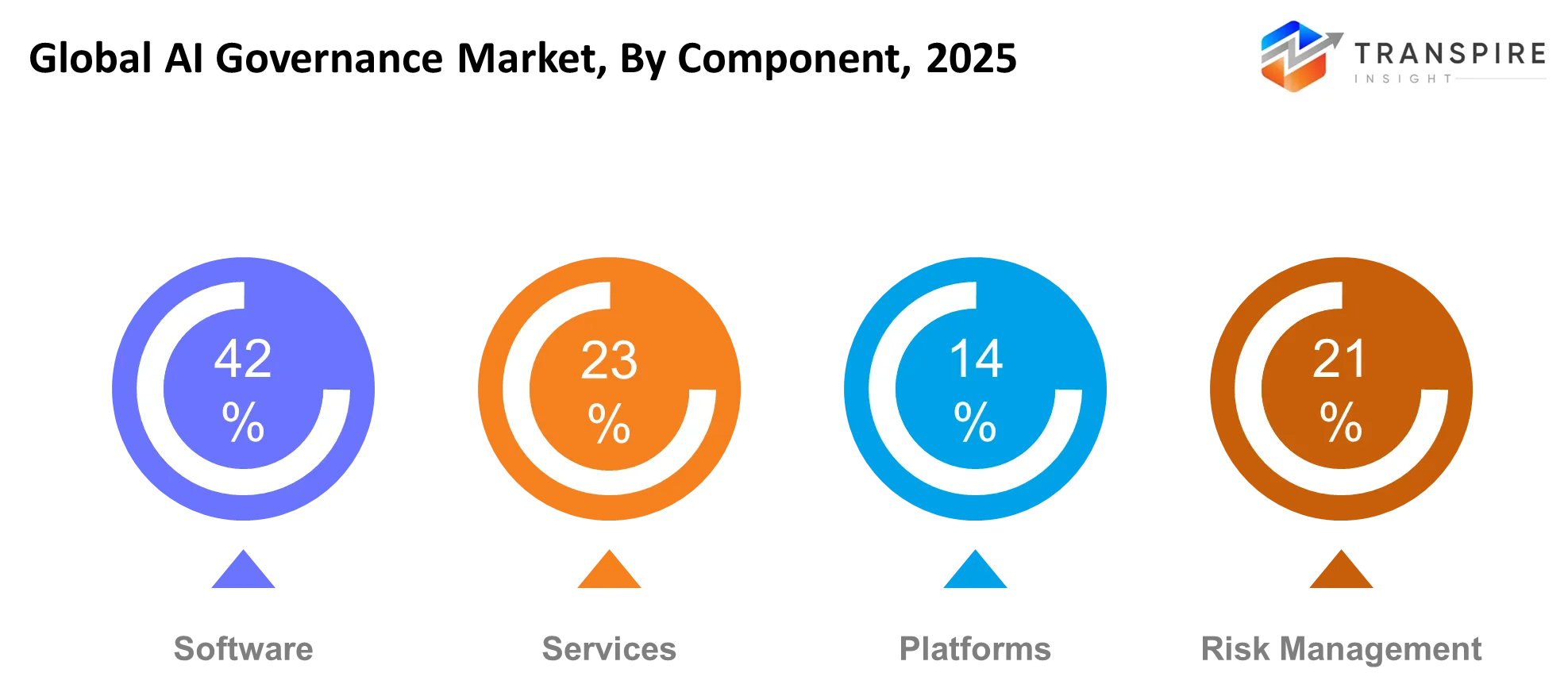
In the Global AI Governance Market, based on its segmentation into software, services, and platforms, software products take the lead since businesses are becoming more and more dependent on software that can automate compliance management, explainable AI, AI bias detection, and model lifecycle monitoring. Software is chosen as an option since it allows for the continuous monitoring of generative AI while minimizing any risks and eliminating the need for audits. The use of services is gradually growing since businesses require consultations, implementation, and policy design for adhering to quickly changing legislation regarding AI systems. At the same time, platforms represent a promising trend in the field of governance since businesses strive to establish ecosystems for their companies where risk assessment, security monitoring, and policy enforcement can be conducted all at once. In the long run, the platform-based approach to governance will become more prevalent since enterprises will be looking for an integrated system for managing AI.
To learn more about this report, Download Free Sample Report
By Application
AI risk management remains the largest category since companies are now focused on governance over artificial intelligence decision-making mechanisms. Companies have started to embrace governance technologies for finding any form of biases in algorithms, avoiding cybersecurity breaches, and mitigating any financial and reputational risks that may occur from using faulty AI technology. Governance through compliance has been showing promising growth trends as more and more regulations, including the European Union AI Act, are being developed, along with high demands for automatic document management. The development of monitoring applications is happening fast through the use of behavioral analytics and predictive governance systems, which allow for the detection of model drift, hallucinations, and other irregular activities within AI systems before it causes any problems for their operation. AI governance that addresses ethics will become a strategic issue in trying to build up consumer confidence and responsible operations.
By End-User
Enterprises represent the most prominent end-user group since there is increased use of artificial intelligence across various enterprise functionalities such as customer service, cybersecurity, analytics, and operations automation. Enterprises have more advanced governance structures since there is increased adoption of enterprise-level AI technologies, and hence there are higher risks of legal and compliance liabilities. Governments emerge as key areas of growth since sovereign AI, digital regulation, and responsible AI regulations will be implemented within governmental structures to increase transparency and accountability. The BFSI is one of the key adopting industries because of the need for complex governance frameworks to facilitate the monitoring of AI technologies used for purposes of fraud detection and automation of regulatory processes. In addition, healthcare facilities will continue to increase their AI adoption levels owing to the growing requirement of explanations in diagnostic applications and data security concerns.
What are the Key Use Cases Driving the Global AI Governance Market?
Enterprise risk and compliance management are the major use cases that will drive growth in the Global AI Governance Market with enterprise risk management in the BFSI sector needing to have governance frameworks to enable effective oversight of automatic loan approvals, fraud detection, and automated decisions.
Growing use cases are seen in the health care and government verticals, where the applications of governance technologies include overseeing clinical diagnostics, ensuring privacy of patient data, auditing of government programs, and automating citizen services. In such cases, real-time monitoring and bias detection features are vital as organizations roll out large-scale generative AI models.
Other growing use cases include governing AI agents, verifying synthetic content, and governing AI due to cybersecurity needs. Enterprises are turning to predictive AI governance tools that can detect problems like hallucinations and unauthorized use of AI algorithms before they cause operational issues.
|
Report Metrics |
Details |
|
Market size value in 2025 |
USD 307.9 Million |
|
Market size value in 2026 |
USD 418.74 Million |
|
Revenue forecast in 2033 |
USD 3622.93 Million |
|
Growth rate |
CAGR of 36.1% from 2026 to 2033 |
|
Base year |
2025 |
|
Historical data |
2020 - 2024 |
|
Forecast period |
2026 - 2033 |
|
Report coverage |
Market trends, drivers, restraints, opportunities, competitive landscape, technological advancements, regulatory analysis, and regional insights |
|
Regional scope |
North America, Europe, Asia-Pacific, Latin America, Middle East & Africa |
|
Key company profiled |
IBM, Microsoft, Google, Amazon AWS, Oracle, SAP, Deloitte, PwC, Accenture, Capgemini, Infosys, TCS, Wipro, HCLTech, SAS Institute |
|
Customization scope |
Customized regional analysis, company profiling, segment-specific insights, and strategic trend assessment available upon request |
|
Report Segmentation |
By Component (Software, Services, Platforms), By Application (Risk Management, Compliance, Monitoring, Ethics), By End-User (Enterprises, Government, BFSI, Healthcare) |
Which Regions are Driving the Global AI Governance Market Growth?
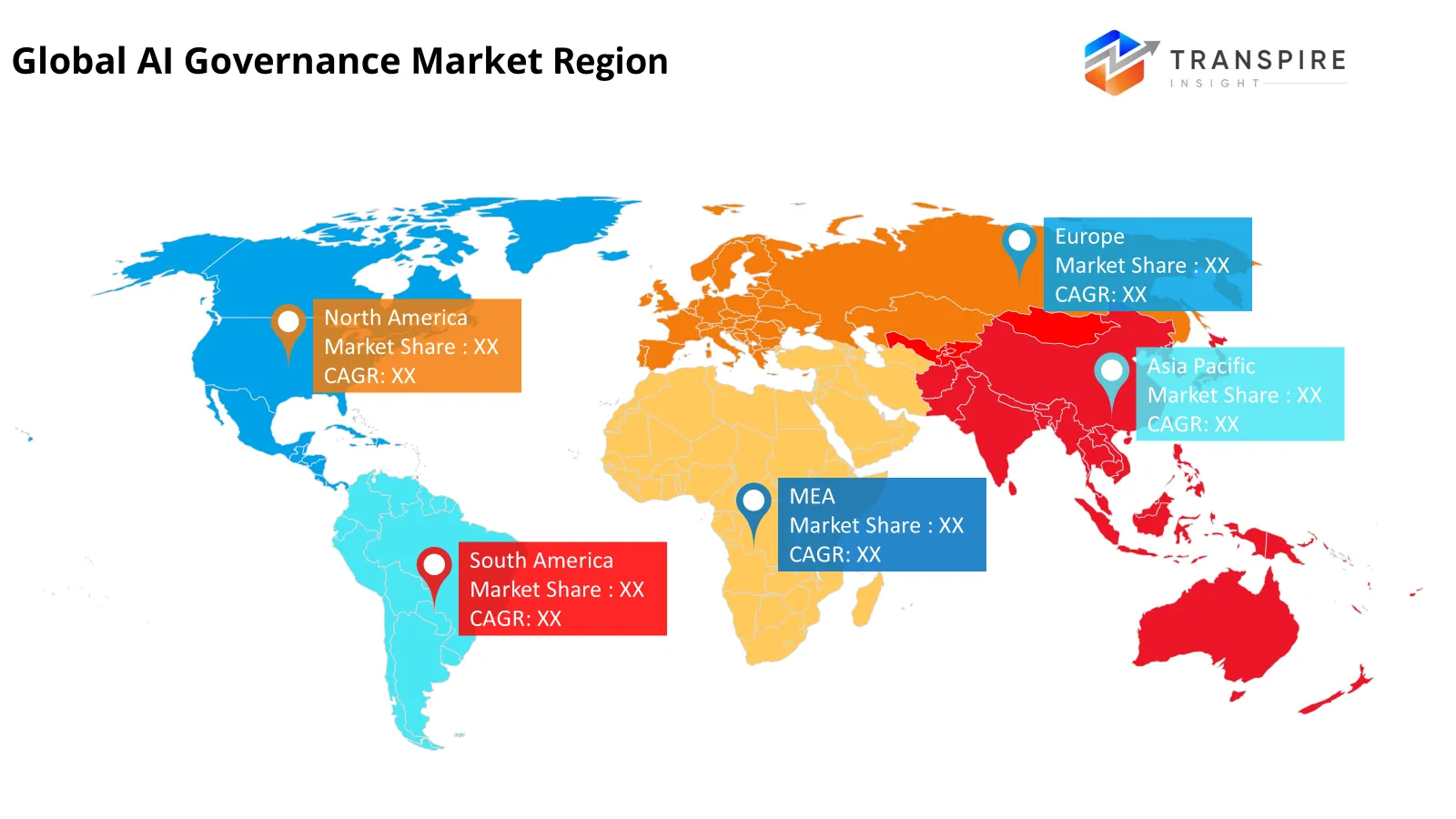
North America holds sway over the market for AI Governance owing to its well-developed artificial intelligence environment, robust cloud infrastructure, and rapid enterprise adoption of generative AI solutions. Such leadership is enabled through the presence of leading technology players like Microsoft, IBM, and Oracle that continually invest in expanding their governance, explainability, and compliance of AI solutions. Regional growth opportunities for AI Governance are also fueled by the growing conversations on responsible AI, cybersecurity within enterprises, and investments in AI auditing systems.
The second largest market is Europe with regulation of AI driven by policy and institutions that ensure that AI is trustworthy. In contrast to North America, where expansion is driven by innovations, Europe’s growth is characterized by the emphasis on compliance, AI ethics, and data privacy. Europe’s steady growth can be attributed to well-coordinated regulatory ecosystems, digital government initiatives in the public sector, and growing interest in transparent AI implementations in healthcare, manufacturing, and finance. In August 2024, Saw one significant event, namely, the coming into effect of the EU AI Act, which became the world’s first regulation concerning AI and propelled companies to invest more into their AI governance solutions in Germany, France, and other EU countries.
The Asia-Pacific region appears set to become the fastest-growing regional market because of the rapid digital transformation process, sovereignty-driven AI programs, and increasing enterprise use of autonomous AI solutions. Recently, countries like China, India, Japan, and South Korea have increased their investment in the establishment of local AI capabilities, cybersecurity regulatory regimes, and development of national AI policies. The future potential of the region revolves around localized regulatory regimes, cloud-compliant governance systems, and home-grown AI monitoring technologies to decrease the dependency on foreign AI platforms while achieving digital transformation. In May 2025, researchers and healthcare institutions in Europe and Asia-Pacific stepped up efforts geared toward establishing AI Act-compliant governance for medical AI systems.
To learn more about this report, Download Free Sample Report
Who are the Key Players in the Global AI Governance Market and how do they Compete?
Competitive rivalry in the AI Governance industry is based on technological superiority, regulatory compliance, and integration into complex AI systems. Players in the market compete on their efforts to develop and implement explainable AI functionalities, compliance monitoring, risk assessments, and real-time governance for generative AI. Vendors tend to offer governance platforms not as standalone solutions but as part of overall corporate infrastructure designed to support regulated industries such as banking, healthcare, and governments. In addition, there is an increase in collaboration between cloud providers, cybersecurity vendors, and AI technology suppliers to deliver governance solutions for autonomous AI operation.
IBM relies primarily on innovation-based governance and its WatsonX AI governance solution focused on explainability, biases, and governance at all stages of enterprise AI model lifecycle. Innovation and integration with hybrid cloud infrastructure and compliance automation are key to the vendor's position in the market. In September 2024, IBM extended its governance scope into generative AI via establishment of a generative AI excellence center jointly with Minsait for Europe-based enterprises undergoing AI transformation. On the other hand, Microsoft bases its competition strategy on cloud-scale governance, cybersecurity and responsible AI frameworks implemented in its Azure AI products.
The uniqueness of Oracle stems from the inclusion of AI governance capabilities that can be incorporated into enterprise databases, cloud applications, and analytical solutions, thus allowing organizations to ensure their compliance in current operational environments. SAP aims to build its competitive strength by offering governance software solutions specific to supply chains, finances, and enterprise resource planning apps. In turn, Infosys and Tata Consultancy Services grow based on consultancy services focused on implementing AI governance strategies alongside the development of digital business models and managed services.
Global AI Governance Market Companies:
- IBM
- Microsoft
- Amazon AWS
- Oracle
- SAP
- Deloitte
- PwC
- Accenture
- Capgemini
- Infosys
- TCS
- Wipro
- HCLTech
- SAS Institute
Recent Development News:
In March 2026, IBM collaborated further with NVIDIA at GTC 2026 to enhance AI governance, GPU-based analytics, and regulated AI infrastructure deployment within the enterprise. This collaboration improved real-time AI governance, compliance automation, and scalability in AI enterprise environments.
In May 2026, NTT Data decided to acquire WinWire, which was an AI transformation service firm focusing on agentic AI and cloud-based AI solutions. With this acquisition, NTT Data gained additional enterprise AI governance capabilities and Azure AI integration capabilities.
What Strategic Insights Define the Future of the Global AI Governance Market?
The evolution of the Global AI Governance Market will hinge on the move away from compliance-driven solutions to the development of autonomous AI oversight frameworks integrated into business operations themselves. The advent of agentic AI technology, multimodal models, and self-learning AI will drive more reliance on governance platforms as control centers, not just for regulatory compliance but also for operational efficiency. The overlooked risk involves governance fragmentation due to inconsistent regional regulations as well as the lack of compatibility between regional AI governance standards, leading to potential inefficiencies for international businesses with a presence in several jurisdictions. Conversely, the unheralded opportunity for growth relates to the development of sovereign AI governance, especially among countries in the Asia-Pacific and Middle Eastern regions, who seek to develop their own local AI ecosystems and regulatory frameworks to manage the growing use of AI within business processes.
Global AI Governance Market Segmentation
By Component
- Software
- Services
- Platforms
By Application
- Risk Management
- Compliance
- Monitoring
- Ethics
By End-User
- Enterprises
- Government
- BFSI
- Healthcare
Regional Outlook
North America
- United States
- Canada
- Mexico
Europe
- Germany
- United Kingdom
- France
- Spain
- Italy
- Rest of Europe
Asia Pacific
- Japan
- China
- Australia & New Zealand
- South Korea
- India
- Rest of Asia Pacific
South America
- Brazil
- Argentina
- Rest of South America
Middle East & Africa
- Saudi Arabia
- United Arab Emirates
- South Africa
- Rest of the Middle East & Africa
Frequently Asked Questions
Find quick answers to common questions.
The Global AI Governance Market is expected to reach USD 3622.93 Million by 2033.
Key segments for the Global AI Governance Market are By Component (Software, Services, Platforms), By Application (Risk Management, Compliance, Monitoring, Ethics), By End-User (Enterprises, Government, BFSI, Healthcare).
Global AI Governance Market players are IBM, Microsoft, Google, Amazon AWS, Oracle, SAP, Deloitte, PwC, Accenture, Capgemini, Infosys, TCS, Wipro, HCLTech, SAS Institute.
The Global AI Governance Market size is USD 418.74 Million in 2026.
The Global AI Governance Market CAGR is 36.1% from 2026 to 2033.
- IBM
- Microsoft
- Amazon AWS
- Oracle
- SAP
- Deloitte
- PwC
- Accenture
- Capgemini
- Infosys
- TCS
- Wipro
- HCLTech
- SAS Institute
About the Authors

Mayur Shinde
I am Mayur Shinde, a Senior Research Analyst at Transpire Insight, specializing in the Automotive & Transportation and Information & Communication Technology (ICT) Industry. My work focuses on analyzing emerging market trends, technological advancements, competitive landscapes, and industry developments to deliver accurate, data-driven insights. I am passionate about transforming complex market information into clear, actionable content that helps businesses, professionals, and decision-makers stay informed and make confident strategic decisions.

Chakradhar Khansole
Chakradhar serves as the Research Director at Transpire Insight, bringing over 8 years of experience in technology, innovation, and strategic market intelligence. He specializes in transforming complex market data into actionable business insights that enable organizations to make informed, growth-oriented decisions. Recognized for his strategic vision and analytical expertise, Chakradhar leads high-impact research initiatives, delivering comprehensive market assessments, competitive intelligence, and forward-looking industry analysis.
Recently Published Reports
-
Apr 2026
3D Optical Profiler Market
3D Optical Profiler Market Size, Share & Analysis Report By Type (Desktop 3D Optical Profiler, and Portable 3D Optical Profiler), By Technology (Confocal Technology, and White Light Interference), By End-Use Industry (Manufacturing, Research Institutions, Automotive, Aerospace and Defense, Medical Devices, and Other), and Geography (North America, Europe, Asia-Pacific, Middle East and Africa, South and Central America), 2021 - 2031
-
Apr 2026
Depth Sensor Market
Depth Sensor Market Size, Share & Analysis Report By Type (Infrared Depth Sensors, Time-of-Flight (ToF) Sensors, Stereo Vision Sensors, Structured Light Sensors, Ultrasonic Depth Sensors), By Application (Automotive, Robotics, Gaming, Consumer Electronics, Industrial Automation, Healthcare, Security & Surveillance, Others), By End Users (Automotive Manufacturers, Consumer Electronics Companies, Healthcare Providers, Industrial Companies, Security Agencies, Gaming Companies, Robotics Companies, Others), and Geography (North America, Europe, Asia-Pacific, Middle East and Africa, South and Central America), 2021 – 2031
-
Apr 2026
Digital Manufacturing Market
Digital Manufacturing Market Size, Share & Analysis Report By Component (Hardware, Software, and Services), By Technology (Robotics, 3D Printing, Internet of Things (IoT), and Others), By Application (Automotive and Transportation, Aerospace and Defense, Consumer Electronics, Industrial Machinery, and Others), By Process Type (Computer-Based Designing, Computer-Based Simulation, Computer 3D Visualization, Analytics, and Others), and Geography (North America, Europe, Asia-Pacific, Middle East and Africa, South and Central America), 2021 – 2031
-
Apr 2026
Digital Visa Services Market
Digital Visa Services Market Size, Share & Analysis Report By Type (Individual Travelers, Group Travelers), By Application (Tourism, Business Travel, Others), and Geography (North America, Europe, Asia-Pacific, Middle East and Africa, South and Central America), 2021 – 2031