
Process Automation Market Summary:
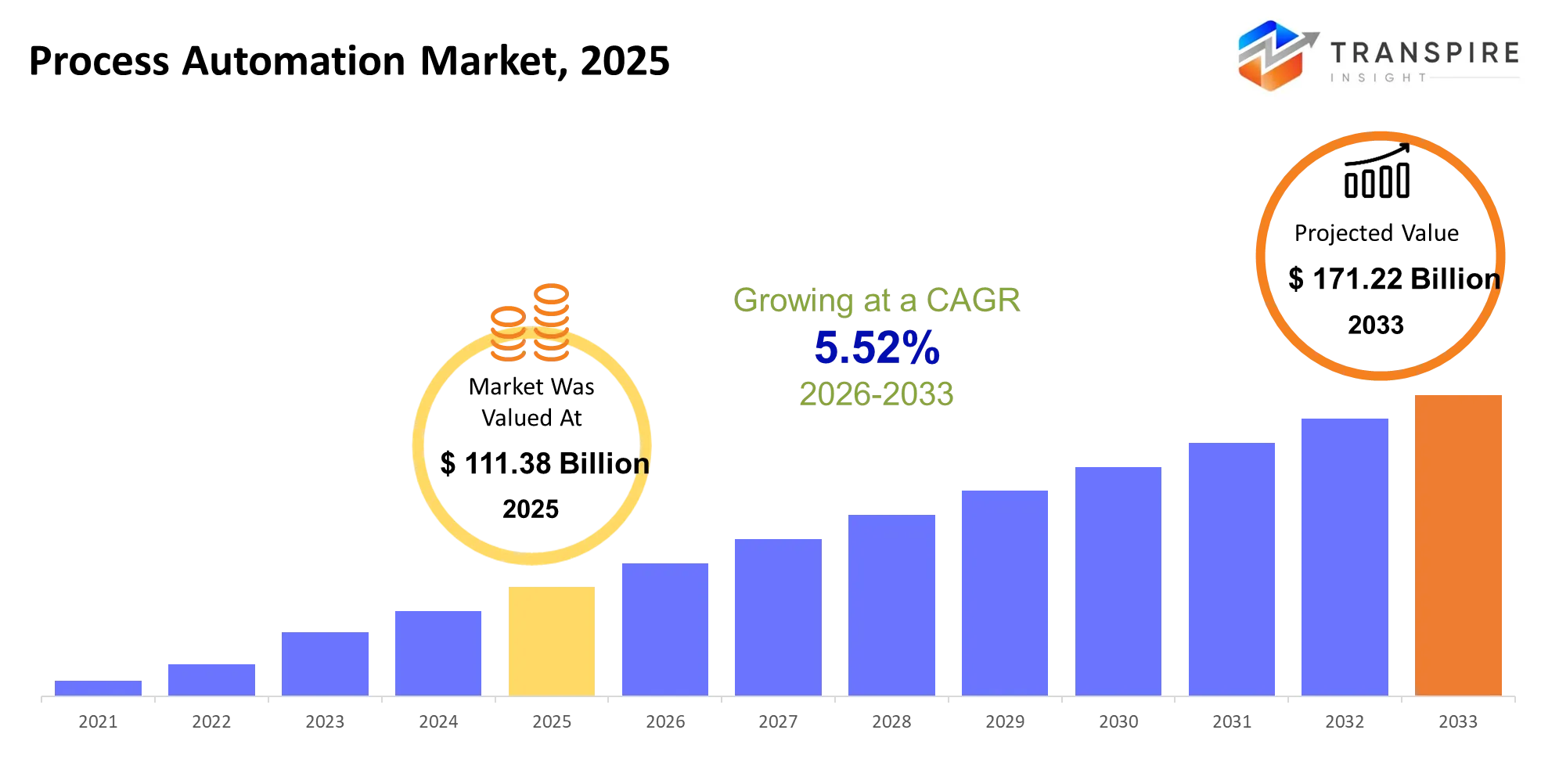
As per the Transpire Insight Analysis, The Process Automation Market size is estimated at USD 111.38 billion in 2025 and is anticipated to reach USD 171.22 billion by 2033, growing at a CAGR of 5.52% from 2026 to 2033.
The process automation market enables organisations to coordinate repetitive tasks in workflows, automate industrial equipment, automate operational information, and keep the outputs consistent in complex processes. In the last 3-5 years, automation has shifted from silos of defined rules to integrated platforms utilizing cloud infrastructure, industrial software, process mining, and AI. A major shift in structure involves the conjunction of operational technology with enterprise IT, where manufacturing information can be leveraged to support decisions related to maintenance, inventory, and scheduling. supply chain interruptions, worker shortages, and the necessity to optimize energy efficiency have led manufacturers and service providers to automate functions that needed human involvement in the past. Automated systems connect the dots where previous silos existed, which enables companies to spot bottlenecks earlier and reduce errors, while optimizing the use of assets. This advancement creates a business case to automate not only units but the complete business process, despite upgrade costs and legacy equipment.
Process Automation Market Size & Forecast:
- Market Size 2025: USD 111.38 Billion
- Expected Market Value (2033): USD 171.22 Billion
- Forecast CAGR (2026–2033): 5.52%
- Leading Region in 2025: North America
- Fastest Growing Region: Asia Pacific
- Key Company Profiles: UiPath, Automation Anywhere, Blue Prism, Microsoft, IBM, SAP, Oracle, Pegasystems, Appian, ServiceNow, NICE, ABBYY, SS&C Technologies, Workato, Nintex.
Key Process Automation Market Insights:
The market is evolving from task automation to connected, AI-enabled operations that enhance decision quality and minimize workflow friction. The level of integration, the measurable productivity benefits, and the ability to scale automation safely are becoming more and more critical for achieving competitive advantage.
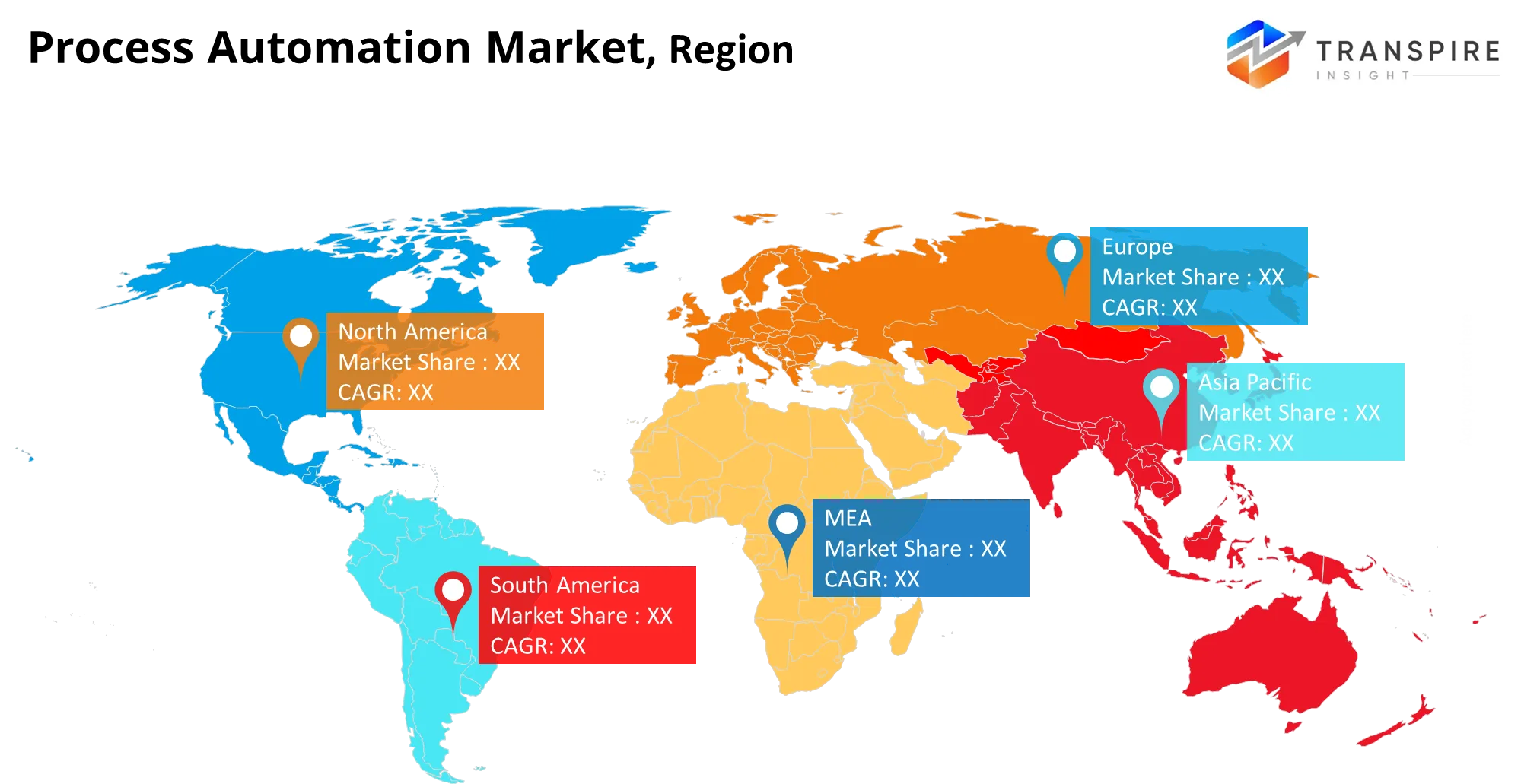
- North America is the top region with a 35.5% market share, bolstered by the fact that the cloud infrastructure is well established and enterprise adoption of AI-driven workflows has begun.
- Asia Pacific accounts for 29.5% and is the fastest-growing region with a CAGR of 13.29% in manufacturing, electronics and energy investments.
- Europe is 24.5%, with the majority of adoption in regulated BFSI, industrial, and public sector process modernisation.
- Shared-services and BPO providers are integrating automation into their managed-service offerings in Latin America, accounting for 6.2%.
- Middle East & Africa accounts for 4.3% of the market, where digitisation, energy projects and smart-city infrastructure are driving growth.
- Pre-configured AI-agent solutions for enterprise deployment and an HCLTech partnership are driving UiPath's expansion.
- In June 2026, Honeywell released Experion Cognition for autonomous, AI-enabled control-room operations.
- As for the tools, Microsoft, IBM, SAP, Oracle, and ServiceNow are integrating automation into larger cloud, ERP, and workflow environments.
- Rather than individual bot licenses, buyers are increasingly looking for outcome-based automation, low-code development, and governance-ready AI.
What are the Key Drivers, Restraints, and Opportunities in the Process Automation Market?
Driver:
Manufacturers are accelerating automation to improve throughput, reduce unplanned downtime, and manage labour-intensive operations. Supply-chain disruptions and skills shortages have pushed companies to replace isolated manual controls with connected production and workflow systems. PwC’s February 2026 industrial manufacturing outlook found that the median share of manufacturers expecting highly automated processes would rise from 18% to 50% by 2030. This transition supports revenue growth for automation software, control systems, integration, and lifecycle services as deployments expand.
Restraint:
Brownfield integration remains the principal constraint. Legacy plants and enterprise systems often use incompatible protocols, fragmented data models, and ageing control equipment, making deployment costly and slow. The problem persists because replacing core infrastructure is capital-intensive, while cybersecurity certification, validation requirements, and scarce automation-engineering talent extend project timelines, particularly for SMEs and emerging-market operators.
Opportunity:
The next opportunity lies in AI-assisted, interoperable automation that connects production planning, maintenance, quality control, and supply-chain decisions. Manufacturers in Asia-Pacific can benefit from investments in smart factories and electronics production, while cloud-connected platforms can help smaller businesses deploy automation incrementally. The World Economic Forum’s 2026 industrial operations outlook highlights the shift toward connected, increasingly autonomous systems, creating opportunities for vendors offering scalable integration, predictive capabilities, and human-supervised automation.
Driver Impact Analysis – Process Automation Market
|
Driver |
Relative Impact on Growth (%) |
Geographic Relevance |
Impact Timeline |
Demand Strength |
Growth Mechanism |
Key Beneficiaries |
Major Constraint |
|
AI-enabled automation and intelligent process optimization |
25% |
North America, Europe, Asia-Pacific |
Short-term (≤2 years) |
High |
Enables predictive control, anomaly detection, and autonomous optimization |
DCS vendors, AI software providers, industrial operators |
Data quality gaps and integration complexity |
|
Industrial digitalization and Industry 4.0 investments |
23% |
Asia-Pacific, North America, Europe |
Medium-term (2–4 years) |
High |
Connects sensors, PLCs, SCADA, and analytics for real-time visibility |
Automation OEMs, system integrators, industrial software vendors |
Legacy infrastructure and high implementation costs |
|
Productivity improvement and skilled-labor shortages |
20% |
North America, Europe, East Asia |
Short-term (≤2 years) |
High |
Automates repetitive workflows, reduces downtime, and improves throughput |
Manufacturers, robotics suppliers, process control vendors |
Workforce reskilling needs and capital constraints |
|
Predictive maintenance, operational resilience, and energy efficiency |
17% |
Europe, North America, Asia-Pacific |
Medium-term (2–4 years) |
High |
Uses process data to prevent failures and optimize energy consumption |
Sensor manufacturers, analytics providers, plant operators |
Incomplete sensor coverage and unreliable historical data |
|
Regulatory compliance, process safety, and sustainability requirements |
15% |
Europe, North America, Asia-Pacific |
Long-term (≥4 years) |
Medium |
Automates monitoring, traceability, emissions reporting, and safety controls |
Process automation vendors, compliance software providers, regulated industries |
Regulatory variation and costly system upgrades |
|
Total |
100% |
— |
— |
— |
— |
— |
What Has the Impact of Artificial Intelligence Been on the Process Automation Market?
AI has elevated process automation from rule-based execution to intelligent decision support. Manufacturing uses computer vision to automate quality inspection; machine-learning algorithms predict failures and optimise energy usage. A survey of industry use cases identifies predictive quality control and targeted reductions in downtime as the most value-driven applications. In banking, insurance, healthcare, and retail, intelligent document processing extracts data from invoices, claims, and customer files; process mining identifies inefficiencies before automation.
Operational gains are measurable. Pilot implementations of intelligent automation in banking, healthcare, and manufacturing have achieved 25-35% reductions in operating costs and 50-60% reductions in cycle times. AI also helps enable predictive maintenance, discover fraud, improve demand planning, and deploy conversational workflow assistants that take care of the repetitive tasks so staff can focus on the exceptions. The main constraints are around integration and risk. Successful AI projects need clean data, strong access controls, traceability, and human oversight; poor data quality or opaque models can result in the automation of bad decisions. Legacy system integration and high customisation costs also slow down adoption.
In October 2026,expanded its partnership with NVIDIA to deploy AI-driven digital twins and adaptive production planning solutions at its Erlangen Electronics Factory. The integration accelerates manufacturing ramp-up timelines and streamlines floor-level autonomous workflows. https://press.siemens.com//en/pressrelease/siemens-partners-nvidia-advance-ai-driven-autonomous-factories
Key Process Automation Market Trends:
Process automation is no longer limited to repetitive tasks, but is now moving towards systems that can coordinate decisions throughout operations. The ability to leverage automation, data quality, AI governance, and staff expertise is becoming a key competitive differentiator in organisations.
- RPA is transforming from desktop scripting to enterprise-level platforms that integrate workflow orchestration, document intelligence, and AI copilots.
- Process mining is becoming a pre-automation field, assisting companies in identifying bottlenecks and prioritizing high-value workflows.
- Cloud and subscription-based automation are lowering up-front capital hurdles and facilitating quicker scaling.
- Low-code and citizen-development tools bring automation ownership back to the business teams.
- Industrial companies are integrating automation, edge computing, and software-defined control with digital twins to enable flexible high-mix production.
- As more and more autonomous workflows are adopted, cybersecurity, auditability, and bot governance are becoming purchase criteria.
- Predictive quality control, reducing downtime, and predictive maintenance are top priorities for manufacturers.
- Generative AI is making its way into reporting, document summarization, knowledge management, and employee-assistance workflows.
- Reusable components, controls, and ROI measurement are becoming the norm for automation centres of excellence.
Process Automation Market Segmentation
Component:
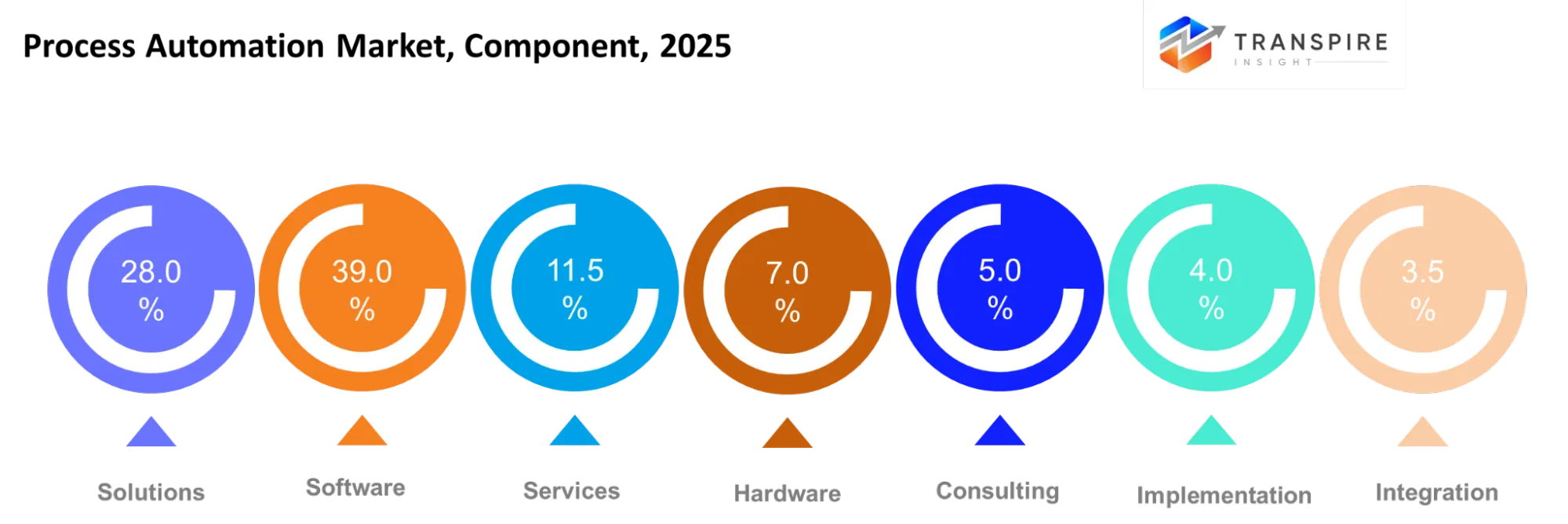
Solutions and software form the market’s core, as enterprises purchase RPA, BPM, workflow, and AI-enabled platforms to automate processes; services including consulting, implementation, integration, and support capture value from complex deployment and lifecycle management. Hardware remains important in industrial settings, where sensors, controllers, and field instruments connect physical operations to digital systems. The growth logic is shifting toward recurring software and managed services because buyers want scalable platforms rather than one-time installations.
Technology:
RPA remains the largest automation entry point, while AI, machine learning, process mining, and intelligent automation represent the fastest-moving layer. Process mining is especially significant because it identifies which workflows should be automated, reducing failed projects and improving returns. Workflow automation and BPM provide the orchestration needed to connect bots, people, systems, and AI models. Future platforms will increasingly combine these technologies into unified intelligent-automation suites.
Deployment:
This is moving toward cloud, SaaS, public cloud, and hybrid models because they lower upfront investment, support remote operations, and enable faster scaling across distributed enterprises. On-premises and private-cloud deployment retain importance in BFSI, healthcare, government, and energy, where data sovereignty, safety, and compliance requirements are strict. Edge deployment is emerging in manufacturing and utilities, where low-latency control, real-time monitoring, and local data processing are essential for reliable operations.mordorintelligence+1
Process Type:
Business process automation and workflow automation dominate enterprise adoption, with industrial process automation providing the building blocks for manufacturing, energy, and utilities. Also, IT process automation, document automation, financial automation, and human resources automation are growing as organisations adopt the ability to automate high-volume, rules-based processes. The HR-related distribution: Core HR 31.5%, Payroll 18.0%, Talent Management 13.5%, Workforce Management 11.5%, Recruitment 9.0%, Learning Management 7.0%, Performance Management 5.5%, Workforce Analytics 4.0%. Core administrative HR still dominates the headcount, but AI-enabled Human Capital Management with a 14.2% CAGR affords the greatest strategic opportunity.
Enterprise Size:
Large enterprises and multinational corporations lead spending because they manage complex, multi-region processes and can fund large-scale automation programs. SMEs and mid-sized firms are adopting cloud-based, low-code automation to avoid heavy implementation costs and reduce dependence on scarce technical talent. Governments and public institutions focus on compliance, citizen services, secure records management, and transparent workflow administration, making governance-ready automation increasingly important.
End User:
BFSI, manufacturing, IT and telecom, healthcare, retail, government, energy and utilities, and logistics apply automation to distinct operational priorities. Manufacturing emphasizes predictive maintenance, quality control, and production optimization; BFSI focuses on compliance, fraud detection, and claims processing. Healthcare uses document and workflow automation, while logistics and retail prioritize order management, inventory visibility, and supply-chain orchestration.
What are the Key Use Cases Driving the Process Automation Market?
Core use cases centre on industrial process automation and workflow software, which coordinate production steps, monitor equipment, and maintain consistent operating conditions. Manufacturers use programmable controls, sensors, and analytics to reduce defects, manage throughput, and detect equipment abnormalities before failures interrupt output.
Expanding applications include financial automation in BFSI, IT service management, document processing in healthcare, and inventory coordination in retail and logistics. RPA and BPM reduce repetitive data entry, accelerate approvals, and improve audit trails across these functions.
Emerging use cases combine AI, process mining, and predictive analytics to optimise energy consumption, anticipate maintenance requirements, and coordinate decisions across connected facilities. Edge-based intelligence supports faster local responses, while human-supervised AI helps organisations introduce adaptive automation without surrendering operational control.
|
Report Metrics |
Details |
|
Market size value in 2025 |
USD 111.38. Billion |
|
Market size value in 2026 |
USD 117.53 Billion |
|
Revenue forecast in 2033 |
USD 171.22 Billion |
|
Growth rate |
CAGR of 5.52% from 2026 to 2033 |
|
Base year |
2025 |
|
Historical data |
2021 - 2024 |
|
Forecast period |
2026 - 2033 |
|
Report coverage |
Revenue forecast, competitive landscape, growth factors, and trends |
|
Regional scope |
United States; Canada; Mexico; United Kingdom; Germany; France; Italy; Spain; Denmark; Sweden; Norway; China; Japan; India; Australia; South Korea; Thailand; Brazil; Argentina; South Africa; Saudi Arabia; United Arab Emirates |
|
Key companies profiled |
UiPath, Automation Anywhere, Blue Prism, Microsoft, IBM, SAP, Oracle, Pegasystems, Appian, ServiceNow, NICE, ABBYY, SS&C Technologies, Workato, Nintex. |
|
Customization scope |
Free report customization (country, regional & segment scope). Available customized purchase options to meet your exact research needs. |
|
Report Segmentation |
Component (Solutions, Services, Software, Hardware, Consulting, Implementation, Integration, Support)Technology (RPA, BPM, AI, Machine Learning, Process Mining, Workflow Automation, Intelligent Automation, Others)Deployment (Cloud, On-Premise, Hybrid, SaaS, Private Cloud, Public Cloud, Edge, Others)Process Type (Business Process Automation, IT Process Automation, Industrial Process Automation, Document Automation, Workflow Automation, Financial Automation, HR Automation, Others)Enterprise Size (Large Enterprises, SMEs, Startups, Government, Multinational Corporations, Mid-Sized Firms, Public Institutions, Others)End User (BFSI, Manufacturing, IT & Telecom, Healthcare, Retail, Government, Energy & Utilities, Logistics). |
Which Regions are Driving the Process Automation Market Growth?
North America leads the Process Automation Market with a 35.5% market share. North America is leading the Process Automation Market because of growing companies, an intelligent enterprise software environment, strong industrial automation suppliers, and investment in digital transformation. Adoption in this region is very high among industrial segments like financial services, manufacturing, healthcare, and technology-intensive industries. High infrastructure for cloud and mature cybersecurity practices are in place to support interface automation platforms to meet enterprise business requirements. As a result, enterprise companies focus more on AI-enabled workflow orchestration and industrial modernisation to enhance productivity and strengthen operational resilience.
In October 2026, Schneider Electric entered into a definitive agreement to acquire US-based industrial software firm PTC in an all-cash transaction valued at $22.6 billion. This major acquisition expands industrial artificial intelligence and product lifecycle management capabilities to bridge physical and digital lifecycles. https://www.se.com/ww/en/assets/pdf/Schneider-Electric-to-acquire-PTC
Europe accounts for 24.5% of the market, supported by its strengths in industrial engineering, its existing manufacturing clusters, and a focus on operational quality and accountability to regulations. In contrast with North America, Europe's growth relies on updated factories, energy efficiency, and interoperability in complex industrial environments. Germany, France, and other industrialized economies provide a stable customer base for process-control and enterprise automation solutions. Moreover, mandated transparency introduced by the EU AI Act, effective August 2026, increases the importance of traceability and appropriate oversight for relevant AI use.
In February 2026, Deutsche Telekom partnered with Nvidia to open the Industrial AI Cloud factory in Munich. Equipped with nearly 10,000 Blackwell GPUs and representing a €1 billion investment, this infrastructure provides European manufacturers with localised capabilities. https://www.dw.com/en/germany-industrial-ai-deutsche-telekom-china-us-robotics-car-industry/a-75871997
Asia Pacific makes up 29.5% and is the fastest-growing region, with a compound annual growth rate of 13.29%. Manufacturing expansion, electronics manufacturing, infrastructure investment, and smart factory initiatives are driving increasing levels of connected automation adoption. Businesses across this region are transitioning from stand-alone equipment to more advanced analytics, predictive maintenance, and production optimisation using artificial intelligence. The greatest future opportunities lie in scalable solutions for manufacturing consistency that also cater for different levels of digital maturity, with Latin America at 6.2% and the Middle East and Africa at 4.3%; opportunities are driven by industrial upgrades, energy projects and digitisation of services.
In October 2026, Foundries launched its new Advanced Facilities Control Centre (AFCC) in Singapore. This deployment integrates five individual semiconductor fabrication control rooms into a unified, intelligent command center utilizing AI-driven predictive maintenance to proactively identify root causes and equipment issues before failures disrupt production. https://gf.com/news-and-events/news/foundries-launches-advanced-facilities-control-centre-in-singapore/
Who are the Key Players in the Process Automation Market, and how do they compete?
Competition includes a variety of other robotic process automation technology providers and organisations, including other enterprise software vendors, workflow platforms, and industrial technology companies. As the market matures, differentiation will increasingly be based on how well the platform integrates with other systems, its artificial intelligence features, the cost of implementation, governance, and whether it produces business results rather than simply automating tasks.
UiPath, Automation Anywhere, and Blue Prism all concentrate on automation of repetitive digital processes, and their main differentiation is in the creation, management, orchestration, and scalability of automation in companies. Microsoft's offering lies in Power Automate and its inclusion within the broader ecosystem of its productivity tools, enabling automation for existing customers. IBM's strength is enterprise integration, AI, and governance, while SAP and Oracle extend automation within the enterprise apps and enterprise resource planning, respectively, with a focus on customer relationships and integrated platforms. Unique capabilities can be found with providers that are particularly focused on low-code application development and workflow orchestration, like Pegasystems and Appian; IT service management, as well as enterprise-wide cross-functional workflows with ServiceNow; customer-service solutions with NICE; document intelligence and data extraction with ABBYY; financial services process outsourcing and automation with SS&C Technologies; and integration-led automation and workflows with Nintex. Industrial automation solutions, software partnerships, and acquisitions are key growth channels as providers seek to reach niche verticals and further diversify their technology stack.
Key Players are:
- UiPath
- Automation Anywhere
- Blue Prism
- Microsoft
- IBM
- SAP
- Oracle
- Pegasystems
- Appian
- ServiceNow
- NICE
- ABBYY
- SS&C Technologies
- Workato
- Nintex
Process Automation Market — Enhanced Competitive Benchmarking
|
Company |
Est. Revenue Share Range |
Key Offerings |
Strategic Positioning |
Geographic Strength |
Technology Focus |
|
Microsoft |
Estimated 5–10% |
Power Automate, Power Automate Desktop, Copilot Studio, Azure Logic Apps |
Ecosystem-led automation integrated across enterprise applications |
North America, Europe, Asia Pacific |
Generative AI, low-code automation, cloud orchestration |
|
UiPath |
Estimated 5–10% |
UiPath Platform, Studio, Robots, Maestro |
RPA leadership with expansion into end-to-end intelligent automation |
North America, Europe, Asia Pacific |
Agentic automation, AI-powered RPA, process orchestration |
|
Automation Anywhere |
Estimated 3–8% |
Automation 360, Automation Co-Pilot, Document Automation |
Cloud-first automation with enterprise-grade bot management |
North America, Asia Pacific, Europe |
Agentic AI, cloud-native RPA, intelligent document processing |
|
IBM |
Estimated 3–7% |
IBM watsonx Orchestrate, IBM Robotic Process Automation, IBM Business Automation Workflow |
Enterprise-scale automation integrated with hybrid-cloud infrastructure |
North America, Europe, Asia Pacific |
AI orchestration, business rules, hybrid-cloud integration |
|
ServiceNow |
Estimated 3–7% |
ServiceNow AI Platform, Workflow Studio, Integration Hub, RPA Hub |
Cross-department workflow orchestration through a unified enterprise platform |
North America, Europe, Asia Pacific |
AI-driven workflows, low-code development, process orchestration |
|
Pegasystems |
Estimated 2–5% |
Pega Platform, Pega Customer Service, Pega Process AI, Pega Robotic Automation |
Complex case management and rules-driven process automation |
North America, Europe, Asia Pacific |
Decision automation, AI-powered BPM, adaptive case management |
|
Appian |
Estimated 2–5% |
Appian Platform, Process HQ, Data Fabric, AI Process Automation |
Low-code development for complex, data-intensive enterprise workflows |
North America, Europe, Asia Pacific |
Low-code architecture, process mining, AI-enabled orchestration |
|
SAP |
Estimated 2–5% |
SAP Build Process Automation, SAP Signavio, SAP Integration Suite |
ERP-connected automation embedded in core business processes |
Europe, North America, Asia Pacific |
ERP-native automation, process mining, business AI |
|
SS&C Blue Prism |
Estimated 1–4% |
Blue Prism Enterprise, Blue Prism Cloud, intelligent automation capabilities |
Governance-focused automation for regulated and complex enterprises |
Europe, North America, Asia Pacific |
Governed RPA, digital workers, enterprise orchestration |
|
NICE |
Estimated 1–4% |
NICE RPA, NEVA, CXone automation capabilities |
Customer-service and contact-centre automation specialisation |
North America, Europe, Asia Pacific |
Attended automation, AI-assisted service workflows, workforce integration |
Recent Development News
- In August 2026, Emerson launched PACEdge 3.0, an industrial edge software platform designed to simplify application deployment and integrate AI, machine learning, and advanced analytics with industrial IoT data. The launch supports real-time operational insights, streamlined device management, and more efficient process automation across industries such as life sciences, oil and gas, and food and beverage. https://www.emerson.com/en/corporate/news/2026/emerson-brings-enhanced-ai-capability-to-the-industrial-edge
- In April 2026, Rockwell Automation and Cytiva launched the Figurate Supervisory Control and Data Acquisition (SCADA) platform for biopharmaceutical manufacturing. The collaboration enables digital integration across equipment from multiple vendors, helping manufacturers reduce digital bottlenecks, minimise human error, and accelerate technology transfer and production scale-up. https://www.rockwellautomation.com/en-in/company/news/press-releases/rockwell-automation-and-cytiva-launch-platform-to-accelerate-digital-transformation-for-biopharma-companies.html
- In May 2026, GE Vernova announced an agreement to acquire Robotech Automation, a Canadian robotics and automation systems integrator, to strengthen its engineering, automation, and robotics capabilities. The acquisition is expected to support the deployment of customised automation solutions and improve integration capabilities for industrial operations and complex manufacturing processes. https://www.gevernova.com/news/press-releases/ge-vernova-to-acquire-robotech-automation
What Strategic Insights Define the Future of the Process Automation Market?
The process automation market is moving toward autonomous, AI-managed process orchestration, where the process automation platform orchestrates employees, systems and AI agents across finance, supply chains, IT and industrial operations. One hidden risk is the automation debt that will build if organisations deploy several disconnected bots and AI capabilities without common data models, governance policies and ownership. That fragmentation may lead to higher maintenance costs, security gaps, and audit and compliance issues. An emerging opportunity is governed agentic automation-where AI orchestrates operational and financial decision-making within established guardrails, particularly in manufacturing and financial services. Process mining can help identify promising workflows before they move into automation investments. Vendors should focus on secure integration, explainable AI controls, openness, and tangible business outcomes. Outcome-based pricing and incremental planning can enable customers to demonstrate ROI while reducing complexity and improving scalability over time.
Key Segmentations are:
Component
- Solutions
- Services
- Software
- Hardware
- Consulting
- Implementation
- Integration
- Support
Technology
- RPA
- BPM
- AI
- Machine Learning
- Process Mining
- Workflow Automation
- Intelligent Automation
- Others
Deployment
- Cloud
- On-Premise
- Hybrid
- SaaS
- Private Cloud
- Public Cloud
- Edge
- Others
Process Type
- Business Process Automation
- IT Process Automation
- Industrial Process Automation
- Document Automation
- Workflow Automation
- Financial Automation
- HR Automation
- Others
Enterprise Size
- Large Enterprises
- SMEs
- Startups
- Government
- Multinational Corporations
- Mid-Sized Firms
- Public Institutions
- Others
End User
- BFSI
- Manufacturing
- IT & Telecom
- Healthcare
- Retail
- Government
- Energy & Utilities
- Logistics
By Regional Analysis
North America
- US
- Canada
- Mexico
Europe
- Germany
- UK
- France
- Italy
- Spain
- Russia
- Rest of Europe
Asia Pacific
- China
- Japan
- India
- South Korea
- Australia
- Rest of Asia Pacific
South America
- Brazil
- Argentina
- Rest of South America
Middle East & Africa
- UAE
- Saudi Arabia
- Qatar
- South Africa
- Rest of the Middle East & Africa
Frequently Asked Questions
Find quick answers to common questions.
The process automation market size was valued at USD 111.38 billion in 2025 and is poised to reach USD 171.22 billion by 2033, expanding at a 5.52% CAGR.
Key segments for the process automation market are Component (Solutions, Services, Software, Hardware, Consulting, Implementation, Integration, Support)Technology (RPA, BPM, AI, Machine Learning, Process Mining, Workflow Automation, Intelligent Automation, Others)Deployment (Cloud, On-Premise, Hybrid, SaaS, Private Cloud, Public Cloud, Edge, Others)Process Type (Business Process Automation, IT Process Automation, Industrial Process Automation, Document Automation, Workflow Automation, Financial Automation, HR Automation, Others)Enterprise Size (Large Enterprises, SMEs, Startups, Government, Multinational Corporations, Mid-Sized Firms, Public Institutions, Others)End User (BFSI, Manufacturing, IT & Telecom, Healthcare, Retail, Government, Energy & Utilities, Logistics).
Growth is primarily driven by AI integration, labour shortages, industrial digitalisation, demand for operational efficiency, predictive maintenance, and the need to reduce manual errors and operating costs
The process automation market is led by major manufacturers, including UiPath, Automation Anywhere, Blue Prism, Microsoft, IBM, SAP, Oracle, Pegasystems, Appian, ServiceNow, NICE, ABBYY, SS&C Technologies, Workato, and Nintex.
North America holds a 35.5% market share, supported by advanced digital infrastructure, strong enterprise software adoption, industrial modernisation, and substantial investment in AI-driven automation.
Key opportunities include governed agentic automation, AI-enabled predictive maintenance, process mining, secure legacy-system integration, and scalable cloud-based automation solutions.
- UiPath
- Automation Anywhere
- Blue Prism
- Microsoft
- IBM
- SAP
- Oracle
- Pegasystems
- Appian
- ServiceNow
- NICE
- ABBYY
- SS&C Technologies
- Workato
- Nintex
About the Authors

Mayur Shinde
I am Mayur Shinde, a Senior Research Analyst at Transpire Insight, specializing in the Automotive & Transportation and Information & Communication Technology (ICT) Industry. My work focuses on analyzing emerging market trends, technological advancements, competitive landscapes, and industry developments to deliver accurate, data-driven insights. I am passionate about transforming complex market information into clear, actionable content that helps businesses, professionals, and decision-makers stay informed and make confident strategic decisions.

Chakradhar Khansole
Chakradhar serves as the Research Director at Transpire Insight, bringing over 8 years of experience in technology, innovation, and strategic market intelligence. He specializes in transforming complex market data into actionable business insights that enable organizations to make informed, growth-oriented decisions. Recognized for his strategic vision and analytical expertise, Chakradhar leads high-impact research initiatives, delivering comprehensive market assessments, competitive intelligence, and forward-looking industry analysis.
Recently Published Reports
-
Apr 2026
3D Optical Profiler Market
3D Optical Profiler Market Size, Share & Analysis Report By Type (Desktop 3D Optical Profiler, and Portable 3D Optical Profiler), By Technology (Confocal Technology, and White Light Interference), By End-Use Industry (Manufacturing, Research Institutions, Automotive, Aerospace and Defense, Medical Devices, and Other), and Geography (North America, Europe, Asia-Pacific, Middle East and Africa, South and Central America), 2021 - 2031
-
Apr 2026
Depth Sensor Market
Depth Sensor Market Size, Share & Analysis Report By Type (Infrared Depth Sensors, Time-of-Flight (ToF) Sensors, Stereo Vision Sensors, Structured Light Sensors, Ultrasonic Depth Sensors), By Application (Automotive, Robotics, Gaming, Consumer Electronics, Industrial Automation, Healthcare, Security & Surveillance, Others), By End Users (Automotive Manufacturers, Consumer Electronics Companies, Healthcare Providers, Industrial Companies, Security Agencies, Gaming Companies, Robotics Companies, Others), and Geography (North America, Europe, Asia-Pacific, Middle East and Africa, South and Central America), 2021 – 2031
-
Apr 2026
Digital Manufacturing Market
Digital Manufacturing Market Size, Share & Analysis Report By Component (Hardware, Software, and Services), By Technology (Robotics, 3D Printing, Internet of Things (IoT), and Others), By Application (Automotive and Transportation, Aerospace and Defense, Consumer Electronics, Industrial Machinery, and Others), By Process Type (Computer-Based Designing, Computer-Based Simulation, Computer 3D Visualization, Analytics, and Others), and Geography (North America, Europe, Asia-Pacific, Middle East and Africa, South and Central America), 2021 – 2031
-
Apr 2026
Digital Visa Services Market
Digital Visa Services Market Size, Share & Analysis Report By Type (Individual Travelers, Group Travelers), By Application (Tourism, Business Travel, Others), and Geography (North America, Europe, Asia-Pacific, Middle East and Africa, South and Central America), 2021 – 2031