

Metal Processing Market Summary:
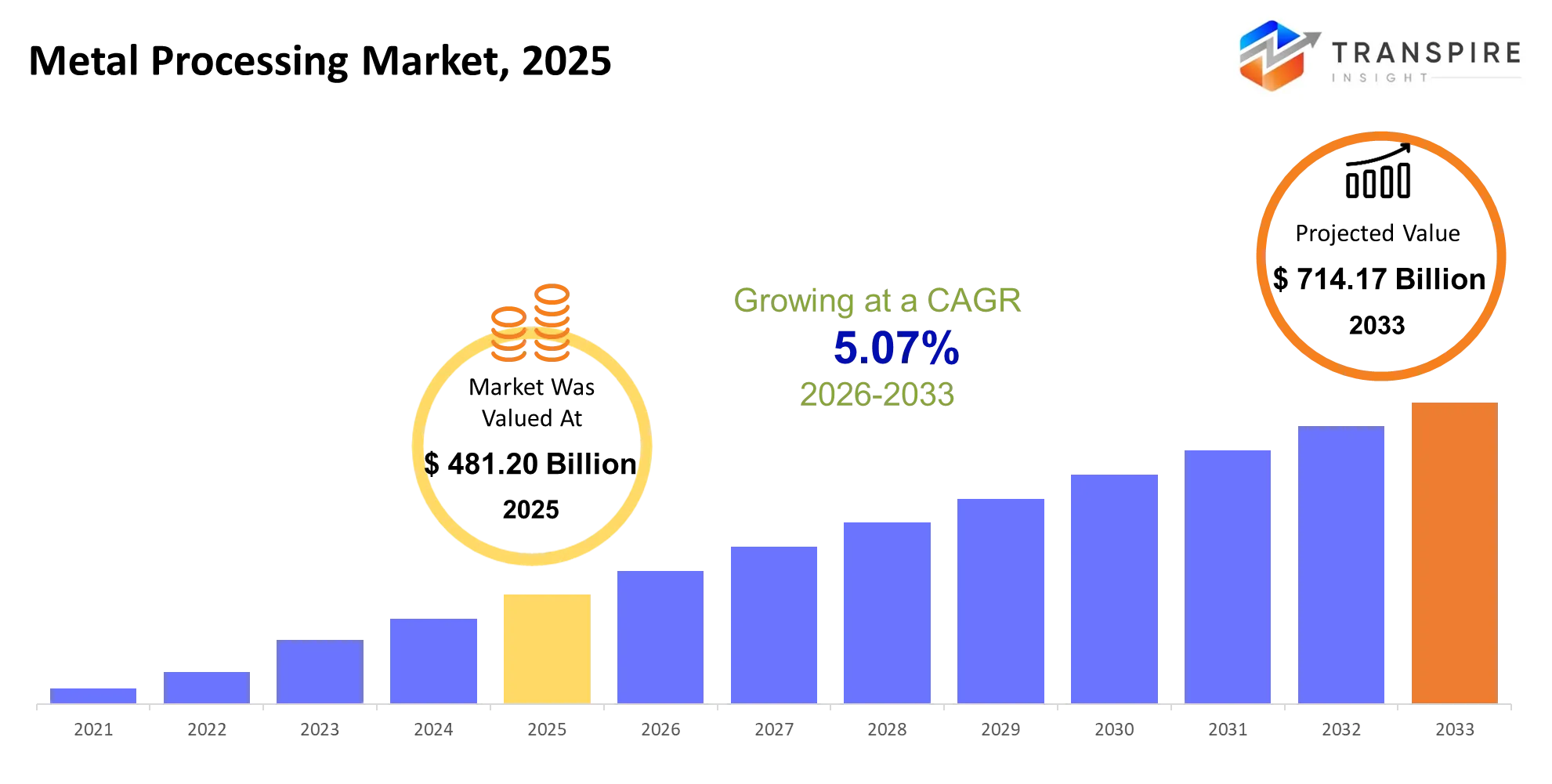
According to Transpire Insight, a detailed research report on the market reflects that the Global Metal Processing Market is valued at approximately USD 481.20 billion in 2025 and is projected to reach USD 505.26 billion in 2026 and USD 714.17 billion by 2033, expanding at a CAGR of 5.07% during the forecast period from 2026 to 2033. The market growth is supported by increasing demand for advanced metal processing technologies, precision manufacturing, automation, industrial production, automotive applications, construction activities, aerospace manufacturing, and the growing adoption of efficient and high-performance metal processing solutions, making it a significant contributor to global manufacturing development, technological innovation, expanding production capabilities, and overall market growth dynamics.
Market Snapshot
- Market Value (2025): USD 481.20 Billion.
- Expected Market Value (2026): USD 505.26 Billion.
- Estimated Market Value (2033): USD 714.17 Billion.
- Forecast CAGR (2026–2033): 5.07%.
- Leading Region in 2025: Asia Pacific
- Second-largest Region: North America
- Fastest Growing Region: Europe
Introduction
Metal Processing Market refers to the worldwide industrial eco-system that involves the conversion of primary metals, alloys, and metals recycling into useful components, semi-finished, and finished industrial products. The metal processing market includes key manufacturing processes such as casting, forging, cutting, forming, machining, welding, heat treatment, and surface finishing. Through these processes, the manufactures can meet the necessary dimensional accuracy, performance, strength, corrosion resistance, and product quality. Metal processing caters to several industry sectors like automotive, aerospace and defense, construction and infrastructure, machinery, energy, electronics, and industrial manufacturing. In the current scenario, automation, CNC machining, laser processing, robotics, digital inspection technology, advanced material usage, and sustainable manufacturing processes are significantly influencing the metal processing market.
For instance:-
- North America: Investments in metal processing are driven by the manufacturing of semiconductors, automobiles, aerospace, and infrastructure using automation and CNC machining for precision and energy-efficient technologies.
- Europe: European metal processors are focusing on green manufacturing, EAF, metal recycling, automation, and energy-efficient technologies to cope with decarbonization and competitiveness challenges.
Key Market Highlights: -
- Asia Pacific is expected to grow at a rapid CAGR in the Metal Processing Market by holding around 46% of the share during the forecast period.
- North America is anticipated to hold roughly 30% share of the Metal Processing Market over the predicted timeframe.
- Europe is anticipated to hold nearly 24% share of the Metal Processing Market over the predicted timeframe.
- By Process Type, the Machining dominated the market and holds nearly 44% share in 2025 and is projected to grow at a substantial CAGR during the forecast period.
- By Metal Type, the Aluminum dominated the market and holds close to 33% share in 2025 and is projected to grow at a substantial CAGR during the forecast period.
- By Equipment, the Milling machines dominated the market and holds about 28% share in 2025 and is projected to grow at a substantial CAGR during the forecast period.
- The steel policy in India focuses on the production of specialty steel within the country, scrap recycling, quality control, and green technology, which is boosting metal processing capacity and competitiveness.
How is Technology Driving Growth in the Metal Processing Market?
Advancements in technology are boosting the growth of the Metal Processing Market through increased efficiency, accuracy, and effectiveness of the process. Artificial Intelligence and Machine Learning are used in predicting maintenance, process optimization, and monitoring quality in real time. Sensors are able to generate continuous information about machines and the process, leading to reduced downtime and better energy management. Robots and CNC machines improve the accuracy of cutting, machining, forming, and welding processes in order to solve shortage of skilled laborers. Additive manufacturing helps with the creation of complex shapes and prototypes while saving materials.
|
Report Metrics |
Details |
|
Market size value in 2025 |
USD 481.20 Billion |
|
Market size value in 2026 |
USD 505.26 Billion |
|
Revenue forecast in 2033 |
USD 714.17 Billion |
|
Growth rate |
CAGR of 5.07% from 2026 to 2033 |
|
Base year |
2025 |
|
Historical data |
2021 - 2024 |
|
Forecast period |
2026 - 2033 |
|
Report coverage |
Revenue forecast, competitive landscape, growth factors, and trends |
|
Regional scope |
United States; Canada; Mexico; United Kingdom; Germany; France; Italy; Spain; Denmark; Sweden; Norway; China; Japan; India; Australia; South Korea; Thailand; Brazil; Argentina; South Africa; Saudi Arabia; United Arab Emirates |
|
Key company profiled |
Trumpf, Amada, Bystronic, DMG MORI, Komatsu, Mitsubishi Electric, Mazak, Okuma, Haas Automation, Schuler, JTEKT, FANUC, Yamazaki Mazak, Prima Power, Salvagnini |
|
Customization scope |
Free report customization (country, regional & segment scope). Avail customized purchase options to meet your exact research needs. |
|
Report Segmentation |
By Process Type (Machining, Metal Forming, Casting, Forging, Stamping, Welding, Cutting, Others); By Metal Type (Steel, Aluminum, Copper, Iron, Titanium, Nickel, Zinc, Others); By Equipment (CNC Machines, Laser Cutting Machines, Presses, Lathes, Milling Machines, Welding Equipment, Casting Equipment, Others); By Application (Automotive, Aerospace, Construction, Industrial Machinery, Electronics, Energy, Consumer Goods, Others); By End User (Manufacturing, Automotive, Aerospace, Construction, Energy, Electronics, Heavy Industry, Others) |
Market Drivers
The Metal Processing Market is driven by expanding manufacturing investments, infrastructure development, and rising demand for precision-engineered metal components across automotive, aerospace, construction, energy, and industrial sectors. Increasing adoption of CNC machinery, robotics, automated welding, laser cutting, and smart manufacturing systems is improving processing precision, productivity, and operational efficiency. For instance, manufacturers are investing in advanced automation to address labor shortages and strengthen production capabilities. In addition, growing emphasis on energy efficiency, metal recycling, electric arc furnaces, and low-carbon processing technologies is accelerating investment in sustainable metal manufacturing. These trends are strengthening capacity expansion, technological modernization, and long-term market growth globally.
For instance:- Asia Pacific: The manufacturing in China, India, Japan, and South Korea is increasing metal processing capacity through smart manufacturing, robotics, CNC machining, automobile manufacturing, and renewable energy infrastructure.
Restrain
Some of the challenges faced by the Metal Processing Industry include the need for significant investment in machinery that is computer numeric controlled (CNC), automated and uses digital manufacturing technologies, especially for small-scale processors. Shortage of skilled labor to operate the sophisticated processing equipment limits production capacity. Instability in prices of metals and energy increases cost. Environmental, safety and waste disposal policies incur additional compliance costs. There may be material substitution through the use of lighter metals such as plastics and other composite materials.
|
Driver |
Relative Impact on Growth (%) |
Geographic Relevance |
Impact Timeline |
Demand Strength |
Growth Mechanism |
Key Beneficiaries |
Major Constraint |
|
Industrial Automation and Industry 4.0 Adoption |
25% |
Asia Pacific, North America, Europe |
Short-term |
High |
Automates cutting, forming, welding, and machining for higher throughput. |
Metal processors, automation vendors, machine manufacturers, OEMs |
High upfront automation investment limits smaller processors. |
|
Infrastructure, Construction, and Manufacturing Expansion |
23% |
Asia Pacific, Middle East, North America |
Medium-term |
High |
Expanding infrastructure and manufacturing increases processed metal requirements. |
Steel processors, fabricators, construction firms, equipment manufacturers |
Cyclical construction spending can weaken processing demand. |
|
Advanced Laser and Precision Processing Technologies |
20% |
Asia Pacific, Europe, North America |
Short-term |
High |
Fiber lasers improve cutting precision, speed, material utilization, and productivity. |
Laser equipment suppliers, fabricators, automotive and aerospace manufacturers |
Skilled workforce and equipment costs constrain adoption. |
|
Automotive and Electric Vehicle Manufacturing Growth |
17% |
Asia Pacific, Europe, North America |
Medium-term |
High |
Lightweight structures and battery components increase precision metal processing requirements. |
Automotive OEMs, EV manufacturers, component suppliers, processors |
EV demand volatility can delay capacity expansion projects. |
|
Decarbonization, Energy Efficiency, and Green Manufacturing |
15% |
Europe, Asia Pacific, North America |
Long-term |
Medium |
Low-carbon processing drives efficient furnaces, recycling, electrification, and cleaner production. |
Green-metal producers, recyclers, technology vendors, industrial manufacturers |
High transition costs and uncertain technology economics constrain adoption. |
Analysis of Prices and Consumer Behaviour
Metal Processing Market is led by high-end processed metal products (68% of total market; mainly because of the demand of automotive, construction, aerospace and industrial manufacturing industries). The pricing of high-end, value added processed metal products would be 35% higher as compared to other products since they have been processed using the latest technology, quality certified materials and dimensional performance control. Around 45% of total unit sales of metal processing products will be in the form of standard processed metal products. The sales volume of these products is driven by the versatile use of processed metals in manufacturing and their durability and longevity. Automotive and industrial manufacturing industries are expected to make up for around 70% of the demand from these industries. The consumer buying behavior reveals that 55% of the buyers give utmost importance to precision of processing, quality of material and product consistency. Another 33% of buyers prefer bulk purchase agreements or long term agreements in order to reduce the cost of procurement and ensuring supply consistency in the international market.
|
Company |
Est. Revenue Share Range |
Key Offerings |
Strategic Positioning |
Geographic Strength |
Technology Focus |
|
ArcelorMittal |
0.9–1.3% (Estimated) |
Advanced high-strength steel; automotive steel; laser-welded blanks; coated steel |
Global leadership through advanced steel solutions |
Europe, North America, Latin America |
AHSS, laser welding, lightweighting, digital process optimization |
|
Nippon Steel Corporation |
0.7–1.0% (Estimated) |
Automotive steel; electrical steel; coated products; specialty steel |
Premium positioning through high-value steel innovation |
Asia Pacific, North America, Europe |
Advanced steel grades, automation, process control, decarbonization |
|
China Baowu Steel Group |
0.9–1.2% (Estimated) |
Flat steel; long steel; automotive steel; specialty products |
Scale leadership supported by integrated production |
Asia Pacific, China, Middle East |
Smart steelmaking, automation, advanced metallurgy, energy efficiency |
|
Tata Steel |
0.4–0.7% (Estimated) |
Automotive steel; downstream processing; construction products; coated steel |
Integrated processing with strong regional diversification |
India, Europe, Southeast Asia |
Industry 4.0, AI, advanced coatings, precision processing |
|
thyssenkrupp AG |
0.5–0.8% (Estimated) |
Flat steel; automotive components; processed steel; materials services |
Value-added processing and automotive integration |
Europe, North America, Asia Pacific |
Digital manufacturing, advanced forming, automation, green steel |
|
JFE Steel Corporation |
0.4–0.7% (Estimated) |
Automotive steel; electrical steel; coated steel; specialty alloys |
Technology-led specialty and automotive steel supplier |
Japan, Asia Pacific, North America |
Advanced metallurgy, high-strength steel, AI process control |
|
Nucor Corporation |
0.4–0.6% (Estimated) |
Sheet steel; plate; structural steel; engineered bar products |
Cost leadership through efficient EAF-based production |
North America, Mexico |
Electric arc furnaces, scrap recycling, automation, digital manufacturing |
|
POSCO |
0.4–0.7% (Estimated) |
Automotive steel; galvanized steel; electrical steel; specialty materials |
Premium materials leadership with global automotive focus |
Asia Pacific, North America, Europe |
Smart factories, advanced alloys, AI, hydrogen-based steelmaking |
|
Gerdau S.A. |
0.3–0.5% (Estimated) |
Rebar; structural steel; special sections; downstream steel products |
Regional scale through vertically integrated processing |
Latin America, North America |
EAF recycling, automation, downstream value-added processing |
|
Hyundai Steel |
0.2–0.4% (Estimated) |
Automotive steel; plate; H-beams; galvanized products |
Automotive-focused integrated steel processing strategy |
Asia Pacific, North America |
AHSS, automotive forming, smart manufacturing, energy efficiency |
Who are the Key Players in the Metal Processing Market and how do they compete?
The competitiveness of the international market in Metal Processing is possible thanks to the companies specializing in technological innovation, industry-specific solutions, and the creation of global distribution channels. Competing not only through pricing but also through durable equipment, innovative processing technologies, intelligent and connected solutions, and digital platform integration, such competition will drive constant product innovation while providing productivity, processing efficiency, resource optimization, and operational visibility for companies.
Using advanced laser cutting systems, precise metal processing solutions, automation technology, and digitally connected equipment, Trumpf builds up its market position. Using efficient metalworking machines, precise cutting systems, automation technology, and processing technology specifically designed for industrial manufacturing and metal fabrication, Amada distinguishes itself from its competitors. Bystronic builds its market position through the provision of integrated solutions in metal cutting, bending, automation, and smart manufacturing solutions, which help manufacturers become more productive and efficient.
Top Companies in the Metal Processing Market
- Trumpf
- Amada
- Bystronic
- DMG MORI
- Komatsu
- Mitsubishi Electric
- Mazak
- Okuma
- Haas Automation
- Schuler
- JTEKT
- FANUC
- Yamazaki Mazak
- Prima Power
- Salvagnini
|
Investment Factor |
Why It Matters to Investors |
Opportunity |
Investment Implication |
|
Industrial Automation & Smart Processing |
Automation improves throughput, precision, quality consistency, and labor productivity across processing operations. |
Invest in automated cutting, forming, welding, machining, robotics, and digital monitoring solutions. |
Why it is attractive: Productivity gains support scalable industrial returns. |
|
EV & Automotive Metal Processing |
EV manufacturing requires lightweight structures, battery enclosures, high-strength steel, aluminum, and precision-formed components. |
Target AHSS, lightweight metals, battery-related structures, precision forming, and specialized automotive processing. |
Why it is attractive: EV manufacturing creates specialized processing demand. |
|
Advanced & Precision Processing |
Laser cutting, CNC machining, automated forming, and intelligent inspection enable higher-value and more complex applications. |
Develop precision processing capabilities serving aerospace, automotive, electronics, energy, and industrial equipment customers. |
Why it is attractive: Precision capabilities enable higher-value customer applications. |
|
Infrastructure & Manufacturing Expansion |
Infrastructure, construction, industrial equipment, and manufacturing projects require substantial processed metal inputs and fabrication capacity. |
Expand processing facilities near major construction, industrial, transportation, and manufacturing clusters. |
Why it is attractive: Infrastructure investment sustains long-cycle processing demand. |
|
Low-Carbon & Circular Metal Processing |
Energy efficiency, scrap recycling, EAF production, and lower-carbon processing are reshaping procurement and production strategies. |
Invest in recycling, energy-efficient equipment, EAF-related services, renewable-powered processing, and green-metal supply chains. |
Why it is attractive: Decarbonization creates new industrial investment niches. |
|
Asia Pacific Capacity Expansion |
Asia Pacific offers extensive manufacturing ecosystems, infrastructure development, automotive production, and expanding processing capacity. |
Establish localized processing, service centers, technology partnerships, and specialized production facilities. |
Why it is attractive: Regional manufacturing depth supports long-term expansion. |
Metal Processing Market Segmentation
The Metal Processing Market share is divided into five categories: By Process Type, By Metal Type, By Equipment, By Application, By End User.
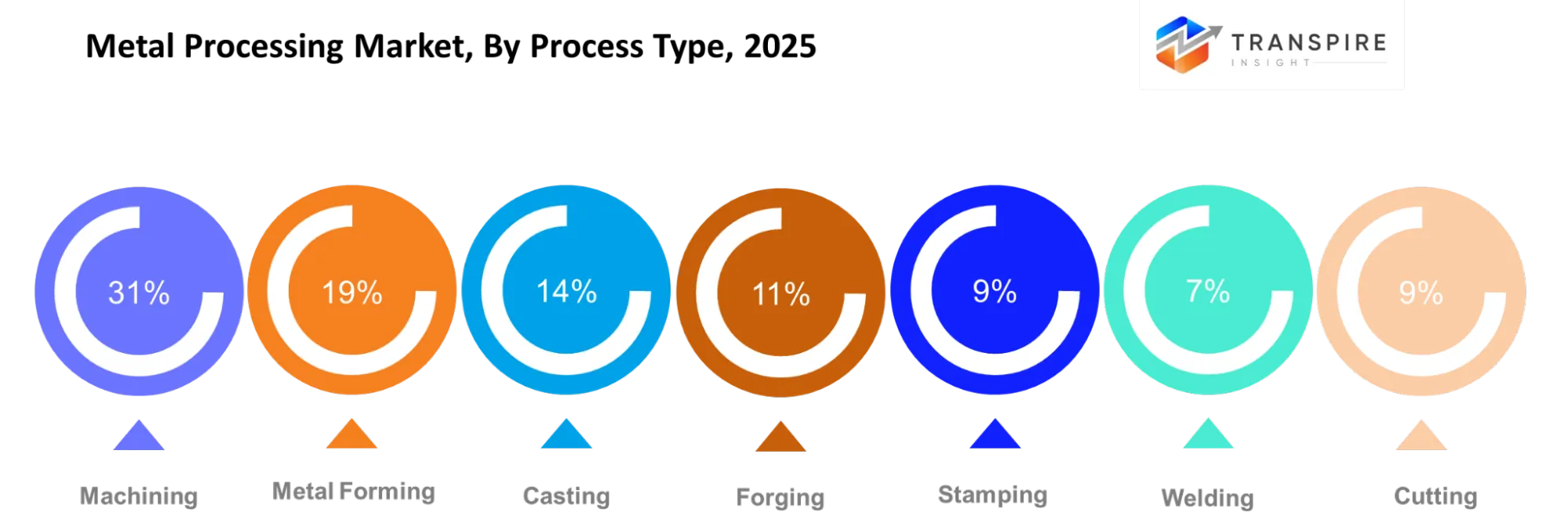
The Machining dominated the market, accounting for nearly 44% in 2025 and is expected to rise at a significant CAGR during the forecast period.
The Metal Processing Market is by process type into machining, metal forming, casting, forging, stamping, welding, cutting, others. Among these, the Machining dominated the market, accounting for nearly 44% in 2025 and expected to increase at a significant CAGR during the forecast period. The Machining segment led the Metal Processing Market, making up almost 44% in 2025, owing to the increasing need for precise components, CNC machining, automation, and advanced industrial manufacturing.
The Aluminum dominated the market, accounting for close to 33% in 2025, and is expected to rise at a significant CAGR during the forecast period
The Metal Processing Market is segmented by metal type into steel, aluminum, copper, iron, titanium, nickel, zinc, others. Among these, the Aluminum dominated the market, accounting for close to 33% in 2025 and expected to increase at a significant CAGR during the forecast period. The Aluminum segment led the Metal Processing Market, making up almost 33% in 2025, owing to their light weight, corrosion-resistant nature, recycling capability, and increasing demands from the automotive industry.
The Milling machines dominated the market, accounting for about 28% in 2025 and is expected to rise at a significant CAGR during the forecast period.
The Metal Processing Market by equipment into cnc machines, laser cutting machines, presses, lathes, milling machines, welding equipment, casting equipment, others. Among these, the Milling machines dominated the market, accounting for about 28% in 2025 and expected to increase at a significant CAGR during the forecast period. The Milling Machines segment led the Metal Processing Market, making up almost 28% in 2025, owing to their precision machining capabilities and ability to manufacture complex components and automation.
Regional Segment Analysis of the Metal Processing Market
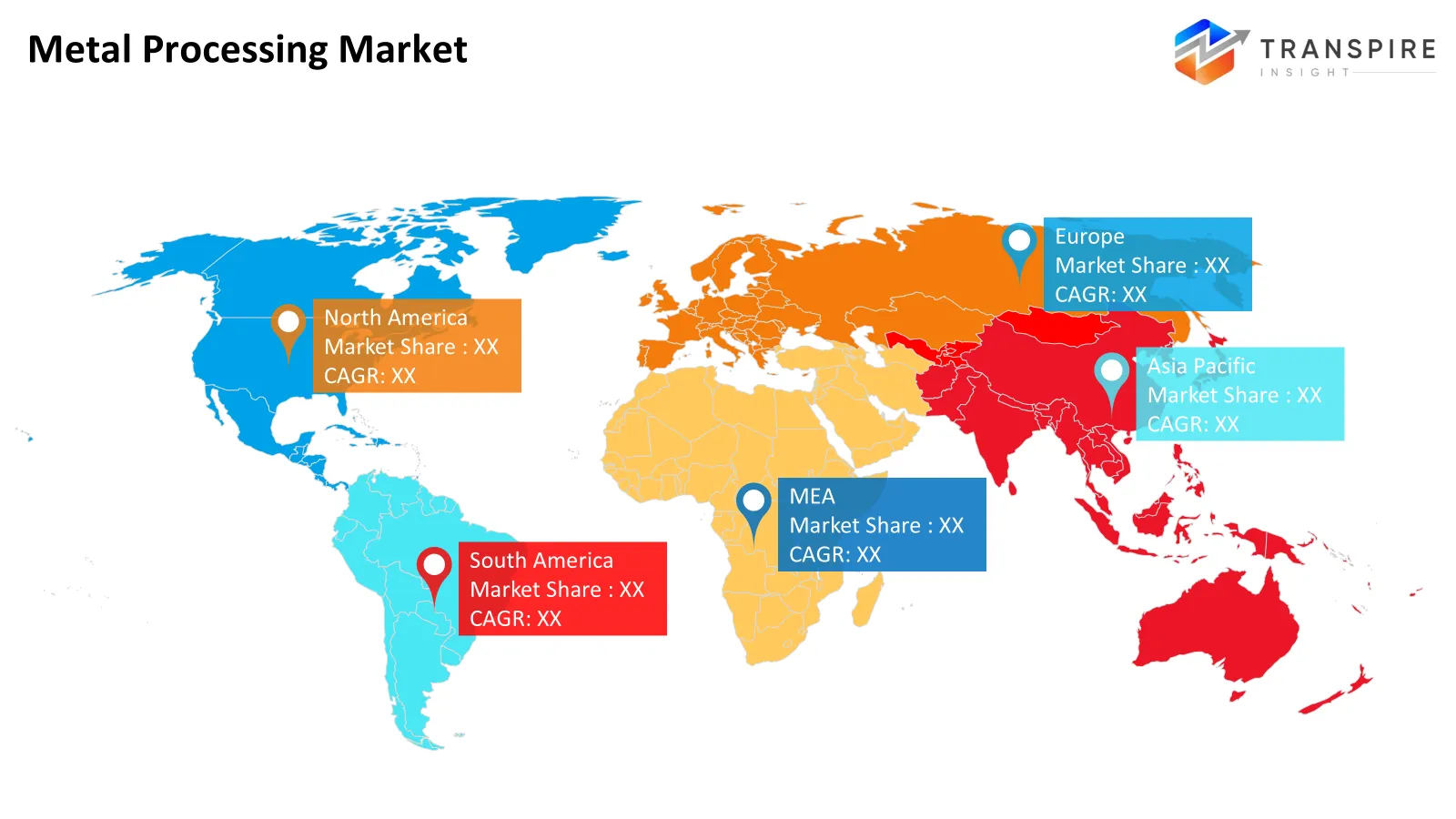
- Europe (Germany, France, U.K., Italy, Spain, Rest of Europe)
- North America (U.S., Canada, Mexico)
- Asia-Pacific (China, Japan, India, Rest of APAC)
- South America (Brazil and the Rest of South America)
- The Middle East and Africa (UAE, South Africa, Rest of MEA)
Asia Pacific is expected to grow at a rapid CAGR in the Metal Processing Market, holding around 46% of the share during the forecast period.
The Asia Pacific will be the high-growth region in terms of the Metal Processing Market and will capture about 46% of the share due to the growth of the manufacturing industry, automobile industry, infrastructure building, and industrial automation. China, India, Japan, and South Korea will enhance their metal processing capability through investments in CNC machining, robotics, precision machining, metal fabrication, and smart manufacturing.
North America is the high-growth region in the Metal Processing Market during the period, holding roughly 30% share.
North America is the high-growth region in the Metal Processing Market during the forecast period and will capture about 30% of the share due to the growth of advanced manufacturing, automotive industry, aerospace industry, infrastructure development, and industrial automation. The US and Canada will increase their investments in CNC machining, robotics, laser processing, precision fabrication, and smart manufacturing systems. High demand for metal components and electric vehicles production will enhance market growth and processing capability in the region.
Europe is the fastest-growing region in the Metal Processing Market during the period, holding nearly 24% share.
Europe leads the way in terms of the Metal Processing Market’s growth rate and accounts for almost 24% of the market share thanks to manufacturing, automobiles, aerospace, infrastructural development, and automation. European companies are increasing their investment in computer numerical control machines, robots, lasers, energy-efficient machinery, and green technology. The increasing use of electric vehicles, precision-engineered products, metal recycling, and sustainability drives growth in the metal processing market.
Strategies for Market Growth in Non-Leading Regions:
The development of non-leading regions by means of effective metal processing technology will be helpful for small- and medium-sized processors. Local processing of metals, creation of regional metal processing facilities will minimize the dependency on imports as well as reduce production costs. The development of partnership with regional metal producers, manufacturers, automotive sector, construction firms and industrial distributors will help in penetrating the market for metal processing technologies. For better awareness about advance machining, fabrication, quality control, automation, sustainable processing, training and skills upgrading will be required. Moreover, flexible financing options, supply agreements and contract manufacturing will increase accessibility of metal processing technologies and encourage its adoption in the industry. Development of cooperative programs with government, manufacturing, infrastructure and industrial development programs, sales and service digital platforms will increase accessibility of metal processing technologies and help in the sustainable growth of the worldwide market in developing regions.
Future Market Trends for the Metal Processing Market: -
- Specialization in Life Coaching Niche: The trend towards more specialized life coaching is taking shape through career, leadership, wellness, relationship, and personal development coaching that addresses individual clients’ requirements.
- Life Coaching Using AI and Digitization: Artificial intelligence, virtual mediums, analytical tracking of progress, and digital technology are bringing a change in the delivery of life coaching services.
- Coaching Professionalism and Organizational Development Programs: Professionalism and accountability in life coaching is gaining traction along with organizational programs for coaching development.
Recent Development
- In September 14, 2026 – Introduction of EMDUR Biotechnology by Quaker Houghton: Quaker Houghton unveiled EMDUR biotechnology which helps in achieving better microbiological control in aluminum hot rolling emulsions along with metal processing fluid stability.
- In July 15, 2026 – Acquisition of Mate Precision Technologies by TRUMPF: TRUMPF introduced its latest move with the acquisition of Mate Precision Technologies adding more tooling options for punching, bending and sheet metal processing for global manufacturers.
- In June 15, 2026 – Use of Artificial Intelligence in Quality Control Systems: AI powered vision systems help in providing real time dimensional inspection, weld quality analysis and automated defect detection in metal processing industries.
- In May 2026 – Orders of US Metalworking Machinery Increased: US metalworking machinery orders saw strong year-over-year growth as there was an increase in investment in automation and manufacturing equipment.
Market Segment
This study forecasts revenue at global, regional and country levels from 2020 to 2033. Transpire Insight has segmented the Metal Processing Market based on the below-mentioned segments:
Metal Processing Market, By Process Type
- Machining
- Metal Forming
- Casting
- Forging
- Stamping
- Welding
- Cutting
- Others
Metal Processing Market, By Metal Type
- Steel
- Aluminum
- Copper
- Iron
- Titanium
- Nickel
- Zinc
- Others
Metal Processing Market, By Equipment
- CNC Machines
- Laser Cutting Machines
- Presses
- Lathes
- Milling Machines
- Welding Equipment
- Casting Equipment
- Others
Metal Processing Market, By Application
- Automotive
- Aerospace
- Construction
- Industrial Machinery
- Electronics
- Energy
- Consumer Goods
- Others
Metal Processing Market, By End User
- Manufacturing
- Automotive
- Aerospace
- Construction
- Energy
- Electronics
- Heavy Industry
- Others
By Regional Analysis
North America
- US
- Canada
- Mexico
Europe
- Germany
- UK
- France
- Italy
- Spain
- Russia
- Rest of Europe
Asia Pacific
- China
- Japan
- India
- South Korea
- Australia
- Rest of Asia Pacific
South America
- Brazil
- Argentina
- Rest of South America
Middle East & Africa
- UAE
- Saudi Arabia
- Qatar
- South Africa
- Rest of the Middle East & Africa
Frequently Asked Questions
Find quick answers to common questions.
The Metal Processing Market is valued at USD 505.26 billion in 2026, reflecting continued industrial expansion and technological modernization.
Market growth is driven by automation, precision manufacturing, infrastructure development, automotive production, advanced machinery, and sustainable metal processing technologies.
Machining dominates the market with nearly 44% share in 2025, supported by precision requirements, CNC adoption, automation, and complex component manufacturing.
Asia Pacific leads with approximately 46% share, supported by manufacturing expansion, automotive production, infrastructure investment, automation, and technological modernization.
The Metal Processing Market is projected to reach USD 714.17 billion by 2033, expanding at a 5.07% CAGR from 2026–2033.
- Trumpf
- Amada
- Bystronic
- DMG MORI
- Komatsu
- Mitsubishi Electric
- Mazak
- Okuma
- Haas Automation
- Schuler
- JTEKT
- FANUC
- Yamazaki Mazak
- Prima Power
- Salvagnini
About the Authors

Kartik bhong
I am Kartik Bhong, a Senior Research Analyst at Transpire Insight, specializing in the Packaging, Manufacturing, and Construction industry. My work focuses on analyzing market trends, emerging technologies, industry regulations, and competitive landscapes to deliver accurate, data-driven insights. I am passionate about transforming complex industry information into clear, practical content that helps businesses, professionals, and decision-makers stay informed and make confident strategic decisions. Through continuous research and a strong commitment to accuracy, I strive to create reliable, well-researched content that reflects the latest developments across these dynamic industries and supports the vision of Transpire Insight in delivering valuable market intelligence.

Chakradhar Khansole
Chakradhar serves as the Research Director at Transpire Insight, bringing over 8 years of experience in technology, innovation, and strategic market intelligence. He specializes in transforming complex market data into actionable business insights that enable organizations to make informed, growth-oriented decisions. Recognized for his strategic vision and analytical expertise, Chakradhar leads high-impact research initiatives, delivering comprehensive market assessments, competitive intelligence, and forward-looking industry analysis.
Recently Published Reports
-
Apr 2026
Handling and Lifting Equipment Market
Handling and Lifting Equipment Market Size, Share & Analysis Report By Product (Cranes and Hoists, Forklifts, Conveyor Systems, Aerial Work Platforms, Others), By Application (E-Commerce, Automotive and Railway, Food and Beverages, Aviation, Others), and Geography (North America, Europe, Asia-Pacific, Middle East and Africa, South and Central America), 2021 - 2031
-
Apr 2026
HVAC Equipment Market
HVAC Equipment Market Size, Share & Analysis Report By Heating Equipment Type (Boilers and Furnaces, Heat Pumps, and Unitary Heaters), By Ventilation Equipment (Air Handling Units, Humidifiers and Dehumidifiers, Air Filters, and Fan Coiling Units), By Air Conditioning Equipment (Unitary Air Conditioners, Room Air Conditioners, Packaged Terminal Air Conditioners, and Chillers), By End User (Commercial, Residential, Industrial, and others), and Geography (North America, Europe, Asia-Pacific, Middle East and Africa, South and Central America), 2021 – 2031
-
Apr 2026
Refrigeration Valves Market
Refrigeration Valves Market Size, Share & Analysis Report By Type (Solenoid Valves, Expansion Valves, Check Valves, Service Valves, Others), By Application (Commercial Refrigeration, Industrial Refrigeration, Transport Refrigeration, Residential Refrigeration, Air Conditioning Systems), By End User (Food and Beverage Industry, Pharmaceutical Industry, HVAC Industry, Chemical Industry, Others), and Geography (North America, Europe, Asia-Pacific, Middle East and Africa, South and Central America), 2021 – 2031
-
Apr 2026
E-Commerce Packaging Materials Market
E-Commerce Packaging Materials Market By Material Type (Corrugated Boxes, Paper & Paperboard, Foam & Cushioning Materials, Plastic Packaging, Flexible Packaging, Protective Packaging, Others), By Product(Primary Packaging, Secondary Packaging, Tertiary Packaging), By Packaging Function (Protective Packaging, Branding & Presentation Packaging, Transit & Logistic Packaging, Sustainable Packaging, Tamper Evidence Packaging), By End-User (Retail & Consumer Goods, Electronic Appliances, Food & Beverages, Healthcare & Pharmaceutical, Fashion & Apparel, Home & Furnishing, Others); By Industry Analysis, Size, Share, Growth, Trends, and Forecasts 2021-2033