

Precipitated Silica Market Summary:
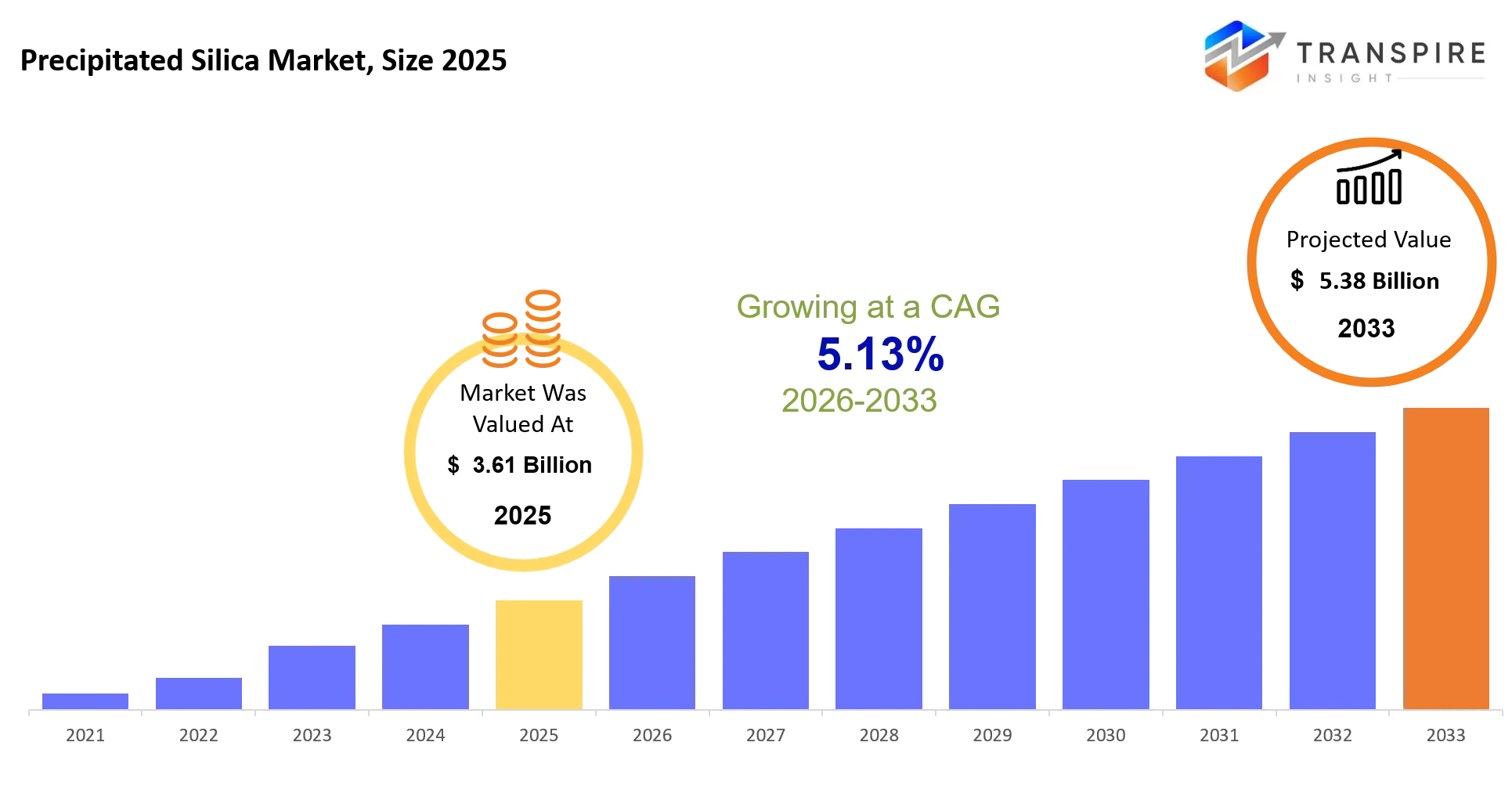
As per the Transpire Insights Analysis, the Precipitated Silica Market size is estimated at USD 3.61 billion in 2025 and is anticipated to reach USD 5.38 billion by 2033, growing at a CAGR of 5.13% from 2026 to 2033.
The precipitated silica market is not just a bulk-material business anymore; it is in the business of selling performance results in tyres, oral care, food, coatings and rubber parts. In recent years, the market has transformed from a volume-driven procurement process to specification-driven sourcing, as electric vehicle tyres, food safety, and eco-friendly production practices raised the bar for sourcing criteria. The largest catalyst was the boom in low-rolling-resistance tyre programs, which compelled OEMs and tier-one compounders to specifically ask for silica grades that boost energy efficiency without diminishing wear or traction. This change has led to an increased requirement for rubber-grade and highly dispersible silica, as paybacks are for performance and not raw filler tonnages. So, in practice, the demands of more stringent technical targets are driving increased silica loading and increasing the value of the tonnage sold; hence, growth is favouring higher-grade application-specific products over commodity output.
Precipitated Silica Market Size & Forecast:
- Global Market Size 2025: USD 3.61 Billion
- Expected Market Value (2033): USD 5.38 Billion
- Forecast CAGR (2026–2033): 5.13%
- Leading Region in 2025: Asia Pacific
- Fastest Growing Region: North America
- Key Company Profiles: Evonik Industries, Solvay, PPG Industries, W. R. Grace, Madhu Silica, Tosoh Corporation, PQ Corporation, Oriental Silicas, Quechen Silicon Chemical, IQE Group, Fuji Silysia Chemical, Akzo Nobel, Cabot Corporation, Nouryon, Denka Company
Key Precipitated Silica Market Insights:
Precipitated silica is transitioning from a bulk filler industry to a performance and compliance material industry, with tyre efficiency, food purity and circular sourcing influencing the buyer's decision. The winners are the ones that can provide consistent particle behaviour, audited sustainability claims and local supply in high-growth areas.
- Evonik Industries has increased technical cooperation in Asia Pacific due to the 48% share of the region.
- Solvay's sustainable silica innovations support stricter carbon and circular manufacturing regulations and benefit 24% in Europe.
- PPG Industries' process digitalisation for high-quality industrial and speciality silica production advances 21% in North America.
- The 46% Rubber Grade Silica leadership indicates improved collaboration between silica suppliers and tyre companies in creating next-generation compounds.
- As PQ Corporation continues to create controlled-abrasion materials for high-end oral-care products, 18% Toothpaste Grade Silica is growing.
- The 14% Food Grade Silica demand is increasing because manufacturers are seeking to process in a cleaner environment, control moisture and trace ingredients.
- Automated process optimisation helps coatings, catalysts and speciality chemical production with 10% Industrial Grade Silica.
- The 8% Highly Dispersible Silica market is driving investments in EV mobility by Quechen Silicon Chemical and Oriental Silicas at a CAGR of 15.8%.
- Export-oriented supply strategies are gaining traction in 4% Middle East and Africa, and 3% Latin America, where industrial manufacturing is growing.
What are the Key Drivers, Restraints, and Opportunities in the Precipitated Silica Market?
Driver:
EV and green-tire deployment is the most obvious growth driver for precipitated silica because silica enables tyre manufacturers to lower rolling resistance without negatively impacting wet grip. That makes it directly relevant to automaker range targets, fuel-efficiency regulations, and premium tyre pricing. The impetus has been electrification because the increased weight of EVs combined with higher torque levels exacerbate wear and energy-loss issues, encouraging compounders to adopt rubber-grade, high-dispersibility silica grades in tread compounds.
Restraint:
Due to high energy consumption and demanding drying and wastewater treatment requirements, precipitous silica production remains expensive due to the wet-process approach being the industry standard. This burden is more difficult for small producers to carry as reactor upgrades, water recovery systems, and other compliance measures impose an additional fixed cost to reduce operating margin and slow capacity upgrades.
Opportunity:
Bio-circular feedstocks are offering a greener sourcing story for precipitated silica, in particular where customers are demanding lower-carbon inputs without sacrificing performance. Silica derived from rice-husk, for instance, is entering the market as it can be used in rubber, construction and other industrial applications, while high-purity silica is also used in battery-related applications where chemical purity and high dispersibility are prized. This provides a pathway into Europe and Asia, where sustainability-driven purchasing and electric-vehicle supply chains are taking hold.
What Has the Impact of Artificial Intelligence Been on the Precipitated Silica Market?
Artificial intelligence is incrementally changing precipitated silica production by enhancing process intelligence instead of merely automating processes. As product quality relies on precision control of particle structure, surface area, porosity, and dispersion properties, silica producers are utilizing AI-based models to tune precipitation parameters, pH, slurry solids content, drying temperature, and particle-size distribution in real time. These solutions ingest sensor inputs combined with historical plant data to reduce batch variation, eliminate process drift, and decrease off-quality byproducts.
AI analyses also forecast raw-material cost changes, equipment failures, and progressive quality change to help producers maintain desired specifications, reduce production delays, and increase overall throughput. As a consequence, silica producers reduce waste and energy usage while increasing overall productivity, and smoothing transitions between silica grades used in tyres, oral-care, coatings, and other speciality markets. Despite these benefits, adoption of AI solutions is lagging in the industry as many older plants do not have the sophisticated sensors, consistent data frameworks, and high-quality datasets necessary for machine learning, limiting AI applications and uptake from cascading down to more mature manufacturing facilities.
Key Precipitated Silica Market Trends:
Market momentum is shifting from commodity silica to application-specific grades, and sustainability/compliance is becoming purchase filters, not secondary claims. Producers with control over the particle morphology, energy intensity and traceability are gaining pricing power.
- The EV tyre programs are taking silica from the filler to the performance-enabler stage in tread design.
- Green-tire regulation has helped to drive consumer demand for low rolling resistance compounds.
- The use of bio-circular feedstock is shifting from fossil-based feedstock to traceable waste-derived silica.
- Speciality grades are growing due to the increasing purity and feel control requirements of oral-care and food formulators.
- The surge in capacity is in the direction of Asia-Pacific, where demand for tyres and industries is concentrated.
- Business sales and acquisitions in the last few years are boosting supplier scale and technical support.
- The cost of drying now becomes a competitive lever, and energy efficiency can make a difference.
- As manufacturers rely on analytics to maintain quality consistency between batches, digital process control is growing in importance.
Precipitated Silica Market Segmentation
By Product Type:
Rubber Grade Silica leads with a 46% share as tyre makers use its reinforcement capabilities to improve rolling resistance, wear, and wet traction performance. Toothpaste Grade Silica has a 18% share, due to high-end oral-care products with stringent abrasivity requirements. Food Grade Silica has a 14% share, as it provides anti-caking and flow-control capabilities.
Industrial Grade Silica has a 10% share as it is used in coatings, chemicals, and catalysts.
Highly Dispersible Silica has an 8% share and is expected to grow at a 15.8% CAGR due to innovation in electric vehicle tyre development. Cosmetic Grade Silica and Others have a 2% share each due to their application in high-value formulations.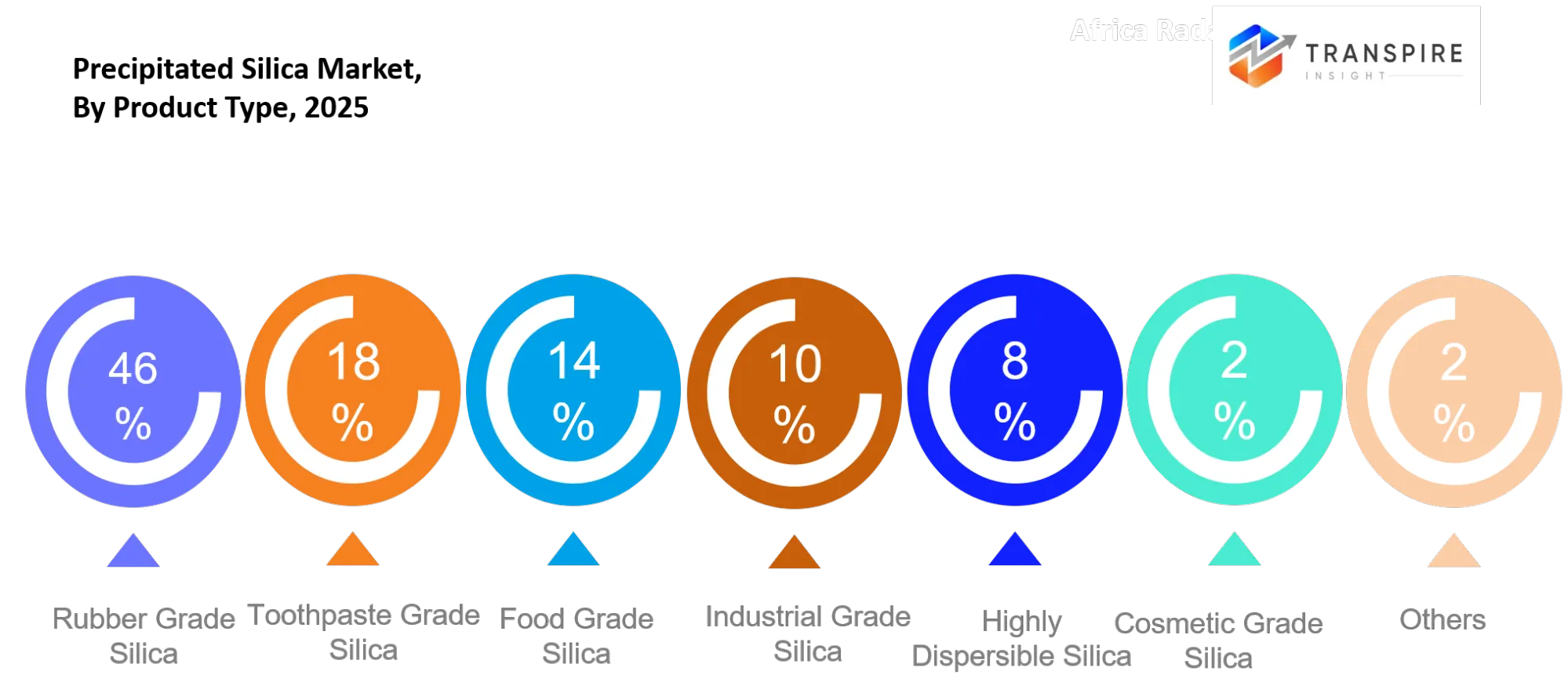
By Application:
Tires continue to be the greatest consumption sector as silica helps with fuel savings and tyre longevity. Oral care continues to grow with new toothpaste formulations, and food & beverages, personal care, paints & coatings, animal feed, industrial processing and many other end-use applications rely more and more on engineered silica to improve performance and ensure formulation stability.
By End User:
The lowest consumption is from the rubber makers and the automotive industry because of the high quality of tyres they produce. The food manufacturing companies, the personal care and pharmaceutical manufacturers, chemical firms, and all the other industrial customers are demanding varying grades of silica to meet stringent regulations and performance specifications.
By Form:
The commercial powder format is still the favoured form because of ease of handling and wide industrial applicability. Granules minimize dust formation, microbeads confer desirable performance for precise dosages, slurry facilitates continuous manufacturing processes, and other specific types are suited for automated processing environments.
By Distribution Channel:
Direct sales prevail based on long-term supply agreements with large industrial consumers. Chemical distributors are more effective in the penetration of regional markets; online B2B (business-to-business) channels, OEMs (original equipment manufacturers), and exporters are increasing procurement efficiency and technical support, and increasing the import-export of products.
What are the Key Use Cases Driving the Precipitated Silica Market?
The primary end-use remains tyre reinforcement with Rubber Grade Silica at 46% and Highly Dispersible Silica at 8%, a more recent addition helping to further improve wet grip, rolling efficiency, and wear balance in the latest tread compounds.
This is still by far the greatest demand; however, it will be surpassed by ongoing growth from oral care, food processing, and personal care, where Toothpaste Grade Silica at 18% and Food Grade Silica at 14% aid in controlled abrasion, texture, flow, and anti-caking qualities.
High-purity speciality grades are beginning to appear in end-use such as coatings, separator systems for lithium-ion battery electrolytes, and higher-performance industrial processing where better compound accuracy, purity, and sustainability are increasingly demanded.
|
Report Metrics |
Details |
|
Market size value in 2025 |
USD 3.16 Billion |
|
Market size value in 2026 |
USD 3.79 Billion |
|
Revenue forecast in 2033 |
USD 5.38 Billion |
|
Growth rate |
CAGR of 5.13% from 2026 to 2033 |
|
Base year |
2025 |
|
Historical data |
2021 - 2024 |
|
Forecast period |
2026 - 2033 |
|
Report coverage |
Revenue forecast, competitive landscape, growth factors, and trends |
|
Regional scope |
United States; Canada; Mexico; United Kingdom; Germany; France; Italy; Spain; Denmark; Sweden; Norway; China; Japan; India; Australia; South Korea; Thailand; Brazil; Argentina; South Africa; Saudi Arabia; United Arab Emirates |
|
Key companies profiled |
Evonik Industries, Solvay, PPG Industries, W. R. Grace, Madhu Silica, Tosoh Corporation, PQ Corporation, Oriental Silicas, Quechen Silicon Chemical, IQE Group, Fuji Silysia Chemical, Akzo Nobel, Cabot Corporation, Nouryon, Denka Company. |
|
Customization scope |
Free report customisation (country, regional & segment scope). Avail customised purchase options to meet your exact research needs. |
|
Report Segmentation |
By Product Type (Rubber Grade Silica, Food Grade Silica, Toothpaste Grade Silica, Industrial Grade Silica, Cosmetic Grade Silica, Highly Dispersible Silica, Specialty Silica, Others); By Application (Tires, Food & Beverages, Oral Care, Personal Care, Paints & Coatings, Animal Feed, Industrial Processing, Others); By End User (Automotive Industry, Food Manufacturers, Personal Care Companies, Chemical Industry, Rubber Manufacturers, Pharmaceutical Companies, Others); By Form (Powder, Granules, Microbeads, Slurry, Others); By Distribution Channel (Direct Sales, Chemical Distributors, Online B2B Platforms, OEM Suppliers, Exporters, Others) |
Which Regions are Driving the Precipitated Silica Market Growth?
Asia Pacific holds the largest market share of 48%, due to a convergence of the largest tyre manufacturing base, availability of multiple feedstock choices including silica-linked and high industrial capacity density. Local rubber demand, export-oriented tyre manufacture and cost-effective raw material options, e.g., rice husk ash valorisation, offer a cost advantage to China, India and Southeast Asia. The supportive policy climate for manufacturing localisation and infrastructure for large-scale chemical production bolsters such a local circle of suppliers.
In May 2026, Yokohama Rubber announced a $130 million capital investment to construct a new greenfield off-the-road (OTR) tire plant in Odisha, India. This expansion scales local high-capacity manufacturing infrastructure to meet surging industrial demand.
Europe accounts for 24% and is distinct from Asia Pacific, where volume remains the focus, having already turned to compliance, carbon and high-performance tyres. Procurement conditions driven by sustainability are pushing buyers towards circular, low-carbon silica, while rigorous food and chemical restrictions favour higher purity grades. It is more mature but remains resilient as OEMs, formulators and chemical manufacturers are closely connected across the value chain. That sustains demand, even when end markets are decelerating. In July 2026, Solvay commenced waste sand-based precipitated silica production across its Asian facilities to support the tyre industry's circular raw material targets.
North America is the fastest growing, 16.5% CAGR, 21% share, due to producers investing in high-dispersion capacity and customers in EVs and battery-near specialty materials. New plant start-ups and circular-silica launches have altered the base of competition, making supply more local and specification-dependent. The opportunity is greatest where sustainability claims, technical service and reliable supply matter more than commodity price. This gives North America a greater role in premium grades than its share would imply.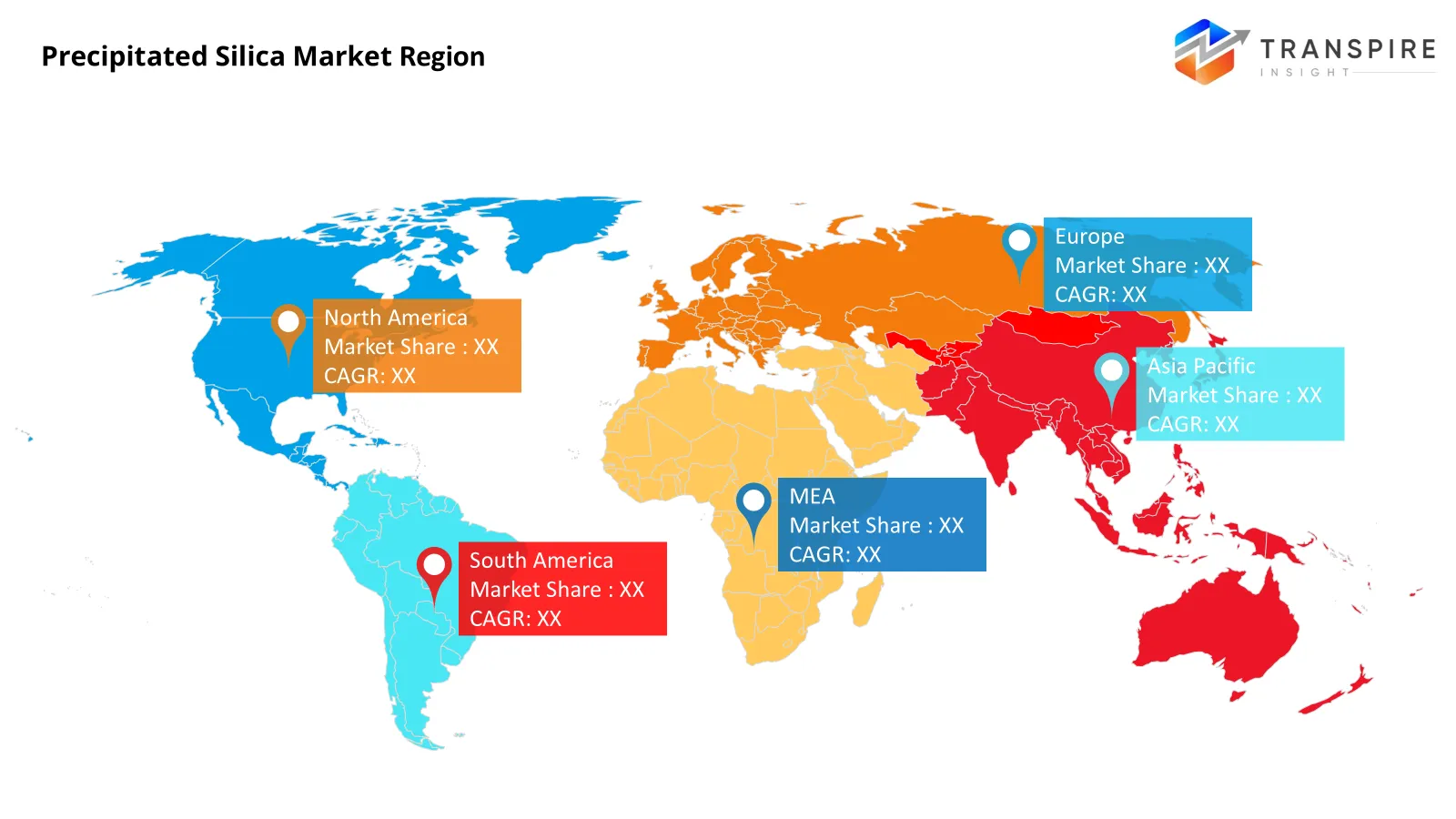
Who are the Key Players in the Precipitated Silica Market and how do they Compete?
The focus of competition is shifting away from production volume to application engineering, manufacturing efficiency, sustainability and customer relationships in the long term. Suppliers will be challenged to produce more customized grades of silica to meet the ever-higher demands for performance specifications for tyres, oral care, food, coatings and specialty industrial products.
Evonik Industries, Solvay, PPG Industries and W. R. Grace highlight product innovation, technology leadership through advanced material science and sustainable manufacturing capabilities to sustain their premium position. While Madhu Silica, Oriental Silicas and Quechen Silicon Chemical position on competitive manufacturing costs and developing regional manufacturing bases and catering to fast-growing Asian tyre producers through local supply chains. PQ Corporation, Tosoh Corporation, Fuji Silysia Chemical, Denka Company, Cabot Corporation, Nouryon, Akzo Nobel and IQE Group are distinguished by advanced speciality formulations, technical service, and customized product development. Their expansion model focuses on production upgrades, lower carbon manufacturing, digital process optimisation, and focused investments in electric vehicles, oral care, pharmaceutical and speciality chemicals, which grow faster, thus leading to higher customer loyalty and products with higher value.
Key Players are:
- Evonik Industries
- Solvay
- PPG Industries
- W. R. Grace
- Madhu Silica
- Tosoh Corporation
- PQ Corporation
- Oriental Silicas
- Quechen Silicon Chemical
- IQE Group
- Fuji Silysia Chemical
- Akzo Nobel
- Cabot Corporation
- Nouryon
- Denka Company
Recent Development News
- In May 2026, BASF signed an agreement to sell its complete silicates business, including its production facility in Düsseldorf, Germany, to PQ Corporation. This asset divestment reshapes downstream supply pipelines by expanding the buyer's localized sodium silicate platform, a foundational raw material needed for high-purity synthetic precipitated silica formulations.
What Strategic Insights Define the Future of the Precipitated Silica Market?
The Precipitated Silica Market continues to transition from high-volume commodity supply into focused, application-specific contracts built on consistent quality and technical performance for long-term customer relationships. Lead producers are increasingly looking to differentiate by custom silica grades built for premium tyre formulations, active oral care compounds, food processing, or growing new industries. The new challenge is that if commitments to circularity can outpace plant-level traceability, those producers may come under increased customer scrutiny for compliance and credibility if environmental claims cannot be substantiated.
There are several opportunities to develop premium silica for electric vehicle tyres, power pack materials and high-performance consumer formulations enabled by particle control for higher margins. To be ready to compete going forward, lower carbon production technologies, sensor-enabled manufacturing, digital quality control and regional production capacity within reach of key automotive and consumer manufacturing clusters are recommended.
Key Segmentations are:
By Product Type
- Rubber Grade Silica
- Food Grade Silica
- Toothpaste Grade Silica
- Industrial Grade Silica
- Cosmetic Grade Silica
- Highly Dispersible Silica
- Specialty Silica
- Others
By Application
- Tires
- Food & Beverages
- Oral Care
- Personal Care
- Paints & Coatings
- Animal Feed
- Industrial Processing
- Others
By End User
- Automotive Industry
- Food Manufacturers
- Personal Care Companies
- Chemical Industry
- Rubber Manufacturers
- Pharmaceutical Companies
- Others
By Form
- Powder
- Granules
- Microbeads
- Slurry
- Others
By Distribution Channel
- Direct Sales
- Chemical Distributors
- Online B2B Platforms
- OEM Suppliers
- Exporters
- Others
Regional Outlook
North America
- US
- Canada
- Mexico
Europe
- Germany
- UK
- France
- Italy
- Spain
- Russia
- Rest of Europe
Asia Pacific
- China
- Japan
- India
- South Korea
- Australia
- Rest of Asia Pacific
South America
- Brazil
- Argentina
- Rest of South America
Middle East & Africa
- UAE
- Saudi Arabia
- Qatar
- South Africa
- Rest of the Middle East & Africa
Frequently Asked Questions
Find quick answers to common questions.
The Precipitated Silica Market size was valued at USD 3.61 billion in 2025 and is poised to reach USD 5.38 billion by 2033, expanding at a 5.13% CAGR.
Key segments for the Precipitated Silica Market are By Product Type (Rubber Grade Silica, Food Grade Silica, Toothpaste Grade Silica, Industrial Grade Silica, Cosmetic Grade Silica, Highly Dispersible Silica, Specialty Silica, Others); By Application (Tires, Food & Beverages, Oral Care, Personal Care, Paints & Coatings, Animal Feed, Industrial Processing, Others); By End User (Automotive Industry, Food Manufacturers, Personal Care Companies, Chemical Industry, Rubber Manufacturers, Pharmaceutical Companies, Others); By Form (Powder, Granules, Microbeads, Slurry, Others); By Distribution Channel (Direct Sales, Chemical Distributors, Online B2B Platforms, OEM Suppliers, Exporters, Others).
Growth is primarily driven by EV and green-tire demand, stricter fuel-efficiency rules, rising oral-care and food-grade silica use, and the shift to high-dispersion, bio-based, and application-specific formulations.
The Precipitated Silica Market is led by major manufacturers including Evonik Industries, Solvay, PPG Industries, W. R. Grace, Madhu Silica, Tosoh Corporation, PQ Corporation, Oriental Silicas, Quechen Silicon Chemical, IQE Group, Fuji Silysia Chemical, Akzo Nobel, Cabot Corporation, Nouryon, Denka Company.
Asia Pacific influences global market dynamics most strongly with a 48% share because it combines large tyre manufacturing capacity, strong industrial demand, and feedstock-linked circular silica opportunities across China, India, and Southeast Asia.
Commercial opportunities include premium HDS for EV tyres, circular, bio-based silica from rice husk ash, high-purity grades for oral care and battery separators, and regional capacity expansion near major tyre and consumer-formulation hubs.
- Evonik Industries
- Solvay
- PPG Industries
- W. R. Grace
- Madhu Silica
- Tosoh Corporation
- PQ Corporation
- Oriental Silicas
- Quechen Silicon Chemical
- IQE Group
- Fuji Silysia Chemical
- Akzo Nobel
- Cabot Corporation
- Nouryon
- Denka Company
About the Authors

Pankaj Ghogare Patil
I am Pankaj Ghogare Patil, a Senior Research Analyst at Transpire Insight, specializing in the Pharmaceutical, Chemicals & Materials, Healthcare IT, and Biotechnology industry. My expertise lies in conducting comprehensive market research, analyzing industry trends, evaluating competitive landscapes, and translating complex data into actionable insights. At Transpire Insight, I closely follow emerging technologies, regulatory developments, and market innovations to create accurate, well-researched, and informative content that helps businesses and professionals make informed decisions. I am committed to producing credible, evidence-based articles that reflect industry best practices while making technical topics accessible and valuable for a broad audience.

Chakradhar Khansole
Chakradhar serves as the Research Director at Transpire Insight, bringing over 8 years of experience in technology, innovation, and strategic market intelligence. He specializes in transforming complex market data into actionable business insights that enable organizations to make informed, growth-oriented decisions. Recognized for his strategic vision and analytical expertise, Chakradhar leads high-impact research initiatives, delivering comprehensive market assessments, competitive intelligence, and forward-looking industry analysis.
Recently Published Reports
-
May 2026
Healthcare Polymer Packaging Market
Healthcare Polymer Packaging Market Size, Share & Analysis Report By Packaging Type (Syringes, IV Bottles and Pouches, Clamshells, Blisters, Bottles & Jars, Containers, Tubes, IV Parental Packaging, Others), By Type (Regulated, Non-regulated), By Polymer Type (LDPE (Low-Density Polyethylene), HDPE (High-Density Polyethylene), Homo-polymer (Homo), Random Copolymer (Random), Block Copolymer (Block), PET, Polystyrene, Polyvinyl Chloride, Polyamide/EVOH, Others), and Geography (North America, Europe, Asia-Pacific, Middle East and Africa, South and Central America), 2021 - 2031
-
Apr 2026
Hydrophilic Tape (Waterstop) Market
Hydrophilic Tape (Waterstop) Market Size, Share & Analysis Report By Type (Bentonite-Based Hydrophilic Tape, Rubber-Based Hydrophilic Tape), By Application (Residential Buildings, Commercial Buildings, Infrastructure Projects), and Geography (North America, Europe, Asia-Pacific, Middle East and Africa, South and Central America), 2021 - 2031
-
Apr 2026
Metalens Market
Metalens Market Size, Share & Analysis Report By Type (Visible Light Metalens, and Infrared Metalens), By Application (Consumer Electronics, Automotive Electronics, Industrial, Medical, and Others), and Geography (North America, Europe, Asia-Pacific, Middle East and Africa, South and Central America), 2021 - 2031
-
Apr 2026
PBT Resin Market
PBT Resin Market Size, Share & Analysis Report By Type (Reinforced PBT Resin, Unreinforced PBT Resin), By Processing Method (Injection Molding, Extrusion, Blow Molding, Others), By End-User (Automotive, Electrical & Electronics, Consumer Appliances, Industrial Machinery, Medical Devices, Packaging, Others), and Geography (North America, Europe, Asia-Pacific, Middle East and Africa, South and Central America), 2021 - 2031