

Port Equipment Market Summary:
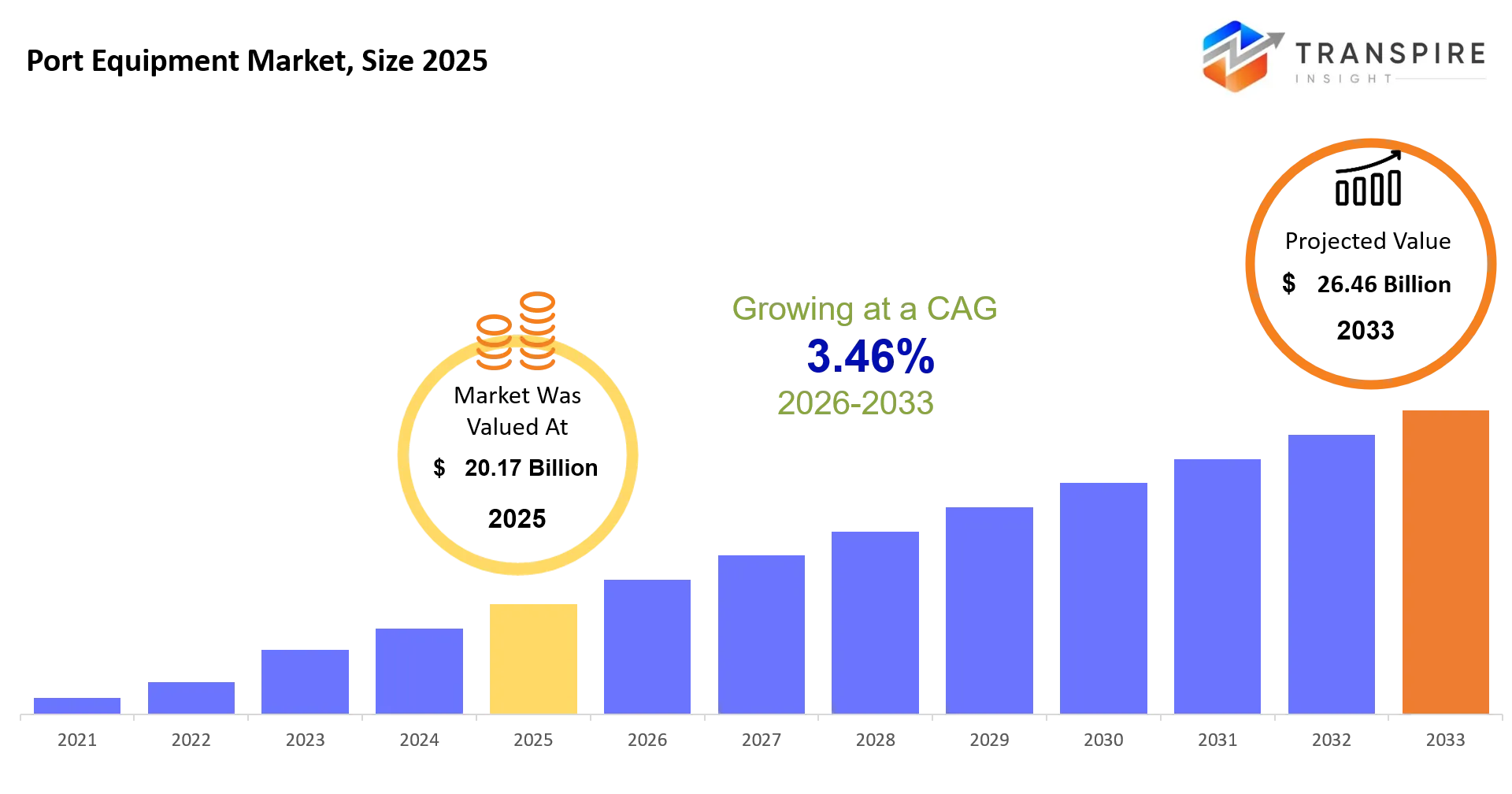
As per Transpire Insight Analysis,the Port Equipment Market size is estimated at USD 20.17 billion in 2025 and is anticipated to reach USD 26.46 billion by 2033, growing at a CAGR of 3.46% from 2026 to 2033.
The Port Equipment Market provides hi-tech cargo handling machinery and automation solutions for cargo handling, conveying, and storing in container ports, bulk ports, or intermodal logistics platforms. Over the last 3-5 years, the port equipment market transitioned from traditional diesel-operated equipment to hi-tech, electrified, and networked terminal automation. Ports are seeking higher throughput and utilize automation, remote control & operation, AI-enabled equipment, and digitalization to achieve these goals. As government funding for infrastructure projects supports complete terminal automation projects, the rapid deployment of mega-container carriers is the driver for terminal automation/modernization to gain higher handling capacity and greater efficiency for shrinking vessel turnaround time. The market is fueled by rising maritime trade, cargo throughput, and investments in intelligent port infrastructure to motivate terminal operators to retire aging handling equipment with higher capacity, higher throughput, higher density, and lower operating costs.
Port Equipment Market Size & Forecast:
- Global Market Size 2025: USD 20.17 Billion
- Expected Market Value (2033): USD 26.46 Billion
- Forecast CAGR (2026–2033): 3.46%
- Leading Region in 2025: Asia Pacific (46%)
- Fastest Growing Region: Middle East & Africa (8% & CAGR 18.4%)
- Key Company Profiles: Konecranes, Liebherr, Kalmar, Cargotec, SANY Group, ZPMC, Terex, Hyster-Yale, Toyota Material Handling, ABB, Siemens, Mitsubishi Logisnext, TIL Limited, CVS Ferrari, Doosan Bobcat
Key Port Equipment Market Insights:
The shift from equipment procurement to intelligence-layered ecosystems, where automation, electrification, and data interoperability become the keys to competitive advantage, is underway.
- Ship-to-shore cranes at 35% are becoming more and more remote-controlled by Konecranes and ZPMC, with the shift from manual cab to centralized command centres to control multiple cranes at once.
- Port-side emissions regulations are being met by replacing diesel rubber-tired gantry cranes at 22% with battery electric models from Kalmar and Liebherr.
- At 15%, reach stackers are getting telematics from SANY and Terex, which helps in predictive maintenance and minimizes unplanned downtime in intermodal operations.
- ABB and Siemens are introducing modular AGV systems for brownfield retrofits to boost yard throughput, as AGVs are moving beyond greenfield terminals at 11%.
- AI-driven port systems at 9% are moving from pilots to core terminal OS, with Mitsubishi Logisnext and TIL Limited incorporating machine learning to optimize berth and yard in real time.
- CVS Ferrari and Doosan Bobcat are upgrading their terminal tractors with hybrid drives, cutting fuel usage and complying with stricter emissions regulations.
- The biggest application is still container handling, accounting for 54% of the market, and a high-speed automated system is being developed by Toyota Material Handling and Hyster-Yale to serve ultra-large vessels.
- Governments and logistics companies are more interested in 24/7 operations than manual work, and fully automated equipment is growing fastest, with 76% of ports now integrating some automation.
What are the Key Drivers, Restraints, and Opportunities in the Port Equipment Market?
Driver:
The growth of mega-20,000+ TEU container ships and tighter port-side decarbonization requirements concurrently require terminal operators to invest in higher-capacity, lower-emission equipment. The above is driven by our emissions targets and the need to handle mega-ships without increasing vessel turnaround. This affects revenue in the following ways by tilting the equipment mix toward high-priced automated ship-to-shore cranes (STS), electric rubber-tired gantry cranes, and AI-enabled port operations, which all have a higher unit price with persistent aftermarket and/or software-service revenue streams.
Restraint:
Growth is constrained by multi-million dollar CAPEX requirements and long ROI cycles for automated and electrified systems (especially in emerging markets). This is a structural issue because of the long life cycles of port equipment, the financing constraints, the sharp raw-material price fluctuations, and skill shortages for high-end systems that slow down replacement and upgrades.
Opportunity:
The growth is the incremental retrofitting of existing brownfield ports with modular automation and electrification packages instead of waiting for greenfield investment. European and North American ports are progressively moving to remote-controlled cranes, battery-electric terminal tractors and AI-powered yard planning as a short-term adoption step, creating a huge addressable market for modification kits and hybrid systems. Retrofits prolong asset life, decrease initial capex and lessen operational interruption relative to full replacement.
What Has the Impact of Artificial Intelligence Been on the Port Equipment Market?
Artificial intelligence has had a relatively modest direct impact on the asbestos gloves market, as this is a mature, low-technology personal protective equipment (PPE) segment with primarily manual, specification-based production. Nonetheless, AI is being employed more commonly upstream in the wider industrial safety and PPE supply chain for demand planning, inventory management, and quality assurance at manufacturing facilities also producing heat-resistant gloves. In terms of automation, AI-enabled vision technology is adopted at certain glove factories to identify product flaws on production lines, minimizing scrap and standardizing heat-resistant product quality. Predictions are appearing based on AI-supported data analysis to identify regional fluctuations in demand for asbestos gloves by correlating demand fluctuations at refineries, blast furnaces, and steel mills, and thus enabling manufacturers and distributors to stock product in anticipation of scheduled closures. Operational efficiency is driven by AI-led warehouse management systems that speed up order processing and minimise stockouts for safety-related PPE. An important drawback, however, remains the cost and integration challenges of installing AI-powered quality assurance or demand planning systems on the production lines of smaller firms, creating a dichotomy between large, diversified industrial gloves manufacturers and smaller specialists in asbestos gloves.
Key Port Equipment Market Trends:
The market is shifting from equipment-driven operations to a digitally enabled, automation-driven port ecosystem optimised for throughput and sustainability. Mechanical performance is not enough anymore to differentiate products and services; software intelligence, electrification, and seamless equipment interoperability are becoming more and more important.
- Ports are switching to electric and hybrid-powered cargo handling equipment to help meet decarbonisation goals.
- The optimization of berth plans, container allocation, and cargo flow is enhanced by
AI-driven terminal operating systems.
- AGVs are gradually replacing manually operated transport systems in container terminals.
- The use of remote-controlled cranes is improving worker safety and precision handling and increasing productivity.
- Digital twin technology is being adopted to integrate into terminal expansion planning and operating performance simulation.
- Continuous condition monitoring is helping to lower the risk of unexpected equipment failure through predictive maintenance platforms.
- As ports look to be more flexible and less dependent on a single vendor, open system automation architectures are becoming the choice of preference.
- Brownfield modernization projects are moving forward quickly with modular retrofit solutions to reduce the disruption of operations during technology retrofits.
Port Equipment Market Segmentation
By Product Type:
Ship-to-shore cranes dominate at 35% of the market, reflecting their critical role in vessel servicing and the shift toward larger, AI-enabled models that command premium pricing. Rubber-tired gantry cranes hold 22%, driven by electrification mandates and the need for flexible yard operations, while reach stackers at 15% remain essential for smaller ports and intermodal terminals. Automated guided vehicles at 11% and AI-enabled port systems at 9% represent the fastest-growing segments, as terminals prioritize automation to improve throughput and reduce labour costs. Terminal tractors at 5% and others at 3% serve niche applications, with growth tied to electrification and telematics adoption.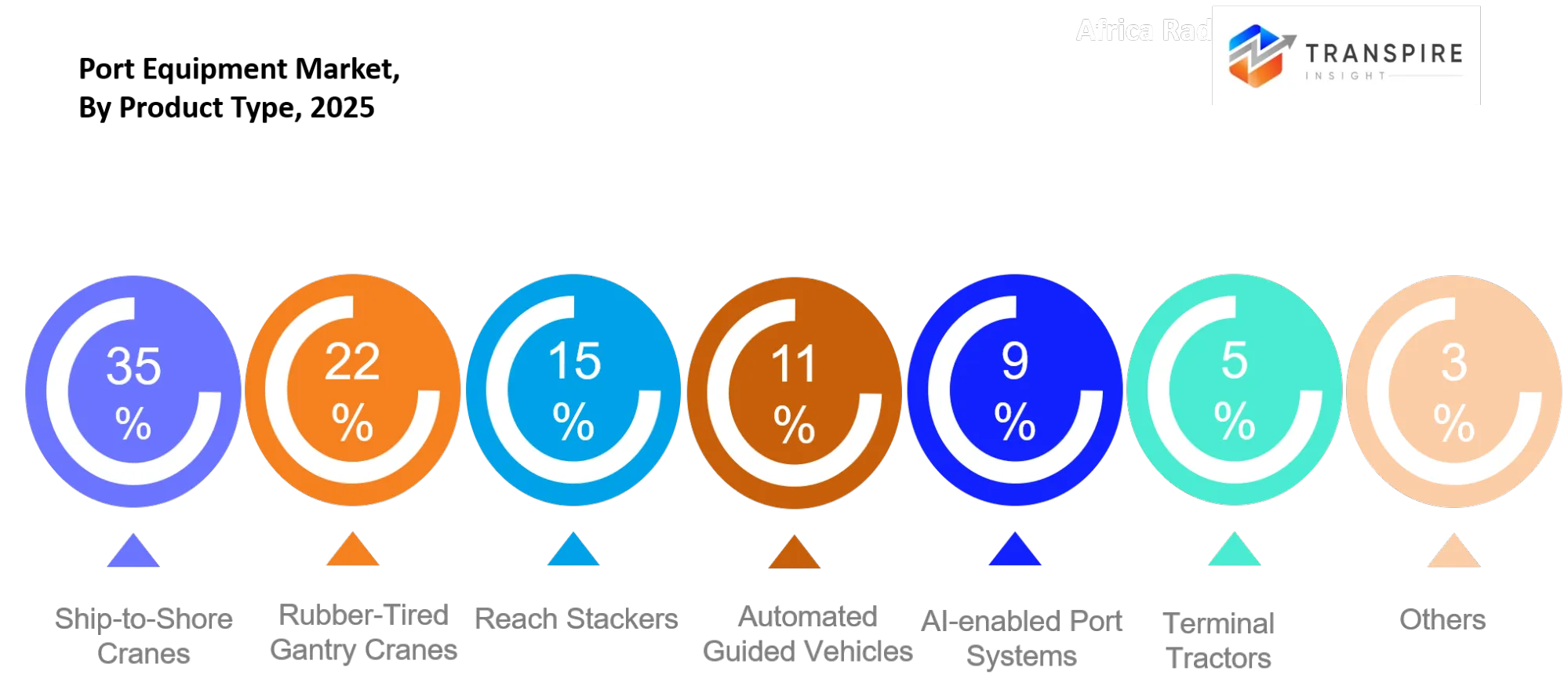
By Application:
Container handling is foremost, driven by the twin demands of deploying ever larger vessels along with automation and unparalleled speed, in contrast to the slow growth of bulk and general cargo trades, which are underpinned by the trade cycles of commodities. Intermodal logistics is on the rise, with containers merging into the rail and road networks of global economies.
By End User:
Container ports and government port authorities are the largest investors in automation and electrification, while logistics and shipping firms are the fastest-growing suppliers of equipment to private terminals and inland hubs. Bulk ports and inland ports are next, with developments linked to regionally focused trade corridors and infrastructure expenditure.
By Automation:
While manual equipment has a strong foothold in emerging markets, semi-automated and fully automated port equipment is growing its share in mature ports, with AI-enabled and remotely operated equipment representing the high-growth frontier. As a result of labour constraints and the drive to operate round-the-clock, this can have future implications on equipment design and service offerings.
By Distribution Channel:
The share of direct sales and OEM suppliers is currently high as ports prefer working with longer-term partners for integrated project solutions. Industrial distributors and EPC contractors target smaller regional projects. E-com will not represent a significant channel of sale due to the high value of port equipment and specific customer requirements.
What are the Key Use Cases Driving the Port Equipment Market?
The main application is for Container handling, continuing to be the leading end-use market, with the largest share, at 35% of the Ship-to-Shore Cranes segment. These high-power lifting systems facilitate fast loading/unloading of large container ships while increasing berth productivity and lowering vessel turnaround.
The use of applications continues to grow in bulk cargo terminals, Ro-Ro cargo terminals, intermodal logistics centres, and inland ports, where dedicated machinery enables these terminals to handle cargo more effectively, achieve greater storage utilization, and provide better multimodal linkages to global supply chains.
Developing use cases focus on autonomous container terminals and intelligent port operations employing AI-enabled Port Systems; the most rapidly expanding sub-sector with a CAGR of 17.6%. They apply predictive analytics, automated guided vehicles and remote crane operations, and intelligent transportation management systems to optimize productivity in next-generation digital port infrastructure.
|
Report Metrics |
Details |
|
Market size value in 2025 |
USD 20.17 Billion |
|
Market size value in 2026 |
USD 20.85 Billion |
|
Revenue forecast in 2033 |
USD 26.46 Billion |
|
Growth rate |
CAGR of 3.46% from 2026 to 2033 |
|
Base year |
2025 |
|
Historical data |
2021 - 2024 |
|
Forecast period |
2026 - 2033 |
|
Report coverage |
Revenue forecast, competitive landscape, growth factors, and trends |
|
Regional scope |
United States; Canada; Mexico; United Kingdom; Germany; France; Italy; Spain; Denmark; Sweden; Norway; China; Japan; India; Australia; South Korea; Thailand; Brazil; Argentina; South Africa; Saudi Arabia; United Arab Emirates |
|
Key companies profiled |
Konecranes, Liebherr, Kalmar, Cargotec, SANY Group, ZPMC, Terex, Hyster-Yale, Toyota Material Handling, ABB, Siemens, Mitsubishi Logisnext, TIL Limited, CVS Ferrari, Doosan Bobcat |
|
Customization scope |
Free report customisation (country, regional & segment scope). Avail customised purchase options to meet your exact research needs. |
|
Report Segmentation |
By Product Type (Ship-to-Shore Cranes, Rubber-Tired Gantry Cranes, Rail-Mounted Gantry Cranes, Reach Stackers, Forklifts, Terminal Tractors, Automated Guided Vehicles, Others); By Application (Container Handling, Bulk Cargo Handling, General Cargo, Ro-Ro Operations, Liquid Cargo Handling, Intermodal Logistics, Others); By End User (Container Ports, Bulk Ports, Inland Ports, Logistics Companies, Shipping Companies, Government Port Authorities, Others); By Automation (Manual Equipment, Semi-Automated Equipment, Fully Automated Equipment, AI-enabled Port Systems, Remote-operated Equipment, Others); By Distribution Channel (Direct Sales, OEM Suppliers, Industrial Distributors, EPC Contractors, Others) |
Which Regions are Driving the Port Equipment Market Growth?
Asia Pacific represents 46% of the world port equipment demand, underpinned by large port infrastructure investment, surging manufacturing exports, and large-scale terminal modernization. Investment programs supported by the government, terminal electrification programs, increased penetration of advanced cranes and AGVs are further consolidating the regional port equipment ecosystem. Robust domestic manufacturing power allows for increasing equipment availability and a resilient supply chain. Chinese, Singaporean, and South Korean key container hubs keep redefining the operational standards, consolidating the Asia Pacific region as the world reference for advanced port equipment deployment. In March 2026, Mitsui O.S.K. Lines and PSA Singapore partnered to form a joint-venture ro-ro terminal, enhancing operational standards at Southeast Asia's primary automotive transhipment centre.
Europe accounts for 24% of the market, with mature port infrastructure and less emphasis on capacity growth and more focus on decarbonisation. As opposed to green-field automation investment by ports in Asia Pacific, European operators are retrofitting existing terminals with electric and remote-controlled equipment to adapt to higher European Union (EU) emissions standards; long-term service contracts with OEMs, a mature regulator, a well-educated workforce and technological knowledge at their disposal ensures reliable, predictable demand for costly, high-quality electrical equipment, though growth levels are generally much slower than in emerging markets.
Middle East & Africa is the fastest growing at 18.4% CAGR, pushed by recent port modernization investments. After several dollars of cargo volumes shift from oil-dependent economies to diversified logistics hubs, ports in this region such as Jebel Ali, Djibouti and Mombasa are gearing up for automation and electrification overhauls to prepare for future transhipment hub demands between Asia and Europe. This will create additional demand for large ship-to-shore cranes and automated yard cranes. This yet-to-grow region accounts for around 8% of the demand today but will see significant expansion as cargo trade routes are relocated. In March 2026, DP World added three new semi-automated ship-to-shore quay cranes at Jeddah Islamic Port, increasing terminal capacity and boosting berth productivity to handle ultra-large container vessels.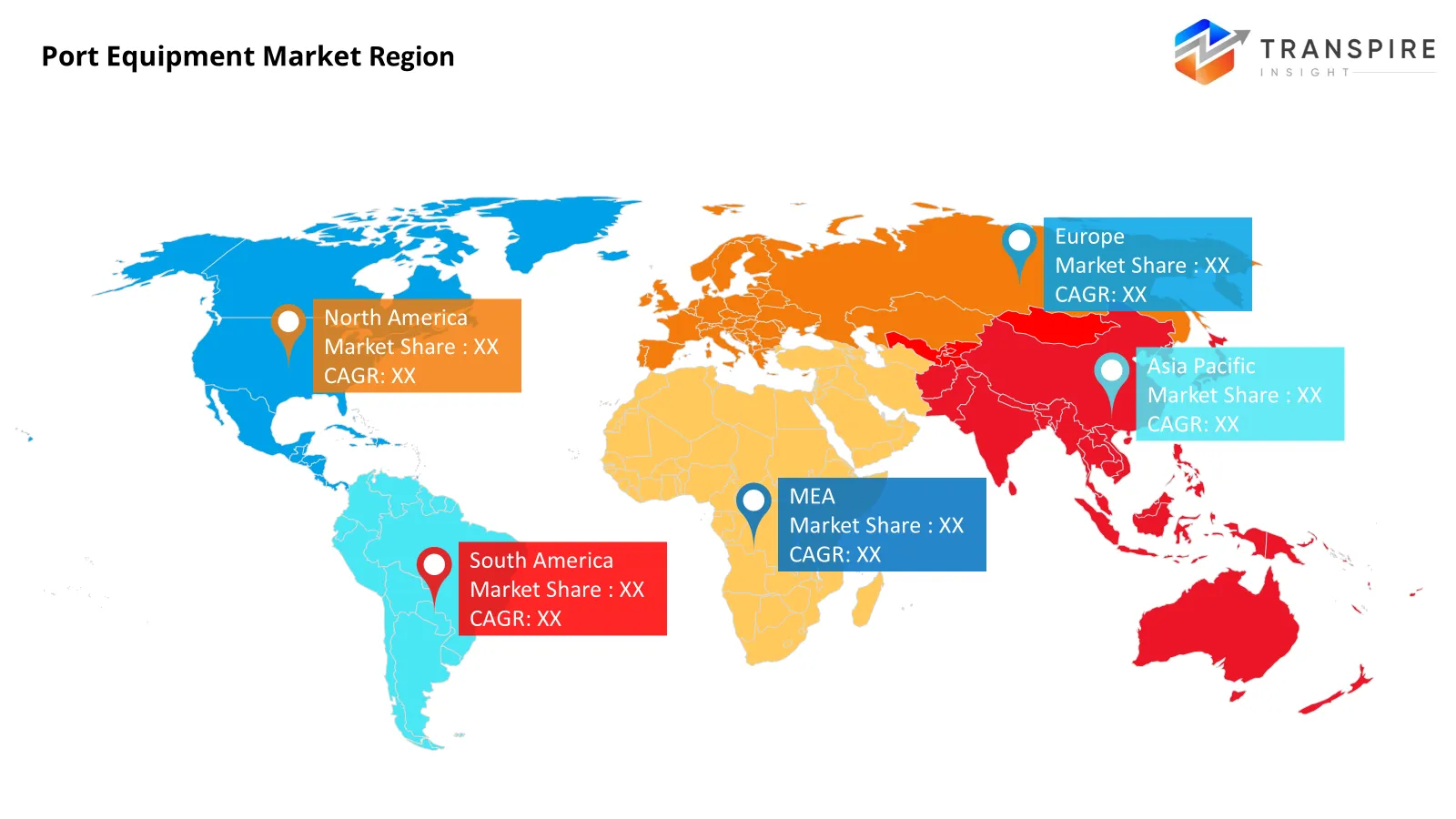
Who are the Key Players in the Port Equipment Market and how do they Compete?
The world port equipment business is extremely competitive, with OEMs competing over automation suites, electrification portfolios and local service ecosystems rather than strictly on price. Competition is focused on which vendor can provide a truly integrated solution encompassing the hardware, software, and long-term support, generating high switching costs for the port operators.
Konecranes and Liebherr compete on innovation, providing AI-enabled remote-controlled cranes and electrified gantry systems that have high cost premiums. Kalmar (Cargotec) and ZPMC differentiate through economies of scale and vertical integration, combining automation software with equipment sales to win service revenue from customers. SANY Group and Terex achieve cost leadership and offer equipment at aggressive prices, reaching out to emerging markets with local manufacturing plans. ABB and Siemens concentrate on specific automation and electrification parts, pipelining drive systems and control software to equipment OEMs rather than competing directly. Mitsubishi Logisnext, TIL Limited and CVS Ferrari are extending their focus on regional markets and developing specific solutions for various port structures and regulatory regimes. Hyster-Yale, Toyota Material Handling and Doosan Bobcat are drawing on their broader experience in material handling to cross-sell port equipment as part of integrated logistics packages.
Key players are:
- Konecranes
- Liebherr
- Kalmar
- Cargotec
- SANY Group
- ZPMC
- Terex
- Hyster-Yale
- Toyota Material Handling
- ABB
- Siemens
- Mitsubishi Logisnext
- TIL Limited
- CVS Ferrari
- Doosan Bobcat
Recent Development News
- In March 2026, Konecranes announced an order for two battery-electric Rubber-Tired Gantry (RTG) cranes from HHLA TK Estonia. Equipped with a 296-kWh battery system, these cranes enable full-shift operations with zero tailpipe emissions, accelerating the transition toward fully electrified port equipment and decarbonized container terminal operations.
What Strategic Insights Define the Future of the Port Equipment Market?
The market is evolving towards intelligent, electrified terminal ecosystems in which cargo handling equipment is integrated into a broader, AI-enabled logistics network rather than operated as individual assets. The persistent consolidation of automation software and integration module expertise among a handful of OEMs is leading to Vendor lock-in, higher total ownership costs, and reduced operational flexibility for port operators. The market presents a large near-term opportunity for brownfield port upgrades with modular automation, electrification, and digital retrofits that significantly improve productivity but do not entail the capital costs of greenfield infrastructure investment. Automation developers should invest in openness, interoperability, and modularity in digital control systems, open-architected software, and scalable hardware designs that can accommodate unforeseen future upgrades and integration of third-party automation. Port users should leverage modular procurement approaches that facilitate incremental digital transformation while maintaining operational agility over the long run.
Key Segmentations are:
By Product Type
- Ship-to-Shore Cranes
- Rubber-Tired Gantry Cranes
- Rail-Mounted Gantry Cranes
- Reach Stackers
- Forklifts
- Terminal Tractors
- Automated Guided Vehicles
- Others
By Application
- Container Handling
- Bulk Cargo Handling
- General Cargo
- Ro-Ro Operations
- Liquid Cargo Handling
- Intermodal Logistics
- Others
By End User
- Container Ports
- Bulk Ports
- Inland Ports
- Logistics Companies
- Shipping Companies
- Government Port Authorities
- Others
By Automation
- Manual Equipment
- Semi-Automated Equipment
- Fully Automated Equipment
- AI-enabled Port Systems
- Remote-operated Equipment
- Others
By Distribution Channel
- Direct Sales
- OEM Suppliers
- Industrial Distributors
- EPC Contractors
- Others
Regional Outlook
North America
- US
- Canada
- Mexico
- US
- Canada
Europe
- Germany
- UK
- France
- Italy
- Spain
- Rest of Europe
Asia Pacific
- China
- Japan
- India
- South Korea
- Australia
- Rest of Asia Pacific
South America
- Brazil
- Argentina
- Rest of South America
Middle East & Africa
- UAE
- Saudi Arabia
- Qatar
- South Africa
- Rest of the Middle East & Africa
Frequently Asked Questions
Find quick answers to common questions.
The Port Equipment Market size was valued at USD 20.17 billion in 2025 and is poised to reach USD 26.46 billion by 2033, expanding at a 3.46% CAGR.
Key segments for the Port Equipment Market are By Product Type (Ship-to-Shore Cranes, Rubber-Tired Gantry Cranes, Rail-Mounted Gantry Cranes, Reach Stackers, Forklifts, Terminal Tractors, Automated Guided Vehicles, Others); By Application (Container Handling, Bulk Cargo Handling, General Cargo, Ro-Ro Operations, Liquid Cargo Handling, Intermodal Logistics, Others); By End User (Container Ports, Bulk Ports, Inland Ports, Logistics Companies, Shipping Companies, Government Port Authorities, Others); By Automation (Manual Equipment, Semi-Automated Equipment, Fully Automated Equipment, AI-enabled Port Systems, Remote-operated Equipment, Others); By Distribution Channel (Direct Sales, OEM Suppliers, Industrial Distributors, EPC Contractors, Others).
Growth is primarily driven by rising global seaborne trade volumes, proliferation of ultra-large container vessels requiring higher-capacity handling equipment, accelerated terminal automation to address labour constraints, and stricter port-side decarbonization mandates forcing electrification of cranes, gantries, and terminal tractors.
The Port Equipment Market is led by major manufacturers including Konecranes, Liebherr, Kalmar, Cargotec, SANY Group, ZPMC, Terex, Hyster-Yale, Toyota Material Handling, ABB, Siemens, Mitsubishi Logisnext, TIL Limited, CVS Ferrari, Doosan Bobcat.
Asia Pacific holds 46% of global port equipment demand, driven by its position as the world's largest container transhipment hub with major ports in China, Singapore, and South Korea handling approximately 60% of global containerised trade, supported by government-backed port modernisation programs, Belt and Road infrastructure investments, and aggressive adoption of automation and electrification to service ultra-large vessels.
Commercial opportunities include brownfield retrofit markets for modular automation and electrification kits, AI-enabled port systems and remote-operated equipment upgrades, battery-electric terminal tractor and hybrid crane conversions, and open-architecture software platforms that reduce vendor lock-in while enabling incremental terminal modernization.
- Konecranes
- Liebherr
- Kalmar
- Cargotec
- SANY Group
- ZPMC
- Terex
- Hyster-Yale
- Toyota Material Handling
- ABB
- Siemens
- Mitsubishi Logisnext
- TIL Limited
- CVS Ferrari
- Doosan Bobcat
About the Authors

Mayur Shinde
I am Mayur Shinde, a Senior Research Analyst at Transpire Insight, specializing in the Automotive & Transportation and Information & Communication Technology (ICT) Industry. My work focuses on analyzing emerging market trends, technological advancements, competitive landscapes, and industry developments to deliver accurate, data-driven insights. I am passionate about transforming complex market information into clear, actionable content that helps businesses, professionals, and decision-makers stay informed and make confident strategic decisions.

Chakradhar Khansole
Chakradhar serves as the Research Director at Transpire Insight, bringing over 8 years of experience in technology, innovation, and strategic market intelligence. He specializes in transforming complex market data into actionable business insights that enable organizations to make informed, growth-oriented decisions. Recognized for his strategic vision and analytical expertise, Chakradhar leads high-impact research initiatives, delivering comprehensive market assessments, competitive intelligence, and forward-looking industry analysis.
Recently Published Reports
-
Apr 2026
ATV & UTV Market
ATV & UTV Market Size, Share & Analysis Report By Type (ATV, and UTV), By Variants (Less Than 400 CC, 400 CC To 800 CC, and More Than 800 CC), and Geography (North America, Europe, Asia-Pacific, Middle East and Africa, South and Central America), 2021 - 2031
-
Apr 2026
Automotive Central Gateway Module Market
Automotive Central Gateway Module Market Size, Share & Analysis Report By Type (Ethernet Central Gateway Module, CAN Central Gateway Module, LIN Central Gateway Module, and FlexRay), By Application (Powertrain Control, Body Control, Infotainment System, Advanced Driver Assistance Systems (ADAS), and Others), By End User (Passenger Vehicles, and Commercial Vehicles), and Geography (North America, Europe, Asia-Pacific, Middle East and Africa, South and Central America), 2021 - 2031
-
Apr 2026
Automotive Engine Oil Filter Market
Automotive Engine Oil Filter Market Size, Share & Analysis Report By Filter Type (Fuel Filter, Engine Oil Filter, Hydraulic Oil Filter, and Others), By Filter Media (Cellulose, Synthetic, and Micro), By Sales Channel (OEMs, and Aftermarket), By Vehicle Type (Passenger Cars, Light Commercial Vehicles, Heavy Duty Trucks, Buses and Coaches, and Off-road Vehicles), and Geography (North America, Europe, Asia-Pacific, Middle East and Africa, South and Central America), 2021 - 2031
-
Apr 2026
Automotive Parts Aluminium Die Casting Market
Automotive Parts Aluminium Die Casting Market Size, Share & Analysis Report By Production Process (Pressure Die Casting, Vacuum Die Casting, Squeeze Die Casting, Gravity Die Casting), By Application (Body Parts, Engine Parts, Transmission Parts, Battery And Related Components, Other Application Types), and Geography (North America, Europe, Asia-Pacific, Middle East and Africa, South and Central America), 2021 - 2031
Our Clients



