
Europe Ship-to-Shore (STS) Container Cranes Market Size & Forecast:
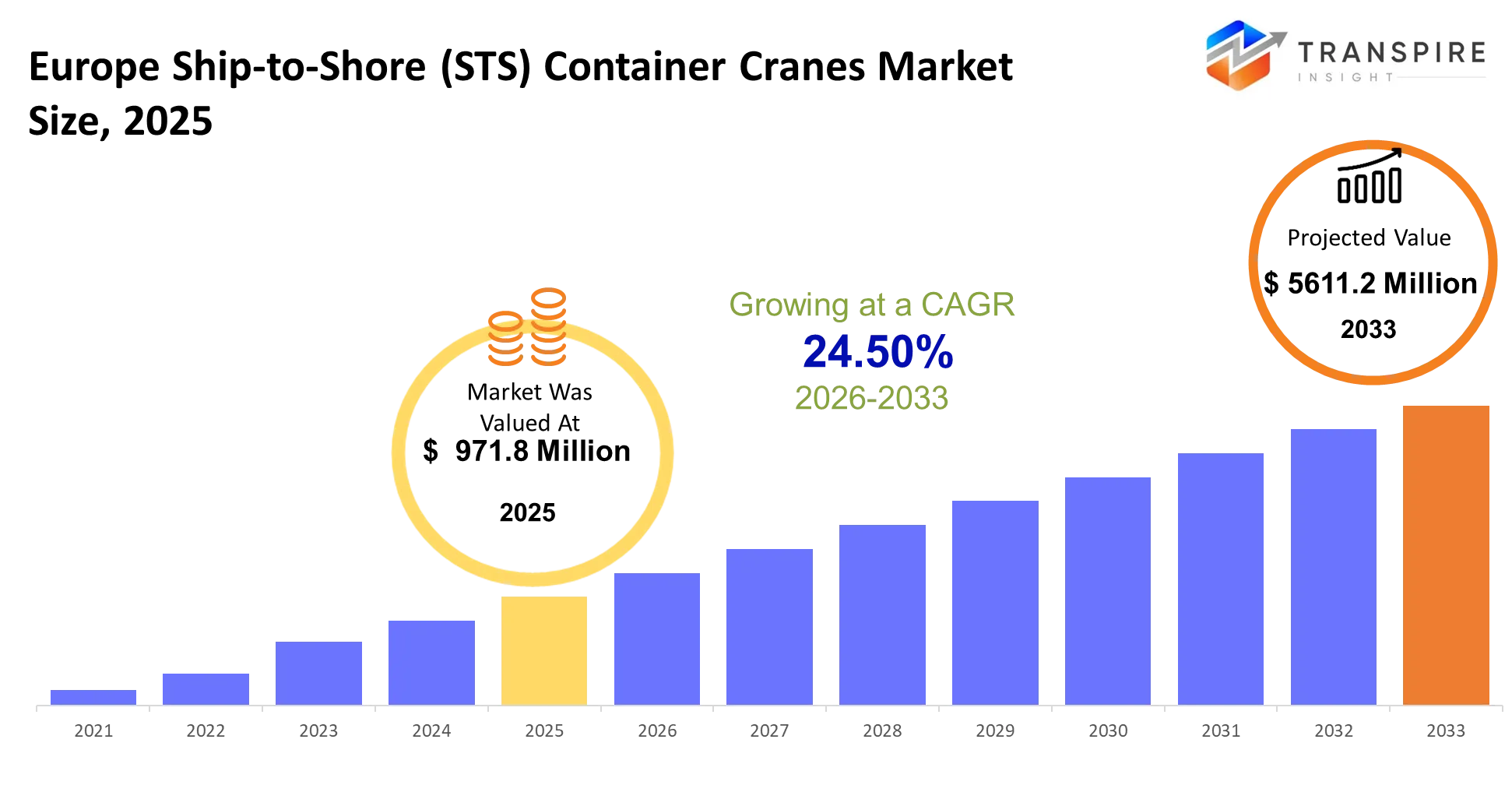
- Europe Ship-to-Shore (STS) Container Cranes Market Size 2025: USD 971.8 Million
- Europe Ship-to-Shore (STS) Container Cranes Market Size 2033: USD 5611.2 Million
- Europe Ship-to-Shore (STS) Container Cranes Market CAGR: 24.50%
- Europe Ship-to-Shore (STS) Container Cranes Market Segments: By Type (Single Boom, Double Boom, Automated STS, Others), By Application (Container Handling, Port Operations, Logistics, Shipping, Others), By End-User (Port Authorities, Shipping Companies, Logistics Firms, Government, Others), By Capacity (Panamax, Post-Panamax, Super Post-Panamax, Others).
To learn more about this report,  Download Free Sample Report
Europe Ship-to-Shore (STS) Container Cranes Market Summary:
The Europe Ship-to-Shore (STS) Container Cranes Market size is estimated at USD 971.8 Million in 2025 and is anticipated to reach USD 5611.2 Million by 2033, growing at a CAGR of 24.50% from 2026 to 2033. Ship-to-shore (STS) container cranes serve as the essential link between ocean vessels and port terminals because they execute swift container operations which allow ships to load and unload cargo with precise accuracy. The equipment determines the speed at which ports complete ship processing which creates effects on shipping schedules and port traffic and European trade operations throughout the entire logistics system.
The market has experienced a complete transition during the last three to five years because of the growing demand for systems that use electric power and automated technology in crane operations. Terminal operators are replacing diesel-powered and manually operated units with remote-controlled or fully automated cranes to cut labor dependency and meet stricter emissions targets. The main reason for supply chain problems after the pandemic period began in Europe was that vital ports faced operational problems which resulted in operators needing to build capacity to handle more shipments.
Modernization cycles drive growth because they create more economic impact than new port construction efforts. The ports focus on increasing their operational efficiency through berth performance enhancements which results in better value from their crane upgrades and digital system integration and extended service agreements.
Key Market Insights
- Western Europe maintains its lead in the Europe Ship-to-Shore STS Container Cranes Market because it possesses major container terminals which enable it to generate more than 55 percent of the market.
- Northern Europe experiences its most rapid development phase until 2030 because of smart port development projects and environmentally sustainable infrastructure improvements.
- The market for Automated STS cranes will reach 48 percent share because companies need to improve their workforce efficiency through better control of their operations.
- The second largest market share belongs to semi-automated cranes, which assist mid-sized ports that are developing their digital operation systems.
- The STS cranes market will expand its fastest through 2025 to 2030 when European Union emission standards begin to enforce their regulations.
- Container handling operations make up 85 percent of all applications because they represent essential port functions which handle the majority of cargo traffic.
- Transshipment hubs display their strongest market growth because intra-European trade and Asia-Europe trade corridor activity increases.
- The commercial port market will reach 60 percent share in 2024 because ports use their high-capacity crane systems to speed up ship docking processes.
- Private terminal operators experience their fastest market growth because they develop their business operations through port concession models.
What are the Key Drivers, Restraints, and Opportunities in the Europe Ship-to-Shore (STS) Container Cranes Market?
The growth of the Europe Ship-to-Shore Container Cranes Market originates from its primary connection to the port industry which now requires more automated systems together with electric systems because of new EU emissions regulations and increasing labor expenses. Ports deal with increasing carbon costs under systems which include the EU Emissions Trading System that renders diesel equipment unprofitable over an extended period. Terminal operators have turned to remote-controlled and fully automated STS cranes because labor shortages and union restrictions have made it necessary to do so. The transition results in higher initial costs for each crane because of its direct impact on capital expenditures while generating additional income through software systems and predictive maintenance and service agreements. Crane suppliers now secure more profitable contracts because they provide complete terminal modernization solutions instead of selling single equipment items.
The high initial expenses needed for crane replacement and terminal retrofitting functions as a fundamental structural obstacle. The process of switching to automated STS systems requires organizations to acquire new cranes together with essential grid improvements and digital system development and employee training programs. The costs associated with these projects reach more than ten million dollars at each terminal which leads smaller and mid-sized ports to postpone their technology adoption. The structural constraint requires extended periods for investment returns while it needs both regulatory authorization and port authority funding systems. The situation which results from this constraint prevents immediate revenue expansion while it results in different rates of technology adoption among various areas.
The integration of digital twin technology with STS crane systems presents a major business opportunity. Northern European ports test real-time simulation systems which recreate crane movements to improve container handling efficiency and decrease operational downtime. The system provides operators with a method to boost operational capacity through existing resources. Crane manufacturers who incorporate these features into their products will gain two benefits which include generating ongoing software income and establishing themselves as market leaders who demonstrate their value through advanced operational knowledge and lifting capabilities.
What Has the Impact of Artificial Intelligence Been on the Europe Ship-to-Shore (STS) Container Cranes Market?
European ports now use artificial intelligence and advanced digital systems to transform their ship-to-shore crane operations. Operators now use AI-based control systems which handle automatic crane operations and load management and collision detection in real time. The systems utilize sensor and camera data to enhance container handling operations which leads to decreased manual work and increased productivity at the berth. The digital compliance tools track energy consumption and equipment performance to meet port-level emission targets which establishes a data-driven method for meeting regulatory requirements.
Machine learning models enable predictive maintenance through their ability to analyze vibration patterns and motor temperature and usage cycles. The system enables operators to detect component wear which prevents failure from occurring, thus achieving unplanned downtime reduction of up to 20% in highly visited terminals. Some ports use digital twins which create real-time crane operation simulations to enhance yard operations and minimize equipment downtime. The operational cost reductions and stable throughput performance under changing demand patterns result from these enhancements.
AI adoption encounters a practical barrier because of the difficulties involved in integrating new systems. The majority of terminals use traditional crane systems which lack unified data systems, so they need extensive system updates and financial investments before they can use advanced analytics tools.
Key Market Trends
- European ports began using integrated automation systems which include hardware and software and lifecycle service agreements after they stopped purchasing independent cranes during the period starting from 2020.
- The process of electrification began to accelerate after 2021 because EU carbon pricing made diesel-powered cranes less practical which led operators to switch to electric and hybrid STS systems.
- Remote-controlled crane technology has become more popular because labor shortages and union contract discussions make it necessary for operators to decrease their terminal staff requirements.
- The period between 2020 and 2022 saw supply chain disruptions which revealed berth inefficiencies, which led ports to purchase high-capacity cranes that could reach farther distances and complete their operations more quickly.
- Konecranes and Liebherr have developed digital service solutions which enable them to generate revenue through predictive maintenance and performance contracts that extend over multiple years.
- The Northern European ports have tested digital twin platforms since 2022 which allow them to simulate crane operations in real time while analyzing the impact of reduced idle time on their operations.
- Mid-sized ports that have limited capital resources now prefer modular crane systems because these systems enable them to upgrade parts of their equipment instead of purchasing entirely new systems.
- ZPMC, a Chinese supplier, has forced European manufacturers to compete by developing automation software and engineering solutions that use less energy because of ongoing price pressure.
- The process of crane procurement at ports now follows ESG reporting frameworks because ports have started to implement energy monitoring systems which help them fulfill stricter disclosure and compliance standards.
- The use of AI-based vision systems has resulted in better container positioning because these systems reduce handling errors and make high-volume terminal operations more consistent.
Europe Ship-to-Shore (STS) Container Cranes Market Segmentation
By Type
The automated STS crane system has become the primary choice for ports because it provides accurate operations and safe handling and efficient workforce management. Small ports continue to use single boom cranes because they cost less and their installation process is easier than double boom systems which stay in use at high-traffic terminals that need to extend their reach. The industrial sector is adopting automated systems because businesses face staffing shortages and must comply with more stringent rules.
The semi-automated systems serve as intermediate solutions for mid-sized ports which lack the capacity to implement complete automation. The future development process will establish hybrid systems which merge mechanical system dependability with software-based intelligence capabilities, enabling producers to develop systems that customers can upgrade without needing to acquire new technologies.
By Application
Container handling remains the leading application because it directly connects to both global trade volume and port performance indicators. Port operations and logistics segments have gained traction as operators integrate crane systems with yard management and intermodal networks. Shipping-related applications remain steady, supported by consistent vessel traffic across major European trade routes.
The demand patterns show a transition from using cranes as separate machines to operating systems that include cranes as components of their logistics networks. This evolution pushes manufacturers to align product offerings with digital platforms and data integration capabilities. The future growth of the industry depends on the capacity of crane systems to establish connections with terminal automation systems and cargo optimization technologies.
By End-User
The port authorities operate as end-users who hold the biggest market share because they directly control their infrastructure investment decisions. Advanced systems implementation at large commercial ports occurs because port authorities need to increase berth operational efficiency and decrease the time required for ships to return to service. Shipping companies influence procurement indirectly by demanding faster and more reliable handling services, while logistics firms increasingly participate through public-private partnerships and terminal concessions.
Government entities assume both regulatory and funding responsibilities particularly for sustainability-related infrastructure improvements. Private operators now enter the market because they want to achieve operational efficiency while obtaining long-term profitability. The transition indicates procurement methods now prioritize commercial interests which use performance guarantees and service contracts as essential factors for making purchase decisions.
By Capacity
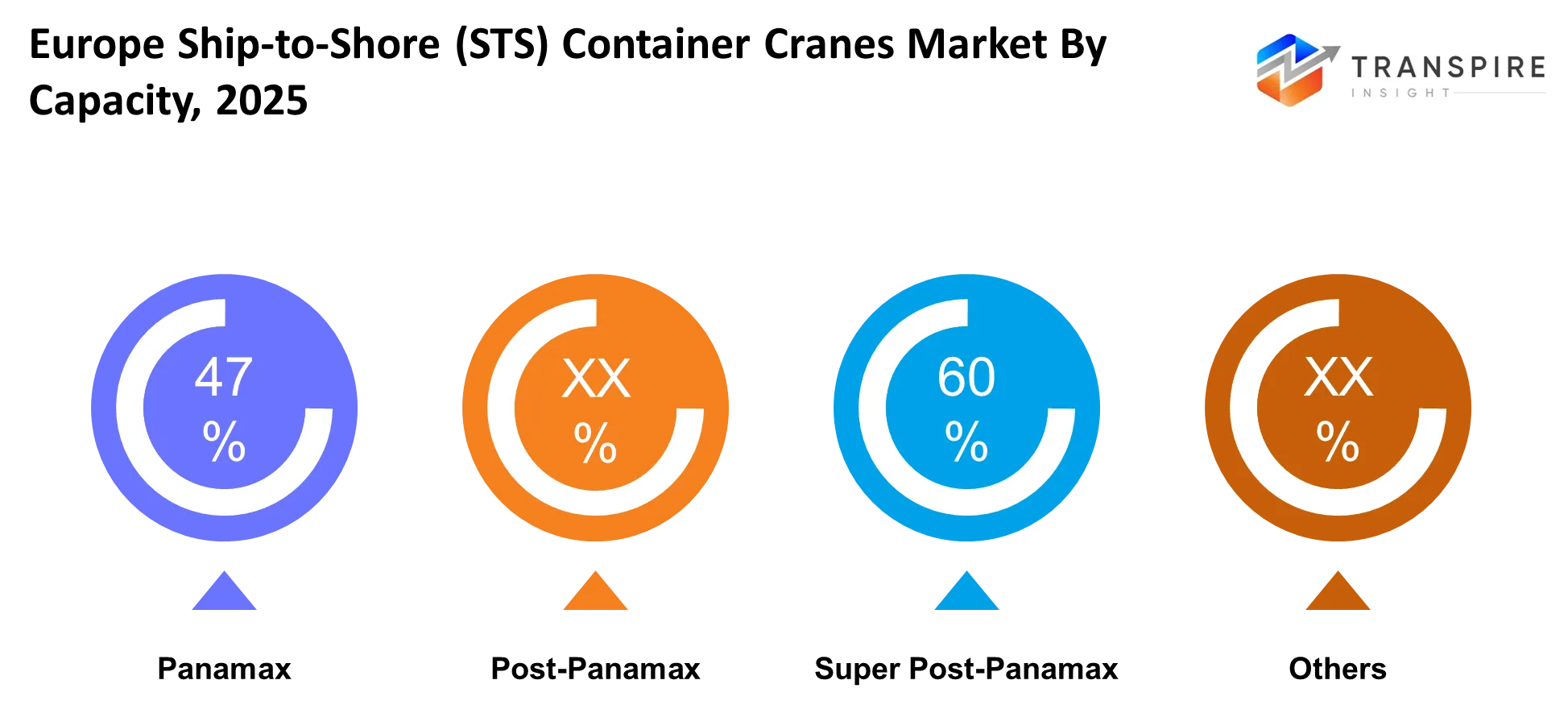
European ports experience post-Panamax and super post-Panamax crane usage since container vessels have grown larger than Panamax capacity. Panamax cranes remain relevant in secondary ports that handle smaller vessels or regional traffic. The expansion of ultra-large container ships has forced terminals to upgrade crane outreach and lifting height, which results in a strong replacement cycle at major hubs.
Demand patterns favor high-capacity cranes that can handle wider vessels without increasing berth time. Future implications include continued investment in super post-Panamax systems and potential demand for ultra-high-capacity designs as fleet sizes evolve. Manufacturers need to solve structural engineering problems while achieving energy efficiency goals and integrating automation systems to keep their competitive edge.
To learn more about this report, Download Free Sample Report
What are the Key Use Cases Driving the Europe Ship-to-Shore (STS) Container Cranes Market?
The Europe Ship-to-Shore (STS) Container Cranes Market exists because commercial ports use STS cranes for container operations. The high-volume terminals that operate post-Panamax and ultra-large vessels use STS cranes to achieve their scheduled turnaround times and maintain their berth operations.
Transshipment hubs and private terminal operators represent expanding applications of these systems. The facilities need flexible crane operations and faster cycle times to support their operations because they handle feeder vessel transfers and regional cargo redistribution for their complex logistics networks.
The new use cases for these applications show semi-automated terminals at smaller ports and green port initiatives that support EU climate targets. The applications develop electrified crane systems and digital monitoring tools to achieve higher efficiency standards and lower emissions requirements.
|
Report Metrics |
Details |
|
Market size value in 2025 |
USD 971.8 Million |
|
Market size value in 2026 |
USD 1209.9 Million |
|
Revenue forecast in 2033 |
USD 5611.2 Million |
|
Growth rate |
CAGR of 24.50% from 2026 to 2033 |
|
Base year |
2025 |
|
Historical data |
2021 - 2024 |
|
Forecast period |
2026 - 2033 |
|
Report coverage |
Revenue forecast, competitive landscape, growth factors, and trends |
|
Regional scope |
Europe (Germany, United Kingdom, France, Italy, Spain and Rest of Europe) |
|
Key company profiled |
Konecranes, Liebherr, ZPMC, Kalmar, ABB, Siemens, Mitsubishi Heavy Industries, Hyundai Samho, Doosan, Cargotec, Terex, TTS Group, Sany, Shanghai Zhenhua, Paceco |
|
Customization scope |
Free report customization (country, regional & segment scope). Avail customized purchase options to meet your exact research needs. |
|
Report Segmentation |
By Type (Single Boom, Double Boom, Automated STS, Others), By Application (Container Handling, Port Operations, Logistics, Shipping, Others), By End-User (Port Authorities, Shipping Companies, Logistics Firms, Government, Others), By Capacity (Panamax, Post-Panamax, Super Post-Panamax, Others) |
Which Regions are Driving the Europe Ship-to-Shore (STS) Container Cranes Market Growth?
The market leader in Western Europe shows its dominance through its network of major ports which includes Rotterdam and Antwerp and Hamburg as its main container handling facilities. The implementation of EU emissions regulations has resulted in rapid adoption of electrified automated crane technologies through their strict enforcement. Port authorities operate their organization within well-established financial systems which enable them to make ongoing infrastructure improvements while implementing new digital technologies. The combination of established suppliers and available funding resources enables sustained investment activities which strengthen regional market leadership.
Southern Europe exists as a reliable second tier market because it serves as the main entry point for trade between the Mediterranean region and countries throughout the world. The ports of Spain and Italy and Greece experience regular shipping activity which connects with the Asia to Europe trade routes. The operators maintain a steady investment approach which avoids aggressive spending because they prefer to make small system improvements through affordable crane system installations. Public-private partnerships and economic resilience create a stable market environment which equipment suppliers can predict.
Northern Europe demonstrates its strongest growth potential because smart port technology and sustainability infrastructure programs are being adopted throughout the region. Norway and Denmark have experienced operational model changes because of recent investments in digital twins and automated terminals. The establishment of green shipping corridors through policy incentives has resulted in increased demand for advanced crane technologies. The upcoming growth period until 2033 presents significant business possibilities for technology companies and investors who focus on high-value port projects which drive market innovation.
Who are the Key Players in the Europe Ship-to-Shore (STS) Container Cranes Market and How Do They Compete?
The Europe Ship-to-Shore (STS) Container Cranes Market experiences moderate consolidation because a few global heavy engineering firms control the majority of high-value contracts. Companies protect their market position through multi-year maintenance contracts, complete automation solutions, and established connections with port authorities. The new companies encounter hurdles which stem from the necessity to obtain certifications and the difficulties involved in tailored solutions and the substantial financial expenses required to switch between different port systems. The market competition now evaluates companies based on their ability to integrate technology with their equipment and their capacity to maintain equipment throughout its entire life cycle and their success in enhancing digital operational efficiency.
Konecranes develops its unique market position through its development of crane systems which incorporate both automation technology and remote control capabilities. The company strengthens its position through predictive maintenance platforms that enhance equipment availability while decreasing operating expenses for terminal operators. Liebherr Group competes through engineering precision and modular crane designs that allow customization for different berth configurations. The company needs to develop its expansion plan through complete system integration with European ports together with its ongoing development of electrified crane technology.
ZPMC establishes itself as the price leader because it operates extensive manufacturing facilities which enable it to provide cost-effective solutions for high-volume port projects. The Cargotec subsidiary Kalmar focuses on developing software-based systems which enable crane operation and provide remote monitoring capabilities to help build intelligent terminals. ABB develops its unique market position through its power system and control software solutions which are essential for operating crane systems and its electrification and industrial automation technologies. The companies expand their operations through forming strategic alliances with port operators, establishing technological partnerships, and implementing advanced automated terminal systems in selected locations throughout Europe.
Company List
- Konecranes
- Liebherr
- ZPMC
- Kalmar
- ABB
- Siemens
- Mitsubishi Heavy Industries
- Hyundai Samho
- Doosan
- Cargotec
- Terex
- TTS Group
- Sany
- Shanghai Zhenhua
- Paceco
Recent Development News
In February 2026, Liebherr completes STS crane height upgrade at Port of Grangemouth: Liebherr completed a structural upgrade of two ship-to-shore cranes at the Port of Grangemouth, increasing lift height by 2.2 metres. The modification enables handling of higher container stacks and larger next-generation straddle carriers while extending crane service life with minimal operational disruption.
Source: https://www.forthports.co.uk
In February 2026, PSA Antwerp installs mega STS cranes at Europa Terminal: PSA Antwerp received five of the largest-ever ship-to-shore cranes for the Port of Antwerp-Bruges as part of its Project Emerald modernisation programme. The cranes are designed for ultra-large container vessels, featuring a 52m height, 71.8m outreach, and 112-tonne dual-hoist capacity to improve berth productivity and turnaround times.
Source: https://www.porttechnology.org
What Strategic Insights Define the Future of the Europe Ship-to-Shore (STS) Container Cranes Market?
The Europe Ship-to-Shore (STS) Container Cranes Market is transitioning toward complete integration of software-driven port systems which use crane hardware as a component of their digitalized tracking systems. The industry faces three main factors because automation requirements and carbon reduction regulations and berth operational efficiency needs require solutions that do not require additional physical port development. The next 5 to 7 years will see businesses create value through their abilities to manage equipment throughout its entire life cycle and their capacity to operate systems from remote locations and their use of data to improve system performance.
The danger exists that organizations will become dependent on proprietary automation technologies because they will face difficulties in transitioning to other systems. Ports that implement digital systems from specific vendors will face increased switching expenses which will decrease their operational flexibility and force them to rely on a limited number of vendors. The procurement process will suffer problems because this method will restrict system implementation and result in permanent supplier relationships.
AI-based retrofitting solutions for existing cranes present a significant opportunity because mid-sized Southern and Eastern European ports require these systems but lack resources for complete crane replacements. vendors who offer modular automation system upgrades with financing options will meet supply needs which remain unfilled. Market participants need to focus on building systems which can work together with existing systems and create designs that make it easy to upgrade current equipment to compete in automated terminal markets.
Europe Ship-to-Shore (STS) Container Cranes Market Report Segmentation
By Type
- Single Boom
- Double Boom
- Automated STS
- Others
By Application
- Container Handling
- Port Operations
- Logistics
- Shipping
- Others
By End-User
- Port Authoritie
- Shipping Companies
- Logistics Firms
- Government
- Others
By Capacity
- Panamax
- Post-Panamax
- Super Post-Panamax
- Others
Frequently Asked Questions
Find quick answers to common questions.
The approximate Europe Ship-to-Shore (STS) Container Cranes Market size for the market will be USD 5611.2 Million in 2033.
The key segments of the Europe Ship-to-Shore (STS) Container Cranes Market are By Type (Single Boom, Double Boom, Automated STS, Others), By Application (Container Handling, Port Operations, Logistics, Shipping, Others), By End-User (Port Authorities, Shipping Companies, Logistics Firms, Government, Others), By Capacity (Panamax, Post-Panamax, Super Post-Panamax, Others).
Major players in the Europe Ship-to-Shore (STS) Container Cranes Market are Konecranes, Liebherr, ZPMC, Kalmar, ABB, Siemens, Mitsubishi Heavy Industries, Hyundai Samho, Doosan, Cargotec, Terex, TTS Group, Sany, Shanghai Zhenhua, Paceco.
The current market size of the Europe Ship-to-Shore (STS) Container Cranes Market is USD 971.8 Million in 2025.
The Europe Ship-to-Shore (STS) Container Cranes Market CAGR is 24.50%.
- Konecranes
- Liebherr
- ZPMC
- Kalmar
- ABB
- Siemens
- Mitsubishi Heavy Industries
- Hyundai Samho
- Doosan
- Cargotec
- Terex
- TTS Group
- Sany
- Shanghai Zhenhua
- Paceco
Recently Published Reports
-
Apr 2026
3D Optical Profiler Market
3D Optical Profiler Market Size, Share & Analysis Report By Type (Desktop 3D Optical Profiler, and Portable 3D Optical Profiler), By Technology (Confocal Technology, and White Light Interference), By End-Use Industry (Manufacturing, Research Institutions, Automotive, Aerospace and Defense, Medical Devices, and Other), and Geography (North America, Europe, Asia-Pacific, Middle East and Africa, South and Central America), 2021 - 2031
-
Apr 2026
Depth Sensor Market
Depth Sensor Market Size, Share & Analysis Report By Type (Infrared Depth Sensors, Time-of-Flight (ToF) Sensors, Stereo Vision Sensors, Structured Light Sensors, Ultrasonic Depth Sensors), By Application (Automotive, Robotics, Gaming, Consumer Electronics, Industrial Automation, Healthcare, Security & Surveillance, Others), By End Users (Automotive Manufacturers, Consumer Electronics Companies, Healthcare Providers, Industrial Companies, Security Agencies, Gaming Companies, Robotics Companies, Others), and Geography (North America, Europe, Asia-Pacific, Middle East and Africa, South and Central America), 2021 – 2031
-
Apr 2026
Digital Manufacturing Market
Digital Manufacturing Market Size, Share & Analysis Report By Component (Hardware, Software, and Services), By Technology (Robotics, 3D Printing, Internet of Things (IoT), and Others), By Application (Automotive and Transportation, Aerospace and Defense, Consumer Electronics, Industrial Machinery, and Others), By Process Type (Computer-Based Designing, Computer-Based Simulation, Computer 3D Visualization, Analytics, and Others), and Geography (North America, Europe, Asia-Pacific, Middle East and Africa, South and Central America), 2021 – 2031
-
Apr 2026
Digital Visa Services Market
Digital Visa Services Market Size, Share & Analysis Report By Type (Individual Travelers, Group Travelers), By Application (Tourism, Business Travel, Others), and Geography (North America, Europe, Asia-Pacific, Middle East and Africa, South and Central America), 2021 – 2031