Pharmaceutical Customer Relationship Management Software Market Summary:
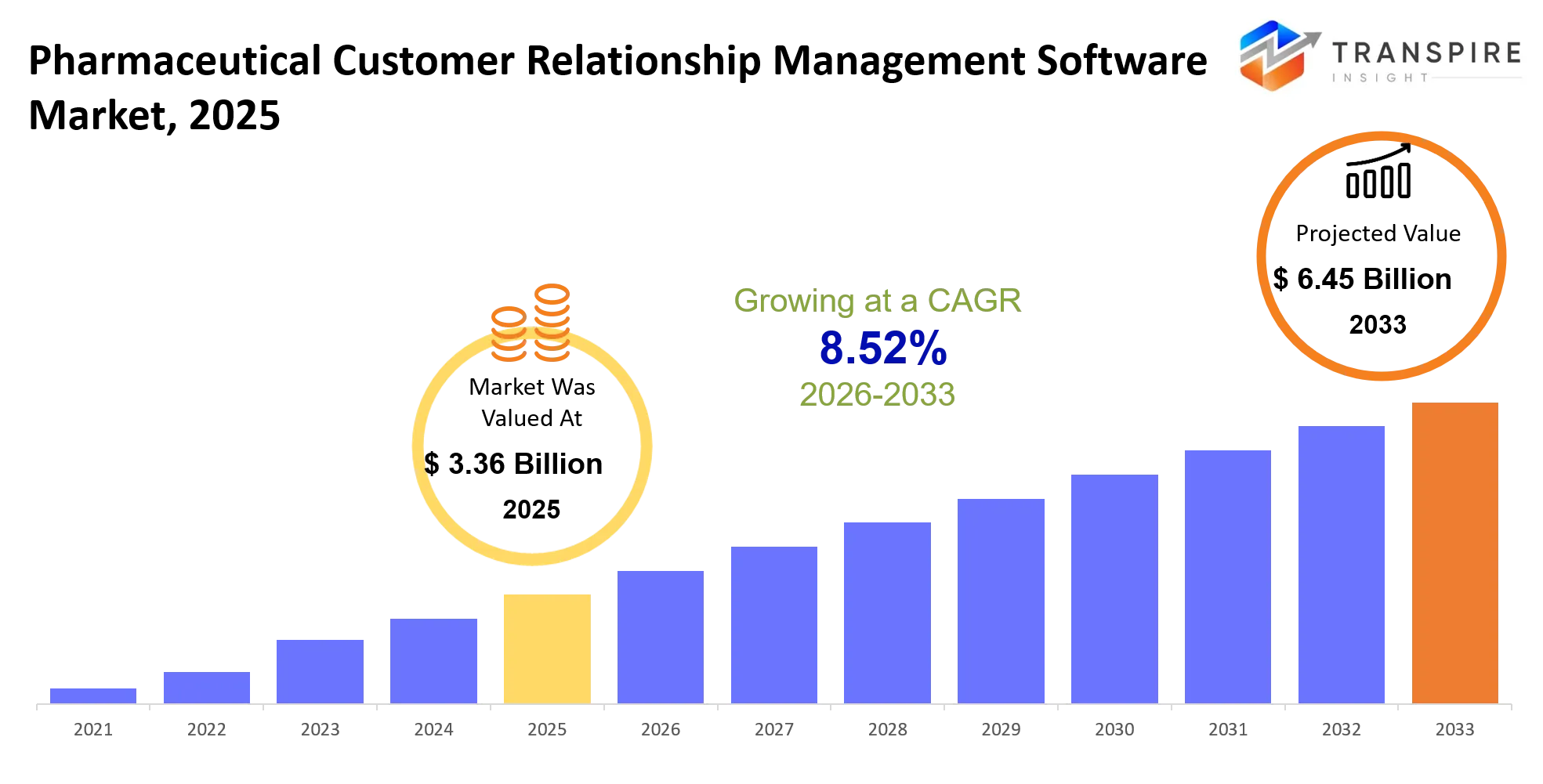
As per the Transpire Insight Analysis, The Pharmaceutical Customer Relationship Management Software Market size is estimated at USD 3.36 billion in 2025 and is anticipated to reach USD 6.45 billion by 2033, growing at a CAGR of 8.52% from 2026 to 2033.
The Pharmaceutical Customer Relationship Management Software Market aims to help drug manufacturers coordinate communication with healthcare professionals, conduct field sales, deliver compliant promotional content, and measure engagement across digital and physical channels. Over the last three to five years, pharmaceutical companies have started to evolve from standalone contact lists and visit-logging solutions to integrated platforms that link commercial analytics, marketing automation, and compliant customer engagement. The industry is also experiencing a fundamental shift from disparate and legacy CRM systems to cloud-based, life-science-focused platforms with built-in artificial intelligence. This migration to modern platforms, along with the need for data standards, is shifting procurement priorities, according to Veeva, which noted more than 125 customers are utilising Vault CRM. As multichannel engagement expands, all-in-one CRM systems will provide similar benefits, enabling companies to optimise sales force deployment, personalise engagement, and provide auditable records to drive adoption and repeat software sales.
Pharmaceutical Customer Relationship Management Software Market Size & Forecast:
- Market Size 2025: USD 3.36 Billion
- Expected Market Value (2033): USD 6.45 Billion
- Forecast CAGR (2026–2033): 8.52%
- Leading Region in 2025: North America
- Fastest Growing Region: Asia Pacific
- Key Company Profiles: Veeva Systems, Salesforce, Microsoft, IQVIA, Oracle, SAP, ZS Associates, Pitcher AG, Aktana, Salesforce Life Sciences, Cegedim, Indegene, Pegasystems, Creatio, ServiceNow.
Key Pharmaceutical Customer Relationship Management Software Market Insights:
Pharmaceutical CRM is evolving from mere customer databases to comprehensive commercial platforms, integrating compliant engagement, analytics, and AI-driven field operations. Turning the many interactions with HCPs into actionable commercial evidence without compromising data governance is a critical aspect of market differentiation.
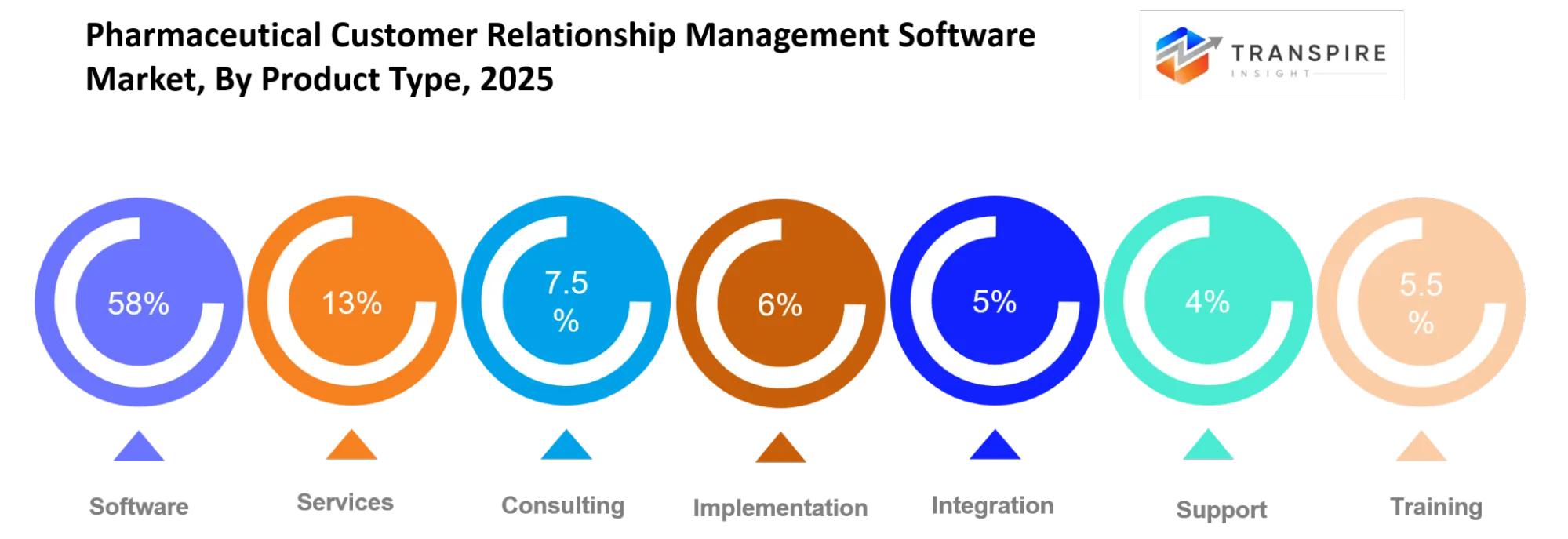
- Vendors are integrating AI agents, analytics, and compliance checks into commercial workflows, accounting for 58.6% of the market for software.
- AI-powered CRM is growing at a 13.7% CAGR, driven by next-best-action models, conversational field tools, and predictive HCP engagement.
- In December 2025, Veeva introduced AI Agents for Vault CRM, which feature pre-call, voice, free-text compliance, and media-search features.
- In October 2025, Salesforce launched Life Sciences Cloud generally available, which will combine with Agentforce data to compete with Veeva's vertical-platform approach.
- IQVIA differentiates itself with its proprietary prescription, claims, and provider data, while OCE is supporting about 400 customers in 130+ countries.
- Services accounted for 13.5% of the market, with the demand for AI configuration, data migration, validation, and managed compliance support increasing.
- Cloud-based deployment is growing as field teams demand mobile, real-time access to approved content and CRM insights.
- HCP engagement continues to be the top application, with patient engagement and market-access coordination strategically extending CRM.
- Consulting represents 7.5%, with pharmaceutical companies rethinking their omnichannel operating models to focus on engagement, not software.
What are the Key Drivers, Restraints, and Opportunities in the Pharmaceutical Customer Relationship Management Software Market?
Driver:
Pharmaceutical commercial teams increasingly need a unified view of HCP interactions across field visits, email, remote meetings, and approved digital content. The shift toward omnichannel engagement has encouraged investment in CRM systems that combine customer records with territory planning and campaign analytics. As fragmented tools create inconsistent data and duplicate work, integrated platforms can improve representative productivity and support better allocation of commercial resources, strengthening adoption across large drug manufacturers.
Restraint:
Implementation remains difficult because pharmaceutical companies operate across countries with different privacy requirements, promotional codes, consent rules, and reporting processes. Legacy databases, customised workflows, and validation requirements increase migration costs and extend deployment timelines. These structural barriers are particularly significant for multinational firms that must maintain reliable audit trails while transferring historical customer data and preserving business continuity.
Opportunity:
AI-enabled CRM offers scope to move from recording interactions toward recommending the next best engagement, prioritising HCPs, and automating administrative work. In June 2026, Close-Up International reported an AI-powered CRM deployment at AGEPHA Pharma across its US sales force, illustrating practical commercial adoption. Asia-Pacific also presents an opportunity as regional pharmaceutical companies modernise field operations and digital engagement. Vendors that combine localised compliance, interoperable data, and explainable AI can unlock broader adoption without compromising governance.
Pharmaceutical Customer Relationship Management Software Market — Driver Impact Analysis
|
Driver |
Relative Impact on Growth (%) |
Geographic Relevance |
Impact Timeline |
Demand Strength |
Growth Mechanism |
Key Beneficiaries |
Major Constraint |
|
Omnichannel engagement and pharmaceutical sales-force digitalization |
27% |
North America, Europe, Asia-Pacific |
Short-term (≤2 years) |
High |
Unifies field visits, email, video, and digital campaigns. |
Pharmaceutical firms, CRM vendors, commercial service providers |
Fragmented customer data limits channel coordination. |
|
AI-driven HCP segmentation, predictive analytics, and personalized engagement |
24% |
North America, Europe, Asia-Pacific |
Medium-term (2–4 years) |
High |
Predicts HCP preferences and recommends relevant compliant interactions. |
AI vendors, pharmaceutical marketers, analytics providers |
Poor data quality reduces predictive model reliability. |
|
Regulatory compliance, promotional governance, and auditable customer interactions |
19% |
North America, Europe, Asia-Pacific |
Short-term (≤2 years) |
High |
Automates consent tracking, approved content, and interaction records. |
Pharmaceutical companies, compliance teams, regulated CRM providers |
Changing regulations increase implementation and maintenance costs. |
|
Cloud CRM modernization and integration of commercial data systems |
17% |
North America, Europe, Asia-Pacific |
Medium-term (2–4 years) |
High |
Connects CRM with ERP, prescription, and marketing platforms. |
Cloud providers, CRM vendors, system integrators, pharmaceutical firms |
Legacy migration creates cost, complexity, and downtime risks. |
|
Specialty drug launches and expansion of targeted HCP engagement |
13% |
North America, Europe, Asia-Pacific |
Long-term (≥4 years) |
Medium |
Supports precision targeting across complex specialty treatment pathways. |
Biopharma companies, specialty sales teams, CRM technology vendors |
Limited HCP access and lengthy product commercialization cycles. |
|
Total |
100% |
Global |
— |
— |
— |
— |
— |
What Has the Impact of Artificial Intelligence Been on the Pharmaceutical Customer Relationship Management Software Market?
Artificial intelligence is elevating pharmaceutical customer relationship management from manual record-keeping to decision support. Automation is effectively automating routine activities such as call-note capture, tagging of content, appointment scheduling, and compliance screening of promotional messages. Predictive models are being used to analyse prescribing behaviour, customer engagement history, coverage, and market indicators to prioritise accounts, forecast adoption, and recommend targeted engagement strategies. Operationally, artificial intelligence is enabling field force productivity by helping with next-best-action guidance, call-prep, channel optimisation across in-person, digital, and email channels, and customer engagement. Veeva's Vault CRM AI agents launched in December 2025 to enhance the field with pre-call prep, semantic content search, free-text compliance checking, and voice input; similar and focused on AI-orchestrated customer engagement is IQVIA's OCE+. The main challenge is integration and inaccuracy; the output depends on clean, appropriate, and consented data, and budgets are high, requiring connectors to enterprise resource planning (ERP) and medical, marketing, and compliance systems; human oversight is essential, since poorly rated recommendations or noncompliant messages could create regulatory exposure.
In June 2026, Veeva Systems acquired Copli, an AI-powered platform designed to automate marketing and promotional compliance. This acquisition embeds automated compliance directly into life sciences commercial workflows, allowing pharmaceutical companies to streamline the review of promotional communications while mitigating the regulatory risks associated with non-compliant messaging.
Key Pharmaceutical Customer Relationship Management Software Market Trends:
The Pharmaceutical CRM is changing from a system that just tracks sales activity to an intelligence layer that links commercial teams, customer data, and approved engagement. Actionable insights, interoperability, and compliance directly integrated into daily processes are becoming key factors in competitive differentiation.
- CRM solutions are becoming a single HCP-engagement centre connecting sales, marketing and medical teams.
- Static call plans and manual territory prioritisation are being replaced with AI-generated next-best-action recommendations.
- Omnichannel engagement is growing, with companies scheduling field visits alongside email, webinars and digital content.
- Compliance is now part of the workflows, with audit trails, consent management and automated checks of promotional content.
- Cloud and mobile-first deployment is on the rise, as field teams need to access data in real time across territories.
- There is a steady rise in patient engagement use cases, particularly in speciality and rare disease therapies, as well as traditional HCP engagement.
- AI agents for pre-call planning, voice capture, content search, and compliance review of call notes are being added by vendors.
- The Veeva–Salesforce non-compete agreement came to an end in September 2025, adding pressure on platform choice.
- Built-in regulatory controls and promotion controls make life-sciences-specific CRM the preferred choice over generic CRM.
Pharmaceutical Customer Relationship Management Software Market Segmentation
Component:
Software accounts for 58.6% as pharma companies want an end-to-end platform for engaging with healthcare professionals, commercial analytics, and compliance process workflows. Services account for 13.5%, driven by implementation services, data migration, and system optimisation. Consulting is 7.5%, offering strategic consulting to pharmaceutical companies for the optimum investment in CRM for commercial effectiveness and assurance of meeting regulatory standards. Implementation is 6.0%, integration with marketing, analytics, and enterprise systems is 5.0%, support contributes 4.0%, maintenance is 2.9%, and training is 2.5%. As the artificial intelligence capabilities evolve, specialist services are growing in demand to address data quality, workflow configuration, user adoption, and validation requirements for pharmaceutical commercial activities.
Deployment:
Cloud-based and SaaS deployments support scalable access, faster updates, and centralised administration, making them attractive to pharmaceutical companies operating across multiple regions. Public-cloud models offer flexible infrastructure, while private-cloud and hosted environments provide alternative control arrangements. On-premises systems remain relevant where legacy infrastructure or internal governance restricts migration. Hybrid deployment enables gradual modernisation, allowing companies to integrate existing databases with newer CRM capabilities while minimising disruption to established commercial workflows.
Function:
Sales force automation remains central to pharmaceutical CRM, supporting visit scheduling, territory allocation, representative productivity, and activity reporting. Marketing automation and campaign management coordinate communication across digital and in-person channels, while contact management maintains structured healthcare professional records. Customer service supports relationship continuity, and analytics converts engagement data into commercial insights. Compliance management strengthens promotional oversight through approved-content controls, access permissions, and auditable records, helping pharmaceutical organisations balance commercial effectiveness with regulatory responsibilities.
End User:
Pharmaceutical companies form the core user group because extensive sales networks require coordinated healthcare professional engagement, territory management, and compliant reporting. Biotechnology companies use CRM to manage specialised stakeholder relationships, while contract research organisations (CROs) coordinate interactions across research programs. Medical device companies apply similar capabilities to commercial account management. Distributors and wholesalers benefit from improved customer coordination, while healthcare providers use relationship-management capabilities for relevant institutional interactions. Other users adopt specialised workflows aligned with their operational requirements.
Application:
Healthcare professional (HCP) engagement remains a core application, helping pharmaceutical companies coordinate representative visits, digital communications, and follow-up activities. Sales management and field force management support territory planning, performance monitoring, and resource allocation. Patient engagement extends CRM into support-program coordination, while omnichannel marketing connects communication across multiple touchpoints. Account management helps teams organise institutional relationships, and market-access applications support interactions with payers and other stakeholders. Integrated platforms can improve visibility across commercial activities and create more consistent engagement experiences.
Enterprise Size:
Large enterprises and pharmaceutical companies require sophisticated CRM capabilities to coordinate international sales teams, multilingual workflows, regional compliance, and centralised reporting. Mid-sized enterprises and regional pharmaceutical companies often prioritise flexibility and manageable implementation costs. SMEs and startups may favour modular SaaS platforms that reduce infrastructure requirements and allow gradual expansion. Government organisations can require additional governance and procurement controls. AI-powered CRM is projected to grow at a 13.7% CAGR, reflecting interest in predictive engagement, automated reporting, and data-driven commercial decisions across organisations of different sizes.
What are the Key Use Cases Driving the Pharmaceutical Customer Relationship Management Software Market?
The primary use case is pharmaceutical sales force automation, aligned with the dominant software component. Representatives use CRM to schedule HCP visits, record interactions, manage territories, and track follow-ups. Centralised records improve coordination and help commercial leaders assess field performance.
Expanding applications include omnichannel marketing, HCP segmentation, campaign measurement, and account management. Integration with approved-content systems enables consistent communication across field visits and digital channels, while analytics helps teams refine engagement strategies.
Emerging use cases include AI-assisted call preparation, next-best-action recommendations, automated visit summaries, and predictive account prioritisation. Patient-support coordination and market-access engagement also create opportunities beyond traditional sales management. Adoption will depend on reliable data, integration quality, and safeguards that preserve privacy and promotional compliance.
|
Report Metrics |
Details |
|
Market size value in 2025 |
USD 3.36 Billion |
|
Market size value in 2026 |
USD 3.64 Billion |
|
Revenue forecast in 2033 |
USD 6.45 Billion |
|
Growth rate |
CAGR of 8.52% from 2026 to 2033 |
|
Base year |
2025 |
|
Historical data |
2021 - 2024 |
|
Forecast period |
2026 - 2033 |
|
Report coverage |
Revenue forecast, competitive landscape, growth factors, and trends |
|
Regional scope |
United States; Canada; Mexico; United Kingdom; Germany; France; Italy; Spain; Denmark; Sweden; Norway; China; Japan; India; Australia; South Korea; Thailand; Brazil; Argentina; South Africa; Saudi Arabia; United Arab Emirates |
|
Key companies profiled |
Veeva Systems, Salesforce, Microsoft, IQVIA, Oracle, SAP, ZS Associates, Pitcher AG, Aktana, Salesforce Life Sciences, Cegedim, Indegene, Pegasystems, Creatio, ServiceNow |
|
Customization scope |
Free report customization (country, regional & segment scope). Available customized purchase options to meet your exact research needs. |
|
Report Segmentation |
Component (Software, Services, Consulting, Implementation, Integration, Support, Training, Maintenance)Deployment (Cloud-Based, On-Premise, Hybrid, SaaS, Private Cloud, Public Cloud, Hosted, Others)Function (Sales Force Automation, Marketing Automation, Customer Service, Analytics, Contact Management, Campaign Management, Compliance Management, Others)End User (Pharmaceutical Companies, Biotechnology Companies, CROs, Medical Device Companies, Distributors, Wholesalers, Healthcare Providers, Others)Application (HCP Engagement, Patient Engagement, Sales Management, Field Force Management, Omnichannel Marketing, Account Management, Market Access, Others)Enterprise Size (Large Enterprises, Mid-Sized Enterprises, SMEs, Pharma Companies, Regional Pharma Companies, Startups, Government Organizations, Others) |
Which Regions are Driving the Pharmaceutical Customer Relationship Management Software Market Growth?
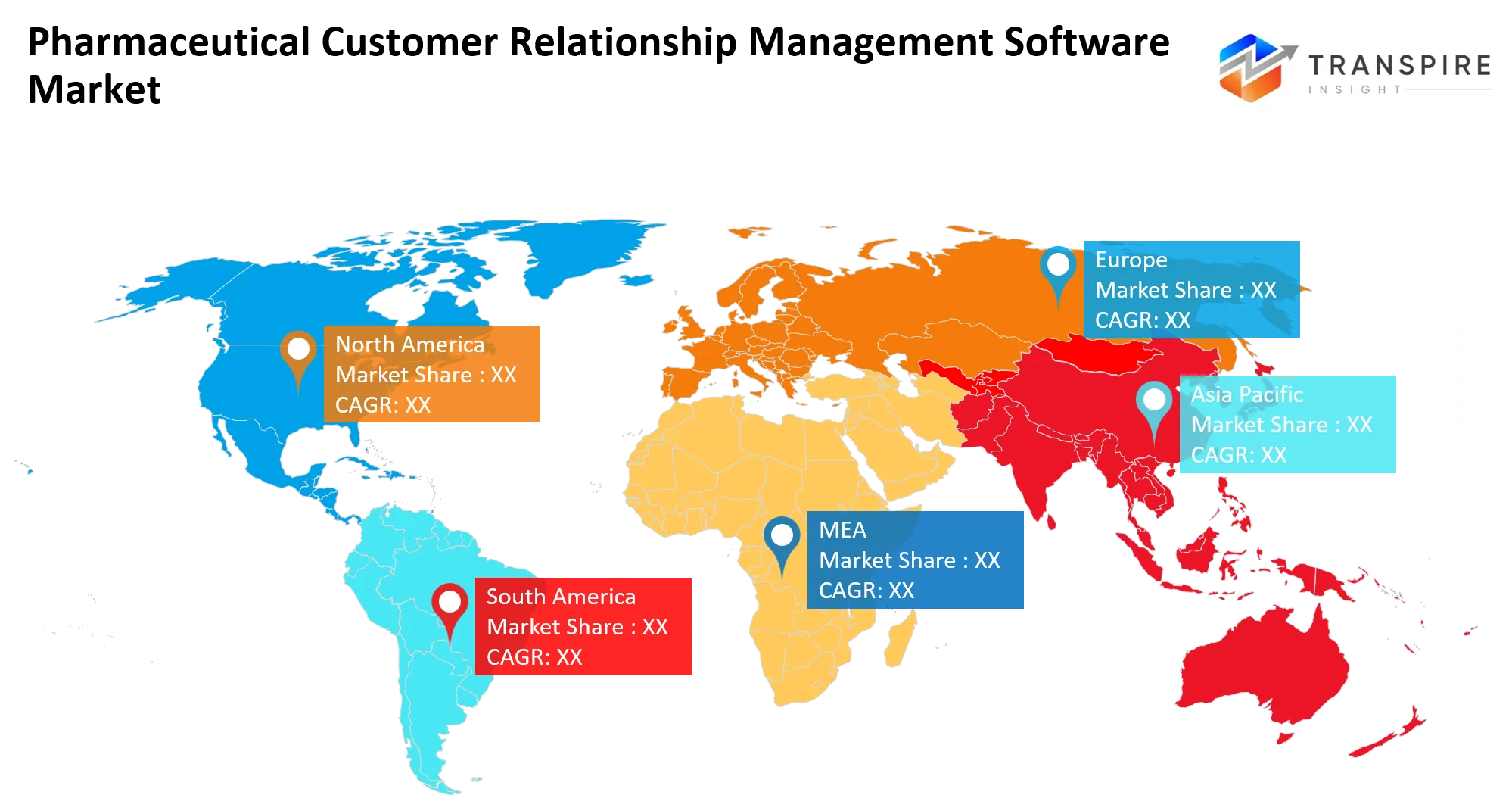
North America, accounting for 46.8% of platforms due to the presence of international pharma companies' corporate headquarters, early adoption of AI-enabled Customer Relationship Management systems and commercial teams, and its evolution as a leading market for digital health adoption. A healthy digital health landscape with a mature data privacy and promotional compliance environment, high expectations of the pharma industry for personalised engagement from healthcare professionals and proximity to vendors such as Veeva, Salesforce, IQVIA and Microsoft help power premium platform investment.
In October 2026, IQVIA expanded its clinical technology collaboration by selecting Veeva Systems' core applications—including Veeva CTMS, eTMF, Study Startup, and Site Connect—as the enterprise standard across its clinical development studies.
Europe has 28.0% and a compliance-based growth model compared to North America. The General Data Protection Regulation, country-specific rules, and market multilingualism make governance, consent management, and auditability necessary purchasing factors. Pharmaceuticals are demanded persistently, public health services are generally efficient and – for instance in Europe – there is a growing focus on engaging and empowering patients through the internet, though complex regulatory requirements may impinge on such activities.
In June 2026, Veeva Systems previewed its upcoming Veeva Falcon agentic labour platform and new Vault AI innovations at the Veeva R&D and Quality Summit Europe. This deployment helps European biopharmaceutical organisations streamline complex data processes, maintain strict compliance, and simplify cross-border operations across highly regulated EU markets.
Asia-Pacific is the fastest-growing region for the pharmaceutical industry, with a CAGR of 14.8% and 16.7% of the market. The expansion of regional pharmaceutical manufacturing, coupled with investment in biotech, digital health infrastructure, and the digitisation of field forces in the region, has driven demand for a scalable cloud-based customer relationship management system. While Latin America (4.8%) and Middle East & Africa (3.7%) are smaller markets, local distributors, healthcare providers, and nascent pharma brands in these regions are evolving their commercial operations.
In January 2026, Docquity launched Docquity Engage, an AI-powered healthcare professional (HCP) intelligence engine. This product rollout enables life sciences and pharmaceutical companies to capture real-time physician insights, optimise field-force commercial engagement, and enhance the performance of their CRM-driven campaigns.
Who are the Key Players in the Pharmaceutical Customer Relationship Management Software Market, and how do they compete?
Competition has centred on industry-specific functionality, data linking, compliance, and the ability to connect commercial engagement to insights. Veeva Systems separates itself with life-sciences-specific workflows and Vault CRM. Salesforce Life Sciences combines CRM with Agentforce AI and a broader enterprise cloud ecosystem. IQVIA argues that its OCE platform ties commercial engagement to niche data and analytics.
This includes the enterprise cloud, data and business-process offerings of Microsoft, Oracle and SAP for their engagement with companies that want to be aligned with their enterprise technology investments. ZS Associates specialises in commercial strategy and analytics, while Aktana is an expert in artificial intelligence-enabled next-best-action offering. Pitcher AG is a differentiator with its mobile sales enablement and digital content offering, while Cegedim is based on healthcare-specific data and knowledge of customer relationship management.
Indegene is centred on life sciences technology integrated with commercialisation services; Pegasystems mainly on workflow automation and decisioning; Creatio focused on configurable low-code work processes; and ServiceNow on enterprise process for services, without being a pharmaceutical customer relationship management implementation in their offering. Strategies for expansion are becoming more focused on artificial intelligence, interoperability, and cooperation. Please be aware that Salesforce Life Sciences is not a vendor but an industry solution from Salesforce.
Key Players are:
- Veeva Systems
- Salesforce
- Microsoft
- IQVIA
- Oracle
- SAP
- ZS Associates
- Pitcher AG
- Aktana
- Salesforce Life Sciences
- Cegedim
- Indegene
- Pegasystems
- Creatio
- ServiceNow
Pharmaceutical Customer Relationship Management Software Market — Enhanced Competitive Benchmarking
|
Company |
Est. Revenue Share Range |
Key Offerings |
Strategic Positioning |
Geographic Strength |
Technology Focus |
|
Veeva Systems |
Estimated 20–30% |
Vault CRM, Campaign Manager, Align, Network MDM |
Pharma-native platform leadership with integrated commercial workflows |
North America, Europe, Asia Pacific |
Embedded AI, unified HCP data, compliant omnichannel engagement |
|
Salesforce |
Estimated 12–22% |
Life Sciences Cloud, Agentforce, Data 360, MuleSoft integrations |
Enterprise ecosystem strategy with scalable life-sciences CRM capabilities |
North America, Europe, Asia Pacific |
Generative AI, workflow automation, cloud data integration |
|
IQVIA |
Estimated 10–18% |
Orchestrated Customer Engagement (OCE), IQVIA CRM, commercial analytics |
Differentiation through proprietary healthcare data and commercial intelligence |
North America, Europe, Asia Pacific |
AI-driven next-best action, HCP data integration, predictive analytics |
|
Pitcher AG |
Estimated 3–7% |
Pitcher CRM, Pitcher Impact, digital sales enablement, content engagement |
Mobile-first specialist focused on personalized field engagement |
Europe, North America, Asia Pacific |
Offline-capable mobile CRM, interactive content, AI-assisted selling |
|
Cegedim |
Estimated 2–6% |
Mobile Intelligence, Pharma CRM, OneKey, customer reference data |
European specialization supported by pharmaceutical data expertise |
Europe, Latin America, Asia Pacific |
HCP master data, mobile field-force automation, territory management |
|
Exeevo |
Estimated 1–4% |
Omnipresence CRM, omnichannel engagement, medical affairs workflows |
Microsoft-aligned vertical CRM for commercial and medical teams |
North America, Europe, Asia Pacific |
Microsoft cloud integration, low-code workflows, unified customer engagement |
|
SANeForce |
Estimated 1–4% |
Pharma SFA, field-force CRM, sales analytics, order management |
Value-oriented pharma sales automation for emerging markets |
Asia Pacific, Middle East & Africa |
Mobile sales automation, cloud reporting, field-force analytics |
|
Proxima Cloud CRM |
Estimated 0.5–2% |
Pharma CRM, field-force automation, HCP management, reporting |
Cost-conscious specialist targeting pharmaceutical sales teams |
Asia Pacific, Middle East & Africa |
Cloud CRM, mobile workflows, configurable sales analytics |
|
Platforce |
Estimated 0.5–2% |
Pharma CRM, e-detailing, field-force management, omnichannel engagement |
Flexible specialist platform emphasising deployment accessibility |
Europe, Asia Pacific, Middle East & Africa |
Mobile-first CRM, digital detailing, automated field reporting |
|
Aktana |
Estimated 0.5–2% |
Intelligent Engagement, next-best-action recommendations, commercial decision support |
AI-specialist differentiation through optimisation of existing CRM platforms |
North America, Europe, Asia Pacific |
Machine learning, next-best-action engines, predictive recommendations |
Recent Development News
In August 2026, Veeva Systems announced that Eli Lilly and Company had committed to adopting Vault CRM globally. The agreement strengthens the platform's role in pharmaceutical commercial operations, with potential to support coordinated healthcare-professional engagement and AI-enabled workflows across Lilly's business.
In May 2026, Salesforce announced that Agentforce Life Sciences was being used by more than 140 organisations, including pharmaceutical companies such as Chiesi and Moderna. The adoption milestone reflects growing interest in AI-supported clinical and commercial workflows, personalised healthcare-professional engagement, and more integrated life-sciences customer relationship management.
https://www.salesforce.com/news/stories/agentforce-life-sciences-140-organizations
In March 2026, Veeva Systems announced that more than 125 customers worldwide were live on Vault CRM, including major biopharmaceutical companies across the United States, Europe, and Japan. The milestone highlights growing adoption of life-sciences-specific CRM platforms and the shift toward AI-enabled, compliant commercial engagement.
What Strategic Insights Define the Future of the Pharmaceutical Customer Relationship Management Software Market?
The market is heading towards agentic, data-enabled CRM platforms that embed HCP engagement, medical communication, patient support and market access in a single, centrally governed place. The risk here is the reliance on third-party artificial intelligence (AI) that draws on disconnected data, or that is based on consented information that doesn't feel right – leading to wrong recommendations, audit trails that don't make sense, or content that breaches regulations – undermining trust and increasing regulatory exposure. An opportunity is to embed external AI agents (such as IQVIA) and partner data directly into the CRM workflows, enabling traceable, on-demand decision support that doesn't require a full system replacement. Pharma vendors should look to build interoperable, compliant-by-design, and migration-friendly (through flexible architecture) AI. Pharma buyers should seek platforms that can connect commercial, medical, and patient data and be monitored by human actors.
Key Segmentations are:
Component
- Software
- Services
- Consulting
- Implementation
- Integration
- Support
- Training
- Maintenance
Deployment
- Cloud-Based
- On-Premise
- Hybrid
- SaaS
- Private Cloud
- Public Cloud
- Hosted
- Others
Function
- Sales Force Automation
- Marketing Automation
- Customer Service
- Analytics
- Contact Management
- Campaign Management
- Compliance Management
- Others
End User
- Pharmaceutical Companies
- Biotechnology Companies
- CROs
- Medical Device Companies
- Distributors
- Wholesalers
- Healthcare Providers
- Others
Application
- HCP Engagement
- Patient Engagement
- Sales Management
- Field Force Management
- Omnichannel Marketing
- Account Management
- Market Access
- Others
Enterprise Size
- Large Enterprises
- Mid-Sized Enterprises
- SMEs
- Pharma Companies
- Regional Pharma Companies
- Startups
- Government Organizations
- Others
Frequently Asked Questions
Find quick answers to common questions.
The pharmaceutical customer relationship management software market size was valued at USD 3.36 billion in 2025 and is poised to reach USD 6.45 billion by 2033, expanding at an 8.52% CAGR
Key segments for the pharmaceutical customer relationship management software market are Component (Software, Services, Consulting, Implementation, Integration, Support, Training, Maintenance)Deployment (Cloud-Based, On-Premise, Hybrid, SaaS, Private Cloud, Public Cloud, Hosted, Others)Function (Sales Force Automation, Marketing Automation, Customer Service, Analytics, Contact Management, Campaign Management, Compliance Management, Others)End User (Pharmaceutical Companies, Biotechnology Companies, CROs, Medical Device Companies, Distributors, Wholesalers, Healthcare Providers, Others)Application (HCP Engagement, Patient Engagement, Sales Management, Field Force Management, Omnichannel Marketing, Account Management, Market Access, Others)Enterprise Size (Large Enterprises, Mid-Sized Enterprises, SMEs, Pharma Companies, Regional Pharma Companies, Startups, Government Organizations, Others).
Growth is primarily driven by omnichannel HCP engagement, cloud-based CRM adoption, AI-powered analytics, pharmaceutical sales automation, and increasing compliance requirements.
The market is led by major manufacturers, including Veeva Systems, Salesforce, Microsoft, IQVIA, Oracle, SAP, ZS Associates, Pitcher AG, Aktana, Salesforce Life Sciences, Cegedim, Indegene, Pegasystems, Creatio, and ServiceNow.
North America holds a 46.8% market share, supported by major pharmaceutical companies, mature cloud infrastructure, strong technology investment, and advanced commercial operations
Key opportunities include AI-powered predictive engagement, cloud-based CRM modernization, multilingual solutions across Asia-Pacific, and integration with pharmaceutical data analytics and marketing platforms.
- Veeva Systems
- Salesforce
- Microsoft
- IQVIA
- Oracle
- SAP
- ZS Associates
- Pitcher AG
- Aktana
- Salesforce Life Sciences
- Cegedim
- Indegene
- Pegasystems
- Creatio
- ServiceNow
About the Authors

Pankaj Ghogare Patil
I am Pankaj Ghogare Patil, a Senior Research Analyst at Transpire Insight, specializing in the Pharmaceutical, Chemicals & Materials, Healthcare IT, and Biotechnology industry. My expertise lies in conducting comprehensive market research, analyzing industry trends, evaluating competitive landscapes, and translating complex data into actionable insights. At Transpire Insight, I closely follow emerging technologies, regulatory developments, and market innovations to create accurate, well-researched, and informative content that helps businesses and professionals make informed decisions. I am committed to producing credible, evidence-based articles that reflect industry best practices while making technical topics accessible and valuable for a broad audience.

Chakradhar Khansole
Chakradhar serves as the Research Director at Transpire Insight, bringing over 8 years of experience in technology, innovation, and strategic market intelligence. He specializes in transforming complex market data into actionable business insights that enable organizations to make informed, growth-oriented decisions. Recognized for his strategic vision and analytical expertise, Chakradhar leads high-impact research initiatives, delivering comprehensive market assessments, competitive intelligence, and forward-looking industry analysis.
Recently Published Reports
-
Apr 2026
AI in Diabetic Retinopathy Market
AI in Diabetic Retinopathy Market Size, Share & Analysis Report By Type (Screening AI Systems, Diagnostic AI Systems, and Predictive AI Models), By Application Segment (Hospitals, Ophthalmology Clinics, Diagnostic Centers, and Research and Development), and Geography (North America, Europe, Asia-Pacific, Middle East and Africa, South and Central America), 2021 - 2031
-
Apr 2026
Psychometric Tests Market
Psychometric Tests Market Size, Share & Analysis Report By Type (Personality Tests, Ability/Aptitude Tests, Skill/Knowledge Tests, and Others), By Application (Talent Acquisition and Talent Management), and Geography (North America, Europe, Asia-Pacific, Middle East and Africa, South and Central America), 2021 – 2031
-
Apr 2026
Rare Biological Sample Collection Market
Rare Biological Sample Collection Market Size, Share & Analysis Report By Type (Isolation Kits & Reagent, Blood Collection Tubes, and Others), By Application (Oncology, Transcriptomics, Pharmacogenomics, and Others), and Geography (North America, Europe, Asia-Pacific, Middle East and Africa, South and Central America), 2021 – 2031
-
Jul 2026
Diabetic Retinopathy Market
Diabetic Retinopathy Market Size, Share & Analysis Report By Type (Proliferative Diabetic Retinopathy, and Diabetic Macular Edema (DME)), By Treatment Type (Anti VEGF Drug, Steroid Implants, Laser Surgeries, and Vitrectomy), and Geography (North America, Europe, Asia-Pacific, Middle East and Africa, South and Central America), 2021 – 2031
Our Clients