

Middle East and Africa Cloud-based Contact Center Market Summary
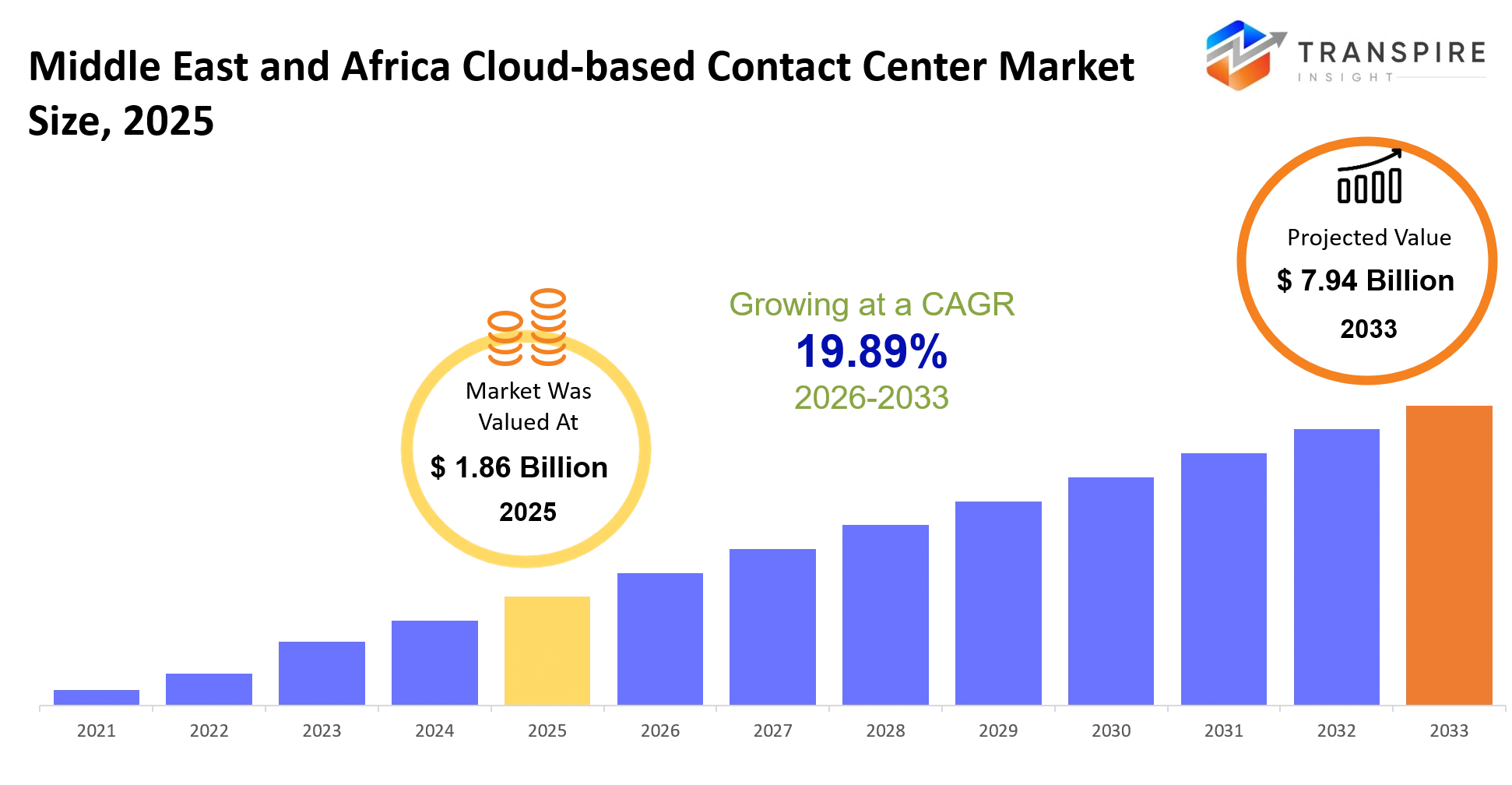
As per Transpire Insight Analysis the Middle East and Africa Cloud-based Contact Center Market size is estimated at USD 1.86 Billion in 2025 and is anticipated to reach USD 7.94 Billion by 2033, growing at a CAGR of 19.89% from 2026 to 2033.
In the Middle East and Africa, the Cloud based Contact Center Market is basically about letting enterprises handle customer interactions, not only through voice but also email , chat, social media, and various messaging channels, using cloud infrastructure instead of those on-premise systems. It generally allows organizations to boost customer support, trim infrastructure spend, and ramp up operations faster, all while backing remote teams and multilingual workforce needs, which is kinda crucial. Over the last five years , the whole market vibe moved away from older, legacy call center platforms, toward AI driven cloud contact center setups that also connect things like workforce optimization, analytics, and omnichannel engagement together.
Then COVID-19 hit, and that transition got pushed even harder. Traditional contact centers were shown to be limited, so organizations had to adopt flexible cloud powered operations rather quickly . Meanwhile, digital transformation efforts across banking , telecom, retail, and government have kept raising their budgets for customer experience technologies. So when enterprises modernize older communication systems and start automating customer interactions, vendors tend to see more subscription revenue streams, while organizations get better agent efficiency, quicker resolutions, and stronger customer loyalty , which ends up mattering in the long run.
Middle East and Africa Cloud-based Contact Center Market Size & Forecast:
- Middle East and Africa Cloud-based Contact Center Market Size 2025: USD 1.86 Billion
- Expected Market Value 2033: USD 7.94 Billion
- Forecast CAGR: 19.89%
- Leading region in 2025:
- Fastest Growing region:
- Key Profile: Genesys, NICE, Five9, Cisco, Amazon Web Services, Microsoft, RingCentral, 8x8, Avaya, Talkdesk, Zendesk, Vonage, Alvaria, Content Guru, Salesforce.
Key Market Insights
- The Middle East dominates the Middle East and Africa Cloud-based Contact Center Market, with an estimated 68% market share in 2025, sort of pushed by cloud investments across the UAE and Saudi Arabia.
- Meanwhile Africa is set to grow the quickest through 2033, supported by broadband expansion, plus enterprise cloud adoption that keeps getting louder in the market.
- When we look at deployment, Public Cloud still leads, roughly 52% market share in 2025, while Hybrid Cloud is seeing the fastest uptake among industries that are highly regulated.
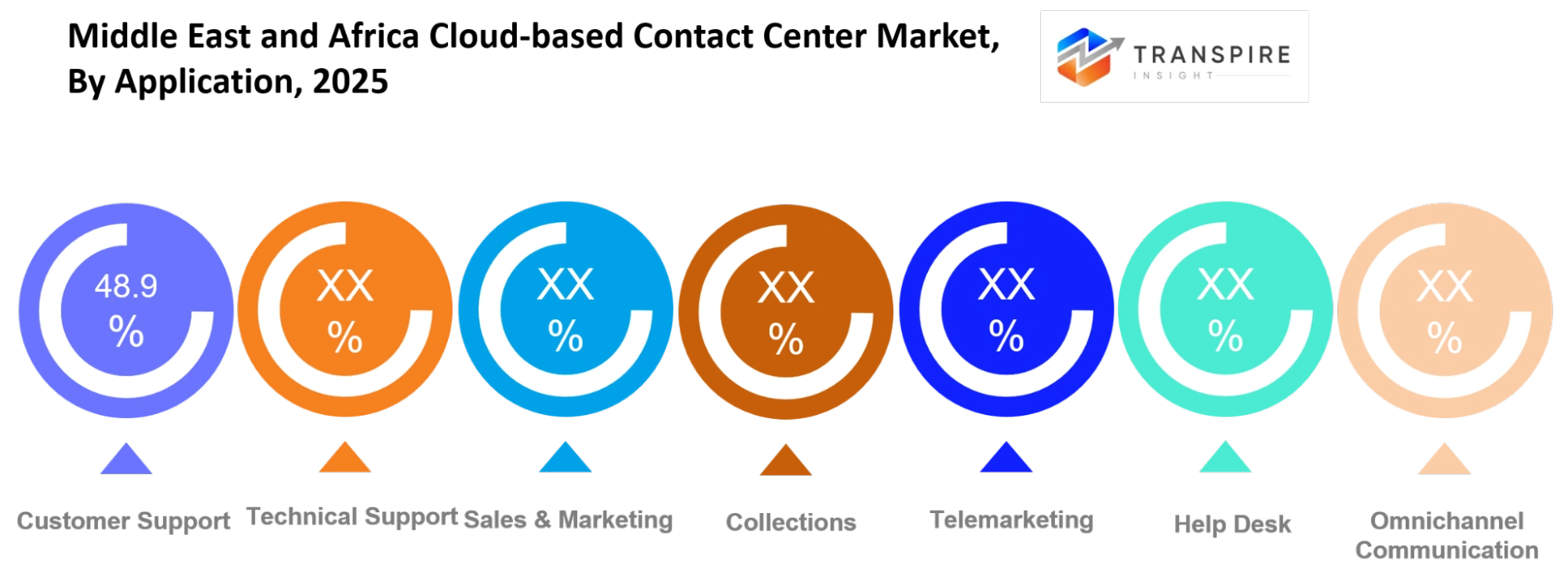
- For applications, Customer Support stays on top, bringing in nearly 46% of total revenue, and AI-powered technical support keeps expanding quickly through 2033.
- When it comes to verticals, BFSI is sitting at roughly 31% of market revenue in 2025— mostly because banks modernize customer engagement, and they also kind of push harder on digital banking experiences.
- Retail and e-commerce is basically the fastest-growing end user segment, driven by omnichannel shopping journeys, plus AI-assisted customer support that feels more immediate.
- On the vendor side you’ve got Genesys, NICE, Cisco, Amazon Web Services, Microsoft, and Talkdesk, all still pushing strategic expansion, largely focused on AI powered customer engagement platforms, and then those regional cloud partnerships that let everything move faster.
- And over time, vendors are embedding generative AI and conversational analytics, along with intelligent virtual agents, which in practice can cut average handling time by something like 20% to 35% across enterprise deployments.
- Meanwhile, strategic partnerships between hyperscale cloud providers and regional telecom operators have, since 2022, sped up enterprise migration away from older legacy contact center infrastructure.
- Finally, organizations are leaning more into integrated workforce management, real-time analytics, and CRM connectivity, to improve first-contact resolution, as well as customer satisfaction KPIs.
What are the Key Drivers, Restraints, and Opportunities in the Middle East and Africa Cloud-based Contact Center Market?
The strongest driver reshaping this market is kinda the rapid enterprise migration, from legacy contact center infrastructure toward cloud-native customer engagement platforms, which is moving fast. In the UAE, Saudi Arabia, South Africa, and a number of other nearby economies, national digital transformation plans have pushed organizations to modernize customer service operations while also supporting hybrid work arrangements. With cloud deployment, businesses typically reduce capital expenditure , shorten rollouts and timelines a lot, and they can expand contact center capacity during seasonal surges without as much headache. On top of that, AI powered automation, speech analytics, and omnichannel communication help boost agent performance plus the overall customer experience. That in turn tends to raise recurring subscription revenue for solution providers, while also speeding up enterprise uptake.
But there are still some big structural problems, and honestly the most important ones are data sovereignty obligations plus uneven cloud infrastructure. A lot of financial institutions, healthcare providers, and government agencies still have strict rules about how customer data gets stored and processed. Several African markets also deal with inconsistent connectivity and limited hyperscale cloud availability, so large scale migration becomes technically tricky, not always straightforward. Because of these regulatory and infrastructure limits, cloud adoption gets delayed, deployments become more complex, and vendor revenue gets squeezed, especially for those trying to sell into highly regulated sectors.
Still, a major opportunity is there, specifically in growing AI-enabled customer engagement solutions across emerging African economies and less served industries. More investment in hyperscale data centers, 5G rollouts, and improving regional cloud availability are creating more favorable conditions for adopting cloud contact centers.
What Has the Impact of Artificial Intelligence Been on the Middle East and Africa Cloud-based Contact Center Market?
Artificial intelligence sort of has, fundamentally, changed cloud based contact center work across the Middle East and Africa in a pretty noticeable way. It automates the usual customer chats and tweaks operational efficiency at the same time, even if that sounds a bit broad. AI powered virtual assistants, plus conversational chatbots resolve typical questions without an agent stepping in, while “smart” routing systems look at what the customer seems to want and send each request to the most suitable representative. Then there are speech analytics tools that sit on top of live conversations, catch customer sentiment ,and suggest answers that can raise first contact success rates and overall service quality.
Also, machine learning models help with predictive workforce planning, forecasting call volumes, adjusting staffing rosters, and spotting likely service delays before they become a real issue for the customer experience. With advanced analytics organizations can anticipate customer behavior, cut down agent idle stretches, and get better operational efficiency while keeping service expenses lower. Generative AI adds another layer too, it can assist agents by summarizing calls, drafting suggested replies ,and even logging customer interactions automatically, so the after call routine drops quite a bit.
But, even with all these advantages, AI rollout is still held back by integration costs that are high, especially when legacy enterprise systems are involved. Data quality can be messy and inconsistent, and there’s also a shortage of localized language datasets for Arabic and multiple African languages. On top of that, teams have to handle governance, cybersecurity, and regulatory compliance concerns before using AI across an entire enterprise, particularly in tightly regulated spaces like banking and healthcare.
Key Market Trends
- Starting 2021, many enterprises just kinda started moving faster from on-premise contact centers toward cloud-native customer engagement platforms, and in doing so they’ve seen lower infrastructure costs and quicker deployments, more or less.
- AI-driven conversational assistants have also nudged customer self-service adoption up, where automated interactions can manage something like 30% to 40% of routine service requests in the most advanced setups.
- Meanwhile, omnichannel communication has sort of flipped from “nice to have” into an actual core procurement thing, because organizations try to fold voice, email, messaging, and social channels into one smoother experience that just flows.
- Since 2022, cloud providers have been pushing more investment into regional data centers, mostly so they can support data residency compliance more directly and, at the same time, tighten application performance too.
- Genesys, NICE, Cisco, Microsoft, and Amazon Web Services are continuing to expand their AI capabilities as well, usually via strategic acquisitions, alliances, and general product invention that keeps the roadmap moving forward.
- Workforce optimization tools are also getting more blended, combining predictive scheduling, real-time coaching, and performance analytics into one thing , so agent output goes up and service quality becomes more consistent.
- Generative AI adoption has gained momentum since 2023, which helps teams create automated conversation summaries, do better knowledge retrieval, and resolve customer issues at a faster pace.
- Hybrid cloud architectures have become more popular too, especially in regulated industries, where organizations want operational flexibility, but still have to stay inside compliance and security requirements.
- And across the board, regional telecom providers are increasingly working together with hyperscale cloud vendors, aiming to deliver integrated communications along with customer engagement solutions for enterprise customers.
- Finally, buyers now seem to prioritize platforms with open APIs, CRM integration, advanced analytics, and multilingual AI, rather than going with standalone voice-centric contact center solutions, full stop.
Middle East and Africa Cloud-based Contact Center Market Segmentation
By Component
The component segment has Software, Services, Consulting, Integration Services, Analytics Solutions, Workforce Optimization, AI Solutions, and Others in it, and somehow software takes the biggest slice since enterprises basically need centralized platforms for customer engagement, call routing, and that all-in-one omnichannel communication stuff. Services keep growing too, because organizations want implementation support, maintenance, technical assistance, platform upgrades across the deployment cycles, and you know, the usual ongoing needs that appear after go-live.
Consulting tends to back the whole digital transformation planning process with cloud migration strategies, compliance assessment, and even solution selection work before implementation actually starts. Integration Services then do the connecting part, linking contact center platforms with CRM systems, enterprise applications, communication tools, and business databases so workflows feel less fragmented and more seamless.
Analytics Solutions help organizations track customer behavior, agent performance, service quality, plus operational efficiency, usually via real-time reporting and predictive insights that are meant to spot patterns earlier. Workforce Optimization leans into scheduling, quality monitoring, coaching, and resource allocation, so operating costs stay under control while service levels remain steady.
AI Solutions handle more automation for customer interactions using virtual assistants, intelligent routing, speech analytics, sentiment analysis, and conversational intelligence, which overall boosts response accuracy. Finally, Others covers add-on capabilities like security, compliance management, recording solutions, and customized communication tools aimed at industry-specific operational requirements.
By Deployment
The deployment segment spans Public Cloud, Private Cloud, Hybrid Cloud, Multi-Cloud, SaaS, Edge Cloud, On-Premise Integration, and Others , so organizations can pick the setup based on day to day operational priorities plus regulatory needs . Public Cloud still wins as the most used choice, mainly due to lower build expenses, quicker rollout, and that flexible scaling kind of support which helps enterprise digital transformation efforts . Private Cloud tends to pull in financial organizations, healthcare providers, and government agencies because they want more direct governance over sensitive customer data , not just “reasonable” oversight. Hybrid Cloud , it blends public with private environments, allowing teams to juggle security compliance , and operational agility at the same time.
With Multi-Cloud strategies organizations can lessen reliance on one single provider while also boosting resilience and business continuity across different, spread out environments . SaaS deployment makes software delivery simpler via subscription based access, automatic upgrades, and less hands on infrastructure management. Edge Cloud helps with low-latency communications by running some workloads nearer to end users, which improves reaction times for time sensitive customer touchpoints . On-Premise Integration connects the existing enterprise systems with cloud applications, while “Others” cover more customized deployment models created for specialized operational needs and particular regulatory requirements.
By Application
In the application segment, you’ll find Customer Support , Technical Support, Sales & Marketing, Collections, Telemarketing, Help Desk, Omnichannel Communication, and Others— though it kinda reads in a straight line, it’s not really. Customer support ends up taking the biggest share because organizations tend to focus heavily on customer satisfaction and service quality , like, that’s the point. Technical Support helps users with product troubleshooting, service requests, software guidance and remote issue resolution, across multiple communication channels and formats. Sales & Marketing teams lean on cloud contact center platforms to handle outbound campaigns, lead nurturing, customer engagement , and tailored communications which then lift conversion rates. Collections applications support payment reminders , account recovery work, and automated customer outreach too, while still keeping regulatory compliance in check
Telemarketing still keeps benefiting from automated dialing, campaign management, and performance monitoring tools, which boost operational productivity. Help Desk operations streamline internal employee support , IT service requests , and incident management, using centralized communication platforms so it doesn’t get messy. Omnichannel Communication ties together voice, email, chat, messaging applications, and social media into one unified customer experience, with consistent service delivery. Others covers stuff like appointment scheduling, emergency response coordination , customer surveys, and specialized communication workflows across different industries, basically the “not quite the same category” layer.
By End User
The end user segment is basically BFSI, Retail, Healthcare, IT & Telecom, Government, Travel & Hospitality, E-commerce, and Others, but BFSI is out in front, largely because secure customer engagement, regulatory compliance, and digital banking services really need a reliable cloud communication platform that doesn’t flinch. Retail organizations, for their part, tend to build customer loyalty with personalized support, order handling, promotional outreach, and those integrated shopping experiences that feel almost seamless. In Healthcare, providers focus on patient scheduling, appointment nudges, handling medical inquiries, and the internal admin communication side too, while still keeping to data privacy standards, even if the process gets complicated. IT & Telecom organizations manage technical support, service activation, customer onboarding, and network help via scalable cloud infrastructure, so they can cope with traffic spikes and changing demand.
Government agencies modernize citizen services, complaint tracking, emergency outreach, and public information delivery through centralized customer engagement platforms. Travel & Hospitality organizations refine reservation management, itinerary guidance, travel updates, and customer assistance when services get disrupted, because timing matters. E-commerce businesses boost order tracking, returns processing, payment help, and post purchase engagement through omnichannel communication, not just one channel. And then Others covers education, utilities, manufacturing, logistics, and professional services, where the whole point is efficient customer interaction management across a bunch of different digital routes, even when things get busy.
By Enterprise Size
The enterprise size segment includes Large Enterprises, Medium Enterprises, Small Enterprises, Startups, Government Organizations, SMEs, and Others, kind of showing different day to day operational needs and investment capacities, too. In particular, Large Enterprises end up generating the highest revenue, because complex customer operations tend to need scalable communication platforms, advanced analytics, AI capabilities, and workforce optimization solutions spanning multiple locations. Medium Enterprises are moving more and more toward cloud platforms, to get operational flexibility, without having to make major infrastructure investments. Small Enterprises usually do well with subscription based pricing, it helps trim implementation costs while still giving enterprise grade customer engagement functionality.
Startups tend to adopt cloud contact center solutions, since they allow rapid deployment, flexible scalability, and integrated digital communication support, which helps business expansion when technology resources are limited. Government Organizations invest in cloud platforms to enhance citizen engagement, service delivery, and administrative communication, while also backing modernization initiatives. SMEs keep expanding adoption because affordable cloud services improve competitiveness, overall customer experience, and operational efficiency, without significant capital expenditure. Others covers nonprofit organizations, educational institutions, and specialized service providers, they often need adaptable communication solutions for varied operational environments.
What are the Key Use Cases Driving the Middle East and Africa Cloud-based Contact Center Market?
Customer service still feels like the main use case, across banking, telecommunications, retail, and e-commerce, because fast issue resolution really does sway customer satisfaction and that kind of long term staying with the brand too. With AI powered routing, omnichannel communication , and real time analytics, organizations can cut down response times while also keeping service more consistent across huge customer populations.
In a similar way, technical support and sales engagement keep growing across IT, telecom, and healthcare, where remote assistance plus more personal messaging tends to boost operational efficiency. Financial institutions in particular lean on cloud contact center platforms for payment nudges, account checks, fraud alerts, and safer customer interactions , all while they still need to satisfy regulatory requirements
Some of the newer use cases are AI assisted workforce management, multilingual virtual assistants, and predictive customer engagement driven by generative AI. Also, government agencies and travel organizations are testing intelligent citizen support, automated service notifications, and digital self service platforms that will, over the forecast period, strengthen day to day operations, and reduce friction for users.
|
Report Metrics |
Details |
|
Market size value in 2025 |
USD 1.86 Billion |
|
Market size value in 2026 |
USD 2.23 Billion |
|
Revenue forecast in 2033 |
USD 7.94 Billion |
|
Growth rate |
CAGR of 19.89% from 2026 to 2033 |
|
Base year |
2025 |
|
Historical data |
2021 - 2024 |
|
Forecast period |
2026 - 2033 |
|
Report coverage |
Revenue forecast, competitive landscape, growth factors, and trends |
|
Regional scope |
Middle East and Africa (Saudi Arabia, United Arab Emirates, South Africa, Rest of Middle East and Africa) |
|
Key company profiled |
Genesys, NICE, Five9, Cisco, Amazon Web Services, Microsoft, RingCentral, 8x8, Avaya, Talkdesk, Zendesk, Vonage, Alvaria, Content Guru, Salesforce. |
|
Customization scope |
Free report customization (country, regional & segment scope). Avail customized purchase options to meet your exact research needs. |
|
Report Segmentation |
By Component (Software, Services, Consulting, Integration Services, Analytics Solutions, Workforce Optimization, AI Solutions, Others); By Deployment (Public Cloud, Private Cloud, Hybrid Cloud, Multi-Cloud, SaaS, Edge Cloud, On-Premise Integration, Others); By Application (Customer Support, Technical Support, Sales & Marketing, Collections, Telemarketing, Help Desk, Omnichannel Communication, Others); By End User (BFSI, Retail, Healthcare, IT & Telecom, Government, Travel & Hospitality, E-commerce, Others); By Enterprise Size (Large Enterprises, Medium Enterprises, Small Enterprises, Startups, Government Organizations, SMEs, Others). |
Which Regions are Driving the Middle East and Africa Cloud-based Contact Center Market Growth?
The Middle East kinda stands out as the biggest regional market , with the United Arab Emirates and Saudi Arabia really leading the pack. A lot of government-backed digital economy programs, plus national cloud strategies and pretty strict data governance frameworks, have pushed enterprises to upgrade their customer engagement infrastructure, using cloud based platforms. Banks, telecom operators, airlines, and government agencies are still putting money into AI-enabled contact centers to make citizen and customer services better. Also the region gets a lot of momentum from a pretty mature ecosystem, like hyperscale cloud providers, regional data centers, tech partners and managed service providers , which helps keep that long term market leadership going.
South Africa ends up in the second spot, mainly due to its established business process outsourcing industry and the steady way enterprises keep investing in technology. In a way, unlike the Gulf markets , the growth there relies less on government transformation programs and more on a solid private sector that continues to enhance customer experience platforms in a consistent manner. Big banking groups, insurance firms, retailers and telecoms providers keep moving away from older contact center setups, and they’re swapping in cloud-native solutions to strengthen operational resilience. Stable regulatory habits, trained customer service workforces , and ongoing spending on digital business operations make South Africa a dependable stream for recurring market revenue.
Meanwhile, the Rest of Africa, including Kenya , Nigeria , Egypt and a bunch of emerging countries, is forecast to grow the quickest through 2033.
Who are the Key Players in the Middle East and Africa Cloud-based Contact Center Market and How Do They Compete?
Competition is still kind of moderately concentrated, and most global cloud contact center providers are mainly going after buyers with artificial intelligence strengths, platform hookups, cloud infrastructure and industry tuned service offerings not only on price, you know. The older players keep beefing up their AI suites, while newer cloud-native entrants tend to win with faster rollout cycles, more adaptable subscription models and also open integration ecosystems that feel easier to plug into. Lately, real success is about getting one unified customer journey working across voice, messaging, email, and social channels while also keeping regulatory compliance in mind and offering localized cloud deployment.
Genesys stands out with AI powered experience orchestration plus deeper enterprise integration work, which helps it manage intricate multinational rollouts. It has grown strategic alliances with tech partners, and it also keeps boosting investment in generative AI in order to automate customer conversations and workforce management tasks. NICE, on the other hand, pushes the CXone platform, mixing conversational AI, workforce optimization, analytics, and compliance functions in a way that tends to land well in heavily regulated industries. Its partnerships with communications providers help it reach wider international deployments while at the same time strengthening enterprise AI adoption.
Microsoft leans hard on the Azure cloud ecosystem, Teams integration, and the broader enterprise productivity lineup, all to deliver highly linked customer engagement environments. Meanwhile Amazon Web Services keeps expanding via Amazon Connect, using consumption based pricing, AI services, and tight integration with the overall AWS cloud platform, especially for organizations that want scalable infrastructure.
Company List
- Genesys
- NICE
- Five9
- Cisco
- Amazon Web Services
- Microsoft
- RingCentral
- 8x8
- Avaya
- Talkdesk
- Zendesk
- Vonage
- Alvaria
- Content Guru
- Salesforce
Recent Development News
In October 2025, Talkdesk expanded its partnership with Databricks. The collaboration strengthens AI-driven customer experience automation by integrating the Databricks Data Intelligence Platform into Talkdesk Customer Experience Automation, improving enterprise AI capabilities.
Source: https://www.talkdesk.com
In November 2025, NICE entered a strategic partnership with Tata Communications. The agreement combines NICE CXone with Tata Communications' digital engagement capabilities to accelerate AI-powered cloud contact center deployments across global enterprises.
Source: https://www.nice.com
In July 2025, Genesys announced USD 1.5 billion in investment commitments from Salesforce and ServiceNow. The investment strengthens AI-powered customer experience orchestration and expands strategic collaboration across enterprise customer engagement platforms.
Source: https://www.genesys.com
What Strategic Insights Define the Future of the Middle East and Africa Cloud-based Contact Center Market?
The market kinda seems like it is headed toward an AI first customer experience platform thing, one where conversational intelligence and workforce optimization are basically stitched together with predictive analytics, plus unified communications in one cloud environment. And yeah, this shift will get help from more regional cloud infrastructure rolling out, enterprise digital transformation programs that keep going, and also stronger investment in customer experience because it’s becoming a competitive business function, not just a “nice to have.”
At the same time there’s a risk that isn’t super obvious, it’s more like a quieter problem. Growing reliance on only a handful of hyperscale cloud providers could ramp up vendor concentration, make migrations more complex, and create longer term pricing pressure on enterprise customers.
But there’s also a real, emerging opening here. Industry specific AI platforms are starting to show up for financial services, healthcare, and government groups that need localized compliance and multilingual customer engagement, not just generic automation. Market participants should really focus on open platform architectures, build regional partnerships, and make sure the AI is responsible enough so integration with existing enterprise systems feels easier, while still handling changing data sovereignty rules and regulatory requirements.
Middle East and Africa Cloud-based Contact Center Market Report Segmentation
By Component
- Software
- Services
- Consulting
- Integration Services
- Analytics Solutions
- Workforce Optimization
- AI Solutions
- Others
By Deployment
- Public Cloud
- Private Cloud
- Hybrid Cloud
- Multi-Cloud
- SaaS
- Edge Cloud
- On-Premise Integration
- Others
By Application
- Customer Support
- Technical Support
- Sales & Marketing
- Collections
- Telemarketing
- Help Desk
- Omnichannel Communication
- Others
By End User
- BFSI
- Retail
- Healthcare
- IT & Telecom
- Government
- Travel & Hospitality
- E-commerce
- Others
By Enterprise Size
- Large Enterprises
- Medium Enterprises
- Small Enterprises
- Startups
- Government Organizations
- SMEs
- Others
Frequently Asked Questions
Find quick answers to common questions.
The expected Middle East and Africa Cloud-based Contact Center Market size for the market will be USD 7.94 Billion in 2033.
Key segments for the Middle East and Africa Cloud-based Contact Center Market are By Component (Software, Services, Consulting, Integration Services, Analytics Solutions, Workforce Optimization, AI Solutions, Others); By Deployment (Public Cloud, Private Cloud, Hybrid Cloud, Multi-Cloud, SaaS, Edge Cloud, On-Premise Integration, Others); By Application (Customer Support, Technical Support, Sales & Marketing, Collections, Telemarketing, Help Desk, Omnichannel Communication, Others); By End User (BFSI, Retail, Healthcare, IT & Telecom, Government, Travel & Hospitality, E-commerce, Others); By Enterprise Size (Large Enterprises, Medium Enterprises, Small Enterprises, Startups, Government Organizations, SMEs, Others).
Major Middle East and Africa Cloud-based Contact Center Market players are Genesys, NICE, Five9, Cisco, Amazon Web Services, Microsoft, RingCentral, 8x8, Avaya, Talkdesk, Zendesk, Vonage, Alvaria, Content Guru, Salesforce.
The Middle East and Africa Cloud-based Contact Center Market size is USD 1.86 Billion in 2025.
The Middle East and Africa Cloud-based Contact Center Market CAGR is 19.89% from 2026 to 2033.
- Genesys
- NICE
- Five9
- Cisco
- Amazon Web Services
- Microsoft
- RingCentral
- 8x8
- Avaya
- Talkdesk
- Zendesk
- Vonage
- Alvaria
- Content Guru
- Salesforce
About the Authors

Mayur Shinde
I am Mayur Shinde, a Senior Research Analyst at Transpire Insight, specializing in the Automotive & Transportation and Information & Communication Technology (ICT) Industry. My work focuses on analyzing emerging market trends, technological advancements, competitive landscapes, and industry developments to deliver accurate, data-driven insights. I am passionate about transforming complex market information into clear, actionable content that helps businesses, professionals, and decision-makers stay informed and make confident strategic decisions.

Chakradhar Khansole
Chakradhar serves as the Research Director at Transpire Insight, bringing over 8 years of experience in technology, innovation, and strategic market intelligence. He specializes in transforming complex market data into actionable business insights that enable organizations to make informed, growth-oriented decisions. Recognized for his strategic vision and analytical expertise, Chakradhar leads high-impact research initiatives, delivering comprehensive market assessments, competitive intelligence, and forward-looking industry analysis.
Recently Published Reports
-
Apr 2026
3D Optical Profiler Market
3D Optical Profiler Market Size, Share & Analysis Report By Type (Desktop 3D Optical Profiler, and Portable 3D Optical Profiler), By Technology (Confocal Technology, and White Light Interference), By End-Use Industry (Manufacturing, Research Institutions, Automotive, Aerospace and Defense, Medical Devices, and Other), and Geography (North America, Europe, Asia-Pacific, Middle East and Africa, South and Central America), 2021 - 2031
-
Apr 2026
Depth Sensor Market
Depth Sensor Market Size, Share & Analysis Report By Type (Infrared Depth Sensors, Time-of-Flight (ToF) Sensors, Stereo Vision Sensors, Structured Light Sensors, Ultrasonic Depth Sensors), By Application (Automotive, Robotics, Gaming, Consumer Electronics, Industrial Automation, Healthcare, Security & Surveillance, Others), By End Users (Automotive Manufacturers, Consumer Electronics Companies, Healthcare Providers, Industrial Companies, Security Agencies, Gaming Companies, Robotics Companies, Others), and Geography (North America, Europe, Asia-Pacific, Middle East and Africa, South and Central America), 2021 – 2031
-
Apr 2026
Digital Manufacturing Market
Digital Manufacturing Market Size, Share & Analysis Report By Component (Hardware, Software, and Services), By Technology (Robotics, 3D Printing, Internet of Things (IoT), and Others), By Application (Automotive and Transportation, Aerospace and Defense, Consumer Electronics, Industrial Machinery, and Others), By Process Type (Computer-Based Designing, Computer-Based Simulation, Computer 3D Visualization, Analytics, and Others), and Geography (North America, Europe, Asia-Pacific, Middle East and Africa, South and Central America), 2021 – 2031
-
Apr 2026
Digital Visa Services Market
Digital Visa Services Market Size, Share & Analysis Report By Type (Individual Travelers, Group Travelers), By Application (Tourism, Business Travel, Others), and Geography (North America, Europe, Asia-Pacific, Middle East and Africa, South and Central America), 2021 – 2031